PE Sponsors Are Asking the Wrong AI Question. Here's the One That Actually Moves EBITDA.
There's a conversation happening in private equity right now that goes something like this.
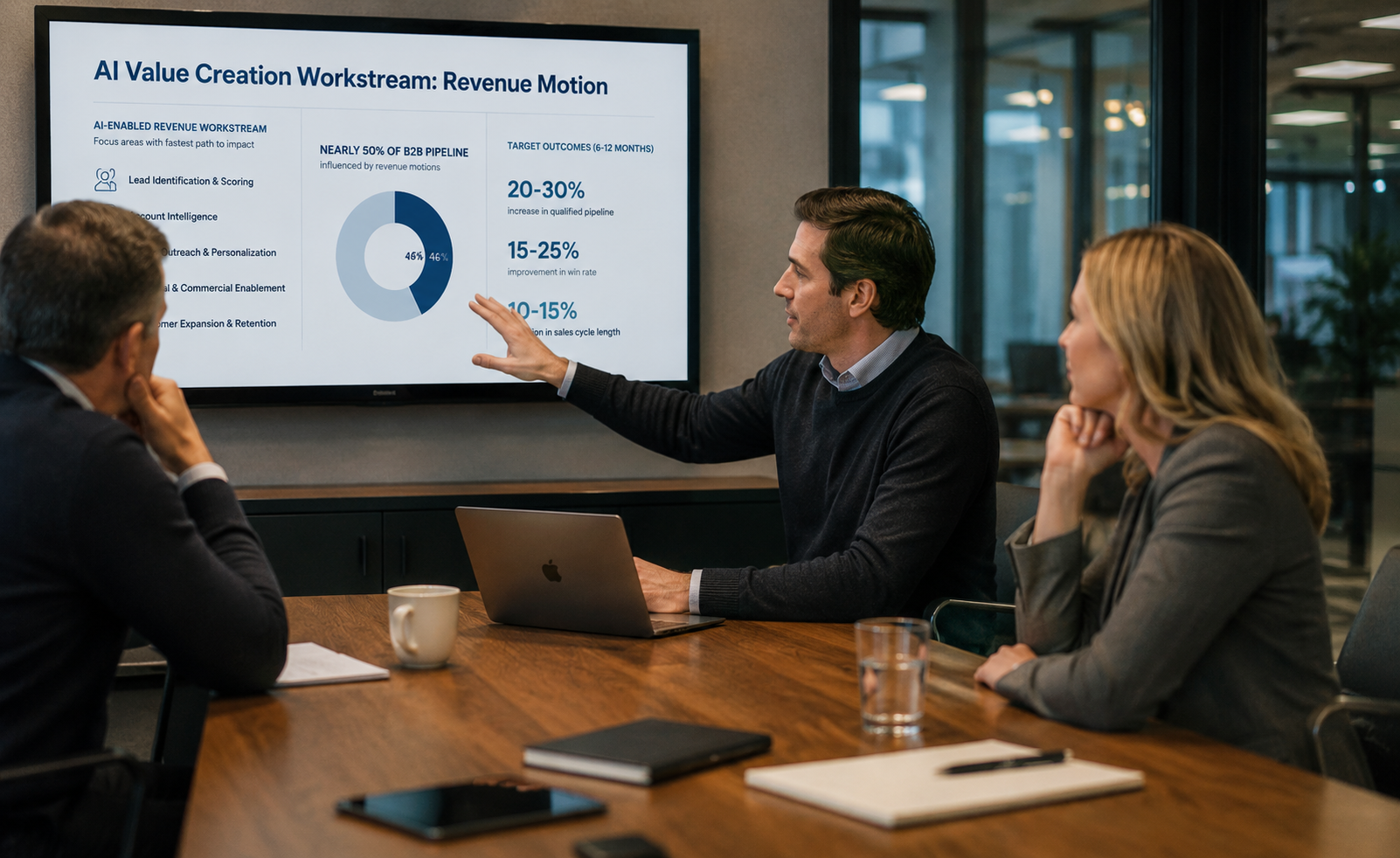
The LP calls ask about AI. The value creation plans name AI as a workstream. The CEOs are getting pitched by every boutique with a deck and a demo. And somewhere in the middle of all of it, the operating partner is sitting with a portfolio of ten or fifteen companies, most of them $20M to $150M in revenue, and the honest answer to "what's our portfolio AI plan" is still a slide, not a system.
The reason isn't lack of interest. It's a structural pricing problem.
The enterprise AI joint ventures announced by the major foundation model companies are built for megafunds. The engagement sizes required to make the economics work — think seven figures for a single deployment — don't price down to a mid-market portco's budget without breaking the provider's unit economics. Those products weren't built for the lower middle market. They were never going to be.
So the operating partners managing the bulk of PE portfolio companies — the ones outside the top tier of AUM — are stuck looking for an AI workstream that actually fits the operational reality of their companies and their hold periods.
Here's what most of them are missing: the highest-ROI AI workstream available to a B2B portfolio company right now isn't an enterprise transformation. It's AI search visibility. And almost nobody in the PE ecosystem is talking about it.
The AI Shift That's Already Hitting Your Portcos' Revenue
Before getting into the value creation angle, it's worth grounding this in what's actually changed in how B2B buyers find vendors.
89% of B2B buyers now use generative AI at every stage of the purchase journey. That's not a projection — that's the current baseline. When a procurement lead at a potential customer asks ChatGPT or Perplexity to recommend vendors in your portco's category, that query is now part of the buying process. The answer that comes back shapes the consideration set before a human ever visits a website. Onely
Organic search already generates 44.6% of B2B revenue — more than doubling the contribution of any other marketing channel. What's shifting now is the surface where that organic visibility gets determined. It's no longer just Google rankings. It's whether your portco's brand appears in AI-generated answers — the synthesis layer that sits above the ten blue links and increasingly replaces them. Gtm8020
AI search traffic converts at 14.2% compared to Google's 2.8% — roughly five times higher. The buyers arriving via AI citations are arriving pre-educated, pre-qualified, and actively evaluating. They're not browsing. They're in the buying process. Optimist
For a B2B portco with a $5M to $25M average deal size, that conversion differential is material. It shows up in pipeline velocity, CAC, and eventually in the EBITDA bridge. It also shows up in exit multiples, as buyers increasingly assess whether a portco's revenue model is durable in an AI-intermediated search environment.
The problem is that most mid-market portcos have neither the internal capability to execute on AI search visibility nor an operating partner with a framework for thinking about it as a value creation lever. They're running 2022 SEO playbooks — if they're running anything at all — while the search surface their buyers use is fundamentally changing underneath them.
Why This Is the Right AI Workstream for the Mid-Market
The mid-market operating model has a specific set of constraints that makes most enterprise AI programs a bad fit.
Management bandwidth is thin. A $40M revenue company doesn't have the bench to absorb a six-month transformation engagement that requires cross-functional participation from finance, IT, sales, and operations simultaneously. The workstreams that actually move the needle in a PE hold period are the ones that are focused, fast to value, and don't require the CEO to reorganize around them.
PE firms are prioritizing AI initiatives that directly drive EBITDA growth — predictive pricing, supply chain optimization, customer analytics — and firms embedding AI into operational playbooks are creating measurable value faster. But the common thread in every playbook that works is specificity. The portco that tries to run a horizontal AI transformation is the one that ends up with a pilot that never becomes a system. CliftonLarsonAllen
AI search visibility is different because it maps directly to the revenue motion that already exists. The portco already has a website. It already has a sales team talking to buyers who researched them online. It already has content — probably underperforming content — that could be restructured to appear in AI-generated answers. The inputs are already there. What's missing is the strategy and the execution to optimize for the surface where the buying process now begins.
PE firms will increasingly leverage AI for revenue and business model transformation, not just cost optimization and EBITDA focus. AI search visibility is exactly that: a revenue-model transformation in the specific channel — organic discovery — that already drives nearly half of B2B revenue. It doesn't require rebuilding the business. It requires upgrading how the business gets found. FTI
And it fits a hold period. A well-executed AI search program takes 90 days to build the technical and content foundation, 3 to 6 months to start producing measurable AI citation share, and compounds from there. That timeline fits a 3-to-5-year hold with room to build the asset, demonstrate it in the CIM, and price it into the exit narrative.
Translating the Metrics into PE Language
The reason AI search hasn't entered the PE value creation conversation yet is largely a translation problem. The practitioners who understand GEO and AI search visibility speak in terms of citation frequency, Share of Model, and organic traffic. Operating partners speak in EBITDA contribution, ARR, MOIC, and CAC.
These are the same data, described differently. Here's how the translation works in practice.
Organic pipeline contribution → EBITDA bridge. Top-performing B2B organizations report organic search contributing 15 to 25% of pipeline. For a portco with $10M in new ARR, that's $1.5M to $2.5M of pipeline generated at a cost structure that compounds rather than scales linearly with spend. When organic contribution increases — because the portco's AI visibility improves and more buyers find them through AI-assisted research — that increment drops to EBITDA faster than any paid channel. Onely
AI citation share → competitive moat narrative. In a sale process, a portco that can demonstrate it is consistently cited by ChatGPT and Perplexity when buyers in its category are evaluating vendors has something qualitatively different from one that can show Google rankings. It has evidence that its brand is embedded in the information layer that shapes buyer consideration. That's a durable asset — one that strategic acquirers and financial sponsors increasingly understand how to value.
CAC from organic vs. paid → margin expansion. Organic search generates pipeline at 40% of paid acquisition cost in mature programs. For a portco spending heavily on paid search and paid social to drive pipeline, a well-executed AI search program is a margin lever, not just a growth lever. Shifting pipeline mix toward organic reduces CAC and expands EBITDA margin without requiring a headcount increase. Exceedseo
Content as durable asset → multiple expansion. Citation authority compounds over time, much the way domain authority did in the early years of search. A portco that invested in building AI citation share during the hold period enters the exit process with an organic growth engine that a buyer doesn't have to rebuild from scratch. That's worth something in the multiple, particularly as buyers become more sophisticated about assessing AI readiness. Enrichlabs
What a 90-Day AI Search Workstream Actually Looks Like
The operating partner's objection to most AI pitches is reasonable: the proposals are ambitious, the timelines are long, and the connection to near-term financial outcomes is unclear. The AI search workstream doesn't have to work that way.
A focused 90-day program for a mid-market B2B portco has a specific, executable scope:
Days 1–30: Diagnostic and foundation. Audit the portco's current AI citation presence across ChatGPT, Perplexity, and Google AI Overviews. Identify where competitors are being cited and the portco isn't. Assess the technical foundation — schema markup, content structure, entity clarity — and close the gaps that are most material to AI retrievability. This is the work that produces immediate signal: you learn exactly where the portco stands and what's blocking AI visibility.
Days 31–60: Content restructuring and GEO optimization. Restructure existing content for AI synthesis — leading with direct answers, adding structured headings, incorporating FAQ formats, and implementing the citation-friendly patterns that AI retrieval systems favor. Identify and close the content gaps that are costing the portco citation share in its category. This phase doesn't require building new content from scratch; it requires making existing content work harder for the surface where buyers are now researching.
Days 61–90: Measurement and compounding. Stand up the citation measurement infrastructure — tracking citation frequency, Share of Model, and AI-referred traffic as new KPIs alongside existing organic metrics. Establish the baselines that make the program reportable to the board and comparable at exit. Begin the compounding cycle: new content created for AI synthesis, existing content maintained for freshness, and entity authority signals built over time.
By month 3, you have a program running, a measurement framework in place, and early data on AI citation improvement. By month 6, you have a demonstrable organic contribution story. By the end of the hold period, you have a durable asset.
The Portfolio Diagnostic Angle
For operating partners managing multiple portcos, the most efficient first move isn't running this program everywhere simultaneously. It's identifying where it moves the needle fastest.
The right filter is simple: which portcos have the highest organic revenue potential and the weakest AI search visibility relative to their competitive set? Those are the companies where 90 days of focused work produces the clearest EBITDA contribution, and where the gap between current performance and what's achievable is large enough to be material at exit.
According to Alvarez & Marsal's 2025 North America Value Creation in Private Equity Report, 72% of PE firms realized less than 75% of planned value, and 55% are investing in value creation initiatives more than one year into the hold cycle. The firms extracting the most value are the ones identifying high-payback workstreams early and running them with discipline throughout the hold period, not scrambling for value creation initiatives in the final 18 months before a sale process. Harnham
A portfolio diagnostic — running a rapid AI search audit across five representative portcos, scoring them on citation presence, content quality, and technical readiness — produces a heatmap in roughly four weeks. That heatmap tells you where to focus first, how to sequence the program across the portfolio, and what the realistic contribution looks like in PE-native terms. It's the input the value creation plan needs, not the output.
Why the Window Is Now
The 47% of brands without a GEO strategy today aren't uniformly distributed. In most B2B verticals at the mid-market level, AI search visibility is still a first-mover opportunity. The portco that builds citation authority in its category over the next 12 to 18 months does so while competition for that citation share is low. The one that waits until AI search optimization is table stakes — 18 months from now, at higher cost, from less specialized providers — pays more for a smaller advantage.
Accenture reports that every $1 invested in AI transformation can deliver an annualized EBITDA uplift of 2–4x at exit. That multiplier is highest for the investments made earliest in the adoption curve, when the structural advantage is still being built rather than maintained. Lampi
The PE sponsors who run AI search diagnostics across their portfolios in the next two quarters own the data moat. They know which portcos are positioned to win as AI intermediates more of the B2B buying journey, and they have programs running in the ones where the opportunity is largest. The ones who wait are buying the same product later, at a higher price, from a less specialized provider — and with less hold period left to compound it.
The question isn't whether AI search visibility matters for mid-market B2B portcos. The buyers those portcos are trying to reach have already moved there. The question is who builds the advantage early.
Ready to Run a Portfolio AI Search Diagnostic?
Ritner Digital works with operating partners and B2B portfolio companies to build AI search programs that translate directly into PE-native value creation metrics. We start with a diagnostic that tells you exactly where each portco stands, what's blocking AI visibility, and what the contribution to pipeline and EBITDA looks like if you close the gap.
Let's talk about your portfolio →
Ritner Digital is a Philadelphia-area SEO and AI search agency specializing in generative engine optimization and enterprise SEO for B2B organizations. We work directly — no account managers, no templated plans, transparent pricing from the start.
Frequently Asked Questions
What is AI search visibility and why does it matter for PE portfolio companies?
AI search visibility refers to how often and how prominently a company's brand appears in AI-generated answers from platforms like ChatGPT, Perplexity, and Google AI Overviews. For PE portfolio companies, it matters because this is increasingly where B2B buyers begin their research. When a procurement lead asks an AI platform to recommend vendors in a category, the brands that appear in that answer shape the consideration set before any website gets visited. For mid-market B2B portcos, being absent from that answer is the equivalent of being absent from the first page of Google in 2015 — except the compounding disadvantage accumulates faster.
How does AI search optimization connect to EBITDA and exit value?
The connection runs through pipeline contribution and CAC. Organic search already contributes 15 to 25% of pipeline for top-performing B2B companies, at roughly 40% of paid acquisition cost. When AI search visibility improves, that organic pipeline contribution grows — which flows directly to EBITDA margin because the cost structure of organic doesn't scale linearly with pipeline volume the way paid does. At exit, a portco with documented AI citation share and a compounding organic growth engine commands a better story in the CIM than one whose revenue model depends on paid acquisition that a buyer has to maintain at the same spend level.
Why can't mid-market portfolio companies just use the enterprise AI programs the big platforms are announcing?
The economics don't work at the mid-market scale. The enterprise AI joint ventures being built by the major foundation model providers are structured around engagement sizes — often $1M to $4M for a single deployment — that only make sense for the largest portfolio companies at the biggest funds. A $40M revenue portco cannot absorb that spend, and the providers can't price it down without breaking their own unit economics. Those products were not built for the lower middle market. AI search visibility is different — it's a focused, right-sized workstream with a cost structure that fits mid-market budgets and a payback timeline that fits a PE hold period.
How long does it take to see results from an AI search program?
The diagnostic and technical foundation can be completed in 30 days. Early signals — improvements in citation frequency and AI-referred traffic — begin showing up in months 2 and 3. Measurable pipeline contribution from organic is typically visible between months 4 and 6, depending on the portco's sales cycle length and starting baseline. The program compounds from there: citation authority builds over time, content assets accumulate, and the organic contribution to pipeline grows without a proportional increase in spend. For a 3-to-5-year hold period, starting early is the difference between compounding the advantage and playing catch-up.
What does a portfolio-level AI search diagnostic actually produce?
The diagnostic runs a rapid AI visibility audit across a representative sample of portfolio companies — typically five — and scores each one across citation presence, content quality for AI synthesis, technical readiness, and competitive gap. The output is a prioritized heatmap: which portcos have the largest gap between current AI visibility and what's achievable, which have the highest revenue upside from closing that gap, and where 90 days of focused work is most likely to move the EBITDA needle. It gives the operating partner a data-backed sequencing decision rather than an intuition about where to focus the AI workstream first.
How is this different from the SEO program the portco already has?
Most mid-market B2B portcos either have a basic SEO program focused on Google rankings, or no program at all. Traditional SEO optimizes for ranking in a list of search results. AI search optimization — GEO — optimizes for being cited inside AI-generated answers, which requires different content structures, different technical signals, and different measurement infrastructure. The two are complementary, not competing: a strong traditional SEO foundation makes AI visibility easier to build. But the portco running a 2022 SEO playbook is not automatically winning AI citation share. The gap between where most mid-market portcos are and where they need to be on AI search is the opportunity — and it's largely uncontested in most B2B verticals right now.