The PE Operating Partner's Glossary of AI Search: Every Term Translated into Language Your Portfolio Actually Uses
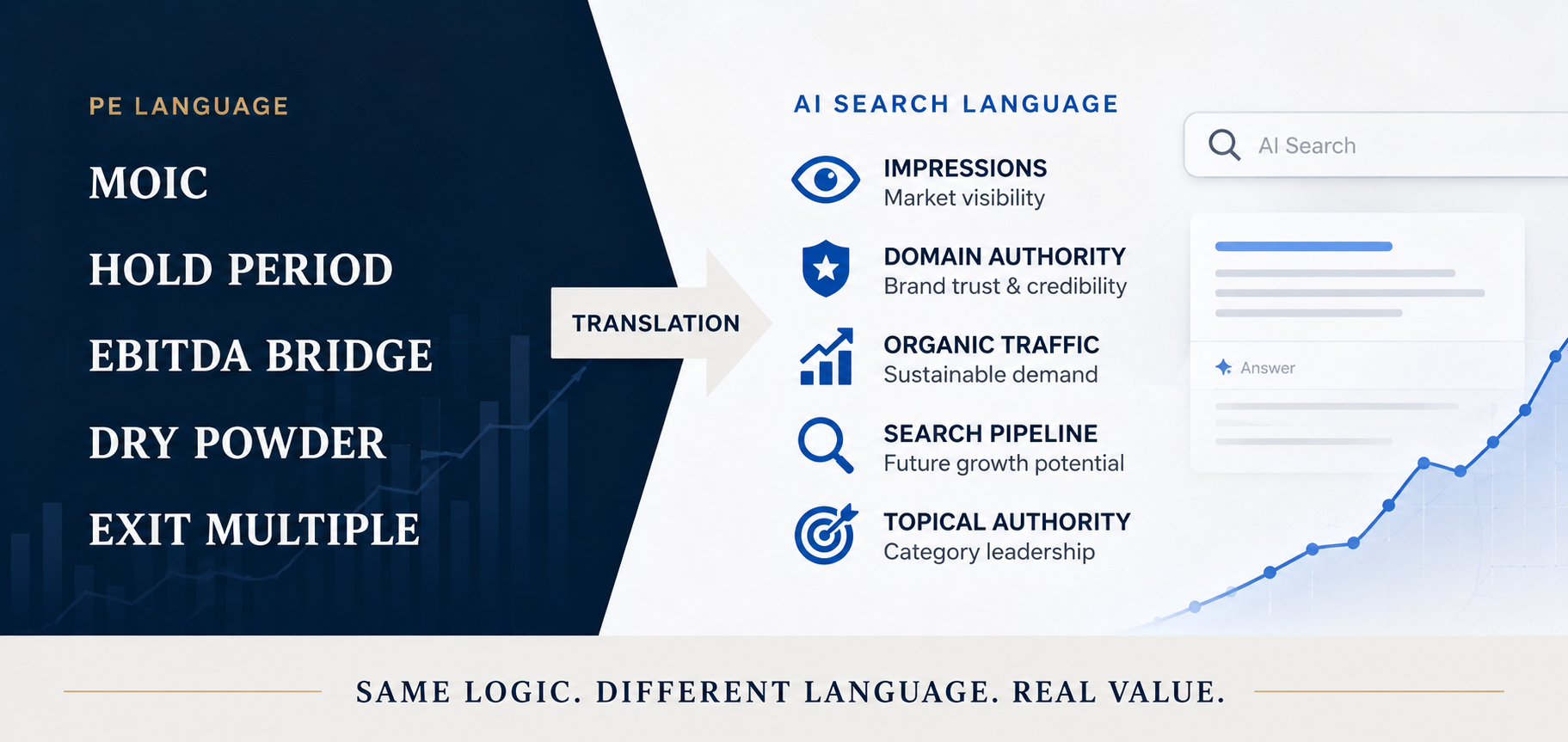
If you're a PE operating partner, you've sat through at least three AI pitches in the last six months. Maybe a dozen. The decks use words like "impressions," "domain authority," "keyword rankings," and "organic traffic" — and somewhere in the middle of slide four you've mentally checked out because none of it maps to how you think about value.
That's not a you problem. It's a translation problem.
The mechanics of AI search optimization and the mechanics of PE value creation are describing the same thing: building a durable asset that compounds over a hold period, contributes measurably to revenue, and makes the business more valuable at exit than it was at entry. The practitioners just developed completely different vocabularies for it.
This glossary exists to close that gap. For every term you use every day in your value creation work, there's a direct AI search equivalent — same logic, different language. Once you see the translation, the investment thesis for AI search visibility writes itself.
MOIC → Citation Authority Compounding
In PE, MOIC (Multiple on Invested Capital) is the clearest expression of what compounding does to an early investment over time. A dollar invested in year one that builds on itself produces a multiple that a dollar invested in year four never can. The timing of the investment is inseparable from the return.
Citation authority in AI search works exactly the same way. When your portco's content starts getting cited by ChatGPT, Perplexity, and Google AI Overviews, those citations build credibility signals that make future citations more likely. The AI systems that decide whose content to surface treat established citation patterns as a trust signal — the brand that has been consistently cited is more likely to be cited again than the brand that just entered the space.
The portco that builds citation authority in year one of a hold period is compounding that asset for three to five years. The one that starts in year four is buying the same product at a higher price with less time to see the multiple. The MOIC logic is identical. The only variable is when you start.
Hold Period → SEO / GEO Investment Timeline
PE hold periods exist because value creation takes time. You don't buy a company on Monday and sell it on Friday. The operational improvements, the revenue expansion, the margin enhancement — they require a runway to compound and a timeline that matches the nature of the work.
AI search visibility has its own hold period logic. The technical foundation, content restructuring, and entity authority signals that determine whether a portco appears in AI-generated answers take 90 days to build and 3 to 6 months to produce measurable citation share. The full contribution to pipeline and revenue becomes clear between months 6 and 12. And like operational value creation, the results compound — the program running for 36 months is worth materially more than the program running for 6.
The implication for sequencing is the same as it is in PE: start early in the hold period, run the program with discipline throughout, and measure it consistently so you can demonstrate the asset in the exit process. An AI search program started in the last 18 months of a hold period produces a fraction of the value of one started in the first quarter after close.
EBITDA Bridge → Organic Pipeline Contribution
The EBITDA bridge is one of the most useful tools in PE because it forces specificity. It doesn't ask "did the business do better?" It asks "where exactly did the improvement come from, how much did it contribute, and what drove it?" Revenue growth, margin expansion, cost reduction — each gets its own line.
Organic pipeline contribution is the AI search equivalent. It doesn't ask "did traffic go up?" It asks "how much qualified pipeline did organic search generate, what was the CAC compared to paid channels, and how did that contribution change over the measurement period?" The top-performing B2B organizations track organic contributing 15 to 25% of total pipeline — at roughly 40% of paid acquisition cost. When AI search visibility improves and more buyers find the portco through AI-assisted research, that organic pipeline contribution line on the bridge moves.
The key shift for operating partners is insisting on this framing from the start. An AI search program measured only in traffic and rankings produces a marketing report. An AI search program measured in pipeline contribution, CAC differential, and revenue attribution produces an EBITDA bridge line.
Value Creation Plan → AI Search Program Roadmap
The value creation plan is the document that makes a PE investment thesis operational. It translates the investment rationale into specific workstreams, owners, timelines, and milestones. It's the difference between a thesis that lives in a memo and one that drives 100-day plans and quarterly reviews.
The AI search program roadmap is the same document for organic revenue. It translates the AI visibility thesis — "our portco should be cited when buyers in our category ask AI platforms for vendor recommendations" — into specific phases: technical foundation in days 1 to 30, content restructuring and GEO optimization in days 31 to 60, measurement infrastructure and compounding in days 61 to 90, and ongoing execution throughout the hold period.
Without the roadmap, AI search is a slide in the value creation deck that never becomes a system. With it, it's a workstream with an owner, a timeline, milestones, and quarterly metrics that show up in the same portfolio review as every other value creation initiative.
Portfolio Diagnostic → AI Visibility Audit
Before a PE firm deploys capital across a portfolio, it runs diagnostics. Which companies have the most upside? Where is the execution risk highest? Which workstreams will move the EBITDA needle fastest, and in which companies? The diagnostic produces the heatmap that makes capital allocation decisions defensible.
The AI visibility audit is the same tool for organic search. It runs a rapid assessment of each portco's current citation presence across ChatGPT, Perplexity, and Google AI Overviews, benchmarks it against the competitive set, identifies the technical and content gaps that are blocking AI retrievability, and scores each company on upside potential. The output is a prioritized heatmap: which portcos have the largest gap between current AI visibility and what's achievable, and where 90 days of focused work produces the clearest pipeline contribution.
For an operating partner managing 10 to 15 portcos, the audit answers the sequencing question that makes the whole program executable: don't try to run everything everywhere simultaneously — identify the two or three companies where the opportunity is largest and start there.
Due Diligence → Technical SEO / GEO Audit
In PE due diligence, you're assessing the health of the asset before you commit capital. Financial statements, customer concentration, management team, operational risks — everything that could affect the value of the investment gets stress-tested before close. The goal is to know exactly what you're buying, including the problems you're going to have to fix.
A technical SEO and GEO audit does the same thing for a portco's organic search foundation. It assesses whether the site is technically sound enough for search engines and AI systems to crawl, index, and trust it. It identifies structural problems — broken architecture, missing schema markup, duplicate content, thin pages, poor entity clarity — that are suppressing visibility regardless of how good the content is. And it surfaces the gaps between where the portco is and where it needs to be for AI citation to be achievable.
Run this at or shortly after close and it tells you exactly what you're working with. Skip it and you spend six months executing a content program on a foundation that can't support the results you're expecting — the organic equivalent of discovering a customer concentration problem 18 months into the hold period.
Proprietary Deal Flow → Branded Search & Direct AI Citation
Proprietary deal flow is the holy grail of PE because it means you're not competing in a banker-run auction where every bidder pays the same premium. The business owner found you, called you directly, and the conversation started without a process. The source of that advantage is brand — the firm's reputation, thought leadership, and presence in the spaces where owners research their options before engaging a banker.
Branded search and direct AI citation are the same advantage for portfolio companies. When a buyer in a portco's category types the company's name directly into Google or asks an AI platform "tell me about [portco]," they've already self-selected. They found the brand before the sales team found them. That buyer has a shorter sales cycle, higher intent, and lower CAC than any buyer generated through paid acquisition.
Building branded search strength and AI citation for a portco's brand name is building proprietary deal flow for its sales team. The buyers come in pre-educated, pre-qualified, and having already decided the brand is worth a conversation — without a paid channel having to initiate it.
Add-On Acquisition → Content Expansion / Topic Cluster
Add-on acquisitions are how PE firms extend platform value without building from scratch. Rather than organically growing into an adjacent market over three years, you buy a company that already has the capabilities, the customers, and the credibility in that space. The platform gets bigger faster than organic growth alone allows.
Content expansion and topic clusters work the same way in AI search. When a portco has built citation authority in its core category, expanding into adjacent topics — the problems its buyers have before they need the portco's product, the comparisons they're making during evaluation, the implementation questions they have after purchase — extends the portco's visibility across a wider slice of the buying journey without starting from zero.
Each new topic cluster is an add-on to the organic platform. It brings new buyers into the funnel at different stages, extends the brand's presence in AI-generated answers across a broader set of queries, and compounds the overall citation authority of the domain. The sequencing logic is identical to the add-on strategy: establish the platform, then expand into adjacencies where the existing foundation creates an unfair advantage.
Management Bandwidth → Implementation Velocity
One of the most consistent constraints in mid-market PE is management bandwidth. The leadership team at a $40M revenue company is already running at capacity. Every new initiative competes for the same finite pool of executive attention, and the workstreams that fail are usually the ones that require more management involvement than the team can actually sustain.
Implementation velocity is the AI search equivalent — and it's the most underappreciated constraint in organic search programs. The technical changes, content decisions, and structural updates that produce AI visibility don't fail because the strategy is wrong. They fail because they sit in a queue waiting for developer time, legal approval, or an executive decision that never gets prioritized. The gap between what the audit recommends and what actually gets implemented is where most AI search programs die.
The operating partner who understands this constraint builds for it: either by ensuring the portco has a clear internal owner with authority to move recommendations into execution, or by structuring the agency relationship so the external partner has enough access and credibility to keep the program moving without requiring constant management escalation. Same problem as every other value creation workstream. Same solution: ownership, authority, and accountability.
Exit Multiple → Domain Authority / Citation Share at Exit
Exit multiple expansion is the highest-leverage value creation outcome in PE. Everything else being equal, a business that exits at 9x EBITDA instead of 7x on the same earnings number produces a dramatically different return. The multiple is a function of growth quality, revenue durability, competitive positioning, and the buyer's confidence that the business will continue performing after close.
Domain authority and citation share are the organic search assets that contribute to that multiple. A portco that exits with strong AI citation share in its category — consistently appearing in AI-generated answers when buyers research its space — has something a strategic acquirer or financial sponsor increasingly knows how to value. It means the revenue model is partially self-sustaining through organic discovery. It means the CAC is structurally lower than a competitor dependent on paid acquisition. And it means the buyer doesn't have to rebuild the inbound engine from scratch after close.
In an exit process, the portco that can show compounding organic pipeline contribution, growing AI citation share, and a content library that continues producing inbound leads without ongoing spend is telling a durability story. Durable revenue commands a higher multiple. The organic search asset is part of what makes the revenue durable.
LP Reporting → SEO / GEO Performance Reporting
LP reporting exists because the people who committed capital deserve a clear, honest accounting of how it's performing, what's working, what isn't, and what the path to return looks like. The best LP reports don't hide the scoreboard — they show granular performance data, explain the variance from plan, and give investors confidence that the team knows what it's doing and why.
SEO and GEO performance reporting should work exactly the same way. Not a vanity metrics dashboard showing traffic and rankings that don't connect to business outcomes — but a report that shows pipeline contribution from organic, citation frequency trends across AI platforms, CAC differential versus paid channels, and progress against the AI visibility baseline established at the start of the program. The operating partner who insists on this framing from the first engagement is the one who can show LPs a concrete, measurable AI workstream with financial outcomes attached — not a slide that says "AI" with an arrow pointing up.
Dry Powder → Untapped Citation Opportunity
Dry powder is committed but undeployed capital — the firm has the resources, the mandate, and the intent to invest, but hasn't yet identified the right opportunity or the right moment. It represents potential that hasn't been converted to return.
Untapped citation opportunity is the AI search equivalent. In most B2B verticals at the mid-market level, the majority of high-value queries that buyers use to research vendors, evaluate options, and make purchasing decisions are not yet dominated by any single brand in AI-generated answers. The citation share is unclaimed. The operating partner whose portcos move into that space now — building content, entity authority, and technical foundations for AI retrievability — is deploying into a market where competition for the asset is still low.
That window doesn't stay open indefinitely. As AI search optimization becomes standard practice rather than early-mover territory, the cost of building citation share increases and the advantage of having built it early compounds. The firms that deploy their dry powder into this opportunity in the next two to four quarters are buying the asset at the best price it will ever be available at.
The Translation in One Sentence
AI search visibility is a value creation workstream that builds a durable organic revenue asset over a hold period, contributes measurably to pipeline and EBITDA, and commands a higher exit multiple — and the only reason it hasn't been in more value creation plans is that the people who execute it have been speaking the wrong language.
Now you have the dictionary.
Ready to Put This in Your Value Creation Plan?
Ritner Digital works with PE operating partners and B2B portfolio companies to build AI search programs that report in the metrics that matter — pipeline contribution, CAC, EBITDA bridge, and exit narrative. We start with a portfolio diagnostic that tells you exactly where each portco stands and where 90 days of focused work moves the needle most.
Let's talk about your portfolio →
Ritner Digital is a Philadelphia-area SEO and AI search agency specializing in generative engine optimization and enterprise SEO for B2B organizations. We work directly — no account managers, no templated plans, transparent pricing from the start.
Frequently Asked Questions
What is AI search visibility and how is it different from traditional SEO?
Traditional SEO optimizes your content to rank in Google's list of search results — success is measured in keyword rankings, organic traffic, and clicks. AI search visibility, also called GEO (Generative Engine Optimization), optimizes your content to be cited inside AI-generated answers from platforms like ChatGPT, Perplexity, and Google AI Overviews. The difference matters because B2B buyers are increasingly using AI platforms to build their vendor consideration sets before they ever visit a website. If your portco's brand doesn't appear in those answers, it doesn't exist to a growing share of its most qualified buyers — regardless of where it ranks on Google.
How do you measure AI search performance in terms PE operating partners actually use?
The metrics that matter are pipeline contribution from organic search, CAC differential versus paid acquisition channels, citation frequency across AI platforms, and Share of Model — how often your portco's brand appears in AI-generated answers relative to competitors. These translate directly into EBITDA bridge language: organic pipeline contribution is a revenue line, lower CAC from organic versus paid is a margin line, and compounding citation authority is an asset that supports exit multiple expansion. An AI search program that reports only in traffic and rankings is running a 2019 playbook. The right program reports the same way every other value creation workstream does — against financial outcomes.
When in the hold period should an operating partner start an AI search program?
As early as possible after close, for the same reason you wouldn't wait until year four to start an operational improvement program. AI search visibility compounds over time — citation authority built in year one produces a multiple that citation authority built in year four never can. The practical first move is a portfolio diagnostic in the first 90 days: audit AI visibility across representative portcos, identify where the gap between current performance and achievable performance is largest, and sequence the program starting with the highest-upside companies. Starting the diagnostic early costs very little. Starting the program late costs compounding returns you can never recover.
Can mid-market portfolio companies compete in AI search against larger, better-resourced competitors?
Often more effectively than you'd expect. The AI citation landscape in most B2B verticals at the mid-market level is still largely unclaimed — the large incumbents haven't necessarily built strong AI visibility just because they have large marketing budgets. AI systems favor content that is well-structured, authoritative, and citation-worthy regardless of the size of the company producing it. A mid-market portco with a focused AI search program, clear entity authority in its category, and content designed for AI synthesis can build citation share faster than a larger competitor running a fragmented, unfocused content operation. The window where that asymmetric advantage is available won't stay open indefinitely.
How does AI search visibility affect exit valuation?
It contributes to exit valuation through three channels. First, organic pipeline contribution reduces CAC and improves EBITDA margin, which flows directly into the earnings number the exit multiple is applied to. Second, a portco with documented, compounding AI citation share tells a revenue durability story — the inbound engine continues producing qualified pipeline without ongoing paid spend, which buyers price as lower risk. Third, in a sell-side process, the portco that can demonstrate AI visibility in its category is telling a forward-looking story about where its buyers are going and why the business is structurally positioned to capture them. Sophisticated buyers increasingly know how to value that. The ones who don't yet will within the next two to three years.
What's the difference between running SEO for a PE firm versus running it for portfolio companies?
SEO for a PE firm itself is about the firm's own brand visibility — helping the firm appear when LPs research managers, when founders search for exit options, or when intermediaries look for buyers in a particular sector. That's a legitimate practice but it's a different problem entirely. What this glossary addresses is AI search visibility as a value creation lever inside portfolio companies — optimizing the portco's own organic discovery so its buyers find it through AI-assisted research, generating pipeline contribution that shows up in the portco's EBITDA. These are two separate programs with two separate buyers, two separate goals, and two separate sets of metrics.