We're Not an SEO Agency. We're a Value Creation Firm That Happens to Work in Search.
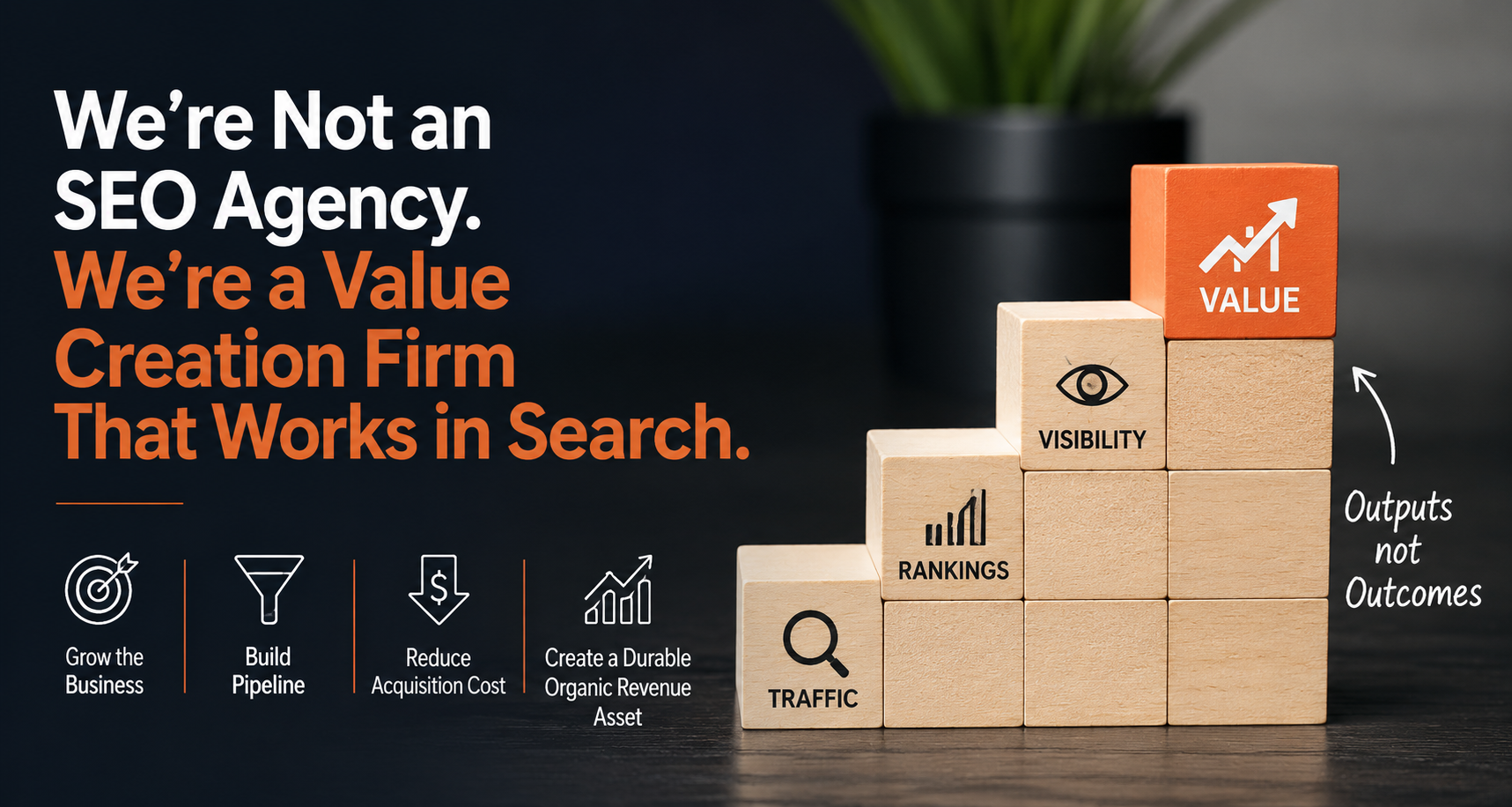
When most companies go looking for an SEO agency, they're looking for the same thing: more traffic. More rankings. More visibility. The brief is usually some version of "we need to show up better on Google" and the success metric is usually some version of "organic sessions went up."
That's a legitimate service. There are hundreds of agencies that provide it competently.
It's also not what Ritner Digital does.
Not because we can't deliver traffic and rankings — we do, consistently, and the data backs it up. But because traffic and rankings are outputs, not outcomes. They're the mechanism, not the point. The point is always the same thing: grow the business. Build pipeline. Reduce acquisition cost. Create a durable organic revenue asset that makes the company more valuable than it was before we started working together.
That's a different brief. It requires a different kind of firm.
The Problem With How Companies Think About SEO Agencies
The typical mental model for an SEO agency puts it in the same category as a web design shop or a social media manager — a vendor that handles a specific marketing function, reports on its own metrics, and operates largely disconnected from the financial outcomes the business actually cares about.
That model made a certain kind of sense when SEO was primarily a traffic play. Rank for keywords, drive sessions, hand the leads off to sales, let someone else figure out whether they convert. The SEO agency's job ended at the top of the funnel, and the metrics reflected that — rankings, impressions, clicks.
That model is broken now for two reasons.
The first is measurement. B2B buyers interact with 10 to 15 touchpoints before a purchase decision. Multi-touch attribution has made it possible to trace organic search's contribution to pipeline and closed revenue with enough precision to put it on an EBITDA bridge. The agencies still reporting only on traffic and rankings are choosing not to connect their work to business outcomes — and the companies accepting those reports are leaving accountability on the table.
The second is AI search. 89% of B2B buyers now use generative AI at every stage of the purchase journey. The surface where organic visibility gets determined has expanded beyond Google rankings to include AI-generated answers from ChatGPT, Perplexity, and Google AI Overviews. A company that ranks on page one of Google but doesn't appear in AI-generated answers when its buyers are researching vendors is losing ground on the surface that increasingly shapes the consideration set. An agency that isn't optimizing for both surfaces isn't doing the full job. Onely
The SEO agency model wasn't built for either of these realities. A value creation firm has to be.
What a Value Creation Firm Actually Does Differently
The difference isn't cosmetic. It runs through every part of how the work gets scoped, executed, and measured.
It starts with the business outcome, not the channel.
A traditional SEO engagement starts with a keyword audit and a content calendar. A value creation engagement starts with a different set of questions: What does qualified pipeline look like for this business? What's the current CAC from paid channels, and what would a 30% shift toward organic contribution do to EBITDA margin? Where in the buyer journey is organic search most likely to influence a purchase decision, and what content needs to exist at each of those points?
The channel — SEO, GEO, content, technical infrastructure — is the answer to those questions, not the starting point. The strategy is built backward from the financial outcome, not forward from the keyword list.
It measures what the business measures.
Organic search generates 44.6% of B2B revenue — more than doubling the contribution of any other marketing channel. That number should show up in how an organic search program is reported. Pipeline contribution, MQLs and SQLs from organic, CAC differential versus paid, revenue influenced by organic touchpoints — these are the metrics that connect the work to the business. They're also the metrics that justify continued investment, inform budget allocation decisions, and tell a story that a CFO or an operating partner can actually use. Gtm8020
Traffic and rankings are leading indicators. They're worth tracking. They're not worth reporting as primary success metrics when the data exists to go further.
It builds assets, not campaigns.
Campaigns have start dates and end dates. Assets compound. A well-structured piece of content that earns AI citation share in a competitive B2B category doesn't stop working when the campaign budget runs out — it continues producing inbound pipeline, continues building entity authority, and continues compounding the organic revenue contribution of the business.
Citation authority, like domain authority before it, compounds over time. The content library, the technical foundation, the entity signals, the citation patterns across AI platforms — these are balance sheet assets, not income statement line items. A value creation firm builds them with that framing in mind. Enrichlabs
It operates upstream, not downstream.
The decisions that most determine organic search performance aren't made in the content calendar. They're made when the site architecture is designed, when the product naming convention is established, when the content taxonomy is built, when the development team is deciding what to ship next. A value creation firm has to be in those conversations — not auditing outcomes after the fact, but shaping inputs before they're finalized.
SEO must live upstream in decision-making. Search performance is created when decisions are made about site structure, content scope, taxonomy, product naming, and internal linking frameworks. SEO cannot succeed if it only reviews outcomes; it must help shape inputs. That's true for traditional SEO. It's even more true for AI search, where the structural signals that determine whether a brand gets cited are embedded in how the entire digital presence is built. Search Engine Journal
Why This Distinction Matters More for Some Companies Than Others
Not every company needs a value creation firm. A local service business with a well-maintained Google Business Profile and a handful of location pages needs a competent SEO vendor, not a strategic partner building an EBITDA bridge.
The distinction matters most for three types of organizations.
B2B companies with long sales cycles and high deal values. When a single closed deal is worth $50,000 or $500,000, the ROI math on organic search investment is completely different from a consumer e-commerce play. The pipeline contribution from a well-executed AI search program at a B2B company with a $150,000 ACV isn't a marketing metric — it's a material revenue line. These companies need their organic search program reported and managed like the revenue driver it actually is.
Companies preparing for or coming out of a transaction. Whether that's a PE-backed portco in a hold period, a founder-owned business building toward an exit, or a company that just went through a sale process and needs to demonstrate organic revenue durability to the new owner — the stakes around organic search performance are financial, not just marketing. The story that gets told in a CIM or a board deck about organic pipeline contribution either supports or undermines the valuation narrative. That's not a channel metric. That's a business outcome.
Companies where AI search is already disrupting the buyer journey. A McKinsey study estimates that 44% of consumers now use AI as their main source of information for purchasing decisions. For B2B businesses, the trend is even more pronounced — 90% of B2B buyers integrate generative AI at some point in their buying journey. For companies in categories where AI-assisted research is already shaping the consideration set, the gap between brands with strong AI citation share and brands without it is widening every quarter. Closing that gap is not a marketing project. It's a competitive positioning decision with direct revenue consequences. Mekaa
What Ritner Digital Actually Does
We are an SEO and GEO firm. That's the accurate description of the technical work we do — optimizing for traditional search rankings and for AI citation share simultaneously, because the B2B buyer journey now runs through both surfaces and treating them as separate programs produces worse results than integrating them.
But the brief we operate against is always a business brief, not a channel brief.
We build organic pipeline engines for B2B companies. We translate AI search visibility into EBITDA contribution, CAC reduction, and exit narrative. We run portfolio diagnostics for PE operating partners who need to know where AI search represents the highest-upside value creation opportunity across their companies. We produce reporting that shows up in board decks, not just marketing dashboards.
We don't do cookie-cutter plans. We don't hide behind account managers. We don't report on metrics that don't connect to the financial outcomes our clients actually care about. And we don't treat AI search as a trend to bolt onto an existing SEO engagement — we treat it as the infrastructure decision it actually is, because the companies that build it now are compounding an advantage that gets harder and more expensive to replicate every quarter they wait.
The agencies that call themselves SEO firms and report on traffic are a commodity. There are hundreds of them and most of them are fine at what they do.
We are building something different — a firm that sits at the intersection of search, AI visibility, and business value creation, and measures itself against the outcomes that actually matter to the companies and investors we work with.
A Note for PE Operating Partners
If you manage a portfolio of B2B companies and your value creation plan has "AI" on a slide but not in a system — this is the conversation to have.
AI search visibility is the value creation workstream that fits the mid-market operational reality: focused scope, right-sized budget, measurable contribution to pipeline and EBITDA, and a compounding asset that supports the exit narrative. It doesn't require a seven-figure enterprise transformation engagement. It requires a partner who understands both the search infrastructure and the financial outcomes — and who reports in the language your LPs and board actually use.
We start with a portfolio diagnostic. Five representative portcos, four weeks, a prioritized heatmap of where AI search investment moves the EBITDA needle most. From there, the program runs with the same discipline as any other value creation workstream — clear ownership, defined milestones, financial metrics that show up in the same quarterly review as everything else.
The sponsors who run this in the next two quarters own the data moat. The ones who wait buy the same product later, at a higher price, with less hold period left to compound it.
Ready to Work With a Firm That Measures Itself Against Your Bottom Line?
Whether you're a B2B company building pipeline, a founder preparing for an exit, or a PE operating partner looking for the AI workstream that actually fits your portfolio — the conversation starts the same way: tell us what the business needs to do financially, and we'll build the organic search program that gets it there.
Let's talk →
Ritner Digital is a Philadelphia-area SEO and AI search agency specializing in generative engine optimization, enterprise SEO, and organic value creation for B2B organizations. We work directly — no account managers, no templated plans, transparent pricing from the start.
Frequently Asked Questions
What makes Ritner Digital different from a traditional SEO agency?
Most SEO agencies measure success in traffic, rankings, and impressions. Ritner Digital measures success in pipeline contribution, CAC reduction, and EBITDA impact. The technical work — SEO, GEO, content, schema, entity optimization — is the same. The difference is what we build it toward and how we report on it. Every engagement starts with a business outcome, not a keyword list. Every report connects the organic search work to the financial metrics that actually drive decisions at the executive and board level. That's not a positioning statement. It's a different operating model.
What is GEO and why does it matter as much as traditional SEO?
GEO stands for Generative Engine Optimization — the practice of structuring your content to be cited in AI-generated answers from platforms like ChatGPT, Perplexity, and Google AI Overviews. It matters because B2B buyers are increasingly using these platforms to research vendors, build consideration sets, and make purchasing decisions before they ever visit a website or talk to a sales team. A company that ranks well on Google but doesn't appear in AI-generated answers is invisible to a growing share of its most qualified buyers. We optimize for both surfaces simultaneously because the B2B buyer journey now runs through both.
What kind of companies does Ritner Digital work best with?
We work best with B2B companies where organic search has a direct and measurable connection to revenue — typically companies with longer sales cycles, higher deal values, and buyers who research extensively before making a decision. That includes founder-owned businesses building toward an exit, companies that have recently gone through a transaction and need to demonstrate organic revenue durability, and PE-backed portfolio companies where the operating partner needs a value creation workstream that reports in financial terms. If your average deal value is high enough that a single closed opportunity from organic search justifies the investment, we're probably a fit.
How does Ritner Digital work with PE operating partners and portfolio companies?
We start with a portfolio diagnostic — a rapid AI visibility audit across a representative sample of portfolio companies that produces a prioritized heatmap of where AI search investment is most likely to move the EBITDA needle. From there, we run focused programs at the highest-upside portcos, structured around the same discipline as any other value creation workstream: clear ownership, defined milestones, and reporting that shows up in quarterly reviews in pipeline contribution and CAC terms, not marketing metrics. We work directly with operating partners, portco CMOs, or both depending on how the portfolio is structured.
How long does it take to see results?
The diagnostic and technical foundation are completed in the first 30 days. Early signals — improvements in AI citation frequency and organic traffic to high-intent pages — begin showing in months 2 and 3. Measurable pipeline contribution from organic typically becomes clear between months 4 and 6, depending on the company's sales cycle length and starting baseline. The program compounds from there. We set these expectations upfront and report against leading indicators in the early months so there's always visibility into whether the program is on track, even before the full pipeline contribution is measurable.
Does Ritner Digital work with companies that already have an in-house SEO team?
Yes, and it's often the most effective model. An in-house team brings institutional knowledge, cross-functional access, and implementation authority that an outside partner can't replicate. What we bring is GEO specialization, AI citation measurement infrastructure, cross-industry pattern recognition, and the external pressure that keeps recommendations moving into implementation rather than sitting in a backlog. The hybrid model — strong internal ownership combined with specialized external execution — consistently outperforms either fully in-house or fully outsourced for companies serious about AI search as a value creation workstream.
What does reporting look like?
We don't send traffic dashboards. Reporting covers pipeline contribution from organic, MQLs and SQLs attributed to organic search, CAC differential between organic and paid acquisition, AI citation frequency and Share of Model trends across ChatGPT and Perplexity, and progress against the technical and content milestones established at program launch. For PE-backed companies, we structure reporting to map directly onto the value creation plan — the same format, the same cadence, and the same financial framing as every other workstream being reviewed by the operating partner and board.