HubSpot's AEO Tracker: A Hands-On First Look at What It Actually Does
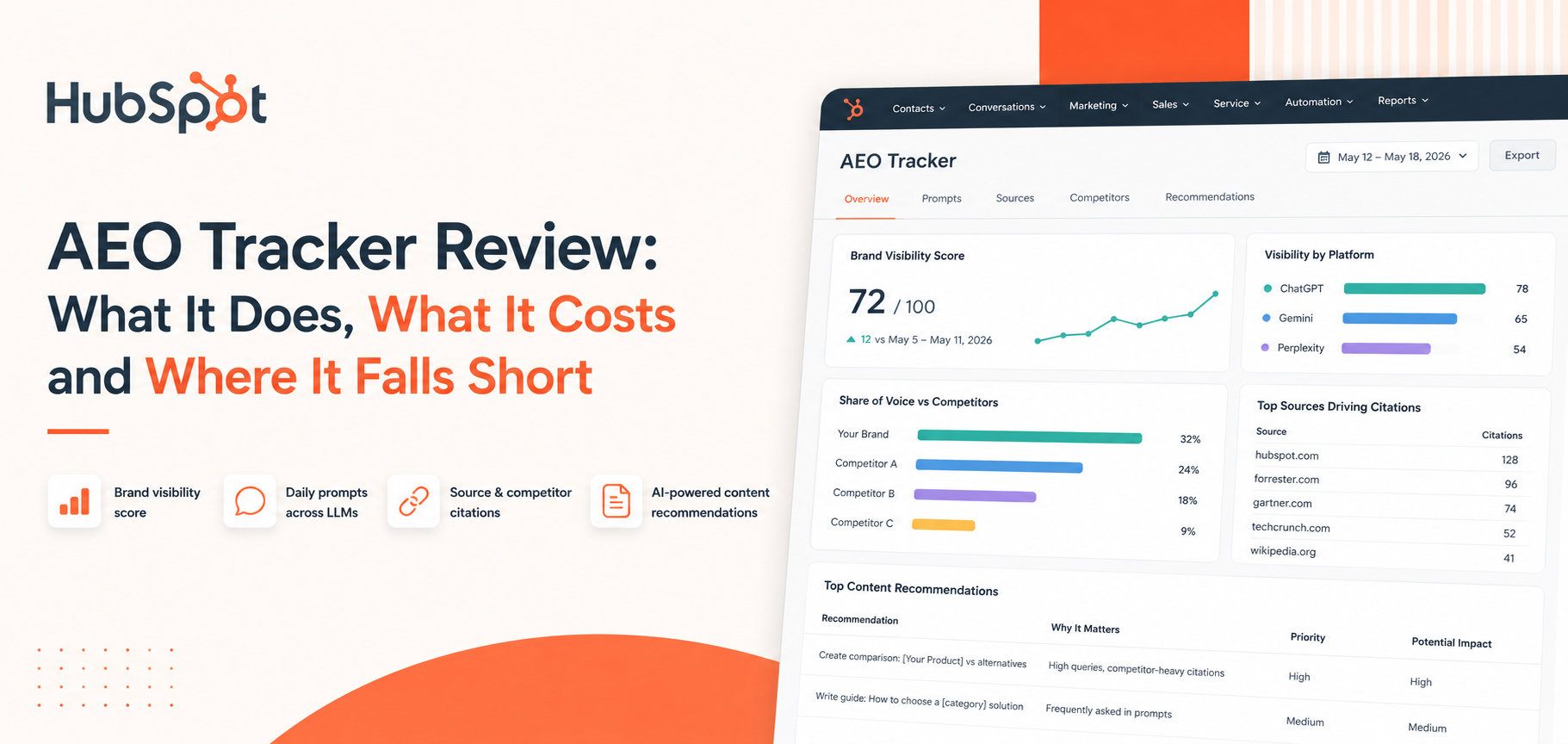
When a platform with 200,000+ customers ships a new tool, it's worth paying attention — not just to the feature, but to what it signals about where the market is going. HubSpot launched its AEO tracker in Spring 2026, and we've been living in it. Here's what the tool actually does, how it works in practice, where it's genuinely useful, and where it still has room to grow.
First: What Is AEO and Why Does It Need Its Own Tracker?
AEO — Answer Engine Optimization — is the practice of improving how often and how prominently your brand appears in AI-generated answers from platforms like ChatGPT, Perplexity, and Gemini. It's distinct from traditional SEO in a specific way: SEO optimizes for ranking in a list of search results. AEO optimizes for being cited inside the synthesized answer that increasingly replaces that list.
The measurement problem is what makes AEO hard. Traditional SEO has Google Search Console — a free, authoritative, daily data source that tells you exactly which queries you're appearing for, at what position, and with what click rate. AEO has had no equivalent. You could manually test prompts in ChatGPT and Perplexity, but doing that systematically across dozens of buyer-relevant queries, across three platforms, every day, and against competitors, was either an enormous manual effort or required stitching together several expensive third-party tools.
HubSpot's answer to that gap is a new solution that shows marketers how their business appears across answer engines like ChatGPT, Gemini, and Perplexity, and gives them recommendations to improve. It launched alongside data that gives the measurement problem real urgency: organic traffic for HubSpot customers is down 27% year-over-year, while HubSpot AEO beta users who prioritized answer engines saw AI referral traffic grow 20% compared to customers not using the tool. HubSpotHubSpot
That's the context. Here's the tool.
What HubSpot AEO Actually Tracks
HubSpot's AEO tool gives you four things: a visibility score, prompt tracking, citation analysis, and prioritized recommendations. Each one covers a different layer of the AEO measurement problem. HubSpot
The Brand Visibility Score
The main dashboard shows your brand visibility score, how that score trends over time across ChatGPT, Gemini, and Perplexity, and includes a competitive landscape with share of voice metrics. HubSpot
The visibility score is the headline number — the percentage of your tracked prompts where your brand appears in an AI-generated response. It's an aggregate, which means it's most useful as a trend indicator rather than an absolute benchmark. A score of 40% is meaningless in isolation. A score that moved from 28% to 40% over six weeks after you restructured three pages for AI synthesis — that's actionable.
The sentiment layer adds meaningful nuance. Scoring covers three layers: general sentiment (the overall positive, negative, or neutral tone of AI descriptions), contextual sentiment (how sentiment varies across different topics and use cases), and source-based sentiment (the credibility and reliability of sources influencing how AI represents your brand). For B2B companies where brand reputation is a real buying factor, understanding whether AI is describing you as "trusted by enterprise teams" or surfacing a two-year-old customer complaint is genuinely valuable. HubSpot
Prompt Tracking
This is the most operationally useful part of the tool for most marketing teams. HubSpot AEO runs each tracked prompt daily against ChatGPT, Perplexity, and Gemini simultaneously, capturing each answer engine's response, brand mentions, sentiment, and citation sources. You don't need to configure anything or run queries manually — the cross-platform analysis happens continuously every day. HubSpot
The prompt tracking interface lets you see the exact response each AI platform returned for a given query, whether your brand was mentioned, how it was described, and which sources were cited in the answer. You can filter by answer engine, buyer's journey stage, product and service relevance, and more. HubSpot
One thing worth noting: prompt selection matters enormously here. The tool is only as good as the prompts you're tracking, and because AEO is connected to your CRM from day one, HubSpot automatically suggests prompts based on your industries, competitors, and customer segments rather than using generic industry questions. For HubSpot customers that have clean CRM data, this is a genuine advantage over standalone AEO tools that require you to build your prompt library from scratch. Stream Creative
Citation Analysis
Citation analysis breaks down which domains and content types are driving AI mentions for your brand and your competitors. You can see how your citation rate compares to competitors over time, which source types — owned, competitor, third-party, social, affiliate, and more — and content types — blog, news, product, social, and more — are driving AI mentions, and which specific pages are being cited most often. HubSpot
This is the layer that turns AEO measurement into an actionable content strategy. Knowing that your brand visibility score is 35% is interesting. Knowing that competitor X is being cited in 60% of prompts because three industry publications keep referencing their research, while your owned content is almost never the cited source — that tells you exactly what to do next.
The citation analysis view also solves one of the more frustrating problems in AEO: figuring out why a competitor is winning visibility you aren't. You can find out exactly who AI is citing and why your competitors might be getting mentioned instead of you. HubSpot
Recommendations
HubSpot takes everything it learns from your prompt tracking and citation analysis and generates a prioritized list of content recommendations. Each one is tagged with a content type — listicle, how-to, guide, product page — a content channel — blog, website, social — a priority level, and the specific prompts it's meant to target. You can update the status of each recommendation, which turns the tab into something closer to a backlog your team can actually work through. Processproconsulting
The recommendations tab is where HubSpot's platform integration earns its keep. Most standalone AEO tools produce a visibility report and leave you to figure out what to do with it. HubSpot connects the recommendation directly to content creation workflows, so you can move from "we're losing visibility on mid-funnel evaluation prompts" to a drafted blog post without leaving the platform.
HubSpot has announced that Content Actions — a feature that lets you generate content directly inside the AEO tool — will be available starting June 2026. That's the logical completion of the loop: see the gap, get the recommendation, produce the content, track the visibility change. Processproconsulting
Pricing and Access
Two versions of HubSpot AEO are currently available. The trial version lets you track 10 prompts on ChatGPT for 28 days at no cost. The paid plan is $50 per month and tracks 25 prompts run daily across ChatGPT, Perplexity, and Gemini — a maximum of 2,500 answers per month. Stream Creative
For existing HubSpot customers: if you're on Marketing Hub Pro or Enterprise, HubSpot AEO is included in your subscription at no additional cost. Marketing Hub Professional tracks 25 prompts daily across three engines. Enterprise tracks 50 prompts daily across three engines for a maximum of 5,000 answers per month. Processproconsulting
At $50 per month standalone, it's one of the most accessible entry points into systematic AEO measurement available right now. Most dedicated AEO tracking tools run $200 to $500+ per month. The tradeoff is prompt volume — 25 prompts is enough to get real signal for a focused B2B brand, but enterprise teams managing large portfolios of products or serving multiple buyer personas will hit the ceiling quickly.
What It Does Well
The daily cross-platform tracking is genuinely valuable. Running 25 prompts daily across ChatGPT, Perplexity, and Gemini — automatically, continuously, without manual effort — is the core problem the tool solves. Before tools like this existed, any serious AEO measurement required either significant manual effort or expensive custom infrastructure. The $50/month price point makes systematic measurement accessible to companies that couldn't justify a dedicated AEO toolstack.
The CRM integration is a real differentiator. Every other AEO tool asks you to build your prompt library from scratch. HubSpot knows your customers, your competitors, your industries, and your product lines — and it uses that to suggest prompts that actually reflect your buyer's research behavior. For HubSpot customers with clean CRM data, this is genuinely better than starting from a generic keyword list.
Citation analysis is the most actionable feature. Knowing which specific domains and content types are driving AI citations in your category is the data that makes AEO strategy possible. Without it, you're optimizing blind. The ability to see competitor citation sources alongside your own is the feature that most clearly separates this from a vanity dashboard.
The recommendations tab has real operational value. A prioritized, status-trackable list of specific content actions connected to the visibility data is what turns measurement into execution. Most marketing teams don't fail at AEO because they lack data — they fail because the data doesn't translate into a clear to-do list. The recommendations tab solves that.
Where It Still Has Room to Grow
25 prompts is a meaningful constraint for many B2B companies. A B2B company serving three buyer personas across two product lines in multiple industries can easily identify 50 to 100 prompts worth tracking. At 25 prompts on the paid standalone plan, you have to make deliberate prioritization decisions about which part of the buyer journey to instrument first. That's not a fatal limitation — it forces useful prioritization — but it's worth knowing going in.
The tool tracks where you are, not why AI says what it says. Citation analysis tells you which sources are being cited. What it doesn't fully explain is the semantic and structural reasons why certain content earns citations while similar content doesn't. The "why" behind AI retrieval decisions — entity clarity, answer-first structure, schema markup, content freshness — requires understanding that the tool's recommendations point toward but don't fully surface.
Revenue attribution is still a gap. HubSpot's traffic analytics now breaks out AI-referred traffic as its own source, so you can tie brand visibility to actual web traffic, contact records, and pipeline. That's a meaningful step forward. But closing the loop from "brand visibility score improved by 8 points" to "that contributed X dollars of pipeline" still requires manual work to connect the AEO data to CRM outcomes. The tool is getting closer to making AEO a business metric rather than a marketing metric — but it's not fully there yet. Processproconsulting
Prompt limits affect enterprise use cases. For a PE operating partner trying to run AEO measurement across five to ten portfolio companies, or an enterprise marketing team tracking AI visibility across a large product portfolio, the per-plan prompt limits create real capacity constraints. Enterprise teams will likely need either multiple seats or a higher-tier enterprise plan to get the prompt coverage that makes the data statistically meaningful.
The Bigger Signal
It's worth stepping back from the feature review for a moment to acknowledge what the tool's existence means.
HubSpot doesn't ship products ahead of market demand. HubSpot has been ahead of every major shift in how buyers discover products. In 2006 they defined inbound marketing before the industry had a name for it. In 2013 they made SEO a marketing function, not a technical one. In 2026 they built AEO tools based on what actually worked on their own brand, then made them available to everyone. HubSpot
When HubSpot builds a product category, it's because that category is transitioning from early adopter territory to mainstream expectation. The AEO tracker is a signal that AI citation measurement is no longer a nice-to-have for forward-thinking marketing teams — it's becoming table stakes. The companies that have been building AEO programs for the past 12 to 18 months are entering a period where everyone else is catching up. The companies starting now are entering a market where the measurement infrastructure exists but the citation authority gap is still closeable.
42% of CRM software buyers now use AI search as part of their evaluation process. That number will be higher in 12 months. The buyers doing AI-assisted research in your category are already there. The question is whether your brand is in the answer they get. HubSpot
Bottom Line
HubSpot's AEO tracker is the most accessible, most integrated entry point into systematic AEO measurement available right now. For companies already on Marketing Hub Pro or Enterprise, there's no reason not to be using it — the cost is zero and the signal it provides on where your brand stands in AI-generated answers is genuinely valuable. For companies not on HubSpot, $50 per month for 25 daily tracked prompts across three platforms is a reasonable starting point for understanding your AI visibility baseline.
What the tool doesn't do is replace the strategic and execution work of actually improving AEO performance. It tells you where you stand and what to work on. Getting your brand into the AI answers that matter — and keeping it there as the landscape shifts — requires the content strategy, entity optimization, and technical foundation that the recommendations tab points toward but can't execute for you.
The measurement problem in AEO is getting solved. The execution gap is where the work still lives.
Ritner Digital specializes in AI search optimization and GEO for B2B organizations. If you want help turning AEO visibility data into an execution plan that actually moves your citation share, we can help.
Let's talk →
Ritner Digital is a Philadelphia-area SEO and AI search agency specializing in generative engine optimization and enterprise SEO for B2B organizations. We work directly — no account managers, no templated plans, transparent pricing from the start.
Frequently Asked Questions
What is HubSpot AEO and how is it different from HubSpot's existing SEO tools?
HubSpot's existing SEO tools track traditional search performance — keyword rankings, organic traffic, page authority, and on-page optimization suggestions. HubSpot AEO tracks something entirely different: how your brand appears in AI-generated answers from ChatGPT, Gemini, and Perplexity. The metrics are different too. Instead of rankings and clicks, AEO measures brand visibility score, share of voice, sentiment, and citation sources. The two tools are complementary — SEO tells you how you're performing in traditional search results, AEO tells you how you're performing in the AI-generated answers that are increasingly replacing those results for B2B buyers.
How many prompts should I track in HubSpot AEO and how do I choose them?
Start with the prompts that map most directly to your buyer's research behavior — the questions a qualified prospect would ask an AI platform when evaluating solutions in your category. For a B2B company, that typically means a mix of category-level prompts ("what is the best [category] software for [use case]"), comparison prompts ("how does [your brand] compare to [competitor]"), and problem-aware prompts ("how do I solve [specific pain point]"). The paid plan's 25-prompt limit means you'll need to prioritize — focus first on mid and bottom-funnel prompts where AI citations directly influence purchase decisions, then expand to awareness-stage prompts as you build confidence in the tool. HubSpot's CRM-based prompt suggestions are a useful starting point, but review them critically against what your sales team actually hears from prospects in discovery calls.
Does HubSpot AEO work if I'm not already a HubSpot customer?
Yes. HubSpot AEO is available as a standalone tool for $50 per month with no existing HubSpot subscription required. The standalone version tracks 25 prompts daily across ChatGPT, Perplexity, and Gemini. The tradeoff is that you lose the CRM integration benefits — automatic prompt suggestions based on your customer data, recommendations connected directly to your content tools, and the ability to tie AEO visibility data to pipeline and contact records in your HubSpot dashboard. For companies not on HubSpot, the standalone tool still provides meaningful AI visibility measurement. But the platform integration is a genuine differentiator that makes the tool more useful for HubSpot customers than for those using it in isolation.
How do I interpret my brand visibility score and what's a good number?
Your brand visibility score is the percentage of your tracked prompts where your brand appears in an AI-generated response. There's no universal benchmark for what's "good" because it depends entirely on your category, your competitive set, and which prompts you're tracking. A 40% visibility score on highly competitive category prompts is strong. A 40% score on branded prompts that specifically mention your company name is a problem. The most useful way to interpret the score is as a trend indicator rather than an absolute benchmark — is it moving up or down week over week, and can you correlate changes with specific content or coverage actions you took? Competitor share of voice alongside your score is the other critical context. A visibility score of 35% means something different if your nearest competitor is at 20% versus 65%.
What's the difference between brand mentions and citations in HubSpot AEO?
Brand mentions are instances where your company name appears in an AI-generated answer, regardless of whether a link back to your site is included. Citations are mentions that include a clickable source link pointing to a specific page on your domain. Both matter, but they tell different stories. High mentions with low citations means AI systems are referencing your brand by name — which builds awareness — but aren't pulling directly from your content as a source. That gap typically signals a content structure or retrievability problem: your brand is known to the AI but your owned content isn't formatted or structured in a way that earns direct citation. The goal is to grow both, with citations being the higher-value signal because they drive actual referral traffic alongside the brand awareness.
How does HubSpot AEO connect to revenue and pipeline, not just visibility metrics?
HubSpot's traffic analytics now breaks out AI-referred traffic as its own source channel, which means you can track the full path from AI citation to website visit to contact record to pipeline in your HubSpot CRM. In practice, connecting a visibility score improvement to a specific pipeline contribution still requires deliberate attribution setup — you need to be tracking AI-referred sessions in your analytics, tagging them appropriately, and connecting them to your lead and opportunity data. The tool gets you most of the way there for HubSpot customers with clean attribution data. The remaining gap is tying a two-point improvement in brand visibility score to a specific revenue line, which requires enough volume of AI-referred traffic and enough time in the measurement window to make the correlation statistically meaningful. For most B2B companies in the early stages of AEO measurement, focus first on establishing the visibility baseline and demonstrating AI referral traffic growth — the revenue attribution story becomes clearer as volume builds.
Is HubSpot AEO enough on its own or do I need additional AEO tools?
For most small to mid-market B2B companies, HubSpot AEO is sufficient as a starting measurement layer — especially if you're already on Marketing Hub Pro or Enterprise and the tool is included at no additional cost. Where you might need additional tooling is at the enterprise level, where 25 to 50 prompt limits create real coverage gaps across large product portfolios or multiple buyer segments, or where you need deeper technical analysis of why specific content is or isn't being cited. HubSpot AEO tells you what is happening to your AI visibility. Understanding the structural and technical reasons behind those patterns — entity clarity, schema markup, content freshness signals, passage-level extractability — and executing the optimization work that closes the gaps is where a dedicated AEO strategy and execution partner adds value beyond what any measurement tool provides on its own.