Philadelphia Is Building Like a City That Believes in Itself. Is Your Marketing Keeping Up?
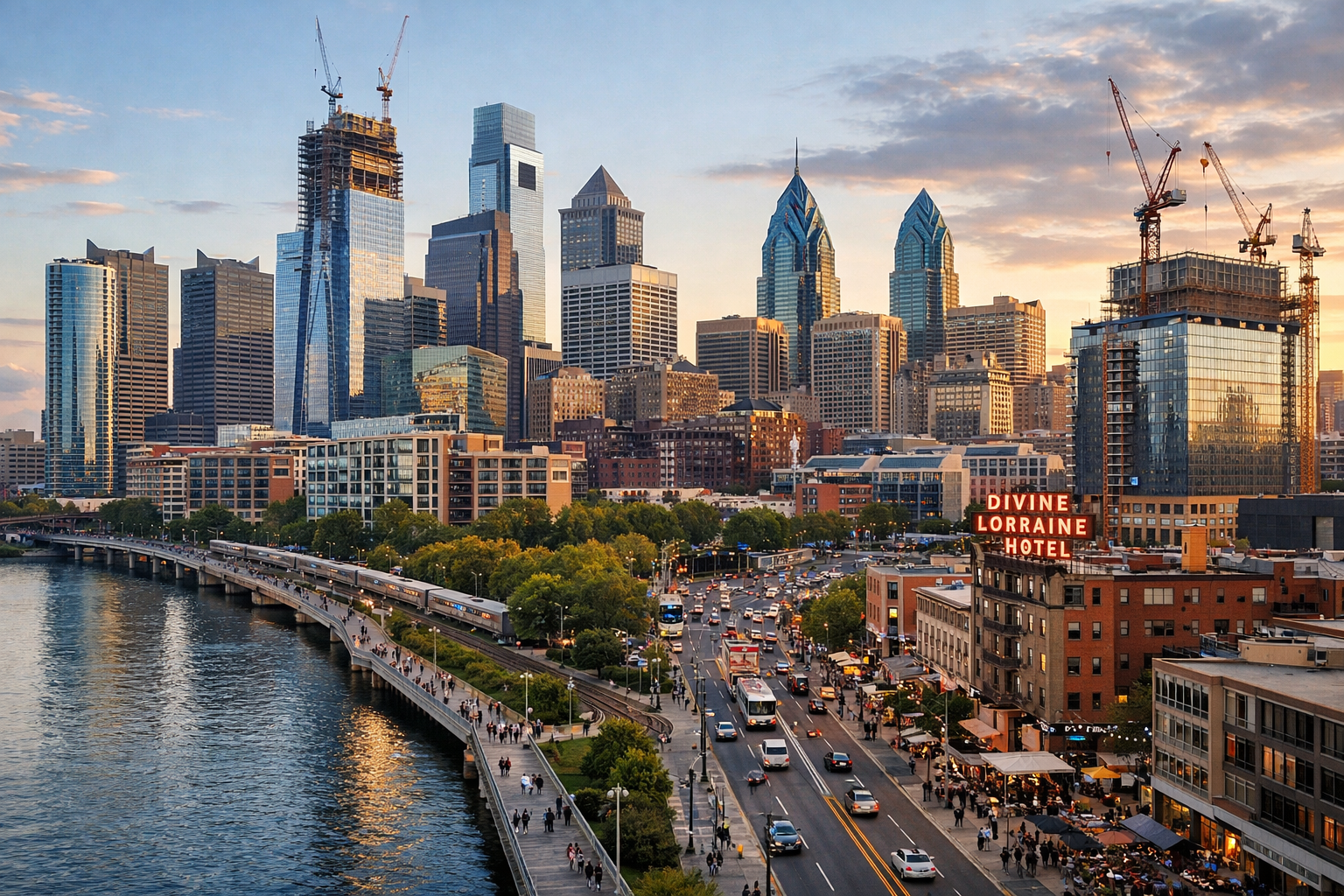
There's a version of Philadelphia that exists in the minds of people who haven't been paying attention. It's the city of Rocky steps and cheesesteaks and sports heartbreak, perpetually in New York's shadow, perpetually underestimated. That version of the city is increasingly a relic.
The Philadelphia being built right now — in Center City, along the Schuylkill, at the Navy Yard, on North Broad Street — is something different. It's a city in the middle of a genuine transformation, one backed by billions of dollars in private and institutional investment, attracting major employers, adding thousands of new residents, and reshaping entire neighborhoods that sat dormant for decades.
The 2025 Center City Real Estate Development Report identified 66 major development projects in Center City alone — with 20 projects completed in 2024 and 33 more under construction. Center City's population has grown 20% over the past decade, making it the fourth-largest residential downtown in the nation. Metro Philadelphia
That's not a city treading water. That's a city betting on itself at scale.
And here's the question that every Philadelphia business owner should be sitting with right now: if the city is evolving at this pace, is your marketing evolving with it?
What's Actually Being Built — And What It Means
Before making the marketing argument, it's worth understanding the scale of what's underway. Because the numbers are genuinely staggering, and they tell a story about who Philadelphia is becoming.
Schuylkill Yards: A New Neighborhood Where a Railyard Used to Be
Schuylkill Yards is a 14-acre, $3.5 billion district neighborhood of glassy skyscrapers and maintained green spaces taking shape just west of 30th Street Station — a collaborative project between Drexel University and Brandywine Realty Trust. Rent Philly
When complete, the development will create 6.9 million square feet of office, laboratory, residential, retail, hotel and public green space lera — essentially a new mixed-use neighborhood on land that was previously underutilized railyard infrastructure sitting at the gateway to University City.
The tenant profile tells you something important about what Philadelphia's economy is becoming. Life sciences companies, law firms, tech-forward businesses, and innovation-oriented tenants are moving in. The people who work and live here will be educated, ambitious, and mobile. They'll have options about where to spend money, where to seek services, and which businesses they trust.
The Navy Yard: A Former Military Base Becoming a City Within the City
The Navy Yard's $6 billion development plan will add 8.9 million square feet of residential, retail, science and mixed-use development and up to 12,000 new jobs — transforming the former military base into a residential neighborhood for the first time since it closed in 1996. PhillyVoice
The Navy Yard has already attracted $2.8 billion in public and private investment and currently employs more than 16,000 workers NAIOP — and the residential component, now underway with 614 apartment units in the first phase, means thousands of people will soon be living where ships were once built and repaired.
The $285 million first residential phase — AVE Navy Yard — opened in 2025, bringing 614 units, 75,000 square feet of private amenity spaces, and 25,000 square feet of retail to the site. Navy Yard This is the beginning of a decades-long transformation that will create an entirely new community on Philadelphia's southern waterfront.
Chubb's $430 Million Headquarters: Corporate Philadelphia Is Doubling Down
Chubb's new 18-story headquarters at 2000 Arch Street — valued at $430 million and spanning 438,000 square feet — will bring over 3,000 employees to Center City, including more than 1,200 new jobs. Realestate
This isn't a company hedging. This is one of the largest insurance companies in the world making a nine-figure bet that Philadelphia is the right city for its global headquarters. When companies of this size and caliber make commitments like this, they attract vendors, suppliers, talent, and adjacent businesses in their wake.
17 Market West: The Office-to-Residential Conversion Wave
17 Market West is an 18-story former office tower being converted into 299 apartments with ground-floor retail along Market Street — the city's largest conversion post-pandemic, featuring a rooftop saltwater pool, pickleball courts, a golf simulator, cold plunge pools and a yoga studio. Axios
This project is part of a broader wave of conversions reshaping Center City's residential profile. The people moving into these buildings aren't moving to Philadelphia because they had to. They're choosing it — choosing a city where they can live, work, and build a life without New York prices and without sacrificing urban density and energy.
Harper Square, the Avenue of the Arts, and the Delaware Waterfront
Beyond the marquee projects, the transformation is happening at a neighborhood level across the city. Pearl Properties' Harper Square is adding 50 stories and up to 215 units in Rittenhouse. The Avenue of the Arts is evolving with Calder Gardens on the Parkway and the Philadelphia Ballet's new home on North Broad Street. Metro Philadelphia The Delaware River waterfront has a long-term plan for 12 towers bringing thousands of residential units, offices, retail and a hotel to land that has been largely inaccessible to the public for generations.
Philadelphia now ranks fifth among the most expensive U.S. cities for commercial construction at approximately $428 per square foot — behind only New York, San Francisco, Los Angeles, and Chicago. PHILADELPHIA.Today You don't end up on that list by being a city that's standing still.
The New Philadelphia Resident and Business Customer
Understanding the development pipeline matters for one specific reason: every building going up is bringing people with it. And those people — the professionals moving into Schuylkill Yards apartments, the Navy Yard workers who will soon be living blocks from their offices, the Chubb employees arriving with 1,200 new colleagues — represent a changed customer base for Philadelphia businesses.
This is an audience that has options. They've chosen to be here, which means they're not here because it was the only available option. They've moved into buildings with golf simulators and cold plunge pools because they expect quality in their environment. They work for companies that made half-billion-dollar commitments to this city because those companies believe Philadelphia can compete with any major market in the country.
They research before they buy. They read reviews before they hire. They form opinions about brands based on digital presence before they ever set foot in a business. And when their experience with a business doesn't match the quality they've come to expect from everything else in their lives, they move on.
The marketing that reaches this audience — and earns their trust and their business — looks different from the marketing that worked for a different Philadelphia ten years ago.
What Staying Still Looks Like — And Why It's a Problem
The most common marketing posture among established Philadelphia businesses is one of continuation. Keep doing what's been working. Post on social occasionally. Maybe run some ads. Let word of mouth do most of the heavy lifting.
For a long time, in a lot of Philadelphia markets, that was adequate. The city's business community was tight-knit. Neighborhoods were stable. The customer base moved slowly. A business that had been around for twenty years had the kind of institutional credibility that marketing couldn't buy and didn't need to.
That calculus is changing.
When thousands of new residents arrive in a neighborhood without an established relationship with any local business, the first thing they do is search. They look for the best HVAC company, the most trusted accountant, the law firm with the best reviews, the contractor who shows up on time. They don't have the benefit of twenty years of neighborhood familiarity. They make decisions based on digital presence — who appears in search, who has credible reviews, whose website reflects the quality of their work, whose content answers the questions they're asking.
A business with no SEO presence, a website last updated in 2019, and a Google Business Profile with three reviews from 2021 is invisible to that audience. Completely invisible. The business next door with half the experience but a modern website, active content, 80 recent reviews, and first-page rankings will win that customer every time.
This isn't a hypothetical. It's happening right now in every Philadelphia neighborhood touched by the development wave. And businesses that don't recognize it until their revenue tells them something is wrong will have a much harder time catching up than the ones that move now.
What Evolving Your Marketing Actually Means
Saying "your marketing needs to evolve" is easy. Describing what that actually looks like is more useful. Here are the specific dimensions where Philadelphia businesses need to level up to match the city they're operating in.
Your Website Needs to Reflect the Quality of Your Work
The people moving into $3,500-a-month apartments at 17 Market West and the professionals arriving at Chubb's new headquarters are going to judge your business by your website before they judge it by anything else. If your site looks like it was built in 2015, loads slowly, doesn't work on mobile, and has no clear path to contact you, you've lost them before the relationship started.
A website in 2026 isn't a brochure. It's your best salesperson, working 24 hours a day, either making the case for your business or making the case against it. For a city investing $430 million in a single corporate headquarters, the bar for what "good" looks like in a business website has moved.
SEO Is How New Residents Find You
New residents to Philadelphia are not calling their parents for contractor recommendations. They're not asking neighbors they don't know yet. They're searching. "Best roofing company Philadelphia." "HVAC repair Center City." "Family law attorney South Philly." "Italian restaurant near Navy Yard."
The businesses that show up at the top of those searches have invested in SEO — in content that answers the questions their customers are asking, in technical foundations that make their sites fast and crawlable, in a Google Business Profile that signals credibility through reviews and accurate information. This isn't a complicated concept. It's about being findable when the people who need you are looking.
For every business that operates in a neighborhood being transformed by development, organic search is the most important new customer acquisition channel available. The question is whether you're visible in it.
Content Builds Trust Before the First Conversation
The professionals, business owners, and residents arriving in Philadelphia's new developments make informed decisions. They read. They research. They consume content that helps them evaluate their options before they commit.
A law firm that publishes content explaining how specific types of cases work in Pennsylvania courts is building trust with prospects who haven't called yet. A financial advisor whose blog addresses the specific concerns of young professionals building wealth in a major city is establishing authority with an audience that will eventually need exactly what they offer. A contractor whose website includes detailed explanations of their process, real project outcomes, and honest answers to common questions is differentiating themselves before the estimate conversation begins.
Content marketing isn't just for B2B software companies. It's for any business in any industry where trust is a factor in the purchase decision — which is most businesses operating in a city undergoing a serious transformation.
Reviews Are Infrastructure
In a neighborhood where half the residents arrived in the last three years, reviews are the substitute for the institutional credibility that comes from decades of being known. A business with 150 recent Google reviews has demonstrated at scale that it delivers on its promises. A business with 12 reviews, the most recent from 2022, has demonstrated the opposite — or at least created enough uncertainty that a prospect with options will choose someone else.
Building a systematic process for generating reviews from satisfied customers is one of the highest-ROI activities available to any Philadelphia business right now. It costs almost nothing. It takes discipline and consistency. And for businesses serving neighborhoods where the resident base is rapidly refreshing, it is the difference between being the established choice and being unknown.
Your Brand Should Match the City's Ambition
Philadelphia is building with intention. The developers behind Schuylkill Yards aren't cutting corners on design because they think their tenants won't notice. The teams behind the Navy Yard transformation aren't producing mediocre work because the standards don't matter. The businesses serving Philadelphia's new demographic need to ask themselves whether their brand — their visual identity, their messaging, their digital presence, their customer experience — communicates the same level of intentionality.
This isn't about being expensive or pretentious. It's about being deliberate. A brand that looks like it was designed with care, speaks with a clear and consistent voice, and presents itself as if it takes its own business seriously will earn more trust from a discerning audience than one that looks like an afterthought. The city is raising its own bar. The businesses that thrive in the city being built will raise theirs too.
The Opportunity Is Real — If You Move
The transformation of Philadelphia is not a threat to established businesses. It's the largest single expansion of the available customer base in a generation. Thousands of new residents, thousands of new employees, billions of dollars in new economic activity flowing through neighborhoods and corridors that are being rebuilt from the ground up.
The businesses that will capture the most value from this transformation are the ones that are visible, credible, and trustworthy in the channels where the new Philadelphia resident is looking. That means search. That means content. That means reviews. That means a digital presence that reflects the quality of what you actually deliver.
Philadelphia is building like a city that believes in itself. The question isn't whether the opportunity is there. It's whether your marketing is ready to meet it.
Ritner Digital is a Philadelphia-based agency built for the businesses that make this city work. If your marketing isn't keeping pace with the city being built around you, let's talk about what to do about it.
Frequently Asked Questions
My business has been here for 20+ years and we've always grown through word of mouth. Why does any of this matter now?
Word of mouth still matters — but the mechanics of how it works have changed. When someone gets a referral for your business today, the first thing they do is Google you. They look at your website, read your reviews, check how recently you've been active, and form an opinion before they ever call. If what they find doesn't match the quality your existing customers would describe, you've lost them before the conversation started. Twenty years of reputation is an enormous asset. A modern digital presence is what makes that reputation visible to the thousands of new residents arriving in Philadelphia who don't have the benefit of knowing you yet.
How do new residents actually find local businesses in a city they just moved to?
Search, almost exclusively. They don't have neighbors they know yet. They don't have family in the area to ask. They open Google and type what they need — "plumber near me," "best accountant Center City Philadelphia," "family dentist Rittenhouse Square." The businesses that appear at the top of those results, have strong recent reviews, and present a credible website win that customer. The businesses that don't appear don't get considered. There's no in-between. For businesses in neighborhoods being transformed by new development, organic search is the single most important new customer acquisition channel available right now.
We already have a website. Is that enough?
It depends entirely on what the website is doing. A website that loads slowly, doesn't work well on mobile, has no clear call to action, hasn't been updated in years, and doesn't appear in search results for the terms your customers are searching is not an asset — it's a liability. Visitors who arrive and encounter a dated or confusing experience leave with a worse impression than if they'd found nothing at all. The question isn't whether you have a website. It's whether your website is making the case for your business every hour of every day to the people who are actively looking for what you offer.
What neighborhoods should Philadelphia businesses be paying most attention to right now?
Any neighborhood touched by major development activity — which at this point covers a significant portion of the city. Center City is the obvious anchor, with 66 active development projects and thousands of new residential units either completed or under construction. University City and the Schuylkill Yards corridor are adding life sciences workers and young professionals. The Navy Yard and its surrounding South Philadelphia neighborhoods will see significant residential influx as the first apartments fill and the broader development plan advances. Northern Liberties, Fishtown, and Point Breeze continue attracting young professionals priced out of Center City. If your business serves any of these areas, the customer base is actively refreshing — meaning the opportunity and the competition for new customers are both growing simultaneously.
We don't have time to manage content, SEO, and reviews on top of running the business. Where do we start?
Start with your Google Business Profile. It's free, it directly affects whether you appear in local search results, and it's where reviews live. Make sure every field is complete and accurate, add recent photos, and implement a simple process for asking satisfied customers to leave a review immediately after a positive experience. That single step — done consistently — produces more visible impact on local search performance than almost anything else a small business can do. From there, a basic SEO audit of your website and one or two well-targeted blog posts per month addressing the questions your customers are actually searching for will build organic visibility over time. You don't need to do everything at once. You need to start with the highest-leverage activities and build from there.
How does Philadelphia's development boom affect B2B businesses, not just consumer-facing ones?
Significantly. Every major development project brings with it a network of companies, vendors, contractors, and service providers. Chubb's new headquarters means thousands of employees who need professional services — legal, financial, insurance, HR, and more. The Navy Yard's life sciences expansion means dozens of companies needing specialized B2B services. Schuylkill Yards is attracting exactly the kind of tech-forward, innovation-oriented businesses that represent ideal clients for professional services firms of all kinds. B2B businesses that establish strong digital presence and topical authority in their niche are positioning themselves to be the vendor of choice when those companies are evaluating their options — which they will be, because a company that just moved its headquarters to a new city is actively building its vendor relationships from scratch.
Does Philadelphia's construction boom affect how businesses should think about their local SEO specifically?
Yes — in a specific and actionable way. As new residents arrive and new businesses open, the search landscape in each affected neighborhood becomes more active and more competitive simultaneously. More people are searching for local services. More businesses are trying to rank for those searches. The businesses that invested in local SEO before the wave crested — building their Google Business Profile authority, accumulating recent reviews, creating location-specific content, earning local backlinks — will hold meaningful advantages over businesses that begin the same process two years from now. Local SEO compounds, which means starting earlier produces disproportionately better results than starting later. The development pipeline is visible and predictable. The opportunity to get ahead of it is open right now.
Is this a good time to rebrand or update our visual identity as a Philadelphia business?
It depends on where your brand currently stands. If your visual identity hasn't been touched in a decade, your logo looks dated, and your marketing materials don't reflect the quality of work you deliver, then yes — the arrival of a more discerning customer base in your market makes a brand refresh a high-leverage investment. First impressions are formed faster than ever, and a brand that looks like it takes itself seriously will earn more trust from a new audience than one that doesn't. If your brand is fundamentally sound but your digital presence is weak, prioritize the digital infrastructure first — SEO, website performance, review generation, content — because those will produce more immediate impact on your ability to be found and chosen by the new Philadelphia customer.
Ritner Digital is based in the Philadelphia area and built for businesses like yours. If your marketing isn't ready for the city being built around you, let's have that conversation.