SEO for Cleveland HVAC Companies: How to Rank When Customers Need You Most
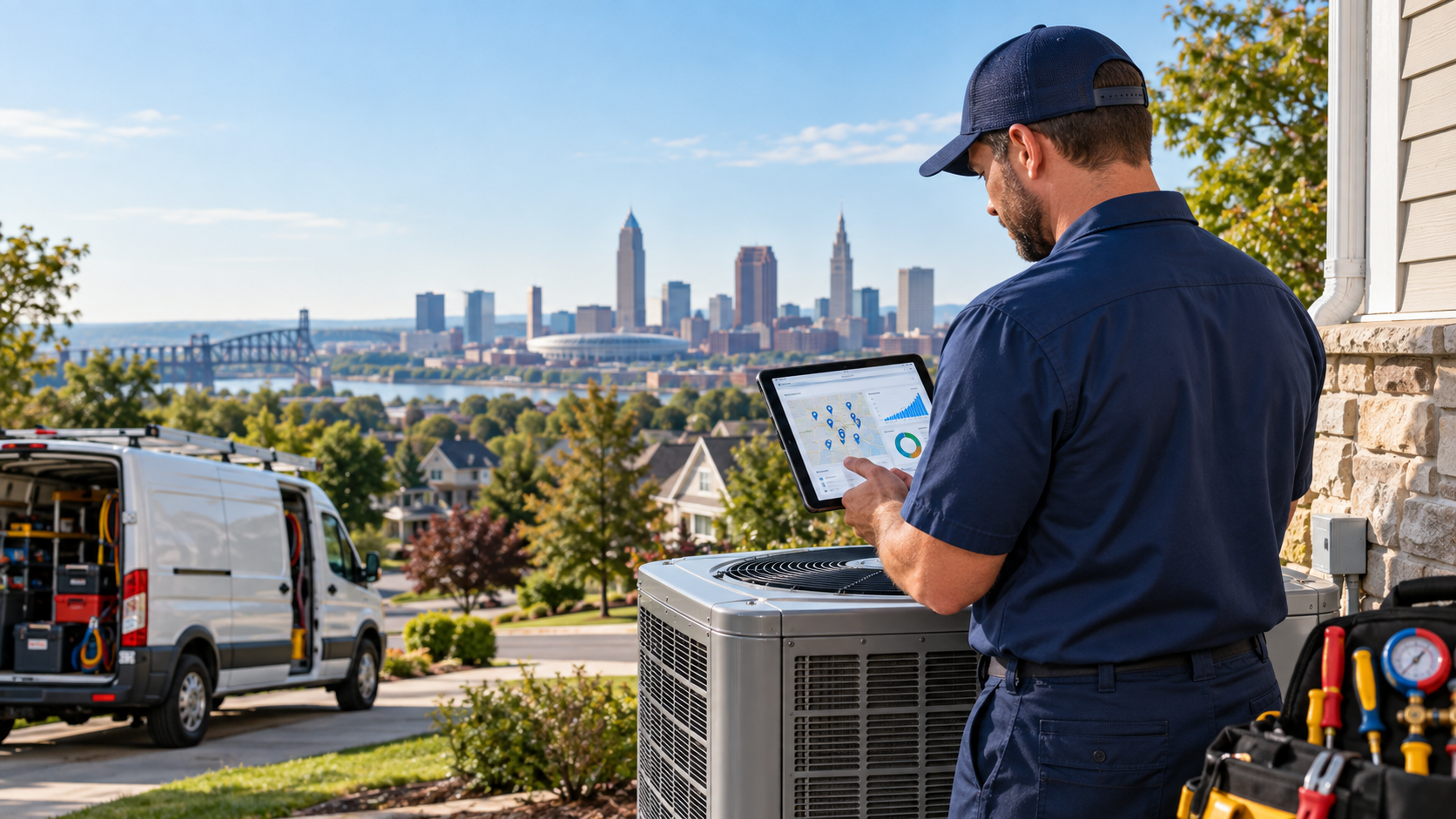
When a furnace stops working during a Cleveland winter, the homeowner is not casually researching HVAC companies.
They need help.
When an air conditioner fails during a hot July afternoon, the customer may be comparing contractors from their phone while standing inside an uncomfortable house.
That makes HVAC search different from many other forms of digital marketing.
The customer often has:
a specific problem,
high urgency,
a geographic constraint,
and:
an immediate reason to call.
For Cleveland HVAC contractors, ranking at the right moment can therefore be enormously valuable.
A homeowner might search:
furnace repair Cleveland
AC repair near me
HVAC contractor Cleveland Ohio
emergency furnace repair
heat pump installer Cleveland
boiler repair Cleveland
air conditioner replacement near me
If your company appears prominently in Google Search or Google Maps, you enter the customer's consideration set.
If your competitors appear instead, they may receive the call.
That is why effective HVAC SEO is not simply about increasing website traffic.
It is about building visibility around the exact services, locations, and urgent problems that produce profitable HVAC jobs.
Cleveland's climate makes that particularly important. National Weather Service climate normals for Cleveland show a normal mean temperature around 29.1°F in January and 74.5°F in July, with approximately 63.8 inches of normal annual snowfall. That creates meaningful seasonal heating and cooling demand throughout the region.
The strongest Cleveland HVAC SEO strategies recognize that seasonality while building year-round visibility.
What Is HVAC SEO?
HVAC SEO is the process of improving an HVAC company's visibility in unpaid search results and local Google results.
For a Cleveland contractor, that can include:
Google Business Profile optimization
Google Maps SEO
Furnace repair pages
Air conditioning repair pages
Installation and replacement pages
Heat pump pages
Boiler pages
Indoor air quality pages
Location and service-area content
Review acquisition
Local backlinks
Technical SEO
Mobile optimization
Conversion tracking
AI search visibility
The objective is not merely to rank the homepage.
The objective is to build a search presence around the many situations that cause customers to hire an HVAC company.
Why HVAC SEO Is Different From General Local SEO
Every local business benefits from being visible.
HVAC businesses face several additional challenges.
Search Intent Can Be Extremely Urgent
Someone researching landscaping may take weeks to choose a provider.
Someone whose furnace stopped working in January may choose an HVAC contractor within minutes.
The search is closer to:
“Who can solve this now?”
than:
“Which companies should I research over the next month?”
HVAC Demand Is Seasonal
Heating searches increase when temperatures fall.
Cooling demand increases as temperatures rise.
Maintenance, replacement, air-quality, boiler, and heat-pump searches can follow different seasonal patterns.
That means SEO should be built before peak demand arrives.
Geography Matters
Most HVAC companies operate within a defined service territory.
A contractor based in Cleveland may serve:
Lakewood
Parma
Rocky River
Westlake
Cleveland Heights
Shaker Heights
Beachwood
Strongsville
North Olmsted
Solon
But Google Maps rankings may change dramatically depending on where the customer is searching.
Google explicitly says distance is one of the main factors used in local rankings.
Trust Matters
HVAC technicians may enter a customer's home and recommend repairs or equipment costing hundreds or thousands of dollars.
Customers care about:
Reviews
Experience
Licensing or credentials where applicable
Brands serviced
Financing
Guarantees
Responsiveness
Professionalism
An HVAC website needs to establish confidence quickly.
Cleveland HVAC SEO Starts With Search Intent
Do not start by creating 100 blog posts.
Start by understanding why people search.
HVAC keywords can be grouped into several major categories.
1. Emergency HVAC Searches
These searches typically represent some of the highest urgency.
Examples include:
emergency HVAC Cleveland
emergency furnace repair Cleveland
24 hour HVAC Cleveland
AC stopped working Cleveland
no heat Cleveland
furnace not working near me
People performing these searches may be ready to call immediately.
If your company genuinely provides emergency or after-hours service, the website should make that clear.
Do not advertise 24/7 availability unless you actually provide it.
2. HVAC Repair Searches
Repair searches indicate that the customer already knows something is wrong.
Examples:
furnace repair Cleveland
AC repair Cleveland
boiler repair Cleveland
heat pump repair Cleveland
air conditioner repair near me
These should generally correspond with substantive service pages.
A generic homepage stating:
We handle all heating and cooling needs.
is not as useful as dedicated pages that clearly explain each service.
3. HVAC Replacement and Installation Searches
Replacement searches can represent larger jobs.
Examples:
furnace installation Cleveland
AC replacement Cleveland
new furnace Cleveland
heat pump installation Cleveland
boiler replacement Cleveland
These customers frequently have additional questions about:
Cost
Equipment options
Efficiency
Financing
Installation timelines
Warranties
Home size
System compatibility
Your pages should answer those questions.
4. Maintenance Searches
Preventive-maintenance intent is different.
Customers may search:
furnace tune up Cleveland
AC maintenance Cleveland
HVAC maintenance plan
air conditioner tune up near me
These searches can generate lower-value transactions initially but may create valuable long-term customer relationships.
Maintenance customers can later need:
Repairs
Replacements
Indoor air-quality products
Additional systems
Referral services
Do not ignore maintenance SEO simply because emergency jobs feel more exciting.
5. Problem-Based HVAC Searches
Customers do not always know which service they need.
They search the symptom.
Examples:
furnace blowing cold air
AC running but house not cooling
furnace keeps shutting off
air conditioner making loud noise
boiler leaking water
heat pump freezing up
These searches create excellent informational content opportunities.
The page can explain:
Potential causes
Safe checks the homeowner can make
When professional service is appropriate
What information to gather before calling
Avoid encouraging customers to perform dangerous electrical, gas, refrigerant, or combustion-system repairs themselves.
Educational content should help the homeowner understand the problem and know when to contact a qualified technician.
6. Location-Based HVAC Searches
Geography becomes especially important for local contractors.
Examples include:
HVAC contractor Cleveland
furnace repair Lakewood
AC repair Parma
HVAC company Westlake
heating contractor Cleveland Heights
boiler repair Shaker Heights
Location intent can be explicit.
It can also be implicit through:
HVAC contractor near me
Google uses the searcher's location as part of determining local results.
Google Maps Is Critical for HVAC Companies
A large portion of HVAC discovery happens through local search.
Someone searches:
furnace repair near me
and sees businesses in the local results before reaching many traditional organic listings.
Google says local rankings are primarily determined by:
relevance, distance, and prominence.
That framework should influence your strategy.
Relevance
Does Google understand that your company provides the service being searched?
Signals can include:
Business category
Business Profile services
Website content
Service pages
Other business information
Distance
How far is your company from the searcher?
You cannot SEO your office into physically being closer to someone.
That is why HVAC Maps rankings can differ from neighborhood to neighborhood.
Prominence
How established does the business appear?
Google says prominence can incorporate information such as links and reviews, and that more reviews and positive ratings can help local rankings.
For HVAC companies, that makes reputation and broader local authority especially important.
Optimize Your Google Business Profile
A Cleveland HVAC contractor should treat Google Business Profile as a core marketing asset.
Google says a verified profile lets eligible businesses manage information across Search and Maps, including phone number, hours, website, service area, photos, and reviews.
Start with accuracy.
Choose the Correct Primary Category
Google says the categories selected for a Business Profile affect local ranking and recommends using the most specific category that accurately represents the primary business.
For many heating and cooling companies, the appropriate primary category may be:
HVAC contractor
depending on the actual business.
Additional categories may also make sense where they accurately reflect substantial services.
Do not add categories merely because they contain attractive keywords.
Accuracy comes first.
Third-party local SEO research reinforces the importance of this decision. Whitespark's 2026 Local Search Ranking Factors survey ranked primary Google Business Profile category as the top perceived Map Pack factor among the local search professionals surveyed. That is expert survey research rather than an official disclosure of Google's algorithm, but it demonstrates how important category selection is considered in the industry.
Add Your HVAC Services
Google allows eligible service businesses to add individual services to Business Profile.
Google says services may be highlighted when customers search for an offering a business provides.
An HVAC company might include legitimate services such as:
Furnace repair
Furnace installation
Air conditioning repair
AC installation
Heat pump repair
Heat pump installation
Boiler repair
Boiler installation
Ductwork
HVAC maintenance
Indoor air quality
Only include services you actually provide.
Do not turn service titles into keyword-stuffed phrases such as:
BEST CHEAP FURNACE REPAIR CLEVELAND 24/7
Use ordinary service terminology.
Configure Your Service Area Correctly
Many HVAC businesses travel to customers and do not receive customers at their office.
Google considers these service-area businesses.
If customers do not visit your address, Google says the address should not be displayed publicly.
Google currently allows eligible businesses to configure up to 20 service areas, based on cities, postal codes, or other recognized geographic areas.
Google also says the boundaries of the overall service area should generally remain within roughly two hours of driving time from the business's base.
A Cleveland HVAC company might legitimately serve a combination of:
Cleveland
Lakewood
Parma
Westlake
Rocky River
Strongsville
Cleveland Heights
Shaker Heights
Beachwood
North Olmsted
depending on actual operations.
Do not list cities your technicians would not realistically service.
Service Areas Do Not Automatically Create Rankings
This is one of the most important things HVAC companies need to understand.
Adding Westlake to Google Business Profile does not move your business into Westlake.
Adding Strongsville does not create a second HVAC office.
Google still uses distance when determining local results.
Your service-area settings should accurately communicate the territory you serve.
Broader ranking coverage requires a combination of:
Geographic relevance
Strong website content
Reviews
Authority
Service relevance
Actual proximity
Do Not Use Fake HVAC Offices to Rank in More Cities
A contractor may be tempted to create profiles using:
Virtual offices
Mailboxes
Coworking addresses
Technician homes
Unstaffed suites
to create the appearance of multiple locations.
Google's Business Profile rules do not permit ordinary service-area businesses to use virtual offices as though they were staffed locations. A qualifying storefront or coworking location needs to meet Google's requirements, including appropriate staffing and customer access.
If your HVAC company truly operates separate staffed locations with separate teams and service areas, multiple profiles may be appropriate.
If it does not, do not manufacture them.
Reviews Matter Tremendously for HVAC Companies
Google explicitly says more reviews and positive ratings can help a business's local ranking.
Reviews also influence the customer.
Imagine a homeowner comparing:
Company A — 4.8 stars, 326 reviews
with:
Company B — 4.1 stars, 24 reviews
Review numbers alone do not prove which contractor will perform better.
But the profiles create different levels of social proof.
BrightLocal's 2026 local-search research also found that consumers evaluate more than the first result; reviews, location, complete information, and other trust signals influence which local business they choose.
Build review requests into your normal customer process.
Ask Real HVAC Customers for Reviews
Google provides an official review link and QR code that businesses can share with customers.
Google suggests using these through channels such as:
Thank-you emails
Receipts
Customer communications
In-store displays where appropriate
For HVAC contractors, a natural workflow could be:
Job completed → customer confirms work is complete → review request sent → optional polite follow-up
Do not wait until the team happens to remember.
Make the process systematic.
Never Incentivize Google Reviews
Do not offer:
$25 gift cards
Discounts
Free tune-ups
Contest entries
Cash
Free filters
in exchange for Google reviews.
Google explicitly prohibits incentives in exchange for reviews.
Google also prohibits selectively soliciting only positive reviews or requiring specific content in customer feedback.
Ask for an honest review.
Do not ask for five stars.
Respond to HVAC Reviews
Review responses can strengthen trust.
A positive response can be simple:
Thank you for choosing our team for your furnace repair. We appreciate the feedback and are glad we could help.
A negative response needs more care.
Do not publicly argue with the customer.
Do not reveal sensitive account information.
Try to move detailed disputes into a private conversation.
Future customers often evaluate how the business handles criticism.
Build a Dedicated Page for Every Major HVAC Service
An HVAC website should not rely on one page called:
Services
with six bullet points.
Major revenue-producing services deserve their own pages.
A strong structure could include:
/furnace-repair/
/furnace-installation/
/ac-repair/
/air-conditioning-installation/
/heat-pumps/
/boiler-repair/
/hvac-maintenance/
/indoor-air-quality/
This approach creates far more relevance than attempting to make the homepage rank for everything.
Whitespark's 2026 expert survey also ranked having dedicated pages for each service among the stronger perceived factors influencing local organic performance.
What Should an HVAC Service Page Include?
A high-quality service page should answer the questions customers ask before calling.
For a furnace-repair page, that might include:
Common furnace problems
Systems serviced
Signs professional repair is needed
Whether emergency service is available
What customers can expect
Service territory
Frequently asked questions
Contact options
For installation pages, also discuss:
Replacement indicators
Equipment options
Sizing
Installation process
Financing where available
Warranty information
Maintenance
Do not pad pages with paragraphs that say nothing.
Useful specificity is more valuable than word count alone.
Create Furnace Repair Content Before Winter
The worst time to begin developing furnace-repair SEO is after the first major cold snap.
SEO takes time.
Pages need to be:
Created
Crawled
Indexed
Evaluated
Linked internally
Supported by authority
The National Weather Service's Cleveland climate normals show normal January mean temperatures around 29°F, with normal January lows around 22°F.
When temperatures fall, heating systems become urgent.
Your search visibility should already exist.
Build and improve heating pages during the off-season.
Create AC Content Before Summer
The same principle applies to cooling.
Cleveland's normal July high is approximately 83.7°F, with a normal monthly mean around 74.5°F.
Recent weather can rise significantly above those averages. For example, the National Weather Service recorded a Cleveland high of 97°F on July 1, 2026.
Demand can spike quickly during hot periods.
Do not wait for a heat wave to create:
AC repair pages
Air-conditioner replacement content
Tune-up pages
Emergency cooling information
Seasonal SEO should be proactive.
Build Heat Pump Visibility
Heat pumps have become a much larger part of HVAC conversations.
A Cleveland HVAC contractor that installs or services heat pumps can create content around:
Heat pump installation
Heat pump repair
Cold-climate heat pumps
Heat pump vs. furnace
Heat pump maintenance
Ducted vs. ductless systems
Heat pump sizing
Backup heat
Avoid generic national content if local experience allows you to add Northeast Ohio context.
Customers want to know whether equipment makes sense for their climate and home.
That creates an opportunity for useful local expertise.
Do Not Forget Boilers
Cleveland has a significant inventory of older buildings and homes, which means many HVAC companies encounter heating systems beyond modern forced-air furnaces.
If you actually service boilers, create dedicated pages for:
Boiler repair
Boiler maintenance
Boiler replacement
Do not bury boiler services below a generic heating paragraph.
If boiler work is profitable and meaningful to the business, make it visible.
Build Content Around Older Cleveland Homes
Local experience can differentiate your website.
Cleveland-area HVAC companies may encounter houses with:
Aging ductwork
Older boilers
Radiators
Retrofitted central air
Finished attic spaces
Additions
Older electrical systems
Insulation challenges
You do not need to claim that every Cleveland home has these issues.
Instead, create content based on the patterns your technicians actually encounter.
For example:
HVAC Considerations When Adding Central Air to an Older Cleveland Home
or:
What to Know Before Replacing a Boiler in an Older Northeast Ohio House
Local expertise creates content generic national websites cannot easily reproduce.
Create Suburb Pages Carefully
Location pages can help communicate where you work.
But they must provide value.
Avoid generating 75 near-identical pages where only the city name changes.
A good local page may include:
Services provided there
Actual projects
Customer testimonials
Neighborhood or housing context
Response information
Relevant FAQs
Local contact process
Examples could include:
/hvac-lakewood-oh/
/hvac-parma-oh/
/hvac-westlake-oh/
when those markets genuinely matter to the company.
Do not create pages for places you do not meaningfully serve.
Do Not Expect Location Pages to Defeat Geography Everywhere
A page targeting:
HVAC Westlake
can strengthen organic relevance.
It does not physically move your Google Business Profile.
Maps results remain influenced by distance.
That means an HVAC company may:
Rank organically in Westlake
Generate website traffic from Westlake
Receive leads from Westlake
while still having weaker Google Maps visibility there than a competitor physically located nearby.
This distinction is important when measuring local SEO.
Build Project and Case Study Content
Completed HVAC projects create excellent evidence.
A case study might document:
Problem: failing furnace in a Cleveland Heights home
System: existing equipment type
Recommendation: replacement or repair
Work completed: specific installation
Challenges: ductwork, space, age of house
Outcome: completed project
Include real photos where possible.
Case studies can improve:
Trust
Local relevance
Service relevance
Website depth
They also give prospective customers an idea of your actual experience.
Use Real HVAC Photography
Avoid filling the entire website with stock images of technicians wearing perfectly clean uniforms while staring at a thermostat.
Use real photography showing:
Technicians
Trucks
Equipment
Installations
Service work
Team
Warehouse
Completed systems
Business location
Google Business Profile supports photos and videos, and third-party 2026 local-search research identifies photo quality among signals experts believe matter for local conversion and visibility.
Real images also strengthen customer confidence.
Show the Brands and Equipment You Actually Service
If accurate, explain which manufacturers or system types you work with.
Customers frequently search combinations such as:
Carrier furnace repair Cleveland
Trane HVAC repair Cleveland
Lennox furnace contractor
Brand-specific information can help customers determine whether you can solve their problem.
But do not imply authorized-dealer or certified status unless the relationship is real.
Accuracy matters.
Answer HVAC Cost Questions
One of the largest missed opportunities in contractor SEO is refusing to discuss money at all.
Customers naturally ask:
How much does furnace repair cost?
How much does a new furnace cost in Cleveland?
How much does AC replacement cost?
How much does a heat pump cost?
You may not be able to provide one fixed price.
That is fine.
Explain the factors that affect cost.
For example:
Equipment
Capacity
Efficiency
Ductwork
Accessibility
Controls
Installation complexity
Additional work
You can provide ranges if you have reliable data and are comfortable publishing them.
Helpful pricing content attracts qualified customers.
Explain Financing Clearly
HVAC replacements can represent major household expenses.
If you offer financing, make it easy to find.
Explain:
Whether financing is available
General process
Where customers apply
Any material terms required by applicable advertising rules
Do not bury financing inside the footer.
For replacement-oriented traffic, it may be an important conversion factor.
Optimize for Mobile First
BrightLocal's July 2026 research found that 73% of surveyed consumers started their most recent local-business search on a mobile device.
That matters enormously for HVAC.
A homeowner with no heat may search from a phone.
Your mobile website should make it easy to:
Call
Request service
See hours
Understand service areas
Find emergency information
Avoid:
Tiny phone numbers
Slow pages
Popups blocking the screen
Complicated forms
Giant hero videos
Menus that barely work
Mobile usability directly affects whether search visibility becomes a lead.
Make the Phone Number Impossible to Miss
For urgent service businesses, the phone remains a critical conversion path.
On mobile:
Put the phone number near the top
Make it click-to-call
Keep it visible where appropriate
Clearly distinguish emergency availability
Do not force a homeowner with no heat to search through five pages to find a number.
Keep HVAC Lead Forms Short
Not every prospect wants to call.
Your service form should ask for enough information to route the lead without becoming an interrogation.
Typical fields might include:
Name
Phone
Email
ZIP code
Service needed
Brief message
You can gather additional information later.
Long forms create friction.
Use Clear Calls to Action
Avoid vague buttons such as:
Learn More
when the intended action is:
Schedule HVAC Service
or:
Request an Estimate
Match the call to action with the customer's stage.
Repair pages may emphasize:
Schedule Repair
Replacement pages may use:
Request an Estimate
Maintenance pages may use:
Book a Tune-Up
Clarity improves conversion.
Use Internal Links Strategically
Your website should connect related topics.
A furnace-repair article might link to:
Furnace repair
Furnace replacement
Maintenance plan
Contact page
A heat-pump comparison might link to:
Heat pump installation
Financing
Service areas
Relevant case study
Internal links help users navigate.
They also help search engines understand page relationships.
Improve Website Speed
An emergency HVAC customer is not going to patiently wait for a bloated website.
Common performance problems include:
Oversized images
Autoplay video
Too many third-party scripts
Poor hosting
Heavy page builders
Unoptimized fonts
Speed matters because it affects usability.
Especially on mobile.
The objective is not a perfect laboratory score at the expense of the website.
It is a fast, functional customer experience.
Make Sure Search Engines Can Crawl the Site
Basic technical SEO still matters.
Review:
Robots.txt
XML sitemap
Canonical tags
Indexability
Redirects
Broken pages
404 errors
Internal links
HTTPS
Mobile functionality
A beautifully written furnace-repair page cannot rank if Google is blocked from indexing it.
Add LocalBusiness Structured Data Where Appropriate
Google supports LocalBusiness structured data for communicating business information including:
Name
Address
Telephone
Hours
Location details
Google recommends using the most specific applicable LocalBusiness subtype where possible and ensuring that structured data accurately reflects page content.
Structured data can improve machine-readable clarity.
It does not guarantee rankings.
Build Local HVAC Backlinks
Prominence extends beyond your website.
Google says links from other websites can contribute to its understanding of local prominence.
Legitimate link opportunities can include:
Local chambers
Trade associations
Equipment manufacturers
Distributors
Community organizations
Sponsorships
Local publications
Business partners
Builder associations
Avoid purchasing hundreds of low-quality links.
One legitimate relationship can be worth more than an enormous collection of irrelevant directory pages.
Build Supplier and Manufacturer Relationships
HVAC companies often have natural relationships with:
Equipment manufacturers
Distributors
Builders
Remodelers
Electricians
Plumbers
Property managers
Some of these relationships can produce legitimate mentions or links.
For example, a manufacturer may maintain a dealer directory.
A local builder may list trusted partners.
A community organization may list sponsors.
These are natural authority signals because they reflect real relationships.
Create Seasonal SEO Campaigns
HVAC companies should think ahead.
A practical content calendar might look like:
SEO should anticipate demand.
Not react after competitors already captured it.
Do Not Pause SEO in the Off-Season
Some contractors invest in SEO only when phones slow down.
That misses how search visibility develops.
Fall furnace rankings are influenced by work completed before fall.
Summer AC visibility should be built before June.
Use slower periods to create and strengthen:
Service pages
Location pages
Case studies
Cost guides
FAQs
Technical improvements
Links
You want your pages established when demand spikes.
Emergency HVAC SEO Requires Operational Reality
Do not optimize for:
24-hour HVAC repair
if nobody answers after 5 PM.
Do not advertise:
same-day furnace repair
if your next appointment is four days away.
SEO should reflect operations.
Otherwise, you may increase traffic while damaging the customer experience and review profile.
Marketing cannot compensate for promises the business cannot fulfill.
Keep Business Hours Accurate
Google recommends maintaining current hours on Business Profile.
This matters especially for HVAC contractors.
If you truly provide emergency service:
say so accurately.
If weekend availability differs:
update it.
Do not mark the company open 24 hours merely because a voicemail system accepts messages.
Whitespark's 2026 local SEO expert survey ranked whether a business is open at the time of the search among the higher perceived Map Pack factors, though Google does not publicly disclose the exact weighting of business hours in its ranking systems.
Accurate hours help customers regardless of ranking impact.
Local Services Ads Can Complement HVAC SEO
HVAC businesses may also be eligible for Google's Local Services Ads depending on category and location.
These advertisements operate separately from organic SEO.
Google requires participating Local Services businesses to complete screening and verification processes that can vary by business type and location and may include:
Identity checks
Business registration
Insurance
License verification
Background checks
Other verification
LSAs can be useful because they capture additional high-intent search visibility.
They should not be confused with organic rankings.
A strong HVAC marketing mix may include:
Google Maps + organic SEO + Local Services Ads + paid search
depending on economics.
Track HVAC SEO by Service
Do not track only:
organic traffic
Break performance down by service.
For example:
Revenue figures can then be connected through your CRM or booking system.
The objective is to identify which SEO efforts create valuable work.
Track by Location
Also examine geography.
A Cleveland HVAC company may receive:
High lead volume from Cleveland
Strong close rates in Lakewood
Larger projects in Westlake
Poor lead quality from an outer service area
You may discover that one suburb produces fewer leads but significantly more revenue.
That can influence:
Content priorities
Advertising
Technician routing
Service-area strategy
Track Google Maps Geographically
Do not ask:
“What position do we rank for HVAC contractor Cleveland?”
There is no single permanent Maps position.
Google uses distance.
The same company may rank:
#1 close to its base
#5 several miles away
and:
outside the visible Map Pack farther across the metro
Use geographic grid tracking to see where visibility rises and falls.
That produces a much more accurate view of local SEO.
Track Calls, Not Just Rankings
Rankings matter because they create opportunities.
Calls matter because they can become customers.
Track:
Calls from Google Business Profile
Calls from organic landing pages
Form submissions
Online bookings
Chat leads
Qualified leads
Booked jobs
Then connect the lead to the service and location.
A keyword increasing from position eight to position three is useful.
But:
12 additional booked furnace replacements
is a much stronger business outcome.
Track Booked Revenue
The ideal HVAC SEO reporting model eventually moves from:
rankings
to:
traffic
to:
leads
to:
booked jobs
to:
revenue and margin.
Suppose one SEO campaign produces 80 leads.
Another produces only 30.
The 30 may be more valuable if they include more:
System replacements
Heat pump installations
Commercial contracts
Maintenance-plan conversions
Lead volume alone cannot tell you that.
Use Call Tracking Carefully
Dynamic call tracking can help attribute phone leads to:
Organic search
Google Ads
Google Business Profile
Other campaigns
Configure it correctly so you do not create inconsistent business information across the web.
The goal is attribution without damaging core business data.
Build an HVAC Content Funnel
Not every visitor is ready to hire immediately.
Content can serve different stages.
Emergency
Why is my furnace blowing cold air?
Evaluation
Repair vs. replace a furnace
Commercial
Furnace replacement Cleveland
Decision
Financing, warranties, reviews, company credentials
A strong HVAC website supports the full customer journey.
Create Comparison Content
Comparison searches can attract customers evaluating expensive systems.
Examples:
heat pump vs. furnace
boiler vs. furnace
single-stage vs. variable-speed furnace
central air vs. ductless mini split
repair vs. replace an AC unit
Explain the tradeoffs fairly.
Do not make your preferred product “win” every comparison.
Credibility comes from explaining when each option makes sense.
Create HVAC FAQ Content
Your technicians probably answer the same questions repeatedly.
Those questions belong on your website.
Examples:
Why does my furnace smell when I first turn it on?
How often should I replace an HVAC filter?
Why is my AC freezing?
When should I replace my furnace?
How long does an HVAC installation take?
Can a heat pump work during a Cleveland winter?
Why is one room hotter than another?
Every real customer question can become useful search content.
Use Technician Expertise
Generic marketing writers may understand SEO.
Your technicians understand HVAC systems.
Combine both.
Interview technicians about:
Common repair calls
Equipment failures
Installation mistakes
Maintenance advice
Cleveland home challenges
Customer misconceptions
Then turn that expertise into well-structured website content.
That produces far more useful material than simply generating articles from keywords.
Avoid Thin AI-Generated HVAC Content
AI makes it inexpensive to publish 500 articles.
That does not make publishing 500 articles a good strategy.
Google's current AI-search guidance continues to emphasize useful, original, non-commodity content rather than mass-generated pages created primarily to manipulate visibility.
An HVAC company should prefer:
one excellent guide based on real technician expertise
over:
20 generic articles repeating information found on every national HVAC website.
HVAC SEO and AI Search
Customers increasingly use AI tools alongside conventional search.
BrightLocal's 2026 research found local customers frequently use multiple channels and that consumers who use AI often verify information through Google or another source before choosing a business.
That means HVAC companies should prepare for searches such as:
“Find a reputable Cleveland HVAC company that installs heat pumps and services older homes.”
or:
“Which HVAC companies near Lakewood offer furnace replacement and financing?”
AI visibility should not be treated as an entirely separate replacement for SEO.
The same fundamentals help:
Clear services
Clear geography
Accurate business information
Strong website content
Reviews
Third-party mentions
Crawlability
Real expertise
Make Your HVAC Company Easy for AI to Understand
A homepage that says:
Comfort solutions for every season.
sounds pleasant.
It communicates very little.
A clearer statement would be:
ABC Heating & Cooling provides furnace repair, air conditioning repair, HVAC replacement, heat pump installation, and boiler service throughout Greater Cleveland.
That gives both people and machines concrete information.
Specificity matters.
Build an HVAC Entity, Not Just Keywords
Search systems increasingly need to understand relationships.
For example:
Business: ABC Heating & Cooling
Location: Cleveland, Ohio
Services: furnace repair, AC repair, heat pumps, boilers
Markets: Cleveland and surrounding service areas
Team: named technicians and leadership
Brands: actual systems serviced
Credentials: legitimate certifications
Projects: documented local installations
Reviews: authentic customer feedback
Your website and external profiles should reinforce those facts consistently.
What Cleveland HVAC Companies Should Avoid
Several SEO shortcuts create unnecessary risk.
Keyword Stuffing the Google Business Profile Name
Use the real-world business name.
Do not rename:
ABC Heating
to:
ABC Heating Best HVAC Furnace AC Repair Cleveland
unless that is genuinely the business's established name.
Fake Offices
Do not create virtual locations solely to rank in additional suburbs.
Duplicate Google Profiles
Do not create separate listings for:
ABC Furnace Repair
ABC AC Repair
ABC Heat Pumps
if these are merely departments or services of one HVAC company.
Fake Reviews
Google prohibits them.
Review Incentives
Google prohibits free products, discounts, and other incentives in exchange for reviews.
Thin Location Pages
Do not produce 100 city pages with identical copy.
Buying Spam Links
Build legitimate local and industry authority.
Promising Emergency Service You Cannot Deliver
Marketing claims should match operations.
Measuring Only Rankings
Track booked HVAC jobs and revenue.
A Practical Cleveland HVAC SEO Roadmap
For HVAC companies starting from scratch, prioritize work in stages.
Phase 1: Technical Foundation
Fix:
Crawlability
Indexing
Mobile performance
Site speed
Analytics
Search Console
Conversion tracking
Call tracking
Phase 2: Google Maps Foundation
Optimize:
Google Business Profile
Primary category
Additional categories
Services
Hours
Service area
Photos
Reviews
Phase 3: Service Relevance
Create strong pages for:
Furnace repair
Furnace installation
AC repair
AC installation
Heat pumps
Boilers
Maintenance
Indoor air quality
prioritized by what the company actually sells.
Phase 4: Geographic Relevance
Strengthen:
Cleveland page
Legitimate suburb pages
Project content
Local case studies
Internal links
Phase 5: Authority
Build:
Reviews
Local backlinks
Supplier mentions
Association memberships
Community links
Relevant media coverage
Phase 6: Content Expansion
Create:
Cost guides
Troubleshooting content
Comparisons
FAQs
Equipment guides
Seasonal resources
Phase 7: Conversion
Improve:
Calls to action
Mobile click-to-call
Forms
Financing information
Emergency messaging
Trust signals
Phase 8: Measurement
Track:
Search visibility
Maps visibility
Calls
Leads
Booked jobs
Revenue
Service profitability
Geographic performance
Then use the data to decide what to build next.
Frequently Asked Questions
What is HVAC SEO?
HVAC SEO is the process of improving a heating and cooling company's visibility across search engines and local search results.
It can include:
Website SEO
Google Maps
Google Business Profile
Service pages
Reviews
Local content
Backlinks
Technical SEO
The objective is to attract customers actively searching for HVAC services.
Does SEO work for HVAC companies?
It can.
HVAC services have substantial search intent because homeowners frequently use search engines when they need repairs, replacement, or maintenance.
Results depend on competition, location, website quality, authority, reviews, and the strength of the SEO campaign.
No legitimate SEO provider can guarantee permanent rankings.
Why is local SEO important for HVAC companies?
HVAC businesses usually serve customers within a defined geographic area.
Local SEO helps the company appear when customers search for contractors near them.
Google says local results are primarily determined by relevance, distance, and prominence.
How do HVAC companies rank higher in Google Maps?
Start with:
Correct Google Business Profile category
Accurate business information
Relevant services
Correct hours
Appropriate service-area setup
Genuine customer reviews
Strong website relevance
Local authority
Google says complete information helps it understand and match businesses to relevant local searches.
What Google Business Profile category should an HVAC company use?
The correct category depends on the actual business.
For many heating and cooling contractors, HVAC contractor may be the most accurate primary category.
Google says the primary category should specifically describe the core business and that category selection affects local ranking.
Should HVAC companies add services to Google Business Profile?
Yes, where the feature is available.
Google says services can be displayed on Business Profiles and may be highlighted when customers search for an offering the company provides.
How many Google Business Profile service areas can an HVAC company add?
Google currently permits up to 20 service areas for eligible service-area and hybrid businesses.
Only add locations you genuinely serve.
Does adding more service areas make an HVAC company rank in more cities?
Not automatically.
Google still considers distance when determining local results.
Service-area settings communicate where you work; they do not create additional physical locations.
Should an HVAC contractor show its home address?
If customers do not visit the address, Google says service-area businesses should hide it from the public Business Profile.
Can an HVAC company use a virtual office for Google Maps?
An ordinary virtual mailing address does not qualify as a legitimate storefront.
Google applies specific requirements to office and coworking locations, including real staffing and customer-facing operations.
How important are Google reviews for HVAC SEO?
Google states that more reviews and positive ratings can help local ranking.
Reviews can also strongly influence whether a homeowner chooses your company after finding it.
Can HVAC companies offer a free filter for a Google review?
No.
Google prohibits incentives such as payments, discounts, free goods, or free services in exchange for reviews.
How can an HVAC company get more Google reviews?
Ask genuine customers after completed service.
Google provides an official review link and QR code businesses can share.
Make the process consistent and easy.
Should an HVAC company have a page for every service?
Major services generally deserve their own useful pages.
Examples include:
Furnace repair
AC repair
Furnace replacement
AC installation
Heat pumps
Boilers
This gives each service enough space to address relevant customer questions.
Should HVAC companies build pages for every suburb?
Only create local pages where they provide genuine value.
Avoid publishing dozens of pages that simply replace one city name with another.
Useful location pages can include actual projects, relevant services, local information, testimonials, and FAQs.
How long does HVAC SEO take?
There is no universal timeline.
It depends on:
Current website strength
Competition
Market
Existing rankings
Google Business Profile
Reviews
Content
Authority
Technical condition
A newer HVAC company may require more foundational work than an established contractor with years of authority.
Should HVAC companies do SEO before winter?
SEO should ideally be developed months before seasonal demand peaks.
Heating pages should be strong before cold weather arrives.
Cooling pages should be established before summer demand spikes.
Is furnace repair SEO different from AC repair SEO?
The fundamentals are similar, but search demand changes seasonally.
Each service should have its own dedicated page and supporting content.
Measure performance independently.
Is emergency HVAC SEO worth targeting?
Yes, if your company genuinely provides emergency service.
Emergency searches can represent extremely high intent.
Do not advertise 24-hour or same-day service unless you can consistently deliver it.
Should HVAC companies publish pricing?
Providing useful pricing information or ranges can attract informed customers.
If exact pricing varies, explain the factors affecting cost.
Transparency can improve qualification and trust.
Should HVAC companies use Local Services Ads?
They can be a useful complement to SEO where eligible.
Google requires participating providers to complete verification procedures that vary by category and location.
Local Services Ads are paid advertising and should be measured separately from organic SEO.
Does website speed matter for HVAC companies?
Yes.
Customers frequently search for local businesses on mobile devices, and slow websites create unnecessary friction.
BrightLocal's 2026 research found mobile devices were the starting point for 73% of surveyed consumers' most recent local-business searches.
Does schema improve HVAC rankings?
Structured data can help search engines understand business information.
Google supports LocalBusiness structured data, but schema does not guarantee rankings.
Use it accurately.
Can HVAC companies get leads from AI search?
Potentially.
Customers increasingly use AI tools during local-business research, though traditional Google Search, Maps, reviews, and websites remain critical parts of the decision process.
Build clear, authoritative website content rather than chasing AI gimmicks.
What should an HVAC company track from SEO?
At minimum:
Google Maps visibility
Organic rankings
Organic traffic
Calls
Forms
Bookings
Qualified leads
Booked jobs
Service type
Location
Revenue
The ultimate goal is not traffic.
It is profitable HVAC work.
HVAC SEO Should Put You in Front of Customers at the Moment of Need
HVAC search is about timing.
A homeowner may ignore heating companies all year.
Then the furnace stops working.
Suddenly:
furnace repair Cleveland
becomes one of the most important searches they make that day.
The same thing happens during the first major summer heat wave.
That creates an enormous opportunity for HVAC companies that prepare before demand arrives.
The strongest Cleveland HVAC SEO strategy combines:
Google Business Profile optimization
Google Maps visibility
strong service pages
genuine reviews
local relevance
useful educational content
technical SEO
mobile conversion
local authority
and:
accurate measurement.
There is no single trick that makes an HVAC company dominate Google.
But there is a repeatable strategy:
Make it exceptionally clear what services you provide.
Show Google and customers where you operate.
Build evidence that you are established and trustworthy.
Answer the questions homeowners ask.
Make calling or booking easy.
And measure whether search visibility actually turns into booked work.
When the temperature drops or the next heat wave arrives, the businesses that already built that visibility have the best opportunity to be found when customers need them most.
Sources
Google Business Profile Help — Improve Your Local Ranking. Google's official explanation of relevance, distance, prominence, complete business information, reviews, and local ranking factors.
Google Business Profile Help — Manage Your Business Category. Official guidance confirming that Business Profile categories affect local rankings and should accurately describe the primary business.
Google Business Profile Help — Manage Your Services. Google's current guidance for displaying services and custom services on eligible Business Profiles.
Google Business Profile Help — Manage Service Areas. Official rules for service-area and hybrid businesses, including the current 20-area limit.
Google Business Profile Help — Guidelines for Representing Your Business. Google's rules covering service-area businesses, virtual offices, staffing, storefronts, and business representation.
Google Business Profile Help — Review Policies and Review Requests. Official guidance covering authentic customer reviews, review links, QR codes, incentives, and fake engagement.
Google Search Central — LocalBusiness Structured Data. Google's official documentation for implementing machine-readable local business information on websites.
Google Local Services — Screening and Verification. Official requirements explaining the verification procedures that may apply to Local Services advertisers.
National Weather Service Cleveland — Climate Normals. Official 1991–2020 Cleveland climate normals covering monthly temperatures, precipitation, and snowfall.
National Weather Service Cleveland — July 2026 Climate Report. Official climatological report documenting Cleveland's July 2026 temperature conditions.
BrightLocal — Consumer Search Behavior 2026. Research examining how consumers use Google, mobile devices, AI, and multiple platforms to find local businesses.
BrightLocal — Local Business Decision Research 2026. Consumer research examining the importance of reviews, location, complete business information, and other factors after a local search.
Whitespark — 2026 Local Search Ranking Factors. Third-party expert survey examining perceived Google Maps, local organic, Local Services Ads, conversion, and AI-search factors.
Generate More HVAC Leads From Cleveland Search
Ritner Digital helps HVAC companies build local SEO strategies around Google Maps, furnace and AC searches, service pages, reviews, local authority, and the neighborhoods and suburbs that generate profitable work.
If your HVAC company is struggling to rank when Cleveland homeowners search for heating and cooling services—or competitors are receiving the calls you should be getting—we can identify the gaps and build a search strategy around your most valuable services and markets.