SEO for Cleveland Roofers: Winning Local Searches Before and After Storms
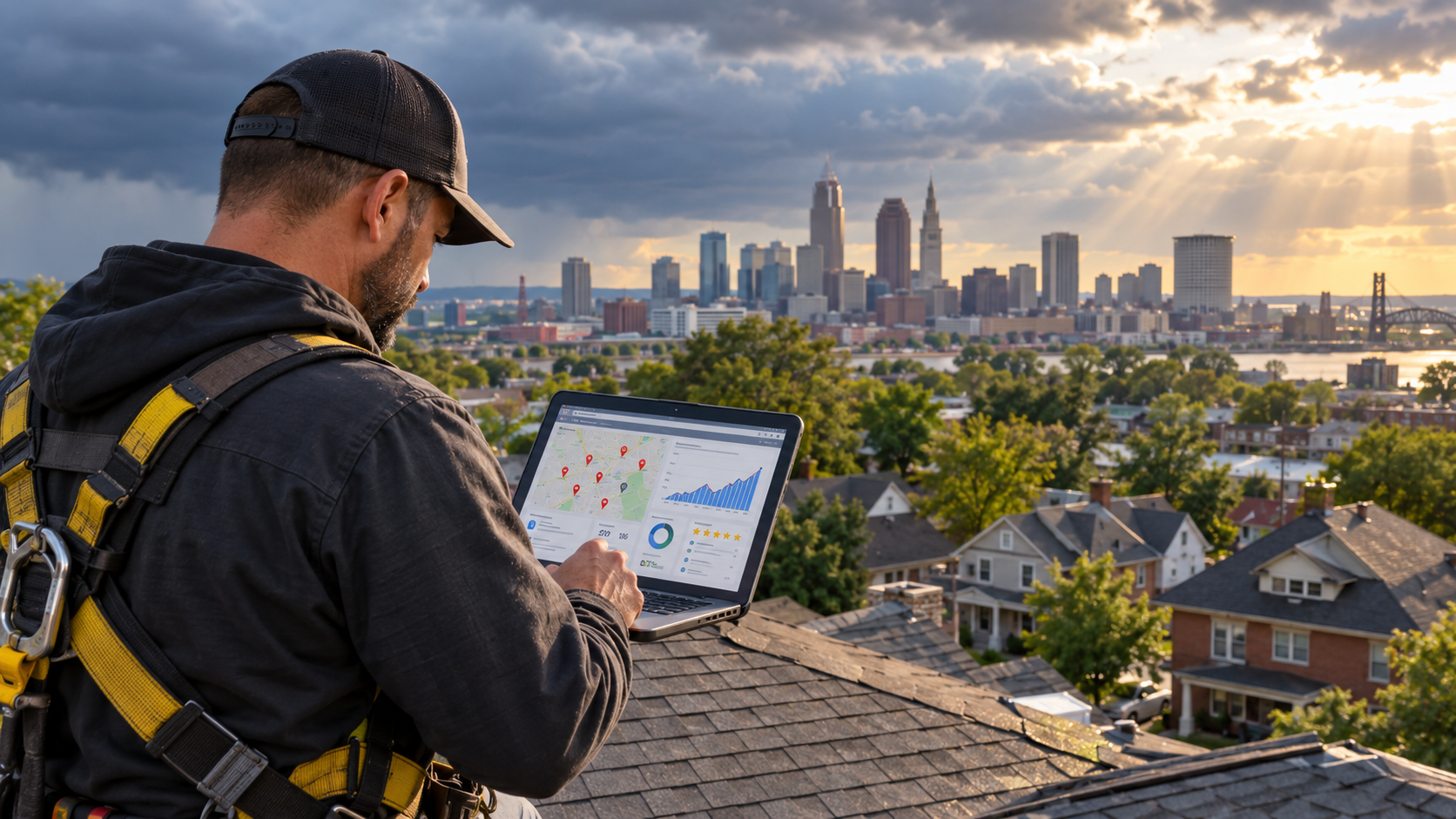
Roofing demand can change overnight.
On a normal Tuesday, a Cleveland homeowner may not think about their roof at all.
Then a severe thunderstorm moves through Northeast Ohio.
Wind knocks branches onto houses.
Hail strikes shingles and siding.
Water begins appearing around a ceiling vent.
Suddenly, thousands of homeowners have the same question:
Who can inspect or repair my roof?
They reach for their phones and search:
roof repair near me
roofer Cleveland
storm damage roof repair Cleveland
emergency roofer near me
hail damage roofing contractor
roof replacement Cleveland Ohio
For roofing companies, those searches represent some of the highest-intent opportunities in local digital marketing.
But there is a problem.
You cannot build strong organic visibility the morning after the storm.
By then, the roofing companies that invested in local SEO months or years earlier may already dominate Google Maps and organic search.
That is why successful roofing SEO is built before demand spikes.
Storms may accelerate the need.
SEO puts your roofing company in position to capture that demand when it arrives.
That matters in Northeast Ohio because damaging weather is not hypothetical.
The National Weather Service's Cleveland office says non-tornadic severe thunderstorms are a frequent hazard across northern Ohio and northwest Pennsylvania, particularly during spring and summer. It reports that Cuyahoga County recorded 588 damaging-wind reports and 285 large-hail reports between 1950 and 2025.
Recent storms illustrate the potential impact. On April 15, 2026, a severe thunderstorm produced a swath of large hail from Cleveland's southern suburbs eastward, with hail reaching two inches or more in some locations and causing damage to homes, businesses, siding, windows, and vehicles.
For Cleveland roofing companies, the opportunity is clear:
Build visibility before the storm.
Be useful when the storm happens.
Remain visible after emergency demand fades.
This guide explains how.
What Is Roofing SEO?
Roofing SEO is the process of improving a roofing company's visibility when property owners search for roof-related services online.
For a Cleveland roofer, that can include:
Google Business Profile optimization
Google Maps rankings
Roof repair pages
Roof replacement pages
Storm-damage roofing content
Hail-damage pages
Emergency roofing pages
Commercial roofing SEO
Service-area pages
Customer reviews
Local backlinks
Technical SEO
Mobile optimization
Conversion tracking
AI search visibility
The purpose is not merely to attract more website visitors.
The objective is to appear when someone has a roofing problem your company can profitably solve.
Why Roofing SEO Is Different From General Local SEO
Roofing has several characteristics that make search particularly valuable.
Roofing Problems Can Become Urgent
A homeowner researching new siding may take weeks to make a decision.
A homeowner with water coming through the ceiling may call someone within minutes.
That creates searches such as:
emergency roof repair Cleveland
roof leaking after storm
roofer open now
storm damage roofer near me
The closer the search is to an active roofing problem, the more commercially valuable visibility can become.
Weather Creates Sudden Demand Surges
Roofing demand can increase quickly after:
High winds
Hail
Severe thunderstorms
Falling trees
Heavy snow
Ice
Freeze-thaw cycles
The National Weather Service defines severe thunderstorms as storms capable of producing hail at least one inch in diameter or wind gusts above 58 mph and notes that hazards of this scale can damage roofs, vehicles, trees, and structures.
Roofing Is Highly Geographic
Customers typically want contractors who actually serve their neighborhood.
Google says local rankings are primarily determined by relevance, distance, and prominence.
A Cleveland roofer may therefore perform differently in:
Downtown Cleveland
Ohio City
Tremont
Lakewood
Parma
Westlake
Rocky River
Cleveland Heights
Shaker Heights
Beachwood
Strongsville
There is no single universal Google Maps ranking.
Roofing Jobs Can Be High Value
Roof repairs may generate relatively modest revenue.
Full roof replacements can generate substantially more.
Commercial roofing projects can be significantly larger still.
That means the SEO strategy should prioritize not only traffic volume but also the types of roofing jobs the company wants.
Start With Roofing Search Intent
Different roofing searches represent different customer needs.
A useful SEO strategy organizes keywords around those needs rather than simply targeting “roofer Cleveland” everywhere.
1. Emergency Roof Repair Searches
These are some of the highest-intent searches.
Examples include:
emergency roofer Cleveland
emergency roof repair Cleveland
roof leak repair near me
roofer open now
storm damaged roof leaking
Customers using these terms may be dealing with active water intrusion or visible damage.
If you genuinely offer urgent or emergency roofing service, create a dedicated page explaining:
What situations you handle
When customers should call
Areas served
Temporary mitigation process
Inspection process
How quickly you typically respond, if you can substantiate it
What customers should safely do while waiting
Do not advertise 24/7 emergency service unless the business actually provides it.
2. Roof Repair Searches
Repair intent is broader.
Examples:
roof repair Cleveland
shingle repair Cleveland
flat roof repair Cleveland
leaking roof Cleveland
roof flashing repair
roof vent leak repair
A dedicated roof-repair page should explain the types of problems the company regularly handles.
That might include:
Missing shingles
Damaged flashing
Roof penetrations
Leaks
Wind damage
Minor storm damage
Flat-roof issues
Avoid diagnosing every leak online.
Roof leaks can originate in places that are not obvious from inside the home.
The page should educate customers while encouraging an appropriate professional inspection.
3. Roof Replacement Searches
Replacement searches can produce some of the highest-value residential leads.
Examples:
roof replacement Cleveland
new roof Cleveland Ohio
roof replacement cost Cleveland
asphalt shingle roof replacement
These customers often need more information than emergency-repair customers.
Your replacement page should address:
Signs a roof may need replacement
Materials offered
Replacement process
Typical timeline
Tear-off process
Ventilation
Underlayment
Cleanup
Warranties
Financing where offered
Permit process where applicable
Pricing factors
The better you answer those questions, the more qualified the eventual inquiry can become.
4. Storm Damage Searches
Storm-related searches deserve a dedicated strategy.
Examples include:
storm damage roofer Cleveland
hail damage roof Cleveland
wind damage roof repair
roof damaged after thunderstorm
emergency tarp roof Cleveland
After a major storm, search behavior can become extremely localized.
Someone in Solon may search differently from someone in Lakewood because the storm path affected neighborhoods differently.
That creates an opportunity for roofing companies with strong local content and established authority.
5. Hail Damage Searches
Hail deserves special attention in Northeast Ohio.
On April 15, 2026, the National Weather Service documented golf-ball-size or larger hail from southern Cleveland suburbs eastward through portions of Geauga and Trumbull counties. Some locations received hail two inches or larger, and wind-driven hail damaged homes and businesses.
Potential customer searches after an event like that include:
hail damage roof inspection
hail damage roofer Solon
hail damaged shingles Cleveland
do I need a new roof after hail
A high-quality hail page can explain:
What hail damage can look like
Why damage may not be obvious from the ground
Why homeowners should avoid climbing onto roofs themselves
What an inspection involves
What documentation the roofer provides
When repair versus replacement may be considered
Avoid making blanket statements such as:
“If hail hit your neighborhood, insurance will buy you a new roof.”
Insurance coverage depends on the policy, damage, deductible, exclusions, documentation, insurer assessment, and other circumstances.
Roofers should describe roofing services accurately without promising claim outcomes.
6. Wind Damage Searches
Wind can damage roofing even without hail.
The National Weather Service's Cleveland office says straight-line wind and hail account for the vast majority of severe-storm damage across its regional forecast area.
During a June 14, 2026 severe-weather event, storms brought damaging wind gusts commonly in the 60–70 mph range and, in some areas of the broader regional event, more than 70 mph.
Useful roofing content can address:
Lifted shingles
Missing shingles
Exposed underlayment
Flashing damage
Tree impacts
Emergency tarping
Water intrusion
Create this content before storm season.
7. Commercial Roofing Searches
Residential and commercial roofing should not be treated as identical search markets.
Commercial searches can include:
commercial roofer Cleveland
flat roof contractor Cleveland
commercial roof repair
TPO roofing Cleveland
EPDM roofing contractor
commercial roof maintenance
If commercial roofing is important to your business, create a dedicated section of the site.
Explain:
Roofing systems
Building types
Repair capabilities
Maintenance
Inspection programs
Replacement
Project management
Safety processes
Relevant credentials
A property manager evaluating a warehouse roof has different questions from a homeowner replacing shingles.
Google Maps Is Critical for Cleveland Roofers
Local roofing searches often trigger Google Maps results.
Google says local rankings are based mainly on:
relevance
distance
and:
prominence.
Each factor matters.
Relevance
Does Google understand that you are actually a roofing company and that you provide the specific service being searched?
Relevant signals can include:
Primary Google Business Profile category
Secondary categories
Services
Website content
Service pages
Business information
Distance
How far is your business from the searcher?
A Cleveland roofing company may rank prominently close to its operating base and become less visible as the customer moves farther away.
Adding another city to your service area does not erase distance.
Prominence
How established does the roofing company appear?
Google says prominence can incorporate information from around the web, including links and reviews. Google also states that more reviews and positive ratings can help local rankings.
That makes reputation and local authority important components of roofing SEO.
Optimize the Google Business Profile
Your roofing company's Google Business Profile may be the first thing a storm-damage customer sees.
Keep it accurate.
At minimum, review:
Business name
Primary category
Additional categories
Phone
Website
Hours
Service areas
Services
Photos
Reviews
Do not treat the profile as something you create once and forget.
Google says complete and accurate business information makes profiles more likely to appear for relevant local searches.
Choose the Correct Roofing Category
The primary Google Business Profile category should accurately describe the company's main business.
For many roofing companies, that may be:
Roofing contractor
if that is the most accurate available category for the business.
Do not choose unrelated categories simply because competitors use them.
Whitespark's 2026 survey of local-search professionals ranked primary Google Business Profile category as the strongest perceived local-pack ranking factor. This is third-party expert research, not an official Google ranking formula, but it reinforces the importance of accurate categorization.
Configure the Roofing Service Area Correctly
Roofers frequently operate as service-area businesses.
Google defines a service-area business as one that travels to customers but does not serve customers at its business address.
If customers do not visit your address, the public address should generally be hidden.
Google currently allows eligible service-area businesses to specify up to 20 service areas, and advises that the overall territory generally should not extend beyond roughly two hours of driving time from the business's base.
A Cleveland roofing business might genuinely serve:
Cleveland
Lakewood
Parma
Rocky River
Westlake
Strongsville
Cleveland Heights
Shaker Heights
Beachwood
Solon
depending on operations.
Only list locations your company actually serves.
Service Areas Are Not Ranking Radius Controls
A common misconception is:
“If I add Westlake to my Google Business Profile, I'll rank in Westlake.”
Not necessarily.
Google uses distance.
Service areas communicate where the company operates; they do not create physical locations.
A roofer based farther away may need stronger:
Organic location content
Reviews
Website authority
Local links
Service relevance
to generate business from that market.
Even then, a physically closer competitor may have a Maps advantage.
Do Not Create Fake Roofing Offices
Storm-driven roofing competition can encourage bad local SEO tactics.
Some contractors create listings using:
Virtual offices
Mailboxes
Coworking spaces
Employee houses
Unstaffed suites
to appear closer to storm-damaged neighborhoods.
That can create serious Google Business Profile risk.
Use legitimate locations that satisfy Google's eligibility rules.
If you are a service-area business operating from one base, build authority around that real business rather than inventing locations.
Reviews Matter Before and After Storms
When storms generate an influx of contractors, reviews become even more important.
Homeowners may suddenly be approached by companies they have never heard of.
A strong local review profile can help demonstrate that your company had a real Cleveland-area reputation before the storm.
Google says more reviews and positive ratings can help local ranking.
Consumer behavior reinforces their importance.
BrightLocal's 2026 review research found that 97% of surveyed consumers read local-business reviews, while more than half went to a business's website after seeing positive reviews.
That means reviews support both discovery and conversion.
Build Reviews Throughout the Year
Do not wait for storm season to start asking.
Build review requests into every completed job:
inspection → work completed → customer confirms completion → review request
This creates a natural ongoing flow of customer feedback.
The goal is not an artificial surge.
A company with reviews accumulated steadily across repairs, replacements, inspections, and maintenance projects generally has stronger evidence of ongoing local operations.
Never Buy Roofing Reviews
Storm markets can become highly competitive.
Do not respond by purchasing reviews.
Google prohibits reviews that do not reflect genuine experiences and prohibits incentives such as payments, discounts, free products, or free services in exchange for reviews. Google also prohibits selectively soliciting only positive reviews.
Avoid:
“Leave five stars for $100 off.”
“Free gutter cleaning if you review us.”
“Our marketing company can add 50 reviews this month.”
Build reputation from actual customers.
Respond to Reviews
Responses help show that the company actively manages its reputation.
For positive reviews, thank the customer naturally.
For negative reviews:
Remain professional
Avoid public arguments
Do not expose sensitive information
Move detailed disputes offline
Correct factual errors carefully
Storm-related roofing reviews can be emotionally charged because projects sometimes involve insurance claims, unexpected costs, or property damage.
Your public response is also being read by future customers.
Build a Dedicated Roof Repair Page
Do not force your homepage to rank for every service.
A dedicated roof-repair page can target:
roof repair Cleveland
while providing information customers actually need.
Include topics such as:
Roof leaks
Missing shingles
Flashing problems
Wind damage
Storm damage
Emergency stabilization
Repair versus replacement
Inspection process
Give the page a clear call to action.
Build a Dedicated Roof Replacement Page
Replacement deserves its own page because the buying decision is different.
Discuss:
Replacement warning signs
Roofing materials
Tear-off
Underlayment
Flashing
Ventilation
Cleanup
Timeline
Permits
Warranties
Financing
Cost factors
A homeowner considering a $10,000+ project wants more information than:
“We replace roofs. Call today.”
Create a Storm Damage Roofing Page
This page can be valuable year-round.
Possible topics include:
Wind damage
Hail damage
Fallen branches
Missing shingles
Emergency tarping
Water intrusion
Roof inspections
Keep insurance language careful.
Roofing companies can document physical conditions.
They should avoid guaranteeing insurer decisions.
A useful statement is:
We can inspect the roof, document visible damage, explain recommended roofing work, and provide an estimate. Coverage decisions are made by your insurer under your policy.
That is much more credible than promising a “free roof.”
Create a Hail Damage Page
Hail-specific content is worthwhile in Northeast Ohio because the region has documented severe hail exposure.
The NWS Cleveland hazard assessment reports more than 50 large-hail reports in every county within its forecast region between 1950 and 2025, with Cuyahoga County recording 285.
A hail page can explain:
Possible shingle impacts
Metal flashing damage
Gutter damage
Siding damage
Why ground-level inspection can miss roof damage
Inspection process
Repair versus replacement considerations
Avoid implying that every hailstorm causes functional roof damage.
Create Wind Damage Content
The NWS Cleveland hazard assessment calls non-tornadic damaging winds a frequent regional hazard.
That gives Cleveland roofing companies a legitimate reason to create useful resources around:
wind damage roof repair
missing shingles after storm
tree fell on roof
what to do after wind damages roof
Focus on safety.
Homeowners should avoid climbing onto damaged roofs themselves—especially during or immediately after severe weather.
Publish Content Immediately After Major Storms—But Make It Useful
A storm creates a temporary local information need.
A roofing company can publish a timely page such as:
April 15 Cleveland Hailstorm: What Homeowners Should Check
If the content is based on a documented local event, cite authoritative weather information.
Explain:
Areas affected
Types of damage homeowners might notice
Safety considerations
How inspections work
What documentation customers should preserve
Do not publish misleading content claiming:
“Your roof definitely has damage.”
Make the page informational and locally specific.
Avoid Creating a New Thin Page for Every Storm
One severe storm does not justify 50 nearly identical pages such as:
hail damage Bedford
hail damage Bedford Heights
hail damage Solon
hail damage Twinsburg
if each page says exactly the same thing.
A better strategy may be one authoritative storm resource supported by existing service and location pages.
Search visibility benefits from useful coverage, not URL inflation.
Build Location Pages for Important Roofing Markets
If specific suburbs generate meaningful business, create genuinely useful pages.
Examples:
/roofing-lakewood-oh/
/roofing-parma-oh/
/roofing-westlake-oh/
/roofing-cleveland-heights-oh/
A good page should include relevant local evidence such as:
Services available
Completed projects
Customer testimonials
Local housing context
Roof types encountered
Storm information where relevant
FAQs
Do not simply swap city names.
Show Real Cleveland Roofing Projects
Project pages can become some of your strongest SEO assets.
Document:
City
Roof type
Existing problem
Material used
Scope
Challenges
Before photos
After photos
Result
For example:
Asphalt Shingle Roof Replacement in Lakewood, Ohio
A strong case study demonstrates:
We perform this service.
We work in this market.
We have actual evidence.
That is valuable for both customers and search engines.
Use Real Before-and-After Photography
Roofing is highly visual.
Customers want evidence.
Use actual photos showing:
Roof replacements
Damaged shingles
Flashing repairs
Commercial roofs
Flat roofs
Crews
Equipment
Vehicles
Completed projects
Avoid building the entire website from generic stock roofing photos.
Real photos establish authenticity.
BrightLocal's 2026 consumer-search research emphasizes that customers consider multiple pieces of business information rather than simply selecting the first result.
Your visual evidence helps them evaluate you.
Make the Site Excellent on Mobile
Roofing searches frequently happen immediately after damage.
Someone may be standing in their driveway holding a phone.
BrightLocal's 2026 research found that 73% of surveyed consumers began their most recent local-business search on mobile.
Your website should therefore make it easy to:
Call
Request an inspection
Upload information
Find emergency services
Read reviews
View service areas
Avoid slow-loading visual effects and intrusive popups.
Make the Phone Number Obvious
Roofing is still phone-driven.
On mobile, use:
Click-to-call
Clear phone number
Visible contact button
Emergency CTA where legitimate
Do not hide the phone number inside the footer.
A homeowner with active water intrusion is not interested in navigating an elaborate website.
Use Short Estimate and Inspection Forms
Roofing forms should collect enough information to start the conversation.
Useful fields can include:
Name
Phone
Email
Address or ZIP
Roofing concern
Service needed
Optional message
Photo uploads can be useful in some workflows, but they should not replace an actual roof inspection when one is necessary.
Do not make customers complete a 20-question questionnaire before requesting service.
Separate Residential and Commercial Roofing
If your company serves both markets, make the distinction obvious.
Residential roofing content might focus on:
Shingles
Replacement
Repairs
Storm damage
Gutters
Commercial roofing might focus on:
TPO
EPDM
Modified bitumen
Coatings
Maintenance
Leak response
Commercial replacement
Separate navigation and service pages improve relevance and customer experience.
Create Roofing Cost Content
Pricing is one of the biggest homeowner questions.
Examples:
How much does a roof replacement cost in Cleveland?
How much does roof repair cost?
How much does a flat roof cost?
You do not need to promise a fixed price.
Explain the variables:
Roof size
Pitch
Number of layers
Material
Decking condition
Flashing
Ventilation
Accessibility
Disposal
Complexity
Code requirements
If your company has reliable pricing data, publish realistic ranges and explain what changes them.
Transparency can improve lead quality.
Explain Permits Accurately
Local regulations are useful SEO content because they answer real homeowner questions.
The City of Cleveland states that residential permits are required for reroofing, while small repairs using the same material may be exempt when replacement does not exceed 10% of the affected roof component.
The City also says contractors performing home building, rehabilitation, or repair work in Cleveland must be bonded, insured, and registered with the City.
A Cleveland roofing company's website can accurately explain:
Whether it handles applicable permits
Its City registration where relevant
What homeowners can expect
Do not claim a local credential you do not actually hold.
Credentials Can Improve Conversion
Customers evaluating roofers after a storm may worry about transient contractors.
Make legitimate credentials easy to verify.
Depending on your business, these may include:
City contractor registration
Insurance
Bonding
Manufacturer certifications
Industry associations
Safety credentials
Years in business
Do not display logos or certifications without authorization.
Specific verifiable facts are more persuasive than:
“Cleveland's most trusted roofer.”
Build Local Backlinks
Google says links from other websites can contribute to local prominence.
Roofing companies can earn legitimate links through:
Chambers
Builders associations
Suppliers
Manufacturers
Community sponsorships
Local organizations
Charities
Business partnerships
Local media
Home-service directories
Avoid buying hundreds of irrelevant directory links.
Authority is strongest when it reflects a real relationship.
Build Manufacturer and Supplier Relationships
Roofers frequently work with:
Shingle manufacturers
Roofing suppliers
Building suppliers
General contractors
Remodelers
Property managers
Some manufacturers maintain contractor directories.
Some suppliers feature contractors or projects.
These links and mentions can be valuable because they are genuinely relevant to roofing.
Publish Useful Seasonal Content
Roofing demand changes through the year.
A content calendar might look like:
The point is preparation.
Build pages before their peak search period.
Do Not Wait for the Storm to Start SEO
SEO takes time.
If a major storm hits on Wednesday and you start your first roofing SEO campaign Thursday, competitors may already have:
Established Google Business Profiles
Hundreds of reviews
Strong roof-repair pages
Hail content
Local backlinks
Years of authority
You cannot compress all of that into 24 hours.
Use quiet periods to build assets.
Storms then create demand for pages that already exist.
Update the Website When a Real Storm Happens
While the foundational content should already exist, major local storms create opportunities for timely updates.
For example:
Cleveland Hail Damage Update — April 2026
could reference the documented NWS event and direct homeowners toward a permanent hail-damage guide.
Timely information can demonstrate local awareness without rebuilding the entire site.
Use Google Business Profile Photos After Projects
Upload legitimate current images showing:
Completed roofs
Crews
Trucks
Commercial projects
Residential replacements
Do not flood the profile with hundreds of repetitive pictures.
Choose useful photos that reinforce the real business.
Maintain Accurate Hours During Storm Demand
If you extend office hours after major storms, update Google Business Profile when appropriate.
If you do not provide round-the-clock service, do not mark the business open 24 hours.
Google recommends maintaining accurate hours as part of complete Business Profile information.
Customer trust matters more than appearing available when you are not.
Track Roofing SEO by Service
Do not report only total leads.
Separate them.
For example:
Now you can understand what search visibility actually produces.
Track Storm Leads Separately
When a major storm occurs, tag incoming leads.
Track:
Storm date
Neighborhood
Search channel
Service requested
Inspection booked
Estimate
Sold project
Revenue
This lets you measure whether your storm SEO strategy actually performed.
You may discover that one geographic area generated significant demand while another produced many poor-quality inquiries.
Track Google Maps Across Greater Cleveland
Do not search:
roofer Cleveland
from your office once and assume that ranking represents the entire market.
Google uses distance.
A roofing company's local visibility can change dramatically across:
Cleveland
Lakewood
Parma
Westlake
Cleveland Heights
Strongsville
Beachwood
Solon
Use geographic grid tracking.
You want to see a map of visibility, not one position.
Measure Calls and Booked Inspections
Rankings are intermediate metrics.
The business goal is:
qualified roofing work.
Track:
Google Business Profile calls
Organic calls
Forms
Inspection requests
Estimates
Booked projects
Then determine which services and locations produce the strongest results.
Measure Revenue, Not Just Leads
Fifty roofing leads may sound better than twenty.
But what if the fifty inquiries produce:
$20,000 in sold work
while the twenty produce:
$150,000?
Lead count alone is insufficient.
Eventually, connect SEO activity to:
Closed projects
Revenue
Gross margin
Job type
Location
That allows marketing decisions to follow economics.
Roofing SEO and AI Search
Customers increasingly combine traditional search with AI tools.
BrightLocal's 2026 consumer research found that 23% used AI during their most recent local-business search, while 75% used more than one channel overall.
A homeowner may ask:
“Which Cleveland roofers specialize in hail damage and have good reviews?”
or:
“Find roof replacement contractors near Cleveland that work on older homes.”
That means roofing companies should make their expertise easy for machines and humans to understand.
Clearly communicate:
Business name
Service territory
Services
Residential versus commercial work
Materials
Credentials
Reviews
Projects
AI visibility should supplement local SEO rather than replace it.
Make Your Roofing Company Specific
Avoid a homepage consisting primarily of:
Quality. Integrity. Excellence.
Those words tell search systems almost nothing.
A stronger description might be:
ABC Roofing provides residential roof repair, asphalt shingle replacement, storm-damage inspections, commercial roofing, and emergency roof service throughout Greater Cleveland.
That communicates what the business actually does.
Use LocalBusiness Structured Data
Google supports LocalBusiness structured data that can communicate information including:
Name
Address
Phone
Hours
Business type
Location information
Google recommends using the most specific appropriate subtype and ensuring structured data matches visible website content.
Schema helps create machine-readable clarity.
It is not a shortcut around strong content and local authority.
Common Roofing SEO Mistakes
Cleveland roofers frequently undermine their own visibility through avoidable mistakes.
Only Optimizing the Homepage
Create dedicated service pages.
Waiting Until Storm Season
SEO should be established before demand rises.
Creating Fake Google Maps Locations
Use legitimate business locations.
Stuffing the Google Business Profile Name
Use the actual real-world business name.
Buying Reviews
Use authentic customer feedback.
Offering Discounts for Reviews
Google prohibits incentives.
Publishing 100 Identical City Pages
Create pages only when they provide meaningful local value.
Writing Only Generic Blog Content
Use real project experience and Cleveland-specific expertise.
Ignoring Commercial Roofing
If it matters to the business, build a dedicated section.
Ignoring Mobile Conversion
Most local searches increasingly begin on phones.
Making Insurance Guarantees
Explain roofing work accurately without promising coverage outcomes.
Tracking Rankings Instead of Sales
Measure inspections, sold jobs, and revenue.
A Practical Cleveland Roofing SEO Roadmap
A roofing company can build search visibility systematically.
Phase 1: Technical Foundation
Fix:
Crawlability
Indexing
Mobile usability
Page speed
Sitemap
Analytics
Search Console
Call tracking
Conversion tracking
Phase 2: Google Maps
Optimize:
Google Business Profile
Primary category
Services
Service areas
Hours
Photos
Reviews
Phase 3: High-Intent Service Pages
Build strong pages for:
Roof repair
Roof replacement
Emergency roof repair
Storm damage
Hail damage
Commercial roofing
Other profitable services
Phase 4: Geographic Coverage
Add useful content around the Cleveland markets the company genuinely serves.
Use real projects and local expertise.
Phase 5: Reputation
Build an ongoing system for:
Asking for reviews
Responding to reviews
Monitoring reputation
Fixing recurring customer problems
Phase 6: Authority
Earn legitimate mentions and links from:
Manufacturers
Suppliers
Local organizations
Industry groups
Community partners
Media
Phase 7: Storm Readiness
Before storm season:
Update storm pages
Confirm forms work
Verify phone routing
Update hours
Test mobile pages
Prepare local weather-content templates
Confirm analytics
Phase 8: Measurement
Track:
Maps visibility
Organic rankings
Calls
Inspections
Estimates
Jobs
Revenue
Geographic performance
That turns SEO from a ranking exercise into a customer-acquisition strategy.
Frequently Asked Questions
What is roofing SEO?
Roofing SEO is the process of improving a roofing company's visibility in Google Search, Google Maps, and other search experiences.
It typically includes local SEO, service pages, reviews, technical SEO, local content, backlinks, and conversion optimization.
Does SEO work for roofing companies?
It can work particularly well because roofing services have strong local search intent.
Customers frequently search for contractors when they have:
Leaks
Storm damage
Missing shingles
Aging roofs
Replacement needs
Performance depends on competition, location, authority, reviews, website quality, and the company's overall strategy.
Why is local SEO important for roofers?
Roofers serve geographic markets.
Google uses relevance, distance, and prominence when determining local results.
Local SEO helps strengthen those signals where they can legitimately be influenced.
How can a Cleveland roofer rank higher on Google Maps?
Start with:
Verified Business Profile
Accurate primary category
Services
Correct service area
Accurate hours
Genuine reviews
Strong website relevance
Local links
Consistent business information
There is no guaranteed formula.
Do reviews help roofing SEO?
Google says more reviews and positive ratings can help local ranking.
Reviews can also heavily influence customer choice.
Can roofers give homeowners a discount for leaving a Google review?
No.
Google prohibits incentives such as discounts, payments, free products, and free services in exchange for reviews.
Ask customers for honest feedback instead.
How many service areas can a roofer add on Google?
Google currently permits eligible service-area businesses to specify up to 20 service areas.
Only list areas you genuinely serve.
Does adding a city to the service area make me rank there?
No.
Google still uses distance when determining local rankings.
A service area is not a substitute for a physical location.
Should roofing companies create suburb pages?
They can be useful when the pages provide genuine local information.
Avoid creating dozens of duplicate pages where only the city name changes.
Should every roofing service have its own page?
Major revenue-producing services generally benefit from dedicated pages.
Whitespark's 2026 local-search expert survey ranked dedicated service pages as the strongest perceived local-organic factor in the survey.
Should roofers create storm damage pages?
Yes, if storm repair is a real service.
Useful topics include hail, wind, emergency repairs, tarping, inspection, and safety.
Build these pages before storms create demand.
Should I create a blog post after every storm?
Not necessarily.
Create storm-specific content when there is a meaningful local event and you can provide useful, accurate information.
Avoid producing dozens of thin pages about minor storms.
How common is severe weather around Cleveland?
The National Weather Service describes severe thunderstorms as a frequent hazard across northern Ohio and northwest Pennsylvania, especially in spring and summer.
Its hazard assessment records hundreds of damaging-wind and large-hail reports in Cuyahoga County over the long-term reporting period.
Can hail damage roofs?
Yes.
The National Weather Service notes that severe hail can damage property including roofs and vehicles.
The actual condition of a specific roof requires an inspection.
What happened during the April 15, 2026 Cleveland-area storm?
NWS Cleveland documented a long-tracked severe thunderstorm that produced golf-ball-size or larger hail from southern Cleveland suburbs eastward, including some reports of hail two inches or larger. The event caused damage to vehicles, homes, businesses, siding, and windows.
Should roofers target “near me” keywords?
You can naturally optimize your overall local presence for nearby customers, but you do not need to repeatedly write “near me” throughout the website.
Google determines proximity partly from the searcher's location.
Focus on strong service relevance, geographic clarity, and local authority.
Do roofers need a Google Business Profile?
Eligible local roofing companies generally benefit substantially from one because it enables visibility through Google Search and Maps.
Service-area businesses should configure their address and territory according to Google's rules.
Does a Cleveland roofer need to be registered with the City?
For work within the City of Cleveland, the Department of Building and Housing states that contractors performing home building, rehabilitation, or repair must be bonded, insured, and registered.
Businesses should confirm requirements applicable to their specific work and jurisdiction.
Does Cleveland require a permit for reroofing?
The City of Cleveland says a residential permit is required for reroofing. Its permitting guidance identifies a limited exception for minor replacement using the same material when no more than 10% of the roof component is replaced.
Requirements can depend on scope, so contractors and homeowners should verify current requirements for the project.
Should roofers publish pricing?
Pricing content can be extremely useful.
If exact costs vary, explain the factors that determine them and provide credible ranges when your business has sufficient data.
Does mobile SEO matter for roofers?
Yes.
BrightLocal's 2026 research found that 73% of surveyed consumers began their most recent search for a local business on a mobile device.
Storm-related roofing customers are especially likely to value fast mobile contact options.
Do roofing companies need backlinks?
Links can strengthen authority.
Google says links from other websites contribute to its understanding of local prominence.
Focus on legitimate local and industry relationships rather than buying spam links.
Can roofing companies appear in AI search?
Potentially.
Customers increasingly use AI alongside Google and other local-search channels. Strong service content, accurate business information, reviews, projects, authority, and clear geographic relevance can support broader digital visibility.
How long does roofing SEO take?
There is no fixed timeline.
Factors include:
Existing website strength
Competition
Location
Reviews
Content
Backlinks
Technical condition
Google Business Profile
Search demand
That is precisely why roofing companies should invest before storms create urgent demand.
What should roofing companies track from SEO?
Track:
Google Maps visibility
Organic rankings
Calls
Forms
Inspections
Estimates
Sold jobs
Revenue
Service type
Geographic market
Traffic is useful.
Booked roofing work is better.
Win Roofing Searches Before the Next Storm Arrives
The biggest mistake a roofing company can make is waiting until demand spikes to become visible.
Storms happen quickly.
Search authority does not.
A strong Cleveland roofing SEO program should already have:
roof repair pages,
roof replacement pages,
storm and hail content,
an optimized Google Business Profile,
genuine reviews,
local authority,
real project evidence,
and:
a mobile website built to convert urgent searches into calls.
Then, when severe weather hits, your company is not starting from zero.
You are already visible.
The storm simply creates more demand for the search presence you built ahead of time.
And when storm activity fades, the same SEO foundation continues generating:
Roof repairs
Replacements
Commercial projects
Inspections
Other profitable roofing work
throughout the year.
That is the real value of roofing SEO.
It is not about chasing the weather.
It is about making sure your Cleveland roofing company is easy to find whenever the weather—or an aging roof—creates the need.
Sources
Google Business Profile Help — Improve Your Local Ranking. Google's official explanation of relevance, distance, prominence, reviews, business information, photos, and local rankings.
Google Business Profile Help — Manage Service Areas. Official guidance for service-area businesses, including the current 20-area limit and location requirements.
Google Business Profile Help — Service Business Overview. Google's guidance on service-area and hybrid businesses and how they appear in Search and Maps.
Google Business Profile — Prohibited and Restricted Content. Google's policies covering fake reviews, incentives, selective review solicitation, and rating manipulation.
Google Search Central — LocalBusiness Structured Data. Official documentation for structured local-business information.
National Weather Service Cleveland — Natural Hazard Risk Assessment. Regional data on severe thunderstorms, damaging winds, hail, and long-term storm reports across northern Ohio and northwest Pennsylvania.
National Weather Service Cleveland — April 15, 2026 Severe Weather. Official storm summary documenting large hail and damaging winds across Northeast Ohio, including Cleveland's southern suburbs.
National Weather Service Cleveland — June 14, 2026 Severe Weather. Official report documenting damaging winds and severe thunderstorms across the region.
National Weather Service — Severe Thunderstorm Safety. Official explanation of severe-thunderstorm wind and hail thresholds and associated property hazards.
City of Cleveland Department of Building and Housing — Contractor Permits. Current guidance on contractor registration, insurance, bonding, permits, and inspections.
City of Cleveland Department of Building and Housing — Permits. Current Cleveland permitting guidance, including roofing and minor-repair requirements.
BrightLocal — Consumer Search Behavior 2026. Research covering Google, mobile search, multi-channel local discovery, and consumer behavior.
BrightLocal — Local Consumer Review Survey 2026. Research examining review usage, recency, ratings, and customer behavior.
Whitespark — 2026 Local Search Ranking Factors. Third-party expert research examining perceived Map Pack and local organic ranking factors.
Generate More Roofing Leads From Cleveland Search
Ritner Digital helps Cleveland roofing companies build local SEO strategies around Google Maps, roof repair and replacement searches, storm-damage demand, reviews, local authority, and the neighborhoods and suburbs that generate profitable projects.
If your roofing company is struggling to rank before and after storms—or competitors are receiving the calls, inspection requests, and replacement leads you should be getting—we can identify the gaps and build a search strategy around your most valuable roofing services and markets.