Small State, Massive Output: The Biggest Brands Born in Delaware and What the First State Is Actually Buying
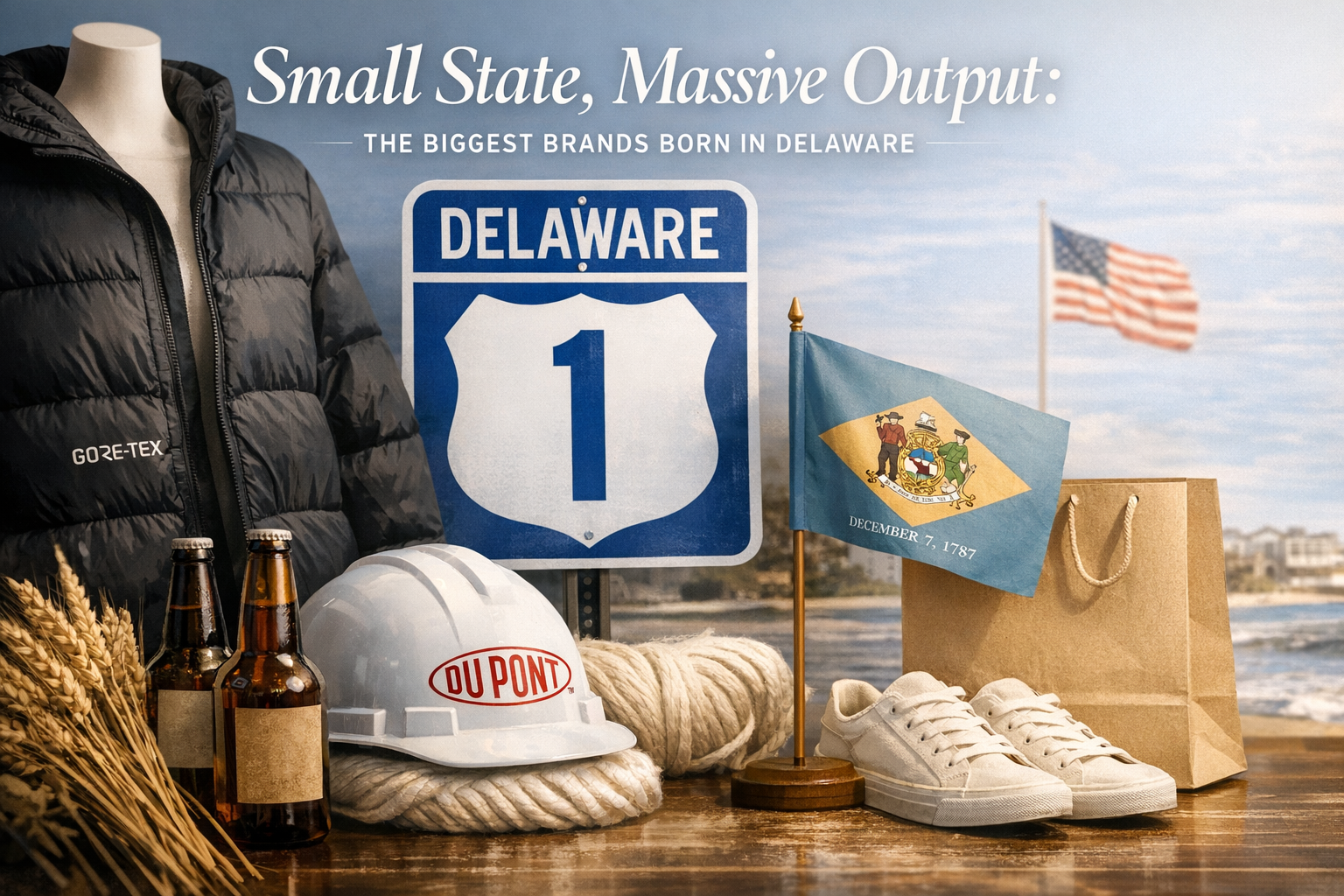
Delaware is not a state that announces itself.
It is 96 miles long, roughly 30 miles wide at its broadest point, and sandwiched between states that are considerably louder about their identities. You can drive through it in under an hour. You can miss it on a map if you're not paying attention. It has the second-smallest population in the country and a landmass that most Californians would describe as a large county.
And yet from this small, quiet, peculiarly shaped corner of the Mid-Atlantic has emerged some of the most consequential companies in American industrial history — and some of the most beloved craft brands in the modern consumer era. The state that gave the Union its first ratification of the Constitution has spent the centuries since being consistently, quietly first at things most people don't notice until they look closely.
This is the latest entry in Ritner Digital's State by State Brand Series. Welcome to Delaware — where the incorporations are favorable, the beaches are underrated, and the beer is genuinely excellent.
The Brands That Made Delaware
DuPont — Wilmington, DE (Est. 1802)
There is no starting anywhere else. DuPont is the story of Delaware's economy, and in many ways the story of American industrial chemistry itself.
Founded in 1802 by French émigré Éleuthère Irénée du Pont on the banks of the Brandywine River near Wilmington, the company began as a gunpowder mill. It spent the next two centuries becoming one of the most consequential manufacturing enterprises in the history of the world. The list of materials DuPont invented or commercialized reads like a syllabus for 20th-century life: nylon, Teflon, Kevlar, Mylar, Lycra, Neoprene, Tyvek, Corian. Nylon changed American fashion. Kevlar saved lives in military and law enforcement applications that are difficult to count. Teflon became a household word in a way that no industrial polymer had any right to expect. At its peak, the du Pont family and the company they built employed up to 10 percent of Delaware's entire population — a degree of economic dominance over a single state that is almost impossible to comprehend by modern standards.
DuPont's legacy in Delaware isn't just corporate. It's architectural, cultural, and civic. The Hotel du Pont in Wilmington, one of the finest historic hotels on the East Coast, opened in 1913. Longwood Gardens, the Winterthur estate, the Hagley Museum — these are du Pont family properties gifted to the public, physical expressions of a relationship between one company and one state that defined both of them for generations.
The company has since merged, split, and reorganized. The 2017 DowDuPont merger and subsequent three-way split into DuPont, Dow, and Corteva Agriscience restructured the legacy business considerably. But DuPont still operates from Wilmington, and the Brandywine Valley that E.I. du Pont chose in 1802 for its water flow and timber still carries the family name across its institutions and landmarks.
No other company has shaped a state the way DuPont shaped Delaware. That is not hyperbole. It is the plain result of doing the math.
W. L. Gore & Associates / GORE-TEX — Newark, DE (Est. 1958)
The second great Delaware industrial story begins in a basement.
On January 1, 1958, Bill Gore — a DuPont engineer who had spent 16 years with the company researching fluoropolymers — and his wife Vieve launched W. L. Gore & Associates out of their home in Newark, Delaware. The first product was insulated wire and cable. Within four years, Gore cables were in space aboard the Telstar satellite. Within six more, they were interconnecting the IBM System/360 — the first mass-produced digital computer.
Then in 1969, the Gores' son Bob made the discovery that changed everything. Attempting to stretch PTFE to fulfill a production order, he applied a rapid, sudden yank to the heated material. Instead of breaking, it expanded 800%, creating a microporous structure that was roughly 70% air. The company eventually named the commercial product GORE-TEX.
GORE-TEX launched as a fabric in 1976, and the outdoor apparel industry was never the same. The promise — waterproof and breathable, not one or the other — was a genuine breakthrough in a category where "waterproof" had long meant "also a sauna." The brand's "Guaranteed to Keep You Dry" promise, introduced in 1989, became one of the most recognizable performance claims in consumer products anywhere. Gore is now a global enterprise with over 13,000 associates, $4.8 billion in annual revenues, and products ranging from artificial heart valves to guitar strings — Elixir strings are a Gore product — to the fiber woven into the retractable roof over Centre Court at Wimbledon.
It all started because a DuPont engineer in Newark, Delaware believed there was more potential in a polymer than his employer had tapped. That's the Delaware story in miniature: patient, scientific, and quietly world-changing.
Dogfish Head Craft Brewery — Milton, DE (Est. 1995)
If DuPont and Gore represent Delaware's industrial legacy, Dogfish Head represents its creative soul.
Sam and Mariah Calagione opened Dogfish Head Brewings & Eats in Rehoboth Beach in June 1995 — Delaware's first brewpub, and at the time the smallest commercial brewery in America. The first batches came off a system that was essentially three small kegs with propane burners underneath, producing 12 gallons at a time for a full restaurant. The philosophy from day one was culinary and unapologetically weird: off-centered ales for off-centered people.
What followed was one of the more remarkable growth stories in American craft brewing. Dogfish Head's continual-hopping technique — adding hops throughout the entire boil rather than at fixed intervals — produced the 60, 90, and 120 Minute IPAs that became some of the most respected and sought-after beers in the country. Sam Calagione won the James Beard Award for Outstanding Wine, Spirits or Beer Professional in 2017. The company grew from that 12-gallon brewpub system to producing 262,000 barrels annually, distributed across more than 30 states. In 2019, it was acquired by the Boston Beer Company in a $300 million deal that made the Calagiones the second-largest non-institutional shareholders of the combined enterprise.
Dogfish Head now operates a production brewery in Milton, a brewpub in Rehoboth Beach, a seafood restaurant (Chesapeake & Maine), and the Dogfish Inn in Lewes — an entire hospitality ecosystem built around the same philosophy that started with propane burners. Calagione himself has pointed to Delaware's history of scrappy, innovative manufacturers — DuPont, Gore — as an inspiration. The DNA of building something extraordinary from unexpected materials runs deep in this state.
W. L. Gore's Other Brand: Elixir Strings — Newark, DE (Est. 1997)
Worth its own mention: Elixir Strings, also a W. L. Gore product, launched in 1997 and used the same ePTFE coating technology that made GORE-TEX waterproof to coat guitar strings — dramatically extending their tone life and transforming how musicians think about string longevity. Today Elixir is the world's best-selling coated guitar string brand. Most players have no idea it was born in the same Newark, Delaware labs that produced waterproof jackets and cardiovascular grafts. That is either strange or wonderful, depending on your disposition. Probably both.
What Delaware Consumers Are Actually Buying
The Corporate Incorporation Economy — And What It Actually Means for Business
Delaware's most distinctive economic trait isn't a product. It's a legal framework. Over 66% of the Fortune 500 are incorporated in Delaware, not because they operate here, but because Delaware's General Corporation Law and its specialized Court of Chancery provide a flexible, predictable, and business-friendly legal environment that companies have relied on for generations. In 2019 alone, over 225,000 new entities were formed under Delaware law.
This creates a consumer economy with a particular character. Wilmington, the state's largest city, is heavily populated by financial services professionals, legal talent, and corporate infrastructure. The consumer market in Delaware's urban core skews toward the professional class that supports the incorporation economy — law firms, banks, financial advisors, trust companies. WSFS Bank, founded in 1832, and Wilmington Trust, founded in 1903 by a du Pont, are both homegrown financial institutions that serve this market directly.
For businesses entering Delaware's consumer market, this professional concentration matters. The Wilmington consumer is not the Rehoboth Beach consumer. Understanding the geographic and demographic split between the state's urban financial corridor and its coastal tourism economy is essential to positioning anything here correctly.
The Beach Economy — Rehoboth, Lewes, and the Shore Market
Delaware's coastline — modest in size, enormous in per-capita economic impact — draws a summer consumer base that is disproportionately affluent, disproportionately from the Philadelphia and Washington D.C. metro areas, and disproportionately willing to spend on food, drink, and experiences that feel genuinely local.
Rehoboth Beach has evolved from a sleepy family shore town into one of the most economically dynamic small beach destinations on the East Coast. The boardwalk draws millions of visitors annually. The restaurant scene has developed real culinary ambition. Dogfish Head's brewpub on Rehoboth Avenue is a destination in its own right. Grotto Pizza — a Delaware original founded in Rehoboth in 1960 — is a genuine regional institution with a devoted following that treats its distinctive sweet sauce and boardwalk locations as non-negotiable summer rituals.
The beach consumer in Delaware is a strong test market for food and beverage brands with a regional identity. Brands that earn loyalty in Rehoboth get carried home to D.C., Philadelphia, Baltimore, and Northern Virginia — the same tourism-to-national-brand pipeline that Maine has leveraged so effectively with its lobster economy and Portland food scene.
Craft Beer as Delaware Identity
Delaware punches well above its weight in craft brewing, and Dogfish Head is only the beginning of why. Iron Hill Brewery, founded in Newark in 1997, operates a growing collection of brewpubs throughout Delaware, Pennsylvania, and New Jersey, and has won more medals at the Great American Beer Festival than virtually any comparable operation. Fordham & Dominion, brewing from Dover, distributes throughout the Mid-Atlantic. 3rd Wave Brewing in Lewes and a growing roster of smaller producers have built out a craft beer ecosystem that, on a per-capita basis, competes with states many times Delaware's size.
Delaware changed its brewery laws in 1995 — the same year Dogfish Head opened — and the craft beer industry that followed has become one of the state's defining consumer culture stories. For brands entering Delaware's market, the craft beer ecosystem is a useful lens: Delaware consumers reward transparency, quality ingredients, genuine local identity, and a willingness to do something unusual. Those values extend well beyond beer.
The Outdoors and Performance Consumer
Delaware's proximity to the Chesapeake Bay, the Atlantic coast, and the vast network of state parks and wildlife areas along its inland corridor creates a meaningful outdoor recreation consumer base. Kayaking, fishing, birding, hiking, cycling — Delaware's outdoor recreation economy is real and growing, fueled in part by a broader Mid-Atlantic trend toward outdoor spending that accelerated sharply in 2020 and has not fully reversed.
For performance brands — footwear, outerwear, equipment — Delaware consumers are a practical, experienced cohort. They buy what works in coastal Mid-Atlantic conditions: humid summers, unpredictable shoulder seasons, brackish-water environments that are hard on gear. GORE-TEX's origins here are not incidental — these are exactly the conditions that demand breathable waterproofing.
What Makes Delaware's Brand Ecosystem Unique
Two economies in one small state. Delaware's corporate-legal economy in Wilmington and its coastal tourism economy in the beach towns are genuinely distinct markets with different consumers, different spending priorities, and different brand languages. The mistake is treating Delaware as a single consumer market. It isn't. The professional in Greenville and the summer renter in Dewey Beach are not the same audience, and brands that succeed in one may need to be repositioned entirely for the other.
The First State has a first-mover reflex. From being the first to ratify the Constitution to being the first to pass a corporate law framework sophisticated enough to attract the majority of American business, Delaware has a cultural orientation toward getting there before anyone else and doing it correctly. The brands that resonate here tend to share that disposition — substantive, quality-forward, not chasing trends.
Small geography, outsized influence. Delaware's population is under one million. Its brands — DuPont, GORE-TEX, Dogfish Head — operate at global scale. The lesson is the same one that Maine teaches: a state's size has very little to do with the ambition of what it builds. What it has to do with is the quality, patience, and genuine distinctiveness of what gets made here. Delaware has been making things that last for over two centuries. That is the brand identity, whether the state knows it or not.
Ritner Digital works with brands across the Mid-Atlantic and beyond — helping them build the kind of digital presence that reflects what they've actually built. If your marketing isn't keeping up with your company, let's talk.
Frequently Asked Questions
What is Delaware's most famous brand?
DuPont is Delaware's most historically significant brand by virtually any measure — founded in 1802, responsible for nylon, Teflon, Kevlar, and dozens of other materials that defined 20th-century life, and deeply woven into the state's civic and physical identity in ways that no other company-state relationship in America quite matches. Among modern consumer brands, Dogfish Head is Delaware's most recognized name — a craft brewery that grew from the smallest commercial operation in the country to a $300 million acquisition without ever losing the off-centered identity it started with.
Why are so many companies incorporated in Delaware if they don't actually operate there?
Delaware's General Corporation Law and its Court of Chancery — a specialized business court with no jury trials and over two centuries of consistent, sophisticated case law — make it the most predictable and business-friendly incorporation environment in the country. Over 66% of Fortune 500 companies are incorporated in Delaware for this reason. It has nothing to do with where those companies are headquartered or where their employees work. It is a legal and structural choice, not an operational one. The distinction matters for understanding Delaware's actual consumer economy, which is driven by a professional financial and legal class in Wilmington and a coastal tourism economy along the shore — not by the millions of entities that exist on paper in the state.
Is Dogfish Head still independently owned?
No. Dogfish Head was acquired by the Boston Beer Company — the maker of Samuel Adams — in a $300 million deal announced in May 2019. Founders Sam and Mariah Calagione converted their Dogfish Head stock into Boston Beer Co. stock, making them the second-largest non-institutional shareholders of the combined enterprise. The brewery continues to operate from Milton and Rehoboth Beach, and the brand's off-centered identity has remained largely intact under the new ownership structure.
What is GORE-TEX and where did it come from?
GORE-TEX is a waterproof, breathable fabric technology developed by W. L. Gore & Associates, a company founded in a Newark, Delaware basement in 1958 by Bill and Vieve Gore — both former DuPont employees. The core material, expanded PTFE, was discovered by their son Bob in 1969 when he applied a rapid stretch to the polymer and found that instead of breaking, it expanded 800% into a microporous structure. GORE-TEX fabric launched commercially in 1976. Today W. L. Gore & Associates generates $4.8 billion in annual revenues and produces everything from cardiovascular grafts to coated guitar strings — all from the same Newark, Delaware headquarters where it started.
What should a brand know before entering the Delaware market?
The most important thing is that Delaware is not one market. Wilmington and the surrounding New Castle County corridor is a professional, financial-services-heavy consumer base with spending patterns that reflect that. The Sussex County beach towns — Rehoboth, Lewes, Dewey, Bethany — draw an affluent, heavily Mid-Atlantic tourist audience whose spending is seasonal and experience-driven. What works in one doesn't automatically work in the other. Beyond the geographic split, Delaware consumers across both markets tend to respond to quality, authenticity, and genuine local identity — the same values that built DuPont, GORE-TEX, and Dogfish Head into something that lasted. Brands that come in performing those values without backing them up tend to get found out quickly in a state this small, where word travels fast and repeat business is everything.