Palmetto State Power: The Biggest Brands Born in South Carolina and What the Palmetto State Is Actually Buying
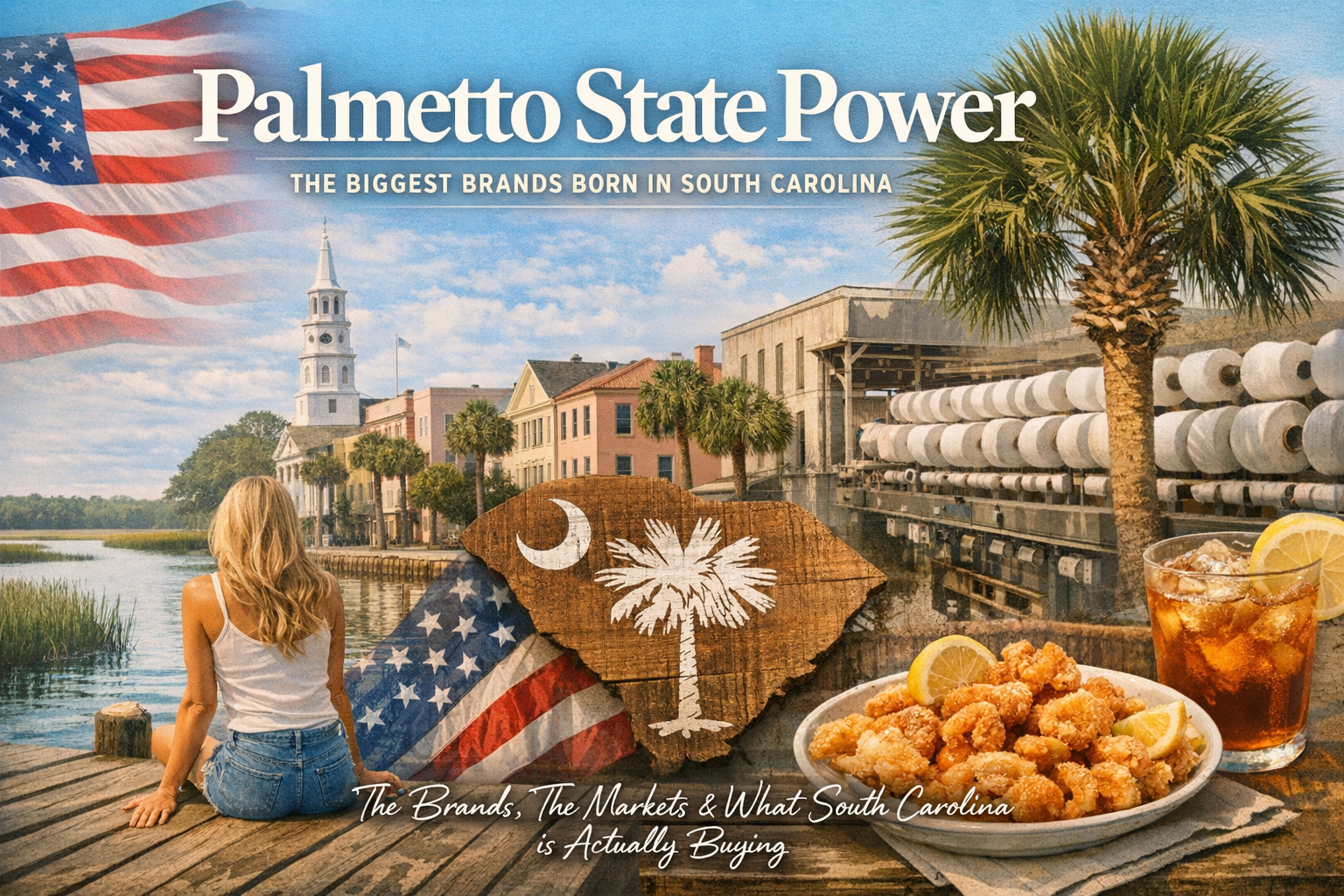
South Carolina does not get enough credit.
It is a state that most of the country thinks it understands — beaches, golf, barbecue, college football, the occasional political primary — and almost entirely misses. The reality of South Carolina's economy is considerably more interesting than its tourism brochure suggests. It is a state where the textile industry once employed entire generations and left an innovation culture in its wake. Where a Spartanburg Upstate corridor became an unlikely hub for some of the most recognizable hospitality brands in America. Where a state that was long defined by manufacturing has quietly become one of the most significant automotive production centers in the country, while still producing some of the South's most beloved food institutions.
The brands that came out of South Carolina didn't mostly come from glamour or venture capital. They came from grit, from the mill towns, from people who built businesses with their hands and scaled them the hard way.
This is the latest entry in Ritner Digital's State by State Brand Series. Welcome to the Palmetto State — where the barbecue debate never ends, the textile legacy runs deep, and the brands are tougher than they look.
The Brands That Made South Carolina
Milliken & Company — Spartanburg, SC (Est. 1865 / HQ in SC since 1958)
The story of South Carolina's textile industry is the story of Milliken, and the story of Milliken is the story of what a company becomes when it refuses to stop innovating.
Milliken's roots go back to 1865 in Portland, Maine, where Seth Milliken and William Deering founded a small woolen fabrics distributorship. By 1884 the company had made its first investment in South Carolina, becoming part owners of Pacolet Manufacturing Company in Spartanburg. Over the following decades, as the textile industry's center of gravity shifted from New England to the South, Milliken moved with it — and eventually became the industry. In 1958, Roger Milliken moved the company's headquarters to a 600-acre campus in Spartanburg anchored by one of the most sophisticated textile research facilities ever built.
Milliken & Company today is one of the largest privately held manufacturing companies in the world — with over 2,500 U.S. patents, operations across specialty chemicals, performance textiles, healthcare, and floor coverings, and a global footprint that includes plants across the U.S., Europe, and Asia. It employs more than 7,000 associates. Roger Milliken, who led the company from 1947 until his death in 2010, was named Textile Leader of the Century by the industry's leading trade publication and received the Malcolm Baldrige National Quality Award, the Deming Prize, and the European Quality Award.
Milliken is also one of the most secretive large companies in America — privately held, family-controlled, sharing almost no financial data publicly. In Spartanburg, though, its presence is impossible to miss. The research campus, the philanthropy, the civic investment — Milliken is to Spartanburg what DuPont is to Wilmington. The physical and cultural anchor of a city that built an identity around making things well.
Denny's — Spartanburg, SC (HQ since 1990)
Denny's didn't start in South Carolina — it began as Danny's Donuts in Lakewood, California in 1953 — but it landed in Spartanburg in 1990 and has been headquartered there ever since, making it one of the more unlikely pairings of brand and city in American business history. The chain relocated its corporate offices from Irvine, California to a newly constructed 18-story tower in downtown Spartanburg — a tower originally commissioned by Spartan Food Systems, the Hardee's franchise empire co-founded by Jerry Richardson, the future Carolina Panthers owner who started his business career in Spartanburg with a championship football bonus and a Hardee's franchise.
The Denny's Tower, as locals call it, became one of Spartanburg's defining landmarks — the kind of architectural fact that is funnier the longer you think about it, a Grand Slam beacon rising above a mid-sized South Carolina city that somehow ended up as the world headquarters of America's most recognizable 24-hour diner chain. With over 1,400 locations operating globally, Denny's has called Spartanburg home for over three decades. The company went private in January 2026 following a $620 million acquisition — and it is still, improbably, headquartered on Main Street in Spartanburg, South Carolina.
Southeastern Freight Lines — Lexington, SC (Est. 1950)
Southeastern Freight Lines is the kind of company that South Carolina produces and the rest of the country quietly depends on without knowing its name.
Founded in 1950 by W.T. Cassels Sr. in Lexington with 14 trucks, 20 employees, and a $5,000 loan, Southeastern built itself into the premier regional less-than-truckload carrier in the Southeast and Southwest over the following seven decades. The company operates 89 service centers across 13 states and Puerto Rico, delivers more than 99.35% on-time service in next-day lanes, and has received over 500 quality awards from customers and industry associations. It is still privately held. Still headquartered in Lexington. Still family-controlled, now in its third generation.
Southeastern's founding philosophy — "If you take care of your people, they will take care of the customer, and that will take care of the future" — sounds like something a business school professor would put on a slide and a logistics operator would quietly ignore. Southeastern actually runs the company that way. It has consistently ranked among the best companies in its industry for employee satisfaction and service quality simultaneously, which is harder to do than it sounds in an industry where those things are usually in tension.
For brands and businesses trying to understand what South Carolina builds at its best, Southeastern Freight Lines is as good an example as any. No marketing department. No national campaigns. Just 75 years of delivering what they promised, on time, in one of the toughest operating environments in American logistics.
Ryan's Family Steak Houses — Greenville, SC (Est. 1977)
Ryan's is a South Carolina original — and one of the most genuinely interesting restaurant origin stories the state has produced.
Alvin McCall Sr. started in Greenville as an accountant, then a builder, then a Volkswagen dealer, before turning to restaurants in 1970 with Western Family Steak House — a concept that became Quincy's, grew rapidly across the Southeast, and was eventually sold to Trans World Corporation. McCall retained the right to compete, and in 1977 started Ryan's, opening his first location on Laurens Road in Greenville in 1978. By the early 1990s Ryan's had grown into one of the largest family steakhouse buffet chains in the country, with a Restaurants & Institutions survey naming it the best steakhouse in the United States in 1990.
Ryan's eventual decline — absorbed into Buffets Inc., which went through multiple bankruptcy cycles — is a familiar story for casual dining brands that expanded aggressively into a category that got squeezed from both ends by fast casual on one side and full-service dining on the other. But the origin story is pure Greenville, pure South Carolina: a practical, quality-obsessed businessman who applied contractor's principles to the restaurant business and built something that millions of Southeastern families ate at for a generation.
Hardee's — Greenville, NC / Spartanburg, SC (SC Manufacturing Connection)
While Hardee's was technically founded in Greenville, North Carolina in 1960 by Wilber Hardee, its growth into a national chain is inseparable from Spartanburg. Spartan Food Systems, the Spartanburg company co-founded by Jerry Richardson, became the largest Hardee's franchisee in the country — and the infrastructure, operational expertise, and corporate energy that powered Hardee's Southeast expansion was built in South Carolina. The Spartanburg food service ecosystem that grew around Spartan Food Systems, and later around Denny's, gave the Upstate a hospitality industry identity that persists today.
Nucor's South Carolina Origin — Darlington and Florence, SC (Steel Roots Est. 1962)
Nucor Corporation — now headquartered in Charlotte and the largest steel producer in the United States — has its deepest roots in South Carolina. The company that became Nucor acquired Vulcraft, a Florence, South Carolina steel joist manufacturer, in 1962, and it was Vulcraft's profitability as the only functional business in a failing conglomerate that gave Kenneth Iverson the platform to rebuild the company from the ground up. Nucor built its first steel mill in Darlington, South Carolina in 1968 — the electric arc furnace operation that pioneered the minimill model and eventually changed the entire American steel industry.
The Darlington mill was the bet-the-company moment. Iverson secured a $6 million loan against everything the company had, built the mill, survived the early production problems, and watched earnings soar by 1971. The minimill revolution that followed — lower cost, more efficient, more flexible than the legacy integrated steel giants — reshaped American manufacturing. It was built in Darlington, South Carolina, and it started because a Spartanburg steel joist company was the only thing worth saving.
What South Carolina Consumers Are Actually Buying
Barbecue as Identity, Not Just Food
No consumer category is more deeply tied to South Carolina's cultural identity than barbecue — and South Carolina's barbecue identity is distinctive even within the intensely competitive and hotly debated world of American regional barbecue. South Carolina is the only state with four recognized barbecue traditions — mustard-based, vinegar and pepper, light tomato, and heavy tomato — reflecting distinct geographic and cultural zones within a single state. The mustard-based sauce of the Midlands, in particular, is a South Carolina original that traces back to German immigrant communities in the 18th century and has no real equivalent anywhere else in the country.
For food brands entering South Carolina, barbecue is not a category — it is a worldview. South Carolinians have opinions about their barbecue that are passed down generationally and defended with genuine conviction. The brands that earn loyalty in this space do so through decades of consistency and genuine community connection. The restaurants that matter in South Carolina barbecue are not national chains — they are institutions with history, family ownership, and specific wood-burning traditions that can't be replicated by a commissary kitchen.
The Textile Legacy Consumer
South Carolina's Upstate — Greenville, Spartanburg, and the mill towns between and around them — was built by the textile industry. That industry is largely gone, replaced by automotive manufacturing, healthcare, and professional services, but its cultural imprint on the consumer landscape is permanent. The Upstate consumer was shaped by a manufacturing culture that valued practical quality, durability, and fair dealing. The brands that have consistently performed well here are brands that deliver on their promise without excessive embellishment — the same values that Milliken built its global reputation on, the same values that Southeastern Freight Lines has operated by for 75 years.
The Upstate is now one of the fastest-growing economic regions in the Southeast. Greenville, in particular, has undergone a downtown transformation over the past 20 years that has attracted new residents, new restaurants, new creative businesses, and a younger professional demographic that is reshaping what the Upstate consumer market looks like. The Falls Park on the Reedy River, the restaurants and boutiques of Main Street, the growing arts and food scene — Greenville is no longer just an industrial city. It is one of the more interesting mid-sized cities in America, and its consumer market reflects that complexity.
Coastal and Tourism Consumer Markets
South Carolina's coastline is one of its most powerful economic assets. Myrtle Beach, the Grand Strand, Hilton Head, Charleston, and the ACE Basin draw millions of visitors annually from the Southeast and beyond. The tourist consumer in South Carolina is a powerful market for food, beverage, outdoor recreation, and branded merchandise — and the coastal South Carolina consumer, particularly in Charleston and Hilton Head, is affluent, food-literate, and increasingly oriented toward local sourcing and craft products.
Charleston in particular has become one of the most significant food and culture destinations in the American South. Its restaurant scene punches at a level well above its population size. Its hospitality industry generates enormous economic activity. And its consumer market — a mix of longtime residents, new transplants from the Northeast and Midwest, and a constant flow of tourists — is both demanding and loyal to brands that earn its trust.
For food, beverage, and hospitality brands, Charleston is a proving ground similar to Portland, Maine or Austin, Texas: get it right here, in a market that cares deeply and talks loudly, and the brand carries nationally.
The Automotive Economy
BMW's Greer, South Carolina plant — opened in 1994 and now BMW's largest production facility anywhere in the world — produces around 1,500 vehicles per day and employs roughly 11,000 people. Volvo opened its first U.S. manufacturing plant in Ridgeville in 2018. The ripple effects of these operations through the Upstate economy are enormous: supplier networks, ancillary services, a professional workforce that earns and spends at levels that have reshaped the regional consumer market entirely.
The BMW plant doesn't just produce vehicles — it produced a labor market and a consumer culture. The workforce it draws and retains spends locally, demands quality, and has elevated the restaurant, retail, and housing markets of Greenville-Spartanburg into something that would have been unrecognizable to the mill town economy of a generation earlier.
What Makes South Carolina's Brand Ecosystem Unique
The Upstate built it, the coast sells it. South Carolina's brand identity has two distinct centers of gravity that rarely get discussed together. The Upstate built manufacturing brands — Milliken, Nucor, Southeastern Freight, the restaurant chains out of Greenville and Spartanburg — that are defined by operational excellence, durability, and decades of compounding trust. The coast built tourism and hospitality brands defined by experience, beauty, and the particular quality of a place that people travel specifically to reach. The most interesting South Carolina brands find a way to carry both of those things simultaneously.
Grit is the brand value. The companies that emerged from South Carolina's mill town and manufacturing culture share a common characteristic: they were built on delivery, not on marketing. Southeastern Freight Lines has never run a national ad campaign. Milliken doesn't publish its revenue. The brands that lasted here lasted because they did the work, decade after decade, without requiring attention to survive. That disposition — build something real, let the quality speak — is the Palmetto State brand value in its most distilled form.
The state is in transition and knows it. South Carolina is simultaneously one of the fastest-growing states in the country and one of the most conscious of its own history. The Upstate is being reshaped by automotive and tech investment. Charleston is being reshaped by migration and tourism. The tension between the South Carolina that was built by the mill and the South Carolina being built by the transplant is real and active — and the brands that navigate it best are the ones that honor the former without being frozen by it.
Ritner Digital works with brands across the Southeast and beyond — helping growing companies build the kind of digital presence that reflects what they've actually built. If your marketing isn't keeping pace with your growth, let's talk.
Frequently Asked Questions
What is South Carolina's most famous brand?
Denny's is South Carolina's most recognizable corporate name by sheer national footprint — over 1,400 locations operated globally from a headquarters on Main Street in Spartanburg. Among brands born and scaled entirely in South Carolina, Milliken & Company is the most historically significant — a privately held manufacturing giant that helped define the state's textile economy for over a century and still operates as one of the largest privately held companies in the world from its Spartanburg campus. Southeastern Freight Lines is the state's most respected brand within its industry, consistently rated among the best-run regional trucking companies in the country.
Why is Denny's headquartered in Spartanburg, South Carolina?
Denny's relocated to Spartanburg in 1990 when Trans World Services — its parent company at the time — moved operations into a newly constructed 18-story tower in downtown Spartanburg. The tower was originally commissioned by Spartan Food Systems, a Spartanburg-based restaurant empire co-founded by Jerry Richardson, who used a professional football signing bonus to buy into a Hardee's franchise and eventually built one of the largest fast food operations in the Southeast. When Trans World acquired Spartan and later consolidated operations, Spartanburg became the corporate home — and Denny's has stayed there ever since, through multiple ownership changes, a bankruptcy, and a 2026 going-private transaction.
What is South Carolina's barbecue tradition and why does it matter for brands?
South Carolina is unique among American states in having four distinct regional barbecue traditions — mustard-based sauce in the Midlands, vinegar and pepper in the Pee Dee, light tomato in parts of the Upstate, and heavy tomato toward the western counties. The mustard-based tradition, sometimes called Carolina Gold sauce, traces back to German immigrant communities and has no real parallel anywhere else in the country. For food and beverage brands entering South Carolina, barbecue is a cultural touchstone that signals whether a brand genuinely understands where it is. Consumers here can tell the difference between a brand that respects the local tradition and one that appropriated the aesthetic without doing the research. Getting barbecue wrong in South Carolina is a fast way to lose credibility with the consumers you most want.
What should a brand know before entering the South Carolina market?
South Carolina is not one market. The Upstate around Greenville and Spartanburg is a manufacturing and professional services economy that is growing fast, shaped by automotive investment and a wave of corporate relocations, with consumers who value quality, practicality, and brands that deliver on their promises without overpromising. The Midlands around Columbia is a government, military, and university economy with different spending patterns. The coast — Charleston, Hilton Head, Myrtle Beach — is a tourism and affluent-transplant economy where experience, aesthetics, and local credibility matter enormously. A brand strategy that works in Spartanburg may need significant repositioning for Charleston, and vice versa. Understanding which South Carolina you're entering is the first and most important marketing decision you'll make in this state.