Technical SEO for Financial Websites: What Your Dev Team Needs to Know
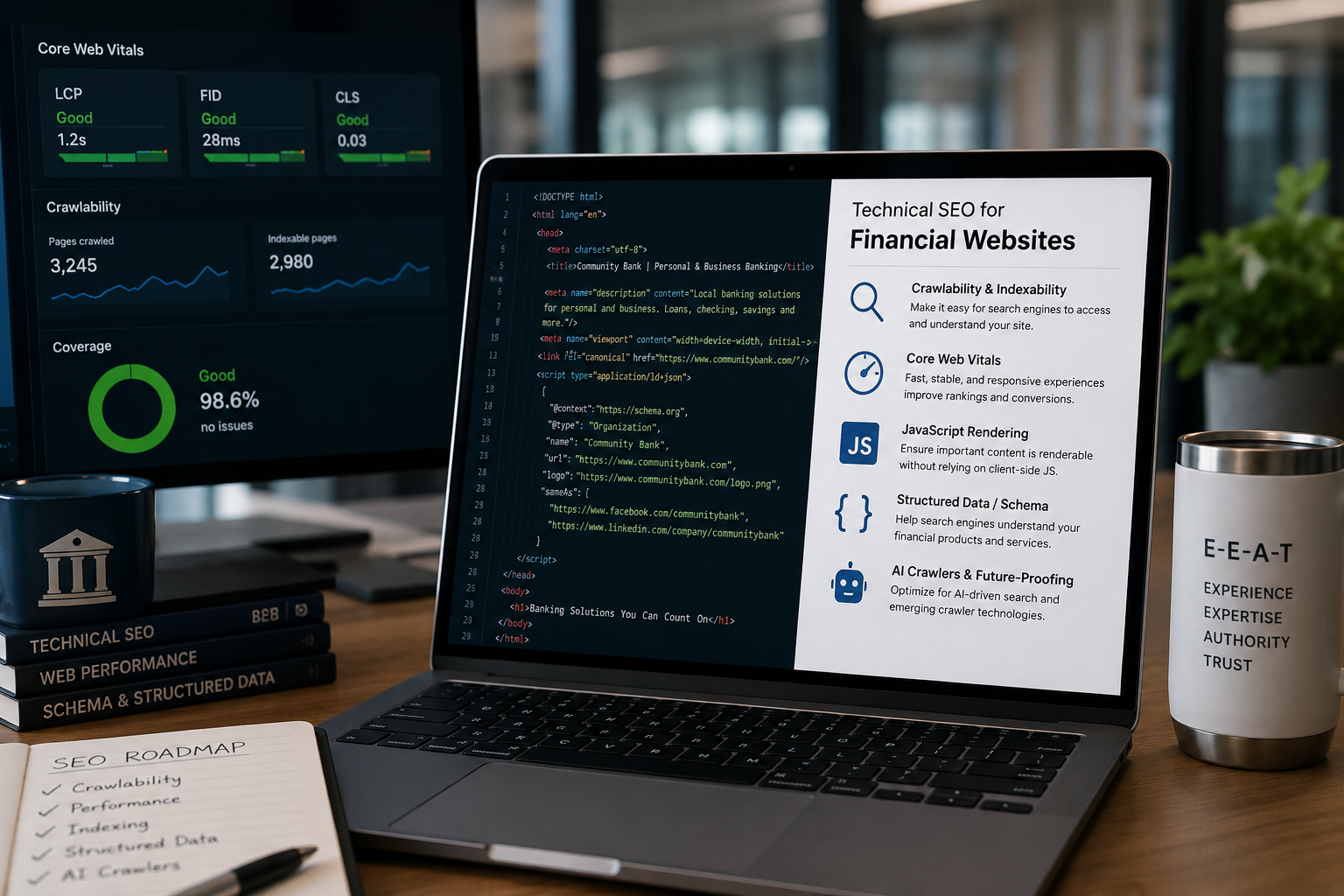
Technical SEO is the part of search optimization that never makes it into the marketing meeting highlight reel. It's not glamorous, it doesn't go viral, and most of the work happens in code your members will never see. But for banks, credit unions, and other financial institutions, it's the foundation that determines whether all your content and local SEO efforts actually pay off. A business can produce outstanding content and earn quality backlinks and still rank poorly if search engines can't effectively crawl, understand, and index that content. Involvedigital
There's a real upside here for your engineering team: technical SEO is the fastest-return work in the entire discipline. Fixing technical SEO issues is often the fastest-return investment in an SEO program — unlike content marketing, which takes months to mature, technical fixes can produce ranking improvements within weeks as Google re-crawls and re-indexes resolved pages. And unlike link building, it's entirely within your control, with no outreach or external dependencies. Involvedigital
This guide is written to bridge the gap between marketing and engineering. It covers what your dev team actually needs to prioritize on a financial website in 2026 — and a few new requirements that didn't exist even two years ago.
How to Think About Technical SEO Priorities
A useful mental model before diving in: technical SEO factors are the price of entry, not the thing that wins the game. Technical SEO factors are now qualifiers, not differentiators — they ensure your content can compete, but they do not guarantee visibility on their own. Failing them creates a structural disadvantage; passing them simply lets your content do its job. OWT INDIA
The work falls into two tiers. Tier 1 (foundation) is crawlability: a clean robots.txt without AI crawler blocks, a healthy XML sitemap, correct canonical tags, and HTTPS throughout. Tier 2 (performance) is Core Web Vitals, schema markup, and mobile-first implementation. The sequencing matters: businesses that address Tier 1 issues first consistently see the fastest improvement, because technical foundation issues suppress the performance of all other SEO investment. InvolvedigitalInvolvedigital
Tier 1: Crawlability and Indexation
Everything starts here. A fundamental truth in technical SEO: Google cannot rank a page it cannot crawl and index. While this sounds obvious, crawlability and indexation failures are among the most common and most damaging technical SEO issues affecting mid-market websites. TechLooker
For your dev team, the crawlability checklist on a financial site comes down to a handful of items:
Confirm your priority pages are actually indexed. Check Google Search Console's coverage report for your product pages, branch pages, and rate pages. Watch for accidental noindex tags and misconfigured robots.txt rules that quietly remove pages from search entirely.
Keep your XML sitemap current and submitted. Remember its limits, though — an XML sitemap lists the URLs you want Google to crawl, but it does not guarantee crawling or indexing; it is an invitation, not an instruction. W3era
Use clean, descriptive URLs. Short, keyword-focused URLs like /auto-loans-spokane improve both crawl efficiency and navigation.
Mind your status codes. A critical recent change: Google now clarifies that pages returning non-200 status codes (like 4xx or 5xx) may be excluded from the rendering queue entirely. Yotpo
One note on crawl budget: it's not a concern for every site. For smaller sites, crawl budget is rarely a limiting factor — it becomes important mainly for large or complex websites. Most community banks and credit unions don't need to obsess over it, but large multi-branch institutions with thousands of location and product URLs should. Duplicate content from parameter URLs, session IDs, and pagination is the most common technical issue on large sites, so deduplication and canonicalization deserve attention there. OWT INDIAW3era
The JavaScript Rendering Problem (Read This One Carefully)
If your dev team takes away a single thing from this guide, make it this. JavaScript rendering is now one of the highest-stakes technical decisions on a financial website, and it's where many institutions are silently losing visibility.
Here's the core issue. Although Google has improved rendering capabilities, server-side rendering (SSR) is still the recommended approach to ensure pages have the greatest potential to rank. For AI bots the situation is even clearer, as most AI crawlers do not execute JavaScript — if critical content relies on JS to render, it will be invisible to systems like Perplexity, ChatGPT, or Claude. That makes rendering strategy a business decision with a direct impact on visibility. DebugBearDebugBear
For financial sites this is not hypothetical — it's a documented failure mode. As Ritner Digital's own credit union audit work found, many AI crawlers prioritize speed and don't fully render JavaScript, so if your branch locator, rate tables, or FAQ content is injected client-side, an AI system may see an empty page. In one credit union scorecard, a major institution's JavaScript-dependent locator meant AI systems couldn't access its branch information through standard crawling at all. Ritner Digital
The practical instruction for your dev team: make sure your most important content — branch locations, rates, product details, FAQs — is present in the server-rendered HTML, not injected after load. Ensure main content is accessible as plain HTML, not dependent on JavaScript rendering. If you're building or rebuilding, consider modern approaches that solve this cleanly. Frameworks are moving toward "island architecture," where the browser only hydrates interactive elements rather than the entire page, dramatically reducing main-thread execution time and directly improving INP scores. InvolvedigitalYotpo
Tier 2: Core Web Vitals
Core Web Vitals are the performance metrics Google uses to quantify real user experience, and they're confirmed ranking signals. There are three, and your dev team should know the 2026 thresholds cold. Largest Contentful Paint (LCP) should occur within 2.5 seconds, Interaction to Next Paint (INP) should be under 200 milliseconds, and Cumulative Layout Shift (CLS) should be under 0.1. Critically, these thresholds must be met for at least 75% of page visits to pass. GoogleInvolvedigital
It helps to understand what each measures and what tends to break it:
LCP (loading). Most commonly impacted by unoptimized hero images, render-blocking resources, slow server response times (TTFB over 600ms), and client-side rendering delays. Involvedigital
INP (responsiveness). This is the hard one. INP is the most commonly failed Core Web Vital in 2026 because it requires optimizing JavaScript execution throughout the entire user session, not just on initial load. Heavy third-party scripts — analytics, ad platforms, chat widgets — unoptimized React/Vue components, and synchronous JavaScript execution are the primary failure causes. Financial sites tend to be heavy on exactly these scripts, so INP deserves focused attention. TechLooker
CLS (stability). Especially important for finance, where layout shifts cause costly misclicks on application forms and "Apply Now" buttons.
A word of perspective: aim for "good," not perfection. Core Web Vitals function primarily as tiebreakers in competitive niches — they won't compensate for poor content or missing authority signals, but failing them in a competitive space creates a structural disadvantage. And always prioritize the right data source — fix issues flagged in field data (Google Search Console) first, since that's the data Google uses for ranking, and use lab data (Lighthouse) as your diagnostic tool. InvolvedigitalW3era
Concrete optimizations your team can implement: serve next-gen image formats like WebP and AVIF, implement responsive images with srcset, defer offscreen images with lazy loading, minimize JavaScript bundle size, and invest in reliable hosting and CDNs. For server response, edge computing through services like Cloudflare Workers or Vercel Edge Functions can reduce latency by 40-70%. NoGoodALM Corp
Mobile-First and HTTPS: Non-Negotiable Baselines
Two items here are no longer optional — they're assumed. Since 2023 Google has been mobile-first for all sites, meaning it uses the mobile version of your site for crawling, indexing, and ranking. Your mobile site is your SEO site. Because mobile connections are slower, mobile scores are typically worse than desktop, so test Core Web Vitals on mobile specifically, not just desktop. W3eraW3era
HTTPS is similarly settled. HTTPS has been a confirmed ranking signal since 2014 and is now a baseline expectation, not a differentiator — sites still running HTTP in 2026 face both ranking penalties and user trust barriers from browser "Not Secure" warnings. For a financial institution handling sensitive data, full HTTPS coverage with no mixed-content warnings is simply table stakes. W3era
Structured Data: Schema Markup for Financial Sites
Schema markup is how you translate your content into a language search engines and AI systems can read directly, and it's increasingly important for AI visibility. Structured data is the language of LLMs. At minimum, your dev team should implement Organization, LocalBusiness, Article, and FAQ schema across the relevant page templates, using JSON-LD. YotpoInvolvedigital
For multi-branch institutions, LocalBusiness schema on each branch page reinforces geographic relevance. For your blog and educational content, Article and FAQ schema support rich results and AI citation eligibility.
There's one discipline your engineers must build into their deployment process, though — guarding against schema drift. Schema drift occurs when the structured data in your code contradicts the visible content on the page; when that happens, Google loses trust in your data. To prevent it, developers should implement automated testing that verifies the JSON-LD values match the rendered DOM elements before every deployment. On a financial site where rates and product terms change, this is especially important — a schema-stated rate that no longer matches the page is both a trust problem and a potential compliance issue. Yotpo
The New Layer: AI Crawler Accessibility
The biggest change to technical SEO in the last two years is the arrival of AI crawlers as a meaningful audience. In a single month of late 2024, GPTBot and ClaudeBot combined made requests equivalent to roughly 20% of Googlebot's volume, and by 2026 AI crawlers collectively represent a meaningful share of server traffic for most websites.
The instruction for your dev team is twofold. First, don't accidentally block them. Ensure GPTBot, ClaudeBot, and PerplexityBot are not inadvertently blocked in your robots.txt. Second, govern your bot access deliberately. It's increasingly important to manage your robots.txt to differentiate between beneficial retrieval agents like OAI-SearchBot and non-beneficial training scrapers. Combined with the server-side rendering point above, these steps determine whether ChatGPT, Perplexity, and Google's AI Overviews can cite your institution at all. InvolvedigitalYotpo
How to Audit: A Starting Checklist for Your Dev Team
Pulling it together, here are the priority areas to run through during a technical audit, drawn from current best practice: Core Web Vitals scores via PageSpeed Insights and the Chrome UX Report; crawl budget usage and blocked/non-indexed page inventory; JavaScript rendering verification via Search Console's URL Inspection; internal link depth mapping and orphaned page identification; mobile usability issues; structured data validation via the Rich Results Test; and duplicate content and canonical tag implementation. A complete technical SEO audit typically reveals 10-30 prioritized issues, each with a clear business impact estimate. TechLookerTechLooker
Run a full audit at least annually, with lighter technical checks quarterly — and always run a complete audit before and after any website redesign or migration, which is where the most damaging technical regressions tend to happen.
Frequently Asked Questions
What are the most important technical SEO factors for a financial website?
They split into two tiers. Tier 1 is crawlability — clean robots.txt, a healthy XML sitemap, correct canonical tags, and HTTPS throughout — and Tier 2 is performance, meaning Core Web Vitals (LCP under 2.5s, INP under 200ms, CLS under 0.1), schema markup, and mobile-first implementation. Fix Tier 1 first, since foundation issues suppress everything else. Involvedigital
Will JavaScript hurt my financial site's SEO?
It can, if critical content depends on it. Most AI crawlers do not execute JavaScript, so if critical content relies on JS to render, it will be invisible to systems like Perplexity, ChatGPT, or Claude, and server-side rendering is still Google's recommended approach. Make sure rates, branch info, and product details are in the server-rendered HTML. DebugBear
What Core Web Vitals scores should we target?
The "good" thresholds are well-defined. Aim for LCP within 2.5 seconds, INP under 200 milliseconds, and CLS under 0.1. Note that these must be met for at least 75% of page visits to pass, and that INP is the most commonly failed metric in 2026 because of heavy third-party scripts. Google + 2
Does my financial website still need HTTPS and mobile optimization in 2026?
Yes, but think of them as baselines rather than advantages. Mobile responsiveness and security (HTTPS) are now baseline expectations — they no longer provide a competitive advantage, but failing them can limit visibility. Google evaluates your mobile site as the primary version, so test performance on mobile specifically. OWT INDIA
How fast can technical SEO fixes improve our rankings?
Faster than most other SEO work. Technical fixes can produce ranking improvements within weeks as Google re-crawls and re-indexes resolved pages, unlike content marketing, which takes months to mature — which is exactly why many institutions start their SEO program with a technical audit. Involvedigital
Ready to Get Your Technical Foundation Right?
Crawlability issues, JavaScript that hides your rates from AI crawlers, failing Core Web Vitals, schema drift — these are the silent problems that cap the return on every other dollar you spend on SEO and content. Ritner Digital helps financial institutions diagnose and fix the technical issues holding their search visibility back, and work alongside your dev team to implement the fixes correctly.
Get in touch with Ritner Digital → for a technical SEO audit that hands your engineers a clear, prioritized list of what to fix and why.
Sources
Involve Digital — Technical SEO Foundations 2026
Techlooker — Technical SEO Guide 2026: Core Web Vitals & Crawlability
DebugBear — Technical SEO Checklist: The Complete Guide for 2026
ALM Corp — Core Web Vitals 2026: Technical SEO That Actually Moves the Needle
OWT India — Technical SEO in 2026: Core Web Vitals, Indexing & Crawl Budget
Google Search Central — Understanding Core Web Vitals and Google Search Results
Ritner Digital — The Complete SEO Audit Checklist for Credit Union Websites