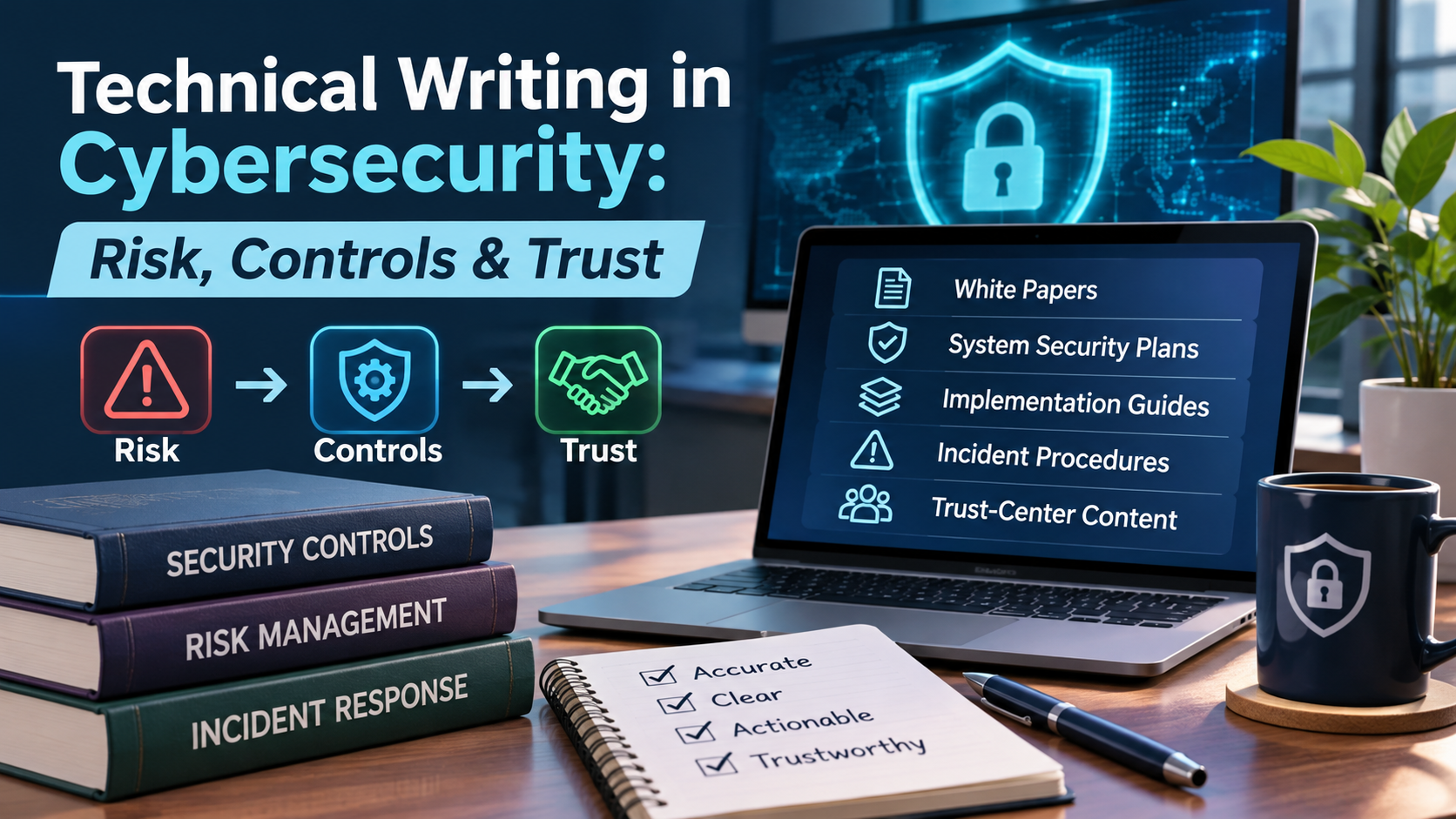
Why cybersecurity documentation, technical white papers, implementation guides, incident response procedures, and customer-facing security explanations require technical accuracy, clear communication, and careful professional review.
Imagine a software company preparing to sign a contract with a large enterprise customer.
The prospective customer likes the product.
The platform meets its operational needs, the pricing is acceptable, and the implementation team believes the integration will be straightforward.
But before the agreement can move forward, the customer's security team sends a detailed questionnaire.
How is customer data protected?
What authentication methods are supported?
Who can access sensitive information?
How does the company monitor security events?
What happens if a security incident occurs?
Which security controls have been independently assessed?
Does the company have documented processes for managing vulnerabilities?
Suddenly, the sales conversation becomes a technical documentation challenge.
The company may have strong security practices.
Its engineers may understand the system architecture.
Its security team may have implemented appropriate controls.
But that doesn't necessarily mean the organization can explain those controls clearly.
Perhaps the answers are scattered across internal policies, engineering notes, security reports, and previous customer questionnaires.
Maybe the website makes broad claims about security without providing enough detail.
Perhaps the company's technical white paper was written two years ago and hasn't been updated to reflect changes in its infrastructure.
The customer wants reliable information.
The company needs to provide it without disclosing sensitive security details or making promises that exceed what its systems actually support.
And the person responsible for preparing the response has to understand the difference.
That's where technical writing in cybersecurity becomes essential.
Cybersecurity documentation is more than explaining software features or defining technical terminology.
It communicates how organizations understand risk, implement security measures, respond to incidents, and demonstrate accountability.
Some documents are intended for security professionals.
Others are written for executives, customers, employees, auditors, or business partners.
Each audience needs a different level of detail.
But the information must remain consistent.
A customer-facing security explanation shouldn't contradict the company's actual architecture.
An incident response procedure shouldn't describe responsibilities nobody has accepted.
A technical white paper shouldn't claim that a control provides guarantees it cannot deliver.
And an implementation guide shouldn't recommend insecure configurations simply because they're easier to explain.
In cybersecurity, clarity matters.
But accuracy, evidence, confidentiality, and professional judgment are just as important.
As organizations become more dependent on digital systems, cloud services, third-party integrations, and AI-assisted workflows, the need for reliable security documentation continues to grow.
Understanding how to communicate complex cybersecurity information without distorting it is now an important part of both technical operations and business trust.
What Is Technical Writing in Cybersecurity?
Cybersecurity technical writing involves creating and maintaining documentation that explains information systems, security requirements, risks, safeguards, processes, and technical responsibilities.
The work can include many different kinds of content.
A security engineer may need a technical implementation guide.
A system administrator may need instructions for configuring access controls.
An incident response team may need an approved procedure describing responsibilities during a security event.
An auditor may require evidence of documented controls and their implementation.
An executive may need an understandable explanation of material cybersecurity risks.
A customer may simply want to know how a vendor handles their information.
These documents aren't interchangeable.
A technical architecture document may contain details that should not appear on a public website.
An internal incident response procedure may describe confidential systems, contacts, and escalation processes.
A customer-facing security overview can explain relevant practices without exposing those internal details.
A well-developed documentation strategy recognizes the purpose of each document and the information its readers are authorized to receive.
The National Institute of Standards and Technology provides a useful foundation through its Cybersecurity Framework 2.0.
Released in February 2024, the framework organizes cybersecurity outcomes around six functions:
Govern
Identify
Protect
Detect
Respond
Recover
These functions provide a way for organizations to communicate cybersecurity priorities across technical and business roles.
They also illustrate how broad cybersecurity documentation can become.
An organization needs to explain not only its security technologies, but also how risk is governed, monitored, managed, and addressed.
Technical writing helps make that information usable.
However, a writer should never independently decide whether a security control is effective or a risk is acceptable unless they possess the appropriate authority and expertise.
Those decisions require qualified security and organizational leadership.
Why Cybersecurity Communication Is Particularly Challenging
Cybersecurity is filled with specialized terminology.
Security professionals discuss identity and access management, encryption, authentication, network segmentation, threat modeling, vulnerability management, incident containment, and numerous other concepts.
These terms are useful because they describe specific technical ideas.
But they can also create confusion when readers have different backgrounds.
A cybersecurity engineer may understand what a particular access-control policy does.
A purchasing manager may only need to know whether employees can be assigned different permission levels.
An executive may want to understand how an access-control weakness could affect business operations.
A customer may be asking whether unauthorized people can view sensitive information.
The underlying subject is related.
But each reader needs an explanation suited to their responsibilities.
This creates two risks.
The first is using language that's too technical for the intended audience.
The second is simplifying security information so aggressively that the explanation becomes misleading.
For example, a company might say:
"Our encryption makes customer data completely secure."
That sentence is easy to understand.
But it's not a defensible general security guarantee.
Encryption can help protect information under specified conditions.
It doesn't eliminate every possible security risk.
Compromised credentials, implementation weaknesses, improper access controls, and other problems may still expose data.
A more accurate explanation would describe the particular encryption protections the organization actually uses, their scope, and any relevant limitations.
The exact wording needs to be verified by the security team.
Good cybersecurity writing explains what a control does without implying that it does more than the evidence supports.
1. Security Documentation: Creating a Reliable Record of How Systems Are Protected
Security documentation can serve several purposes within an organization.
Some documents establish policies.
Others describe system architecture or technical controls.
Some support risk assessments.
Others provide evidence for security reviews, audits, or compliance activities.
Organizations may maintain information security policies, access-control procedures, asset inventories, system security plans, risk registers, architecture diagrams, and vulnerability management records.
The exact documentation requirements depend on the organization's size, industry, contractual obligations, legal requirements, and selected security framework.
Not every company needs the same set of documents.
But every organization benefits from having security information that is accurate, appropriately controlled, and accessible to authorized personnel.
Policies, Standards, and Procedures Have Different Purposes
These terms are often used interchangeably, but they can serve different functions.
A security policy communicates organizational expectations and responsibilities.
A standard may establish more specific requirements for implementing those expectations.
A procedure explains how an approved activity should be performed.
For example, a company might have a policy requiring appropriate access restrictions.
A related standard may define approved authentication or account-management requirements.
An internal procedure could explain how authorized administrators implement or review those controls.
The exact relationship depends on the organization's governance system.
Technical writers can help establish consistent terminology and structure.
But the underlying requirements need to be approved by the appropriate security, risk, and organizational authorities.
System Security Plans Require More Than Generic Statements
In June 2026, NIST finalized Special Publication 800-18 Revision 2, Developing Security, Privacy, and Cybersecurity Supply Chain Risk Management Plans for Systems.
The updated publication addresses system security plans, system privacy plans, and cybersecurity supply chain risk management plans as connected forms of system planning.
It emphasizes the importance of documenting how security and related risk-management requirements apply to actual systems.
This is an important distinction.
A document that says an organization follows strong security practices doesn't necessarily explain what those practices are.
A useful system plan may need to describe the system boundary, responsibilities, selected controls, implementation details, and relationships with relevant external services.
The specific content depends on the applicable framework and organizational requirements.
But the broader principle is clear.
Security documentation should describe the real system—not an idealized version of how the organization wishes the system operated.
2. Explaining Cybersecurity Risk Without Creating False Confidence
Risk communication is one of the most important responsibilities in cybersecurity technical writing.
Organizations need to make decisions about threats, vulnerabilities, potential consequences, and the resources required to address them.
But risk is easy to communicate poorly.
A technical team might describe an issue as critical.
A business leader may interpret that word as meaning a successful attack is inevitable.
Another reader may see a medium-risk finding and assume it can be ignored.
Neither interpretation necessarily reflects the actual assessment.
Security risk needs context.
Threats, Vulnerabilities, and Risks Are Related but Different
A threat is a potential source or cause of harm.
A vulnerability is a weakness or condition that could be exploited.
Risk concerns the potential consequences and likelihood associated with adverse events, interpreted through the organization's assessment method.
These concepts shouldn't be treated as synonyms.
NIST's Special Publication 800-30 Revision 1, Guide for Conducting Risk Assessments, describes evaluating threats, vulnerabilities, likelihood, and potential adverse impacts.
The guide provides a structured approach to conducting risk assessments.
For technical writers, the significance is that risk statements need a clear basis.
Consider a hypothetical organization that identifies a weakness in an internal application.
A useful risk description might identify the affected system, the relevant threat scenario, the business consequences, existing safeguards, and the uncertainty associated with the assessment.
It should not simply declare that the entire company is in immediate danger without supporting evidence.
Likewise, a low probability estimate shouldn't be presented as proof that an event cannot occur.
Risk Ratings Need Definitions
Terms such as low, medium, high, and critical can be helpful.
But the organization should explain what they mean.
Different assessment methods may use different scales.
One organization's high-risk designation may not correspond directly to another's.
A technical writer can help document the methodology and communicate the results consistently.
But the security team must establish the assessment criteria and validate the conclusions.
Risk Statements Should Explain Business Impact
Security professionals may focus on the technical weakness.
Executives often need to understand the consequences.
Would a successful incident disrupt operations?
Could sensitive information be exposed?
Could customers lose access to a service?
Might the organization face contractual or legal obligations?
These questions connect technical risk with organizational decision-making.
The goal isn't to exaggerate consequences.
It's to help the appropriate decision-makers understand what the assessment actually establishes.
3. Security Controls: Describing What's Implemented and What It Accomplishes
Security controls are safeguards or measures used to manage risk.
They may be technical, administrative, or physical.
Examples include access restrictions, monitoring processes, approved configuration requirements, employee training, physical safeguards, and incident response procedures.
But listing security controls isn't the same as demonstrating that they work.
This distinction is essential for accurate cybersecurity documentation.
A Control Description Must Reflect Reality
Imagine a company stating:
"All systems use multifactor authentication."
That sounds reassuring.
But does it apply to every system?
Does it include service accounts?
Are there approved exceptions?
Does the requirement apply to employees, customers, administrators, or some combination?
Was the statement verified?
A more precise description may need to identify the systems or user populations covered by the control and any relevant limitations.
The wording should come from actual implementation evidence.
A technical writer can improve clarity.
They shouldn't convert a partially implemented control into an organization-wide guarantee.
NIST Provides a Structured Control Catalog
NIST Special Publication 800-53 Revision 5 provides a catalog of security and privacy controls.
The catalog includes areas such as access control, audit and accountability, configuration management, incident response, and system integrity.
Organizations may use the framework in different ways depending on applicable requirements and risk-management practices.
The key point for technical writers is that controls need context.
A framework reference doesn't automatically prove compliance or effective implementation.
It establishes a structure that organizations may use to define, implement, and evaluate safeguards.
NIST's companion publication, SP 800-53A Revision 5, provides assessment procedures for examining security and privacy controls.
This reinforces an important distinction between describing a control and assessing it.
One document may explain what the organization intends to do.
Another may record evidence of what has actually been implemented.
Good cybersecurity communication keeps those concepts separate.
4. Security Architecture Documentation: Explaining How Systems Work
Cybersecurity depends partly on understanding systems and their relationships.
Security teams need to know what assets exist, how data moves, where trust boundaries occur, and which components depend on others.
Architecture documentation can help communicate that information.
Depending on the environment, it may include diagrams, system inventories, component descriptions, network relationships, data flows, and integration details.
These materials can support design reviews, threat modeling, incident investigations, and operational planning.
But they also require careful handling because some details may be sensitive.
Data Flow Diagrams Help Explain Security Boundaries
The OWASP Threat Modeling Cheat Sheet describes the use of data flow diagrams and structured threat-modeling activities.
Threat modeling helps teams examine systems, identify potential threats, consider mitigations, and review their findings.
A data flow diagram can show how information moves between components.
It may help reveal where security boundaries exist and where protective controls are relevant.
Technical writers can assist by making diagrams understandable and ensuring descriptions use consistent terminology.
But security specialists must validate the architecture and threat analysis.
A Diagram Isn't Automatically a Verified Architecture
A system diagram may look precise while remaining incomplete.
Perhaps an integration was added after the diagram was created.
Maybe a service has been migrated.
An authentication process could have changed.
Or the drawing might omit a critical dependency.
These issues can affect how the diagram is interpreted.
A technical writer should not assume that a diagram is accurate simply because it was created by a technical team.
The appropriate system owners should confirm that it reflects the relevant environment and revision.
Sensitive Architecture Information Needs Access Controls
Internal documentation may describe technologies, configurations, network relationships, or operational details that shouldn't be publicly distributed.
Organizations need to determine which information can be shared and with whom.
A customer may benefit from understanding the general security architecture without receiving internal configuration details.
The challenge is finding the appropriate level of transparency.
The objective is to provide enough accurate information for legitimate evaluation without unnecessarily exposing sensitive systems.
5. Technical White Papers: Demonstrating Security Expertise Without Overpromising
Technical white papers are commonly used by cybersecurity vendors, cloud providers, software companies, and other technology organizations.
They may explain a security architecture, examine a threat category, describe a technical approach, or present research findings.
A white paper can serve an educational purpose while also supporting marketing, sales, or technical evaluation.
But it needs a stronger factual foundation than ordinary promotional messaging.
A White Paper Should Have a Defined Technical Purpose
Consider a cybersecurity company publishing a white paper about identity security.
The document could explain the relevant problem, discuss available approaches, describe the company's architecture, and identify limitations.
That would be different from a brochure containing general claims about superior protection.
A useful technical white paper should help readers understand something meaningful.
It may include methodology, system descriptions, limitations, supporting evidence, and references.
If the company performed testing or research, the paper should explain the relevant conditions and what the results actually demonstrate.
Research Claims Need Evidence
Security white papers sometimes contain statements about detection accuracy, vulnerability reduction, performance, or resilience.
Those claims need appropriate support.
A statement that a product identifies a particular category of threat may require evidence from testing.
A claim that one architecture is more secure than another depends on the assumptions and criteria used for comparison.
A percentage without a defined methodology can be misleading.
Technical writers can help organize the evidence and explain results.
But they shouldn't invent testing outcomes or strengthen conclusions beyond what the technical evaluation supports.
White Papers Should Disclose Relevant Limitations
A product may perform well under particular conditions.
That doesn't mean it will deliver identical results in every environment.
An evaluation may involve specific configurations, workloads, datasets, or threat models.
The white paper should describe those conditions where they materially affect interpretation.
Acknowledging limitations doesn't make a technical document less credible.
It helps readers understand what the evidence can and cannot establish.
A convincing cybersecurity white paper explains why its claims are justified—not simply why its product sounds impressive.
6. Implementation Guides: Making Security Controls Usable
Implementation guides translate security requirements and product capabilities into practical instructions.
They may help administrators configure authentication, establish access policies, deploy monitoring tools, connect security products, or maintain approved settings.
These documents are especially important because readers may follow their instructions directly.
An inaccurate guide can create operational problems.
It may also unintentionally weaken security.
Begin With the Intended Environment
A configuration guide should identify which products, versions, roles, and environments it applies to.
Instructions may vary across cloud platforms, operating systems, product editions, or deployment models.
A guide that omits these distinctions may appear universal when it isn't.
Readers should understand whether they have the permissions and prerequisites needed to complete the procedure.
Explain the Purpose of Important Settings
A step-by-step guide can be easier to understand when readers know why a particular setting matters.
For example, a procedure might explain that an approved authentication setting supports the organization's access-control requirements.
But the explanation needs to reflect the actual feature.
A writer shouldn't invent a security benefit based on the setting's name.
The relevant product and security experts should confirm the technical meaning.
Validate the Procedure Before Publication
Implementation instructions should be reviewed against the actual supported product and configuration.
Where feasible, qualified personnel should test them in an appropriate environment.
Commands, screenshots, expected outputs, and prerequisites need verification.
Changes that could affect production systems should be handled through the organization's approved change-management process.
A polished guide with untested commands isn't ready simply because it reads well.
Security Defaults Matter
The Cybersecurity and Infrastructure Security Agency has advocated for software manufacturers to assume greater responsibility for secure products through its Secure by Design initiative.
The broader principle is that security should be considered during product design and should not depend entirely on customers discovering and configuring complex protections themselves.
Documentation supports secure use, but it should not be used to compensate for avoidable insecure product design.
An implementation guide can explain what customers need to configure.
It shouldn't imply that customers are responsible for every aspect of the vendor's security.
7. Incident Response Procedures: Documentation That Matters Under Pressure
A security incident can create intense pressure.
Technical teams need to investigate events.
Leadership needs reliable updates.
Legal and privacy personnel may need to assess obligations.
Customer-facing teams may receive urgent questions.
Decisions may need to be made with incomplete information.
This is precisely when clear, current procedures become valuable.
But cybersecurity incident documentation is not one single document.
Organizations often use several related resources.
Incident Response Plans Establish the Overall Approach
An incident response plan typically describes how the organization prepares for and manages cybersecurity incidents.
It may establish governance, roles, escalation procedures, communication responsibilities, and other coordination requirements.
In April 2025, NIST finalized Special Publication 800-61 Revision 3, Incident Response Recommendations and Considerations for Cybersecurity Risk Management.
The updated guidance aligns incident response considerations with the NIST Cybersecurity Framework 2.0.
It emphasizes integrating response preparation and activities into broader cybersecurity risk management.
This is useful because incident response isn't simply a technical task performed after a problem is discovered.
It involves organizational preparation, coordination, and recovery.
Playbooks Provide More Specific Guidance
A playbook may describe how an authorized team responds to a particular category of incident or vulnerability.
The CISA Federal Government Cybersecurity Incident and Vulnerability Response Playbooks provide structured examples developed for relevant federal civilian executive branch agencies.
Although other organizations can learn from their approach, the playbooks aren't automatically binding on every private business.
The lesson for technical writing is that incident procedures need enough structure to support coordinated action.
A useful playbook should identify the intended audience, responsible roles, escalation points, and applicable decision authorities.
It should also be based on the organization's actual systems and approved response methods.
A generic incident template may be a starting point, but it cannot replace organization-specific planning.
Incident Records Preserve What Actually Happened
During an incident, teams may need to document observations, decisions, actions taken, and known uncertainties.
Those records can support internal coordination, post-incident analysis, and other legitimate requirements.
But the information should be factual.
An early suspicion should not be recorded as a confirmed root cause.
A preliminary estimate of affected systems shouldn't become a definitive statement without verification.
A hypothesis about an attacker shouldn't be presented as established fact.
Clear distinctions between confirmed findings and ongoing investigation are essential.
8. Incident Communications Need Technical Accuracy and Careful Approval
Technical incident procedures and customer communications serve different audiences.
Security responders may need detailed technical records.
Executives may need concise information about business impact and decisions.
Customers may need to understand whether their data or services are affected.
Regulators or other authorities may require information under applicable laws.
These communications need coordination.
Security Writers Should Not Independently Announce an Incident
Public statements about cybersecurity incidents can involve legal, regulatory, privacy, contractual, and reputational consequences.
A technical writer may prepare a draft.
But the organization needs an authorized review and approval process.
Depending on the incident, this may involve security leadership, legal counsel, privacy professionals, communications teams, and executive management.
The applicable notification obligations vary by jurisdiction, industry, affected information, and organizational role.
There isn't one universal breach-notification deadline that applies to every organization.
Distinguish Known Facts From Unknowns
Imagine a company discovers suspicious activity.
The investigation is still underway.
It may know that a particular system experienced unauthorized activity.
But it may not yet know whether customer information was accessed.
A responsible communication should not announce that no customer data was affected unless that conclusion is supported.
Likewise, it shouldn't claim that every customer was affected before the scope has been established.
Clear communication means acknowledging uncertainty when necessary.
It also means updating statements when verified information changes.
Breach Communication Should Be Understandable
The United Kingdom's Information Commissioner's Office provides guidance on personal data breaches, including considerations for assessing incidents and communicating with affected people.
The guidance applies within the relevant UK data protection context and should not be treated as a universal rule for all jurisdictions.
Still, it illustrates the importance of clear descriptions, relevant consequences, and useful information for recipients.
People affected by an incident need communication they can understand.
They shouldn't have to decode specialized security terminology to determine what the organization is telling them.
9. Post-Incident Reports Turn Events Into Organizational Knowledge
Incident documentation shouldn't end when immediate operations return to normal.
A post-incident report can help an organization evaluate what happened and what should change.
Depending on the circumstances, it may address the timeline, detection, response, impact, contributing factors, and lessons learned.
But these reports need careful handling.
They may contain sensitive security information, personal data, confidential business details, or legally significant analysis.
The organization should determine the appropriate audience and retention procedures.
The Timeline Should Be Evidence-Based
A report should distinguish between when an event occurred, when it was detected, when it was investigated, and when particular actions were taken.
Those dates and times may come from different records.
Writers shouldn't fill gaps by guessing.
If part of the timeline remains uncertain, that limitation should be identified.
Root Causes Should Be Verified
A post-incident report may examine technical causes and organizational contributors.
But identifying a root cause requires appropriate investigation.
A writer should not independently decide that an employee error, product defect, or control failure caused the incident.
Those conclusions belong to the qualified investigation team.
Lessons Learned Need Assigned Ownership
Recommendations are more useful when the organization identifies who is responsible for evaluating and implementing them.
A statement such as "Improve security monitoring" may be too vague.
The relevant team needs to define the actual improvement, priority, ownership, and validation process.
Technical writing can help make those commitments understandable and traceable.
10. Customer-Facing Security Explanations: Building Trust Without Making Empty Promises
Customers increasingly want to understand the security practices of companies they do business with.
This is especially common among SaaS providers, cloud platforms, financial technology businesses, healthcare technology companies, and organizations handling sensitive information.
Customer questions may involve data storage, encryption, authentication, permissions, incident response, backups, and third-party services.
Some of these questions can be answered through public documentation.
Others may require confidential information-sharing arrangements or individualized security reviews.
A company's security content strategy should reflect those differences.
Explain What the Customer Actually Needs to Know
A typical customer may not need to understand the details of every internal security system.
They might need answers to more practical questions.
Can users enable multifactor authentication?
How are administrator permissions managed?
What information does the service process?
Which security responsibilities belong to the customer?
Where can the customer obtain relevant audit or compliance information?
These are legitimate questions.
A useful security overview addresses them in clear language.
It should also explain important conditions or limitations.
Shared Responsibility Deserves Particular Attention
Cloud services often involve shared security responsibilities.
The provider may manage particular infrastructure or service protections.
Customers may remain responsible for account configuration, user access, or other aspects of their environment.
The exact allocation varies by service and contract.
The Cloud Security Alliance's Cloud Controls Matrix provides a structured approach to cloud security controls and shared responsibilities.
Its 2026 version 4.1 materials include guidance for understanding security responsibility across cloud service models.
This highlights why customer-facing security documentation should clearly identify what the vendor does and what customers need to do.
A broad statement that "security is our responsibility" may be misleading if important safeguards depend on customer configuration.
The reverse is also true.
A vendor shouldn't shift every security responsibility to customers when the service provider controls key parts of the system.
Security Trust Centers Can Centralize Information
Some organizations maintain security or trust centers containing approved information about their security practices.
These resources may include general security overviews, privacy information, compliance materials, service descriptions, and ways to request additional documentation.
The structure should reflect the organization's audience and disclosure policies.
A public trust center can answer common questions without exposing sensitive internal procedures.
Restricted reports may require access controls and contractual protections.
The central requirement is consistency.
The information should agree with the organization's actual practices and current approved documentation.
11. SOC 2 Reports and Compliance Claims Need Precise Language
Cybersecurity marketing often includes references to independent assessments and compliance frameworks.
These statements can be useful to customers evaluating vendors.
But inaccurate terminology can create confusion.
Consider the phrase "SOC 2 certified."
SOC 2 is an attestation reporting framework, not a generic product certification.
Organizations undergo examinations performed by qualified independent service auditors.
The report's scope and findings matter.
The American Institute of Certified Public Accountants' SOC 2 guidance addresses examinations of service organization controls relevant to security, availability, processing integrity, confidentiality, and privacy.
A company's public explanation should accurately reflect the report it has received.
It shouldn't imply that every system or service is covered if the examination scope is narrower.
It shouldn't treat an audit as a guarantee that no security incident can occur.
And it shouldn't imply that particular controls were assessed if that claim isn't supported by the report.
SOC 2 Type I and Type II Are Not Interchangeable
SOC 2 Type I and Type II reports differ in their scope of examination.
A Type I report addresses the design of controls as of a particular date.
A Type II report also addresses operating effectiveness over a specified period.
Customers evaluating the evidence may care about that distinction.
Technical writers preparing security explanations need to use the correct terminology.
The appropriate legal, compliance, and audit professionals should confirm public representations of the report.
Compliance Doesn't Eliminate Security Risk
Meeting a framework requirement or undergoing an assessment does not mean an organization is immune to cyberattacks.
Security is an ongoing process.
Controls can change.
Threats evolve.
Systems are updated.
Human and operational factors remain relevant.
Customer-facing security content should explain genuine achievements without suggesting that compliance removes every risk.
12. Security Marketing Claims Must Match the Evidence
Cybersecurity companies frequently use strong language in marketing.
"Enterprise-grade security."
"Military-grade encryption."
"Completely protected."
"Guaranteed secure."
"Impossible to hack."
These expressions may sound reassuring.
But they can be vague, unsupported, or misleading.
The Federal Trade Commission's Start with Security guidance discusses lessons from data security enforcement cases.
It emphasizes that companies should ensure their security and privacy representations match their actual practices.
The FTC has also explained that misleading security and privacy promises can create legal problems.
For technical writers, the implication is straightforward.
Marketing language shouldn't overstate what a security product or control does.
If a business claims that data is encrypted, the claim should be technically accurate for the specified circumstances.
If a company describes security monitoring, it should not imply coverage that doesn't exist.
If a service offers optional security features, the public explanation shouldn't suggest those features are always enabled unless that is true.
A technical writer can help replace broad promises with meaningful, verified statements.
Trust is strengthened by accurate explanations—not by the biggest security claim a company can fit into a headline.
13. Vulnerability Disclosure Documentation Is Part of Responsible Security Communication
Organizations that develop software may receive reports about potential vulnerabilities from customers, researchers, or other external parties.
They need a way to manage those reports.
A vulnerability disclosure policy can explain how people should submit information, what systems are in scope, how the organization handles reports, and which activities are permitted.
This is an area where public-facing documentation supports security operations.
In July 2026, CISA released joint guidance on coordinated vulnerability disclosure programs.
The guidance describes the importance of establishing processes for receiving and coordinating vulnerability reports.
It also addresses the role of vulnerability disclosure policies.
A clear policy can help researchers understand how to report legitimate findings.
But it shouldn't grant permissions the organization doesn't actually intend to provide.
The terms need review by security and legal personnel.
Security Advisories Need Accuracy and Timing
When a product vulnerability is confirmed, an organization may need to publish an advisory or customer notification.
The content can involve affected versions, potential impact, available updates, and other verified information.
The disclosure process may require coordination with engineering teams, incident responders, external researchers, vendors, or other relevant parties.
Writers can help make the message clear.
But they should not independently determine technical severity, affected systems, remediation details, or disclosure timing.
Those decisions belong to the authorized security and organizational teams.
14. Security Documentation Must Be Maintained as Systems Change
Cybersecurity information becomes outdated.
Cloud infrastructure changes.
Authentication methods evolve.
New products are introduced.
Vulnerabilities are discovered.
Security policies are revised.
An organization may change providers or introduce new integrations.
A security document that was accurate last year may no longer reflect current practices.
This creates risks for internal operations and customer communications.
Version Control Is Essential
Documents should have appropriate ownership and revision processes.
Readers need to know which procedures are current.
Teams should be able to identify superseded information.
Approved changes should be traceable where required.
The level of control depends on the document.
A public security overview may require periodic review and update triggers.
An incident response plan may require formal approvals and regular exercises.
A system security plan may be tied to ongoing risk-management activities.
A configuration guide may need updating whenever a supported product version changes.
The important point is that documentation maintenance must be connected to real technical changes.
Security Claims Need Review Triggers
Imagine a company publishes a security page explaining that it uses a particular infrastructure provider.
Later, the company changes its architecture.
If the website isn't updated, the security explanation may become inaccurate.
Similar problems can occur when an authentication feature changes, an independent assessment expires, or a product introduces new functionality.
Organizations should identify changes that trigger documentation review.
A security claim should not remain publicly available indefinitely simply because nobody remembers to check it.
15. AI Can Help Cybersecurity Writers, but It Cannot Replace Security Verification
Generative AI can support cybersecurity content production.
It may help organize technical notes.
It can prepare draft explanations of approved security concepts.
It may suggest clearer headings or identify inconsistent terminology.
It can help summarize verified information for different audiences.
But cybersecurity introduces special concerns.
An AI system may hallucinate a technical control.
It could recommend an outdated configuration.
It might overstate the effectiveness of a safeguard.
It may combine information from different environments.
It could generate an incident summary that treats unconfirmed findings as facts.
It might also inadvertently expose sensitive details if confidential information is processed through an inappropriate tool.
AI-Generated Security Content Needs Review
The final document should be checked against authoritative information.
Relevant security engineers or system owners should verify technical claims.
Compliance professionals should review applicable attestations and framework statements.
Legal counsel may need to review disclosures, contract representations, or incident communications.
Public content should undergo an appropriate sensitivity review.
AI can help produce a first draft.
It cannot independently establish that the company's security posture matches the draft.
Confidential Information Needs Approved Handling
Not every document is appropriate to upload to a general-purpose AI service.
Internal architecture information, incident evidence, customer records, credentials, and security assessments may contain sensitive information.
Organizations need approved tools, appropriate access controls, and established data-handling procedures.
The document-production process should not create additional security exposure.
A faster writing workflow isn't worth compromising the information the organization is supposed to protect.
16. A Practical Cybersecurity Documentation Workflow
Organizations can improve cybersecurity technical writing by establishing a consistent, risk-based workflow.
The details will depend on the document's purpose and sensitivity.
Step 1: Define the Audience and Purpose
Determine whether the document serves engineers, security operations, executives, auditors, customers, or another group.
Identify what the reader needs to understand or accomplish.
The intended audience determines the level of technical detail and access restrictions.
Step 2: Establish Authoritative Sources
Use verified system information, approved policies, relevant standards, test results, or other appropriate evidence.
Confirm the applicable product versions and environments.
Identify conflicting or incomplete information before drafting.
Step 3: Assign an Information Classification
Determine whether the content is public, internal, confidential, restricted, or subject to another classification.
The document should only contain information suitable for its intended audience.
Sensitive details may require removal, aggregation, or controlled distribution.
Step 4: Prepare a Structured Draft
Use precise terminology.
Distinguish requirements from recommendations.
Separate confirmed facts from assumptions or estimates.
Explain the purpose of important controls without overstating their effectiveness.
Step 5: Obtain Qualified Technical Review
Security engineers, system owners, or other appropriate experts should verify technical claims and instructions.
Risk assessments require authorized security and risk-management review.
Incident procedures require the relevant response leadership to validate responsibilities and actions.
Step 6: Review Legal, Privacy, and Compliance Implications
Determine whether the content includes contractual promises, regulatory statements, audit claims, personal information, or other legally significant material.
Obtain the appropriate specialized review.
Not every document requires the same process, but high-impact statements shouldn't be approved solely through editorial review.
Step 7: Test Procedures When Appropriate
Implementation guides and operational runbooks should be checked against supported systems and approved workflows.
Testing should occur in suitable environments and through authorized personnel.
Potentially disruptive actions require appropriate safeguards.
Step 8: Verify Customer-Facing Claims
Public explanations must reflect what the organization actually does.
Check the scope of security controls.
Confirm certification or attestation terminology.
Review limitations and customer responsibilities.
Remove unsupported guarantees.
Step 9: Publish Through Approved Channels
Use document controls appropriate to the content.
Confirm the audience has the correct access.
Maintain revision history and required approvals.
Avoid distributing sensitive internal material through public channels.
Step 10: Establish Ongoing Maintenance
Assign document ownership.
Define review schedules and change triggers.
Update content when systems, controls, assessments, or requirements change.
Use feedback from security teams, customers, and auditors to identify gaps.
The goal is reliable information throughout the document's lifecycle.
17. Measuring Cybersecurity Documentation Quality
Cybersecurity documentation shouldn't be evaluated solely by production speed or page count.
A long policy isn't necessarily effective.
A detailed white paper isn't automatically accurate.
A large knowledge base doesn't guarantee that administrators can find correct instructions.
Quality depends on whether the content fulfills its purpose.
For implementation guides, organizations can evaluate whether authorized users successfully complete approved tasks.
For system security plans, they can assess completeness, consistency, and traceability to actual controls.
For incident response procedures, exercises and reviews may reveal unclear responsibilities or missing information.
For customer-facing content, feedback may show whether the material answers recurring security questions accurately.
For technical white papers, review should establish whether claims are supported by the evidence presented.
Documentation errors, outdated references, and review findings can also provide useful indicators.
However, a security incident doesn't automatically prove documentation caused the problem.
And the absence of incidents doesn't prove every procedure is correct.
Metrics should help organizations improve communication, not create a false sense of assurance.
18. Common Cybersecurity Technical Writing Mistakes
One mistake is using vague security promises.
Statements about complete protection or guaranteed security can misrepresent actual capabilities.
Another is describing planned controls as though they're already implemented.
A security roadmap isn't the same as a verified control.
A third mistake is confusing compliance references with proof of universal security.
An audit or assessment has a defined scope.
It does not establish immunity from future incidents.
Another is publishing implementation instructions without testing or technical review.
An incorrect configuration can create operational problems or weaken protections.
Organizations may also share excessive architecture detail in public materials.
Transparency is valuable, but sensitive information needs appropriate controls.
Another problem is failing to maintain incident procedures.
An outdated contact list or unclear escalation responsibility can create confusion when time matters.
Finally, businesses may allow marketing teams to strengthen technical claims without security approval.
The resulting content may be persuasive but inaccurate.
Responsible cybersecurity writing requires collaboration.
19. A 90-Day Plan to Improve Cybersecurity Documentation
An organization doesn't need to rewrite every policy and procedure immediately.
A focused assessment can identify the documents that create the greatest operational or communication risks.
Days 1–30: Inventory and Evaluate Existing Content
Identify major documentation categories.
Review system security plans, policies, implementation guides, incident procedures, customer security explanations, and available compliance materials.
Determine who owns each document.
Identify outdated references, missing approvals, inconsistent claims, and inappropriate access.
Speak with security engineering, IT, compliance, legal, customer success, and other relevant teams.
Prioritize content according to risk and business need.
Days 31–60: Improve High-Priority Documents
Select the most important gaps.
Perhaps the incident response procedure needs clearer responsibilities.
Maybe the customer security overview includes unsupported claims.
An implementation guide could be missing prerequisites.
A system plan may not reflect a recent architecture change.
Work with the appropriate experts to correct the material.
Establish standard structures and terminology where helpful.
Document the required review and approval process.
Days 61–90: Establish Ongoing Governance
Define document ownership and review triggers.
Connect documentation changes to security and product changes.
Clarify information classification and publication rules.
Establish processes for reviewing customer-facing security claims.
Evaluate whether important procedures have been tested or exercised appropriately.
Then monitor for new gaps.
The goal isn't to produce a perfect documentation library in ninety days.
It's to establish a reliable process that can maintain accuracy as technology and risk change.
Frequently Asked Questions
What is technical writing in cybersecurity?
Cybersecurity technical writing involves creating and maintaining documents that explain security systems, risks, controls, processes, and technical requirements.
Examples include security policies, system security plans, implementation guides, incident response procedures, technical white papers, and customer-facing security explanations.
The purpose is to communicate complex information accurately to the people who need it.
Why is technical writing important in cybersecurity?
Cybersecurity requires coordination between technical teams, leadership, customers, auditors, and other stakeholders.
Clear documentation helps people understand responsibilities, evaluate security practices, and follow approved procedures.
Inaccurate or outdated content can create confusion, unsupported expectations, or operational problems.
What documents does a cybersecurity company need?
The appropriate documents depend on the organization's activities, systems, contractual obligations, applicable regulations, and risk-management framework.
Common categories include policies, procedures, system documentation, risk records, incident response plans, implementation guides, and customer security information.
Not every company needs an identical documentation library.
What's the difference between a security policy and a security procedure?
A security policy generally establishes organizational expectations and responsibilities.
A procedure explains how an approved activity should be carried out.
Standards may provide more specific requirements between those levels.
The exact terminology and document structure depend on the organization's governance process.
What is a system security plan?
A system security plan describes relevant security information associated with a system, including its scope, responsibilities, requirements, and control implementation.
NIST SP 800-18 Revision 2 provides current guidance on system security, privacy, and cybersecurity supply chain risk management plans.
The content should reflect the actual system and its applicable requirements.
How do technical writers explain cybersecurity risk?
Technical writers can help organize risk information around threats, vulnerabilities, potential impact, likelihood, existing safeguards, and relevant uncertainty.
They should use the organization's approved risk-assessment methodology.
Qualified security and risk-management professionals must validate the technical assessment and determine risk acceptance.
What makes a good cybersecurity white paper?
A useful cybersecurity white paper has a clearly defined purpose, accurate technical explanations, credible evidence, and appropriate acknowledgment of limitations.
It may explain an architecture, examine a security problem, or present research findings.
Claims about product effectiveness or performance should be supported by verified information.
Should security white papers include technical details?
They should include enough information to support their intended purpose and audience.
However, organizations must assess whether particular details are sensitive.
Internal architecture, configurations, and other restricted information may be inappropriate for public distribution.
Technical completeness must be balanced with responsible disclosure.
What should a cybersecurity implementation guide include?
A guide should identify its intended users, supported environment, prerequisites, authorized steps, and expected results.
Important warnings and limitations should be clear.
Technical instructions should be verified by qualified personnel and tested where appropriate.
The guide should reflect approved configurations rather than assumptions.
What is an incident response playbook?
An incident response playbook provides structured guidance for handling a particular category of security event or vulnerability.
It may identify roles, escalation procedures, decision points, and approved actions.
A playbook should be aligned with the organization's broader incident response plan and maintained as systems and responsibilities change.
How is an incident response plan different from a playbook?
An incident response plan typically establishes the organization's overall approach, governance, responsibilities, and coordination requirements.
A playbook provides more specific instructions for a particular scenario.
The exact structure varies by organization.
Both require appropriate security and operational review.
Who should approve cybersecurity incident communications?
Approval responsibilities depend on the organization and incident.
Relevant reviewers may include security leadership, legal counsel, privacy professionals, communications teams, and executive management.
Technical writers can prepare drafts, but significant public or customer notifications should follow the organization's authorized process and applicable legal requirements.
How can businesses explain security controls to customers?
Businesses should focus on accurate, relevant information.
They can explain the purpose of controls, what systems or data they cover, and which responsibilities belong to the customer.
Claims should reflect verified implementation.
Sensitive information should be shared only through appropriate channels.
Is SOC 2 a certification?
SOC 2 is an attestation reporting framework rather than a general product certification.
Independent service auditors examine controls within a defined scope.
Public statements should accurately identify the type, scope, and applicable period of the report.
A SOC 2 examination doesn't guarantee that an organization cannot experience a security incident.
What's the difference between SOC 2 Type I and Type II?
A Type I examination addresses the design of relevant controls as of a specified date.
A Type II examination also evaluates operating effectiveness over a defined period.
Customers should examine the actual report and its scope rather than relying solely on promotional descriptions.
Does using the NIST Cybersecurity Framework mean a company is secure?
Not automatically.
The NIST Cybersecurity Framework provides a structured approach to cybersecurity risk management.
Using it doesn't guarantee that controls are effectively implemented or that the organization is free from security risk.
Actual practices, assessments, and ongoing management matter.
Why is version control important for security documentation?
Systems, configurations, controls, and procedures change over time.
Version control helps people identify current information and distinguish it from superseded material.
Outdated instructions can create confusion or cause administrators to follow procedures that no longer apply.
Can AI write cybersecurity documentation?
AI can assist with drafting, editing, organizing information, and summarizing approved materials.
However, generated content may contain inaccurate technical claims, unsupported assumptions, or outdated guidance.
Relevant security experts should verify the information.
Organizations must also protect sensitive materials when using AI tools.
What is a vulnerability disclosure policy?
A vulnerability disclosure policy explains how external parties can report potential security weaknesses.
It may describe authorized testing scope, reporting channels, and how submissions are handled.
The terms should be reviewed by the appropriate security and legal personnel.
How should cybersecurity documentation be reviewed?
Review should reflect the document's purpose and risk.
Security professionals should verify technical content.
System owners may need to confirm implementation details.
Compliance and legal professionals may need to assess regulatory, contractual, or public claims.
Sensitive material also requires appropriate information-classification and publication controls.
How can cybersecurity documentation support SEO?
Public cybersecurity resources can answer questions about security concepts, products, and implementation considerations.
Accurate technical content may help potential customers discover and understand a business.
However, SEO should not encourage organizations to publish sensitive information or make unsupported claims.
Documentation should be written for users first.
What's the biggest mistake in cybersecurity technical writing?
One of the most significant mistakes is confusing persuasive language with verified security information.
A company may describe controls more broadly than they're implemented, claim guarantees that cannot be established, or rely on outdated technical details.
Strong cybersecurity writing makes claims that are accurate, appropriately scoped, and supported by evidence.
Cybersecurity Documentation Should Make Complex Systems Understandable, Not Make Risk Disappear
Cybersecurity is complicated.
Organizations rely on interconnected systems, cloud platforms, software applications, employees, service providers, and other technologies.
Threats change.
Vulnerabilities are discovered.
Controls require maintenance.
Incidents demand coordinated decisions.
And customers want understandable explanations of how their information is protected.
Technical writing helps connect all these activities.
A system security plan helps document relevant controls and responsibilities.
A risk assessment helps decision-makers understand potential consequences.
A technical white paper explains an architecture or security approach.
An implementation guide helps authorized users configure systems correctly.
An incident response procedure supports coordination during difficult situations.
A customer-facing security overview helps people understand what a company does and which responsibilities remain theirs.
Each document serves a different purpose.
But they all depend on accuracy.
A security control shouldn't be described as implemented unless it actually is.
A risk estimate shouldn't be treated as a certainty.
An incident hypothesis shouldn't be announced as a confirmed fact.
A compliance report shouldn't be described as broader than its actual scope.
And a security marketing claim shouldn't promise protection that the organization cannot substantiate.
The strongest cybersecurity documentation doesn't pretend that risk has disappeared. It explains how the organization understands, manages, and communicates that risk.
That's where technical writing creates real value.
It helps security professionals share their expertise.
It helps executives make informed decisions.
It helps customers evaluate vendors.
It helps employees understand their responsibilities.
And it helps organizations preserve reliable information as their systems and practices evolve.
AI and automation may make documentation faster to produce.
But the need for verified sources, qualified review, controlled access, and accountable communication remains.
Because in cybersecurity, a document isn't trustworthy simply because it sounds technical.
It's trustworthy when its claims are accurate, its limitations are clear, and the people relying on it can understand what the information actually means.
Build Cybersecurity Content That Communicates Expertise and Earns Trust
Cybersecurity organizations often need to explain sophisticated products, services, and technical concepts to audiences with different levels of knowledge.
That requires more than industry terminology or generic promises about protection.
A strong digital presence should help potential customers understand what your organization offers, how its expertise applies to their needs, and where to find accurate information.
At Ritner Digital, I help businesses strengthen their online visibility through SEO, AI search optimization, content strategy, and digital marketing built around clear, useful communication.
Whether you're developing educational cybersecurity content, improving your technical website pages, or creating a content strategy that helps prospective customers understand complex services, thoughtful marketing can make your expertise more accessible.
Security claims, implementation instructions, controlled policies, and incident communications must still receive the appropriate qualified technical, legal, compliance, or organizational review.
Let's talk about building a clearer, more credible digital presence for your cybersecurity business.