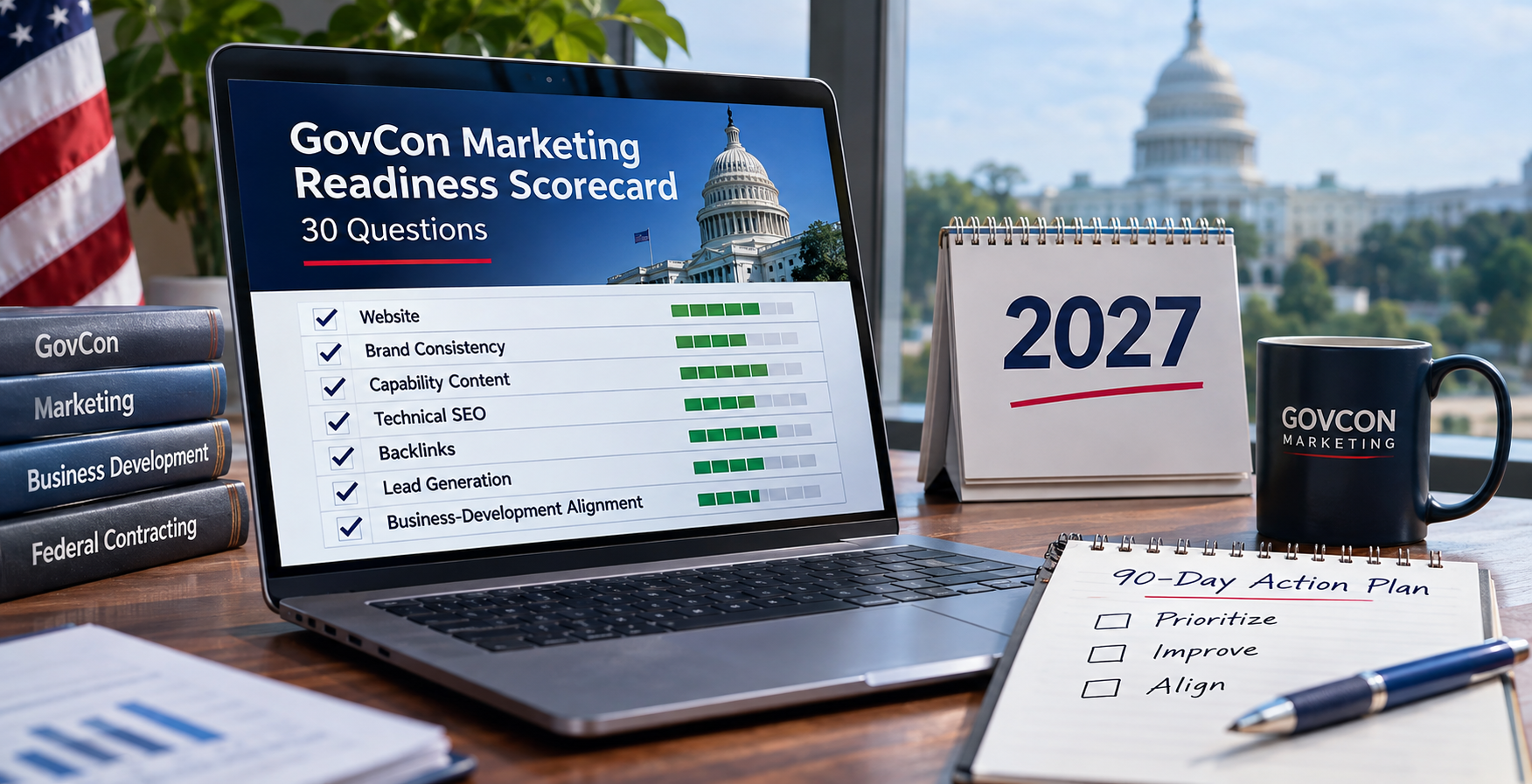
Is your government contracting company actually ready for 2027—or does your marketing simply look busy? Use these 30 practical questions to evaluate your website, brand consistency, capability content, backlinks, lead generation, and business-development alignment before investing in another year of digital marketing.
Your government contracting company has a business-development plan for 2027.
Your leadership team has identified target markets.
Your capture professionals are researching potential opportunities.
Your technical team understands the services your organization can perform.
And someone has probably suggested increasing the marketing budget.
Maybe it's time for a new website.
More blog posts.
Better search rankings.
A stronger LinkedIn presence.
Additional backlinks.
Or a lead-generation campaign.
Those investments could be useful.
But before approving them, there's a more important question.
Is your existing digital presence ready to support the company you're trying to grow?
Imagine a potential prime contractor discovers your business through an industry introduction.
They visit your website.
The homepage contains broad promises about innovation and mission success.
The service pages haven't been updated since 2023.
Your capability statement describes services that aren't mentioned online.
Your company's SBA Small Business Search profile emphasizes a different specialization.
The website contains several award announcements but little useful information about actual work performed.
And the contact form sends messages to an inbox nobody monitors.
Meanwhile, your marketing agency reports that website traffic increased.
Your LinkedIn posts received more impressions.
And the business earned a dozen new backlinks.
On paper, marketing looks active.
But from the perspective of a relevant teaming partner, the company may still be difficult to understand and contact.
That's the difference between marketing activity and marketing readiness.
Activity means you're doing things.
Readiness means the essential information, systems, and processes are in place to support the business's actual objectives.
For government contractors, those objectives may include becoming easier for appropriate prime contractors to evaluate, communicating verified capabilities, supporting legitimate business-development conversations, recruiting qualified personnel, or explaining new service areas.
Your website may contribute to those outcomes.
But it doesn't control federal procurement decisions.
It can't guarantee a subcontract award.
And a backlink from another website doesn't establish that your company meets a solicitation's requirements.
The right marketing audit should acknowledge those limits.
It should evaluate what marketing can reasonably influence.
It should also identify the gaps that make other business-development work harder.
That's the purpose of this 2027 GovCon Marketing Readiness Scorecard.
The following 30 questions are organized into six areas:
Website experience and conversion readiness
Brand identity and official-profile consistency
Capability content and credibility
Technical SEO, backlinks, and discoverability
Lead generation and inquiry qualification
Business-development alignment and accountability
You can complete the assessment without a complicated dashboard.
And you don't need to redesign the entire website to act on the results.
First, Understand What This Scorecard Measures
This assessment focuses on public-facing marketing readiness and the internal processes needed to maintain it.
It's not a formal federal acquisition evaluation.
It isn't a cybersecurity compliance assessment.
It doesn't determine whether your business qualifies for a small-business program.
And it doesn't predict whether you will win contracts in 2027.
Instead, it asks whether your company's public information and marketing systems are accurate, useful, discoverable, and connected to its business-development priorities.
How to Score Each Question
Give each of the 30 questions a score from zero to two.
0 points: The requirement is missing, unreliable, materially inaccurate, or not understood.
1 point: The company addresses it partially, inconsistently, or without a reliable process.
2 points: The requirement is meaningfully addressed, supported by evidence, and maintained.
Add the scores for a possible maximum of 60 points.
These are illustrative editorial criteria, not an industry-standard benchmark or a validated predictor of government contracting performance.
Most importantly, a high total score should never excuse a serious factual or security problem.
A misleading certification claim, an unauthorized disclosure, or a nonfunctioning contact form deserves attention regardless of the overall score.
Assign a responsible owner and record the evidence behind each answer.
Let's begin.
Section One: Website Experience and Conversion Readiness
Your website doesn't have to be elaborate.
It does need to help relevant visitors understand the company and take appropriate next steps.
1. Can a potential teaming partner understand what your company actually does within two minutes?
Open the homepage as an unfamiliar visitor.
Can you identify the firm's primary services?
Does the site distinguish real specializations from broad industry categories?
A headline about mission-critical innovation isn't enough.
Give yourself two points when the core capabilities are clear, specific, and supported by substantive service pages.
2. Does the website reflect the company you operate today?
Government contractors evolve.
New services emerge.
Teams grow.
The organization may move into different markets.
An outdated website can create confusion about current capabilities.
Compare its content with the company's current business-development priorities and verified service portfolio.
If important offerings are missing or discontinued services remain prominent, the site isn't fully ready.
3. Are important service pages easy to navigate and use on mobile devices?
A prospective partner may open your website immediately after an event or introduction.
Core capability pages should be reachable without confusing navigation.
They should load reliably and present essential information on both desktop and mobile.
Check the actual experience instead of relying only on a website design preview.
4. Does your contact page provide a clear path for legitimate business inquiries?
Can a prime contractor find the appropriate business-development contact?
Is there an understandable way to submit a teaming inquiry?
Are forms short enough for an initial conversation?
Do they avoid requesting unnecessary sensitive information?
A contact page isn't effective merely because it contains a Submit button.
5. Have you verified that contact forms and inquiries actually reach someone?
Submit an authorized test inquiry.
Confirm that the message is processed, delivered, and routed to the appropriate person.
Check the confirmation shown to the visitor.
Verify that inboxes are monitored and that the process doesn't depend on a former employee's email address.
A technically successful form click isn't necessarily a successfully received business inquiry.
Section Two: Brand Identity and Official-Profile Consistency
Your brand is more than a logo.
For government contractors, it includes the factual identity and qualifications people encounter across different sources.
6. Do your website, capability statement, and official profiles describe the same business?
Compare your current website with relevant federal and small-business records.
Check the legal entity, public brand, service descriptions, certifications, and business identifiers.
Different formats can provide different levels of detail.
But the underlying facts should agree.
A prospective partner shouldn't need to reconcile contradictory versions of your company.
7. Is your SAM.gov information current and accurately represented?
SAM.gov serves official federal entity registration and identification functions.
Companies seeking direct federal awards as prime awardees generally need the appropriate registration.
Certain other activities may require only a Unique Entity ID, depending on the circumstances.
A website can display accurate business information, but it doesn't replace official registration.
8. Is your SBA Small Business Search profile complete where applicable?
The Small Business Administration explains that prime contractors use Small Business Search, formerly Dynamic Small Business Search, to identify potential small-business partners.
The SBA recommends keeping capabilities narratives, relevant NAICS codes, keywords, certifications, and performance history current.
A generic or outdated profile can undermine the consistency of your digital presence.
9. Are business classifications, certifications, and contract vehicles represented accurately?
Verify every significant qualification claim.
A pending certification isn't an approved certification.
An employee credential isn't automatically an organization-wide credential.
An affiliate's contract vehicle doesn't necessarily belong to the company featured on your homepage.
And a subcontractor's experience shouldn't be presented as a direct prime award.
10. Can someone recognize the same company across your website, LinkedIn, and public materials?
Check the logo, company name, descriptions, professional profiles, and contact details.
Brand consistency doesn't require identical wording everywhere.
It requires an understandable public identity.
If your website describes one specialization and your LinkedIn page describes another, that disconnect may need attention.
Section Three: Capability Content and Credibility
A government contractor's content should explain real work.
It shouldn't simply generate traffic by repeating industry terminology.
11. Does each priority service page explain specific work your company performs?
"Cybersecurity solutions" can describe many different services.
So can "cloud modernization" or "program support."
A useful capability page explains what the organization actually provides.
It can distinguish advisory services from engineering, implementation, operations, or staffing.
The language should be technically accurate and approved.
12. Does your website contain credible, appropriately approved evidence of experience?
Relevant project summaries, verified corporate experience, and accurate staff qualifications can help visitors understand your capabilities.
But public case studies are different from official federal past-performance evaluations.
Don't publish restricted CPARS material or invent results.
When certain customer information cannot be released, use approved capability descriptions instead.
13. Do your award announcements distinguish selection from performance?
Winning a contract isn't the same thing as delivering the work.
Review headlines and news posts.
Do they distinguish an IDIQ ceiling from obligated funding or earned revenue?
Do they identify the correct prime, subcontractor, or joint venture role?
Do they describe anticipated services rather than completed outcomes when appropriate?
14. Is your published technical and regulatory information current?
Review pages discussing acquisition rules, cybersecurity requirements, certifications, and program schedules.
A time-sensitive article may have been accurate when published but outdated after an official change.
An old CMMC deadline, for example, shouldn't continue appearing as current guidance after the implementation schedule has changed.
Assign technical reviewers to material claims.
15. Does your content answer questions relevant to actual target audiences?
Your website may contain dozens of articles about industry trends.
But do those articles help a potential partner understand your expertise?
Ask whether the content addresses real service questions, technical topics the company understands, and information its intended audiences need.
Google's people-first content guidance emphasizes original, helpful, reliable information over content created mainly to manipulate rankings.
Section Four: Technical SEO, Backlinks, and Discoverability
This is where many government contractors confuse activity with actual search visibility.
A company may have backlinks and publish frequent articles while its most important capability pages remain difficult to discover.
16. Can search engines access the important public pages you want indexed?
Google's technical requirements identify basic conditions for indexing eligibility.
Googlebot needs access.
The page must return a successful response.
And it must contain indexable content.
Those requirements don't guarantee indexing.
Use Google Search Console to inspect important URLs and identify actual problems.
17. Are your internal links helping people find relevant capabilities?
Internal links are different from backlinks.
They connect pages within your own website.
A cloud engineering article should lead visitors to the relevant cloud capability page when appropriate.
A case study can connect to the service it illustrates.
Google's link best practices recommend crawlable links with descriptive, relevant anchor text.
Don't leave important pages isolated.
18. Do your backlinks come from relevant, legitimate sources?
A backlink is a link from another website to yours.
Not all backlinks have equal relevance or credibility.
A genuine reference from an appropriate industry organization, professional resource, event page, or independent publication may be useful.
But a large collection of unrelated low-quality links doesn't establish expertise.
Evaluate context and legitimacy rather than chasing a raw backlink count.
19. Are you avoiding paid link schemes and manipulative backlink tactics?
Google's spam policies identify link spam practices such as buying links for ranking purposes, excessive link exchanges, automated link creation, and certain low-quality directory tactics.
Paid promotional links must be appropriately qualified, such as with rel="sponsored" or rel="nofollow".
A marketing agency shouldn't promise hundreds of ranking links through undisclosed schemes.
20. Do you have a realistic plan to earn relevant mentions and links?
Legitimate link opportunities may arise from useful, original content, accurate professional listings, approved industry participation, speaking engagements, and independently chosen editorial references.
A backlink from a government-related website is not automatically an endorsement or guarantee of higher rankings.
Don't manufacture government relationships to attract links.
The strongest plan begins with content and activities other people have a legitimate reason to reference.
Section Five: Lead Generation and Inquiry Quality
More website traffic doesn't automatically mean more relevant business development.
Your marketing measurement should distinguish different stages.
21. Have you defined what a qualified GovCon marketing inquiry actually means?
A website inquiry might come from a potential prime contractor, a recruiting candidate, a vendor, or an unrelated salesperson.
Your organization should define which types of messages are relevant to its goals.
For some companies, a qualified inquiry may involve a legitimate organization seeking a service the contractor performs.
That is different from automatically counting every form submission as a lead.
22. Can your analytics distinguish an attempted submission from a successfully received inquiry?
Google Analytics 4 includes events for lead-generation activity.
But an event triggered when someone clicks Submit may not prove that the backend processed the message.
Review the technical implementation.
When possible, track confirmed successful actions separately from incomplete attempts.
Don't send personally identifiable or sensitive inquiry details into analytics systems.
23. Does someone review and qualify inbound messages?
Google's recommended GA4 events distinguish actions such as generate_lead and qualify_lead.
The distinction reflects a practical business need.
Someone has to determine whether a received inquiry is relevant.
That judgment may be performed by business development and recorded in an appropriate CRM or other controlled system.
24. Are you measuring relevant discovery rather than traffic volume alone?
A company providing specialized federal systems engineering may attract visitors looking for unrelated consumer technology services.
That traffic may increase analytics totals without supporting the firm's goals.
Use Search Console and appropriate analytics to understand which service pages and search queries are generating relevant activity.
Don't assume every impression, click, or visit represents a future contract opportunity.
25. Does your website offer an appropriate next step for each important audience?
A prospective teaming partner may need a business-development contact.
A potential employee may need an active Careers page.
Someone researching a capability may benefit from an approved statement or relevant service page.
Not every visitor should be pushed through the same lengthy sales form.
Good conversion design supports the visitor's legitimate purpose.
Section Six: Business-Development Alignment and Accountability
The final five questions determine whether marketing activity connects to the company's actual work.
26. Does marketing understand the company's priority markets and capabilities for 2027?
The marketing team should know which services are strategically important.
It should understand the kinds of organizations the business-development team wants to reach.
That doesn't require sharing sensitive capture plans with every vendor.
It does require a clear, approved statement of priorities.
Without that direction, content can become disconnected from the business.
27. Are marketing materials useful during real teaming and partner conversations?
Ask business-development employees whether they share website pages, capability statements, or approved project summaries.
Do the materials answer recurring questions?
Do employees avoid sending links because the website is outdated?
A website can be useful even when it isn't directly generating an inquiry.
Supporting an existing introduction is a legitimate role.
28. Does your prime contractor research lead to targeted outreach rather than generic campaigns?
The GSA's small-business opportunity resources identify tools such as SBA SUBNet, federal spending information, and subcontracting directories.
These can support research.
But a list of prime contractors is not automatically a list of ready buyers.
Outreach should reflect genuine capability fit, current information, and applicable communication requirements.
29. Is someone accountable for updating content, profiles, and contact information?
A website can become outdated even after a successful redesign.
Who owns the company biography?
Who approves new capability pages?
Who updates the public capability statement?
Who checks official profile consistency?
Who tests the contact form?
Assign responsibilities rather than assuming marketing will somehow stay current.
30. Can you explain what marketing contributed without claiming it caused every contract award?
Measure observable work.
That may include completed capability pages, corrected errors, relevant search discovery, successfully received inquiries, qualified conversations, and documented use of marketing materials.
A later subcontract award can depend on many factors beyond marketing.
Good reporting acknowledges that distinction.
An agency shouldn't automatically attribute contract value to a backlink, website visit, or form submission.
How to Interpret Your 2027 GovCon Marketing Readiness Score
Add the points for all 30 questions.
Your maximum score is 60.
For an illustrative interpretation, consider the following ranges.
0–29 points: The company has substantial foundational gaps. Prioritize factual accuracy, essential website functionality, company identity, and inquiry routing before investing heavily in traffic campaigns.
30–44 points: Some important elements are working, but inconsistencies and process weaknesses remain. Focus on the highest-impact problems rather than attempting to improve every marketing channel simultaneously.
45–54 points: The core presence is relatively established under this framework. Look for specific improvements in capability content, relevant discoverability, qualified inquiries, and internal accountability.
55–60 points: The organization appears well prepared under this editorial checklist, but it still needs ongoing verification, maintenance, and measurement.
These bands are planning tools.
They are not federal standards, independent maturity assessments, or predictors of rankings, leads, or contract awards.
Pay Attention to Zero Scores
A zero on a critical question may be more important than a high total score.
For example, a company might earn 54 points overall while having a broken business-development contact form.
Or it might score well on brand consistency while displaying a misleading certification claim.
Those issues deserve priority regardless of the total.
Compare Categories, Not Just the Total
If your brand information is accurate but backlink practices are questionable, address the backlink problem.
If technical SEO is sound but your service pages say almost nothing, improve the content.
If the website attracts relevant traffic but nobody handles inquiries, fix the business-development handoff.
The score is a starting point for decisions—not a marketing trophy.
Why Backlink Quantity Is a Weak GovCon Marketing Goal
Because this article focuses partly on backlinks and lead generation, it's worth examining backlink strategy more closely.
Some agencies advertise backlinks as though the only important variable is the number.
They may promise 50 links per month.
Or 100.
They may emphasize high domain authority scores.
And they may argue that the company's website needs more links before any other marketing work can succeed.
That approach can miss the real issue.
Relevance Matters
A legitimate link from a relevant industry resource may help a reader discover information about your business.
An unrelated link from a low-quality directory may provide little value.
Third-Party Scores Aren't Government Credentials
Commercial SEO tools provide their own metrics for evaluating websites and link profiles.
Those scores aren't federal certifications.
Nor are they Google's official ranking scores.
They can be useful diagnostic tools, but they should not become the entire marketing objective.
Press Release Distribution Isn't Automatic Link Building
Publishing a legitimate contract award announcement may be appropriate after required review.
But distributing press releases primarily to create keyword-rich ranking links can raise issues under Google's link spam policies.
A press release should communicate real company news.
It shouldn't become a disguised paid-link scheme.
You Cannot Buy a Government Endorsement
A link from a government website may exist for informational reasons.
It doesn't automatically mean the government recommends your company.
Never describe a backlink as proof of a federal endorsement.
Good Content Can Support Earned References
An approved technical article or genuinely useful resource may give other organizations a reason to cite your work.
But even excellent content doesn't guarantee backlinks.
Earned link development is a long-term effort rooted in legitimate relevance.
A Practical GovCon Backlink Strategy for 2027
Instead of purchasing link packages, begin by identifying where appropriate references to the company could naturally occur.
Review Existing Mentions
Does a legitimate industry organization already mention your company but link to an outdated URL?
You may be able to request an accurate update through normal channels.
Keep Professional Listings Accurate
Relevant memberships, event participation, and legitimate business profiles may provide public company references.
Their value should come from authenticity and usefulness.
Publish Original Expertise Where Appropriate
Technical specialists may have insights they can share publicly.
A well-sourced article answering a real industry question may be useful beyond your website.
Participate in Relevant Events
Approved speaker biographies or event listings can create legitimate visibility.
Don't participate solely to manufacture a backlink.
Avoid Reciprocal Link Networks
Excessive exchanges designed primarily to manipulate rankings are specifically addressed by Google's spam policies.
Review the Agency's Methods
If an SEO provider refuses to explain where links come from or how they're obtained, ask more questions.
A credible backlink strategy should withstand scrutiny.
A Fictional Example: Why a 38/60 Score Can Still Be Useful
Consider a fictional government contractor called Summit Federal Technologies.
It employs about 40 people and provides verified enterprise IT and cybersecurity support services.
The company's leadership completes the 30-question assessment.
Its total is 38 out of 60.
That number isn't an independent evaluation or a real client result.
It's an illustration of how the scorecard can guide priorities.
What's Working
Summit's website is mobile-friendly.
The company has current corporate contact information.
Its capability statement is generally accurate.
And the business-development team has identified a manageable group of potential partners.
What's Not Working
The services are difficult to understand.
The website contains little approved experience information.
An SEO provider has been purchasing low-quality backlinks.
The contact form is inconsistent.
And marketing counts all submissions as qualified leads.
The Wrong Response
Summit could purchase a larger backlink package.
It could publish more generic articles.
Or it could redesign the homepage without resolving the underlying content and routing problems.
That would create more activity.
But it might leave the most important weaknesses unresolved.
The Better Response
The company verifies its core services.
It rewrites priority capability pages.
It reviews and discontinues manipulative link practices.
It tests contact submissions.
It establishes lead qualification criteria.
And it connects the content to real business-development needs.
The Lesson
The scorecard is useful because it identifies what to fix.
The point isn't to raise the score through superficial changes.
It's to improve how the digital presence functions.
A 90-Day 2027 GovCon Marketing Readiness Plan
A 90-day program can help organize the work.
The following timeline is illustrative.
Days 1–30: Verify, Audit, and Prioritize
Complete the 30-question assessment with leadership, business development, marketing, and technical stakeholders.
Review official company information.
Check capability statements.
Test the website and contact process.
Examine search visibility and existing backlinks.
Identify outdated or misleading claims.
Prioritize serious factual, security, and operational issues.
Days 31–60: Improve the Core Foundation
Rewrite the homepage where needed.
Develop or improve priority service pages.
Update public capability information.
Fix important indexing, navigation, and contact problems.
Stop inappropriate link-building practices.
Clarify lead qualification and routing.
Establish content ownership.
Days 61–90: Support Relevant Discovery and Conversations
Review technical SEO improvements.
Develop useful content tied to actual capabilities.
Pursue legitimate industry visibility where appropriate.
Connect marketing materials to business-development outreach.
Review successfully received and qualified inquiries.
Measure what has actually improved.
Define the next quarter's priorities.
What Should You Expect?
A more accurate and useful website.
Clearer company positioning.
Better internal consistency.
A more defensible backlink approach.
A more reliable inquiry process.
And better alignment between marketing and business development.
Those are reasonable marketing deliverables.
They are not guarantees of new federal awards.
How to Decide What Deserves Budget in 2027
After the assessment, the company should have a better understanding of what it needs.
If the website is misleading or broken, address that first.
If core service pages are missing, develop them before paying to drive more traffic.
If company records and marketing materials conflict, correct them.
If the existing backlinks came from manipulative tactics, review and stop the underlying practices rather than automatically buying replacements.
If the company receives relevant inquiries but fails to respond, fix the handling process.
A Redesign Isn't Always the Answer
Some businesses need better content and maintenance.
Others have genuinely outgrown their website structure or technology.
The audit should determine the scope.
A Retainer Isn't Always the First Step
A focused project may be sufficient to resolve major foundational gaps.
Ongoing support may make sense when the company needs regular content development, SEO maintenance, reporting, or website updates.
Choose Work With a Clear Purpose
Every proposed marketing activity should address an identified problem or support a defined business objective.
Avoid buying services merely because they are popular.
Ask for Transparent Deliverables
A marketing agency should be able to explain what it will do, who will review the work, and how outcomes will be assessed.
For GovCon businesses, realistic accountability is more useful than inflated promises.
Frequently Asked Questions
1. What is a GovCon marketing readiness scorecard?
It is a structured way to evaluate whether a government contractor's website, public company information, content, search visibility, inquiry process, and marketing operations support its business goals. This 30-question version is an editorial planning tool, not an official federal assessment.
2. Why should contractors conduct a marketing audit before 2027?
A review can identify outdated content, inaccurate business information, broken contact forms, weak capability messaging, or marketing activities disconnected from business development. Addressing these problems may make future spending more purposeful.
3. Is a high readiness score a guarantee of federal contract success?
No. Contract outcomes depend on many factors beyond marketing, including eligibility, technical capability, competition, pricing, procurement rules, and evaluation criteria. The scorecard does not predict federal awards.
4. Does a small government contractor need a large website?
Not necessarily. A smaller site can be effective when it provides accurate service descriptions, relevant qualifications, a professional user experience, and reliable contact information. A larger website isn't automatically a stronger one.
5. How often should a GovCon website be audited?
There is no universal mandatory marketing-audit frequency. A substantial review before a new planning year can be useful, with additional checks after major changes to services, business identity, certifications, website technology, or applicable public guidance.
6. Should the website and SBA Small Business Search profile match?
They should be factually consistent. The website can provide more detail than an official discovery profile, but services, entity information, and certification claims should not contradict one another.
7. Does SAM.gov registration replace having a website?
No. SAM.gov serves official federal registration and entity identification functions. A marketing website serves a different purpose by providing public explanations of the business's services, experience, and contact information.
8. Are backlinks important for government contractor SEO?
Backlinks may help search engines discover pages and evaluate relevance. But their usefulness depends on the source and context. A large number of low-quality or manipulative links is not a credible strategy.
9. Should a GovCon company buy backlinks?
Buying links primarily to manipulate rankings violates Google's link spam policies. Legitimate paid advertising or sponsorship links should be appropriately qualified. Focus on authentic visibility and useful content rather than purchased ranking signals.
10. Do links from government websites guarantee better rankings?
No. A legitimate government-site link may be relevant, but it doesn't guarantee higher rankings, federal endorsement, or contract eligibility. Its existence must be understood in context.
11. Can press releases be used to build backlinks?
Legitimate press releases can communicate company news. However, distributing keyword-rich, unqualified links primarily to manipulate rankings can fall under Google's link spam policies. The primary purpose should be accurate communication.
12. What's the difference between internal links and backlinks?
Internal links connect pages on the same website. Backlinks come from other websites. Both can help people discover useful information, but they serve different purposes and should not be treated as interchangeable metrics.
13. What is a qualified lead in GovCon marketing?
A qualified lead is an inquiry that meets criteria defined by the company's business-development process. For example, it may involve an identifiable organization with a legitimate interest in relevant capabilities. A form submission alone doesn't establish qualification.
14. Can GA4 track qualified leads?
Google Analytics 4 provides recommended lead-generation and lead-qualification events. But meaningful qualification usually requires information and decisions from the business-development process. Tracking should be implemented accurately and without exposing prohibited personal or sensitive data.
15. What if our website generates traffic but few relevant inquiries?
Review whether the traffic matches your intended audience, whether service pages explain your capabilities, and whether the contact process works. More traffic isn't necessarily the solution if visitors are unrelated to your actual services.
16. Should government contractors publish past-performance case studies?
Appropriate, verified public project information may help explain a company's experience. But public case studies are different from official performance evaluations and must respect contractual, security, and disclosure requirements.
17. How important is LinkedIn for a GovCon company?
A current LinkedIn presence may support professional research and business relationships. It should reinforce the company's actual identity and capabilities. Posting frequency and follower counts alone aren't measures of successful teaming.
18. Do we need a website redesign to improve our score?
Not automatically. Some problems can be corrected through content updates, technical fixes, profile maintenance, or better inquiry routing. A redesign makes sense when the overall structure or technology no longer supports the business.
19. How much should a contractor spend on GovCon SEO and lead generation in 2027?
There is no universal budget. Spending should reflect the company's size, goals, current website condition, target audiences, internal resources, and defined deliverables. Fixing foundational problems may be more valuable than immediately purchasing an ongoing campaign.
20. What's the first action after completing the scorecard?
Identify critical inaccuracies and operational failures, assign an owner, and prioritize corrections. Then use the remaining results to build a realistic 90-day action plan focused on relevant capabilities, discoverability, inquiry handling, and business-development support.
Is Your 2027 GovCon Marketing Plan Built on a Strong Foundation?
Government contractors spend significant time preparing for future work.
They research opportunities.
Develop teams.
Build technical capabilities.
Maintain contract vehicles.
Pursue relevant certifications.
And work to establish relationships with prospective partners.
Marketing should help communicate that effort.
But it can't do so reliably when the public information is outdated, generic, inconsistent, or difficult to access.
A professional website matters.
So does a current capability statement.
Accurate official profiles matter.
Useful content matters.
Relevant backlinks can support discovery.
And an effective contact process makes legitimate business conversations easier to begin.
But these elements need to work together.
A high-performing website isn't simply the one with the most pages.
A strong backlink strategy isn't the one with the largest number of purchased links.
And successful lead generation isn't the process that counts every vendor solicitation as a new opportunity.
For government contractors, readiness means something more practical.
Can the right audience understand the business?
Can they verify appropriate public qualifications?
Can they find useful capability information?
Can they reach someone who can respond?
And can the marketing team explain what its work contributed without claiming responsibility for federal awards it didn't control?
Those questions deserve attention before 2027.
The 30-question scorecard provides a way to begin.
Use it to identify gaps.
Decide what needs fixing.
Determine which projects deserve budget.
And clarify who owns the work.
You may discover that a website refresh is sufficient.
You may need a more substantial redesign.
Perhaps the priority is correcting official profiles and capability content.
Or your biggest problem may be an unreliable contact process that has gone unnoticed for months.
The point isn't to do more marketing in 2027. It's to make sure the marketing you do is accurate, useful, and connected to the business you're trying to grow.
Because a full content calendar doesn't automatically mean your company is ready.
Neither does a growing backlink report.
And a busy marketing dashboard isn't necessarily evidence of meaningful business-development progress.
A strong foundation is easier to build when you know what's missing.
Is Your Government Contracting Company Ready for 2027?
At Ritner Digital, we believe government contractor marketing should begin with an understanding of the actual business.
That means reviewing your website, service positioning, public company information, content, search visibility, and the paths that help relevant visitors contact your team.
You may need a focused website audit.
Clearer capability pages.
Better SEO and internal linking.
A review of backlink practices.
Stronger coordination between your website and capability statement.
Or a redesign that reflects the organization you've become.
The right project depends on the gaps—not a generic marketing package.
Ritner Digital helps businesses improve website design, content strategy, SEO, and digital positioning around their goals.
Contact Ritner Digital to discuss your 2027 government contracting marketing priorities and identify opportunities to build a stronger digital foundation.
Because the most useful question isn't how much marketing activity you can fit into next year.
It's whether your marketing is ready to support the opportunities your business-development team is actually pursuing.