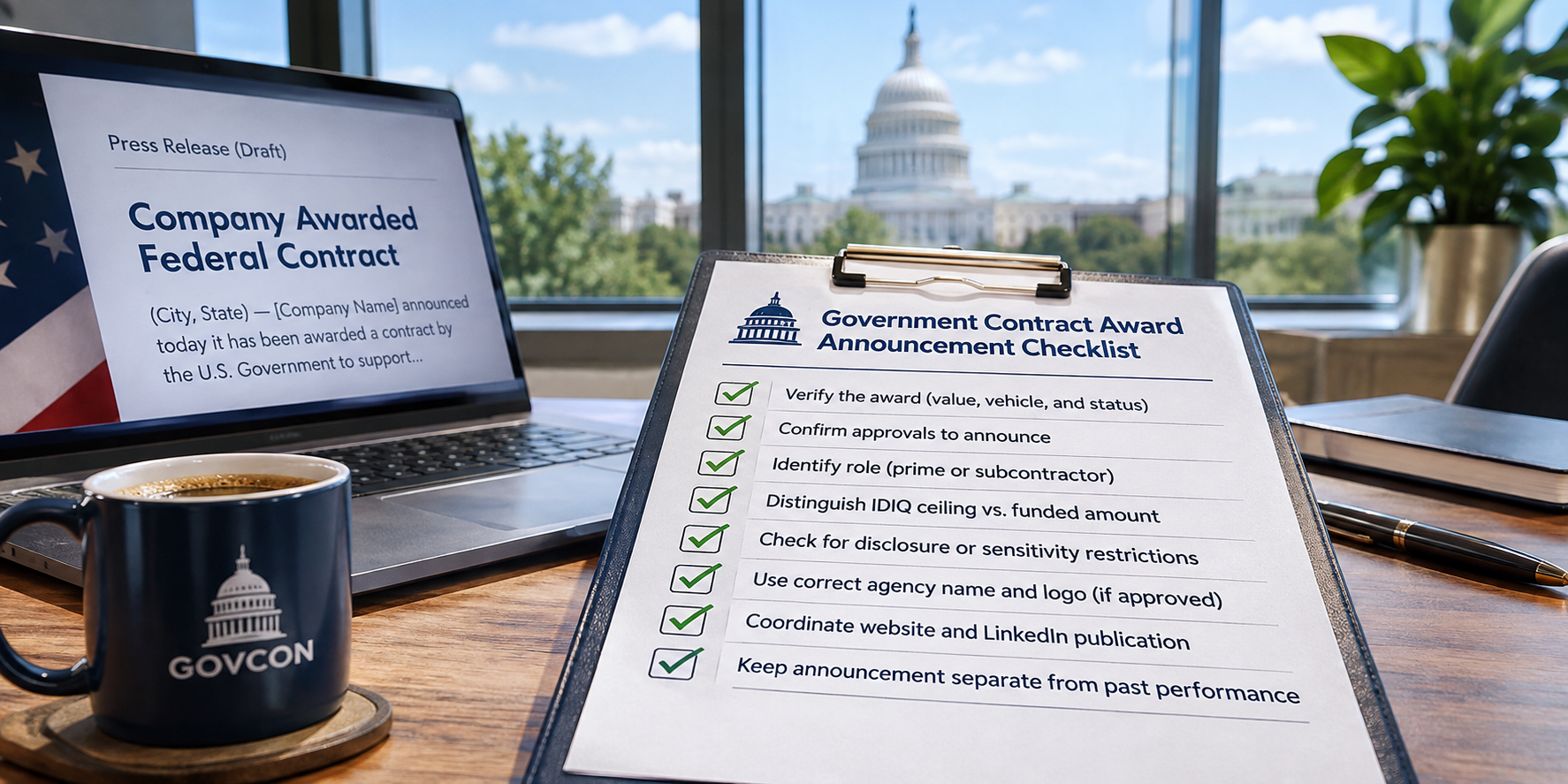
Winning a government contract is a meaningful milestone. Announcing it publicly, however, requires more than an impressive headline and a contract value. Here's how government contractors can verify award details, navigate disclosure restrictions, avoid misleading claims, and turn approved contract news into useful business-development content.
Your government contracting company just received exciting news.
You've won a federal contract.
Maybe it's your first prime award.
Perhaps your business secured a new task order.
Or you've been selected as a subcontractor on a larger federal program.
Your leadership team wants to celebrate.
Your employees deserve recognition.
And your marketing team sees an opportunity to tell the market about the company's growth.
Someone opens a document and starts writing.
"Northern Virginia Government Contractor Wins $75 Million Federal Contract to Deliver Mission-Critical Technology Solutions."
The headline sounds impressive.
The marketing team prepares a website announcement.
Someone designs a LinkedIn graphic.
Your business-development director wants to send the news to potential teaming partners.
And the company president is ready to share a quote about innovation, mission success, and exceptional service.
But before anyone clicks Publish, there are several questions worth answering.
Was your company awarded a $75 million contract—or a place on a contract vehicle with a $75 million maximum ceiling?
Does the value include unexercised options?
Has the government officially announced the award?
Does your contract contain a publicity or disclosure restriction?
Is your company the prime contractor, a subcontractor, or part of a joint venture?
Can you publicly name the customer?
Are you authorized to use the agency's logo?
And does the announcement describe work you've been selected to perform—or work you've actually completed?
These aren't minor editing questions.
They can determine whether your announcement is accurate, appropriate, and genuinely useful.
A government contract award announcement is not just a marketing opportunity. It's a factual statement about a contractual event.
The details matter.
A misleading headline can make your business appear to have earned revenue it hasn't received.
An inaccurate service description can create confusion about your capabilities.
A poorly attributed announcement can make subcontracted work look like a direct federal prime award.
And an unauthorized release can create contractual or security concerns.
That doesn't mean government contractors should avoid announcing legitimate achievements.
Award announcements can support company visibility, employee recognition, recruitment, and professional relationships.
They can show that a business is active in the federal contracting market.
They may give existing contacts an appropriate reason to reconnect.
And they can provide useful context for prospective teaming partners.
But an announcement should never exaggerate what the award actually represents.
It also shouldn't disclose information the company isn't authorized to publish.
The goal is to celebrate the award without creating confusion about the contract, the company's role, or its future performance.
This guide provides a practical government contract award announcement checklist covering what to verify, what to publish, what to leave out, and how to manage approvals before the news appears on your website or LinkedIn.
Why Government Contract Award Announcements Need a Different Review Process
A typical business might announce a new customer or project through a relatively simple marketing workflow.
Government contracting is different.
Federal awards can involve public announcement procedures, procurement-sensitive information, contractual disclosure clauses, classified programs, proprietary information, and multiple organizations performing different roles.
The applicable requirements can vary by agency, contract, subcontract, and program.
That means there is no single universal rule allowing every government contractor to issue a press release whenever it receives an award notification.
Federal Agencies Have Their Own Announcement Procedures
FAR 5.303 addresses government announcements of certain contract awards.
It establishes public-release procedures for covered awards and allows agency acquisition regulations to specify different requirements.
For applicable announcements, timing is coordinated with the agency's release process.
The provision governs government announcement responsibilities.
It is not a blanket authorization for contractors to disclose whatever information they want.
The Contract May Include Additional Restrictions
Defense contracts, for example, may incorporate DFARS 252.204-7000, Disclosure of Information.
When that clause applies, it restricts the release of unclassified information pertaining to the contract or related program unless one of the clause's exceptions is satisfied.
One route is obtaining prior written approval from the contracting officer.
For requests under that route, the clause requires submission at least 10 business days before the proposed release date.
The clause also addresses subcontractors, whose requests must pass through the prime contractor to the contracting officer.
That ten-business-day rule is specific to the applicable clause—not a universal press-release deadline for every federal contract.
Other Agencies May Have Publicity Requirements
Agency-specific acquisition clauses and policies can impose additional approval requirements.
For instance, the Department of Homeland Security's acquisition regulations address contractor publicity and the release of information involving sensitive or classified work.
Public Award Information Doesn't Eliminate Every Restriction
An agency might publish an award notice identifying your company.
That doesn't automatically authorize you to publish additional technical details, photographs, performance claims, or proprietary information.
The appropriate review depends on the information, relevant clauses, and contract circumstances.
For this reason, the first step in producing an award announcement should be determining what the organization is actually authorized to say.
What Exactly Did Your Company Win?
Before writing the headline, establish which contractual event occurred.
Several types of awards and agreements can sound similar in marketing but mean different things.
A Direct Prime Contract
Your company may have received a federal contract directly from an agency.
If so, the announcement should accurately identify the recipient entity and the approved nature of the work.
An IDIQ Contract
An indefinite-delivery, indefinite-quantity contract provides a mechanism for the government to order supplies or services within established limits during a specified period.
Under FAR 16.504, an IDIQ contract specifies a minimum and maximum quantity or value.
The maximum amount is not necessarily the amount the government has ordered, paid, or will ultimately spend.
A Task or Delivery Order
A company may receive an order under an existing contract vehicle.
That is different from receiving the underlying vehicle itself.
The announcement should distinguish the two.
A Multiple-Award Contract Vehicle Position
Selection for a multiple-award vehicle may create eligibility to compete for or receive orders under the vehicle's terms.
It doesn't automatically mean the contractor has been awarded the maximum potential work available across the entire program.
A Subcontract Award
A prime contractor may select your business to perform part of a larger engagement.
That can be an important achievement.
But your announcement should not imply that your company received the federal prime award directly.
A Joint Venture Award
A joint venture may be the actual recipient.
If so, distinguish the joint venture's role from that of its participating companies.
A Contract Modification or Option Exercise
A modification or exercised option may expand, extend, or otherwise change an existing contractual arrangement.
It should not automatically be marketed as a completely new award.
An Other Transaction Agreement
Some federal agreements operate outside conventional FAR contract structures.
Don't label every agreement a federal contract without confirming the correct instrument.
The exact nature of the award should determine the announcement—not the other way around.
The Government Contract Award Announcement Checklist
The following checklist is designed for marketing, business development, leadership, contracts, and security teams.
It isn't a substitute for contractual review or legal advice.
Its purpose is to make the publication process more reliable.
Part One: Verify the Award Before Writing the Announcement
1. Confirm That the Award Is Official
Start with the underlying contractual event.
Has the agreement or relevant award action actually been executed?
Is the notification final, or is your company still awaiting a formal action?
Don't announce an anticipated award as a completed award.
Being selected for negotiations, receiving a notice of intent, or being identified as an apparent successful offeror may not mean the same thing as a completed contract award.
Your contracts team should verify the status.
2. Identify the Correct Award Recipient
Confirm the precise legal entity that received the award.
This matters when your business has subsidiaries, affiliates, joint ventures, or multiple brands.
If the award belongs to a joint venture, don't automatically announce it as a direct award to one member company.
Use the appropriate approved naming convention.
3. Confirm Your Company's Contractual Role
Are you the prime contractor?
A subcontractor?
A joint venture member?
A teammate selected for a particular portion of the work?
The public description should identify the actual role.
A subcontractor shouldn't claim the full prime award as its own contract.
4. Verify the Contract or Order Type
Determine whether you're announcing a standalone contract, IDIQ, task order, delivery order, subcontract, modification, option exercise, or another agreement.
The type affects the meaning of the award and the language used to describe it.
5. Verify the Award Date
Check the actual award or effective date reflected in the authorized records.
Don't use the date when marketing first heard about the award as though it were the official award date.
If the company is announcing the news later, make that distinction clear.
6. Check the Award Amount and Its Meaning
Before including a dollar value, determine exactly what the figure represents.
Is it the funded amount?
The initial obligation?
The value of a task order?
An estimated total?
A maximum ceiling?
A potential amount including options?
The USAspending.gov Federal Spending Guide distinguishes obligations from outlays.
An obligation represents a government commitment to spend funds.
An outlay occurs when money is actually paid.
Neither should automatically be described as the contractor's completed revenue or verified performance outcome.
7. Confirm the Period of Performance
Check when work is scheduled to begin and end.
Identify whether the announcement includes options or potential extensions.
Don't imply that every possible option has already been exercised.
And don't describe a five-year potential period as five years of completed performance.
Part Two: Confirm What Can Be Released
8. Review the Applicable Publicity and Disclosure Clauses
Ask the contracts team to identify restrictions associated with the specific award.
For certain defense contracts, DFARS 252.204-7000 may apply.
Other agency clauses may impose different requirements.
The marketing team shouldn't assume that a general company policy is sufficient for every agreement.
9. Confirm the Government's Announcement Status
If the agency is preparing an official public announcement, coordinate timing through the appropriate contractual or public affairs channels.
Do not assume that learning about the award internally means the public-release process has been completed.
FAR 5.303 establishes agency announcement procedures for covered awards, and supplemental rules may differ.
The company should verify the circumstances rather than selecting an arbitrary publication time.
10. Obtain Required Written Approvals
When an applicable clause or agreement requires prior approval, obtain it before publishing.
Keep a record of the material reviewed and the authorization received.
Approval of one version doesn't necessarily authorize substantial additions or new claims.
For subcontract awards, the prime contractor may need to coordinate the request.
11. Review Classified, Controlled, and Sensitive Information
A contract award can involve information that is not appropriate for public release.
Under 32 CFR 117.15, even unclassified information pertaining to a classified contract may require review before public disclosure.
That provision specifically addresses promotional materials.
The regulation includes limited exceptions, but their applicability depends on the circumstances and government direction.
Controlled Unclassified Information, proprietary technical data, sensitive program details, and other restricted material may have additional requirements.
Removing a classification marking or omitting a program name does not automatically make information publishable.
12. Verify Customer Names, Logos, and Quotes
Don't assume that receiving a government contract authorizes the use of the agency's seal.
USAGov's guidance on federal materials explains that government trademarks and agency logos generally require permission.
It also prohibits use of government materials in ways that suggest unauthorized government endorsement.
Customer quotations deserve similar care.
A statement made by a government employee during contract activity isn't automatically an authorized advertising testimonial.
Part Three: Write the Announcement Accurately
13. Describe the Award Without Overstating It
The opening paragraph should explain what happened.
Identify the recipient and nature of the award using approved information.
Describe the amount only with the appropriate qualification.
Avoid headlines that inflate an IDIQ ceiling into guaranteed revenue.
14. Explain the Work the Company Is Expected to Perform
A useful award announcement tells readers more than the contract title.
Where authorized, explain the general services your company has been selected to provide.
Use clear, specific language.
But distinguish anticipated work from work already performed.
15. Avoid Claiming Outcomes Before Performance
A newly awarded contract doesn't establish that the contractor has already delivered the anticipated results.
If the work hasn't started, don't write that your team has transformed the agency's operations or achieved dramatic savings.
Those may be intended objectives.
They are not yet verified outcomes.
16. Verify Leadership Quotes
Executive quotations should be real, reviewed, and accurately attributed.
They may explain why the work aligns with the company's capabilities or express appreciation for the opportunity.
They shouldn't disclose restricted information or imply government endorsement.
Avoid inventing quotations simply because press releases typically contain one.
17. Check Every Claim About the Company's Qualifications
If the announcement mentions certifications, contract vehicles, business status, past performance, or technical expertise, verify the claim.
An award to one legal entity doesn't automatically mean every affiliate holds the same qualifications.
An employee's previous experience isn't automatically corporate past performance.
Part Four: Prepare the Announcement for Publication
18. Confirm the Approved Version and Publication Channels
Before distribution, identify the final approved text.
Determine whether the authorization covers the company website, LinkedIn, press distribution, email, or other intended channels.
A permission tied to one version, medium, or purpose shouldn't automatically be stretched to cover additional material.
19. Link the Announcement to Relevant Capabilities
An announcement is more useful when readers can understand the company's actual service offerings.
Where appropriate, link from the news article to an existing, approved capability page.
Don't force visitors to read an unrelated promotional brochure to determine what your company does.
20. Archive the Records and Maintain the Page
Keep the approved announcement, relevant verification notes, and required release records according to the company's applicable policies.
If the contract is later modified, canceled, completed, or otherwise materially changed, review whether the published description remains accurate.
A news announcement can remain a historical record.
But it shouldn't continue making misleading present-tense claims.
What Should You Actually Publish?
After completing the checklist, you may discover that a concise announcement is more appropriate than a long press release.
That's fine.
A useful award announcement generally needs only the information that is both accurate and authorized.
Depending on the specific agreement, appropriate public content might include the company's name, the type of award, a high-level description of the services, the relevant customer when permitted, the date, an accurately characterized contract value, and a company contact.
Not every element belongs in every announcement.
Lead With the Actual News
The headline should communicate the award.
Avoid vague language that obscures the contractual event.
Explain the Relevant Capability
If the company received a cloud infrastructure task order, the announcement can explain the approved type of cloud work.
If the award relates to professional services, identify the functions involved.
The description should reflect the actual scope.
Give Readers Useful Context
A visitor may want to understand how the award relates to the organization's established services.
That's more useful than several paragraphs repeating mission-critical slogans.
Keep the Language Measured
Receiving an award is an achievement.
You don't need to claim that it proves the company is the nation's leading provider in its category.
Offer an Appropriate Next Step
A prospective partner can be directed to a relevant capability page or business-development contact.
The announcement should support further research rather than function as an exaggerated sales pitch.
What Should You Leave Out?
Sometimes the most important work happens during editing.
The marketing team may have legitimate access to internal information that isn't suitable for publication.
A good review identifies what should remain private or be omitted until authorization is established.
Unapproved Contract or Program Details
Don't disclose restricted technical information, customer requirements, nonpublic schedules, or program relationships merely because they make the announcement more compelling.
Source-Selection and Protected Proposal Information
FAR 3.104-4 addresses the protection of contractor bid or proposal information and source-selection information.
An award announcement is not a reason to disclose protected procurement material.
Unverified Financial Claims
Avoid describing ceiling amounts as realized revenue.
Don't present unexercised options as funded work.
And don't attribute a prime contract's full value to a subcontractor.
Unsupported Performance Claims
An award does not prove that the company has already met schedules, delivered systems, or improved performance.
Unauthorized Agency Logos
Government seals aren't decorative credentials.
Use them only when appropriate permission and other requirements are satisfied.
Invented Customer Testimonials
A fictional statement from a contracting officer or program manager doesn't become acceptable because it sounds positive.
Sensitive Employee Information
Don't identify individuals, assignments, work locations, or qualifications in ways that violate security, privacy, or contractual requirements.
Broad Claims of Government Endorsement
A federal contract is not a general government recommendation of the contractor's products or services.
A credible announcement should be confident about what happened and restrained about what hasn't been established.
Before and After: Three Government Contract Award Headlines
These examples are fictional and assume the underlying information has been verified and approved for the intended release.
Example One: The IDIQ Ceiling Problem
Misleading headline:
"Meridian Federal Wins $100 Million in Federal Cloud Revenue."
Suppose the underlying agreement is an IDIQ with a $100 million maximum ceiling.
The headline implies a financial result that the contract doesn't necessarily support.
More accurate headline:
"Meridian Federal Selected for Federal Cloud Services IDIQ With a Maximum Ceiling of $100 Million."
The body should explain that orders are issued under the contract's terms and that the ceiling does not guarantee the full value will be ordered.
Even this revised wording should only be published when the amount and other details are authorized for public release.
Example Two: Prime Versus Subcontractor
Misleading headline:
"Blue Ridge Cyber Awarded Major Defense Agency Contract."
Suppose Blue Ridge Cyber was actually selected by a prime contractor to provide a specialized portion of the work.
The headline may create the impression of a direct government prime award.
More accurate headline:
"Blue Ridge Cyber Selected to Provide Cybersecurity Engineering Support as a Subcontractor."
If naming the prime contractor, government customer, or program isn't authorized, the company should not include those details.
Example Three: Award Versus Completed Work
Misleading headline:
"Northstar Engineering Modernizes Federal Enterprise Systems Through New Award."
Suppose performance has not started.
The wording suggests the modernization has already occurred.
More accurate headline:
"Northstar Engineering Receives Award to Support Federal Enterprise Systems Modernization."
The announcement can describe the anticipated services without claiming completed outcomes.
The Pattern
The better headline doesn't necessarily sound more exciting.
It sounds more accurate.
That is a stronger foundation for government contractor credibility.
A Practical Award Announcement Example
Here's an illustrative format showing how a concise announcement might read after the company has obtained all required approvals.
The company and project below are fictional.
The example is not authorization to publish any real contract information.
Example: Approved Award Announcement
Meridian Federal Technologies Receives Federal IT Infrastructure Support Award
Meridian Federal Technologies, a fictional provider of enterprise IT and infrastructure engineering services, has received a federal contract award to provide technical support services within an enterprise information technology environment.
Under the award, Meridian is expected to provide approved infrastructure support activities, including systems administration and technical operations services, consistent with the agreement's terms.
"We appreciate the opportunity to apply our team's technical expertise to this work," said the company's fictional president. "Our focus will be on performing the responsibilities established under the award."
Meridian Federal Technologies provides enterprise IT support, infrastructure engineering, and related technical services.
For additional company information, visit the organization's capability pages or contact its business-development team.
Why This Format Works
It identifies the award event.
It describes anticipated work rather than claiming completed performance.
It doesn't include an invented contract value.
And it provides a natural connection to the company's broader capabilities.
For a real announcement, the wording would need to be replaced with verified facts and reviewed under the relevant release requirements.
Should You Publish an Award Announcement on LinkedIn?
LinkedIn can be a useful distribution channel for approved company news.
But it shouldn't become a separate, less-controlled version of the announcement.
Use the Approved Facts
Keep the company's role, award type, and value consistent.
Avoid Graphic Design That Changes the Meaning
A social media graphic displaying "$100M WIN" may mislead readers even when the accompanying article explains that the amount is only an IDIQ ceiling.
The visual and text should communicate the same facts.
Link Back to the Company Website
An approved website article can provide additional context and connect visitors to relevant capabilities.
Don't Add Unapproved Customer Tags or Logos
Tagging a government agency or attaching its seal may raise different communication concerns from a neutral reference in approved text.
Don't Assume Personal Profiles Are Exempt
An executive posting from a personal LinkedIn account is still making a public disclosure.
The applicable restrictions don't disappear because the content isn't published through the corporate account.
Coordinate Employee Sharing
Employees can often help amplify approved news.
But they shouldn't add sensitive details, unpublished program names, or unsupported claims when sharing it.
The goal is consistent communication.
Not maximum amplification at the expense of accuracy.
How Award Announcements Fit Into a Larger GovCon Content Strategy
An award announcement is one type of company content.
It should not be expected to carry the entire marketing program.
A government contractor website may also need capability pages, verified company information, appropriate experience summaries, and clear contact paths.
Award Announcements Communicate Selection
They explain that a contractual event occurred.
Capability Pages Communicate Services
They help readers understand what the company actually performs.
Approved Case Studies Communicate Work
Where appropriate, project summaries may explain completed services, deliverables, and substantiated outcomes.
Capability Statements Provide Concise Overviews
They can support targeted outreach and professional introductions.
Company News Communicates Growth
An award can be relevant to the company's development.
But the announcement shouldn't imply that every award automatically creates a new capability.
Avoid Repeating the Same Generic Story
If every award post contains nearly identical paragraphs about innovation and excellence, the company's news archive may provide little differentiated information.
Write about the actual, approved event.
Make the Content Useful for Search Visitors
Google's people-first content guidance emphasizes reliable information that serves readers.
An accurate award announcement can be useful company news.
But publishing frequent award announcements doesn't guarantee improved search rankings.
An award announcement should make a specific event understandable—not substitute for explaining the company's capabilities.
Why Award Announcements and Case Studies Should Stay Separate
One recurring marketing mistake is trying to turn a new award announcement into proof of successful past performance.
That's premature.
An announcement can describe what the company has been selected to do.
A case study can describe actual work once appropriate information exists and has been cleared for public use.
Don't Predict Results as Facts
A contract may have objectives related to modernization, efficiency, security, or service delivery.
Those are not automatically completed achievements.
Capture Performance Evidence Internally
The company may develop verified records of work as performance progresses.
Review Future Public Summaries Separately
Approval to announce the award should not automatically be interpreted as permission to publish later technical results.
Protect Formal Evaluations
FAR 42.1503 establishes procedures and disclosure restrictions relating to contractor performance evaluations.
An official CPARS assessment is not an unrestricted public testimonial.
Publish Outcomes Only When Supported
When a verified, authorized result becomes available, it may justify a separate case study.
Until then, the award announcement should remain an accurate record of the award itself.
A 48-Hour Prepublication Review—When the Release Is Authorized
Companies often want to publish quickly.
But urgency should not override contractual requirements.
If the applicable agreement requires a longer advance approval process, including the ten-business-day request period under DFARS 252.204-7000, that process takes precedence.
Once necessary authorization and release timing have been established, a focused internal review may be organized as follows.
First Stage: Verify the Facts
Contracts personnel confirm the award's status, recipient, type, amount, period, and permitted public details.
Second Stage: Review Disclosure
The relevant contracts, security, legal, or public affairs personnel determine whether the draft meets applicable requirements.
Third Stage: Confirm the Message
Business development verifies that the description accurately reflects the company's role and capabilities.
Fourth Stage: Prepare the Channels
Marketing creates the website article and any authorized social or email versions.
Fifth Stage: Final Approval
The designated approver confirms the final text and intended publication channels.
Sixth Stage: Publish and Check
After publication, confirm that the live page matches the approved version.
Test the links.
Review the social copy.
Make sure no additional details were introduced during formatting.
This is an editorial workflow, not a replacement for contract-specific approval timing.
The Seven Most Common Award Announcement Mistakes
Many publication problems arise from predictable misunderstandings.
Mistake One: Rushing Before Approval
The company receives award news and publishes immediately without checking contractual restrictions.
Mistake Two: Inflating Financial Meaning
A ceiling or potential total value becomes a claim of revenue.
Mistake Three: Misidentifying the Awardee
A subsidiary, joint venture, or subcontractor is presented as the direct prime recipient.
Mistake Four: Overstating Performance
Expected work is described as completed results.
Mistake Five: Using Government Branding Improperly
An agency seal or official image is added without appropriate permission.
Mistake Six: Publishing Details That Were Never Cleared
A writer adds technical context or customer details that weren't part of the approved version.
Mistake Seven: Leaving Incorrect Information Online
The company discovers an error but never corrects its website, LinkedIn post, PDF, or downloadable press release.
These mistakes can often be prevented through a straightforward review process.
That process doesn't need to suppress legitimate company news.
It needs to keep the news accurate.
How to Handle a Correction After Publication
Even well-managed companies can discover errors.
Perhaps the initial award value was described incorrectly.
Maybe the wrong legal entity was named.
Or a marketing employee used an unapproved photograph.
The appropriate response depends on the circumstances.
Escalate Material Problems Immediately
If the issue involves restricted information or a contractual disclosure concern, involve the appropriate contracts, security, legal, or government contact personnel without delay.
Correct Factual Errors
Update misleading descriptions and values using verified information.
Review Every Distribution Channel
A corrected website post doesn't automatically fix LinkedIn, email campaigns, downloadable files, or third-party press distributions.
Preserve Required Records
Maintain records of approvals and corrections according to applicable obligations and internal policies.
Don't Quietly Alter Historical Facts to Make Them Look Better
If an award was modified or the actual scope changed, distinguish the original event from the later development.
Improve the Process
Identify how the error occurred.
Was the contract type misunderstood?
Did the agency add information after the draft was approved?
Was the social graphic outside the review workflow?
Use the answer to prevent repetition.
Who Should Own the Award Announcement Process?
A marketing agency may be responsible for drafting and publishing content.
But it shouldn't independently decide which contract information can be released.
A practical process requires clear roles.
Contracts or Business Administration
Verify the actual contractual facts.
Security and Compliance
Review protected information and applicable release restrictions.
Business Development
Confirm the company's role and the business purpose of the message.
Technical Leadership
Verify descriptions of anticipated services and technical capabilities.
Marketing
Develop clear copy, coordinate approved visual materials, prepare distribution, and maintain the published content.
Authorized Company Leadership
Provide final approval where assigned.
The exact structure depends on the organization.
A smaller contractor may have fewer people performing these functions.
But the responsibilities still need to be covered.
Marketing should own the clarity of the announcement—not independently determine the legal permission to publish it.
Questions to Ask a GovCon Marketing Agency About Award Announcements
If you're hiring outside help for government contractor communications, ask how the agency approaches factual verification.
Does it know the difference between an IDIQ ceiling and obligated funding?
Can it distinguish a prime award from a subcontract?
Will it review contract-specific publication requirements with your authorized team?
Does it understand that government award notices don't automatically clear additional promotional claims?
How does it handle agency names and logos?
Will it avoid inventing customer testimonials?
Does it separate award announcements from past-performance case studies?
Who approves the final copy?
Can the agency manage corrections after publication?
And does your company retain ownership of the website, content, and distribution accounts?
An agency shouldn't need unrestricted access to contract files or sensitive information to produce appropriate public copy.
It needs verified, approved source material and a clear review process.
Frequently Asked Questions
1. Can a government contractor announce that it won a federal contract?
Often, yes, when the information is accurate and the release is permitted. But contract-specific disclosure clauses, agency policies, security requirements, and publication timing may apply. A contractor should verify the award and required permissions before publishing.
2. Do we need government approval before publishing a contract award press release?
It depends on the agreement and applicable requirements. For example, DFARS 252.204-7000 can require prior written approval for certain unclassified contract-related disclosures, unless an exception applies. Other agencies or contracts may impose different rules.
3. If the government already announced the award, can we issue our own release?
An official public announcement can help establish certain facts as public. However, it doesn't automatically authorize additional technical details, customer quotations, photographs, agency logos, or proprietary information. Review the relevant contract terms and intended content.
4. How long does government approval take?
There is no universal timeline for every award announcement. When DFARS 252.204-7000 applies and approval is sought under its written-authorization provision, requests must be submitted at least ten business days before the proposed release. Other requirements may differ.
5. Can we announce an award before the agency publishes its notice?
Don't assume that is permitted. Government announcement procedures and contract-specific rules may control timing. Coordinate through the appropriate authorized channels before publishing.
6. Should we publish the total contract value?
Only if the amount is verified and appropriate for release. Explain whether it is a task-order value, funded amount, maximum ceiling, or potential total including options. Don't present a ceiling as guaranteed revenue.
7. Is an IDIQ ceiling the same as a contract award amount?
An IDIQ ceiling represents the maximum quantity or value permitted under the contract's terms. It does not guarantee that the government will order the entire amount. Any announcement should identify the figure accurately.
8. What's the difference between an obligation and an outlay?
USAspending.gov defines an obligation as a government commitment to spend funds and an outlay as money actually paid. Neither should be automatically equated with the contractor's completed work or net revenue.
9. Can a subcontractor announce that it won a federal contract?
A subcontractor can potentially announce a legitimate subcontract award when permitted, but it should accurately identify its relationship to the prime and customer. Applicable subcontract terms and disclosure clauses may require coordination through the prime contractor.
10. Can a joint venture member announce an award as its own?
The announcement should accurately identify the awarded entity. If a joint venture received the award, a member company should not misrepresent the award as a separate direct contract to itself.
11. Can we use the federal agency's seal or logo?
Government logos and trademarks generally require permission. A contractor should not use agency marks in a way that implies unauthorized sponsorship or endorsement. An award doesn't automatically grant permission to use the customer's seal.
12. Can we quote the contracting officer?
Only when the quote is accurate and its use is appropriately authorized. A statement made during contract administration isn't automatically an approved advertising testimonial.
13. Can we announce classified or sensitive contract work?
Classified information cannot be publicly disclosed. Even unclassified information pertaining to a classified contract may require prior public-release review under 32 CFR 117.15. The applicable government security guidance controls the details.
14. What if our contract contains DFARS 252.204-7000?
Review the clause carefully with your contracts and security personnel. It restricts certain unclassified contract-related releases and establishes conditions for permitted disclosures, including a prior written approval process and subcontractor coordination requirements.
15. Should we include the contract number in the announcement?
Only when the information is appropriate and authorized for release. A contract number may help readers identify a public award, but it isn't required for every company press release. The applicable disclosure requirements should guide the decision.
16. Can we say the award proves we're a trusted government partner?
Marketing should avoid implying that the government endorses or recommends the company's services merely because it awarded a contract. It is safer and more informative to explain the actual award and verified capabilities without unsupported evaluative claims.
17. Is an award announcement the same as a past-performance case study?
No. An award announcement reports a contractual event. A case study describes work performed, relevant deliverables, and substantiated results, where publication is authorized. A new award shouldn't be presented as completed performance.
18. Should award announcements appear on our website or LinkedIn?
Either or both may be useful when the content is approved for those channels. A website article can provide a durable source of company news, while LinkedIn can support professional distribution. Every version should remain accurate and within the authorized release scope.
19. Do contract award press releases improve SEO?
They can provide useful, original company news and may be discoverable through search. But Google doesn't guarantee improved rankings from press releases or from publishing award announcements frequently. Accuracy and value to readers should come first.
20. What's the most important step before publishing a government contract award announcement?
Verify the contractual event and determine what the company is authorized to release. Confirm the recipient, role, contract type, value, date, and intended public details with the responsible personnel before drafting promotional claims.
Celebrate the Award. Protect the Facts.
Winning government contracts is important.
It can represent months or years of business-development effort.
It may create opportunities for employees.
It can help a company expand into relevant service areas.
And it deserves appropriate recognition.
But a contract award announcement should do more than sound impressive.
It should accurately explain what happened.
It should distinguish actual awards from anticipated work.
It should treat contract values carefully.
It should represent prime, subcontractor, and joint venture roles correctly.
And it should respect the restrictions that may govern public communication.
For many government contractors, that requires closer collaboration between marketing and the teams responsible for contracts, technical content, and security.
The extra review isn't intended to make the company less visible.
It's intended to make the visibility useful and responsible.
An approved announcement can help your audience understand the company's work.
It can complement your capability pages.
It can support legitimate professional relationships.
And it can provide a record of the organization's development.
But it doesn't need to exaggerate potential revenue.
Borrow authority from government logos.
Invent performance outcomes.
Or disclose information the public isn't authorized to receive.
A strong government contract award announcement tells the right story about a real event—with the right facts and the right permissions.
That is better for credibility.
Better for long-term brand consistency.
And more useful to prospective teaming partners trying to understand what your company actually does.
Your business-development team has worked to win the opportunity.
Your operational teams now have responsibilities to perform.
Your marketing should honor both sides of that achievement.
Celebrate the selection.
Explain the anticipated work accurately.
And reserve performance claims for the day your company has legitimate results it can substantiate and share.
Because in government contracting, the value of an announcement isn't determined by how large the headline looks.
It's determined by how accurately and responsibly the company communicates what it has earned the right to announce.
Does Your Government Contracting Website Communicate Company News Clearly and Accurately?
At Ritner Digital, we believe strong government contractor marketing should be built around real capabilities, verified information, and clear communication.
That includes presenting legitimate contract award news in a way that supports the company's broader website and positioning strategy.
Your business may need more consistent announcement templates.
A better-organized News section.
Clearer capability pages.
Improved alignment between your website and capability statement.
Or a website redesign that makes verified company information easier to find.
The starting point should be understanding your business, its public communication goals, and its existing content—not rushing to publish the most dramatic headline possible.
Ritner Digital helps businesses improve website design, content strategy, SEO, and digital positioning around their actual goals.
Contact Ritner Digital to discuss your government contracting website, content strategy, and opportunities to present company news more effectively.
All contract-related disclosures should remain subject to the client's applicable contractual requirements and authorized review processes.
Because winning the award is an achievement.
Communicating it accurately is part of protecting the credibility you've earned.