The AI Citation Gap Is Costing You Business — And Most Brands Don't Even Know It
We asked ChatGPT five questions on May 16, 2026. Questions that your customers — or your competitors' customers — are typing into AI systems right now. Questions about how AI discovers content, who gets cited, how visibility is measured, and why the old SEO scorecards are becoming obsolete.
The answers were illuminating. The gaps in those answers were even more illuminating.
This is not a summary of what ChatGPT said. This is an analysis of what the responses reveal about where digital marketing is right now — and what brands need to understand to survive the shift from search engines to answer engines.
Part I: What Is the AI Citation Gap? (And Why ChatGPT Couldn't Give Us Any Sources)
Our first prompt was simple: "What is the AI citation gap?"
ChatGPT's answer was thorough. It described the mismatch between how much AI systems use human-created content and how little attribution, compensation, or visibility the original creators receive. It touched on journalism, academia, creative industries, and SEO economics. It explained how publishers lose pageviews when users get answers directly from AI instead of clicking through to the source.
There was one notable problem with the response: it cited zero sources.
Read that again. A response explaining the AI citation gap — the phenomenon of AI systems failing to attribute the content they're drawing from — itself failed to attribute the content it was drawing from.
This isn't just ironic. It's diagnostic.
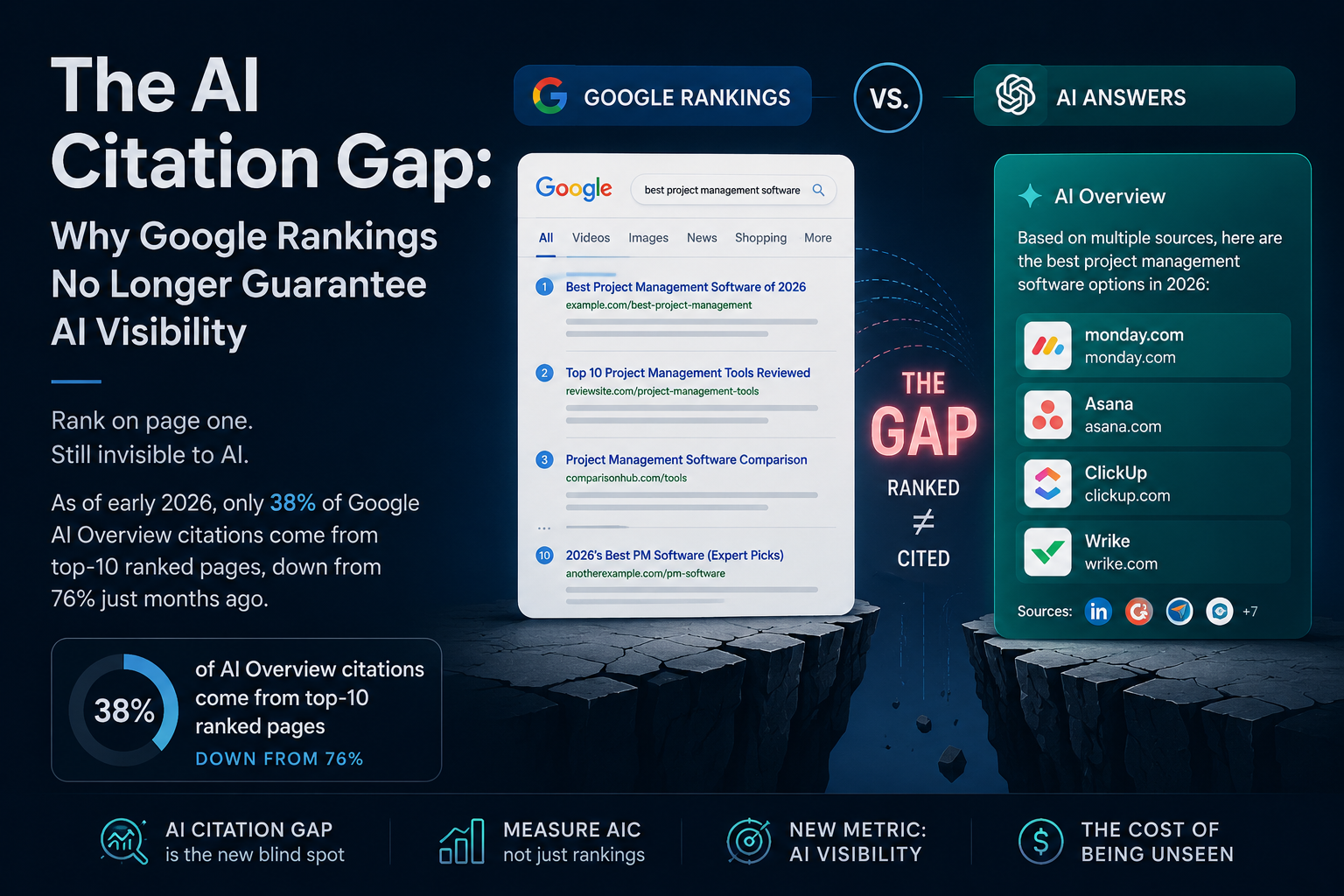
The citation gap refers to the difference between businesses that are frequently referenced in AI-generated answers and businesses that remain absent from those responses — even if their website ranks well in traditional search results. But the gap runs deeper than brand visibility. It's a gap in the entire attribution ecosystem. Content gets consumed. Insights get synthesized. Original thinking gets laundered through an AI summary layer, and the source disappears. Teqnoor
For brands, this creates a dual threat: you may be losing traffic to AI answers built on your own content, while simultaneously failing to appear in AI answers that could be sending you new customers.
ChatGPT handles an estimated 12% of Google's query volume but sends 190 times less traffic to external websites. That ratio is the citation gap in its most brutal economic form. The information flows one way. The credit — and the clicks — often don't follow. Digital Applied Team
Understanding this gap is the prerequisite for everything that follows.
Part II: Does Your Google Ranking Still Matter for AI Citations? (Yes, But Less Than You Think)
Our second prompt asked whether Google rankings affect whether AI systems cite you.
ChatGPT said yes — but only partially. It noted that AI systems still tend to favor content with strong web authority signals, but that ranking number one does not guarantee AI citations. It pointed to Reddit, YouTube, forums, and third-party reviews as sources that AI systems cite heavily, sometimes over pages that rank much higher in traditional search. It estimated roughly 12% overlap between URLs cited by AI assistants and Google's top 10 organic results.
That 12% figure lines up with what the data now shows — and the trajectory is moving in the wrong direction.
In mid-2025, approximately three out of four pages cited in an AI Overview also ranked in the top 10 organic results for the same keyword. By early 2026, that figure stands at roughly one in three — or possibly as low as one in six, depending on the data source you reference. ALM Corp
This is not a minor statistical fluctuation. It reflects a structural shift in how Google's AI selects and attributes source material. ALM Corp
The mechanism behind this shift matters. The most likely explanation for the widening gap between organic rankings and AI Overview citations is the query fan-out process — a mechanism that Google has confirmed is central to how AI Overviews are constructed. Rather than simply pulling from the top ranked result, AI systems decompose a query into multiple sub-queries, retrieve answers from a much wider pool of sources, and synthesize them. That synthesis process doesn't weight your domain authority the same way a PageRank algorithm does. ALM Corp
The good news is that authority still matters — a lot. Domain authority is the strongest single predictor of AI citations, per SE Ranking, and high-authority domains get cited at roughly 3x the rate of low-authority domains for the same query. Analyze AI
Pages updated within 2 months get approximately 28% more citations than pages over 2 years old. Freshness, it turns out, is no longer just a ranking factor. It's a citation factor. DEV Community
What does this mean practically? The data argues for a dual strategy: maintain traditional ranking for queries where AI features are absent, while specifically optimizing content structure, citation worthiness, and entity relationships for AI citation. Digital Applied Team
Traditional SEO is the foundation. AI visibility is a separate structure you build on top of it — with different architectural rules.
Part III: CTR vs. AIC — The Metric That Doesn't Officially Exist (Yet)
Our third prompt asked for the difference between CTR and AIC in SEO.
ChatGPT gave a clear breakdown. CTR (click-through rate) is well established: clicks divided by impressions, expressed as a percentage. A measure of how compelling your search listing is. AIC, it explained, is less standardized — an informal term emerging in SEO conversations to describe traffic or visibility influenced by AI systems. It noted that unlike CTR, AIC does not yet have an official Google-standard definition.
No sources were cited, because in a meaningful sense, there aren't many canonical ones yet. AIC is a concept the industry is actively constructing in real time.
But here's what the data tells us about why this emerging metric matters so much.
If your page ranks first on Google, your probability of appearing in that query's AI Overview jumps to 33.07%. That means even at the absolute peak of traditional SEO performance, you're being skipped by AI two-thirds of the time. CTR tells you how many people clicked your listing. AIC — however you choose to define it — tells you whether AI systems are sending you into the conversation at all. The Digital Bloom
These are not the same funnel.
The transition from CTR-centric to citation-centric thinking represents a fundamental reframe of what "visibility" means. In the CTR world, you were competing for attention on a results page. In the AIC world, you're competing to be the source an AI system trusts enough to include when synthesizing an answer — and that answer may never include a link at all.
ChatGPT only cites 15% of the pages it retrieves. 85% of the sources retrieved during a user's search are never cited. Your content can be consulted and still go completely unacknowledged. Position Digital
This is the core business case for developing AIC as a tracked metric. If your content is informing AI answers but not being credited, you have no visibility into a channel that may be shaping your prospects' decisions before they ever conduct a traditional search.
Semrush projects that AI channels will drive equal economic value to traditional search by late 2027 — not equal traffic, but equal value, because the higher conversion premium of AI-referred visitors compensates for lower volume. The brands that build citation tracking infrastructure now will be measuring this value shift in real time. The ones that don't will be guessing. The Digital Bloom
Part IV: How Do You Actually Measure AI Search Visibility?
Our fourth prompt asked how to measure AI search visibility.
ChatGPT's answer here was the most operationally detailed of the five. No sources cited, but the framework it outlined — prompt monitoring, citation frequency tracking, entity recognition, sentiment analysis, position tracking within AI answers, and downstream business metrics — maps closely to what practitioners are actually doing in the field.
The response described a five-layer measurement stack: building a prompt universe, testing across AI engines, scoring mentions and citations, mapping content to AI outcomes, and connecting everything to business attribution.
This is directionally correct, and it reflects how sophisticated teams are starting to approach the problem. But there are nuances the ChatGPT response didn't surface.
Users' opening questions trigger web searches in AI systems; follow-up questions rarely do. If you want to be cited, you need to win the "first question" — the query that kicks off a research journey, not the clarifying follow-up. This means your prompt universe for measurement should be weighted heavily toward top-of-funnel, awareness-stage queries — not the deep product comparison questions you might assume matter most. Position Digital
ChatGPT doesn't pick one winner. It cites direct competitors together. This is critical context for how you interpret your measurement data. Appearing in an AI answer alongside competitors is not failure. It's table stakes. The question becomes: are you appearing at all, and when you do appear, what's the framing? Position Digital
A G2 SEO Tools Report finding makes the stakes concrete: traditional keyword gap analysis misses 62% of AI search opportunities. Standard rank trackers built for a world of numbered results lists simply cannot capture whether your brand was mentioned in thousands of AI conversations yesterday. Slatehq
The measurement infrastructure for AI visibility is still being built. Platforms like Profound, Peec AI, Otterly, and Scrunch AI are attempting to fill this gap. But even without purpose-built tooling, any brand can start with a manual prompt testing protocol: take your 20 highest-value target queries, run them through ChatGPT, Claude, Perplexity, and Gemini, and document who appears, in what order, with what framing. Do this monthly. That's a citation benchmark.
The gap between your current SERP position and whether you appear in AI Overviews for the same keywords is your Revenue Visibility Gap — the revenue you're leaving on the table by ranking without being cited. The Digital Bloom
Knowing that number changes everything about how you prioritize content investment.
Part V: SEO Benchmark Reports in the Age of AI — Why Your Current Scorecard Is Incomplete
Our fifth prompt asked what SEO benchmark reports are and why they matter.
ChatGPT gave a solid, textbook answer: benchmark reports establish a measurable baseline for search performance, track progress against competitors, guide budget decisions, diagnose drops early, and align marketing teams around shared KPIs. Standard metrics covered included organic traffic, keyword rankings, CTR, backlink profiles, domain authority, and Core Web Vitals.
Again, no sources cited. And again, the more interesting story is in what the answer didn't include.
A traditional SEO benchmark report built on those metrics alone is now telling you roughly half the story. According to Gartner's 2026 AI Search Trends Report, AI Overviews now appear in 15-25% of Google searches, with significantly higher rates for informational queries. McKinsey's Digital Report projects that 85% of search experiences will be AI-driven by the end of 2026. Slatehq
If your benchmark doesn't include AI citation metrics, you're measuring a channel that's shrinking while flying blind on a channel that's growing.
Forrester's 2026 research found that content providing unique information gain ranks three times higher in AI responses than content that rehashes existing consensus. "Information gain" is not a metric that appears in most SEO benchmark reports. It should. Slatehq
What does an AI-era benchmark report look like? In addition to the traditional metrics, it should include: citation rate by AI engine (ChatGPT, Perplexity, Gemini, Claude), brand mention share in AI answers for your top 20 target queries, sentiment framing when cited, position within AI answer, and competitor citation frequency for the same prompt set.
In an analysis of 83,670 AI citations, the top 10 brands captured 30% of all AI mentions, and most of them were the same brands that already dominate Google's first page in their category. That concentration matters. Benchmark reports that only measure traditional rankings miss the compounding advantage that AI visibility creates for already-dominant brands. Analyze AI
The benchmark is not just a scorecard. It's a strategic early warning system. And right now, most brands are running it with a significant blind spot.
The Through Line: What Five ChatGPT Prompts Tell Us About the State of AI SEO
Stepping back from the individual questions, the meta-observation from this exercise is striking.
We asked an AI system five questions about AI search visibility, AI citations, and AI-era SEO. The system produced informed, coherent, and broadly accurate answers. It cited sources on only one of the five prompts. For the other four, it synthesized from its training data with no attribution.
That behavior is not a bug. It's exactly what the AI citation gap describes. AI systems are excellent at synthesizing information. They are inconsistent at crediting the specific sources behind that synthesis. And as these systems become the primary interface for information discovery, the brands that don't understand this dynamic will continue losing visibility they can't measure, to competitors they can't see, through a channel they haven't built for.
The strategic implications are clear:
AI citations are the new first-page ranking. The game has changed from "appear in the top 10" to "be the source AI trusts when synthesizing an answer." These are related but not equivalent. Rankings still matter, but they are no longer sufficient on their own. ALM Corp
Measurement infrastructure matters now. The companies that build citation tracking infrastructure in 2026 will be measuring the value shift from traditional search to AI search in real time. That lead will compound. The Digital Bloom
Content quality is being re-defined. The old content playbook — optimize for keywords, build links, produce volume — is not enough. Content with genuine information gain ranks three times higher in AI responses. Original research, unique data, authoritative framing, and direct answers to specific questions are what get cited. Slatehq
The citation gap is a revenue gap. Every query where a competitor appears in an AI answer and you don't is a conversation with a potential customer that you're not part of. At scale, that's not a visibility problem. It's a pipeline problem.
What Ritner Digital Does About It
At Ritner Digital, we've built our service model around exactly this transition. We help brands understand where they stand in the AI citation landscape, identify the specific content and authority gaps driving their invisibility, and build the infrastructure to close those gaps systematically.
That includes AI citation audits across ChatGPT, Perplexity, Google AI Overviews, and Claude. It includes benchmark reporting that goes beyond traditional rankings to capture your AI share of voice. And it includes content strategy that's built for extractability — structured, authoritative, answer-oriented content that AI systems choose to cite when the question gets asked.
The brands winning AI visibility right now aren't the ones who got lucky. They're the ones who started paying attention early, built measurement systems, and invested in content that earns trust from both search algorithms and AI synthesis engines.
Ready to find out where you stand in the AI citation gap?
Let's talk. Contact Ritner Digital today.
We'll audit your current AI visibility, identify your Revenue Visibility Gap, and show you exactly what it would take to become the source your industry's buyers find — no matter where they're searching.
Sources: ALM Corp (March 2026), SlateHQ / Gartner / McKinsey / Forrester (2026), TryAnalyze.ai (May 2026), The Digital Bloom (May 2026), DEV Community / SE Ranking (May 2026), Position.digital (May 2026), DigitalApplied.com (April 2026), Teqnoor (March 2026).
Frequently Asked Questions
What is the AI citation gap in simple terms?
The AI citation gap is the disconnect between content that AI systems use to build their answers and content that actually gets credited in those answers. Your brand can be informing AI responses without ever appearing in them. Think of it as doing the work without getting the credit — or the click.
I rank on page one of Google. Doesn't that mean AI will cite me?
Not necessarily. As of early 2026, only about 38% of Google AI Overview citations come from top-10 ranked pages — down from 76% in mid-2025. Ranking well still helps, but it's no longer a reliable path to AI citation on its own. You need to optimize for both.
What's the difference between SEO and AEO?
SEO (Search Engine Optimization) is about getting your page to rank in a list of results. AEO (Answer Engine Optimization) is about getting your content chosen as the source an AI uses when synthesizing a direct answer. The goal shifts from "appear in the results" to "become the answer."
What is AIC and how is it different from CTR?
CTR (click-through rate) measures how often someone clicks your listing after seeing it in search results. AIC (AI-influenced clicks or AI citation context) measures visibility and engagement driven by AI systems — how often you're cited, mentioned, or recommended in AI-generated answers. CTR measures search performance. AIC measures AI performance. Both matter, but most brands are only tracking one.
How do I know if AI is already citing my brand?
Start manually. Run your 10 to 20 highest-value target queries through ChatGPT, Perplexity, Gemini, and Claude. Document who appears, in what position, and with what framing. If your competitors show up and you don't, you have a citation gap. Do this monthly and you have a benchmark.
What type of content gets cited by AI systems?
Content that is structured, specific, and directly answer-oriented. AI systems favor original research, proprietary data, clear FAQ formats, strong semantic clarity, and content that's been referenced or validated across multiple platforms. Rehashed consensus content gets skipped. Genuine information gain gets cited — Forrester's 2026 research found that content with real information gain ranks three times higher in AI responses.
Does my domain authority still matter for AI citations?
Yes — significantly. Domain authority is still the single strongest predictor of AI citation frequency. High-authority domains get cited at roughly three times the rate of low-authority domains for the same query. Building authority through traditional SEO remains the foundation. AI optimization is the layer on top.
My content is being used by AI but I'm not getting traffic. What's happening?
This is the citation gap at work. AI systems retrieve far more content than they cite — one analysis found that 85% of sources retrieved during a user's AI search session are never cited in the response. Your content may be informing answers without ever being credited or linked. The fix involves restructuring content to be more extractable, quotable, and directly answer-oriented so AI systems surface you explicitly rather than drawing from you silently.
What is an AI visibility benchmark report?
It's a structured analysis of how your brand appears — or doesn't appear — in AI-generated answers across major platforms. Unlike a traditional SEO benchmark, it tracks citation rate by AI engine, brand mention share for target queries, sentiment framing, competitor citation frequency, and position within AI answers. It tells you your Revenue Visibility Gap: the business you're losing by ranking without being cited.
How quickly can AI citation visibility change?
Quickly. Pages updated within the last two months receive approximately 28% more AI citations than pages that are two or more years old. AI systems favor fresh, maintained content. Unlike traditional SEO — where authority compounds slowly — AI citation behavior can shift meaningfully within weeks of a content update or a platform model change.
Where do I start if I want to close my citation gap?
Three steps. First, audit — run your target queries across all major AI platforms and document where you appear versus your competitors. Second, identify your highest-priority gaps — queries with commercial intent where you're absent. Third, invest in content that earns citations: structured, authoritative, original, and directly answer-oriented.
Ritner Digital can walk you through all three. Start here.