The Simplest Thing a Founder With 90K Followers Did to Have Their Best Quarter Ever
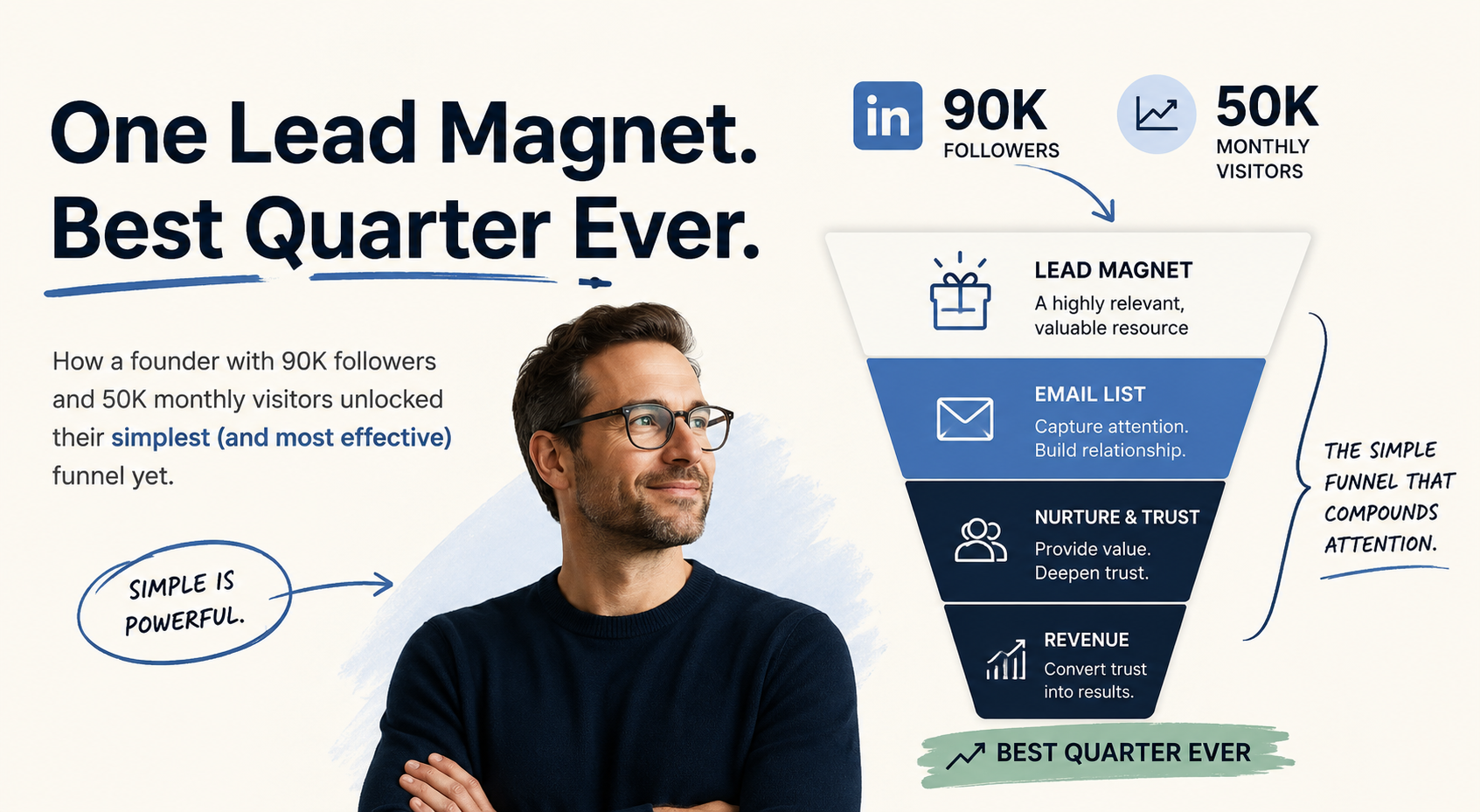
We had a conversation recently with a founder that's been sitting with us ever since.
They had the kind of brand most people spend years trying to build. Ninety thousand LinkedIn followers — genuine ones, built through consistent content and a real point of view. A website pulling fifty thousand visitors a month. A well-established reputation in their space. By most measures, they were doing everything right.
And yet the business had been plateauing. Traffic was healthy. Engagement was good. Inquiries were inconsistent.
Then they simplified. Specifically, they did one thing: they added a lead magnet. A single, focused, genuinely useful resource — free to access, built around the exact problem their best clients hire them to solve. They pointed their existing LinkedIn audience to it. They added it to their site. They built a short email sequence behind it.
That quarter was their best ever.
We're not sharing this as a feel-good story about a brand doing well. We're sharing it because the gap between what this founder had — real audience, real traffic, real credibility — and what they were capturing from that audience is a gap that exists at a lot of brands right now. And the thing that closed it wasn't a rebrand, a paid campaign, or a new service offering.
It was a lead magnet and a slightly more deliberate funnel. That's it.
The Audience You've Built Is Not the Same as the Audience You're Capturing
This is the core issue, and it's worth sitting with before anything else.
A LinkedIn following of ninety thousand people represents years of compounding trust. Every post that performed, every comment thread that went somewhere interesting, every person who hit follow because something you said resonated — that's an asset with genuine value. Same with fifty thousand monthly website visitors. That's not nothing. That's a real pipeline of people who found you, clicked through, and landed somewhere on your site.
The question is: what happened to them next?
For most brands with strong organic presence and no deliberate capture mechanism, the answer is: they left. They read the article, nodded along, maybe bookmarked something, and went back to their day. They might come back. They might not. The brand has no way to continue the conversation because it never got permission to do so.
The average visitor-to-lead rate for B2B websites is 1.4%. Lead-to-customer conversion runs 2 to 5%. The biggest levers aren't fancy tools — they're cleaning your contact data, responding within five minutes, and simplifying your forms. Prospeo
At fifty thousand monthly visitors and a 1.4% visitor-to-lead rate, you're capturing around 700 leads a month. That's with a functional lead capture mechanism in place. Without one, that number trends toward zero — and all of that traffic, all of that trust-building, all of that content work produces no compounding asset whatsoever. It's attention without accumulation.
The founder in this story had ninety thousand people who trusted them enough to follow, and fifty thousand a month showing up to read their thinking. The lead magnet was simply the mechanism that finally let them do something with all of that attention.
Why a Lead Magnet Works When Nothing Else Has Changed
The instinct most brands have when growth plateaus is to change something big. Reposition the offer. Run ads. Hire a sales person. Redesign the website. Add a new service line.
All of those might eventually be the right move. But the founder in this story didn't do any of that. They added one well-placed piece of value and a path for people to receive it. And it worked because the preconditions for it to work were already there.
Here's what a lead magnet does that a homepage or a blog post can't:
It creates a transaction. Not a financial one — an exchange of value. The visitor gives you their email address. You give them something genuinely useful in return. That exchange does two things simultaneously: it captures a contact you can follow up with, and it deepens the trust that made them hand over their email in the first place.
Well-designed lead magnets regularly hit 30 to 50% landing page conversion rates when the offer is narrow, fast to consume, and immediately useful. The average across all lead magnet formats sits between 5 and 15%, depending heavily on traffic source, offer specificity, and form length. Prospeo
The operative phrase is narrow, fast to consume, and immediately useful. Not comprehensive. Not impressive. Not a forty-page ebook that took three months to produce. The lead magnets that convert are the ones that solve one specific problem for one specific person in under twenty minutes.
A team spends six weeks producing a 50-page industry whitepaper, builds a dedicated landing page, runs a paid promotion campaign, and watches the conversion rate land at 1.8%. Meanwhile, the two-page checklist someone made in an afternoon converts at 18%. Prospeo
That dynamic isn't a fluke. It's consistent. The polished comprehensive asset signals effort but creates friction — it's a commitment to consume. The focused, specific, immediately actionable resource signals respect for the reader's time and delivers value before they have to do anything else. That's the trade that converts.
What the Ninety Thousand Followers Actually Represent
Let's talk about the LinkedIn side of this, because it's the part that made this particular story work as well as it did.
A founder-led brand with ninety thousand followers on LinkedIn has something that most paid campaigns can only approximate: a warm audience with genuine context about who you are and what you know. These are not people who saw an ad and clicked. These are people who have read your posts, probably agreed with you publicly, possibly even cited you to colleagues. They trust you before they ever land on your website.
That trust has enormous commercial value — but only if there's a mechanism to convert it. Follower counts don't show up in revenue reports. Email subscribers do. And the path from LinkedIn follower to email subscriber is a lead magnet.
Referral-based lead conversion rates have climbed to 29.1% according to LinkedIn's B2B Sales Insights Report, while cold outreach conversion rates have fallen further to 8.2%. A newly tracked channel — LinkedIn social selling — posted an 18.7% conversion rate.
A LinkedIn audience that already trusts you is not cold traffic. It's warm traffic arriving with context and credibility already established. The conversion rates reflect that. Getting someone who has followed you for two years to download a free resource they find genuinely useful is not a hard sell. The hard part was already done by every post you wrote before this one.
The lead magnet simply gives that trust somewhere to go.
The Funnel That Doesn't Need to Be Complicated
Here's what the simplest version of this looks like — and simple is the point:
One lead magnet. A single, focused resource that solves one specific problem your ideal client has. A checklist, a framework, a short guide, a template, a calculator, an assessment. Something they can use within twenty minutes of downloading it. Stop building 40-page ebooks. A 5-page guide that solves one problem will outperform a comprehensive ebook every single time.
One landing page. Not your homepage. Not a blog post with a form stuck at the bottom. A dedicated page with one job: explain what the resource is, who it's for, what they'll get from it, and a form to claim it. Form fields kept under five — beyond that, conversion drops 10 to 15% per added field. Mobile-optimized delivery is essential — landing pages that don't render well on mobile lose 35% or more of conversions. Prospeo
One email sequence. Not a newsletter. Not a drip campaign with fifteen touchpoints. A short sequence — five to seven emails — that delivers the resource, provides additional context around the problem it solves, and naturally introduces how you help people go further. The five to seven day drip course format works because it builds a daily habit of opening your emails, which trains deliverability and trust simultaneously. Each email delivers a small win, and by the end, the reader feels like they know you. The conversion to paid happens naturally at the end.
One consistent call to action. Every LinkedIn post that touches the relevant topic points to the lead magnet. Every relevant blog post on the site has the lead magnet in it. Every time you speak on a podcast or appear somewhere, you mention the free resource. One thing. Consistently. Not ten different offers competing for attention.
That's the whole system. For a founder with an existing audience and existing traffic, that's enough to have a materially different quarter.
The Part Most Brands Skip: The Offer Has to Actually Be Good
This is where a lot of lead magnet strategies fail — and it's worth being direct about.
A lead magnet that exists primarily to capture an email address, with the useful content treated as an afterthought, will convert poorly and damage trust rather than build it. People can tell immediately whether something was built for them or built for the brand's marketing funnel. The ones that convert at 30 to 50% are genuinely useful on their own, independent of whatever comes next.
The test is simple: would someone get value from this if they never hired you? If the answer is no, it's not a lead magnet. It's a brochure with a form in front of it.
The founder in this story built something their ideal client would find useful whether or not they ever became a paying customer. That's exactly why it worked. It demonstrated expertise without gatekeeping it. It showed rather than told. And the email sequence that followed felt like a natural continuation of something genuinely helpful — not a pivot into sales mode.
The magnet gets the email. The sequence gets the sale. But only if the magnet earns the email through genuine value first. Prospeo
What This Looks Like for Different Founder-Led Brands
The specific format depends on what you do — but the principle is the same across categories. Here are a few ways this plays out:
Consulting and professional services. A diagnostic framework, an assessment, or a short audit tool that helps the prospect understand their current position on the problem you solve. This works particularly well because it delivers immediate personalized insight and naturally surfaces the gap your services address.
Agencies and creative services. A process document, a checklist, or a scored self-assessment that helps prospects evaluate their current approach. The best versions of these are honest enough to acknowledge when someone might not need your help — which paradoxically makes them more trusted and more likely to convert the right people.
B2B SaaS and tools. Calculators that help users estimate costs, ROI, or benefits aren't just converting leads — they're driving revenue, sometimes up to 45% of total deals. If your average deal size is above $5,000 and you're still using a PDF ebook as your primary magnet, you're leaving money on the table.
Education and coaching. A short framework, a five-day email sequence, or access to a specific piece of curriculum that demonstrates the value of the broader program. The goal is to make the prospect feel like they've already started before they've paid anything.
In every case the format matters less than the specificity. A resource built for "marketers" will underperform a resource built for "B2B marketing directors at SaaS companies trying to reduce their cost per qualified lead." The narrower the audience, the higher the conversion — because the person it's built for sees themselves in it immediately.
The Compounding Effect Nobody Talks About
Here's the part of this story that doesn't show up in the first-quarter results but matters enormously over time: a lead magnet doesn't just generate revenue in the quarter you launch it. It builds a compounding asset.
Every month that passes, more people download it. The email list grows. The sequence runs. The trust compounds. Some people convert in week two. Some convert six months later when something shifts in their business. Some forward it to a colleague who becomes a client. Some refer someone because they remember the brand as the one that gave them something useful for free.
80% of customers for one marketing services firm came from their email list, built primarily through lead magnets including gated content, templates, toolkits, webinars, and whitepapers. Prospeo
Traffic comes and goes. An algorithm change, a content dry spell, a slow news cycle — any of these can interrupt the flow of new visitors. But an email list you've earned through genuine value doesn't disappear. It's yours. It's a direct line to people who have already indicated they trust you enough to give you access to their inbox.
For a brand with ninety thousand LinkedIn followers and fifty thousand monthly website visitors, building that list is the highest-leverage marketing activity available. Not a rebrand. Not a new offer. Not a paid campaign. A well-built lead magnet that turns existing attention into a compounding relationship.
The Only Question Left
If you have an audience — on LinkedIn, on your website, in your industry — and you don't have a mechanism for capturing and compounding that attention, the lead magnet question isn't really a tactical one. It's a strategic one.
What is the one problem your best clients share before they hire you? What would be genuinely useful to them right now, regardless of whether they ever pay you? What can you give them that demonstrates exactly how you think — so that when they're ready to hire someone, the shortlist starts and ends with you?
Answer that question. Build the thing. Point your existing audience at it.
That's the whole playbook. The founder with ninety thousand followers figured it out. Their best quarter wasn't the result of working harder or spending more. It was the result of finally giving all of that attention somewhere useful to go.
Want help building a lead magnet strategy that actually fits your audience and converts — without overcomplicating it?
Frequently Asked Questions
How do I know what my lead magnet should actually be about?
Start with the problem your best clients had right before they hired you. Not the problem you solve after they become a client — the problem that made them go looking for help in the first place. That gap between where they are and where they want to be is exactly where your lead magnet lives. The more specifically you can name it, the better it will convert. A resource titled "How to Fix Your LinkedIn Profile" is generic. "The LinkedIn Profile Audit Checklist for B2B Consultants Who Are Getting Traffic But No Inbound Inquiries" is specific — and the person it's built for knows immediately that it's for them. The teams hitting top-quartile conversion rates share a consistent pattern: the lead magnet solves one specific, narrow problem, can be consumed in under twenty minutes, and delivers immediate actionable value — not value that only materializes after they hire you. If you're struggling to narrow it down, look at the questions you get asked most often before someone becomes a client. The most common one is probably your lead magnet. Prospeo
Does the format matter — should it be a PDF, a video, a checklist, a quiz?
Format matters less than specificity and usefulness, but some formats do consistently outperform others depending on your audience and offer. Quizzes convert at 40.1% on average — far higher than most static PDFs. If you're in B2B SaaS or professional services, a calculator or diagnostic quiz tends to outperform a written guide because it delivers a personalized result, and that result naturally leads to "want help fixing this?" For most founder-led brands just getting started, a short written resource — a checklist, a framework document, or a focused guide under ten pages — is the fastest to produce and still converts well when the topic is specific enough. Don't spend three months building the perfect interactive tool when a well-crafted two-page checklist can go live this week and start capturing emails tomorrow. Get something out, see how it converts, and iterate from there. Amra & Elma
How long should my email sequence be after someone downloads the lead magnet?
Short enough that people actually read it, long enough to build genuine trust before introducing a paid offer. Five to seven emails over five to seven days is the range that consistently works for founder-led brands. The five to seven day drip format works because it builds a daily habit of opening your emails, which trains deliverability and trust simultaneously. Each email delivers a small win, and by the end, the reader feels like they know you. The conversion to paid happens naturally rather than feeling forced. The structure that works best is roughly: email one delivers the resource and sets expectations, emails two through five provide additional useful context around the problem the resource addresses, and the final email or two introduce how you help people go further if they want it. The key word is naturally — the sequence should feel like a logical continuation of something helpful, not a pivot into sales mode the moment someone hands over their email address. Prospeo
I already have a newsletter — is that the same thing as a lead magnet?
No, and conflating the two is one of the most common mistakes founder-led brands make. A newsletter is a recurring commitment — people sign up because they want ongoing content from you, which is valuable but a different ask than downloading something with immediate utility. A lead magnet has a specific, immediate value proposition: you get this useful thing right now in exchange for your email address. The transaction is clear and the payoff is instant. 79% of leads never convert to sales — not because the lead magnet was bad, but because of missing follow-up. The magnet gets the email. The sequence gets the sale. A newsletter subscription doesn't have the same conversion mechanism behind it — someone subscribing to receive future content isn't in the same mindset as someone downloading a resource that solves a problem they have right now. Both are worth having, but they serve different functions and shouldn't be treated as substitutes for each other. Martal Group
How do I actually get my LinkedIn audience to engage with the lead magnet?
The most effective approach is also the most straightforward: write posts that address the exact problem the lead magnet solves, and mention the resource naturally in the context of providing value — not as a promotional insert. The post should be useful on its own. The lead magnet mention should feel like a natural extension, not the point of the post. A post that teaches something real and then says "I built a checklist that takes this further — link in the comments" will consistently outperform a post that exists primarily to promote the resource. The sequence gets the sale, but the LinkedIn post gets the click — and LinkedIn posts that demonstrate genuine expertise convert followers to subscribers at significantly higher rates than posts that read as promotional content. Beyond organic posts, pinning the lead magnet link to your profile, adding it to your featured section, and including it in your LinkedIn banner are all low-effort ways to ensure every new profile visitor encounters it without you having to actively promote it in every post. Amra & Elma
What's a realistic conversion rate to expect from my website traffic?
It depends heavily on how targeted your traffic is and how specific your lead magnet offer is, but here's a useful frame: the average visitor-to-lead rate for B2B websites is 1.4%, while well-designed lead magnets with focused landing pages regularly hit 30 to 50% conversion rates when the offer is narrow, fast to consume, and immediately useful. The gap between those two numbers reflects the difference between a generic opt-in buried on a website and a dedicated landing page with a specific compelling offer. For a brand with fifty thousand monthly visitors, moving from no lead capture to even a 2% visitor-to-lead rate means capturing a thousand new email contacts every month — people who already found you organically and trust you enough to hand over their inbox. At fifty thousand visitors, even a modest improvement in capture rate is a significant business asset accumulating month over month. Prospeo
How long does it take to see results after launching a lead magnet?
For a founder-led brand with an existing audience, faster than most people expect. The reason the story in this blog played out over a single quarter is that the preconditions were already there — a warm LinkedIn audience, existing website traffic, established credibility. The lead magnet didn't have to build trust from scratch. It just gave existing trust somewhere to go. For brands earlier in their audience-building journey, the timeline is longer but the compounding effect is real. One marketing services firm reported that 80% of their customers came from their email list, built primarily through lead magnets including gated content, templates, toolkits, webinars, and whitepapers. That kind of result doesn't happen in a quarter — it happens over years of consistent list-building. But the best time to start is always before you need it. An email list built during a growth period is the asset that carries a brand through a slow one. Martal Group
Should I gate the lead magnet or just make it free and ungated?
Gate it — but make the gate worth crossing. The email address exchange is not just a data capture mechanism. It's the beginning of a relationship and a signal of genuine intent. Someone who hands over their email to get your resource has demonstrated more interest than someone who reads an ungated blog post and moves on. That signal is valuable, and the email address gives you a direct line to continue the conversation. Form fields kept under five are essential — beyond that, conversion drops 10 to 15% per added field. Ask for a first name and an email address and nothing else unless there's a specific reason you need more information at this stage. The ungated argument — that removing friction maximizes reach — is true, but reach without a capture mechanism doesn't compound. The goal isn't to maximize the number of people who consume your free resource. It's to build a list of people you can continue serving, and eventually, convert into clients. Gating achieves that. Ungated content does not. Prospeo