The "Genius" Idea Every CEO Keeps Pitching — And Why It Doesn't Work
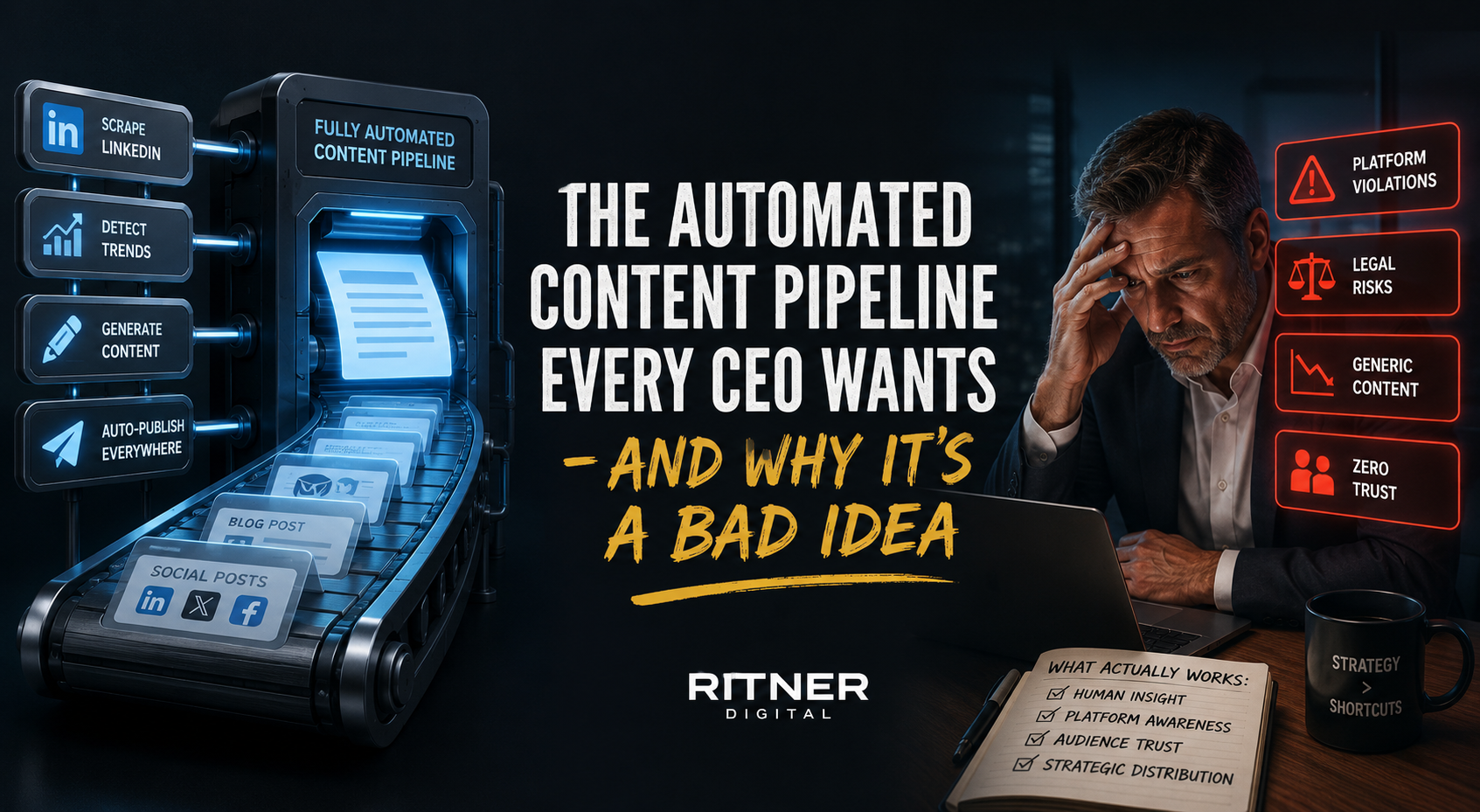
There is a pitch that has been making its way through boardrooms, strategy offsites, and "quick syncs" with solutions architects for the past two years. It goes something like this:
"What if we built a tool that scrapes LinkedIn — or Facebook, or Reddit, or wherever our audience hangs out — figures out what's trending that day, and then automatically writes our newsletter, our blog post, and our LinkedIn content based on that? Then it just publishes it. Fully automated. We're always relevant, always on trend, zero manual effort."
The person pitching this usually says it with the energy of someone who has just discovered fire. They genuinely believe they are the first person to think of it. They are not. Every CEO with a passing familiarity with AI, every solutions architect who has spent twenty minutes with an LLM, and every agency founder who has been to one too many marketing conferences has had some version of this idea.
It sounds elegant. It sounds efficient. It sounds like the kind of thing that would make your competitors jealous.
Here is why it is actually a bad idea dressed up in automation language — and why the people pitching it most confidently tend to understand the least about how content, platforms, and audiences actually work.
Problem One: Scraping LinkedIn Is Not the Stable Foundation You Think It Is
The whole pipeline starts with data collection — and that first step is already shakier than most people realize.
The narrow legal answer is that scraping public LinkedIn pages is not automatically criminal under the CFAA after the hiQ ruling. The useful operator answer is that LinkedIn data is still not safe to build on. That distinction matters enormously. Just because something isn't technically illegal doesn't mean it's a reliable, sustainable business practice. Proxycurl
LinkedIn has shown repeatedly that it is willing to act aggressively and unilaterally against scrapers — not just in court, but through enforcement actions that don't require a lawsuit at all. Public reporting in 2025 noted that Apollo.io and Seamless.ai had their LinkedIn Company Pages removed. LinkedIn showed it can act unilaterally, publicly, and before any public lawsuit appears. Proxycurl
And the technical side isn't much more stable. Third-party social media monitoring tools can't legally scrape LinkedIn, and if they claim that, they might be using browser scraping or shadow profiles, which often violates LinkedIn's Terms of Use and can result in revoked access. EmbedSocial
So the foundation of this entire idea — a reliable, consistent feed of LinkedIn trending content — is built on a surface that the platform actively works to destabilize. Your automated content machine is one LinkedIn enforcement action away from having no inputs whatsoever. That's not a technical problem you can engineer around. It's a structural dependency on a platform that doesn't want you there.
Problem Two: "What's Trending Today" Is Not a Content Strategy
Even if the scraping worked perfectly and the data flowed cleanly, you'd still be solving the wrong problem.
Trend-reactive content — writing about what's already circulating in your industry today — is, almost by definition, late. By the time a topic has enough signal to show up as "trending" in a social listening dataset, the most interesting takes have already been written, the conversation has already peaked, and your algorithmically generated response is arriving at the party after most people have gone home.
The brands and individuals who actually drive conversation in their industries are not reacting to trends. They are setting them. They have a point of view that precedes the trend cycle, not one that's assembled from it. The difference between those two postures is the difference between a brand people follow to find out what to think, and a brand people scroll past because they've already read three better versions of that take from someone else.
Automated trend-reactive content optimizes for relevance-at-volume. What actually builds an audience is relevance-with-originality. An algorithm watching LinkedIn can tell you what everyone is talking about. It cannot tell you what to say about it that no one else has said. That part requires a human with an actual perspective.
Problem Three: LinkedIn's Algorithm Is Specifically Designed to Punish This
Here is the part the CEO pitching this idea almost certainly doesn't know: the platform they want to flood with automated content has spent the last eighteen months building systems specifically to detect and suppress exactly that.
LinkedIn's algorithm in 2025 and 2026 has fundamentally shifted toward authenticity, expertise, and meaningful engagement, with heavy penalties for AI-generated content resulting in 30% less reach and 55% less engagement. Autoposting
Read that again. Not a slight disadvantage. 30% less reach and 55% less engagement — for content the algorithm identifies as AI-generated without genuine human perspective behind it.
LinkedIn scans for spam signals, AI-generated patterns, and engagement pod manipulation before any distribution occurs. Posts flagged for artificial engagement receive immediate suppression. The platform prioritizes obviously human signals over polished AI output in response to generative content proliferation. Growleads
And it's getting stricter, not more lenient. LinkedIn will continue improving AI content detection, with stricter penalties for obvious AI-generated content without personal insights. The bar for authentic content will rise. Teract
LinkedIn has integrated advanced Natural Language Processing classifiers that actively scan text for manipulative prompts and low-authenticity signals. If the system detects artificial or low-effort content, the post's distribution is instantly capped, limiting visibility to a small fraction of first-degree connections. Linkboost
So the plan is to build an automated system that scrapes LinkedIn data, generates content with it, and publishes it to LinkedIn — on a platform that has built a sophisticated AI specifically to find and punish that behavior. This is not a content strategy. It is an arms race you are going to lose.
Problem Four: Automated Newsletters and Blogs Built on Trending Topics Are Already Everywhere — and Nobody Reads Them
The email newsletter landscape in 2026 is saturated with exactly the product this idea would produce. AI-assembled digests of what's trending, reformatted into newsletter form, delivered on a schedule, to inboxes that are already full of the same content from eight other senders.
More than half of LinkedIn posts longer than 100 words are now likely AI-generated — a figure that has transformed the content landscape significantly since 2023. When more than half the content on a professional platform is machine-generated, the content that actually gets read is the content that doesn't feel machine-generated. The scarcity has inverted. Automated output is abundant. Human perspective is what's rare and therefore valuable. evrimagaci
The pitch assumes that volume and consistency are the primary drivers of content success. They're not. A newsletter that arrives every Tuesday with algorithmically assembled trend summaries competes directly with a dozen other algorithmically assembled trend summaries. The one that wins is the one with a genuinely interesting human voice and a point of view people can't get anywhere else. You cannot automate your way to that. You have to earn it.
Problem Five: You Are About to Automate the One Thing That Actually Builds Your Brand
This is the one that should stop the conversation cold, and it almost never does.
The CEO who wants to automate their LinkedIn posts, their newsletter, and their blog is proposing to remove themselves — their actual thinking, their experience, their opinions, their voice — from the content that is supposed to represent them. They want to replace the thing that makes their content worth reading with a system that watches what other people are saying and generates a response to it.
That's not content marketing. That's a very expensive RSS feed with a language model in the middle.
The data is undeniable: authentic employee voices on personal profiles outperform corporate company page content by 561%. The algorithm heavily suppresses company pages because users do not want to interact with logos — they want to interact with people. Linkboost
The brands and executives building genuine influence on LinkedIn in 2026 are doing it with less content, not more — but content that is unmistakably theirs. A weekly post that captures a genuine observation from something that happened in the business that week will outperform five algorithmically generated trend summaries every single time. Average organic post reach has dropped to 8-12% of followers overall, but posts that generate genuine conversation and demonstrate real expertise are actually reaching more people than ever before. Expert LinkedIn
The scarcity that matters is not publishing frequency. It's genuine human perspective. Automating away your perspective to achieve higher publishing frequency is trading the one thing that matters for the one thing that doesn't.
What This Idea Gets Right (And How to Actually Use It)
To be fair to the pitch: the underlying instinct isn't entirely wrong. Social listening is a legitimate and valuable practice. Understanding what your audience is talking about is useful signal. AI-assisted content workflows can genuinely save time. The problem isn't the components — it's the fully-automated end-to-end vision that removes the human from the loop entirely.
Here's what the good version of this idea actually looks like:
Use social listening as an input, not an output. Track what's trending in your category. Use it to inform what topics your team should be writing about. Then have an actual human with an actual opinion write about it. The listening tool tells you where the conversation is. A person with expertise decides what to say about it.
Use AI to accelerate drafts, not to replace thought. AI tools for LinkedIn work best as helpers rather than replacements for your unique voice. AI cannot read your mind, and you still need to do your preparation before expecting it to produce a polished post. The best approach uses AI for research, drafts, and optimization while you add your personal touch. That last sentence is doing all the work. The personal touch is not a nice-to-have. It is the entire product. Skrapp
Distribute consistently, but don't automate authenticity. Scheduling tools are fine. Batching content creation is fine. Having a clear editorial calendar is fine. What's not fine is publishing content that no one on your team has read, reviewed, or put a genuine perspective into — and expecting it to build the kind of audience that creates business results.
The Honest Conversation to Have With Any CEO Pitching This
If someone brings this idea to you — and they will — here are the questions worth asking:
What is the point of view that makes our content worth reading? If the answer is "we cover what's trending in the industry," that's not a point of view. Every other automated newsletter says the same thing.
Who is the human voice behind this brand? If no one can answer that question, the problem is not that you need better automation. The problem is that you haven't decided what your brand actually stands for.
What happens when LinkedIn's enforcement catches the scraper? Because it will. The question is whether your entire content pipeline collapses the day that happens.
Are we trying to build an audience or fill a publishing schedule? Those are different goals that require different strategies. Automation is excellent at filling a publishing schedule. It is not capable of building an audience.
The idea of a fully automated content pipeline that watches the internet, identifies trends, and publishes branded content without human involvement is not a bad idea because the technology isn't good enough. The technology is actually reasonably capable of producing the mechanical output. It's a bad idea because the mechanical output is exactly what audiences are already overwhelmed by — and exactly what platforms are increasingly penalizing.
The thing that cuts through is a human being with something real to say. That part was never something you could buy. It was never something you could automate. And it's not something you should want to.
Want to build a content strategy that actually reflects your brand's voice — and doesn't depend on scrapers, automation bots, or hoping the algorithm doesn't notice?
Let's talk at Ritner Digital →
Frequently Asked Questions
Can't we just use AI to write content and have a human review it before it goes out? Doesn't that solve the authenticity problem?
It helps, but only if the review is substantive rather than cosmetic. There's a meaningful difference between a human editing a draft for grammar and a human genuinely reshaping a piece to reflect their actual experience and perspective. If your review process is someone skimming AI output and hitting approve, the content will read like AI output that someone skimmed and approved — because that's what it is. AI cannot read your mind, and you still need to do your preparation before expecting it to produce a polished post. The best approach uses AI for research, drafts, and optimization while you add your personal touch. The personal touch has to be real, not performative. If it takes a reviewer thirty seconds to approve a post, they haven't added a perspective — they've added a signature. Skrapp
What's actually wrong with writing about trending topics? Isn't that just good content strategy?
Writing about trending topics isn't the problem. Writing about trending topics with nothing original to add is the problem. There's a version of trend-responsive content that works — when a person with genuine expertise reads what's circulating, disagrees with the consensus, adds context the trending conversation is missing, or connects it to something their audience hasn't considered yet. That version requires a human who actually knows the industry well enough to have a non-obvious take. What the automated pipeline produces is a summary of what everyone else is already saying, delivered slightly later than when everyone else said it. The old model rewarded activity — post frequency, hashtag density, engagement pods. The new model rewards demonstrated expertise and authentic professional value. You can post daily with zero reach if the algorithm doesn't recognize your profile's credibility signal. OmniCreator
Is LinkedIn scraping ever okay, or is it always off-limits?
The legal picture is genuinely complicated, and "technically not illegal" is not the same as "safe to build on." Scraping public LinkedIn pages is not automatically criminal under the CFAA after the hiQ ruling — but LinkedIn data is still not safe to build on, and buying it from a vendor does not clean the chain of custody. LinkedIn has demonstrated a clear willingness to act against scrapers through platform-level enforcement — account bans, company page removal, revoked access — without needing to file a lawsuit first. If your content pipeline depends on a consistent feed of scraped LinkedIn data, you have built your strategy on a dependency that LinkedIn can and will disrupt unilaterally and without warning. That's not a legal risk. It's an operational one. Proxycurl
If automated content performs worse, why do so many brands still do it?
Because the feedback loop is slow and the cost savings are visible immediately. A brand that switches to automated content generation sees the budget reduction on day one. The erosion of audience trust, engagement quality, and reach happens gradually — and it's easy to attribute to algorithm changes, seasonal dips, or market conditions rather than the actual cause. More than half of LinkedIn posts longer than 100 words are now likely AI-generated, which means the baseline noise level on the platform has risen dramatically. The brands continuing to automate are competing in an increasingly crowded pool of undifferentiated content, while the ones investing in genuine voice are pulling further ahead. Most brands doing this don't realize it's hurting them until the gap is already significant. evrimagaci
What about using social listening just for research and ideation — not for auto-generating content?
That's genuinely useful and worth doing. The problem with the pitch we described in this post isn't social listening — it's the end-to-end automation that removes human judgment from what gets published. Using a social listening tool to understand what questions your audience is asking, what frustrations are surfacing in your category, and what conversations your competitors are having is legitimate market research. It should inform your editorial calendar, shape your topic selection, and help your team identify where there are gaps in the conversation worth filling. The moment it starts generating the content itself and pushing it to distribution without meaningful human involvement, you've crossed from research tool to noise generator.
Won't our competitors automate this anyway and outpublish us on volume?
Possibly. And they will likely see what happens to brands that outpublish on volume with undifferentiated automated content — which is that they build large follower counts full of people who never read anything they post. Average organic post reach has dropped to 8-12% of followers overall, but posts that generate genuine conversation and demonstrate real expertise are actually reaching more people than ever before. A competitor publishing five automated posts a week and reaching 8% of their followers is not beating you. You publishing two posts a week that people actually read, share, and respond to is the stronger position — in reach, in brand perception, and in the quality of relationships it builds. Volume is not the metric that matters. Audience quality and engagement depth are. Expert LinkedIn
What does a realistic AI-assisted content workflow actually look like if full automation is off the table?
The version that works looks something like this: a human identifies a topic worth writing about, based on their own experience or genuine industry observation. They use social listening tools to understand how the conversation around that topic is currently framing itself — what angles have been covered, what's being missed. They use AI to help structure a draft, suggest supporting points, or speed up the research phase. Then they write the actual post in their own voice, drawing on the AI draft as a starting point rather than a finished product. The final piece is reviewed by someone who knows the brand well enough to catch anything that doesn't sound right. That process still saves significant time compared to writing from scratch. It still benefits from AI assistance. But it produces content that reflects a genuine perspective — which is the only kind of content worth publishing.
Is any of this different for email newsletters versus LinkedIn posts?
The medium changes the format, not the underlying problem. An automated newsletter that aggregates trending content and reformats it into a weekly digest competes directly with every other automated newsletter doing the same thing — and there are many of them. The newsletters that people actually open consistently are the ones with a recognizable voice and a perspective they can't get elsewhere. That applies whether it's a 200-word LinkedIn post or a 2,000-word email. The distribution channel is different. The reason people show up is the same: they trust that the person behind it has something worth saying, and they believe it's actually that person saying it. You can't fake that at scale. You can only build it over time by actually showing up as yourself.