The Genius of Pond Lehocky's Branding: "We're Not a Pond or a Hockey Team"
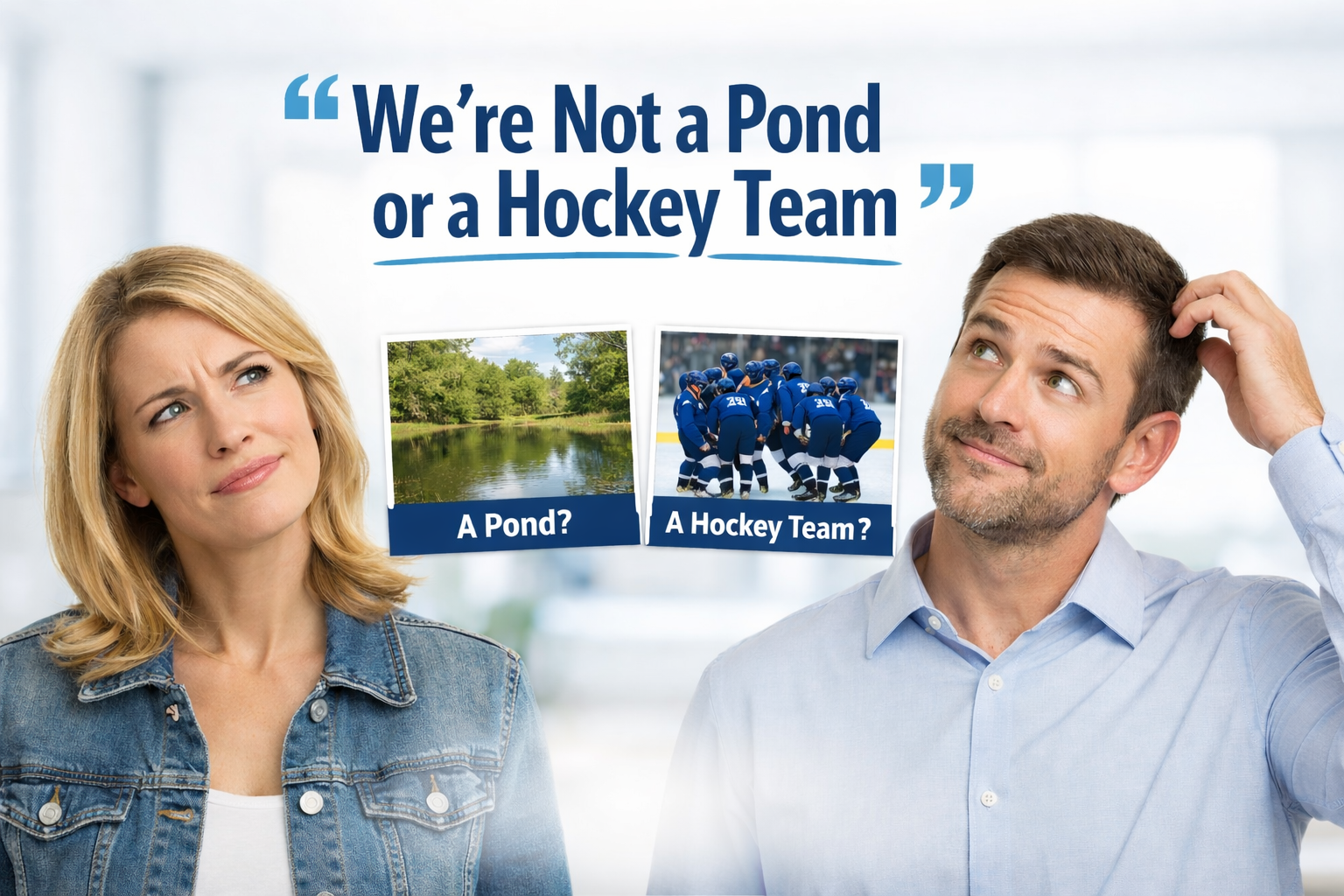
Here's a test. Say the name "Pond Lehocky" out loud to someone who hasn't heard it.
Watch what happens. They pause. They tilt their head slightly. Maybe they smile. Almost certainly, they say something like: "Wait — what is that? A pond? Like, water? Lehocky — is that hockey? Are they a hockey team?"
And just like that, Pond Lehocky has accomplished something most law firms spend millions of dollars trying and failing to do: they made you think about them.
That moment of cognitive friction — the little mental stumble that happens when a brain encounters something it can't immediately categorize — is not a branding accident. It's the whole point. And understanding why it works is a masterclass in how to build a name, a phrase, and a brand identity that sticks in one of the most cluttered advertising categories in existence.
The Category Problem: Legal Advertising Is a Sea of Sameness
To appreciate what Pond Lehocky did, you have to first understand the environment they were competing in.
Legal advertising — especially in the personal injury and workers' compensation space — is one of the most uniform categories in all of marketing. Turn on local TV in any major American city and you will see an attorney standing in front of bookshelves, pointing at the camera, promising to "fight for you." The formula is as reliable as it is forgettable: serious face, serious suit, serious font, a phone number that ends in some repeating digit like 1-800-LAW-1234, and a tagline that sounds exactly like every other firm's tagline.
"We're on your side." "We fight for you." "No fee unless you win." "The results you deserve."
These aren't bad messages. They speak to real concerns potential clients have. But when every firm says the same thing in the same way, none of it lands. It becomes wallpaper. Your brain learns to tune it out the same way it tunes out banner ads and highway billboards for car dealerships.
This is the central challenge of category advertising: when everyone is saying the same thing, being louder doesn't help. You don't need volume. You need differentiation. You need something that makes the brain stop, process, and file away.
Pond Lehocky figured this out — and they built their entire identity around it.
The Name Itself Is the Ad
"Pond Lehocky" is a genuinely unusual name. Jerry Pond and Glenn Lehocky are the founding partners, and like most law firms, the firm bears their surnames. Nothing unusual about that. But the specific combination of those two names produces something remarkable: a string of syllables that sounds like it could mean almost anything except a law firm.
Pond. That's a body of water. Serene, still, natural.
Lehocky. That sounds like it rhymes with hockey. Or maybe it's Eastern European. Or maybe it's some kind of compound word you can't quite place.
Put them together and you get something that doesn't fit neatly into any mental category a listener already has. And that's where the psychology gets interesting.
The brain is a pattern-matching machine. When it encounters new information, it immediately tries to find the closest existing template. "Morgan & Morgan" — law firm, got it. "Smith & Wesson" — guns, understood. "Starbucks" — took years to associate with coffee, but we got there. When a name fits a familiar pattern, the brain files it away efficiently. When it doesn't, the brain pauses to process it — and that processing creates memory encoding.
This is the core mechanism behind one of the most powerful forces in brand psychology: the processing disfluency effect. Research in cognitive psychology consistently shows that information that requires slightly more mental effort to process is remembered more durably than information that goes down too easily. The slight friction of trying to categorize Pond Lehocky — and failing — forces deeper engagement with the name than a forgettable "Philadelphia Injury Attorneys" ever would.
"We're Not a Pond or a Hockey Team": Turning Confusion Into Charisma
The masterstroke is what the firm does with the confusion rather than trying to eliminate it.
Rather than apologizing for the unusual name or burying it in serious legal messaging, they lean into the joke. The line "we're not a pond or a hockey team" — deployed in their advertising with a knowing wink — does something extraordinary: it acknowledges the consumer's confusion, validates it as reasonable, and then turns it into a punchline that cements the brand.
This works on several psychological levels simultaneously.
It creates a shared moment. When the ad acknowledges what you were already thinking, you feel seen. The brand is essentially saying, "Yeah, we know. We get it." That moment of mutual recognition builds a tiny bridge of warmth between the firm and the viewer before a single word has been said about legal services.
It demonstrates self-awareness. A brand that can laugh at itself signals confidence. Insecure brands never make jokes at their own expense. The willingness to acknowledge the weirdness of the name tells the audience: these people are secure enough in what they do that they don't need to pretend the name isn't funny. In a category full of stiff, formal, chest-puffing legal advertising, that self-awareness is startlingly refreshing.
It weaponizes the name's own memorability. By making the joke about the name, the advertising reinforces the name itself. Every time someone sees the ad, they're rehearsing "Pond Lehocky" in their head — and the more times a name is rehearsed, the more deeply it's encoded in long-term memory. This is the spacing effect in action: the humor turns each ad exposure into an active memory exercise rather than passive wallpaper.
It earns the follow-through. Once the joke lands, the pivot to genuine message — workers' compensation, injured workers, fighting for people who've been hurt on the job — hits harder because you're already engaged. You came for the joke. You stayed for the substance. That sequence, levity followed by genuine emotional weight, is one of the oldest and most effective structures in all of storytelling.
The "Unmistakable" Strategy: Owning a Category by Being Categorically Different
Their ad agency D4 Creative built Pond Lehocky's brand positioning around a single word: unmistakable. It's a word that doubles as both aspiration and description. When D4 launched the campaign, the explicit goal was to "position the firm way beyond their peers in terms of their professionalism and the superior results they get for their clients" — and to do it through creative work that "cast a very large shadow."
That framing — be unmistakable — is actually the correct strategic answer to the category sameness problem described above. In a sea of forgettable, interchangeable legal advertising, the highest-value real estate is simply being the thing people remember. Not necessarily the cheapest, not the flashiest, not even the most emotionally resonant. Just the one that sticks when everything else slides off.
The name Pond Lehocky, combined with the playful acknowledgment of its own strangeness, achieves this almost effortlessly. In Philadelphia — and increasingly in other markets they've expanded into — the brand has achieved something most local service firms can only dream of: genuine unaided recall. When someone in the region gets hurt on the job and thinks "I need a workers' comp attorney," Pond Lehocky surfaces. Not because they outspent everyone else on media. Because the name itself is doing memory work that other firms' forgettable names cannot do.
The Emotional Architecture Underneath the Humor
Here's what makes the branding truly sophisticated: the humor is the front door, but the house is built out of something far more serious.
The clients Pond Lehocky represents — injured workers, people whose lives have been upended by workplace accidents, working-class Philadelphians trying to navigate a bureaucratic system that isn't designed to help them — are not looking for a clever punchline when they need help. They're scared. They're in pain. They're facing financial ruin. They need to trust that the firm they're calling will fight for them.
The campaign the firm is most famous for beyond the name — the "Torn Apart" campaign, in which a world-renowned British artist created large-scale portraits of real clients using shredded pieces of their actual case documents, medical records, and insurance bills — is about as far from a cute joke as you can get. It's raw, human, and visually arresting. It says: we see your suffering, we honor your story, and we take what happened to you seriously.
The brilliance of combining a memorable, slightly absurd name with deeply human emotional campaigns is that each element reinforces the other. The name makes you remember the firm. The emotional work makes you trust the firm. Memory plus trust is a remarkably powerful combination in high-stakes service categories where the client is making a decision under duress.
This is what separates truly strategic branding from just being clever. Clever gets you a second look. Strategy converts that second look into a phone call.
What Every Business Can Steal From This
You don't need to be a law firm named after a body of water and a sport you don't play to apply the principles here. The Pond Lehocky formula is actually a repeatable framework:
Lean into what makes you strange, not away from it. The instinct when you have an unusual name, a quirky origin story, or an unexpected niche is to normalize it — to sand down the edges and make the brand easier to swallow. Resist this. What makes you weird is often what makes you memorable. If people always react to something about your brand with a moment of "wait, what?" — that's not a problem to solve. It's a hook to develop.
Acknowledge what the audience is already thinking. The "we're not a pond or a hockey team" line works because it voices the thought the viewer already had. This technique — called mirroring in sales and communication psychology — creates an instant feeling of rapport. When a brand demonstrates that it understands how it's perceived, it signals that it understands its audience, which is the foundation of trust.
Separate the job of getting attention from the job of building trust. The name and humor handle awareness and recall. The emotional campaigns and real client stories handle credibility and conversion. These are different psychological jobs and they require different tools. A common mistake is trying to make one piece of content do both — ending up with something that's neither funny enough to go viral nor serious enough to convert. Pond Lehocky sequences them: get the laugh, earn the attention, then deliver the weight.
Use the category's conventions against it. The legal advertising category is stiff and formal by convention. That convention exists because law firms want to look authoritative and serious. But conventions, once established, create opportunity for the first brand willing to break them — because breaking a convention is how you stand out against the baseline. In a category where everyone is serious, humor is differentiation. In a category where everyone is polished, rawness is differentiation. Find the convention everyone in your category follows reflexively and ask whether breaking it might be the smartest move you could make.
Why This Matters Beyond Philadelphia
Pond Lehocky's brand success is often discussed as a regional story — they're dominant in Philadelphia, well-known in the Pennsylvania market, a notable example of creative legal advertising done right. But the lessons are universal and the psychological mechanisms transfer to any business in any cluttered category.
Every market has its version of the sea of sameness. Financial advisors all promise "peace of mind." Contractors all promise "quality work." Consultants all promise "strategic partnership." Real estate agents all promise to "go above and beyond." The names blur together. The faces blur together. The taglines blur together.
In that environment, the firm, agency, contractor, or consultant willing to acknowledge its own humanity, make the audience feel seen, and trust their audience enough to land a real joke alongside a real message isn't just going to be remembered. They're going to be preferred.
Because preference, in every service category, follows familiarity — and familiarity follows memory — and memory follows the moments when a brand made you stop, smile, and think: wait, not a pond. Not a hockey team. Got it.
Building a brand that sticks is about strategy, psychology, and the courage to be different. At Ritner Digital, we help businesses find and own what makes them unmistakable. Let's talk.
Frequently Asked Questions
Do you really need an unusual name for your brand to be memorable?
No — but you do need something that creates a moment of genuine differentiation, and an unusual name is one of the fastest shortcuts to that. What Pond Lehocky demonstrates isn't that weird names win. It's that anything which creates a brief pause in the audience's pattern-matching process gets remembered more durably than something that goes down too smoothly. That pause can come from a name, a tagline, a visual, a tone of voice, or a positioning angle no one else in your category has claimed. The name is just the most immediate and unavoidable version of that mechanism. If your name is forgettable, you need to compensate for it somewhere else in the brand experience — but you absolutely can.
Isn't humor too risky for a serious service category like legal or professional services?
This is the instinct most firms have, and it's mostly wrong. The actual risk in serious service categories isn't humor — it's invisibility. When every competitor looks and sounds the same, the safest-feeling choice creatively is usually the most dangerous choice strategically, because it guarantees you're indistinguishable. Humor doesn't undermine credibility if it's deployed correctly. The key is sequencing: levity earns attention, substance builds trust. Pond Lehocky gets the laugh with the name, then delivers genuinely emotional, serious campaigns about real injured workers. The humor is the front door — the house is still built on credibility and genuine client advocacy. Used well, a moment of warmth or wit in a stiff category doesn't make you seem less serious. It makes you seem more human, and humans hire humans.
What's the difference between being memorable and just being gimmicky?
Gimmicks get attention once and then wear out. Memorable brands create associations that compound over time. The difference is usually whether there's genuine substance behind the hook. Pond Lehocky's name is the hook, but the award-winning campaigns about real clients whose lives were torn apart by workplace injuries are the substance. If the creative work were only the joke and nothing else, it would feel hollow. Because it's paired with deeply human storytelling that takes the firm's actual mission seriously, the whole thing earns staying power. The test for any brand move is whether it reinforces what you actually do and who you actually serve — or whether it's just noise. Gimmicks are noise dressed up as strategy. Memorable branding makes the noise and the meaning the same thing.
My business has a pretty generic name. Is it too late to build a distinctive brand around it?
Almost never. The name is the starting point of a brand, not the whole brand. Most of the psychological work that creates memorability and preference happens in positioning, messaging, tone of voice, visual identity, and consistent content output over time — not in the name itself. A generic name with a sharp, ownable positioning angle, a consistent visual identity, and a distinctive voice in its content will outperform an interesting name with no coherent strategy behind it every time. What Pond Lehocky did with their name, you can do with your story, your niche, your point of view, your way of talking about what you do. The name is just one lever. There are many others, and most of them are underused.
How do you figure out what actually makes your brand memorable in your specific category?
Start by auditing the category conventions — specifically, what everyone else in your space does reflexively. How do your competitors describe themselves? What do their websites look and sound like? What emotions do their ads try to evoke? What do their taglines say? Once you've mapped the baseline, you can see clearly where the differentiation opportunity is. The convention that everyone else follows is exactly where you should consider breaking ranks, because breaking a category convention is how you stand out against the noise. In legal advertising, the convention was stiff formality and "we fight for you" aggression. Pond Lehocky broke it with warmth, humor, and human storytelling. What's the equivalent convention in your category — and what would happen if you did the opposite?
What does "owning a category" actually mean in practical terms?
It means that when your ideal client thinks about the problem you solve, your name is the first one that surfaces — without them having to search, without prompting, without seeing an ad in that moment. It's unaided top-of-mind recall, and it's the most valuable real estate in any market. For Pond Lehocky, it means that an injured worker in Philadelphia who's been hurt on the job and needs workers' comp representation doesn't think "I need to Google attorneys." They think "Pond Lehocky." That kind of recall is built through the combination of a memorable brand and consistent, repeated exposure over time. It doesn't happen overnight, and it doesn't happen from a single clever campaign. It's the compounding result of a coherent brand strategy executed consistently across every channel, every touchpoint, every piece of content, for years.
Can a small business realistically build this kind of brand recognition, or is this only for firms with big advertising budgets?
Pond Lehocky is a good-sized regional firm with meaningful media spend, but the psychological principles they leveraged don't require a TV budget to apply. A consultant, a boutique agency, a local service business, or a solo professional can use the exact same mechanisms — category differentiation, acknowledged strangeness, self-aware humor, genuine emotional substance — through content strategy, LinkedIn presence, website positioning, and consistent messaging. The difference is that a large firm can compress the timeline with media spend. A smaller brand has to be more patient and more consistent. But the underlying levers are the same. The question isn't whether you can afford to be memorable. It's whether you can afford not to be.
What's the single most actionable takeaway from Pond Lehocky's approach for a business building its brand today?
Stop trying to fit in to your category and start asking what it would take to be unmistakable within it. Most brands spend enormous energy trying to look and sound credible by mirroring what the established players do. That strategy made sense when audiences had fewer choices and less noise to cut through. Today it's a trap. The brands that win attention, memory, and preference are the ones willing to acknowledge their own humanity, take a position, and say something — with their name, their voice, their content, their design — that no one else in the category is saying. You don't need to be the biggest or the loudest. You need to be the one they remember when it matters.
Your brand should be impossible to confuse with anyone else's. At Ritner Digital, we help businesses find and own what makes them unmistakable — from positioning and messaging to content strategy and digital presence. Let's start that conversation.