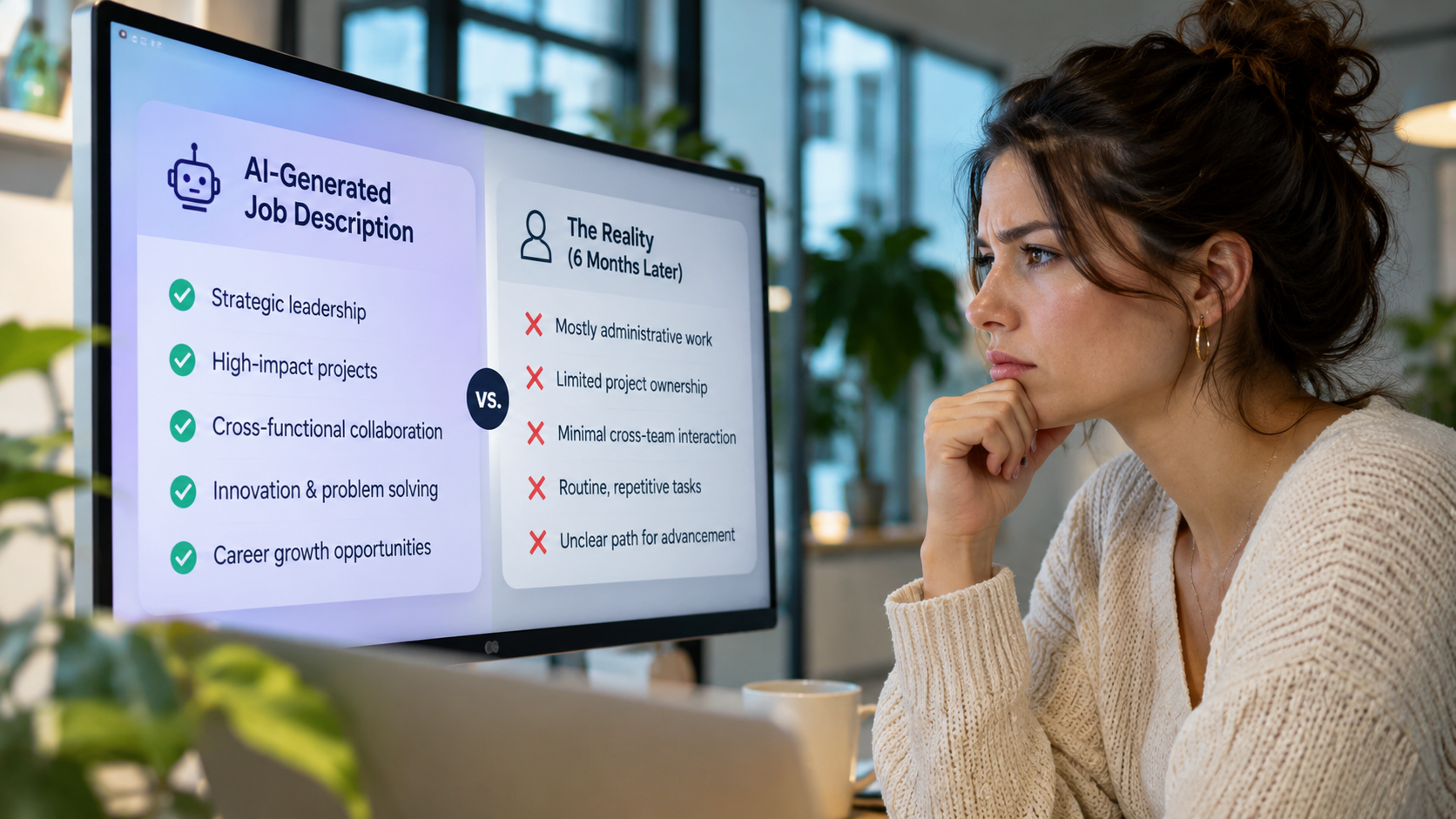
New research finds that 18% of workers say their jobs have changed significantly or no longer resemble what they were hired to do. Meanwhile, employers are using artificial intelligence to write increasingly polished job advertisements. Is the technology helping candidates understand opportunities—or making it easier to advertise jobs that don't match reality?
You find a job posting that sounds almost perfect.
The responsibilities align with your experience.
The company promises opportunities for growth.
The role emphasizes creativity, collaboration, and meaningful work.
The description talks about making an impact, taking ownership, and working with a supportive team.
You apply.
You interview.
You ask questions.
And eventually, you receive an offer.
You accept because the position sounds like the next logical step in your career.
Then you start working.
Within a few weeks, you notice something strange.
The responsibilities aren't quite what you expected.
Instead of developing marketing strategies, you're spending most of your time completing routine administrative work.
The creative projects mentioned during the interview rarely materialize.
The promised opportunities for growth seem vague.
And when you ask about the discrepancy, your manager explains that the team needs everyone to be flexible.
At first, you assume it's part of adjusting to a new position.
But after several months, you realize something more troubling.
The job you're doing isn't the job you thought you accepted.
That experience may be more common than employers realize.
According to ResumeBuilder.com's September 2026 Hiring Bait-and-Switch Report, 18% of surveyed U.S. employees said their current job had changed significantly or was completely different from what they were hired to do.
Another 20% reported that their daily expectations were often unclear or completely unpredictable.
And 30% felt undervalued or overlooked for their contributions.
Those numbers raise important questions about the relationship between recruitment promises and everyday work.
But there's another development worth examining.
Employers are increasingly using artificial intelligence to create job advertisements.
AI can produce polished descriptions in seconds.
It can suggest qualifications, organize responsibilities, and turn a few notes into an attractive advertisement.
That sounds like an obvious productivity improvement.
But what happens when an AI tool writes a convincing description of a position that nobody has actually defined?
What if the posting sounds professional because the language is well structured—not because the company has established what the employee will really do?
And what happens when candidates make major career decisions based on that description?
The concern isn't that AI-generated job descriptions are automatically inaccurate. It's that AI makes it easier to create a convincing promise before an employer has verified that it can deliver on it.
Importantly, the ResumeBuilder.com survey did not investigate whether respondents' job descriptions were generated by AI.
It also did not establish that artificial intelligence caused the discrepancies employees reported.
We cannot take the 18% figure and attribute it to AI-written postings.
But separate research provides a compelling reason to examine the connection.
A field experiment by researchers Emma Wiles and John Horton found that offering employers AI-written drafts reduced the time spent writing job posts by 44%.
Employers were more likely to advertise positions, but the increase in postings did not produce more successful matches.
The AI-assisted descriptions were also more generic and less informative.
Those findings give us something much more concrete to investigate than the assumption that AI simply makes job descriptions worse.
They suggest that making recruitment communication faster does not necessarily make recruitment communication better.
And when the job advertisement is the foundation of a candidate's expectations, that distinction matters.
What the 18% Survey Actually Found
The ResumeBuilder.com report was based on a survey conducted through Pollfish on August 11, 2026.
The research collected responses from 1,023 U.S. employees.
It examined how workers perceived the relationship between what they were promised during hiring and what they experienced afterward.
The headline finding was significant.
Eighteen percent said their jobs had changed substantially or were entirely different from what they were hired to do.
But the full results provide additional context.
Most Workers Reported Some Degree of Alignment
Twenty-six percent said their current role completely matched what they expected.
Fifty-six percent said the role mostly or somewhat matched, with some changes over time.
The remaining 18% reported much more substantial changes.
That distinction matters because most jobs evolve.
A company may introduce new technology.
A department may reorganize.
A customer need may change.
An employee may take on new responsibilities as they gain experience.
Those changes are not automatically evidence of deception.
The meaningful question is whether the actual work remains reasonably consistent with the role the person accepted.
One in Five Workers Reported Unclear Expectations
The survey also found that 20% described their day-to-day role expectations as often unclear or completely unpredictable.
Another 37% said expectations were mostly clear but occasionally ambiguous.
Forty-three percent described their responsibilities as very clear and well defined.
This suggests that the challenge extends beyond recruitment.
Even after someone begins working, unclear expectations can make it difficult to understand what success looks like.
Career Development Was Another Concern
Only 26% reported that career conversations happened proactively.
The others described varying degrees of inconsistency, delay, or avoidance.
That matters because career development is often a major part of the reason someone accepts a position.
A job description may promise growth.
But the employee needs to understand what that growth actually involves.
What the Survey Cannot Tell Us
The study was a self-reported snapshot.
It did not independently compare respondents' original job advertisements with their current duties.
It did not separate deliberate misrepresentation from legitimate organizational change.
It did not demonstrate whether employers were using AI to create recruitment materials.
And it did not establish a causal relationship between job-description quality and employee dissatisfaction.
Those limitations don't invalidate the findings.
They define what the findings mean.
The survey documents a meaningful expectations gap. It doesn't establish what caused that gap.
That is where additional research becomes useful.
The MIT Research That Makes the AI Connection Worth Investigating
If we're going to discuss AI-generated job descriptions as a potential problem, we need evidence beyond the fact that AI exists.
Fortunately, researchers have studied what happens when employers use generative AI to write job advertisements.
In an August 2025 MIT Sloan analysis, journalist Dylan Walsh summarized a field experiment conducted by Emma Wiles and MIT researcher John Horton.
The experiment took place on an online labor marketplace during 2023.
Employers posting jobs for the first time were randomly offered access to AI-generated first drafts.
They could provide a short description of what they needed, then allow the model to create a fuller advertisement.
The results were revealing.
AI Made Job Posting Faster
Employers offered the AI tool spent approximately 44% less time writing job advertisements.
That is a substantial productivity improvement.
Writing a posting no longer required the same level of manual effort.
AI Encouraged More Postings
Employers offered AI assistance were 19% more likely to post a job.
That suggests reduced writing effort made it easier to advertise opportunities.
In some circumstances, that could be beneficial.
A company with a legitimate vacancy might be more willing to publish it.
But easier posting also changes the incentives.
More Postings Didn't Produce More Matches
Despite the increase in advertisements, the researchers found no corresponding increase in completed job matches.
Among posted jobs, AI-assisted advertisements were associated with a 15% lower likelihood of leading to a hire.
That result requires nuance.
The researchers found that some additional postings came from employers with lower intentions of hiring.
The effect wasn't simply that an AI-generated sentence scared away a qualified candidate.
Reducing the cost of posting encouraged some employers to advertise opportunities they were less committed to filling.
AI-Written Posts Were Often More Generic
The researchers also found that AI-assisted descriptions tended to contain less specific information.
Instead of identifying particular technical requirements, a posting might use broad language describing an experienced or motivated professional.
That can sound appealing.
But it may provide less information about whether the candidate is a good match.
The authors' research paper, Generative AI and Labor Market Matching Efficiency, explains how the time saved by employers could be outweighed by the additional effort imposed on job seekers.
This is a particularly important finding.
AI improved one party's efficiency.
But it didn't necessarily improve the overall matching process.
What This Does—and Doesn't—Prove
The study provides credible evidence that AI-generated recruitment content can sometimes become more generic and less informative.
It also shows how reducing the cost of advertising a vacancy can change employer behavior.
However, it does not establish that AI-generated job descriptions cause employees to discover major role discrepancies after being hired.
That would require connecting the original advertisement, employer intentions, interview discussions, actual job duties, and employee outcomes.
Still, the findings give us a plausible mechanism worth testing.
If AI makes a posting easier to produce but less specific, candidates may receive less useful information when evaluating the opportunity.
And if that information isn't checked against real responsibilities, expectations can diverge before the employee even starts.
The Other Side: AI-Written Job Ads Can Be Just as Effective as Human-Written Ads
The evidence isn't entirely negative.
A 2026 peer-reviewed study published in Personnel Review examined perceptions of AI-generated job advertisements across three experiments.
The researchers compared advertisements written by humans with those generated using AI.
Participants included students in Sweden and the United Kingdom, along with HR professionals.
The findings were more encouraging for AI.
AI-generated advertisements were perceived as similarly effective and informative to human-written versions.
HR professionals were also often unable to reliably identify which descriptions were AI-generated.
This matters because it challenges an overly simplistic conclusion.
AI-written job advertisements are not inherently inferior to human-written ones.
A capable tool can produce useful recruitment language.
A human recruiter can also write vague, misleading, or overly promotional copy.
The source of the words isn't the only thing that determines whether they're accurate.
The Two Studies Aren't Necessarily Contradictory
The MIT-linked field experiment examined actual employer behavior and hiring outcomes in an online labor marketplace.
The Personnel Review experiments examined how participants perceived different advertisements.
Those are different research questions.
An advertisement can appear equally appealing and informative in an experiment while a real-world posting process still produces weaker matches under certain conditions.
And a well-edited AI draft may perform differently from a generic draft accepted without review.
The Better Question
Instead of asking whether AI or a human wrote the posting, we should ask:
Does the advertisement accurately represent the position, and did someone with firsthand knowledge verify it?
That's a more useful standard for both employers and job seekers.
A Job Description Is a Marketing Promise
This is where the topic becomes particularly interesting from a branding and communication perspective.
A job advertisement is marketing.
It introduces an organization to a potential audience.
It communicates a value proposition.
It highlights benefits.
It presents a particular experience.
And it asks the reader to take action.
In this case, the conversion isn't a product purchase.
It's a job application.
Eventually, that decision may lead someone to accept employment.
The stakes can be substantial.
A candidate may leave an existing position.
They might decline another offer.
They may change their commute, childcare arrangements, or financial plans.
Some people relocate.
All because they believe the opportunity being described is worth pursuing.
Employer Branding Creates Expectations
A company might describe itself as innovative, collaborative, flexible, or employee-focused.
Those messages influence how candidates interpret the role.
But broad brand language can also obscure practical details.
What does collaboration actually look like?
Who approves decisions?
How often must someone work outside normal hours?
Which tasks will occupy most of the workweek?
What resources are available?
What authority comes with the position?
Those details can have a greater effect on daily satisfaction than the adjectives used to describe the culture.
The Best Recruitment Marketing Is Accurate
Marketing doesn't have to reveal every difficulty in the first sentence.
But it should represent the underlying experience fairly.
A restaurant shouldn't advertise an upscale dining experience that doesn't exist.
A service provider shouldn't promise expertise it cannot deliver.
And an employer shouldn't describe responsibilities, flexibility, authority, or opportunities that aren't part of the actual position.
The same principle applies.
Good marketing attracts people by communicating genuine value.
Misleading marketing creates expectations the experience cannot satisfy.
The Psychology: What Happens When Employment Promises Don't Match Reality?
Organizational psychologists use the term psychological contract to describe the informal expectations between workers and employers.
This is different from a legal employment contract.
The psychological contract includes beliefs about what each party owes the other.
An employee might expect development opportunities, recognition, reasonable workload, or a degree of autonomy.
An employer may expect effort, flexibility, reliability, and commitment.
Some expectations are explicitly discussed.
Others develop through statements and behavior.
The Chartered Institute of Personnel and Development's July 2026 psychological contract guidance explains that these perceptions influence everyday employment relationships.
The Job Advertisement Helps Shape the Psychological Contract
Imagine a posting promises meaningful strategic ownership.
The candidate interprets that as an opportunity to make decisions.
They accept the role.
Then they discover that nearly every decision must be approved by several managers.
The job may still be legitimate.
But the experience conflicts with what the employee believed was promised.
That discrepancy can affect trust.
A Broken Expectation Isn't Always a Broken Contract
Not every disappointment represents a legal breach.
A phrase such as “opportunities for growth” may be interpreted differently by different people.
The employer may genuinely offer learning opportunities without guaranteeing promotion.
An employee might expect advancement within six months.
The company might envision a much longer timeline.
The problem could result from misunderstanding rather than deliberate deception.
But unclear language can still create real dissatisfaction.
Why Precision Matters
Instead of promising unlimited opportunities for growth, a company could describe its actual development process.
Does it offer structured training?
Are career discussions scheduled?
Are promotion criteria documented?
What skills are required for advancement?
Specific information gives candidates something meaningful to evaluate.
Generic promises may create an attractive impression without establishing clear expectations.
Why AI Makes Generic Recruitment Language So Easy
Large language models are effective at producing fluent professional text.
Ask for a job description for a marketing coordinator, and an AI system can generate a polished advertisement quickly.
It might include responsibilities, required skills, preferred qualifications, benefits, and a company culture section.
The result can look complete.
But the model doesn't automatically know what your particular marketing coordinator will do.
It needs accurate information.
If the prompt is vague, the output may rely on common patterns associated with similar positions.
A Job Title Isn't a Complete Job Definition
“Marketing coordinator” can mean different things at different organizations.
In one business, the role may focus on organizing campaigns and managing calendars.
In another, it may involve social media production and event coordination.
A small company might expect the coordinator to work across email, website content, reporting, and customer support.
The title alone doesn't establish the scope.
AI Can Fill Missing Information With Plausible Language
A prompt such as “Write an exciting job advertisement for a marketing coordinator” provides very little operational detail.
The system may respond with familiar descriptions of creativity, collaboration, campaign execution, and analytical thinking.
Those statements can be plausible.
But plausibility isn't verification.
An AI system cannot confirm which duties are real unless someone provides accurate source information.
Professional Tone Can Hide Missing Details
A polished paragraph can create the impression of completeness.
But important information may still be absent.
The posting might not explain the workload.
It may not identify who the position reports to.
It might omit the actual tools employees use.
And it may leave expectations about performance or schedule unclear.
A job advertisement can be grammatically excellent and operationally inaccurate.
That's the central risk.
Not artificial intelligence itself.
The risk is mistaking writing quality for information quality.
An Illustrative Example: Two Job Descriptions for the Same Position
Consider a fictional small business hiring a marketing coordinator.
The following examples are created to illustrate the difference between generic and operationally specific recruitment language.
They are not taken from real employers, and they are not presented as the results of a controlled AI-generation experiment.
Version A: Polished but Vague
Marketing Coordinator — Join Our Growing Team
“We're looking for a passionate, creative, and highly motivated marketing professional to help drive innovative campaigns across multiple channels.
You'll collaborate with cross-functional teams, develop engaging content, support strategic initiatives, analyze performance, and help elevate our brand.
The ideal candidate is adaptable, proactive, detail-oriented, and comfortable working in a fast-paced environment.
This exciting role offers opportunities for professional growth, creative ownership, and meaningful impact.”
It sounds appealing.
But what does the employee actually do?
How much content are they expected to create?
What kind of campaigns?
How many people are on the team?
What does creative ownership mean?
What counts as successful performance?
The description leaves substantial room for interpretation.
Version B: Specific and Verifiable
Marketing Coordinator — Campaign Operations and Content
“This role supports one marketing manager and two service teams.
Most weeks, the coordinator will schedule approved social media posts, prepare the monthly email newsletter, update website content, organize campaign assets, and maintain a basic performance report.
The position involves coordinating work across three established marketing channels rather than independently developing company-wide strategy.
Major campaign decisions are approved by the marketing manager.
The role is primarily execution-focused, with opportunities to contribute ideas during monthly planning meetings.
Success during the first 90 days will be evaluated through accuracy, deadline management, campaign organization, and the ability to use the team's established software.
The position has a defined work schedule, and any expected evening or event support will be discussed during interviews.”
This version is less dramatic.
But it gives the candidate more information.
It explains the core work.
It describes the reporting relationship.
It distinguishes execution from strategic authority.
And it provides a clearer picture of what success involves.
Which One Is Better?
That depends on what the employer actually needs.
If Version B accurately represents the position, it may help candidates assess fit more effectively.
Version A could attract a broader audience.
But the broader appeal may come from ambiguity.
A person seeking a strategic role could read Version A and expect responsibilities that don't exist.
The Important Distinction
The goal isn't to remove every appealing sentence.
It's to connect the appealing language with concrete facts.
An employer can communicate an attractive culture and still describe the real work accurately.
Why AI Can Make a Job Posting Look More Complete Than It Really Is
A major advantage of generative AI is that it can organize incomplete information into polished output.
But that advantage can become a problem when the reader mistakes the finished appearance for a finished planning process.
Imagine a hiring manager has not decided which responsibilities belong to a new position.
They ask an AI tool to write a job description.
The tool produces a complete-looking advertisement.
The manager reviews the wording and approves it.
The organization publishes the role.
But nobody resolved the underlying operational questions.
What work will the new employee own?
Which tasks will remain with existing staff?
Who will train them?
How will their performance be measured?
What happens when priorities conflict?
The document looks finished.
The role isn't.
AI Can Accelerate the Wrong Step
Writing a job advertisement should come after the employer has defined the position.
If the organization reverses that sequence, AI can create a false sense of readiness.
The company now has a document it can publish.
But it still lacks a shared agreement about what the employee will do.
This Is Also a Management Problem
Not every vague job advertisement results from AI.
An organization may have unclear responsibilities long before it adopts new technology.
In an April 2026 SHRM contributor article, a leader described using AI during a large-scale job-classification project and discovering substantial inconsistencies in the underlying job structure.
The lesson wasn't that the AI system had created every problem.
It was that automation exposed ambiguity already present in the organization.
That distinction matters.
AI can introduce new errors.
But it can also make existing organizational weaknesses more visible.
AI Can Change the Job After the Employee Is Hired, Too
There is another reason the relationship between AI and job expectations deserves attention.
Even if a job description was accurate when published, the responsibilities may change after hiring.
AI adoption can alter how tasks are performed.
An employee hired to produce routine content may become responsible for reviewing AI-generated content.
A customer service representative may shift from answering common questions to handling complicated escalations.
A software developer may spend more time reviewing generated code.
A marketing analyst may move from preparing reports to interpreting automated insights.
Some employees may welcome those changes.
Others may feel their role has moved away from the work they expected.
Emerging Research Shows Task Requirements Are Changing
A June 2026 IZA discussion paper on entry-level software work examined how generative AI affected hiring requirements.
The researchers found that junior software postings increasingly demanded more experience and emphasized skills such as problem-solving and communication.
Those changes illustrate how the introduction of AI can reshape the qualifications and responsibilities associated with a role.
However, job postings aren't the same as completed jobs.
The research doesn't establish that every employee is being assigned duties outside their original agreement.
A Separate Analysis Examines New AI-Related Duties
An October 2026 working paper analyzing 18.6 million duty statements found that AI-related tasks were becoming more visible in job advertisements.
In occupations with the highest AI exposure, the share of duty statements classified as newly emerging increased over the study period.
This suggests that employers are adjusting how they describe work.
But it doesn't prove those duties were actually performed after hiring.
The distinction between advertised responsibilities and real tasks is precisely what future research needs to examine.
Role Evolution Can Be Legitimate
A job changing isn't inherently bad.
Organizations need to adapt.
Employees may develop new skills.
Some changes can create better career opportunities.
The problem arises when expectations change substantially without clear communication, appropriate support, or consideration of the employee's role.
A business shouldn't use technological progress as an automatic excuse for assigning an unlimited range of additional duties.
What the Latest Gallup Data Says About Role Clarity
The connection between expectations and workplace experience extends beyond the ResumeBuilder.com survey.
In October 2026, Gallup reported that U.S. employee engagement fell to 29% during the third quarter.
That was its lowest level since 2011.
Gallup also found declining clarity around what employees were expected to do.
The percentage of workers strongly agreeing that they knew what was expected of them fell to 46% in the third quarter.
The report discussed particularly sharp declines among remote and hybrid employees, especially in organizations adopting AI.
These findings are not proof that AI caused the decline in engagement.
Gallup itself emphasizes the importance of leadership communication, employee support, and other workplace conditions.
But the research reinforces why role clarity matters.
Managers Translate Strategy Into Daily Work
A job description might explain the position at a high level.
A manager needs to clarify how those responsibilities operate in practice.
What should the employee prioritize?
Which tasks are most important?
What can wait?
How should the employee use AI?
Which decisions require approval?
How will performance be evaluated?
Without those conversations, even a reasonably accurate job posting can become disconnected from everyday work.
AI Adoption Requires More Communication
In Gallup's July 2026 research on AI and engagement, employees reported better engagement when managers actively supported AI use and communicated expectations.
That suggests organizations should not treat AI adoption as merely a technology rollout.
It's also a workplace communication issue.
Employees need to understand whether AI changes their responsibilities, performance standards, training requirements, or opportunities for development.
When Does Job Evolution Become a Bait-and-Switch?
This is one of the most difficult questions.
Not every change is deceptive.
But some differences are substantial enough to deserve concern.
Consider three hypothetical situations.
Scenario One: Normal Evolution
A company hires a marketing coordinator to organize campaigns.
Six months later, it introduces a new scheduling platform.
The coordinator learns the software and uses it to perform the same general responsibilities.
The tools changed.
The underlying job remains similar.
That would generally look like ordinary role evolution.
Scenario Two: A Significant but Communicated Change
A business hires a marketing specialist focused on content.
A year later, the company reorganizes.
It wants the employee to take on more analytical responsibilities.
Management discusses the proposed change, provides training, adjusts priorities, and considers whether compensation and role documentation should change.
The job evolves substantially.
But the process involves communication and an opportunity to address expectations.
Scenario Three: A Misaligned Position
A company advertises a strategy-focused marketing role.
During interviews, it emphasizes creative ownership and campaign leadership.
After hiring, the employee is assigned primarily customer service, administrative work, and unrelated operational tasks.
Management explains that the employee needs to be flexible but provides no clear plan to align the role with what was discussed.
That situation raises a much more serious expectations problem.
The difference isn't simply the percentage of duties that changed.
It involves what was promised, when the change occurred, how material it was, and whether the employer handled it transparently.
The Legal and Compliance Risks of AI-Generated Job Advertisements
Accurate job descriptions aren't merely a matter of good branding.
They can also have legal and compliance implications.
In February 2026, the U.S. Department of Justice announced a settlement involving a company that used AI-generated recruitment advertisements containing impermissible citizenship-status restrictions.
According to the DOJ, the advertisements included language improperly limiting consideration to certain immigration-status categories.
The settlement addressed allegations under the Immigration and Nationality Act.
This is a concrete example of how AI-generated recruitment content can create problems when employers publish language that hasn't been appropriately reviewed.
It isn't evidence that AI causes role mismatch after hiring.
But it demonstrates that responsibility for a job advertisement remains with the organization using it.
Employers Still Need to Verify Content
The Equal Employment Opportunity Commission's employer best-practice guidance recommends reviewing job advertisements for accuracy and discrimination risks.
It also advises employers to ensure that job descriptions reflect essential functions and don't conflict with the work employees actually perform.
That principle is directly relevant to this discussion.
A job description shouldn't just sound professional.
It should accurately represent the position.
AI Doesn't Remove Employer Accountability
A company can't reasonably treat an AI-generated draft as automatically correct.
Human review remains necessary.
That review should cover responsibilities, qualifications, working conditions, compensation information, and any relevant legal requirements.
The precise obligations vary by location and role.
Employers should seek qualified HR or legal advice where needed.
An Original Research Opportunity: Compare the Job Posting With the Actual Job
The most useful follow-up to the 18% survey would involve more than asking people whether their jobs feel different.
It would compare specific documents and experiences.
The research question could be:
How closely do published job descriptions match the responsibilities employees actually perform—and does AI authorship influence that alignment?
A study like this could help distinguish three separate issues.
First, whether the job description was accurate when the position was advertised.
Second, whether the job changed after the person started.
Third, whether AI-assisted drafting had any measurable relationship with either outcome.
Those distinctions would make the research substantially more informative.
Step 1: Collect the Original Job Descriptions
With appropriate permission, collect job advertisements from participating organizations.
Record the publication date, job title, location, advertised responsibilities, qualifications, compensation range when included, and other material conditions.
Preserve the original text.
Avoid reconstructing the advertisement from memory.
Step 2: Verify How Each Description Was Written
Ask employers whether the posting was human-written, AI-assisted, or primarily generated by AI.
Where possible, examine drafting records or documented workflows.
Don't rely solely on software claiming to detect AI-written text.
Writing style is not reliable proof of authorship.
The 2026 Personnel Review research found that HR professionals frequently struggled to distinguish human-written and AI-generated advertisements.
Step 3: Interview the Hiring Manager
Ask the manager what the position was intended to accomplish at the time of hiring.
Which duties were essential?
Which were occasional?
Which responsibilities were still being defined?
What authority and resources were associated with the job?
This helps distinguish vague advertising from genuinely unclear role design.
Step 4: Document the Employee's Actual Work
With consent and appropriate privacy safeguards, ask employees to describe their work over a defined period.
A two-week or four-week work diary could record major task categories and approximate time allocation.
The objective isn't invasive surveillance.
It's understanding what the role actually involves.
Step 5: Compare the Two
Examine whether the responsibilities appearing in the job advertisement correspond to real tasks.
Were important duties omitted?
Were advertised responsibilities absent?
Did the employee spend substantial time on work unrelated to the original role?
Which changes occurred after hiring?
Step 6: Account for Legitimate Role Evolution
Document reorganizations, promotions, business changes, and new technologies introduced after the employee started.
A position that changed two years after hiring should not automatically be treated as misleading at recruitment.
Step 7: Measure Expectations and Trust
Ask employees how accurately they believe the posting represented the position.
Measure perceived clarity, satisfaction, and confidence in management.
Use consistent questions across participants.
Step 8: Compare AI-Assisted and Human-Written Postings
If the sample is large enough, compare verified AI-assisted and human-written advertisements.
Control for factors such as industry, company size, role type, job tenure, and organizational changes.
A simple difference between groups wouldn't automatically establish causation.
Organizations choosing AI may already differ in meaningful ways.
What This Study Could Reveal
The research could identify whether certain kinds of recruitment language are associated with mismatched expectations.
It could show whether vague promises create predictable misunderstandings.
And it could provide evidence about whether AI assistance affects accuracy under real operating conditions.
This is a proposed research design. I have not conducted these interviews or measured these job-description mismatches independently.
The opportunity is to move beyond speculation toward verifiable evidence.
A Practical Job Description Audit Employers Can Conduct Now
Businesses don't need to wait for a large academic study to improve their hiring materials.
A practical internal audit can identify problems before a job is advertised.
Here's a process employers can use.
1. Define the Job Without AI First
Before drafting the advertisement, ask the hiring manager to explain the position in plain language.
What problem will this employee solve?
What work must get done?
Who currently performs those tasks?
Which responsibilities are essential?
If the manager can't answer these questions, the job may not be ready to advertise.
2. Identify the Core Duties
List the responsibilities expected to occupy most of the employee's time.
Distinguish recurring work from occasional assignments.
Avoid making every task sound equally important.
3. Identify the Actual Decision-Making Authority
Will the employee develop strategies or primarily execute decisions made by someone else?
Can they approve budgets?
Do they supervise people?
Are they responsible for outcomes or supporting someone else's work?
Those distinctions influence how candidates interpret seniority.
4. Verify Required Qualifications
Separate genuinely necessary skills from preferences.
An AI tool may suggest common industry qualifications that don't reflect the organization's needs.
Every requirement should be reviewed.
5. Clarify the Work Environment
Explain relevant schedule expectations, location requirements, travel, on-call responsibilities, and other significant working conditions.
Don't describe a role as flexible if the actual arrangement is highly restrictive.
6. Review Growth Claims
If the advertisement mentions advancement, identify what that means.
Training?
Mentorship?
Expanded responsibilities?
A documented promotion process?
Avoid implying guaranteed progression when none exists.
7. Use AI as an Editor
Once the role is defined, AI can help organize the information.
It can improve clarity, eliminate repetition, and identify areas where the description needs additional detail.
The tool should support accurate communication rather than invent the position.
8. Require Hiring-Manager Approval
The manager who understands the role should review the completed advertisement.
HR should assess consistency and relevant compliance requirements.
A polished draft shouldn't move directly from the AI tool to the careers page without verification.
9. Test the Description With a Current Employee
Where appropriate, ask someone performing comparable work whether the description accurately represents daily responsibilities.
Their perspective may reveal gaps that management overlooked.
10. Review the Posting After Hiring
Once the new employee has settled into the position, compare actual responsibilities with the advertised scope.
If meaningful differences emerge, determine why.
The findings can improve future recruitment and onboarding.
How Job Seekers Can Spot a Vague Description Before Applying
Candidates can't always know what a job will be like.
But they can look for language that deserves clarification.
Watch for Broad Responsibilities Without Priorities
A posting may list content creation, reporting, sales support, project management, customer communication, and strategic planning.
That doesn't automatically make it misleading.
Small organizations often need employees with varied responsibilities.
But candidates should ask which tasks occupy most of the workweek.
Ask What Success Looks Like
A useful interview question is:
“What would you expect the person in this position to accomplish during their first 90 days?”
The answer can reveal whether the organization has defined the role.
Clarify Strategic Versus Execution Work
If the title suggests leadership or strategy, ask how much independent authority comes with it.
Will you make decisions?
Or will you primarily implement instructions?
Both can be legitimate jobs.
They simply attract different candidates.
Investigate Growth Promises
Ask how employees have progressed within the team.
What development resources exist?
How often are career conversations held?
Avoid assuming the phrase “growth opportunities” guarantees promotion.
Ask Why the Position Exists
Is it a replacement?
A new role?
A response to a reorganization?
An expansion into new work?
The answer may help explain how established the responsibilities are.
Keep the Original Posting
Save the advertisement and relevant written information from the recruitment process.
If questions arise later, these records can help clarify what was discussed.
Don't Assume Polished Language Means AI
A generic posting isn't proof that AI wrote it.
Human recruiters have used familiar corporate phrases for decades.
Focus on whether the employer can answer substantive questions.
That's more useful than guessing who or what generated the text.
What Employees Can Do When the Job Doesn't Match the Description
If someone discovers that their responsibilities differ significantly from what they expected, the first step is understanding the scope of the discrepancy.
Has the role evolved for a legitimate business reason?
Was something misunderstood during recruitment?
Were key duties omitted?
Or were specific expectations contradicted?
Document the Differences
Review the original job description, offer materials, and onboarding information.
Identify specific responsibilities that differ.
Avoid relying only on a broad sense that the position isn't what you expected.
Request a Clarifying Conversation
Ask your manager how they define the role today.
Discuss priorities, performance expectations, and which responsibilities are permanent.
Sometimes the discrepancy results from poor communication rather than an intentional bait-and-switch.
Ask About Training and Support
If the role requires new skills, determine what resources are available.
A substantial change may require additional training.
Discuss Material Changes
If responsibilities, work location, compensation, or other significant conditions have changed, consider raising the issue through appropriate management or HR channels.
Employment rights vary by jurisdiction and circumstance.
For legal concerns, seek advice from a qualified professional or relevant authority.
Evaluate the Longer-Term Fit
Not every mismatch can be resolved.
If the role remains substantially different from the opportunity you accepted, you may need to reassess whether it supports your goals.
The important point is making that decision with accurate information.
Why This Matters for Employer Branding
A company can invest heavily in recruitment marketing.
It can create a beautiful careers page.
Publish employee testimonials.
Promote its culture on social media.
And develop a sophisticated employer brand.
But none of that guarantees a positive experience after hiring.
If employees consistently discover that the actual job differs from the advertisement, recruitment messaging may create expectations the organization can't sustain.
Employer Branding Doesn't End at the Offer Letter
The brand promise continues through onboarding, management, development, and daily operations.
Candidates become employees.
They compare what they were told with what they experience.
That comparison can influence trust.
Accuracy Can Be a Competitive Advantage
An employer that clearly explains responsibilities may attract fewer applicants than a vague posting that promises everything.
But the applicants may understand the role better.
The objective shouldn't always be maximizing application volume.
It should be attracting people who are suitable for the actual opportunity.
The MIT-linked research provides a useful reminder that more postings and easier recruitment content do not automatically result in better hiring outcomes.
Transparency Supports the Right Fit
A company should not need to describe every role as an extraordinary career transformation.
Some positions are primarily operational.
Others involve repetitive work.
Some require strict schedules.
Others have limited advancement opportunities.
Those realities can be communicated respectfully.
A candidate who understands them may still be interested.
And a person who wants something different can make an informed decision before accepting.
A realistic job description isn't weak marketing. It's more precise marketing.
The 30-Day AI Job Description Accuracy Plan
For organizations already using generative AI in recruitment, a short audit can create a stronger process.
Week 1: Review Current Advertisements
Identify recently published and active job descriptions.
Check whether responsibilities, compensation information, work arrangements, and qualifications are accurate.
Review how AI was used to create the content.
Prioritize roles with unclear duties or high turnover.
Week 2: Interview Hiring Managers
Ask managers to identify the actual work associated with each position.
Compare their descriptions with the published advertisements.
Resolve contradictions before continuing recruitment.
Week 3: Improve the Writing Workflow
Create a standard AI-assisted drafting process.
Require source information from the hiring manager.
Define what the model may and may not infer.
Include human approval for every published posting.
Week 4: Connect Recruitment With Onboarding
Use the verified job description during onboarding.
Explain priorities and performance expectations.
Establish a process for updating the role when responsibilities change materially.
Collect feedback from recent hires about whether the position matches what they expected.
The purpose isn't to eliminate AI from recruitment.
It's to ensure that faster writing produces accurate communication.
Frequently Asked Questions
1. What percentage of workers say their jobs don't match what they were hired to do?
ResumeBuilder.com's September 2026 report found that 18% of 1,023 surveyed U.S. employees said their current role had changed significantly or was completely different from the one they were hired to perform. The finding reflects respondents' perceptions and doesn't establish that every mismatch resulted from deliberate employer misrepresentation.
2. Does the 18% survey prove AI-generated job descriptions are misleading?
No. The survey did not examine AI authorship or test whether AI caused job-description mismatches. It measured employees' perceptions of how their roles compared with expectations. Separate studies investigate how AI affects recruitment writing and hiring outcomes.
3. Can AI write an accurate job description?
Yes. AI can produce clear and useful recruitment text when given accurate information and appropriate human oversight. A 2026 peer-reviewed study found AI-generated advertisements could perform similarly to human-written versions in perceived informativeness and effectiveness. Accuracy still depends on the information supplied and the review process.
4. What did MIT researchers discover about AI-written job postings?
A field experiment found that AI assistance reduced the time employers spent writing job posts by approximately 44% and increased the likelihood of posting. However, it did not produce more completed matches, and AI-assisted postings were often more generic. The research also identified lower hiring intent among some additional employers who advertised roles.
5. Why do AI-generated job descriptions sometimes sound generic?
Generative AI systems learn patterns from large amounts of text. When given limited information, they may rely on common phrases associated with a job category. That can create polished but unspecific language. Detailed source information and human verification can improve the result.
6. Are human-written job descriptions more trustworthy?
Not automatically. Humans can also write inaccurate, vague, or exaggerated advertisements. The important factors are whether the employer has defined the position and whether the description accurately reflects the actual responsibilities and conditions.
7. What is a hiring bait-and-switch?
In ordinary usage, a hiring bait-and-switch occurs when a candidate is attracted by one representation of a role but encounters materially different conditions or responsibilities. However, the term doesn't establish a legal violation by itself. Circumstances can range from misunderstanding and legitimate organizational change to deliberate misrepresentation.
8. What is the psychological contract at work?
The psychological contract refers to the informal expectations workers and employers develop about their relationship. It can include beliefs about support, development, recognition, responsibility, and fair treatment. A mismatch between expectations and experience may affect trust even when no formal contract has been broken.
9. How can employers prevent AI from inventing job responsibilities?
Start with a verified list of actual responsibilities, qualifications, reporting relationships, and working conditions. Instruct the AI not to add unsupported requirements. Require hiring-manager and HR review before publication. The organization should define the job before asking the model to describe it.
10. Should job descriptions explain the percentage of time spent on each duty?
Providing approximate priorities can help candidates understand the position, especially when a role combines several different functions. Exact percentages may not be practical for every job, but employers should distinguish primary responsibilities from occasional tasks. Any estimates should reflect real expectations.
11. Is it legal for an employer to change someone's duties after hiring?
The answer depends on the employment agreement, applicable law, job requirements, and circumstances. Many roles evolve over time, but certain changes may raise contractual, discrimination, wage-and-hour, or other concerns. Employees with specific legal questions should consult a qualified professional.
12. Can AI-generated recruitment advertisements create legal risks?
Yes. In February 2026, the U.S. Department of Justice announced a settlement concerning allegations that a company published AI-generated job advertisements with unlawful citizenship-status restrictions. Employers remain responsible for reviewing recruitment materials and complying with applicable requirements.
13. How can candidates identify unrealistic job postings?
Look for descriptions with many broad responsibilities but little information about priorities, authority, work arrangements, or performance expectations. Ask hiring managers for concrete examples of a normal workweek and the first 90 days. Vague language alone isn't proof of deception, but it provides a reason to ask questions.
14. Does AI make jobs change faster after hiring?
AI can change how certain tasks are performed and what skills employers value. Emerging research documents shifts in advertised responsibilities and qualifications. However, those studies don't establish that AI is responsible for every case where an employee's job diverges from the original description.
15. Should companies disclose that AI wrote a job advertisement?
Disclosure obligations depend on applicable laws, policies, and circumstances. More important for this specific trust issue is ensuring that the content is accurate, nondiscriminatory, and approved by someone who understands the role. Disclosure of AI authorship alone doesn't establish whether the advertisement is truthful.
16. Can a realistic job description improve employee retention?
Clear expectations can help candidates understand opportunities and may support better role alignment. Gallup research associates clarity and job-description alignment with stronger employee engagement. However, improved wording alone doesn't guarantee retention. Management quality, compensation, working conditions, and career development also matter.
17. What should employees do if their responsibilities differ from the job description?
Document the differences, review relevant written materials, and request clarification from management. Discuss which changes are temporary or permanent and whether support or training is available. For material disputes involving legal rights, seek qualified advice.
18. What's the best way to use AI when writing recruitment materials?
Use AI to organize, clarify, and edit information that the employer has already verified. Avoid asking it to invent responsibilities or culture claims. Require human review, check legal requirements, and connect the final posting to the onboarding process so that the promise matches the work.
The Real Problem Isn't Who Wrote the Job Description. It's Whether Anyone Verified It.
The 18% finding from ResumeBuilder.com deserves attention.
A meaningful share of workers believe their jobs have changed substantially or no longer resemble what they were hired to do.
That creates questions about hiring communication, organizational change, management, and employee expectations.
But it would be a mistake to blame the entire problem on artificial intelligence.
The evidence doesn't support that conclusion.
Jobs were described inaccurately long before generative AI became widely available.
Organizations have always struggled with unclear responsibilities, vague growth promises, and differences between recruitment messaging and workplace reality.
AI hasn't invented those problems.
What it has done is change how easily companies can produce polished recruitment content.
And research suggests that convenience has consequences.
The MIT-linked experiment found that AI-assisted drafting made job posting faster and encouraged additional advertisements, but didn't produce more successful matches.
Other research shows that AI-generated advertisements can be perceived as equally informative and appealing as human-written ones.
Together, those findings point toward a more useful conclusion.
The quality of recruitment communication depends less on whether AI produced the sentences and more on whether the organization supplied accurate information and verified the result.
An employer can use AI responsibly.
It can define the position carefully, provide real requirements, and use technology to improve clarity.
Or it can type a job title into a tool, accept a polished description, and publish promises nobody has checked.
Those are very different processes.
For candidates, the difference may not be obvious until they begin the job.
And by then, the decision may have affected their career, income, schedule, or personal life.
The solution isn't to abandon artificial intelligence.
It's to stop confusing a finished-looking advertisement with a well-defined position.
A job description should communicate reality.
An interview should clarify that reality.
And onboarding should confirm that both sides understand what was agreed upon.
If the role changes, management should communicate those changes rather than expecting employees to quietly adapt to an entirely different set of responsibilities.
Because recruitment is the beginning of a relationship.
And like any relationship, it depends on expectations that both sides can understand.
The future of trustworthy hiring won't be determined by whether job descriptions sound more professional. It will depend on whether those descriptions tell the truth about the work.
Is Your Business Using AI to Communicate More Clearly—or Just More Quickly?
At Ritner Digital, we believe strong digital communication should connect polished messaging with a truthful, useful customer experience.
That principle applies to websites, branding, marketing campaigns, and recruitment communication.
Artificial intelligence can make content production faster.
But speed doesn't replace strategy, clarity, or accountability.
Whether you're refining your employer brand, developing website content, evaluating AI-assisted marketing, or trying to ensure your digital messaging accurately represents your business, the goal should be communication people can trust.
The best content doesn't simply attract attention.
It helps the right people make informed decisions.
Contact Ritner Digital to discuss a content, branding, and digital strategy built around accurate messaging, stronger audience trust, and meaningful business results.
Because the most important thing your content can do isn't just sound convincing.
It's deliver on what it promises.