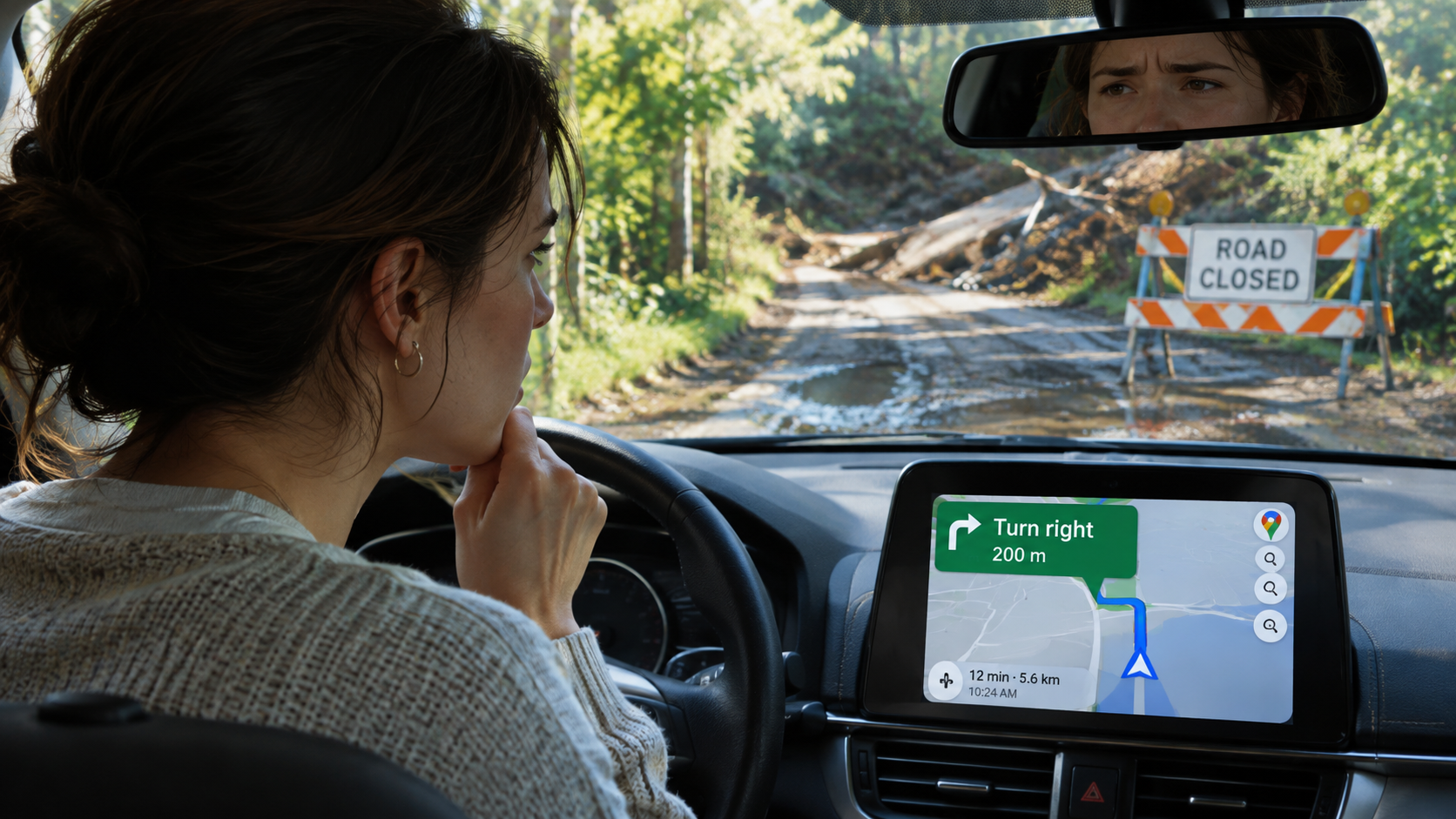
Google Maps is becoming more intelligent, conversational, and visually sophisticated. But the psychology of navigation raises an uncomfortable question: Why do people sometimes follow digital directions even when the road in front of them suggests something is wrong?
You're driving somewhere unfamiliar.
Google Maps tells you to turn right.
The screen shows a perfectly reasonable route. Your estimated arrival time looks good, and the familiar navigation voice sounds confident.
But when you reach the intersection, something doesn't seem right.
The road looks unusually narrow.
There's a sign you didn't expect.
Perhaps the turn leads toward a gravel road instead of the main highway.
You hesitate.
Then you look at your phone.
Google Maps still says to turn.
And for a moment, you find yourself wondering whether the technology knows something you don't.
Maybe it's avoiding traffic.
Maybe there's construction ahead.
Maybe this really is the fastest route.
So you consider following it.
That's the moment when navigation becomes more than a technology problem. It becomes a psychology problem.
We often trust digital directions because they work.
Google Maps has helped millions of people navigate unfamiliar cities, avoid traffic, locate businesses, and reach destinations without studying a paper map.
The convenience is enormous.
But the same reliability that makes navigation technology useful can also make its occasional mistakes difficult to recognize.
When a system gets us where we're going almost every day, we're more likely to give it the benefit of the doubt when something unexpected happens.
That tendency has a name.
It's called automation bias.
And as Google integrates more artificial intelligence into Maps, understanding that bias may become increasingly important.
In March 2026, Google announced a major redesign of Maps involving its Gemini AI models.
The update introduced conversational search through Ask Maps and a new Immersive Navigation experience featuring three-dimensional views, natural-language directions, and more detailed route guidance.
The Associated Press covered the March 12 announcement, describing the integration of Google's Gemini technology into its widely used navigation platform.
Then, on October 20, Google announced additional Gemini personalization capabilities for Android Auto and vehicles with Google built-in.
The direction is clear.
Navigation is becoming more conversational, more personalized, and potentially more persuasive.
But that raises a question.
If we already have trouble questioning a simple navigation instruction, what happens when the system becomes better at explaining its recommendations in a confident, humanlike way?
Will that improve our ability to make informed decisions?
Or will it make us even more willing to trust a route that conflicts with the physical world?
We shouldn't assume that adding Gemini automatically makes Google Maps less accurate.
There is no evidence establishing that the new conversational features caused the documented routing mistakes discussed in this article.
But AI can change how information is presented and how users interpret it.
And sometimes, the way a recommendation is communicated is almost as important as whether it's correct.
To understand why, we need to look at the psychology of automation, the documented failures of digital navigation, and the difference between trusting a tool and surrendering our judgment to it.
Google Maps Has Become More Than a Map
A traditional paper map gives you information.
It shows streets, landmarks, boundaries, and the relationship between locations.
You examine the information and decide where to go.
A navigation application does something different.
It makes a recommendation.
It identifies a route.
It estimates how long the trip will take.
It tells you when to turn.
And if you deviate, it recalculates.
That fundamentally changes the relationship between the person navigating and the information they're using.
Instead of interpreting a map independently, the driver can follow a sequence of instructions.
The process requires less planning.
And in most everyday situations, that's a substantial benefit.
But it also changes where the decision-making happens.
Maps Reduces Cognitive Effort
Imagine planning a drive through a city you've never visited.
Without digital navigation, you might study major roads, memorize several turns, and pay close attention to landmarks.
With Google Maps, you can enter an address and follow the guidance.
The application handles much of the route planning.
You can concentrate on operating the vehicle.
That's one reason navigation technology is so appealing.
It reduces the mental effort involved in finding your way.
But reducing cognitive effort can have an unintended side effect.
When the system handles the route, the user may spend less time developing an independent understanding of it.
We Learn to Follow Instead of Plan
A 2020 study published in Scientific Reports examined GPS use and spatial memory.
Researchers Louisa Dahmani and Véronique Bohbot studied 50 regular drivers and found an association between greater lifetime GPS experience and weaker spatial memory during self-guided navigation tasks.
A smaller longitudinal follow-up involving 13 participants also suggested a relationship between increased GPS use and declining spatial memory performance.
The findings were limited by sample size, and observational relationships don't establish every causal pathway.
More recent research has produced mixed results.
For example, a 2024 study in the Journal of Environmental Psychology, involving 822 U.S. participants, found no significant association between self-reported GPS reliance and performance on its navigation task.
So it would be inaccurate to claim that GPS definitively destroys everyone's sense of direction.
But the broader research raises a legitimate question.
When people increasingly rely on automated guidance, how does that affect their attention to the surrounding environment?
And what happens when the guidance is wrong?
The Psychology of Automation Bias
Automation bias is the tendency to rely on automated recommendations in ways that can replace independent checking or judgment.
It doesn't mean people are foolish.
And it doesn't mean technology is generally unreliable.
It describes a predictable risk in human interactions with systems that usually perform useful tasks.
In their influential 1997 paper, Humans and Automation: Use, Misuse, Disuse, Abuse, researchers Raja Parasuraman and Victor Riley examined how people use automated systems.
They distinguished appropriate use from overreliance and underuse.
One concern was that people could rely too heavily on automation and fail to monitor the system adequately.
That idea has since been studied across aviation, healthcare, transportation, and other domains.
Why Automation Bias Happens
Automated systems often provide recommendations quickly.
They can process more information than a person could reasonably assess in the same time.
Their outputs appear organized and authoritative.
And when they work consistently, users develop confidence.
Those characteristics are useful.
But they can also encourage a person to accept a recommendation without independently evaluating contradictory information.
Two Types of Automation Errors
Researchers often distinguish between errors of commission and errors of omission.
An error of commission occurs when a person follows an incorrect automated recommendation.
For example, a driver turns onto a road because the navigation system recommends it, despite seeing clear evidence that the turn is prohibited.
An error of omission occurs when a person fails to take action because an automated system doesn't alert them to a problem.
For example, a person assumes there is no road restriction because the map hasn't identified one.
These are illustrative navigation examples.
The concepts come from research on automated decision support, including a 1999 study by Linda Skitka, Kathleen Mosier, and Mark Burdick.
In that research, participants using an imperfect automated aid sometimes followed recommendations that conflicted with other valid available information.
The important lesson is that automation can influence judgment even when contradictory evidence exists.
The Study That Helps Explain Why Drivers Follow Wrong Directions
One particularly relevant study examined navigation decisions directly.
Published in 2019 in Frontiers in Psychology, the research investigated how people respond to external directions when navigating routes they've already learned.
Participants learned routes in a simulated environment.
They then navigated again with guidance from different sources, including a GPS, a friend, or a stranger.
Sometimes the guidance was correct.
Sometimes it was incorrect.
The researchers also varied whether participants received feedback about their navigation decisions.
The results revealed something important.
People could know a route and still be influenced by incorrect external guidance.
In one experiment, participants receiving incorrect GPS directions without feedback showed substantially lower turning accuracy than those who received feedback.
The researchers reported accuracy of approximately 52% in the no-feedback condition compared with 69% when feedback was available.
These numbers describe a specific experimental setup, not the percentage of real drivers who would obey a wrong-way instruction.
But the pattern is relevant.
People were influenced by guidance even when they had previously learned the route.
The Source of Advice Matters
The researchers found that participants generally expressed particularly strong trust in GPS guidance.
Yet they sometimes performed better when following a friend.
That suggests people evaluate information partly through the credibility they assign to its source.
A navigation system may seem more authoritative because it appears precise, technical, and data-driven.
A human offering directions may be treated as more subjective.
But confidence in a source doesn't guarantee the source is correct.
Feedback Changes Behavior
The study also found that feedback influenced participants' responses.
When people could evaluate the consequences of their choices, they were better able to adjust.
That leads to an important design question.
If navigation applications make their recommendations more understandable and show relevant uncertainty, can they help users maintain better judgment?
It's a promising question.
But the answer requires testing rather than assumption.
A Real Example: Google Maps and the Wrong-Way Street in Toronto
Automation bias isn't just a theoretical concern.
In May 2026, residents of a Toronto neighborhood described a problem involving Google Maps and a one-way street.
According to UPI's May 6 report, a mapping error on Winona Drive caused drivers to travel in the wrong direction.
The road was southbound-only, but Google Maps reportedly showed incorrect directional information.
Residents noticed a sudden increase in wrong-way traffic.
Some created their own signs warning that the GPS information was incorrect.
Local officials and residents contacted Google.
The city also installed temporary traffic-control measures.
Google said the error had been corrected.
It's a striking case because the conflict wasn't subtle.
There was a real-world traffic restriction.
Yet the digital directions led people toward an incorrect maneuver.
Why This Example Matters
We can't know the private thought process of every driver who made the wrong turn.
Some may have missed the signs.
Others may have been unfamiliar with the neighborhood.
Some might have focused on the map rather than the road.
The reporting doesn't establish each driver's psychological motivation.
But it demonstrates the situation in which automation bias becomes relevant.
A digital instruction conflicts with real-world information.
The user must decide which source deserves priority.
The Road Wasn't Wrong. The Map Was.
That distinction is easy to overlook.
A navigation application represents the physical world.
It doesn't determine the legal direction of traffic.
A software error cannot turn a prohibited maneuver into a permitted one.
The road signs and applicable traffic laws remain controlling.
Yet digital representations can feel authoritative enough that users hesitate when reality doesn't match the screen.
That's the trust problem.
Another 2026 Case: When Maps Sends Drivers Down Private Roads
A separate investigation in North Carolina showed how mapping problems can affect more than ordinary commuters.
In May 2026, WSOC-TV reported that residents in Wingate were concerned about navigation applications directing vehicles onto private roads.
One resident described emergency vehicles entering a dead-end private road and needing to turn around.
The station's reporter independently checked and confirmed that Google Maps directed users along two of the roads residents had identified as problematic.
The story also described delivery drivers entering private property.
The Problem Goes Beyond One Driver
An inaccurate road representation can affect many people.
It can direct unfamiliar drivers into locations they shouldn't enter.
It can disrupt residents.
It can create problems for delivery operations.
And when emergency vehicles are involved, incorrect directions can have particularly serious consequences.
This doesn't establish that every navigation error is caused by automation bias.
The underlying mapping data may be incorrect.
The route-selection system may be responding to that incorrect information.
The human driver then makes a decision based on the recommendation.
Those are different components of the problem.
Understanding them separately is essential.
The Most Serious Consequences of Navigation Errors
The consequences of inaccurate directions can range from mild inconvenience to tragedy.
In September 2023, the Associated Press reported on a lawsuit filed by the family of a North Carolina man who died after driving off a collapsed bridge in 2022.
According to AP's reporting, the lawsuit alleged that Google Maps had directed him along a route involving the bridge despite previous reports that the structure had collapsed.
The lawsuit also raised questions about missing barriers and responsibility for the road.
The report described allegations and the filing of legal claims; it should not be treated as a final judicial determination of responsibility.
The incident illustrates why accurate mapping information can matter so much.
Not every navigation failure is a minor inconvenience.
A wrong turn can become dangerous when it involves a closed bridge, unsuitable road, severe terrain, or another physical hazard.
Why Safety Reporting Needs Precision
It's tempting to describe these incidents as proof that people blindly follow GPS directions.
But that would oversimplify complex events.
Road conditions, signage, visibility, mapping information, driver awareness, and other circumstances may all contribute.
Automation bias is a relevant psychological framework.
It isn't an automatic explanation for every collision involving navigation.
A credible analysis should distinguish documented facts from interpretations about why someone made a decision.
The National Park Service Has Been Warning About This for Years
Some of the clearest guidance about navigation technology comes from the National Park Service.
On its Death Valley National Park directions page, the agency warns visitors not to rely exclusively on vehicle GPS systems.
The park explains that automated navigation can direct people toward incorrect locations, closed roads, or dead ends.
Those problems can become especially serious in remote environments.
Cell service may be unavailable.
Roads may require specialized vehicles.
Water, fuel, and emergency assistance may be far away.
The Mojave National Preserve's current road-conditions guidance offers similar warnings.
It explicitly advises visitors against following certain GPS directions onto dirt roads and notes that third-party mapping applications may suggest routes unsuitable for a particular vehicle or driver's experience.
Why the Problem Is Different in Remote Areas
A wrong turn in a familiar city may add a few minutes to a trip.
A wrong turn in a remote desert environment can create much greater risk.
The application may identify something as a road without adequately communicating its physical condition.
A route may technically connect two locations while being unsuitable for an ordinary passenger vehicle.
The map isn't necessarily evaluating every real-world constraint that matters to the traveler.
A Route Can Be Digitally Connected but Practically Unusable
This is one of the most important distinctions in navigation.
A road network is a representation.
A line connecting two points doesn't guarantee that a particular vehicle can safely travel between them under current conditions.
Weather, closures, vehicle clearance, road maintenance, and other conditions may change what is practical.
A navigation system can be useful while still lacking information needed for a safe decision.
That's why official road guidance remains important.
Why We Continue Trusting Google Maps After Hearing About Errors
If navigation errors can have serious consequences, why do people keep using Google Maps?
Because most of the time, it works.
The technology provides substantial value.
It reduces the uncertainty of traveling somewhere unfamiliar.
It helps people estimate arrival times.
It identifies possible traffic delays.
And it saves users from having to plan every route manually.
One documented error doesn't erase those benefits.
Successful Experiences Build Expectations
Imagine you've used Google Maps hundreds of times.
It has guided you to restaurants, airports, appointments, and unfamiliar neighborhoods.
The recommendations have generally worked.
When the system offers another route, you have a history of successful experiences supporting your trust.
That is not irrational.
It's a reasonable response to a tool that has repeatedly been useful.
The challenge arises when previously earned confidence becomes difficult to override in the presence of contradictory evidence.
The Interface Looks Precise
A highlighted route gives the impression of certainty.
The line follows the road.
A turn appears at a specific intersection.
The arrival time may be displayed down to the minute.
That level of detail can make the recommendation feel authoritative.
But precision of presentation isn't the same as accuracy of information.
An estimated arrival time can be precise-looking while still being uncertain.
A route line can look exact while relying on outdated road data.
Recalculation Reinforces the Sense of Control
If a driver misses a turn, Google Maps recalculates.
The experience suggests that the system can adapt.
Usually, that's helpful.
But recalculation can also make it easier for users to keep following the application without independently reviewing the overall route.
The next instruction arrives quickly.
There's little reason to stop and reconsider unless something seems obviously wrong.
The Psychology of Cognitive Offloading
Another useful concept is cognitive offloading.
People use external tools to reduce the amount of information they must remember or process internally.
A calendar stores appointments.
A calculator handles arithmetic.
A phone stores contact information.
A navigation application manages routes.
This isn't inherently a problem.
Offloading mental work can make people more efficient.
But it changes how much attention they devote to the task.
Navigation Used to Require a Mental Model
Without automated guidance, a traveler might need to understand how neighborhoods, roads, and landmarks fit together.
With turn-by-turn directions, the immediate objective can become simply following the next instruction.
That may reduce the need to construct a detailed mental representation of the route.
A 2025 study in the Ain Shams Engineering Journal examined spatial learning among 36 participants navigating routes in Madinaty, Egypt.
Participants using GPS guidance showed weaker route and landmark recognition than those navigating without it.
The study's sample was small and location-specific.
It doesn't establish a universal effect for all drivers.
But it supports the possibility that the way people navigate influences what they learn about their surroundings.
Not All Research Finds the Same Effect
The evidence isn't unanimous.
As noted earlier, the 2024 study involving 822 U.S. participants found no significant association between self-reported GPS reliance and navigation performance in its particular task.
Other research suggests people adjust their GPS use based on familiarity and confidence rather than blindly following technology in every situation.
A 2024 study published in Cognitive Research: Principles and Implications found that people reported using GPS differently depending on the environment and their own navigation abilities.
This nuance matters.
People aren't passive victims of technology.
They actively evaluate, adapt, and sometimes reject automated recommendations.
The problem is identifying the conditions under which reliance becomes excessive.
Google Maps Is Getting More Conversational
Now consider how the experience is changing.
Google's March 12, 2026 Maps announcement introduced two major features.
The first was Ask Maps.
This allows users to ask complex questions about locations and receive conversational answers.
Instead of conducting several searches, users can describe what they're looking for.
The second was Immersive Navigation.
This redesign introduced richer three-dimensional views, more natural instructions, and additional route context.
Google described it as its biggest navigation upgrade in more than a decade.
The Benefits Are Real
More natural navigation instructions can be useful.
A driver may find it easier to understand a direction associated with a recognizable landmark.
A three-dimensional view may help clarify a complex interchange.
Explaining that one route involves tolls while another involves more traffic can support better decisions.
These features may reduce confusion rather than increase it.
That's an important possibility.
But Conversational Systems Change the Feeling of Advice
A traditional navigation voice might say:
“Turn right in 500 feet.”
A more contextual system might explain an upcoming turn using a landmark or describe why a particular route is preferable.
That additional explanation may make the recommendation feel more understandable.
It may also make it feel more authoritative.
The critical question is whether users are being given meaningful evidence or merely a more fluent presentation.
A convincing explanation cannot compensate for incorrect underlying road information.
Google Is Bringing More Personalization Into Vehicles
On October 20, 2026, Google announced that Gemini's Personal Intelligence capabilities were expanding into cars.
With eligible accounts and permission, Gemini can use information from connected Google services to provide personalized assistance.
Google emphasized hands-free interactions and user control over connected data.
These features may make navigation and vehicle assistance more convenient.
But they also raise broader questions about how much people rely on systems that appear increasingly capable of understanding their needs.
That makes trust calibration more important.
Gemini Isn't Automatically Responsible for Every Google Maps Routing Error
This distinction is essential.
Google Maps has relied on complex routing algorithms, traffic information, location data, and road-network information long before Gemini became integrated into the experience.
Some navigation errors involve inaccurate map data.
Others may involve outdated road closures.
Some involve incorrect turn restrictions or unsuitable routes.
A conversational AI feature isn't necessarily involved in generating those errors.
The Toronto example and other documented navigation failures should not be presented as proof that Gemini caused them.
Different Systems Perform Different Roles
A navigation application may use one system to represent roads, another to estimate traffic, another to calculate routes, and another to communicate recommendations.
Generative AI may help interpret a request, explain a route, or identify landmarks.
That doesn't mean every road decision is produced directly by a language model.
The distinction matters when evaluating risk.
The New Question Is About Presentation and Reliance
Even when the underlying routing system remains unchanged, a more persuasive interface could influence how users respond to recommendations.
A clearer explanation might help a driver make a better choice.
Or it might cause someone to accept inaccurate information more readily.
Both are hypotheses worth testing.
We shouldn't claim an increase in overreliance without evidence.
But the psychology research provides a reason to investigate how presentation affects trust.
A Practical Research Idea: Can People Recognize a Wrong Route?
The most interesting way to study navigation trust isn't to ask people whether they trust Google Maps.
It's to observe what happens when an automated recommendation conflicts with information they can verify.
That creates an opportunity for original research.
However, it's important to design the research safely.
Nobody should deliberately drive the wrong way, enter a closed road, ignore traffic controls, or approach a dangerous route to test an application.
A credible study can combine publicly available route information with controlled, stationary decision-making exercises.
Here's how I would structure it.
Part One: A Desktop Audit of Navigation Accuracy
The first phase would examine whether Google Maps presents routes that conflict with independently verified road information.
The research would be conducted without driving into questionable locations.
Step 1: Select a Defined Geographic Area
Choose a city or region with accessible official road information.
Ideally, use a municipality or transportation agency that publishes one-way restrictions, road closures, or other verified conditions.
Don't choose routes simply because someone online claims they're wrong.
Establish a reliable reference.
Step 2: Identify Suitable Test Conditions
Look for situations involving clear routing constraints.
Examples could include a documented one-way street, a verified road closure, a vehicle restriction, or a location with an official access route.
The conditions should be publicly verifiable.
Avoid relying on temporary or uncertain information without documentation.
Step 3: Record the Official Information
Document the authoritative road restriction.
Record the source, publication date, and any relevant effective dates.
If a restriction is temporary, note when it applies.
That prevents a common research mistake: comparing a current map against an outdated closure notice.
Step 4: Generate Routes in Google Maps
Enter defined starting points and destinations.
Record the date and time.
Document the transportation mode, relevant route preferences, and alternatives displayed.
Capture screenshots before the route is followed.
Step 5: Compare the Directions With the Verified Restriction
Does the suggested route respect the documented rule?
Is the road correctly represented?
Does Maps avoid an officially closed segment?
Does it acknowledge the relevant restriction?
Record the result without assuming that every unusual route is an error.
Step 6: Repeat at Different Times
Traffic conditions and route recommendations can change.
A responsible audit should document those differences.
Use consistent start and destination points, then explain any changing conditions that could affect the result.
Step 7: Review the Evidence
Where a discrepancy appears, confirm the restriction through an appropriate independent source.
A screenshot alone may not establish a routing failure.
If the discrepancy remains credible, document it carefully and consider submitting a correction through Google's official reporting tools.
What This Audit Would Establish
A desktop audit could identify instances where displayed route information conflicts with verified road restrictions.
It would not establish that people actually follow the incorrect directions.
It also wouldn't prove why a routing error occurred.
Those require additional evidence.
This is a proposed methodology, not a report of route tests I conducted.
No original Google Maps test results are being claimed in this article.
Part Two: Test the Psychology of Following the Recommendation
The second phase would examine human decision-making.
Instead of putting participants in actual danger, researchers could use a controlled, stationary exercise.
The objective would be to understand whether people defer to navigation guidance when other information conflicts with it.
A Simple Scenario
Show participants an image of a road intersection.
The image contains an unambiguous one-way or do-not-enter restriction.
Then present a fictional navigation recommendation instructing the driver to take the prohibited turn.
Ask what the participant would do.
Would they follow the digital instruction?
Would they obey the road sign?
Would they stop and verify the route?
Compare Different Presentation Styles
Researchers could randomly assign participants to different conditions.
In the first, a neutral navigation display gives a turn instruction.
In the second, the same incorrect turn appears with a brief explanation suggesting that it's the recommended route.
In the third, the navigation display explicitly acknowledges uncertainty and advises checking road signs.
The route information would be kept otherwise comparable.
This would help isolate whether presentation influences trust.
Use Clearly Labeled Mockups
For ethical and methodological reasons, the research should use clearly documented mockups rather than pretend that Google Maps actually issued the incorrect directions.
If real product screenshots are used, their origin and modifications must be disclosed.
The objective is to test how people respond to different forms of automation advice, not to manufacture evidence of a product error.
Measure More Than the First Answer
Participants could indicate how confident they are in their decision.
They could explain which information they trusted most.
They might also report whether they've previously experienced a navigation error.
These responses could help researchers distinguish simple misunderstanding from reliance on the automated recommendation.
Important Limitations
A stationary exercise isn't the same as driving.
Participants may behave differently when they're under time pressure, distracted, or navigating an unfamiliar environment.
The sample may not represent all drivers.
And knowing they're taking part in a study could change their responses.
The results should be interpreted within those limitations.
Still, this method could produce original evidence about how people evaluate conflicting directions without exposing anyone to road hazards.
The Most Interesting Question Isn't Whether People Make Mistakes
It's whether the design of the technology changes the likelihood of those mistakes.
Imagine two otherwise identical situations.
In both, a navigation system recommends a turn that conflicts with a visible road restriction.
In the first situation, the instruction appears as a simple arrow.
In the second, the same recommendation is accompanied by a confident-sounding explanation.
Would people be more likely to follow the second?
We don't know from this proposed experiment.
That's exactly what makes the question worth testing.
Explanations Can Help or Mislead
A good explanation can clarify a recommendation.
It can help users understand traffic conditions, route tradeoffs, and uncertainty.
But an explanation can also make incorrect information feel more credible if it sounds convincing without being supported by reliable evidence.
The problem isn't conversational AI by itself.
It's the possibility of confusing fluency with accuracy.
Appropriate Uncertainty May Improve Decisions
Imagine a system that says:
“Road information may be outdated. Follow posted traffic restrictions.”
That message may help a user understand the limits of the automated recommendation.
But it could also become irritating if displayed constantly in situations where the guidance is highly reliable.
Designers need to determine when uncertainty warnings are genuinely useful.
Too many warnings can become background noise.
Too few can encourage overconfidence.
Trustworthy automation requires calibration.
What Google Maps Could Do to Support Better Human Judgment
Google's newer features already include some elements that could improve decision-making.
The company says Immersive Navigation provides route previews, visual context, and explanations of tradeoffs between alternatives.
These are potentially valuable.
But there are additional principles worth considering.
Make Important Uncertainty Understandable
A route passing through an area with incomplete or disputed road information may deserve clearer warnings.
The challenge is communicating uncertainty without overwhelming drivers.
Show Relevant Route Tradeoffs
A route that's three minutes faster but uses a narrow local road may not be preferable for every driver.
When practical, presenting meaningful alternatives can support informed choices.
Respect Physical Constraints
Routing recommendations should reflect known one-way restrictions, closures, and other relevant rules.
Improving road-data accuracy remains fundamental regardless of how sophisticated the interface becomes.
Make Error Reporting Easier
People who identify incorrect information should have a practical way to report it.
Google provides mechanisms for submitting road corrections and reporting wrong directions.
But the process should remain understandable and accessible.
Avoid Overstating Certainty
An estimated arrival time is an estimate.
A recommended route is a recommendation based on available information.
The interface should communicate usefulness without implying infallibility.
Preserve Human Agency
The system should help people make safe decisions, not encourage them to disregard the environment around them.
A more capable assistant should ideally make users better informed.
It shouldn't make them less willing to question an obviously incorrect instruction.
What Should Drivers Do When Google Maps Conflicts With Reality?
The most important principle is straightforward.
Follow traffic laws, posted signs, and actual road conditions—not an app instruction that conflicts with them.
If a road is marked closed, don't enter it because the navigation system says to continue.
If a one-way restriction prohibits a turn, don't make the turn because the map recommends it.
If an unpaved road appears unsuitable for your vehicle, don't assume it's safe simply because it appears as a route.
And if you need to investigate a confusing instruction, pull over somewhere legal and safe before interacting with the device.
The National Highway Traffic Safety Administration emphasizes that safe driving requires attention and that phone use can create dangerous distractions.
Trying to solve a navigation problem while driving can introduce another risk.
Verify the Destination
Before beginning a trip, confirm the correct destination and address.
Businesses sometimes move.
Addresses may lead to the wrong entrance.
Large properties may have multiple access points.
A little preparation can prevent unnecessary confusion.
Review Unusual Routes Before Departure
If a route unexpectedly uses remote roads, private drives, or unfamiliar shortcuts, consider checking official information before leaving.
This is especially important in areas with difficult terrain or poor connectivity.
Use Authoritative Road Sources When Appropriate
For closures, major construction, and remote travel, transportation agencies and park authorities may publish more specific information.
The National Park Service explicitly recommends checking official road conditions in areas where navigation apps may be unreliable.
Report Errors Safely
Google provides instructions for reporting wrong directions and correcting road information.
The wrong-directions reporting process is available on desktop in supported regions.
Road edits can be submitted through supported Maps interfaces.
Reporting an error can help improve information for future users, although submission doesn't guarantee immediate correction.
Why This Is Really a Consumer Trust Story
The Google Maps question is part of a much broader shift.
People increasingly rely on digital systems to recommend actions.
AI suggests what to read.
Algorithms recommend what to buy.
Software identifies suspicious financial transactions.
Digital assistants help write documents.
Navigation applications tell us where to go.
Many of those systems are useful precisely because they reduce uncertainty and effort.
But they also create a recurring challenge.
When should we trust the recommendation?
And when should we trust our own observations?
Trust Should Be Earned and Calibrated
A useful automated system should receive appropriate trust when its recommendations are reliable.
But users also need to recognize situations where the available evidence contradicts the output.
In psychological research, this is often described as trust calibration.
The goal isn't to eliminate trust.
It's to align trust with actual system capability.
A Familiar Brand Can Increase Confidence
Google Maps has a familiar interface and a long history of everyday usefulness.
That can reasonably influence how much people trust it.
But brand familiarity isn't proof that every data point is current or correct.
The same applies to other widely used technologies.
More AI Doesn't Automatically Mean More Trustworthy
Gemini-powered navigation may make Maps easier to use.
It may improve certain forms of guidance and route understanding.
But a more conversational experience should not be confused with a guarantee of factual or geographic accuracy.
The reliability of the underlying information remains essential.
The Human Still Needs to Be Able to Say No
One of the most valuable abilities in an AI-assisted environment is recognizing when a recommendation doesn't fit reality.
That might mean questioning a questionable answer.
Rejecting an incorrect financial calculation.
Checking a fabricated citation.
Or refusing to turn onto a road that clearly prohibits entry.
The underlying principle is the same.
Automation should support human judgment, not make contradictory evidence easier to ignore.
What Businesses Can Learn From Google Maps and Automation Bias
This isn't only a story about navigation.
For businesses adopting AI, the psychological lessons are relevant across many workflows.
Imagine a marketing team using AI to analyze campaign performance.
The assistant produces a confident recommendation.
But the underlying numbers don't support its conclusion.
Will the team notice?
Or will the polished explanation make the recommendation seem more credible than it deserves?
Imagine a company using AI to summarize customer feedback.
The system identifies a trend that isn't actually present in the source material.
Will employees verify the claim?
Or will they trust the summary because it appears organized and authoritative?
Navigation provides a visible example of a broader challenge.
Accuracy and Presentation Are Different
An answer can sound confident while being wrong.
A route can look precise while reflecting outdated information.
A report can appear professionally formatted while containing flawed analysis.
Good design doesn't replace verification.
More Detail Isn't Always Better Evidence
An AI system that provides an elaborate explanation may feel more trustworthy than one that offers a short recommendation.
But the length or fluency of an explanation doesn't establish correctness.
Businesses need methods for checking the underlying information.
Human Review Must Be Meaningful
Simply placing a person in the workflow doesn't guarantee that errors will be caught.
If employees routinely accept automated output without evaluating it, human oversight may become superficial.
Training and procedures should encourage appropriate checking.
The Right Level of Trust Depends on Consequences
A minor wording suggestion may require little verification.
A financial analysis, legal recommendation, or safety-critical decision may require much more.
The level of oversight should reflect the risk.
That's a practical way to apply lessons from navigation psychology to business technology.
Frequently Asked Questions
1. Why do people keep trusting Google Maps when it makes mistakes?
Google Maps is useful and often provides accurate directions. Repeated successful experiences encourage confidence. Automation bias can also lead people to rely on recommendations instead of independently checking them, especially when the system appears authoritative. However, not every navigation error is caused by automation bias.
2. What is automation bias?
Automation bias is the tendency to rely on automated advice in ways that can reduce independent checking or lead people to follow incorrect recommendations. Researchers have studied it in aviation, healthcare, and other fields. It can contribute to errors when automated guidance conflicts with other valid information.
3. Can Google Maps send drivers the wrong way on a one-way street?
Yes, incorrect road information can produce improper routing suggestions. In May 2026, residents of Toronto's Winona Drive reported that Google Maps was directing drivers the wrong way on a one-way street. Google said the error was subsequently corrected.
4. Has Google Maps ever directed people toward dangerous roads?
Documented reporting includes navigation errors involving unsuitable private roads and allegations concerning dangerous routes. The National Park Service also warns that GPS navigation can direct travelers toward closed, dead-end, or unsuitable roads in remote areas. Individual incidents can involve several contributing factors.
5. Does Google Maps use artificial intelligence?
Yes. Google has integrated Gemini-powered features into Maps, including conversational assistance, more natural navigation instructions, and enhanced visual guidance. However, that doesn't mean Gemini itself generates every road route or causes every mapping error. Navigation relies on multiple systems and data sources.
6. What changed in Google Maps in 2026?
In March 2026, Google introduced Ask Maps and Immersive Navigation, with conversational recommendations, three-dimensional views, enhanced visual guidance, and route tradeoff explanations. In October, Google announced additional Gemini personalization features for supported vehicle experiences.
7. Does Gemini make Google Maps more accurate?
Google describes improvements intended to make guidance more useful and intuitive. But there's insufficient evidence here to conclude that Gemini has either increased or decreased the frequency of incorrect routes overall. New interface features and underlying road-data accuracy should be evaluated separately.
8. Why would someone follow GPS directions that contradict a road sign?
Possible factors include distraction, unfamiliar surroundings, confidence in the navigation system, difficulty noticing the sign, or automation bias. Without evidence about a particular driver's attention and decision-making, it isn't possible to determine which factor caused an individual mistake.
9. Can GPS use weaken your sense of direction?
Some studies have found associations between GPS reliance and weaker spatial learning or memory, while others haven't found the same relationship. The evidence varies by research method, sample, and navigation task. It's too simplistic to claim that GPS inevitably damages navigation ability.
10. What should I do if Google Maps tells me to enter a closed road?
Do not enter a closed road or make a prohibited turn because an application recommends it. Follow posted signs and applicable laws. If you need to review the route, stop somewhere legal and safe. You can report incorrect directions or road information through Google's supported feedback tools.
11. Are Google Maps directions always based on live traffic?
Google combines current and historical location-related traffic information with other sources to estimate travel times and select routes. Not every road condition or restriction is necessarily captured immediately. Some information may be outdated or incomplete.
12. What is trust calibration?
Trust calibration means matching confidence in a system to its actual reliability and limitations. Appropriate trust allows people to benefit from automation while remaining willing to question it when other evidence indicates a problem.
13. Are AI-generated explanations more persuasive than ordinary directions?
They may influence how users perceive recommendations, but the effect needs to be measured in controlled research. A fluent explanation could improve understanding or create unwarranted confidence. This article proposes a study to investigate that distinction rather than claiming a confirmed effect.
14. How can researchers test automation bias in navigation safely?
Researchers can use stationary, simulated navigation scenarios containing clear conflicts between a digital instruction and road information. Participants can indicate which direction they would choose and why. Such experiments avoid putting drivers in hazardous situations, although their results may not fully predict real-world behavior.
15. Can journalists independently test Google Maps route accuracy?
Yes. A careful desktop audit can compare displayed routes with verified official information about road restrictions, closures, or other conditions. Researchers should document dates, locations, settings, and changing conditions. They should not deliberately drive into unsafe routes to prove an error.
16. How can I report incorrect roads in Google Maps?
Google provides tools for submitting road corrections, including wrong-way restrictions, closures, missing roads, and incorrectly drawn roads. Reporting availability varies by device and region. The company's Help Center explains the supported steps.
17. Should drivers stop using Google Maps?
No general conclusion like that follows from the evidence. Digital navigation provides substantial benefits and can reduce the effort involved in traveling. The more useful approach is to understand its limitations, follow real-world traffic restrictions, and verify unusual routes when necessary.
18. What can AI companies learn from navigation mistakes?
AI providers need to consider not only whether recommendations are usually useful but also whether users can recognize uncertainty, correct errors, and maintain appropriate control. A system that appears confident should still help people identify when its information may be incomplete or wrong.
19. Does a better-looking map make a route more reliable?
Not necessarily. Richer graphics can improve orientation and help users understand complex roads, but visual sophistication doesn't guarantee the accuracy of road data. A route may appear convincing while relying on incorrect information.
20. What is the biggest lesson about Google Maps and consumer trust?
The central lesson is that trust should remain responsive to evidence. Navigation technology is valuable because it usually works, but people still need to recognize when a recommendation conflicts with traffic rules or physical conditions. Useful automation should improve judgment rather than replace it entirely.
The Road in Front of You Still Matters More Than the Route on Your Screen
Google Maps has changed how people navigate.
It has made unfamiliar places easier to reach.
It has reduced the effort required to plan trips.
And it continues to evolve, with Gemini bringing increasingly sophisticated conversational assistance and visual guidance into the experience.
Those advances are meaningful.
But they don't eliminate the gap between a digital representation of the world and the world itself.
A map can contain outdated information.
An algorithm can recommend a route that isn't appropriate for current conditions.
And a driver can misunderstand or overlook information that contradicts the screen.
The psychology of automation helps explain why these situations are so interesting.
We trust systems that repeatedly work.
We develop habits around their recommendations.
And sometimes, we give those recommendations more weight than we should.
That doesn't mean people need to reject navigation technology.
It means they need to maintain the ability to question it.
For technology companies, the challenge is building interfaces that support appropriately calibrated trust.
For researchers, it's understanding how recommendations influence decisions when other evidence is available.
For journalists, it's separating actual mapping errors from assumptions about the psychology of individual drivers.
And for consumers, it's remembering that a confident digital instruction is still a recommendation based on imperfect information.
The most trustworthy navigation system isn't one that convinces us to follow every direction. It's one that helps us reach our destination while making it possible to recognize when the directions are wrong.
That distinction becomes even more important as artificial intelligence makes digital assistants feel increasingly capable and conversational.
Because the future of AI shouldn't simply involve technology that sounds more certain.
It should involve technology that helps people make better decisions.
And sometimes, the better decision is to look up from the screen, pay attention to the road, and trust what the physical world is telling you.
Building Digital Experiences That Earn Customer Trust?
At Ritner Digital, we examine how technology, psychology, and digital design influence the way people make decisions.
From AI-powered search and marketing automation to website usability and customer experience, successful digital strategy requires more than sophisticated technology.
It requires understanding the people using it.
That means creating accurate information, reducing unnecessary confusion, communicating clearly, and building experiences that support informed decisions.
Whether your business is exploring AI adoption, improving digital marketing performance, or trying to create a more trustworthy online experience, the goal should be technology that genuinely helps customers.
Contact Ritner Digital to discuss a digital strategy built around clarity, credibility, and meaningful business results.
Because people don't build trust with technology simply because it's impressive.
They build trust when it proves dependable—and when they're still allowed to question it.