The Lifecycle of Online Content: How Blogs and Service Pages Actually Perform Over Time
One of the most persistent misconceptions in digital marketing is that publishing a piece of content is the end of the work.
You write the blog post. You publish it. You share it once on social media. And then you wait — either for traffic to arrive or for the silence to confirm that it didn't work — before moving on to the next piece.
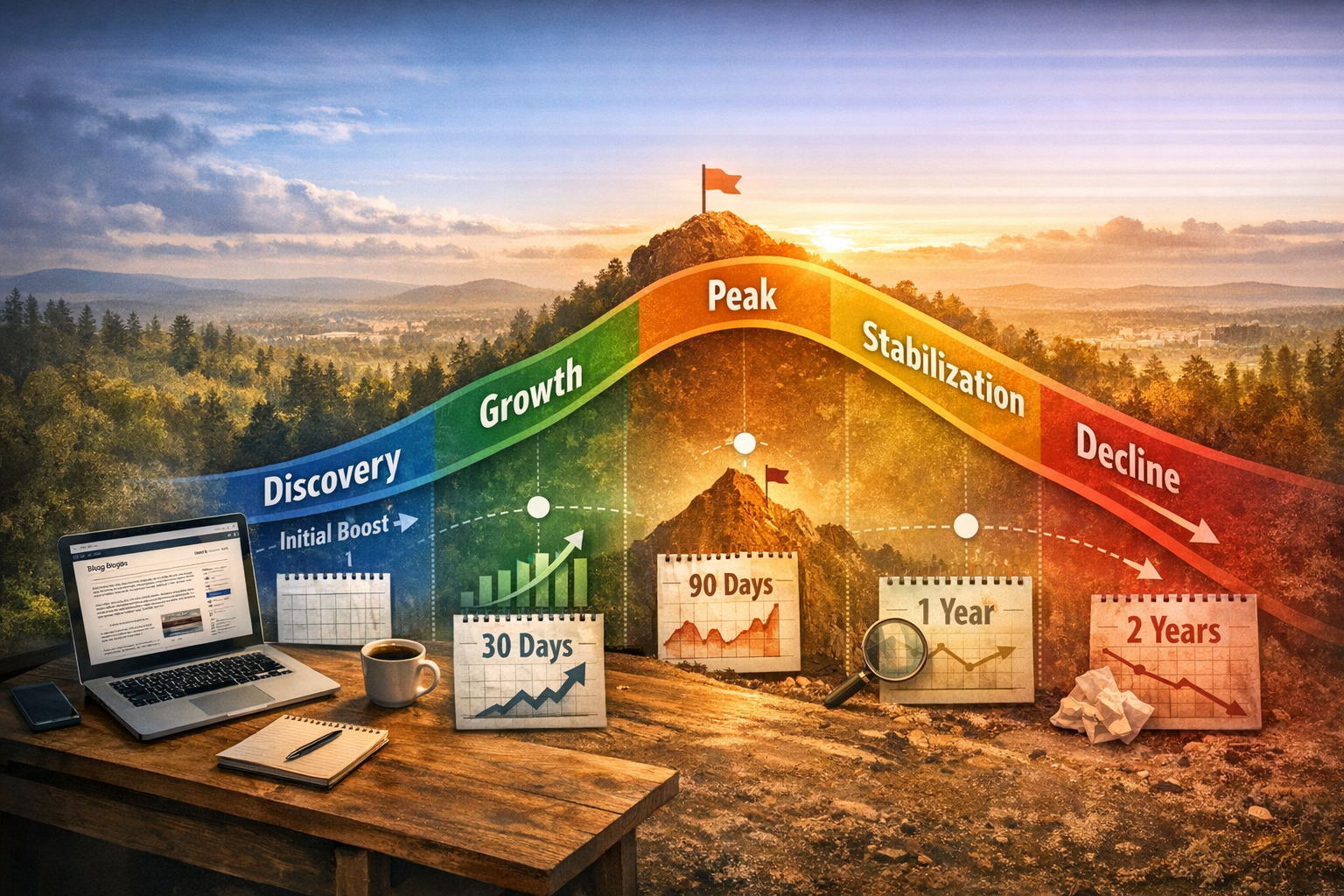
This approach treats content like a single transaction rather than what it actually is: an asset with a lifecycle. Content doesn't perform the same way on day one as it does on day thirty, or day ninety, or two years from now. It goes through distinct phases — discovery, growth, peak, stabilization, and eventual decline — and understanding those phases is what separates organizations that build durable organic traffic from ones that publish constantly without ever accumulating meaningful results.
This post breaks down how that lifecycle actually works, what the research says about when different types of content peak, how long the effects last, and what determines whether a piece becomes a long-term traffic driver or fades quietly into irrelevance.
Phase One: The Crawl and Index Window (Days One Through Fourteen)
The lifecycle of any piece of online content begins not when it's published, but when Google discovers and indexes it — and that gap between publication and indexation is the first variable that most content creators don't fully account for.
For established websites with strong domain authority, active XML sitemaps, and regular publishing cadences, Googlebot typically discovers and indexes new content within hours to a few days of publication. For newer websites or those with less frequent publishing, the discovery window can stretch to one to two weeks. In either case, content that hasn't been indexed hasn't entered its lifecycle yet — it simply doesn't exist from Google's perspective.
During this initial window, the primary factors driving early discovery are internal linking and sitemap submission. A new blog post that's prominently linked from the homepage, a category page, or a high-authority internal page will be discovered significantly faster than one that's only accessible through a date-based archive. This is why internal linking strategy matters even for new content — the sooner Googlebot follows a link to the new page, the sooner the indexing clock starts.
Social sharing and external links in the immediate post-publication period also accelerate this phase. A piece of content that earns external links quickly sends signals to Google that it's generating interest, which can accelerate both crawling and initial ranking consideration.
For most content on most websites, this phase is invisible from an analytics perspective. The page is live, it may be indexed, but it isn't ranking for anything meaningful yet and is generating little to no organic traffic. This is the phase during which many content creators incorrectly conclude that the piece "isn't performing" — when in fact it simply hasn't entered the growth phase yet.
Phase Two: The Growth Phase (Weeks Two Through Twelve)
The growth phase is when content starts to show up in search results and begins accumulating the signals that will determine its long-term performance. For most content on established websites, this phase spans roughly two to twelve weeks after publication — though the timeline varies significantly based on competition level, domain authority, and content quality.
During this phase, Google is actively testing the content — showing it in various positions for different queries to observe how users respond. Click-through rate from search results, time on page, bounce rate, and engagement signals all feed into Google's ongoing assessment of whether the content is serving the searchers it's being shown to. Content that performs well on these behavioral signals gets promoted to higher positions. Content that underperforms gets demoted or remains stuck in positions too low to generate meaningful traffic.
This testing process is why new content often appears in an inconsistent position range during the growth phase — ranking number four one day, number twelve the next, number seven the day after. This volatility is normal and reflects Google's active evaluation rather than a technical problem. The position tends to stabilize as Google accumulates enough behavioral data to make a more confident assessment.
Research from HubSpot's analysis of their own content library found that the majority of blog traffic comes from posts that were published months or even years earlier — not from new posts. In their data, posts older than six months generated significantly more traffic than recently published posts, which speaks directly to the growth phase: new content is almost always underperforming relative to its eventual potential during the first weeks after publication.
The most important input to the growth phase is inbound links. Content that earns links from other websites during this window — through organic discovery, outreach, social sharing, or being cited as a reference by other content creators — will generally achieve significantly better long-term rankings than comparable content without external links. The growth phase is when link acquisition has its highest marginal impact.
Phase Three: The Peak (Months Three Through Six for Most Content)
For the majority of blog posts and article-format content, the traffic peak arrives somewhere between three and six months after publication. This is when the content has accumulated enough authority signals, established stable ranking positions, and built the backlink profile needed to compete consistently for its target queries.
The timing and height of the peak is determined by several intersecting factors.
Keyword competitiveness is the primary determinant of how high the peak reaches. Content targeting lower-competition, long-tail queries can reach its peak position relatively quickly — sometimes within the first month — while content competing for high-volume, commercially significant keywords may spend months in the growth phase before reaching anything close to a competitive position, if it reaches one at all.
Domain authority accelerates the entire lifecycle. Content published on high-authority domains — established publications, large enterprise websites, domains with substantial backlink profiles — moves through the growth phase faster and peaks higher than identical content on newer or less authoritative domains. This is one of the clearest advantages that established websites have over newer ones: the authority accumulated over years of publishing compresses the timeline between publication and meaningful traffic.
Content depth and quality determines the ceiling. A comprehensive, well-researched piece of content that fully addresses its topic has significantly higher peak potential than a thin piece covering the same query superficially. Google's quality systems have become sophisticated enough to distinguish between these, and the depth of coverage a piece offers is one of the clearest predictors of its long-term ranking potential.
Publication timing matters for time-sensitive topics. A piece of content published immediately after a significant event — a product launch, a regulatory change, an industry development — can peak very quickly as search volume spikes around the topic, then fall off sharply as interest normalizes. A piece published too early, before search interest exists, may never reach a meaningful peak. A piece published too late, after the topic is already saturated, faces a much higher competitive bar.
Phase Four: Stabilization and the Evergreen Plateau
After the peak, content enters what is perhaps the most strategically important phase of its lifecycle: stabilization. This is where content either establishes itself as a durable, long-term traffic driver — an evergreen asset — or begins a slow decline toward irrelevance.
Evergreen content is content whose subject matter remains consistently relevant over time, regardless of when someone searches for it. "How to write a cover letter," "what is a 401k," "how to change a tire," "what does a marketing agency do" — these queries represent durable, recurring search demand that doesn't depend on current events or recent developments. Content that ranks well for evergreen queries can generate consistent, compounding traffic for years after publication with relatively little ongoing investment.
The plateau phase for well-performing evergreen content is characterized by relatively stable ranking positions and consistent monthly traffic within a predictable range. Barring significant algorithm updates, major competitive changes, or content becoming outdated, a strong evergreen piece can maintain its position for two, three, five years or more. This is the compounding dividend of content investment — the same piece of content delivering traffic month after month without ongoing creation costs.
Research from Ahrefs, which analyzed the performance of millions of web pages, found that content generally takes two to six months to rank in the top ten results for competitive keywords, and that pages which achieve top ten positions have a meaningful probability of retaining them for extended periods — particularly those in positions one through three, which see significantly lower turnover than positions four through ten.
The stabilization plateau looks very different for service pages than it does for blog content. Service pages — the pages on a website that describe what a business offers, for whom, at what price, with what process — tend to have very different traffic patterns than editorial content. They're not designed to be viral or topical. They're designed to capture high-intent commercial search traffic from people actively looking for a solution. A well-optimized service page can hold its position and generate qualified traffic consistently for years, with updates needed only when the service itself changes or when competitive pressures require a content refresh.
Phase Five: Decline — and Why It Happens
Not all content reaches a stable evergreen plateau. Some content peaks and then declines — sometimes gradually, sometimes sharply — and understanding why is critical for making good decisions about content investment and maintenance.
Content aging and freshness signals are the most common driver of gradual decline. Google considers content freshness as a ranking signal for certain query types — particularly those where users expect recent information. A blog post about "best SEO tools in 2021" published in 2021 will decline as newer posts about best SEO tools in 2024 and 2025 are published and begin outranking it. The content hasn't changed, but its implicit promise of recency has expired.
Competitive displacement is another primary decline mechanism. As a piece of content ages and generates traffic, competitors notice it's ranking well and publish competing pieces with more depth, more recent data, better user experience, or stronger link profiles. Google's comparative quality assessment gradually shifts in favor of the newer, stronger competing content, and rankings slip accordingly.
Algorithm updates can cause sharp, sudden declines in content that was previously performing well. Google's core updates, helpful content updates, and quality-focused algorithm changes periodically reassess large portions of the web's content and adjust rankings based on updated quality signals. Content that was borderline under previous evaluation criteria may fall sharply after an update. Content that was genuinely high-quality tends to survive updates and sometimes improves as lower-quality competitors are demoted.
Topic obsolescence renders content permanently irrelevant regardless of its quality. A detailed explanation of how to use a software product that no longer exists, a guide to a regulation that has been repealed, or a comparison of services that have been discontinued aren't fixable through content updates — the underlying demand for the content simply no longer exists.
Broken link profiles can accelerate decline. If the external websites that link to a piece of content shut down or remove their links, the page loses authority signals that were supporting its ranking position, and performance may degrade accordingly.
The Performance Difference: Blog Posts vs. Service Pages
Blog posts and service pages follow meaningfully different lifecycle patterns, and understanding the distinction is important for setting realistic expectations and making good content strategy decisions.
Blog posts tend to have more dynamic, volatile lifecycles. They typically show a more pronounced growth-peak-stabilize pattern, with meaningful traffic variation over time. The best blog posts become evergreen assets that generate traffic for years. The average blog post gets most of its lifetime traffic in its first one to two years, with performance tapering as content ages and competitors publish fresher versions of the same information. A HubSpot study found that the top ten percent of blog posts by traffic account for the vast majority of total blog traffic — meaning most posts generate modest traffic and a small number generate most of the value. This distribution underscores the importance of quality over quantity in blog content strategy.
Service pages tend to have more stable, durable lifecycle patterns. They don't "peak" in the same dramatic way that topical blog posts do, because they're not chasing trending queries or time-sensitive demand. A well-optimized service page for a stable commercial query can maintain consistent ranking positions for years without significant fluctuation, provided it's maintained and the competitive environment doesn't shift dramatically. The primary lifecycle risk for service pages isn't aging — it's competitive displacement as better-resourced competitors invest in stronger page optimization, more content depth, or more authoritative backlink profiles.
Location pages for multi-location businesses follow a similar stable pattern to service pages, with the additional variable that local search signals — Google Business Profile performance, local citation consistency, and proximity signals — play a larger role in determining ranking position than they do for national or informational content.
What Makes Content Evergreen: The Variables That Determine Longevity
The difference between content that sustains traffic for years and content that peaks and fades comes down to a small number of determinative factors that can be identified and optimized for before and after publication.
Query intent durability is the most fundamental variable. Content targeting queries that people will search for in five years as readily as they search for them today — foundational questions, process explanations, how-to guides, definitional content — has the structural conditions for evergreen performance. Content targeting queries that are specific to a moment in time, a current event, or a product version does not.
Comprehensiveness is the second most important variable. The content that holds its position longest tends to be the most thorough treatment of its topic available — the piece that answers not just the primary query but the related questions that arise from it. Comprehensive content earns more links, satisfies more user intent, and resists competitive displacement better than content that covers a topic superficially.
Brand authority compounds over time in a way that benefits all content on a domain. A website that consistently publishes high-quality content on a specific topic builds topical authority that benefits every piece of content in that space. The tenth piece of content on a topic published by an established authority will outperform the first piece of content on the same topic published by a newer domain — because the accumulated authority signals flow through the internal link structure to newer content.
Regular updates can extend the lifecycle of content that would otherwise decline due to aging. Refreshing statistics, adding new sections, updating examples, and improving the overall depth of a piece signals to Google that the content is being maintained and is still current. Well-executed content updates frequently produce meaningful ranking improvements, often restoring content to near its previous peak performance or exceeding it.
The Compounding Math of a Content Library
Perhaps the most important thing to understand about content lifecycle is not how any individual piece performs, but how a library of content performs collectively over time.
A single blog post, performing well, might generate 500 visits per month. That's useful but not transformative. A library of 100 well-performing blog posts, each generating an average of 200 visits per month, generates 20,000 visits per month from organic search — and that number grows as the library grows, as older posts mature into their peak and plateau phases, and as the domain authority built by the collective content investment lifts the performance of every individual piece.
This compounding dynamic is why consistent content investment over time produces results that are disproportionate to the investment in any single piece. The businesses that have been publishing quality content for three years are operating from a fundamentally different position than the ones that started publishing six months ago — not because any single piece they published was exceptional, but because the cumulative effect of hundreds of pieces, each at different stages of their lifecycle, produces a consistent and growing organic traffic baseline.
The organizations that understand this compound the advantage intentionally — by maintaining older content to extend its lifecycle, by publishing consistently enough to build a substantial library over time, and by tracking the performance of their content at the library level rather than evaluating each piece in isolation.
Content isn't a transaction. It's an investment — and like all investments, the ones held long enough to compound are the ones that produce the most meaningful returns.
At Ritner Digital, we help businesses build content strategies that compound over time — turning consistent publishing investment into durable organic traffic, qualified leads, and search visibility that doesn't depend entirely on paid spend. If you want your content to work harder and longer, let's talk.
Frequently Asked Questions
How long does it realistically take for a new blog post to start generating traffic?
For most websites, meaningful organic traffic from a new blog post begins somewhere between six weeks and six months after publication — and that wide range reflects the genuine variability that exists based on domain authority, keyword competitiveness, and content quality. On a well-established website with strong domain authority targeting a lower-competition keyword, a new post can begin ranking in the top ten within a few weeks and generating consistent traffic within a month or two. On a newer website targeting competitive keywords, the same piece of content might take six months or more to crack the first page, if it gets there at all. The most important mindset shift for anyone managing a content program is to stop evaluating new posts on their first-month performance and instead assess them at the three-to-six-month mark, when they've had enough time to move through the growth phase and approach their natural ranking position. Posts that look like underperformers in week four are often steady traffic drivers by month five.
Is it better to publish a lot of content frequently or fewer pieces at higher quality?
The data strongly favors quality over quantity, though the relationship is more nuanced than a simple either-or. HubSpot's research on their own content library found that the top ten percent of posts by traffic account for the overwhelming majority of total blog traffic — meaning most posts generate modest results and a small number generate outsized results. This distribution holds across virtually every content program, regardless of publishing frequency. Publishing fifty mediocre pieces per month produces a library where most content generates negligible traffic. Publishing eight deeply researched, genuinely comprehensive pieces per month produces a library where a meaningful proportion reach competitive positions and sustain traffic for years. That said, consistency matters alongside quality — a publishing cadence that's sustainable over years is more valuable than an unsustainable burst of high-quality content followed by months of silence. The ideal is the highest quality output that can be maintained consistently over a multi-year timeline.
What exactly is evergreen content and how do I know if what I'm publishing qualifies?
Evergreen content is content whose subject matter remains consistently relevant over time — content that someone would find just as useful searching for it today as they would searching for it two years from now. The simplest test is to ask whether the query your content is targeting would generate the same search volume and intent in three years as it does today. "What is content marketing" is evergreen. "What content marketing trends should you follow in 2024" is not — it has an expiration date built into the title. Foundational how-to content, definitional explanations, process guides, comparison frameworks, and answers to perennial industry questions all tend to be structurally evergreen. Content tied to specific products, software versions, regulations, current events, or named individuals has a natural expiration date that limits its lifecycle regardless of how well it's written. A healthy content library includes both — evergreen pieces as the durable traffic foundation and timely pieces for topical authority and freshness signals — with the strategic emphasis on evergreen for long-term compounding.
Should I update old content, and how do I know which pieces to prioritize?
Updating old content is one of the highest-ROI activities available to any content program, and it's dramatically underutilized relative to new content creation. The prioritization framework is straightforward. Start with content that is already ranking — positions four through fifteen are the sweet spot, because content already in this range has demonstrated relevance and authority for its target query and has the highest probability of moving into the top three with an update. Content ranking on page two or three is also worth prioritizing, as an update combined with targeted link building can push it onto page one. The update itself should add genuine value — new data, additional sections addressing related questions, improved examples, updated statistics — rather than superficial changes like rephrasing existing sentences. Google's freshness signals respond to substantive content additions, not cosmetic edits. After updating, submit the URL through Google Search Console's URL inspection tool to prompt re-crawling. In most cases, meaningfully updated content sees ranking improvements within two to four weeks of being recrawled.
How does domain authority affect how quickly my content performs?
Domain authority — the accumulated authority signals that a website has built through years of publishing quality content and earning inbound links — is one of the single most important variables in content lifecycle timing. A new piece of content published on a high-authority domain like Forbes, HubSpot, or a well-established industry publication can rank in the top ten for competitive keywords within days of publication. The same piece of content published on a domain that launched two years ago might take six months to reach the same position, if it gets there at all. This authority advantage isn't unfair — it's the accumulated return on years of quality content investment and earned trust. The practical implication for newer websites is that content targeting lower-competition, more specific queries will reach traffic potential faster than content targeting high-competition terms that high-authority domains already dominate. As domain authority builds over time through consistent publishing and link acquisition, the full content library benefits — including older posts that gain additional authority signals and may improve in ranking even without being updated.
What happens to content after a Google algorithm update — should I be worried?
Algorithm updates are part of the content lifecycle reality, and the right response to them depends on whether they produce positive or negative movement in your content's performance. Core algorithm updates — which Google releases several times per year — reassess content quality across the web and adjust rankings based on updated quality signals. Content that is genuinely high-quality, comprehensive, and serving real user intent tends to survive updates well and often improves as lower-quality content is demoted. Content that was ranking through historical authority rather than current quality, or that had benefited from gaps in Google's quality detection, is most vulnerable to core update impact. If a piece of content drops significantly after an algorithm update, the most productive response is a genuine quality assessment — is this content as comprehensive as the pieces now outranking it, does it serve user intent as well, is it technically sound — rather than assuming the update was arbitrary. Google's helpful content updates specifically target content written primarily for search engine visibility rather than genuine user value, and the best protection against that class of update is simply publishing content that would be useful to a reader even if Google didn't exist.
Does social media sharing help content perform better in search?
Social media sharing doesn't directly influence search rankings — Google has consistently stated that social signals are not a direct ranking factor. But the indirect effects are real and meaningful. Content that gets shared on social media reaches a wider audience, some of whom may link to it from their own websites or blogs, which does directly influence rankings. A piece that earns ten inbound links partly as a result of social amplification is in a meaningfully stronger position than an identical piece that was never shared. Social sharing also drives referral traffic that generates the behavioral signals — time on page, engagement, return visits — that contribute to Google's quality assessment of the content. Beyond the search implications, social sharing extends the distribution of content to audiences who aren't actively searching for the topic — building brand awareness and trust with potential customers at the top of the funnel in a way that pure search optimization doesn't reach. The most effective content programs treat social distribution and SEO as complementary rather than competing — using social channels to accelerate the early-phase discovery and link acquisition that support long-term search performance.
How do service pages age differently from blog posts, and do they need to be updated too?
Service pages age more gracefully than blog posts because they're not subject to the same freshness dynamics — a service page describing what a business offers doesn't become stale the way a blog post citing statistics from 2021 does. But they do require maintenance, and the triggers for that maintenance are different from blog content. A service page needs updating when the service itself changes, when the competitive landscape shifts and competing pages are offering more depth or better user experience, when the page's ranking positions start declining without an obvious technical cause, or when new information about buyer pain points and questions has emerged that the page isn't currently addressing. The most common service page update mistake is treating the page as done once it's been initially optimized and never revisiting it. Competitors publish better pages. Google's quality standards evolve. User expectations change. A service page that was considered comprehensive three years ago may be significantly thinner than the competitive set today. Annual audits of core service page performance — tracking ranking positions, click-through rates, and conversion performance — are the right maintenance cadence for most businesses.