The Multi-Location Salon Marketing Playbook: Local SEO, Paid Ads, Reviews, and the Agency Partner Who Ties It Together
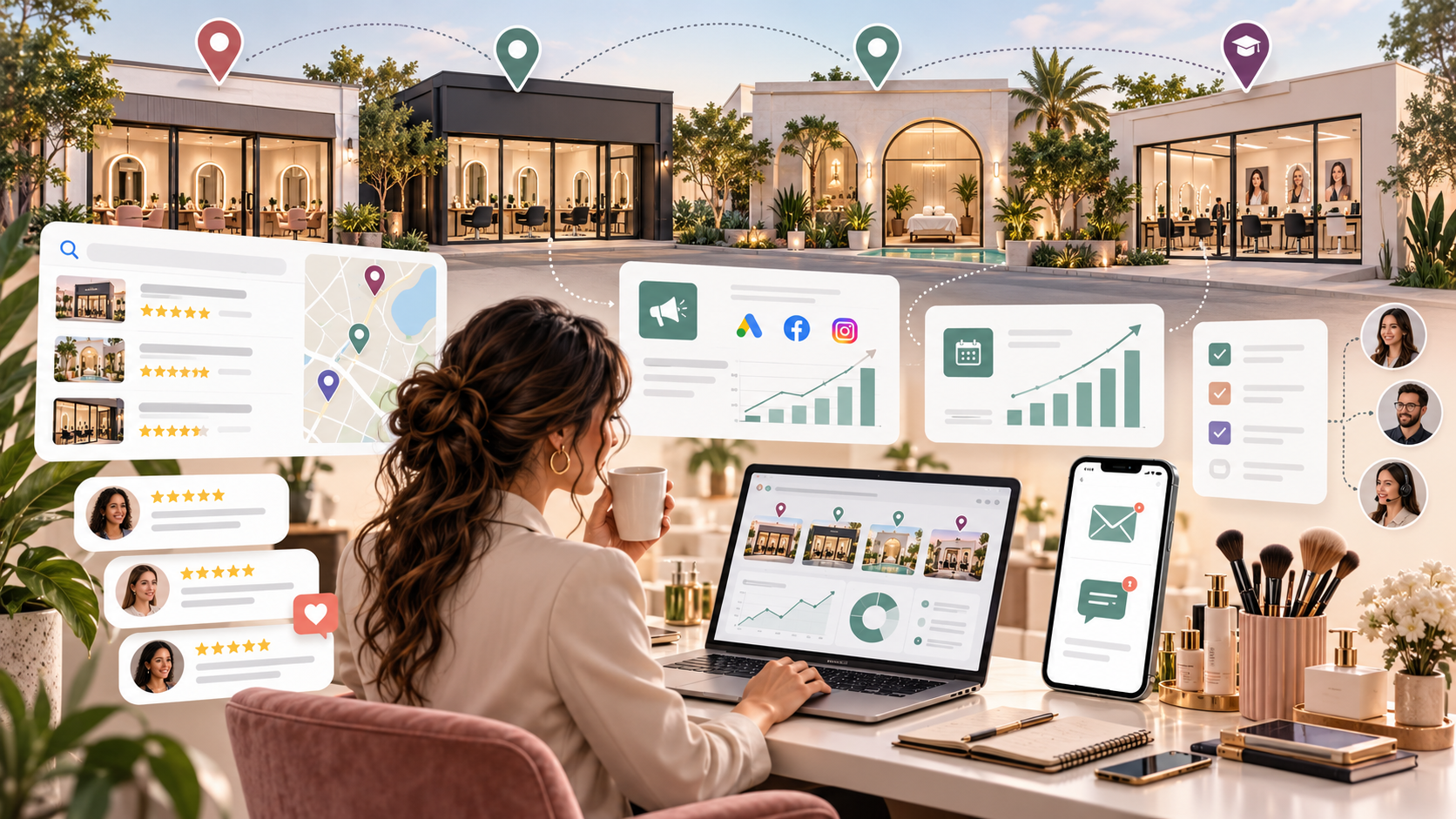
Running marketing for a multi-location salon, spa, or beauty school is a juggling act with no off switch. One day you're promoting a seasonal color service. The next, you're pushing enrollment for an open house. Meanwhile, each location has its own manager, its own stylists, its own Google Business Profile, its own reviews, and its own idea of what the brand should be posting.
Then there are the vendors. A social media agency posts the content. A web or SEO partner handles the website. Someone else might manage paid ads. The reporting lives in four different dashboards, and nobody can say with confidence which dollar brought in which booking.
If that sounds familiar, you're not behind. You're running the kind of business where marketing is genuinely complicated. This guide lays out a practical, source-backed playbook for how multi-location beauty businesses can win in local search, run paid campaigns that actually fill chairs and classrooms, build a review program that holds up to scrutiny, and work with outside partners without losing control of the strategy.
We've linked to primary sources throughout so you can verify what matters.
Why Multi-Location Beauty Marketing Is Its Own Discipline
A single neighborhood salon can get far with a good Google Business Profile, a decent website, and happy clients who tell their friends. A group with several salons, a spa, and a school can't, because the problems multiply.
You're really running three different funnels at once:
Guest acquisition. New clients searching for a service near them ("balayage near me," "best haircut in [town]," "massage near me").
Guest retention. Existing clients who need a reason and a reminder to rebook, upgrade to a membership, or try another service.
Enrollment. Prospective students who are making a much bigger, slower decision, usually involving research, tours, financing questions, and a long consideration window.
Each funnel has different keywords, different ad creative, different conversion events, and different success metrics. A marketing plan that treats them as one blob will underperform on all three.
There's also the brand consistency challenge. Every location should feel like part of the same company while still showing up as the obvious local choice for people nearby. That tension, consistency at the brand level and specificity at the location level, shows up in nearly every section below.
Part One: Win the Local Search Battle
For a service business tied to a physical place, local search is usually the highest-intent channel you have. Someone typing a service plus "near me" is often ready to book.
How Google Decides Who Shows Up
Google's own documentation is refreshingly direct about this. According to Google's guide on how to improve your local ranking, local results are based primarily on three factors: relevance, distance, and prominence.
Relevance is how well a Business Profile matches what someone is searching for.
Distance is how far each business is from the location in the search, or from the searcher if no location is given.
Prominence is how well known a business is. Google says this draws on information from across the web, such as links, articles, and directories, and that review count and review score factor in. More reviews and positive ratings can improve a business's local ranking.
Google also notes that there is no way to request or pay for a better local ranking. You earn it by managing the signals it uses.
That framework is useful for multi-location brands because it tells you which levers you control. You can't change the distance between a salon and a searcher. You can make each location's profile and web presence more relevant, and you can build prominence through reviews and local mentions.
Treat Every Location as Its Own Business Online
The most common multi-location mistake is managing everything at the brand level and neglecting the individual location. Each location needs:
A complete, accurate Google Business Profile. Correct name, address, phone, hours, categories, services, and attributes. Google states that businesses with complete and accurate information are more likely to show up in local search results.
Consistent business information everywhere. Your name, address, and phone number should match across your website, directories, and social profiles. Inconsistencies create confusion about which details are right.
Real photos of that location. Interior, exterior, team, and work samples from that specific site. Stock images and shared brand photos don't help someone decide whether this is the salon they want to walk into.
Regular updates. Holiday hours, new services, promotions, and posts keep a profile active and accurate.
Assign clear ownership for each profile. When no one is responsible, hours go stale, duplicate listings appear, and old phone numbers linger.
Build Location Pages That Earn Their Place
Your website should give each location a dedicated page, and it shouldn't be a thin template with the city name swapped. A strong location page includes:
The address, phone number, hours, parking and transit details, and an embedded map
The services offered at that specific location (not every service the company offers)
Photos of the space and the team
Stylist, esthetician, or educator highlights with links to individual bios
Reviews or testimonials from that location's clients
A clear, trackable booking button and phone number
Local context, such as nearby neighborhoods you serve
It also helps to add structured data. Google's documentation on local business structured data explains how to mark up details like address, hours, and contact information so Google can understand them more reliably.
Be careful, though. If you publish dozens of near-identical pages that differ only by town name, you risk creating exactly the kind of low-value, duplicate content that Google tends to skip. We cover that issue in depth in our guide on why Google sometimes doesn't index good content. The fix is the same here: give each page something real that only that location can offer.
Create Service Pages That Match How People Search
People don't search for "hair services." They search for specific things: balayage, keratin treatments, men's fades, bridal updos, facials, massage, waxing, and, for a school, cosmetology programs, barber programs, esthetics training, and financial aid.
Build a dedicated page for each important service with:
A clear explanation of what the service is and who it's for
Pricing guidance or ranges where you can offer them
What to expect during the appointment, including time and prep
Before-and-after photos or examples (with client permission)
Which locations offer it and who performs it
Common questions and honest answers
A direct path to book
Google's guidance on helpful, people-first content is a good test for these pages. It asks creators whether content offers original information, a substantial and complete description of the topic, and a satisfying experience for the reader, and it encourages making it clear who created the content and why they're credible. For a salon, that's a gift: your stylists are the experts. Put their names, specialties, and real work on the page.
Don't Forget Your School
A beauty school needs its own search strategy, because prospective students use different language and a different decision process. Think about queries like "cosmetology school near me," "how long is barber school," "esthetician license requirements," and "is beauty school worth it."
Program pages, admissions steps, tuition and financial aid explanations, graduate outcomes, student work, and open house information all matter. So do honest answers to the hard questions prospects ask. Content that addresses real concerns, such as cost, schedule, licensing, and career paths, builds trust and brings in people who are further along in their decision.
Part Two: Build a Review Program That Works and Stays Compliant
Reviews do double duty. They influence local rankings, and they influence whether a person who finds you actually books. Google's local ranking documentation specifically calls out review count and score as factors in prominence.
But review programs are also where well-meaning teams get into trouble, and the rules have tightened.
What Google Allows and Prohibits
Google's guidance on reviews says reviews must reflect a genuine experience. Offering incentives, such as free or discounted goods or services, in exchange for posting, changing, or removing a review is considered fake engagement and is strictly prohibited. Google encourages businesses to remind customers to leave reviews, such as by sharing a link or QR code, and to reply to reviews.
There's a newer wrinkle for multi-location teams. In April 2026, Google updated its Maps user-generated content policy. According to PPC Land's reporting, the update added explicit bans on merchants asking staff to solicit a set number of reviews, and on asking staff to solicit reviews containing specific content, including content that names a staff member. In other words, the review contests, stylist leaderboards, and "ask them to mention me by name" scripts that many salons have relied on are now a policy problem.
The same reporting notes that merchants can still solicit or encourage genuine reviews, as long as they don't offer incentives or try to influence the rating or content.
Avoid Review Gating
Review gating means selectively asking only happy customers for public reviews, or routing unhappy customers to a private feedback form instead of the public review page. Many reputation tools make this easy, which is part of why it's common. It's also risky. Reporting on Google's policy notes that businesses shouldn't discourage negative reviews or selectively solicit positive ones.
The better approach is simple and consistent: send the review request to every eligible client, using the same wording, at the same point in the process. Ask for their honest experience, not a five-star rating. Then handle the feedback you get, good and bad, with real follow-through.
The FTC Is Watching Too
This isn't just a Google issue. The Federal Trade Commission finalized a rule banning fake reviews and testimonials that took effect in October 2024. The FTC's announcement says the rule prohibits fake or AI-generated reviews, buying reviews expressing a particular sentiment, undisclosed insider reviews, and review suppression using unfounded legal threats or intimidation. It also lets the agency seek civil penalties against knowing violators.
Practically, that means your team shouldn't write reviews, shouldn't pay or reward customers for positive ones, and shouldn't pressure people to remove negative ones. If employees post reviews, their connection to the business needs to be clear.
Building a Sustainable Review Workflow
A healthy program for a multi-location business looks like this:
Automate the request. Trigger a text or email after each completed appointment, through your booking or CRM system, to every eligible client.
Use one link per location. Make sure each request points to the right location's Google profile.
Keep the ask neutral. Invite honest feedback. Skip scripted language that steers the rating or content.
Monitor weekly. Someone should see every new review within days, across all locations.
Reply to everyone, briefly and personally. Google's own tips encourage short, genuine replies, and not turning replies into sales pitches.
Escalate real problems. If a review reveals a service issue, route it to the location manager and follow up offline.
Report by location. Track review volume, average rating, response time, and trends for each site, so you can spot a struggling location early.
Recognize staff without incentivizing clients. Celebrate great service internally, but don't tie rewards to review counts in ways that conflict with Google's policy.
A program like this takes discipline more than budget, and over time it becomes one of your strongest competitive assets.
Part Three: Run Paid Advertising That Fills Chairs and Classrooms
Organic search takes time. Paid advertising lets you reach people now, test messages quickly, and push specific offers on specific dates. For beauty businesses, the two workhorses are Google Ads and Meta (Facebook and Instagram) advertising.
Match the Platform to the Intent
Google Ads captures demand that already exists. Someone searching for "hair salon open Saturday" or "cosmetology school open house" has told you what they want. Search campaigns, local campaigns, and branded campaigns for each location can all play a role.
Meta ads create demand and remind past clients. They're strong for visual services, seasonal promotions, new-service launches, memberships, event invitations, and retargeting people who've visited your site or engaged with your content. Your best social posts can also become ad creative, which turns your content investment into a paid asset.
Structure Campaigns Around How You Actually Operate
Campaign structure should reflect your business, not the default settings:
Separate campaigns by funnel. Guest acquisition, retention and membership promotions, and school enrollment should each have their own budgets, audiences, and goals.
Segment by location where it matters. Each location draws from a different radius. Budget and targeting should reflect that.
Separate branded from non-branded search. Branded traffic is usually cheap and high-converting. Mixing it with generic terms makes performance look better than it is.
Test deliberately. Change one variable at a time, such as offer, headline, image, or audience, so you know what moved the results.
Keep ownership clear. Whoever builds and optimizes the campaigns should have direct access to the accounts, and your company should own the ad accounts, not the agency.
Conversion Tracking Is the Whole Game
Most wasted ad spend isn't caused by bad ads. It's caused by bad measurement. If your campaigns are optimizing for clicks, page views, or button taps instead of actual bookings and qualified enrollment leads, the platforms will find you more of the wrong people.
For a beauty business, you generally want to track:
Online booking completions by location and service
Phone calls from ads and from your Business Profiles
Form submissions for consultations, events, and school inquiries
Enrollment pipeline stages, such as inquiry, tour, application, and enrolled student
That last one matters because school leads are not all equal. A form fill is not a student. Google Ads supports importing offline conversions, which lets you feed results from your CRM or enrollment system back into the ad platform so it can optimize toward leads that actually turn into outcomes. Google now recommends enhanced conversions for leads as the upgraded approach, and its documentation notes that offline conversion import and enhanced conversions for leads uploads were set to migrate to the Data Manager API starting June 15, 2026. If your setup was built a while ago, it's worth confirming it still works as intended.
Your booking software matters here too. If your platform doesn't pass booking data back to your ad accounts and analytics, you're flying partly blind. A good partner will map the full path from ad click to booking and flag any gaps.
Measure Efficiency, Not Just Volume
Once tracking is sound, the numbers that matter are cost per booking, cost per qualified lead, cost per enrolled student, and return on ad spend (ROAS). Look at them by location, service, and campaign. A promotion that's profitable at one salon might lose money at another. Knowing the difference lets you move budget to what works.
Also look at lead quality, not only cost. A cheap lead who never shows up isn't cheap.
Part Four: Email and SMS, the Retention Engine
For most salons and spas, a returning client is worth far more than a new one, and email and SMS are the most direct way to bring them back. They're also the channels where a well-built system quietly pays for itself.
What to Build
Rebooking reminders timed to each service's natural cycle (color touch-ups, cuts, facials, massages)
Post-visit follow-ups that thank the client, request a review, and suggest an add-on or next appointment
Membership and loyalty communications that explain value clearly and remind members how to use their benefits
Win-back campaigns for clients who haven't visited in a set number of months
Seasonal and event promotions planned on the calendar
Enrollment nurture sequences for school prospects, with open house invitations, financial aid information, student stories, and deadlines
Segment Before You Blast
Sending the same message to every contact is how lists get tired. Segment by location, service history, visit frequency, spend level, and lifecycle stage. A client who comes every six weeks needs a different message than one who hasn't been in a year, and a prospective student needs something entirely different from either.
Get Consent Right
Text messaging in particular carries compliance obligations. Under the Telephone Consumer Protection Act, marketing texts generally require prior express written consent, and carriers expect clear opt-in and opt-out practices, according to this SMS compliance overview. Appointment reminders and promotional messages are treated differently, so your sign-up flow should make clear what people are agreeing to, how often they'll hear from you, and how to stop. Email has its own rules under the CAN-SPAM Act, including accurate sender information and a working opt-out.
This isn't something to improvise. Have your platform settings and consent language reviewed by qualified legal counsel, and make sure any vendors you use follow the same standards.
Part Five: Social Media and the Content Supply Chain
Social media in a multi-location beauty business is rarely about posting. It's about supply. You need a steady stream of fresh, authentic, usable content from every location, and most teams underestimate how hard that is.
Build a Content Asset Pipeline
Great social content starts with great raw material: photos, video, before-and-afters, team moments, event coverage, and school activity. A reliable pipeline typically includes:
Scheduled photo and video shoots at each location, planned around launches and seasons
A simple way for stylists and educators to submit work, such as a shared folder with clear naming rules
Client release forms, completed and stored, before any client appears in marketing
A shared asset library organized by location, service, and date, so the content vendor, your ad team, and your website team can all pull from it
A monthly delivery schedule, so the vendor isn't waiting on assets at the last minute
The businesses that struggle with social media usually don't have a creative problem. They have an asset problem.
Decide Who Does What
A common and effective model is for an internal marketing lead to set priorities, approve content, and maintain brand consistency, while an outside social vendor builds, schedules, and publishes. That division works when roles are clear: the internal owner decides what and why, the vendor handles how and when, and approvals are fast enough that the calendar doesn't slip.
Turn Organic Content into Ads
Your best-performing organic posts are a free testing ground. Posts that earn strong engagement can be boosted or adapted into campaign creative, which saves production costs and tends to look more authentic than polished stock-style ads. Coordinate so that the people running ads can use the content library without waiting on the social team.
Part Six: Plan the Promotional Calendar Before You Need It
Beauty and wellness have strong seasonal rhythms: holiday gifting, prom and wedding seasons, back-to-school, summer and winter refresh cycles, and school enrollment deadlines and open houses. Every one of those requires lead time.
A promotional calendar should be built well ahead so that everyone downstream, including your social vendor, your ad team, your web partner, and your location managers, can prepare. For each promotion, define:
The offer and its rules
The target audience and locations
The channels involved (email, SMS, social, paid, website, in-store)
Creative needs and deadlines
Landing page and booking path
Tracking setup
Staff briefing, so front-desk teams know what's being promoted
The success metric
That last point is the one people skip. If a promotion doesn't have a number attached to it, you can't say afterward whether it worked.
Part Seven: Measurement and Reporting
Multiple locations, multiple funnels, and multiple vendors produce a lot of data. The goal of reporting isn't to display all of it. It's to answer a few questions clearly each month:
Are we getting more of the right customers and students?
Which locations, services, and channels are working?
Where is money being wasted?
What should we do differently next month?
Metrics Worth Watching
Search and local
Organic traffic to service and location pages
Rankings for priority service-plus-location terms
Google Business Profile calls, direction requests, website clicks, and bookings by location
Review volume, rating, and response time by location
Paid
Spend, cost per booking, cost per qualified lead, and ROAS by campaign and location
Conversion rate from click to booking
Email and SMS
List growth, opt-out rates, and revenue or bookings attributed to each campaign
Rebooking rate for clients who received reminders
School
Inquiries, tours, applications, and starts by source
Cost per enrollment
Business outcomes
New versus returning clients
Revenue per location
Membership counts
Be honest about attribution. No tool captures every path. Someone might see an Instagram post, search your name a week later, read your reviews, and book by phone. Look at trends across channels rather than demanding perfect credit for each touch.
Part Eight: Working with an Agency Partner Without Losing Control
Most multi-location beauty companies work with at least one outside partner, and the relationship goes best when it's structured deliberately.
The Internal Owner Matters
Outside partners are strongest when there's a single internal person, or a small team, who owns the marketing strategy and can set priorities, approve work, and hold vendors accountable. Without that, agencies drift toward what's easiest for them, and priorities get set by whoever speaks up last.
Divide Responsibilities Explicitly
A simple way to avoid confusion is to define who is responsible for each area:
Your internal team: brand direction, promotional calendar, offers and pricing, approvals, location and stylist content, enrollment goals, and business context
Your web and SEO partner: technical SEO, site performance and structure, location and service page optimization, indexing and crawl health, tracking implementation, and search reporting
Your social partner: content creation, scheduling, publishing, community management, and boosted post execution
Paid media: campaign structure, creative testing, optimization, and conversion tracking, whether managed internally or by a partner
Put it in writing, and update it when responsibilities shift.
Hold Partners Accountable to Outcomes
Good partners welcome clear targets. Agree on what success looks like for search (rankings and organic traffic for priority terms), for local (calls, directions, and reviews), for paid (cost per booking and per enrollment), and for the business (bookings and revenue). Review progress on a regular schedule, and ask for plain-language explanations when numbers move.
What to Ask Any Agency
Who will actually work on our account, and how much of their time is dedicated to us?
Do we own our ad accounts, analytics, Business Profiles, and website access? (The answer should always be yes.)
How do you handle multi-location structure?
How will you track bookings and enrollment, not just clicks?
What does your review workflow look like, and does it comply with Google and FTC rules?
How do you report, how often, and can we see raw data?
What would you do in the first 90 days?
Red Flags
Guaranteed rankings or guaranteed results
Reporting that focuses on impressions and clicks but never bookings
Reluctance to give you account access
Review tactics that rely on incentives, gating, or staff quotas
Dozens of near-duplicate location pages
Long contracts with vague deliverables
A 90-Day Roadmap
If you're inheriting or rebuilding a multi-location marketing program, here's a sensible sequence.
Days 1 to 30: Audit and fix the foundation
Audit every Google Business Profile for accuracy, duplicates, categories, photos, and ownership
Check the website for indexing, speed, mobile experience, and broken booking paths
Verify conversion tracking across analytics, ads, call tracking, and booking software
Review the current review-request process for gating, incentives, and staff quotas
Document who owns each channel and vendor
Pull a baseline of key numbers by location
Days 31 to 60: Build and launch
Improve or create location pages and priority service pages
Launch or fix the automated review workflow
Restructure paid campaigns by funnel and location, with proper conversion events
Set up core email and SMS flows: rebooking, post-visit, win-back
Build the next two quarters of the promotional calendar
Establish the content asset pipeline and shoot schedule
Days 61 to 90: Optimize and report
Review early performance by location and channel
Shift budget toward what's working
Test new creative and offers
Expand school content and enrollment nurture
Deliver the first full monthly report, with recommendations
Reset targets for the next quarter
Common Mistakes to Avoid
Managing locations only at the brand level. Each site needs its own local presence.
Chasing reviews with incentives or contests. Both Google and the FTC take a hard line.
Optimizing ads for clicks instead of bookings. Tracking determines results.
Treating school enrollment like salon booking. The audience, timeline, and metrics differ.
Publishing thin, duplicate location pages. They waste effort and can go unindexed.
Letting vendors own your accounts. Always keep access and ownership.
Running promotions without a calendar or a metric. Late planning leads to rushed, weaker execution.
Ignoring the content pipeline. Social and ads run on raw assets.
Reporting activity instead of outcomes. Posts published and keywords tracked don't pay the bills.
Frequently Asked Questions
How is marketing a multi-location salon different from marketing a single salon?
You have to manage consistency and local relevance at the same time. Each location needs its own Business Profile, reviews, and location page, while the brand voice, offers, and creative stay unified. You also have to allocate budget across locations and measure performance by site, which adds complexity a single salon doesn't face.
What matters most for ranking in Google Maps?
Google says local results are based primarily on relevance, distance, and prominence. Complete, accurate profiles support relevance, and reviews and mentions across the web support prominence. You can't change how far you are from a searcher, so focus on the signals you control. See Google's local ranking guide.
Can I offer clients a discount for leaving a Google review?
No. Google states that offering incentives such as free or discounted goods or services in exchange for reviews is prohibited, and the FTC's rule also restricts providing compensation or incentives conditioned on a particular sentiment. Encourage honest reviews instead, and thank clients through great service.
Can I ask stylists to get a certain number of reviews or ask clients to mention them by name?
According to reporting on Google's April 2026 policy update, asking staff to solicit a set number of reviews or reviews with specific content, including staff names, is now explicitly barred. Genuine reviews that happen to mention a stylist are fine. Scripting or quota-setting is the issue. Review your current process against Google's latest policy.
What is review gating, and why should I avoid it?
Review gating is steering only happy customers to your public review page, or sending unhappy ones to a private form. It conflicts with Google's guidance on not selectively soliciting positive reviews, and it skews your reputation. Send the same request to all eligible clients instead.
Should I run Google Ads, Meta ads, or both?
Usually both, for different jobs. Google Ads captures people actively searching for a service or school near them. Meta ads build awareness, promote offers and events, and retarget past visitors. Which deserves more budget depends on your goals, seasonality, and what your tracking shows.
How do I track whether ads lead to actual bookings or enrollments?
Set up conversion tracking for online bookings, calls, and forms, and connect your CRM or enrollment system so downstream outcomes flow back to the ad platform. Google Ads offers offline conversion import and enhanced conversions for leads for this purpose. Confirm your booking software can pass data through.
Do I need separate marketing for the school?
Yes. Prospective students search differently, take longer to decide, and need different content: program details, costs, financial aid, licensing, outcomes, and open house invitations. Track inquiries through to enrollment rather than stopping at form fills.
How often should we post on social media?
There's no universal number. Consistency and quality matter more than volume. Build around the content you can reliably produce from your locations, keep a calendar tied to promotions, and measure what drives bookings, not just likes.
Is it okay to text clients about promotions?
Only with proper consent. Marketing texts generally require prior express written consent, and you need clear opt-out options and transparent disclosures. Transactional messages like appointment reminders are treated differently. Consult legal counsel and make sure your platform and vendors are configured correctly.
How long does local SEO take to show results?
Some fixes, like correcting profile errors or tracking, show up quickly. Building prominence through reviews, links, and content usually takes months. Be wary of anyone who guarantees a specific ranking or timeline.
How do I know if my agency is performing?
Ask for reporting tied to business outcomes: bookings, calls, qualified leads, enrollments, and cost per result, broken out by location. Confirm you own your accounts and can access raw data. If reports focus on impressions and activity without connecting to revenue, ask harder questions.
The Bottom Line
Multi-location beauty marketing succeeds when the basics are done consistently and measured honestly: every location is easy to find and trust, reviews are earned and managed within the rules, ads are tied to real bookings and enrollments, email and SMS keep clients coming back, and every partner knows exactly what they own.
None of it requires magic. It requires structure, clear ownership, and a team that treats marketing as a business system and not a pile of disconnected tasks.
Sources
Google Business Profile Help, How to improve your local ranking on Google
Google Business Profile Help, Read and reply to reviews / review best practices
Google Search Central, Local business structured data
Google Search Central, Creating helpful, reliable, people-first content
Google Ads Help, About offline conversion imports
PPC Land, Google tightens Maps review policy: staff names and quotas now banned
Federal Trade Commission, Federal Trade Commission Announces Final Rule Banning Fake Reviews and Testimonials
Quo, The essential SMS compliance guide for business texting in the US
Ready to Simplify Your Multi-Location Marketing?
If you're juggling locations, vendors, and channels and want a partner who can bring structure to search, local, paid media, and reporting, Ritner Digital can help. We'll audit what's working, find what's leaking budget, and build a plan that ties your marketing directly to bookings and enrollments.
Contact Ritner Digital today and let's build a marketing engine that keeps every chair and classroom full.