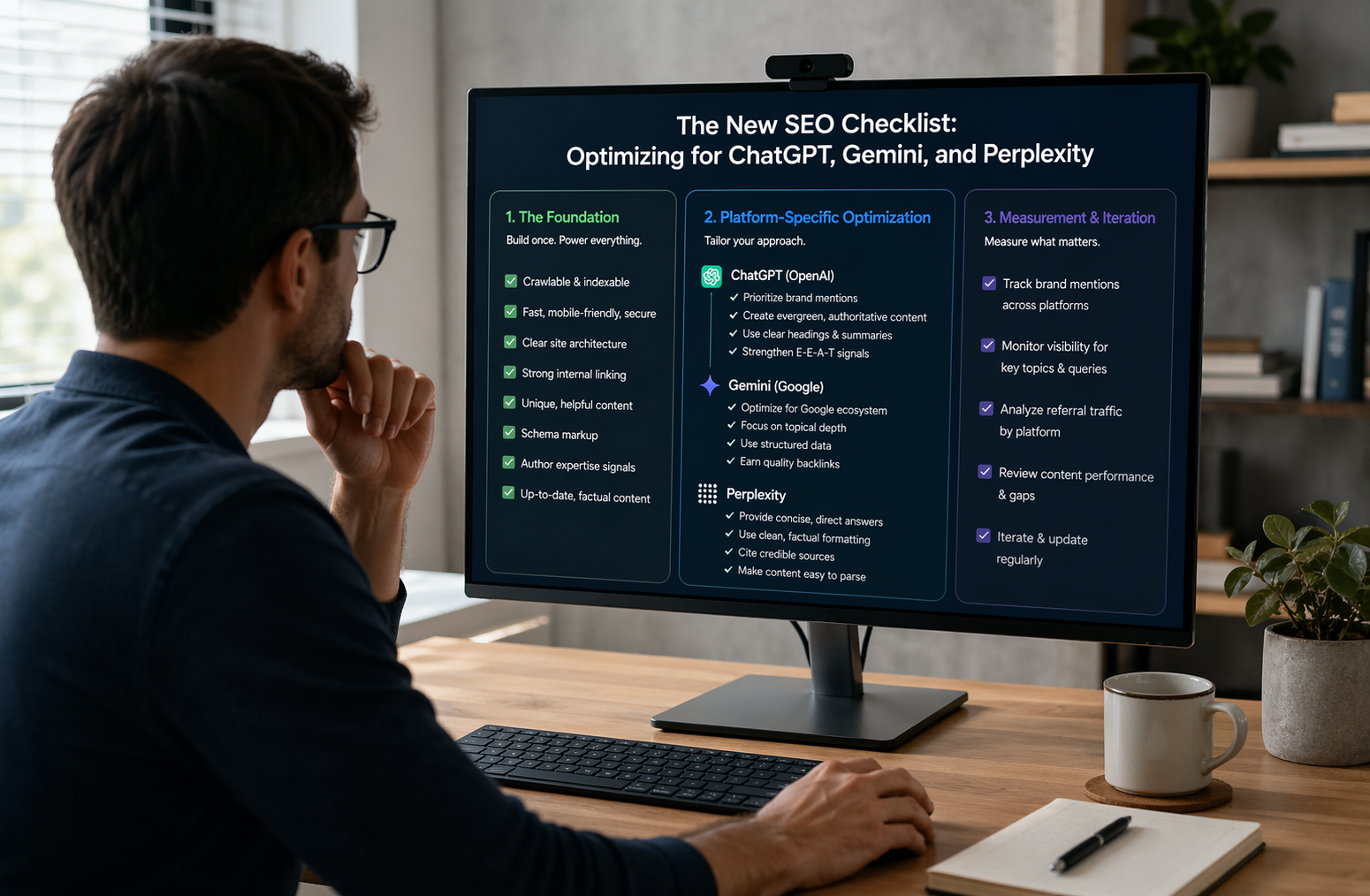
The New SEO Checklist: Optimizing for ChatGPT, Gemini, and Perplexity
The SEO checklist you've been using for the past several years isn't wrong — it's just incomplete. The fundamentals of crawlability, page speed, quality content, and backlink authority still matter. What's changed is that they're now table stakes rather than the whole game. A growing share of how your customers find you, evaluate you, and decide to contact you is happening inside AI interfaces that operate on different selection logic than Google's traditional ranking algorithm.
BrightEdge analyzed millions of AI search responses in 2025 and found that 44% of all AI prompts return zero brand mentions — not because competitors are better, but because brands haven't optimized for AI citation. Wellows Nearly half of all AI searches are producing answers in which no brand earns a citation. That's an enormous visibility gap — and for most businesses, it's entirely fixable.
This checklist covers what you need to do to show up across ChatGPT, Google Gemini, and Perplexity — the three platforms that together account for the overwhelming majority of AI search activity in 2026. Some items apply across all three. Others are platform-specific. Work through all of them, and you'll have a meaningfully more complete optimization foundation than most of your competitors.
Before You Start: Understand the Platform Differences
The single most important thing to internalize before implementing any of this is that ChatGPT, Gemini, and Perplexity are not interchangeable. They use different indexes, weight different signals, and cite different sources.
Wikipedia is the most cited source in ChatGPT at 7.8%, followed by Reddit at 1.8%, Forbes at 1.1%, and G2 at 1.1%. Google is more likely to pull from Wikipedia, YouTube, Reddit, and Quora for AI Overview responses. The top mentioned domains in Perplexity answers are YouTube, Wikipedia, Apple, and Google. Position Digital
ChatGPT prefers Wikipedia and educational sources, while Perplexity favors YouTube content and specialized sources. Optimize for all three simultaneously since they share few common sources, creating multiple visibility opportunities. Getpassionfruit
LLM traffic has significantly higher conversion rates than organic traffic: ChatGPT converts at 15.9%, Perplexity at 10.5%, Claude at 5%, and Gemini at 3%, compared to Google's organic conversion rate of 1.76%. Position Digital Each platform you optimize for is an additional high-converting traffic channel — not a redundant one.
Section 1: Technical Foundation (All Platforms)
These items apply across all three platforms. None of the content optimization in the world matters if AI crawlers can't access your pages.
Audit your robots.txt for AI crawler access. Check that GPTBot, PerplexityBot, ClaudeBot, and Google's crawlers are all explicitly allowed on the pages you want cited. 34% of B2B SaaS companies actively block AI crawlers via robots.txt, removing themselves from the consideration set of the modern B2B buyer. Fuel Online This is the single most damaging technical oversight in AI search optimization.
Optimize page speed aggressively. Pages with a First Contentful Paint under 0.4 seconds average 6.7 citations, while pages loading in over 1.13 seconds average just 2.1. Erlin That is more than a three times difference in citation rate from page speed alone. Optimize images, minimize blocking scripts, use a CDN, and target sub-two-second load times on every priority page.
Ensure content is accessible without JavaScript rendering. AI parsing success for static HTML with schema runs at 94%, while JavaScript-rendered content lands at 23%. Erlin If your most important content is loaded dynamically through JavaScript, AI crawlers are frequently missing it. Server-side rendering or static output for content-critical pages is a prerequisite for consistent AI citation.
Submit sitemaps to all relevant webmaster tools. Submit to Google Search Console for Gemini and AI Overviews. Submit to Bing Webmaster Tools for ChatGPT Search, which uses Bing's index. Enable IndexNow for real-time content submission so fresh content reaches AI retrieval systems quickly.
Implement HTTPS sitewide and resolve all crawl errors. Fix broken links, correct redirect chains, and ensure your server returns clean 200 status codes on priority pages. Technical barriers at any level reduce AI citation probability.
Section 2: Content Structure (All Platforms)
How your content is structured is as important as what it says. AI systems extract information at the passage level — they are not reading your pages as a human would.
Lead every section with a direct answer capsule. Place a 40–60 word, self-contained answer at the opening of every major section, directly beneath the heading. This answer should address the section's question completely without requiring surrounding context. 44.2% of all LLM citations come from the first 30% of text. Position Digital Front-loading your key answers is the highest-leverage structural change you can make.
Use question-phrased headings throughout. Structure H2 and H3 headings as the questions your target audience is asking — not as keyword-dense topic labels. AI systems use headings to understand what question each section addresses, and question-phrased headings improve extraction accuracy significantly.
Keep answer capsules link-free. More than nine in ten answer capsules that drove ChatGPT citations contained no links at all. A concise, self-contained block of text without hyperlinks appears to be easier for AI to extract and attribute. Search Engine Land Place your links before or after the answer capsule — not inside it.
Use structured formats throughout. Q&A style content, numbered lists, how-to guides with clear steps, TL;DR summaries, and FAQ sections make it easier for LLMs to find and use your information in AI-generated answers. Gravitate Design Structured content performs better across all three platforms because it reduces the extraction work the AI has to do.
Aim for optimal passage length. The 134–167 word range has been identified as the optimal passage length for AI extraction — substantive enough to provide complete context, concise enough to be self-contained. Passages significantly longer than this are harder to extract cleanly.
Write with definite language and specific data. ChatGPT is more likely to cite content that uses definite language rather than vague qualifiers, contains a question mark, has a high entity density, a balanced mix of facts and opinions, and uses simple writing structures. Position Digital Replace "the market is growing strongly" with "the market grew 23% in 2025 according to Forrester." Every vague claim is a citation signal you're leaving on the table.
Section 3: Schema Markup (All Platforms)
Schema markup is the most direct signal you can send to AI systems about what your content contains and how it should be interpreted.
Implement FAQPage schema on all Q&A content. This explicitly maps question-and-answer pairs for AI extraction. Pages with FAQ schema are 60% more likely to be featured in AI Overviews compared to those without structured data. Snezzi For Gemini specifically, FAQ schema is one of the clearest eligibility signals for AI Overview inclusion.
Add HowTo schema to all instructional content. Step-by-step content with HowTo schema is one of the most consistently cited content formats across all three platforms. The schema maps your steps directly to the format AI uses for process queries.
Use Article schema with full author markup. Include author name, credentials, and sameAs links to professional profiles. Person schema markup helps Google verify who authors are and what they know — the sameAs property linking author profiles across platforms establishes a consistent online presence. Mike Khorev
Implement Organization schema with consistent NAP data. Name, address, and phone number consistency across schema markup, your website, and external listings anchors your brand entity in AI knowledge models.
Add Table schema to comparison content. Pages with three or more schema types have a 13% higher likelihood of being cited by LLMs. Erlin Comparison pages with structured tables perform particularly well — comparison pages with three tables earn 25.7% more citations. Position Digital
Section 4: E-E-A-T and Authority Signals (All Platforms)
Experience, Expertise, Authoritativeness, and Trustworthiness signals determine whether AI systems trust your content enough to cite it.
Name every author and build author pages. Every piece of content needs a named author with a bio, credentials, professional links, and relevant certifications. Author pages at a dedicated URL — for example, yoursite.com/team/jane-smith— make author entities verifiable and indexable.
Cite sources with links to original research. Every statistical claim should be attributed to a named source with a link. Perplexity's system follows citation chains and assigns higher trust to content that references credible primary sources. UpGrowth The same principle applies across ChatGPT and Gemini — cited, attributable content is structurally more trustworthy than unsourced claims.
Publish original data and proprietary research. Original survey findings, benchmark data, and client outcome metrics give AI models something they cannot source elsewhere. LLMs disproportionately cite content that contains information unavailable elsewhere — original research, proprietary data, firsthand case studies, and expert interviews give models a reason to reference your content specifically. Hubstic
Keep content fresh with visible last-modified dates. Content updated within 30 days receives 3.2 times more citations than older material. Erlin Build a quarterly refresh cycle for priority pages — update statistics, revise examples, add new context, and update the last-modified date visibly on the page.
Section 5: ChatGPT-Specific Checklist Items
Verify Bing indexing and Bingbot access. ChatGPT Search uses Bing's web index. Set up Bing Webmaster Tools, submit your sitemap, confirm Bingbot is allowed in your robots.txt, and audit your Bing rankings separately from your Google rankings. Many sites rank well on Google but have significant gaps in Bing that are directly costing ChatGPT citations.
Build presence on Wikipedia and structured knowledge bases. ChatGPT pulls heavily from structured knowledge bases — nearly half of its citations come from Wikipedia. SEO Sherpa Ensure your brand has accurate Wikipedia representation where applicable and that your Wikidata entity is complete and consistent.
Earn third-party review platform presence. Domains with active profiles on Trustpilot, G2, Capterra, or Yelp have three times higher citation probability compared to sites without such presence. Erlin ChatGPT treats review platform presence as evidence that a brand is real and verifiable.
Optimize for ChatGPT's fan-out query behavior. ChatGPT expands user queries into multiple sub-queries before assembling its answer. Build topic clusters that cover all the sub-questions around your core topics — not just the top-level keyword — to maximize your citation surface area.
Section 6: Google Gemini-Specific Checklist Items
Treat traditional Google SEO as the prerequisite. Nearly 40% of Google AI Overviews rank in the top 10 organic search results, and nearly 70% rank in the top 100. Jasper Your Google ranking is the strongest predictor of Gemini AI Overview inclusion. There is no shortcut around this — Gemini is the platform most directly tied to traditional SEO performance.
Monitor Google Search Console AI Overviews filter. Google Search Console includes an AI Overviews filter in the Performance report. Use it to identify which queries are triggering AI Overviews where you are — and aren't — being cited. Sort by impressions to find your highest-opportunity queries.
Optimize for Google's Knowledge Graph. Positioning your brand as an entity in Google's Knowledge Graph enhances clarity around your brand's identity, which is essential for machines to understand it accurately. Lumar Complete Organization schema with Knowledge Graph IDs, consistent entity descriptions across Google properties, and authoritative external links strengthen your Gemini visibility.
Target commercial intent queries specifically. Commercial searches represented just 6% of AI Overview appearances in January 2025 but rose to 19% by October 2025. AdExchanger Gemini's AI Overviews are expanding into commercial queries — pricing pages, comparison content, and service pages are increasingly appearing in AI Overview results where they previously wouldn't have triggered one.
Section 7: Perplexity-Specific Checklist Items
Prioritize content freshness and visible publication dates. Perplexity explicitly rewards recently updated content. Pages with clear publication dates are cited more frequently. Perplexity also favors direct, factual writing over conversational prose. Yozigo Make your publication and last-updated dates prominent on every page.
Add a Quick Summary section to key pages. Consider adding a 150-word factual summary at the top of each page, designed specifically for AI extraction. Yozigo This is the Perplexity-specific version of the answer capsule — a dense, link-free, fact-forward summary that Perplexity can extract and present as a cited source.
Build authentic Reddit and LinkedIn presence. Perplexity cites Reddit 45% more frequently than other sources, and LinkedIn is one of its most-referenced professional platforms. Genuine participation in relevant Reddit communities — answering questions, sharing expertise, providing value without promotional intent — feeds directly into Perplexity citation likelihood.
Earn mentions in specialized industry sources. Perplexity favors trusted, up-to-date, multi-format content and often cites academic or niche sources. Agile Digital Agency Getting mentioned in industry-specific publications, trade associations, academic citations, and niche authority sites carries particular weight for Perplexity visibility.
Verify PerplexityBot is not blocked. Check your robots.txt explicitly for PerplexityBot. Unlike some platforms, Perplexity indexes content very quickly — pages can appear in Perplexity answers within days of publication — but only if the crawler can access them in the first place.
Section 8: Third-Party Authority Building (All Platforms)
This section covers the off-site work that feeds all three platforms simultaneously.
Get cited in "best of" and comparison articles. 45.48% of informational queries cite articles, while 40.86% of commercial queries cite listicles. Position Digital Being included in authoritative roundup and comparison articles in your industry is one of the most direct paths to AI citation across all platforms. Build an outreach strategy specifically targeting existing listicles and "best of" articles where you should be mentioned.
Earn digital PR coverage on high-authority domains. Distributing content to a wide range of publications can increase AI citations by up to 325% compared to only publishing content on your own site. Position Digital A single piece of original research covered by five authoritative publications multiplies your citation probability dramatically.
Build consistent entity presence across directories. Ensure your brand is described consistently across Google Business Profile, Yelp, Trustpilot, G2, Capterra, Crunchbase, LinkedIn, and any industry-specific directories. Inconsistency in how your brand is described across these sources creates entity resolution noise that reduces AI citation accuracy and likelihood.
Participate in community platforms strategically. Reddit alone has 100 million daily active users generating conversations about brands. Any brand that has wanted to be serious about community but hasn't started should absolutely start taking that more seriously now. eMarketer Authentic, expertise-driven participation in Reddit communities, Quora, and industry forums creates citation assets that feed all three platforms.
Section 9: Measurement (All Platforms)
You cannot improve what you don't measure, and measuring AI visibility requires different tools and approaches than traditional SEO tracking.
Set up AI referral traffic segments in GA4. Create dedicated segments for chat.openai.com, perplexity.ai, claude.ai, gemini.google.com, and copilot.microsoft.com. Track sessions, engagement rate, and conversion rate from each platform separately. AI traffic drove 12.1% more signups for Ahrefs despite making only 0.5% of all visitors Position Digital — conversion rate by source is the metric that reveals true AI search value.
Build a manual testing cadence. Test your 10–20 most important customer queries across ChatGPT, Gemini, and Perplexity at least monthly. Note whether your brand appears, how it's described, and which competitors are cited instead of you. Track citation rate across your query set as your headline KPI.
Use dedicated AI visibility tools for scale. Tools like Ahrefs Brand Radar, Semrush's AI Toolkit, OtterlyAI, Wellows, and Yozigo are purpose-built for tracking citation rates across AI platforms at scale. Manual testing is the starting point — systematic monitoring is the ongoing practice.
Track impressions versus clicks in Search Console. Pages with rising impressions but declining click-through rates are appearing in AI Overviews without earning the citation. These pages are your highest priority for Gemini optimization — they're already being retrieved, just not selected as the cited source.
The Priority Order
If you're implementing this checklist fresh, here's the sequence that delivers the fastest impact:
Start with the technical foundation — robots.txt, page speed, and Bing Webmaster Tools. These fixes unlock access you may currently be blocking entirely. Then restructure your five highest-traffic pages for answer-first content and add FAQ schema. Then audit your third-party presence on review platforms and industry directories. Then build your content refresh cycle and original data publishing calendar. Then implement the platform-specific items as you've addressed the foundation.
Technical fixes typically show impact in about one to two weeks once bots re-crawl. Content improvements tend to compound over two to four weeks. Authority signals like strong backlinks and third-party citations typically take two to three months. Most brands see a meaningful overall lift within roughly three to six months, depending on baseline visibility. Wellows
The businesses working through this checklist now are establishing citation authority that will compound over time. The ones starting this work in six months will face a more competitive landscape and a larger gap to close.
Ready to Work Through This Checklist With Expert Support?
At Ritner Digital, we run complete AI visibility audits that assess every item on this checklist, identify your highest-priority gaps, and build the implementation roadmap to close them — across ChatGPT, Gemini, Perplexity, and every other AI platform where your customers are searching.
Contact Ritner Digital today to schedule a free AI visibility audit and get a personalized version of this checklist showing exactly where your brand stands — and what to prioritize first.
Sources: Position Digital, Wellows, IndexCraft, Yozigo, EMARKETER, Agile Digital Agency, Gravitate Design, Fuel Online, Erlin AI
Frequently Asked Questions
Why do I need separate optimization strategies for ChatGPT, Gemini, and Perplexity instead of one unified approach?
Because each platform uses a different index, weights different authority signals, and cites different sources — often with very little overlap. ChatGPT pulls heavily from Wikipedia and uses Bing's index for live search queries. Gemini is directly tied to Google's traditional search rankings and Knowledge Graph. Perplexity favors Reddit, LinkedIn, and specialized industry sources, and rewards freshness more aggressively than the other two. ChatGPT and Perplexity share fewer than 15% of their cited sources, which means optimizing for one does not automatically optimize for the other. A unified foundation — answer-first content, schema markup, E-E-A-T signals, and technical crawlability — applies across all three. Platform-specific tactics layer on top of that shared base.
What is an answer capsule and is it really that important?
An answer capsule is a 40–60 word, self-contained paragraph placed directly beneath a section heading that completely addresses the question that section covers — without requiring the reader to have read anything before it to understand it. It is the single most important on-page content change you can make for AI citation across all three platforms. Studies show that answer capsules were the most consistent predictor of ChatGPT citations, and that 44% of all LLM citations come from the first 30% of a piece of content. Answer capsules should contain no internal or external links — more than 90% of answer capsules that earned ChatGPT citations were completely link-free. Lead with the answer, support it afterward.
I rank well on Google. Does that mean I'm already visible in Gemini and AI Overviews?
Partially, but not automatically. Gemini has the strongest correlation with traditional Google rankings of the three platforms — nearly 40% of Google AI Overview citations come from pages ranking in the top 10 organic results, and nearly 70% from the top 100. So strong Google rankings give you a meaningful head start with Gemini specifically. However, ranking in traditional results doesn't guarantee AI Overview citation — your content still needs to be structured for extraction, use appropriate schema markup, and demonstrate strong E-E-A-T signals to be selected as the cited source rather than just appearing below the AI Overview. For ChatGPT and Perplexity, the correlation with Google rankings is much weaker, meaning your Google performance offers less advantage on those platforms.
How do I check if AI crawlers are blocked on my site right now?
Open your robots.txt file by navigating to yourdomain.com/robots.txt in your browser. Look for User-agent directives that might catch AI crawlers. The most common issue is a wildcard User-agent: * with broad Disallow rules that blocks everything not explicitly allowed. Specifically check for GPTBot, PerplexityBot, and ClaudeBot. If you want to explicitly allow them, add separate User-agent entries for each followed by Allow: /. Also check that your most important content pages are not tagged with noindex meta directives, that your core content loads without JavaScript rendering being required, and that those pages return 200 status codes rather than errors. If you're unsure, tools like Screaming Frog or Google Search Console's URL inspection can help identify crawlability issues.
Why does Bing matter for this checklist if I'm optimizing for ChatGPT?
Because ChatGPT Search — the live web retrieval mode that activates for current events, recent data, and commercial queries — uses Bing's web index as its primary data source. If your content isn't indexed in Bing or ranks poorly in Bing for your target queries, ChatGPT's live search mode cannot find or cite it regardless of how well you perform on Google. Setting up Bing Webmaster Tools, submitting your sitemap to Bing, confirming Bingbot is allowed in your robots.txt, and monitoring your Bing rankings for priority queries are foundational steps for ChatGPT Search visibility. Many businesses have never touched their Bing presence, which means this is often the fastest way to unlock ChatGPT citation improvements.
What does "entity consistency" mean in practice and why does it matter for AI visibility?
Entity consistency means describing your brand — its name, products, services, location, and key facts — in the same way across every platform where it appears: your website, schema markup, Google Business Profile, LinkedIn, Wikipedia, Wikidata, Crunchbase, Trustpilot, G2, industry directories, and press coverage. AI models build a picture of your brand by aggregating signals from across the web. When those signals are consistent, the model can confidently identify, understand, and cite your brand. When they're inconsistent — different name variations, conflicting product descriptions, contradictory founding dates — the model faces entity resolution confusion that reduces citation accuracy and likelihood. Auditing and standardizing your brand's description across all external platforms is foundational entity SEO work that benefits all three AI platforms simultaneously.
How long before I see results from implementing this checklist?
The timeline varies by what you're fixing. Technical changes — unblocking AI crawlers, correcting robots.txt issues, fixing crawl errors — can produce citation improvements within one to two weeks once AI bots re-crawl your site. Content structural changes like adding answer capsules and FAQ schema typically compound over two to four weeks as crawlers discover and re-index the restructured pages. Authority building — earning third-party coverage, building Reddit presence, accumulating review platform profiles — takes longer, with meaningful citation share gains typically appearing after two to three months of consistent effort. Most brands implementing this checklist systematically see a meaningful overall lift in AI citation rates within three to six months, depending on their baseline visibility and how competitive their category is.
Should I prioritize one platform over the others if I have limited time and budget?
Yes — start where your customers actually search. If your audience is primarily B2B professionals in enterprise software, finance, or legal services, Perplexity is disproportionately valuable because it skews toward high-intent researchers and technical professionals. If your business depends heavily on Google organic traffic and your customers tend to start with Google, prioritize Gemini and Google AI Overviews first since they build directly on your existing SEO foundation. If you're in a consumer category where buyers do conversational research — travel, retail, consumer tech — ChatGPT's broad user base and commercial query coverage makes it the highest-priority target. In all cases, the shared foundation items — answer capsules, schema markup, page speed, author attribution, and robots.txt — should be implemented first because they benefit all three platforms simultaneously.
What metrics should I be tracking to know if this is working?
Track four things. First, AI referral traffic by platform in GA4 — set up segments for chat.openai.com, perplexity.ai, and gemini.google.com and monitor sessions, engagement rate, and conversion rate monthly. Second, citation share — manually test your 10–20 most important customer queries across each platform and track what percentage cite your brand. Third, Google Search Console AI Overviews impressions and clicks — watch for rising impressions with declining clicks, which signals you're appearing in AI Overviews but not earning the citation. Fourth, revenue per AI-referred session — because AI-referred visitors convert at dramatically higher rates than traditional organic visitors, even modest citation share gains can have disproportionate revenue impact that justifies the investment to stakeholders.