The Phrases That Give Away AI Writing (and How to Edit Them Out Before They Cost You Trust)
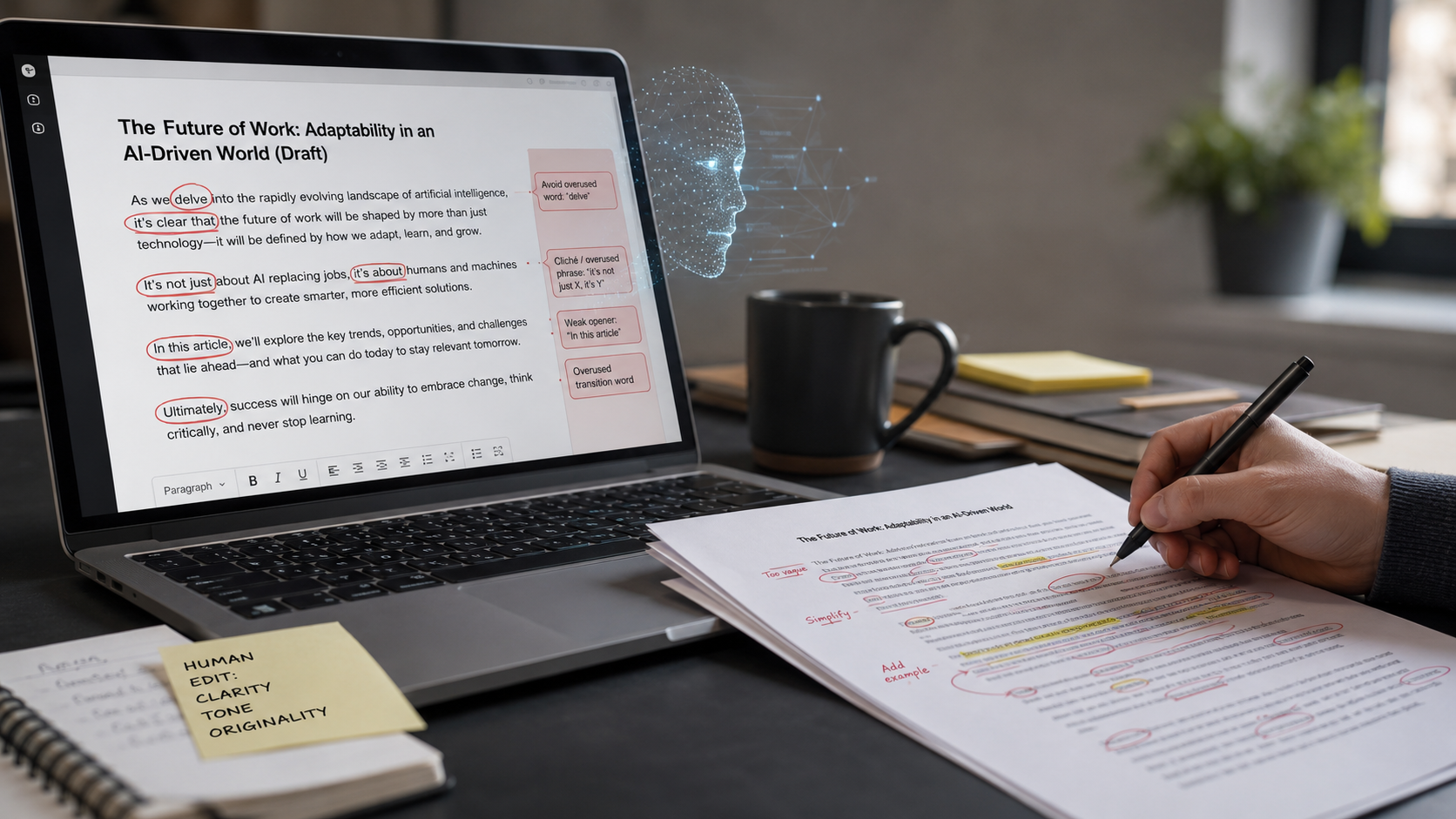
You've felt it before you could name it.
You're reading a blog post, a LinkedIn update, a cold email — and something is off. The grammar is clean. The structure is tidy. Every sentence is technically fine. And yet the whole thing feels like it was written by no one in particular.
Then you spot it. "In today's fast-paced digital landscape, businesses must delve into a rich tapestry of strategies…"
Busted.
AI writing has tells. Not vibes — actual, measurable, documented tells. Researchers have quantified them across millions of documents. Wikipedia's volunteer editors have catalogued them into a 15,000-word field guide. And your readers, whether they realize it or not, have been trained by two-plus years of exposure to spot them on sight.
This matters more than most marketing teams realize. Unedited AI patterns don't just make your content feel generic — they erode the trust signals that determine whether Google ranks you and whether AI engines like ChatGPT and Perplexity cite you as a source. When your content reads like everyone else's output from the same model, you've given both readers and algorithms zero reasons to prefer you.
So let's name the tells. All of them. The words, the phrases, the sentence structures, and the formatting habits — plus the research behind each, and what to write instead.
Why AI Keeps Reaching for the Same Words
First, a quick answer to the obvious question: with essentially all of English available to it, why does a large language model keep pulling from the same small drawer of vocabulary?
Because of how these models work. An LLM predicts the next most probable word, and "most probable" means "least surprising." Vivid, risky, specific word choices live in the statistical tails — exactly the neighborhood a next-word predictor learns to avoid. What you get instead is the center of mass: the average of a million writers, which has no accent and no fingerprint. It's polished precisely because it belongs to no one.
Then the loop feeds itself. AI-generated text floods the web, leaning on the same vocabulary. The next generation of models trains on that text. Each pass concentrates the same flavors further. Meanwhile, humans exposed to AI output start absorbing its habits too — research on scientific abstracts found that em dash usage more than doubled between 2021 and 2025, right as AI writing tools went mainstream. We're not just detecting AI's style. We're catching it.
That's the mechanism. Now for the evidence.
The Research: This Isn't Just a Meme
The "delve is a dead giveaway" discourse started as internet folklore, but it's since been validated at serious scale.
The landmark study is Kobak et al., published in Science Advances, which analyzed more than 14 million PubMed abstracts from 2010 to 2024. Borrowing the "excess mortality" method epidemiologists used during Covid, the researchers measured "excess vocabulary" — words appearing far more often after ChatGPT's release than pre-2022 trends predicted. The findings were stark: at least 10% of 2024 biomedical abstracts showed signs of LLM processing, climbing to roughly 30% in some sub-fields — a vocabulary shift the authors describe as unprecedented, exceeding even the disruption of the pandemic itself.
Which words spiked? Style words. Not new technical terms — flourishes. Delve. Intricate. Notably. Commendable. Meticulous. Underscore. Pivotal. Realm. Showcase.
A separate analysis of PubMed and Scopus records going back 175 years found that "delve" and "underscore" co-appeared in 546 of the 566 articles ever to contain both — 96.5% — in just 2023 and 2024. Nearly two centuries of scientific literature, and virtually every co-occurrence of that word pair happened in a two-year window after ChatGPT launched.
The other essential source is Wikipedia's "Signs of AI Writing" guide, built by the volunteer editors of WikiProject AI Cleanup who deal with undisclosed AI submissions daily. It's the most evidence-based catalogue on the internet because it's drawn from thousands of real examples, not speculation — and Forbes, MakeUseOf, and just about every editor with a pulse has since drawn on it.
With the receipts established, here's the full field guide.
Tier One: The Single-Word Giveaways
These are the vocabulary tells — words that appear dramatically more often in LLM output than in normal human writing of the same genre. One of them proves nothing. A cluster of them in a single piece is a flashing sign.
Delve. The undisputed champion. Nobody "delves into" anything in conversation, yet AI delves constantly. Paul Graham famously called it the single biggest ChatGPT indicator, and the PubMed data backs the instinct.
Tapestry. Almost always paired with "rich," and almost always used to describe something that is not, in any sense, a tapestry. "The company culture was a rich tapestry woven from diverse backgrounds." One editor writing in The Conversation went as far as saying they no longer believe the word can be used innocently in an essay.
Realm. As in "the realm of digital marketing." Humans say "in marketing," or "in the industry," or nothing at all.
Landscape. "The SEO landscape." "The competitive landscape." "The ever-evolving landscape." AI treats every industry like terrain to be surveyed from a hot air balloon.
Testament. Nothing merely exists in AI writing; everything "stands as a testament" to something else.
Underscore. Findings are never shown or suggested — they are underscored, ideally alongside something being delved into.
The rest of the roster: pivotal, multifaceted, intricate, meticulous, robust, seamless, holistic, leverage, harness, unlock, unleash, elevate, foster, navigate, showcase, beacon, cornerstone, paramount, commendable, noteworthy, crucial, compelling, transformative, revolutionary, cutting-edge, game-changer, utilize, facilitate, commence, synergy, embark.
Roundups from AiSDR, Vrid, and others converge on nearly identical lists, and they map closely onto the excess-vocabulary words the Kobak study measured empirically. That convergence is the point: independent observers keep finding the same fingerprint because it's a real fingerprint.
The fix for all of them is the same: swap in the plain word. Utilize becomes use. Commence becomes start. Facilitate becomes help. Leverage becomes use (again — almost everything becomes "use"). "Delve into" becomes "look at." Your writing loses nothing but the costume.
Tier Two: The Phrase-Level Giveaways
Individual words can be excused. Full stock phrases are harder to explain away, because they carry the entire scaffolding of AI sentence construction with them.
"In today's fast-paced digital landscape…"
The all-time classic opener, along with its cousins: "In today's ever-evolving world," "In an era of rapid change," "In the modern business environment." No human being has ever started a story this way at dinner. It's throat-clearing — filler that gestures at authority while saying nothing. Delete the entire sentence and your intro gets stronger 100% of the time.
"It's not just X — it's Y."
Wikipedia's editors call this negative parallelism, and it may be the most reliable phrase-level tell of all. "It's not just a tool — it's a partner." "This isn't about rankings. It's about relationships." "SEO is no longer optional — it's essential."
The construction mimics the shape of insight without containing any. It sets up a strawman nobody proposed, then knocks it down with a reveal that was obvious from the start. Its sibling, "not only… but also," is equally overrepresented in AI output. When you catch one in a draft, rewrite it as a direct statement: instead of "It's not just about traffic — it's about trust," write "Traffic without trust doesn't convert." Say the thing.
"It's important to note that…" / "It's worth mentioning…"
If it's important, note it. The preamble adds nothing but word count and the faint smell of a model hedging. Same family: "It should be noted," "One must consider," "It goes without saying" (then why is it being said?).
"Plays a vital role" / "plays a pivotal role"
In AI writing, nothing simply does anything. It "plays a crucial role in" doing it. Content doesn't help SEO; it "plays a pivotal role in driving organic visibility." The Forbes breakdown of Wikipedia's guide flags this whole family of inflated significance: everything is a watershed moment, a testament, a lasting impact. When every sentence carries maximum weight, none of them do.
"In conclusion" / "In summary" / "Overall" / "In essence"
AI is compulsive about announcing its endings, usually followed by a paragraph that restates everything you just read. Human writers earn their endings; models label them. If your final section could be titled "The Part Where I Repeat Myself," cut it and end on your strongest point instead.
The "from X to Y" comprehensiveness flex
"From strategic planning to implementation support." "From startups to Fortune 500s." "From content creation to technical optimization." The construction sounds comprehensive while communicating almost nothing material — which is exactly why models default to it when they have no specifics to offer. The cure is specifics: name the actual services, the actual clients, the actual outcomes.
"Whether you're a small business owner or a marketing executive…"
The audience-hedging construction. AI doesn't know who it's writing for, so it writes for everyone, which means no one. If you know your reader, address them. If you don't, that's a strategy problem no phrase can fix.
"Let's dive in" / "Let's explore" / "Buckle up"
The transitional pep talk. Also: "Without further ado," "Read on to discover," "In this article, we will discuss…" That last one — meta-commentary about the article's own structure — is dead weight in any format. Readers can see the article. They don't need a narrated tour of it.
The vague authority citation
"Experts say…" "Studies show…" "Industry observers have noted…" — with no expert, study, or observer in sight. Wikipedia's editors flag these weasel constructions constantly, because AI invents authority when it lacks sources. If you can name the source, name it (and link it, like this article does). If you can't, the claim probably shouldn't survive the edit.
Tier Three: The Structural Giveaways
Some tells live above the sentence level. These are often more damning than vocabulary, because they're harder to fake your way out of with a find-and-replace.
The em dash situation — handled fairly
Yes, the internet decided em dashes are "the ChatGPT hyphen." The truth is more nuanced, and worth getting right, because plenty of excellent human writers have used em dashes since long before LLMs existed — as Rolling Stone pointed out, the mark has been a staple of literary writing for centuries.
Here's the accurate version, per Wikipedia's guide: LLM output uses em dashes more often than nonprofessional human writing of the same genre, and uses them where humans would reach for commas, parentheses, or colons. The tell isn't the mark itself. It's the density — three per paragraph in a casual email — combined with the other patterns on this list. An em dash in a well-argued essay is a style choice. An em dash in every sentence of a LinkedIn post that also contains "delve" and "it's not just X" is evidence.
Uniform rhythm (low "burstiness")
Human writing has texture. Long, winding sentences that build an idea across several clauses. Then a short one. Then a fragment, even. AI produces sentences and paragraphs of eerily consistent length and cadence — text that feels extruded rather than composed. Read your draft aloud: if every sentence takes the same breath, a machine's rhythm is showing.
The "Bold term: explanation" list
AI adores this format. Efficiency: it saves time. Scalability: it grows with you. Flexibility: it adapts to your needs. Three to five items, perfectly parallel, each one a category label followed by a sentence that adds little. Combined with excessive bolding, emoji-decorated headers, and rigid Challenges/Benefits/Future Outlook section templates, it's one of the formatting habits Wikipedia's cleanup crew catches most often.
The rule of three, everywhere
"Convenient, efficient, and innovative." "Strategy, execution, and results." Triplets are a legitimate rhetorical device — in a speech. AI deploys them in nearly every paragraph, filling each slot with a near-synonym, because three parallel items is the statistically safest way to end a sentence. Once you notice it, you can't stop noticing it.
The treadmill effect
A subtler one: AI content circles the same idea without advancing it. A 500-word section that contains maybe 100 words of actual new information, with the rest restating, reframing, and padding. It's the reason AI drafts can be simultaneously long and empty. Humans repeat themselves too — but we usually notice on the re-read. The model never re-reads.
Why This Matters for Your Search Visibility (Not Just Your Pride)
If this were purely aesthetic, you could shrug it off. It isn't.
First, readers convert on trust, and these patterns burn it. The moment a prospect clocks your page as unedited AI output, every claim on it gets discounted — including the true ones. We've written before about what actually converts in AI vs. human copywriting, and the pattern holds: specificity, evidence, and voice close deals; generic fluency doesn't.
Second, the machines are grading you too. Google's helpful content systems reward demonstrated experience and expertise — the E-E-A-T signals that generic, tell-riddled content structurally lacks. And in AI search, the bar is arguably higher: answer engines cite sources that show original data, clear positioning, and verifiable authority. Content that reads like the model's own default output gives ChatGPT or Perplexity no reason to cite you, because you've added nothing the model didn't already have. Building the kind of entity-level authority that gets you named and cited starts with publishing things only you could have published.
Third, the arms race is accelerating. Wikipedia's guide notes that heavy LLM users can now identify AI-generated articles about 90% of the time. Your buyers include those people. So do journalists, editors, and the moderators of every community where you'd want your content shared.
How to Fix It: An Editing System, Not a Panic
Here's the part where we don't tell you to stop using AI. Used well — for research synthesis, outlines, first drafts, variant testing — it's a genuine force multiplier. The problem was never the tool. It's publishing the default output. Run every draft, AI-assisted or not, through this pass:
1. Run the kill list. Find-and-replace the Tier One words: delve, tapestry, realm, landscape, leverage, robust, seamless, testament, pivotal, multifaceted, utilize, facilitate, unlock, harness, elevate, foster, showcase, game-changer. Replace each with the plain English equivalent or delete it outright.
2. Hunt the constructions. Search your draft for "not just," "not only," "It's important," "plays a role," "In conclusion," "In today's," "from X to Y" hedges, and "whether you're a." Rewrite each as a direct statement.
3. Delete the meta-commentary. Any sentence describing the article's own structure goes. Your intro should make a claim, not a table of contents.
4. Break the rhythm. Vary sentence length on purpose. Follow a 30-word sentence with a four-word one. Kill at least one perfectly parallel triplet per section.
5. Add what only you know. This is the step that separates edited AI content from genuinely valuable content. Real numbers. Client anecdotes. A screenshot of your own data. An opinion someone could disagree with. We publish our own Search Console numbers every month — like our May 2026 benchmark report — precisely because verifiable specifics are the one thing no model can generate on your behalf.
6. Read it aloud. The final filter. If a sentence would embarrass you spoken to a client's face, it doesn't belong on your website either.
This is essentially the editorial layer we build into our own copywriting and SEO content systems: AI where it accelerates, humans where it counts, and specifics everywhere.
One Honest Caveat Before You Go Witch-Hunting
Every tell on this list has a false-positive problem, and pretending otherwise makes you the LinkedIn person accusing novelists of being robots.
Humans wrote "delve" before ChatGPT existed. Editors have loved em dashes since the 1800s. Academics said "underscore" unprompted. LLMs learned these patterns from us — and now, in a strange feedback loop, we're re-learning them from LLMs, which means the baseline for "normal human writing" is drifting toward the machine's accent even in fully human text. Wikipedia's own guide is explicit that its list is descriptive, not prescriptive: these are observations, not a conviction algorithm, and no single sign proves anything.
So the takeaway isn't "never use these words again," and it definitely isn't "run everything through a detector" — even Wikipedia warns against relying on detection tools alone. The takeaway is density and intent. One tapestry is a word choice. Five tells in two paragraphs is a pattern. And a pattern is what readers — and answer engines — actually punish.
Write like someone in particular. That's the entire trick. It's also, conveniently, the thing that gets you ranked, remembered, and cited.
Frequently Asked Questions
What are the most common words that give away AI writing?
The most documented giveaway words are delve, tapestry, realm, landscape, testament, underscore, pivotal, multifaceted, intricate, meticulous, robust, seamless, leverage, harness, unlock, elevate, foster, showcase, and game-changer. The Kobak et al. study in Science Advances measured many of these empirically across 14 million PubMed abstracts, finding their frequency spiked far beyond pre-ChatGPT trends after late 2022.
What phrases are the biggest AI writing giveaways?
The strongest phrase-level tells are "In today's fast-paced digital landscape," "It's not just X — it's Y" (negative parallelism), "It's important to note that," "plays a pivotal role," "In conclusion / In summary," the "from X to Y" construction, "whether you're a [audience A] or a [audience B]," and "Let's dive in." A single one proves nothing; a cluster of them in one piece is a strong signal.
Do em dashes mean something was written by AI?
Not on their own. Em dashes have been standard in edited English for centuries, and plenty of human writers love them. Per Wikipedia's Signs of AI Writing guide, the actual tell is density and placement: LLMs use em dashes more often than nonprofessional human writing of the same genre, and put them where humans would use commas, parentheses, or colons. Judge them alongside the other patterns, not in isolation.
Can Google or AI search engines detect AI-generated content?
Google has said it rewards helpful content regardless of how it's produced — but content full of AI tells tends to be generic, unspecific, and thin on demonstrated experience, which is exactly what E-E-A-T-driven systems deprioritize. AI answer engines are even less forgiving: they cite sources that add original data and clear positioning, and default model output adds nothing the model didn't already have.
Is it okay to use AI to write blog posts at all?
Yes — the problem is publishing the default output, not using the tool. AI is genuinely useful for research synthesis, outlines, and first drafts. The content that performs is AI-accelerated but human-finished: kill-list edits, varied rhythm, named sources, and specifics only you could supply, like your own data or client results. That's the model behind our copywriting and content systems.
How do I make AI writing sound human?
Run a six-step edit: swap the giveaway words for plain English, rewrite the stock constructions as direct statements, delete meta-commentary about the article itself, vary your sentence lengths on purpose, add verifiable specifics and firsthand experience, and read the whole thing aloud before publishing. Anything you wouldn't say to a client's face gets cut.
Can AI detection tools reliably identify AI writing?
No single tool is reliable enough to act on alone — even Wikipedia's editors explicitly warn against depending on detectors, since they produce false positives on human writing (especially from non-native English speakers) and false negatives on lightly edited AI text. Pattern density plus human judgment beats any detector score.
Want Content That Sounds Like You — and Gets Cited Like a Source?
This is the work we do every day at Ritner Digital: content engineered to rank in Google and get named by ChatGPT, Perplexity, and Gemini — written with the specificity, proof, and voice that generic AI output can't fake. We publish our own data to prove the system works, and we'll show you exactly where your content stands today.
Book a free 30-minute strategy call → No pitch, no obligation — just a real read on your search visibility and a clear next step.
Sources
Kobak, D., González-Márquez, R., Horvát, E.-Á., & Lause, J. — Delving into LLM-assisted writing in biomedical publications through excess vocabulary, Science Advances (arXiv preprint)
Wikipedia: Signs of AI Writing — WikiProject AI Cleanup field guide
Cook, J. — The 10 Giveaway Signs of AI Writing, Wikipedia Reveals, Forbes
Klee, M. — Are Em Dashes Really a Sign of AI Writing?, Rolling Stone
Potkalitsky, N. — Why AI Can't Stop Using Em Dashes
Wikipedia May Have Built the Best AI Writing Detection Guide, MakeUseOf
Delving Into PubMed Records: How AI-Influenced Vocabulary Has Transformed Medical Writing Since ChatGPT, Perspectives on Medical Education