The "Prompt Inventory" Method: How to Find What Your Buyers Actually Ask AI
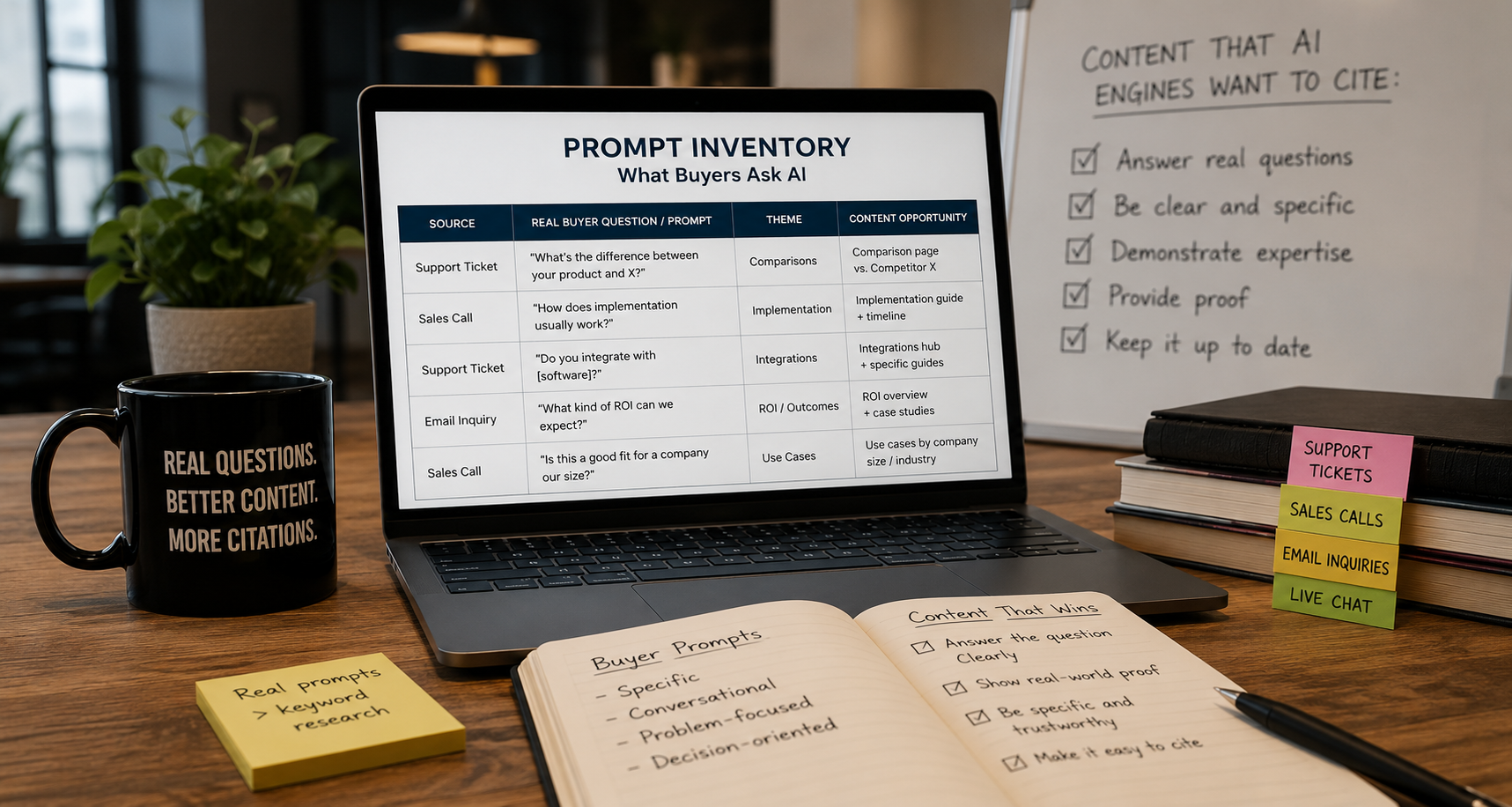
There's a quiet shift in how content gets found, and it changes the homework. For twenty years, the job was keyword research: find the short phrases people type into Google, write pages targeting them. But people don't type at AI engines — they talk to them. They ask full, messy, specific questions, loaded with the exact constraints of their situation. And if your content doesn't answer the real question in the real language, the AI has no reason to cite you when it matters.
So the new homework isn't keyword research. It's prompt research — figuring out the actual questions your buyers ask ChatGPT, Perplexity, and Google's AI before they ever reach you. The good news: you don't need an expensive tool to start, and you're sitting on the single best source of this data already. It's in your inbox, your help desk, and your call recordings. Here's how to mine it.
Why this beats keyword tools (and made-up FAQs)
First, the principle, because it's what makes the method work. The worst thing you can do is invent questions from your desk. As one guide puts it bluntly, the worst mistake is inventing prompts from your desk — prompt mining does the opposite, extracting the questions your customers already ask, word for word, instead of guessing them. Tryhikoo
This matters more than it used to, because AI engines reward genuine question-and-answer content and actively punish the fake kind. Real FAQs built from recurring customer questions help; made-up FAQ blocks built for SEO no longer work and trigger Google's scaled-content classifier. The engines are explicitly looking for content structured around how people actually ask — so the closer you get to your buyers' literal phrasing, the more citable you become. AI Labs Audit
And the highest-value sources are free and already yours. As one breakdown notes, your best sources are internal: support and help-desk tickets are full of recurring questions in your customers' exact words, and sales conversations and objections reveal the highest buying-intent prompts. Tryhikoo
Step 1: Pull from your support tickets and inbox
Start with your support queue, help-desk tickets, and the questions that land in your inbox. This is gold, because people write to support the same way they prompt an AI — in full, plain-language questions, especially when they're stuck or comparing options.
Go back through the last few months and look for the questions that repeat. The ones you've answered ten times are the ones your prospects are asking AI ten thousand times. Don't paraphrase them into tidy marketing language — capture them verbatim, weird phrasing and all. "Can your thing handle [specific situation]?" "What's the difference between you and [competitor]?" "Does this work if I only have [constraint]?" That literal phrasing is the asset.
Step 2: Harvest your sales calls and demos
If support tickets reveal what customers struggle with, sales calls reveal what buyers decide on — which is even higher-intent. Comb through call notes, recordings, or your CRM for the questions and objections that come up before someone buys.
There's one question that unlocks the best material of all. As one prompt-research guide suggests, ask your sales and customer-success team a single thing: "What did the prospect say they already asked ChatGPT before booking this call?" — and those answers become your highest-signal prompts. Increasingly, buyers arrive at the sales call having alreadyresearched you (or your category) through AI. The questions they bring are literal evidence of the prompts that are shaping decisions in your market. Vizup
Pay special attention to comparison and objection language. The "you versus [competitor]" questions, the "is this worth it for a business my size" doubts, the "what about [risk]" hesitations — these are exactly the evaluation-stage prompts that AI answers, and exactly where being cited (or absent) decides whether you make the shortlist.
Step 3: Add your other free, first-party sources
Once you've drained the two richest veins, top up from the other places your buyers' real language already lives:
Your internal site search and chat logs show queries people typed in their own words. Your Google Search Consolesurfaces natural phrasings already driving traffic — and a quick tip from the prompt-research world: filter for who, how, which, and why to isolate the question-shaped queries. And Reddit and Quora threads in your category mirror prompt-style language exactly, since people describe real problems in their own words there — look for recurring themes, complaints, and comparison requests, which are high-intent and real. TryhikooSeaRanks
Step 4: Capture each prompt with its context (don't just list it)
Here's where a simple inventory becomes a useful one. A bare list of questions isn't enough; the context around each question is what tells you how to answer it. For each prompt you collect, jot down a few things alongside the verbatim wording. One prompt-research framework recommends capturing the full prompt text (don't shorten it), the persona and company context, the buying stage, what the buyer is optimizing for (cost, speed, compliance, integrations), and any named tools they mention. Vizup
That last detail — the constraints — is what separates a real buyer prompt from a generic one. People don't ask "best racing-event vendor." They ask "best interactive trade-show activation for a 10×10 booth on a tight budget that can set up indoors." The constraints (budget, size, location, timeline) are part of the prompt, and content that addresses them gets cited for the specific, high-intent questions that actually convert.
Step 5: Tag by buying stage so you cover the whole journey
Sort your inventory into rough stages, because a balanced prompt list covers the full decision, not just the bottom of it. A useful split: awareness (the buyer is exploring a problem and has doubts), consideration (they're building a shortlist and comparing options), and decision (they're ready to buy and resolving final objections).
Most businesses make the mistake of only thinking about purchase-stage questions, and that's a trap — research found that roughly 40% of LLM prompts are transactional and 60% informational, so tracking only purchase-stage prompts means you're invisible during the majority of the research process. The awareness and consideration questions are where you get into the buyer's head before they've formed a shortlist — which is often the whole game. Vizup
Step 6: Turn the inventory into citable content
Now the inventory does its job. Take the recurring questions and build content around them, using the buyer's real phrasing as your headings. The proven structure is simple: pull your top 20 questions from sales calls and support tickets and reuse the exact phrasing as H2s, then answer each one cleanly. The format AI engines reward most is a direct answer up front: as one AEO guide advises, start every page with a clear answer to the top-intent question, followed by context and detail, and use headings that mirror natural queries. HubSpot
Build genuine FAQ sections from genuine questions — five to eight questions per page, sourced from real support data, updated quarterly because question phrasing drifts faster than people think. You're not guessing what AI wants to cite anymore. You're handing it the exact answers to the exact questions your market is asking, in the words they're using. That's content built to be quoted. AI Labs Audit
The honest line: where the DIY ends and the real work begins
You can absolutely do everything above yourself, this week, for free. The prompt inventory is one of the highest-leverage, most doable pieces of AI-search work there is, and most of your competitors aren't doing it. Genuinely — go mine your tickets and calls.
But two things are worth being straight about, because they're where this gets harder than an afternoon's homework. First, an inventory is a snapshot, and buyer language drifts; doing this once helps, but the businesses that win treat prompt research as an ongoing discipline — and at scale, knowing which prompts your buyers ask is different from measuring whether AI is actually citing you on them, which is its own measurement problem. As the research notes, there's no Search Console equivalent for generative AI yet — per-prompt visibility can't be guessed, it has to be measured systematically. Tryhikoo
Second — and this is the bigger one — writing great answers to the right questions gets you eligible to be cited. It doesn't guarantee it. The same AEO case studies that start with buyer-question content also depend on fixing the technical foundation and, above all, building the authority that makes engines trust your answers in the first place. The prompt inventory tells you what to say. Earning the authority to be the source AI quotes when it says it — that's the work that compounds, and it's where a real content-and-authority program earns its keep.
So here's the honest handoff: do the inventory yourself. It's valuable, and you'll learn things about your buyers you didn't know. Then, when you can see the gap between the questions your market is asking and the answers AI is giving without your name attached, you'll know exactly what the bigger work is for — and whether it's time to bring in help to build the engine behind it.
Mined your prompts and realized AI is answering all of them without mentioning you? That's the signal that the work left isn't research — it's building the content engine and authority that turn those buyer questions into citations. That's what we do. Let's talk about it.
Frequently Asked Questions
What is the "prompt inventory" method?
It's the practice of mining your own first-party conversations — support tickets, sales calls, demos, chat logs — to find the exact questions your buyers ask AI engines, in their real words. Instead of guessing keywords, you harvest verbatim questions and build content that answers them. The core principle: the worst mistake is inventing prompts from your desk — prompt mining extracts the questions your customers already ask, word for word, instead of guessing them. Tryhikoo
Why is mining my own conversations better than using a keyword tool?
Because people talk to AI in full, specific questions rather than typing short phrases, and your conversations capture that real language for free. As one breakdown notes, support and help-desk tickets are full of recurring questions in your customers' exact words, and sales conversations and objections reveal the highest buying-intent prompts. Keyword tools give you head terms; your tickets and calls give you the constrained, real-world questions that actually shape buying decisions. Tryhikoo
Which internal sources should I pull from first?
Start with the two richest veins: support tickets (where customers ask full questions when stuck) and sales calls (where buyers reveal what they decide on). Then top up with internal site search and chat logs, Google Search Console — filtered for who, how, which, and why to surface question-shaped queries — and Reddit/Quora threads in your category, where people describe real problems in their own words. TryhikooSeaRanks
What's the single best question to ask my sales team?
Ask them: "What did the prospect say they already asked ChatGPT before booking this call?" Those answers are your highest-signal prompts, because buyers increasingly research you and your category through AI before the sales conversation. The questions they bring to the call are direct evidence of the prompts shaping decisions in your market right now. Vizup
What should I record for each prompt besides the question itself?
Capture the context that tells you how to answer it. A solid framework records the full prompt text (don't shorten it), the persona and company context, the buying stage, what the buyer is optimizing for (cost, speed, compliance, integrations), and any named tools they mention. The constraints especially matter — "best vendor for a 10×10 booth on a tight budget" is a far more citable, higher-intent prompt than "best vendor." Vizup
Why tag prompts by buying stage?
Because a balanced list covers the whole decision, not just the purchase. Most teams only think about bottom-of-funnel questions, which is a trap: research found roughly 40% of LLM prompts are transactional and 60% informational, so tracking only purchase-stage prompts means you're invisible during the majority of the research process. Awareness and consideration questions get you into the buyer's head before they've even built a shortlist. Vizup
How do I turn the inventory into content AI will cite?
Use the buyers' real phrasing as your headings and answer each question directly up front. The proven approach: pull your top 20 questions from sales calls and support tickets and reuse the exact phrasing as H2s, and start every page with a clear answer to the top-intent question, followed by context, using headings that mirror natural queries. Build real FAQ sections from real questions — fake ones now trigger Google's scaled-content classifier. AI Labs AuditHubSpot
If I do all this myself, will AI start citing me?
It makes you eligible — it doesn't guarantee it. Great answers to the right questions are necessary but not sufficient. Two gaps remain: measurement (there's no Search Console equivalent for generative AI yet, so per-prompt visibility has to be measured systematically, not guessed), and authority — engines only cite sources they trust. The inventory tells you whatto say; earning the authority to be the quoted source is the bigger, compounding work behind it. Tryhikoo
Sources
Vizup, Prompt Research for AI Search: How to Find the Questions Buyers Ask ChatGPT — https://www.tryvizup.com/blog/prompt-research-for-ai-search-how-to-find-the-questions-buyers-ask-chatgpt
Hikoo, Which Prompts Your Brand Appears On: 2026 Guide — https://www.tryhikoo.com/en/blog/guides/which-prompts-your-brand-appears-on-2026/
SE Ranking, How to Choose Prompts to Track for AI Visibility — https://seranking.com/blog/how-to-choose-prompts-to-track/
Aleyda Solis, The AI Search Optimization Checklist — https://www.aleydasolis.com/en/ai-search/ai-search-optimization-checklist/
AI Labs Audit, AI Visibility Checklist 2026: 25 Actions to Get Cited — https://ailabsaudit.com/blog/en/aeo-checklist-2026-actions
GrowByData, AI Search Visibility in 2026: The Complete Guide — https://growbydata.com/ai-search-visibility-the-complete-guide/
HubSpot, Answer Engine Optimization Case Studies — https://blog.hubspot.com/marketing/answer-engine-optimization-case-studies
Contently, Top 10 Tools for Answer Engine Optimization (AEO) in 2026 — https://contently.com/2026/04/29/top-10-tools-answer-engine-optimization-aeo-2026/
Omnibound, Best AEO Tools for Answer Engine Optimization — https://www.omnibound.ai/blog/best-aeo-tools-for-answer-engine-optimization