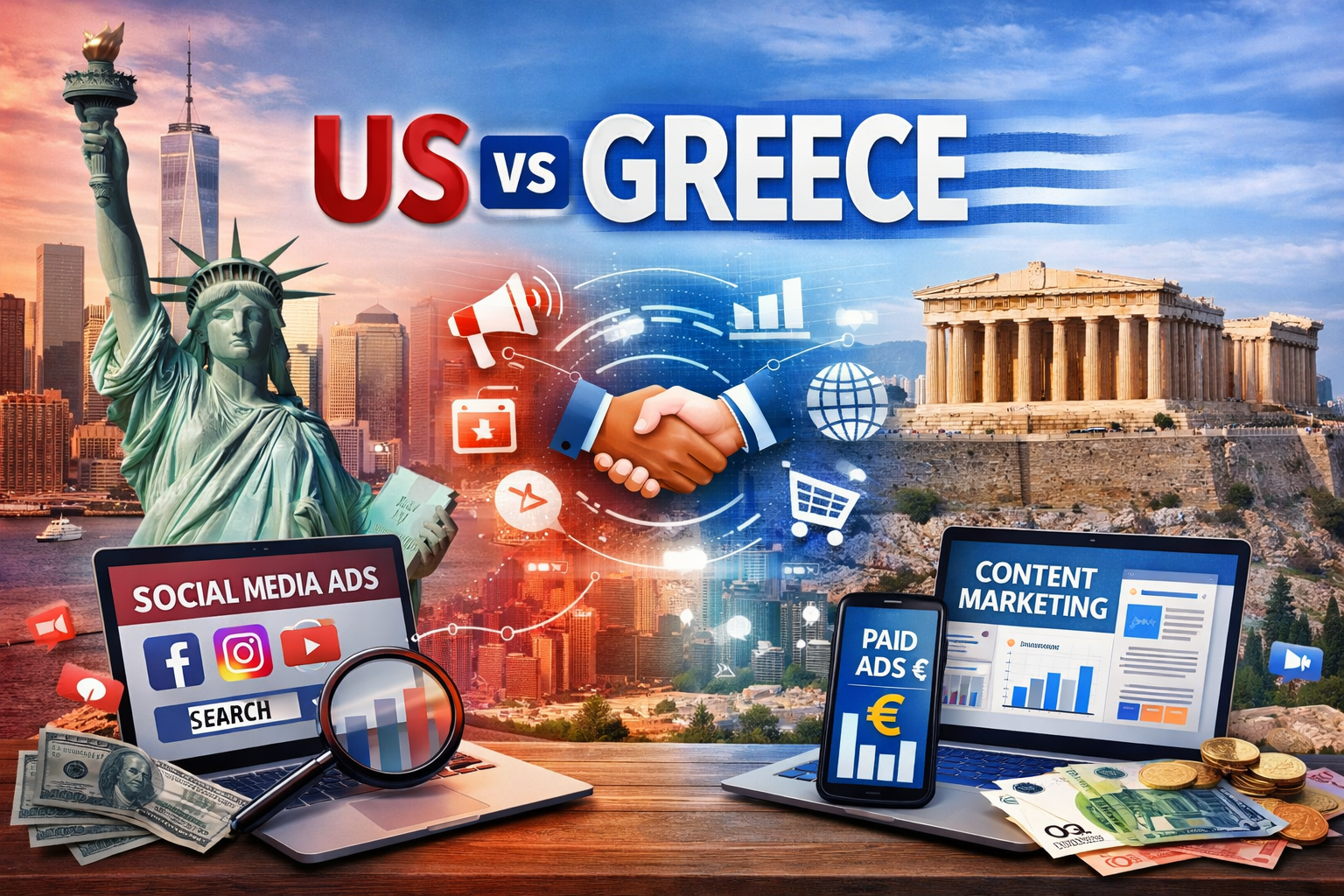
US vs. Greece: How Marketing Trends Compare — And What Each Market Can Learn From the Other
Marketing is marketing, right? You identify an audience, craft a message, pick a channel, and put it in front of the people most likely to respond.
In theory, yes. In practice, the market you're operating in shapes almost every decision you make — which platforms dominate, how much consumers trust different types of advertising, how buyers make decisions, what kind of content stops a scroll versus what gets ignored, and how much budget is even realistic for a business your size.
The United States and Greece sit at genuinely different points in the digital marketing maturity curve. They use different platforms in different ways, spend differently on advertising, and respond to different signals of trust. For any business operating in or marketing to both markets — or simply trying to understand how digital strategy differs across cultures — the comparison is illuminating.
Here's how the two markets stack up across the channels that matter most.
The Landscape: Two Markets, Two Starting Points
Before getting into channels, the baseline numbers tell an important story.
The United States is the world's largest digital advertising market by a wide margin. In the US, online marketing spend grew by 12% in 2024, comprising about 69% of total ad spend — with $0.73 of every advertising dollar going to digital formats. RecurPost The infrastructure, the tooling, the agency ecosystem, the consumer expectations — all of it has been shaped by decades of digital marketing maturation and billions of dollars of investment.
Greece is a significantly smaller market operating on a different timeline. Greece had 8.90 million internet users at the start of 2024, representing an internet penetration rate of 86.2%, with 7.40 million active social media users — equivalent to 71.7% of the total population. DataReportal The digital ecosystem is genuinely well-developed for a market of its size, but the scale, the competition, and the advertising infrastructure are fundamentally different from what US marketers are used to.
One immediately striking difference: search advertising dominates digital ad spend in Greece, accounting for 65.4% of total digital advertising expenditure — the highest share in Europe and dramatically higher than the European average of 43.1%. Display advertising represented just 33% of spend, compared to a European average of 49.9%. Grokipedia
In the US, the split is far more balanced across search, social, display, and video. Greek digital advertising is heavily search-first in a way that American marketers, accustomed to a more diversified channel mix, might find surprising.
Social Media: Same Platforms, Very Different Dynamics
Both markets live on social media. But which platforms dominate, how they're used, and what performs on them differs meaningfully.
In the US, the social media landscape is fractured across a large number of platforms serving different demographics and content formats. LinkedIn dominates B2B. Facebook remains powerful for local business and older demographics. Instagram and TikTok drive younger audiences and product discovery. YouTube is effectively a search engine in its own right. X has a smaller but vocal professional and media audience.
In Greece, the social landscape is more concentrated. YouTube reaches 7.40 million users in Greece, Facebook has 5.00 million users, Instagram has 4.25 million users, and TikTok reaches 3.84 million users aged 18 and above. GrokipediaFacebook and YouTube are dominant in a way that feels closer to 2015 US dynamics than 2025 ones. TikTok is growing fast — the potential reach of ads on TikTok in Greece increased by 14.1% in a single quarter between late 2023 and early 2024 DataReportal — but the platform mix skews older and more established than in the US.
For content strategy, this has real implications. In the US, a brand that ignores TikTok and focuses only on Facebook is leaving a significant younger audience segment unserved. In Greece, that same approach is closer to where the mainstream audience actually is.
The tone and style of content that performs also differs. Greek consumers are increasingly drawn to personalized content and authentic brand interactions, with younger demographics prioritizing brands that align with their values, including sustainability and ethical practices. The rise of social media influencers has reshaped marketing strategies, as consumers seek genuine connections and relatability over traditional celebrity endorsements. Statista
This mirrors a broader US trend, but with a cultural nuance: in Greece, community and personal relationships carry an outsized weight in purchasing decisions. Word-of-mouth and peer recommendation — amplified through social channels — often outperform polished advertising in a way that feels even more pronounced than in the US market.
Search and SEO: The Channel That Works Everywhere — Differently
Google dominates search in both markets. That's where the similarity largely ends.
In the US, the SEO and paid search landscape is extraordinarily competitive. Businesses in almost every industry are fighting for the same keywords, often against well-funded competitors and established brands with years of domain authority. Cost-per-click on Google Ads in competitive US categories can be staggering. The content marketing ecosystem — blogging, video, podcasts, link building — has matured to the point where organic search is a multi-year investment with real strategic depth required to compete.
In Greece, the competitive landscape is less saturated. For many business categories, particularly in local markets and regional tourism, the bar for ranking well is meaningfully lower than in the US equivalent. A well-optimized website, consistent content, and a properly managed Google Business Profile can move the needle in Greece in ways that would take years in an equivalent US market.
The flip side is that Greek consumers' reliance on search as a decision-making tool is significant. For Greek consumers, appearing in search results is considered the most effective way to attract their business, alongside posting on social media and direct mail. Online search and customer reviews are the most popular methods for self-education before making a purchase decision. Medium
This means that in Greece, search visibility isn't just a nice-to-have — it's the primary channel through which consumers discover and evaluate businesses. An American business operating in Greece that brings rigorous US-style SEO practices to a less competitive market can establish dominance relatively quickly. A Greek business that has neglected its search presence is likely invisible to a large portion of its potential customers.
Paid Advertising: Budget Realities and Platform Priorities
The paid advertising reality in the two markets is shaped heavily by scale.
In the US, digital advertising is expensive, competitive, and increasingly sophisticated. The cost to reach a meaningful audience on Google, Meta, or LinkedIn has climbed steadily as more businesses compete for the same eyeballs. A small business entering the paid advertising space for the first time in the US faces a steep learning curve and real financial risk if the campaigns aren't well-structured.
In Greece, the digital advertising market reached approximately €364 million in 2024 Grokipedia — a fraction of the US market. Competition for ad placements is lower, cost-per-click is generally more favorable, and a modest budget can produce meaningful reach in a way that would be difficult in the US.
Over 70% of online transactions in Greece are now made via smartphones, driving businesses to optimize for mobile-first experiences. Radigitalworld This mobile-first reality mirrors the US, where mobile advertising has become the dominant delivery mechanism for digital ads. In both markets, campaigns that aren't built for mobile from the ground up are leaving performance on the table.
One meaningful difference: Greece's advertising market is witnessing mild growth overall, with traditional media maintaining a stronger relative presence than in the US. Statista Television advertising remains a significant force in Greece in a way that has diminished substantially in the US, where streaming fragmentation has eroded the mass-reach power of TV. For businesses operating in Greece, a hybrid traditional-digital approach often still makes strategic sense — particularly for brand awareness campaigns targeting broader demographics.
Content Marketing: The US Is Years Ahead — Which Is a Greenfield Opportunity in Greece
Content marketing — the practice of creating genuinely useful, educational, or entertaining content that builds audience and drives organic traffic over time — is deeply embedded in US marketing culture. Blogging, video series, podcasts, email newsletters, long-form social content: American businesses at virtually every size have at least experimented with these tactics, and the most sophisticated are using them as primary growth drivers.
In Greece, content marketing adoption among small and medium-sized businesses lags significantly. Many small and medium-sized enterprises in Greece lack the expertise to execute advanced digital strategies, representing a real digital skills gap in the market. Radigitalworld
This is simultaneously a challenge and an opportunity. For Greek businesses willing to invest in consistent, high-quality content, the competitive advantage of doing so is enormous precisely because so few competitors are doing it well. The bar is lower. The potential differentiation is higher.
For US businesses marketing to Greek audiences — particularly in the travel, hospitality, and real estate sectors where American investment and interest is strong — there is an opportunity to bring content sophistication to a market that isn't yet flooded with it.
Lead Generation and Email Marketing: Where the US Has a Clear Edge
Email marketing is one of the highest-ROI channels in digital marketing globally. Email marketing generates $36–$40 for every $1 spent, making it one of the highest ROI marketing channels available, with small businesses consistently citing it as their top ROI-driving channel. RecurPost
In the US, email marketing infrastructure is mature. Businesses of all sizes have CRM systems, automated sequences, segmented lists, and sophisticated follow-up workflows. The culture of building an email list as a business asset is well-established.
In Greece, email marketing adoption is more uneven. The channel is used, but automated lead nurturing — the practice of building sequences that warm up leads over time and move them toward a purchasing decision — is far less common among small businesses. Greek consumers identify email marketing as one of the channels most likely to have a negative influence on their buying decisions Medium — which speaks less to email's ineffectiveness as a channel and more to how poorly it is often executed in the Greek market. Poorly targeted, generic, high-frequency email blasts have trained Greek consumers to distrust the channel. Well-executed, personalized, value-driven email marketing stands out precisely because the bar is so low.
This is an area where US best practices — thoughtful segmentation, automated sequences, genuine value exchange — can be imported directly to the Greek market and generate outsized results.
Trust and Culture: The Invisible Variable That Changes Everything
Perhaps the most significant difference between the two markets isn't a channel or a platform — it's culture.
In the US, consumers are accustomed to being marketed to constantly. They've developed sophisticated filters, high skepticism thresholds, and a willingness to tune out anything that feels like advertising. Breaking through requires creativity, specificity, and a genuine value proposition. The market is efficient in the economic sense: good marketing gets rewarded quickly, bad marketing gets ignored even faster.
In Greece, personal relationships and community trust play a larger role in purchasing decisions than in the US. The Greek concept of filoxenia — the cultural emphasis on warmth and genuine connection — extends into the business context. A recommendation from a friend or neighbor carries disproportionate weight. A business that has served a community for years has a trust advantage that no amount of advertising can easily replicate.
For marketers, this means that in Greece, authenticity and relationship-building aren't just buzzwords — they're the primary currency. Tactics that feel transactional or impersonal underperform. Content and advertising that feels warm, specific, and human — that speaks to the Greek cultural value of genuine connection — resonates in a way that polished, corporate messaging often doesn't.
In the US, the same principle is increasingly true, but the baseline expectation for authentic content is already high enough that most businesses are at least paying lip service to it. In Greece, the businesses that genuinely invest in warmth and relationship-building stand out from a large field of competitors still using broadcast advertising as their primary approach.
What Businesses in Both Markets Can Take From This
If you're a US business looking to reach Greek audiences: Your content sophistication is an advantage. Bring it. The Greek market rewards quality content, authentic storytelling, and genuine search presence — and the competition for those positions is far lower than you're used to. Invest in local-language SEO, culturally resonant social content, and relationship-building over volume.
If you're a Greek business looking to grow: The US playbook works — when adapted. Build your search presence first, since it's where your customers are making decisions. Invest in content marketing before your competitors figure out how powerful it is. Fix your email marketing so it delivers value instead of noise. And bring the warmth that Greek culture does naturally into every digital touchpoint.
If you're a business serving both markets: Recognize that the same campaign rarely works equally well in both places. The platform mix, the tone, the budget allocation, the content format — all of it needs to be calibrated to where each market actually is, not where you assume it to be.
Ritner Digital Works in Both Worlds
We understand what drives results in the US market and we understand the Greek market's distinct dynamics. Whether you're a US business looking to reach Greek audiences, a Greek business looking to compete with US-level digital sophistication, or a brand operating across both — we build the strategies and systems that work where your customers actually are.
Let's Talk About Your Market →
Ritner Digital helps businesses build digital marketing strategies that work — regardless of which side of the Atlantic your customers are on. Ready to compete smarter? Let's talk.
Sources:
DataReportal — Digital 2024: Greece
Grokipedia — Digital Marketing in Greece
Statista — Search Advertising Market Greece
Statista — Digital Advertising Market Greece
Statista — Advertising Market Greece
RecurPost — Digital Marketing Statistics 2025
The State of Digital Marketing in Greece 2024
Medium / Sosipatros Birntachas — Greek Consumer Perspective on Marketing
Noria Digital Agency — Advertising in Greece
BYYD — Digital Marketing Trends Worldwide 2025
Frequently Asked Questions
Is digital marketing in Greece as advanced as it is in the US?
Not yet — but it's moving fast. Greece has strong internet penetration and a highly active social media population, but the sophistication of digital marketing strategies among small and medium-sized businesses lags behind the US. Content marketing, email automation, and lead nurturing systems that are standard practice for US businesses are still relatively rare among Greek competitors. That gap is actually an opportunity for businesses willing to invest in doing it right.
Which social media platforms work best for marketing in Greece?
Facebook and YouTube remain the dominant platforms in Greece in a way that feels closer to the US landscape from several years ago. Instagram is strong, particularly for lifestyle, travel, and food brands. TikTok is growing rapidly among younger demographics. LinkedIn has a smaller but growing professional audience. For most Greek businesses, a Facebook and Instagram-first strategy is the right starting point — though the right mix always depends on your specific audience and industry.
Is SEO worth investing in for a Greek market business?
Absolutely — and the return on that investment is often faster than in the US because the competitive landscape is less saturated. Greek consumers rely heavily on search to discover and evaluate businesses, making search visibility one of the highest-leverage investments a Greek business can make. A well-optimized website, consistent content, and a properly maintained Google Business Profile can move the needle in Greece in ways that would take years of effort in an equivalent US market.
Why does Greece spend so much more on search advertising relative to other digital channels?
Search advertising accounts for about 65% of digital ad spend in Greece — the highest proportion in Europe. This reflects both strong consumer reliance on search as a discovery and decision-making tool and a relative underdevelopment of display and social advertising compared to more mature markets. As the Greek digital advertising market matures, that balance will likely shift toward a more diversified channel mix — but for now, search is where Greek advertisers are putting their money.
Do the same paid advertising strategies work in both the US and Greece?
The same principles apply — targeting, relevance, compelling creative, clear offers — but the execution needs to be calibrated to each market. Competition for ad placements is dramatically lower in Greece, which means cost-per-click is generally more favorable and a smaller budget can produce meaningful reach. US campaigns typically require more sophisticated bidding strategies, more creative testing, and larger budgets to compete effectively. Copy, creative, and cultural references also need to be adapted rather than directly translated.
Why do Greek consumers seem to distrust email marketing?
It's less about the channel and more about how it's typically used. Greek consumers have been conditioned by high-volume, generic, poorly targeted email blasts to associate email marketing with spam. Well-executed email marketing — personalized, genuinely valuable, sent at the right frequency — still works well. The bar for standing out is actually lower in Greece than in the US precisely because most businesses aren't doing it well. A thoughtful email strategy in the Greek market can produce outsized results compared to the crowded US inbox environment.
How does cultural trust affect marketing differently in Greece versus the US?
In Greece, personal relationships and community credibility carry significantly more weight in purchasing decisions than in the US. Word-of-mouth, local reputation, and genuine warmth in communication are powerful trust signals that can outperform polished advertising. In the US, consumers are more accustomed to being marketed to and have developed stronger filters against anything that feels inauthentic. Both markets reward genuine connection — but in Greece, the cultural emphasis on relationship over transaction is even more pronounced, and marketing that ignores this dynamic tends to underperform.
Should a Greek business copy US marketing strategies directly?
Borrow from them, don't copy them. US marketing best practices — content marketing, SEO, email automation, lead generation systems — absolutely work in Greece. But they need to be adapted for a smaller market, a different cultural tone, different platform dynamics, and different consumer expectations. The businesses that win in Greece by applying US-level digital sophistication are the ones that bring the strategy but adjust the execution for local context.
What's the biggest mistake US businesses make when marketing to Greek audiences?
Treating Greece like a smaller version of the US. The platform mix is different, the cultural tone is different, the trust signals are different, and the competitive landscape is different. US businesses that import their campaigns wholesale — same creative, same targeting logic, same channel mix — typically underperform. The ones that research the market, adapt their content, and invest in genuine local relevance tend to see significantly better results.
How does Ritner Digital approach marketing across both markets?
We understand both landscapes — the maturity and sophistication of the US market and the distinct dynamics of the Greek market. Whether you're a US business looking to connect with Greek audiences, a Greek business looking to compete with US-level digital strategy, or a brand operating across both, we build the strategies, content systems, and lead generation funnels that work where your customers actually are. No one-size-fits-all playbook — just strategy that fits your market.