Waymo Just Launched in Orlando. What AI Disruption Means for How Customers Find Your Business.
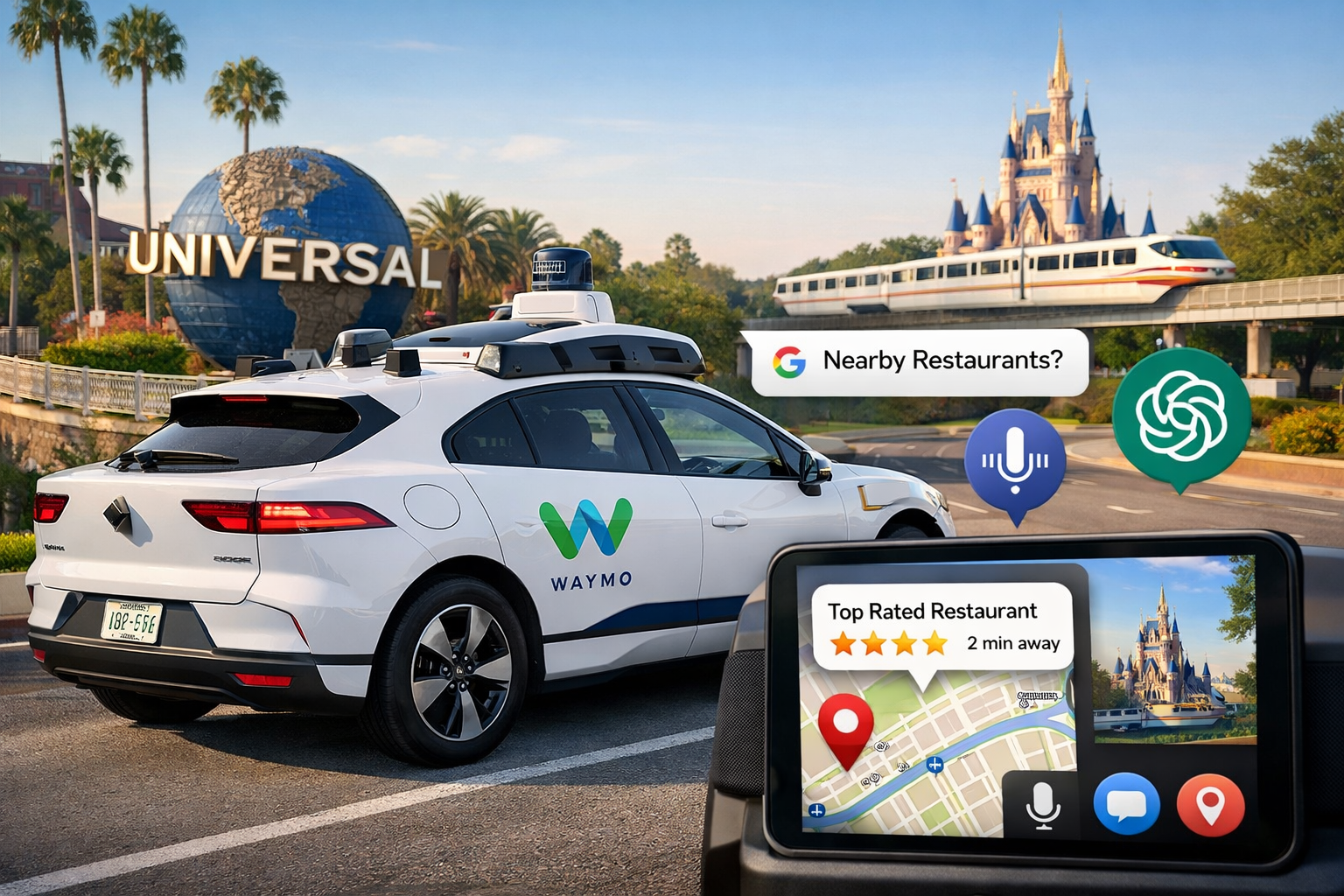
On February 24, 2026, something changed about how people move around Orlando.
Waymo opened its self-driving ride-hailing service to select riders in Orlando, bringing its total commercial markets to ten U.S. cities. WDW News Today The launch was gradual — the company is taking a measured approach, gradually expanding service areas, rider access, and operational capabilities over time ClickOrlando — but the significance isn't in the pace. It's in the fact that it's happening at all.
Waymo's map of Orlando service includes Universal Orlando Resort, parts of Walt Disney World Resort, and Orlando International Airport. WDW News Today Orlando Mayor Buddy Dyer called it "another example of our city's forward thinking and commitment to innovation" and said he planned to be one of the first riders.
For most Orlando residents and visitors, the Waymo launch is a transportation story. For Orlando businesses that depend on customers finding them — which is to say, every Orlando business — it's something more. It's one of the most visible signals yet that the entire ecosystem through which customers discover, navigate to, and choose local businesses is undergoing a fundamental AI-driven transformation.
And the businesses that understand what that transformation means for their marketing are the ones that will be visible in the new landscape. The ones that don't are already becoming invisible without realizing it.
The Connection That Isn't Obvious — But Should Be
The link between a self-driving taxi service and local SEO isn't immediately apparent, and it's worth making explicit.
Waymo isn't just a car without a driver. It's an AI system making constant, real-time decisions about navigation, routing, and destination — and it relies on the same underlying infrastructure of digital business data that powers Google Search, Google Maps, and AI-generated search results. When a Waymo passenger says "take me to a coffee shop near Universal," the vehicle's AI doesn't think like a human browsing Yelp. It queries structured data — business location data, operating hours, category classifications, review signals — and makes a decision based on what that data tells it is the best match for the request.
This is the same mechanism, operating in a different interface, that determines which businesses appear in Google's AI Overviews when someone searches "best breakfast near me" on their phone, which businesses are surfaced by ChatGPT when someone asks "what restaurants should I try in Orlando this weekend," and which businesses Siri or Alexa recommend when someone asks for a local service verbally.
The common thread across all of these experiences — the Waymo AI, Google's AI Overviews, ChatGPT, voice search — is that they're all making decisions about which businesses to surface based on the quality, completeness, and consistency of structured digital business data. Businesses with strong data signals — complete Google Business Profiles, consistent citations across directories, high-quality reviews, structured website content — get recommended. Businesses without those signals don't exist in these AI-mediated discovery experiences.
Waymo in Orlando is a highly visible example of a much broader and already well-advanced transformation in how customers find businesses. Understanding that transformation in full is what this post is about.
What AI Has Already Done to Search — and What Orlando Businesses Need to Know
The AI disruption to customer discovery didn't start when Waymo pulled up to Orlando International Airport. It started in May 2024 when Google rolled out AI Overviews to all U.S. users — and the impact on how customers find businesses has been compounding ever since.
As of January 2026, AI Overviews appear in 25.8% of all U.S. searches, with informational queries triggering them 39.4% of the time. Stackmatix That means more than a quarter of all Google searches now produce an AI-generated summary at the top of the results page — above the traditional ten blue links, above the paid ads, above everything else. For businesses that have built their visibility strategy around ranking in those traditional results, this is a significant structural change.
Independent research conducted throughout 2024 and 2025 shows click-through rate reductions ranging from 34% to 46% when AI summaries appear on search results pages. Search Engine Journal The most rigorous study, conducted by the Pew Research Center tracking 68,000 real search queries, found that users clicked on results 8% of the time when AI Overviews appeared, compared to 15% without them — a 46.7% relative reduction in clicks. Search Engine Journal
For businesses that depend on organic search traffic, this is the most consequential change in the search landscape in decades. Fewer people are clicking through to websites because the AI is answering their questions before they need to. Zero-click searches increased from 56% to 69% between May 2024 and May 2025 Search Engine Journal — meaning that for most searches, the user never visits any website at all. They get what they need from the AI summary and move on.
But here's the critical nuance that most businesses miss: for websites that are cited within the AI Overview, the outcome is the opposite of the trend. Brands cited in the AI summary see a significant increase in organic clicks — up to 35% higher CTR compared to their uncited competitors on the same query. Inovaup
The AI transformation of search isn't eliminating visibility. It's concentrating it. The businesses that the AI cites become more visible than ever. The businesses the AI ignores become less visible than ever. And the dividing line between those two groups is determined by the quality, authority, and structure of their digital presence.
How AI Decides Which Businesses to Surface
Understanding how AI-driven discovery actually works — both in Google's AI Overviews and in the broader ecosystem of AI tools that are reshaping customer behavior — is essential for making informed decisions about marketing investment.
Google's AI Overviews, ChatGPT, Perplexity, voice assistants, and navigation-integrated AI systems like the one running a Waymo vehicle all share a common operational logic: they pull from sources they consider authoritative, trustworthy, and well-structured. They're not browsing the web the way a human searcher would. They're querying a model trained on structured data and favoring sources that meet specific quality criteria.
For local businesses, those criteria map almost directly onto the fundamentals of strong local SEO and digital presence.
Google Business Profile completeness and activity. Google's AI analyzes search intent, real-time location data, and user behavior to display more personalized and context-aware local results. It no longer relies solely on distance or category — it now looks at activity levels, reviews, and online consistency. Map Ranks A Google Business Profile that's complete, regularly updated, actively collecting and responding to reviews, and consistent with the information on the business website sends all the right signals to AI systems evaluating local business quality. An incomplete or neglected profile sends the opposite signals.
Structured content that answers specific questions. AI systems are trained to surface content that directly answers the queries users are asking. Content structured around specific questions — FAQ sections, clear service descriptions, location-specific information — is far more likely to be cited in AI-generated responses than content that's written generically without addressing specific searcher intent. Today, success is no longer just about ranking on page one. It is about being credible and source-worthy within AI-generated summaries. EnFuse Solutions
Review quality and recency. Reviews are one of the most direct signals of real-world business quality available to AI systems. A business with consistent, recent, detailed reviews from verified customers provides AI systems with confidence signals that the business is what it claims to be and is delivering the experience it promises. Review recency matters particularly — AI systems favor businesses with ongoing review activity over those with reviews concentrated in the distant past.
Citation consistency across directories. The consistency of a business's name, address, phone number, and category information across Google, Yelp, TripAdvisor, Facebook, Apple Maps, and the dozens of other directories and data sources that feed into AI systems is a foundational trust signal. Inconsistency across these sources creates confusion in AI systems and reduces confidence in the business data — which translates directly into lower surfacing frequency.
Website authority and topical relevance. Sites that earn citations inside AI Overviews can see CTR increases of up to 35%. Stackmatix Those citations go to websites that have established topical authority through consistent, high-quality content — the same content investment that has always driven organic SEO, now with additional importance as the citation target for AI-generated responses.
The Waymo Factor: How Autonomous Vehicles Change Local Discovery
Waymo's arrival in Orlando introduces a specific and newly significant dimension to the local discovery question: in-vehicle AI recommendations.
Waymo vehicles rely on a combination of cameras, radar, lidar sensors, and artificial intelligence to detect surroundings, predict movement, and navigate without human input. ClickOrlando That AI system is deeply integrated with mapping data, location services, and the same Google ecosystem that powers Search and Maps — because Waymo is an Alphabet company, the parent company of Google.
The practical implication for local businesses is that a Waymo passenger asking the vehicle's AI to recommend a restaurant, find a nearby pharmacy, or navigate to a shopping destination is making a discovery request that the AI handles using the same data signals as a Google Maps search. The businesses with the strongest local SEO signals — complete Google Business Profiles, consistent citations, high review quality, accurate operating hours — are the ones most likely to be recommended by the vehicle's AI.
As autonomous vehicle usage expands in Orlando — and it will expand, with Waymo planning to serve 20 or more cities as part of its broader expansion strategy CNBC — the proportion of local discovery happening through in-vehicle AI interfaces will grow. Passengers who are freed from the responsibility of driving are more likely to use that time for destination research, food discovery, and spontaneous decision-making — all mediated through the vehicle's AI interface.
This is not a distant future scenario. It's happening now, on the roads of Orlando, every day that a Waymo vehicle carries a passenger through the service area that includes Universal, Disney, and MCO. The businesses positioned to capture that in-vehicle discovery traffic are the ones with the strongest existing local digital presence.
The Voice Search Connection: AI Discovery Without a Screen
Waymo's in-vehicle AI is one instance of a broader shift in how AI-mediated discovery works without a traditional search interface. Voice search — already well-established through Siri, Alexa, Google Assistant, and now increasingly through AI-native interfaces like ChatGPT's voice mode — operates on the same fundamental logic.
When someone asks a voice assistant "find me a good dentist near me" or "what's the best Italian restaurant in Orlando," the AI doesn't return a list of ten results for the user to evaluate. It makes a recommendation — one, maybe two businesses — based on its assessment of local business quality data. That recommendation is the entire discovery experience. There's no second page. There's no scrolling. There's no comparison shopping in the traditional sense.
This winner-take-most dynamic is one of the most consequential aspects of AI-driven discovery for local businesses. In traditional search, a business ranking fourth or fifth still gets a meaningful share of clicks. In voice search and AI recommendation, a business that isn't the top recommendation gets nothing. The concentration of visibility into a single recommendation creates enormous stakes for the businesses that earn that recommendation and severe consequences for those that don't.
The factors that determine which business gets recommended by a voice assistant or AI interface are the same ones that determine citation in Google's AI Overviews — completeness, consistency, review quality, content authority, and structural clarity of digital business data. This isn't a different optimization problem. It's the same problem with higher stakes.
What This Means Specifically for Orlando Businesses
Orlando's specific market dynamics amplify both the opportunity and the urgency of AI-driven discovery optimization.
Waymo's service covers Universal Orlando Resort, parts of Walt Disney World Resort, and Orlando International Airport ClickOrlando — three of the highest-traffic destinations in the country. The passengers moving through these areas via Waymo represent some of the highest-value discovery targets available to any Orlando business: visitors with money to spend, open time in their schedules, and zero prior knowledge of the local business landscape. They are making discovery decisions entirely through AI interfaces because they have no pre-existing mental map of local options.
For restaurants, retail, entertainment, hospitality, and service businesses within or near Waymo's service area, the practical question is brutally simple: when a Waymo passenger asks the vehicle's AI to recommend a place to eat, shop, or experience — does your business come up?
The answer to that question is determined right now by the quality of your local digital presence. It's determined by whether your Google Business Profile is complete and actively maintained. By whether your review profile is strong and recent. By whether your website content is structured in ways that AI systems recognize as authoritative. By whether your business data is consistent across every directory and data source that feeds into the AI ecosystem.
These aren't new recommendations. They're the same local SEO fundamentals that have always mattered. What Waymo's arrival in Orlando clarifies is what's at stake when those fundamentals are strong versus when they're neglected — because the discovery interface is now an AI system making a single recommendation to a captive audience rather than a search results page that a human user can browse at their own pace.
The Broader AI Disruption: Three Things Every Orlando Business Should Do Now
The convergence of Waymo on Orlando's roads, Google's AI Overviews reshaping search behavior, and AI-native tools like ChatGPT and Perplexity becoming mainstream discovery channels creates a clear mandate for every local business that wants to remain visible in the AI-mediated discovery environment.
First, treat your Google Business Profile as a living asset, not a static listing. Regular updates are recommended at least once a week — AI loves freshness, and Google's systems favor profiles with ongoing activity over those that were set up and left alone. Map Ranks Accurate hours, recent photos, active review responses, and Q&A content that addresses the specific questions your customers ask are all signals that AI systems use to assess business quality and relevance.
Second, structure your website content around the specific questions your customers ask. The businesses that get cited in AI Overviews are the ones whose content directly and clearly answers specific queries. FAQ pages, service-specific landing pages with detailed descriptions, location pages with accurate structured data — these are the content types that AI systems recognize as answer-worthy. Generic about pages and thin service descriptions don't get cited.
Third, invest in review generation and management as a continuous discipline. Reviews are the most direct proxy available to AI systems for real-world business quality. A business with two hundred recent, detailed, positive reviews sends fundamentally different AI signals than a business with thirty reviews from three years ago — regardless of how good the business actually is. Building and maintaining a strong review profile across Google, Yelp, TripAdvisor, and other relevant platforms is no longer optional for businesses that want to be surfaced in AI-driven discovery.
The Waymo taxi doesn't have a driver. But it has an AI making constant recommendations about where to go, what to visit, and which businesses deserve the passenger's attention. That AI is making those recommendations based on the quality of your digital presence — right now, today, every time a passenger climbs in.
The question isn't whether AI is disrupting how customers find your business. It already has. The question is whether your business is positioned to be found in the new landscape — or whether it's becoming invisible one AI recommendation at a time.
At Ritner Digital, we help Orlando businesses build the digital presence that AI-driven discovery systems recognize and recommend — from Google Business Profile optimization to content strategy to local SEO. If you're not sure how your business is performing in the AI search landscape, let's talk.
Frequently Asked Questions
What does a self-driving taxi service actually have to do with how customers find my business online?
More than most business owners initially assume. Waymo is an Alphabet company — the same parent company as Google — and its vehicles make navigation and destination decisions using the same underlying ecosystem of structured business data that powers Google Search and Google Maps. When a Waymo passenger makes a voice request for a restaurant, pharmacy, or attraction nearby, the AI handling that request queries business data signals — completeness of the Google Business Profile, review quality, category classification, operating hours accuracy — and surfaces a recommendation based on what that data tells it is the most credible match. This is the same logic Google's AI Overviews use when generating search summaries, and the same logic voice assistants use when recommending local businesses. Waymo in Orlando is a highly visible instance of a much broader AI-driven discovery ecosystem that is already reshaping how customers find businesses across every interface — search, voice, maps, and now in-vehicle AI.
How significant is the impact of Google's AI Overviews on local businesses specifically?
For local businesses, AI Overviews have a more nuanced impact than for national or informational content publishers. Research shows that AI Overviews appear for a very small percentage of explicitly local queries — searches with clear geographic intent like "dentist near me" or "pizza in Orlando" — because Google recognizes that local searchers need specific business results rather than AI-generated summaries. The primary AI discovery impact for local businesses comes through the broader reshaping of search behavior: more zero-click searches, more voice-mediated discovery, more AI-assisted decision-making across every platform. The businesses most at risk are those whose local digital presence is weak enough that AI systems don't treat them as credible sources — they don't get cited, they don't get recommended, and they don't appear in the AI-mediated discovery experiences that are becoming the primary way new customers find local businesses. The businesses best positioned are those with strong Google Business Profiles, consistent citations, strong review profiles, and structured website content that AI systems recognize as authoritative and trustworthy.
What is the difference between traditional SEO and what's now required to be visible in AI-driven search?
The foundations are the same — quality content, technical site health, authoritative backlinks, and strong local signals — but the objectives and the way success is measured have shifted. Traditional SEO was optimized for ranking in a list of results that a human user would browse and evaluate. AI-driven search optimizes for being cited in a summary that an AI generates and presents as the answer, or being recommended by an AI system that makes a single recommendation rather than presenting options. The content that gets cited in AI responses is content that is structured to directly answer specific questions, organized around clear topical authority, and associated with a domain that AI systems have determined is trustworthy. This means the investment in content depth, structured data, FAQ formatting, and authoritative source-building that has always been good SEO practice is now even more important — because it determines not just ranking position but whether a business exists in AI-mediated discovery at all. The businesses treating AI visibility as a separate discipline from SEO are overcomplicating it. The businesses treating traditional SEO as sufficient without understanding how AI systems evaluate and cite sources are underinvesting in the dimension that increasingly determines actual discovery outcomes.
How do I know if my business is being cited or recommended in AI-generated search results?
The most practical approach is to conduct regular manual searches for the queries your customers would use to find your business — both through traditional Google search and through AI interfaces like ChatGPT and Perplexity — and observe whether your business appears in the AI-generated responses. For Google specifically, search for your primary service categories combined with your location and note whether AI Overviews appear and whether your business is cited in them. This isn't a perfect audit — AI responses vary by user, location, and query phrasing — but it gives you a directional sense of your AI visibility. Google Search Console provides data on impressions and clicks from traditional search that can help you understand whether AI Overview presence is affecting your click-through rates. Beyond manual testing, monitoring your Google Business Profile's performance metrics — views, direction requests, calls, website visits — gives you signals about whether AI-mediated local discovery is sending traffic to your business or bypassing it.
Is voice search really that important for local businesses in 2026, or is it still mostly a niche behavior?
Voice search has moved well past niche status, particularly for local discovery queries. The specific behavior of asking a device or AI interface for a local recommendation — a restaurant, a service provider, a retailer — is now routine consumer behavior across every demographic. What's changed more recently is the quality and confidence of the AI making those recommendations. Earlier generations of voice search were often frustrating enough that users abandoned the interaction and switched to a screen-based search. Current AI voice interfaces — particularly those integrated with ChatGPT's voice mode, Google's AI-native experiences, and in-vehicle systems like the one in a Waymo — are confident, accurate, and conversational enough that users trust and act on the recommendations without switching to a screen-based verification step. This matters enormously for local businesses because it means the voice recommendation is the entire discovery journey for a growing proportion of customers. There's no second-guessing, no comparison shopping, no alternative results page. The business that gets recommended gets the customer. The businesses that don't are invisible to that interaction entirely.
What specific things should I do to my Google Business Profile to improve AI visibility?
A complete and actively maintained Google Business Profile is the single highest-leverage investment a local business can make for AI-driven discovery visibility, and the specific actions that matter most are concrete and actionable. Ensure every category field is accurately and completely filled in — primary category, secondary categories, service areas, attributes — because category classification is a primary signal AI systems use to match businesses to queries. Add and regularly update photos, because AI systems treating activity level as a quality signal will favor profiles with recent visual content over those with stale or absent images. Actively solicit and respond to reviews, both to build the review volume and recency that AI systems weight heavily and to demonstrate the ongoing engagement that signals an active, quality business. Use the posts feature to publish regular updates — promotions, events, new offerings — because post frequency is an activity signal that influences AI quality assessment. Ensure your hours, phone number, address, and website URL are accurate and consistent with every other place that information appears online. Add products and services with detailed descriptions that include the specific language your customers use when searching, because this structured content feeds directly into how AI systems classify and recommend your business. None of this requires significant technical expertise — it requires consistent attention and the recognition that your Google Business Profile is not a one-time setup task but an ongoing asset that requires regular maintenance.
How should I think about ChatGPT and other AI tools as discovery channels — are they really relevant for local businesses?
Increasingly yes, and the trajectory points toward more rather than less relevance over time. ChatGPT, Perplexity, and other AI-native interfaces are already being used for local discovery by a meaningful and growing user segment — particularly younger, tech-forward consumers who have made AI chat interfaces their default starting point for research rather than Google. When these users ask ChatGPT "what's a good marketing agency in Orlando" or "find me a highly-reviewed seafood restaurant near Disney," the AI draws on the same web data, review platforms, and structured business information that Google does — but presents a single confident recommendation rather than a list of options. For local businesses, the practical implication is that the same investment in review quality, online presence consistency, and structured digital content that improves Google AI visibility also improves visibility in ChatGPT and other AI discovery interfaces. These are not separate optimization problems requiring separate strategies. Strong local digital presence that satisfies the quality criteria for one AI discovery system tends to satisfy them for others — because the underlying data signals those systems evaluate are largely the same.
Is the AI disruption to customer discovery more of a threat or an opportunity for established local Orlando businesses?
It's both, and which one dominates depends almost entirely on whether the business invests in adapting its digital presence or waits for the disruption to resolve itself. For established businesses with strong existing digital presence — complete Google Business Profiles, strong review profiles, consistent citations, quality websites — the AI shift is disproportionately an opportunity. These businesses are the ones AI systems already recognize as authoritative and trustworthy, which means they're positioned to be recommended across the growing range of AI-mediated discovery interfaces. Their established quality signals give them an advantage over newer competitors who haven't yet accumulated the same digital authority. For established businesses with weak or neglected digital presence — the businesses that have coasted on legacy reputation and word-of-mouth without investing in digital foundations — the AI shift is a compounding threat. The discovery channels through which these businesses were previously found are becoming less dominant, and the new AI-mediated channels reward exactly the digital signals they haven't invested in. The businesses most at risk are the ones that have been in Orlando the longest and invested in digital presence the least — because they're facing a market transition at exactly the moment when catching up is hardest.