What Causes Those Sudden Impression Spikes in Google Search Console?
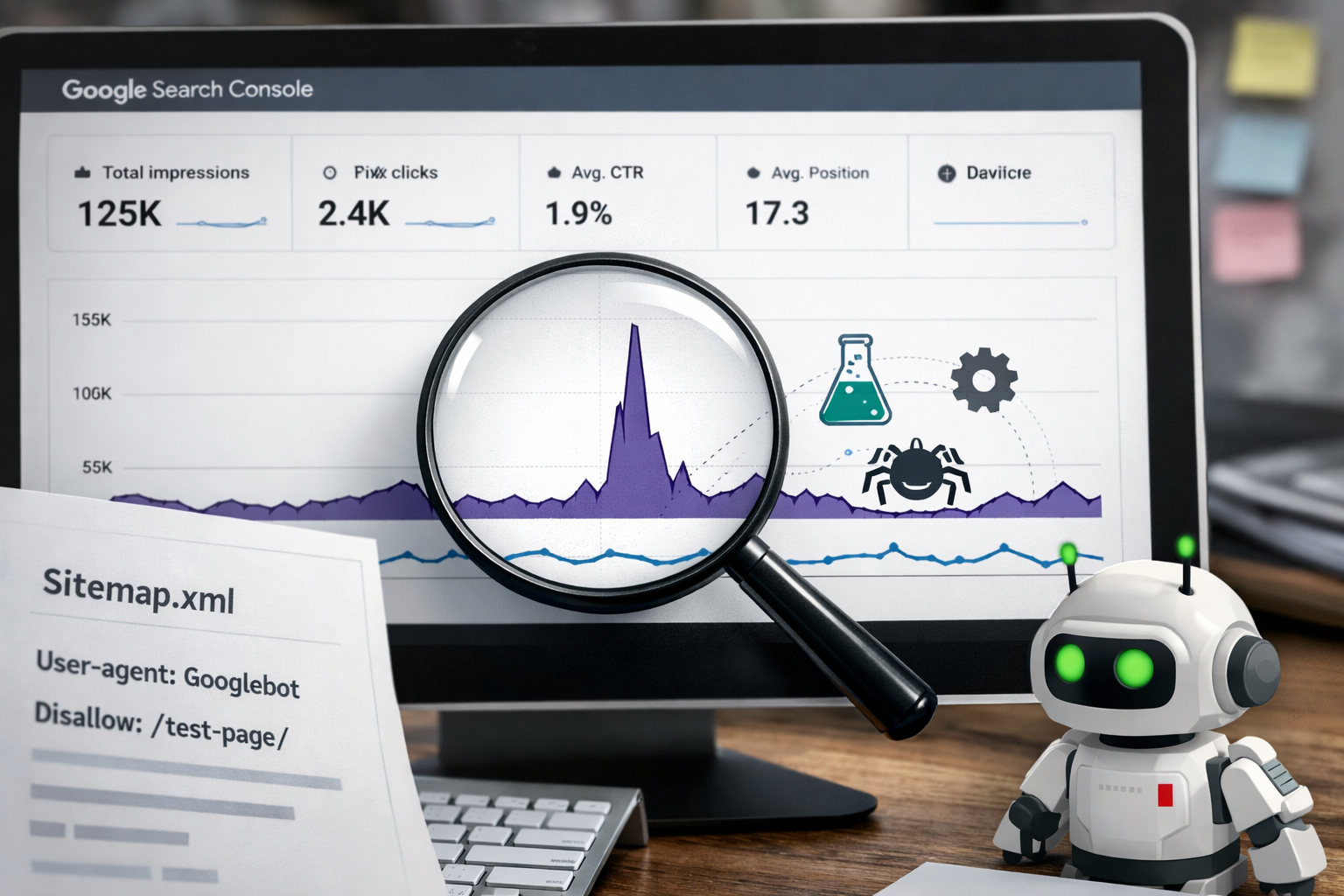
If you've spent any time looking at the performance graphs in Google Search Console, you've seen them.
Everything is moving along at its normal pace — relatively flat impressions, predictable click patterns, steady week-over-week movement — and then suddenly, on a single day or over a short two-to-three-day window, impressions spike dramatically. Sometimes it's a 200% jump. Sometimes it's more. And then, just as quickly, the graph normalizes again, returning to something close to its pre-spike baseline.
The first time this happens, most people assume something has gone very right. The second time, they start to wonder what's actually going on. By the third or fourth time, the pattern raises a genuinely interesting technical question: what is Google actually doing during these spikes, and what does it mean for the health and trajectory of a site's search performance?
The answer involves several distinct mechanisms that can produce impressions spikes, and correctly identifying which one is behind any given spike is what determines whether it's good news, neutral information, or something worth investigating.
First, What Impressions Actually Measure
Before getting into the causes, it's worth being precise about what an impression in Search Console actually represents — because the definition has a specific technical meaning that matters for understanding why spikes happen.
An impression is recorded every time a URL from your website appears in a Google search result that a user sees. Not every URL Google has indexed. Not every page it could theoretically show. Every page it actually shows to an actual user during an actual search session.
This distinction is important because it means impressions are a function of two things happening simultaneously: Google deciding to include your URL in a set of search results, and a user performing a search that triggers those results. A page can be perfectly indexed and ranking in position five for a given query, but if nobody searches for that query on a given day, the page records zero impressions.
The corollary is that an impressions spike doesn't necessarily mean Google has changed its assessment of your site's quality or ranking. It can simply mean that more searches happened for queries your site was already ranking for — or that Google began testing your pages against a broader set of queries than it had been before.
Cause One: Googlebot's Broad Crawl and Testing Behavior
This is the mechanism behind the most common type of impressions spike, particularly on sites that publish regularly and then see unexplained spikes without any obvious external trigger.
Google doesn't simply index a page and assign it a fixed ranking for a fixed set of queries. It continuously tests pages against a wide range of potentially relevant queries to assess how they perform — measuring click-through rates, engagement signals, and ranking positions across a much broader query set than the one the page will eventually settle into.
When Googlebot completes a significant crawl of a site — particularly after a period of content accumulation where multiple new pages have been indexed in a cluster — it may begin testing all of those pages against their potential query matches simultaneously. This testing behavior can produce a dramatic but temporary spike in impressions as Google shows the newly indexed or recently recrawled pages across a wide range of searches, observes how users respond, and then narrows the query association down to the queries where the pages actually perform well.
This is the mechanism most directly relevant to the scenario you described: publishing heavily and consistently, then seeing a spike seemingly at random on a day when nothing obvious has changed. What's happening in this scenario is often that Google's crawl cycle has caught up with a batch of recently accumulated content — content that was published continuously but indexed in a cluster when Googlebot completed its crawl of the sitemap or followed a set of internal links — and is now testing all of it simultaneously against the full range of queries it might be relevant for.
The spike is real. The impressions genuinely happened. But many of them represent Google testing rather than stable ranking, which is why the number often normalizes downward after the spike — the pages settle into the query positions where they actually perform, which is a subset of all the queries Google was testing them against.
Cause Two: XML Sitemap Processing
Google processes XML sitemaps on its own schedule, not on yours. When you submit a sitemap — or when Googlebot revisits a previously submitted sitemap as part of its regular crawl schedule — it processes the list of URLs in the sitemap and queues them for crawling, recrawling, or quality reassessment. For large sites with many URLs, this processing happens in batches, and the timing of when a batch gets processed can be irregular from the site owner's perspective.
When Googlebot processes a significant sitemap refresh — particularly one that includes many newly added or recently updated URLs — it can trigger a burst of crawling activity that results in a cluster of pages being indexed or reindexed in a short window. If that cluster includes pages covering a broad range of topics or keywords, the simultaneous addition of all those pages to the active testing set can produce an impressions spike as Google begins showing all of them against their potential query matches.
The specific scenario of publishing four blogs at once after a period of not publishing is a textbook sitemap-trigger situation. When you publish that cluster of content after a publishing gap, the sitemap gets updated with four new URLs. The next time Googlebot processes the sitemap — which could be days or even a couple of weeks after the content was published, depending on crawl frequency — it discovers all four pages effectively simultaneously and begins testing them all at once. The result is a temporary spike in impressions as all four pages enter Google's active query testing simultaneously, rather than gradually as they would have if they'd been published and discovered one at a time over a period of weeks.
This is also why publishing in a sustained cadence produces smoother impression growth than publishing in bursts — consistent publishing means pages are being discovered and tested in a relatively steady stream rather than in waves, which produces more stable and predictable impression growth patterns rather than the spike-and-normalize pattern that batch publishing tends to create.
Cause Three: A Featured Snippet or SERP Feature Test
A less common but frequently misidentified cause of impression spikes is Google testing a piece of content for a featured snippet, knowledge panel, or other SERP feature position.
Featured snippets — the extracted answer boxes that appear at the top of search results — generate impressions dramatically differently than standard organic positions. When content appears in a featured snippet position, it can be shown across a much wider range of query variations than a standard ten-blue-links result. A piece of content that ranks in position four for a specific query might only generate impressions for that query and a handful of close variants. The same piece of content, shown as a featured snippet, might generate impressions across dozens or hundreds of query variations as Google uses it to answer the broad category of questions that the snippet addresses.
When Google begins testing a page for featured snippet eligibility — showing it as the snippet for a query or set of queries to observe user engagement with the featured result — the page's impression count can spike significantly as it's suddenly being shown across a much wider range of searches than its standard ranking position would produce.
This type of spike tends to be query-concentrated rather than distributed. If you look at the queries data in Search Console during the spike period and see one or a small number of queries suddenly generating a very high volume of impressions with a position metric close to one, that's a strong signal that a featured snippet test is driving the spike rather than a broad recrawl event.
Cause Four: Algorithm Testing and Ranking Experiments
Google runs continuous experiments on its search results — testing different ranking configurations, different result compositions, and different page selections for specific queries to evaluate which arrangements best serve searchers. These experiments can produce temporary impression spikes for pages that are included in a test set.
When Google runs a ranking experiment that includes a page from your site in a test configuration where it receives higher than usual exposure — ranking higher than its normal position for a set of queries, or being shown for queries it doesn't normally appear in — that page accumulates impressions that reflect the experiment's configuration rather than its stable ranking position.
This type of spike is often followed by a return to normal impression levels when the experiment concludes, because the experimental configuration wasn't the final determination — it was a test. The impression data from the experiment period can be misleading if read as evidence that ranking has improved permanently, when in reality it reflects a temporary test state.
The practical way to distinguish algorithm test spikes from genuine ranking improvements is to look at both impressions and clicks over the spike period. A genuine ranking improvement tends to produce correlated increases in both impressions and clicks — because the page is being shown more and users are engaging with it more. An algorithm test spike often shows a disproportionate increase in impressions relative to clicks — the page is being shown to many more users but the click-through rate is lower than it would be for a stable ranking position, because the experimental position may be less well-matched to searcher intent than the page's natural ranking would be.
Cause Five: A Burst of New Inbound Links
External links pointing to your site from other websites are one of the most direct signals Google uses to assess page quality and authority — and when a significant number of new links arrive in a short window, they can trigger an immediate reassessment of the linked pages' ranking eligibility that produces an impression spike.
When another site links to your content — particularly if it's a high-authority site, or if multiple sites link simultaneously as happens when a piece of content goes viral or gets picked up by multiple publications — Googlebot may recrawl the linked pages sooner than its normal schedule and update their ranking assessments based on the new link signals. If the new links are from high-quality sources, the reassessed ranking positions may be meaningfully better than the pre-link positions, which translates into higher impressions as the pages are shown higher in results for their target queries.
This type of spike is distinguished from the others by its relationship to an identifiable external event — a piece of content being shared widely, a journalist citing your research, a high-traffic site linking to a post. If you can identify an external linking event that preceded the spike by a few days to a week, inbound link discovery is the most likely cause.
Cause Six: News, Trending Topics, and Seasonal Demand
Perhaps the most straightforward cause of impression spikes — and the one that's easiest to confirm — is a surge in search demand for topics your content covers.
If your site has content about a topic that suddenly becomes newsworthy, your impressions for that content spike in direct proportion to the spike in search volume for the related queries. This doesn't require any change in your ranking position. If your page ranks in position six for a query that gets searched 1,000 times per month normally and suddenly gets searched 50,000 times in a week because something newsworthy happened in that space, your impressions for that page spike dramatically without any change in your ranking.
Seasonal demand works the same way — if your content covers tax preparation, holiday decorating, hurricane preparedness, or any other topic with cyclical search volume patterns, the annual increase in search demand for those topics will produce a predictable impression spike each year.
This type of spike is the easiest to confirm. Look at the queries driving the spike in Search Console. If they cluster around a specific topic that you can identify as having experienced a recent surge in public interest, demand-driven spike is the answer. It's also the type of spike that's least likely to normalize back to pre-spike levels immediately — if the topic has sustained elevated interest, the impressions may remain elevated, and if the spike genuinely expanded awareness of your content, you may retain some of that visibility even after the immediate demand surge passes.
The Publishing Cadence Question: Why Consistent Beats Bursty
Publishing heavily and consistently and then seeing a spike randomly — the mechanism is almost always a combination of the sitemap processing and Googlebot testing dynamics described above.
When you publish a steady stream of content, Googlebot develops a crawl rhythm for your site based on how frequently it's discovering new content. High-frequency sites with consistent publishing patterns tend to be crawled more frequently, which means new content gets indexed more quickly and enters the testing phase sooner. The impression growth for sites in this mode tends to be smoother and more linear — each new piece of content enters the system individually and contributes its own impression share as it gets tested and settles into its ranking positions.
The spike pattern emerges when there's a mismatch between publishing frequency and crawl frequency. If you're publishing daily but Googlebot is only making a comprehensive sitemap crawl every seven to ten days, a week's worth of content gets discovered and tested simultaneously when the crawl happens — producing a visible spike in the overall impression graph even though the content was published in a steady stream. The spike isn't reflecting anything new about the content's quality. It's reflecting the batch nature of when Googlebot's crawl cycle caught up with the publishing schedule.
This is one of the reasons that internal linking matters even for high-frequency publishers. When new content is linked prominently from existing pages — particularly high-authority pages that Googlebot visits frequently — it gets discovered through the internal link discovery mechanism rather than waiting for the sitemap crawl cycle to catch up. This distributes the discovery timing more evenly across the publishing schedule and tends to produce smoother impression growth than relying on sitemap crawls alone for content discovery.
What to Do With This Information
The most practical application of understanding impression spike causes is knowing which spikes deserve a response and which ones are just informational.
A spike caused by sitemap batch processing or Googlebot testing is informational. It tells you that a cluster of content is entering the testing phase simultaneously, which is worth monitoring to understand which pieces ultimately settle into strong ranking positions and which don't convert the testing impressions into stable traffic. No action required, but worth tracking.
A spike caused by a featured snippet test is an opportunity signal. If Google is testing your content as a featured snippet, that's evidence the content is being evaluated as a strong answer to the query. Ensuring the content is as well-structured and directly answer-oriented as possible — clear header structure, direct answers to the query in the first paragraph, supporting detail below — maximizes the probability that the test converts into a stable featured snippet position.
A spike caused by inbound link acquisition is a reinforcement signal. It tells you that the linked content was compelling enough to attract external links, and that further investment in promoting and amplifying that content is likely to produce additional linking activity.
A spike caused by trending demand is a content opportunity signal. If a topic suddenly generates enormous impressions for your existing content, it's telling you that publishing more content on that topic, and quickly, will capture additional demand while it's elevated.
Understanding what produced the spike is what transforms Search Console data from a collection of interesting numbers into actionable intelligence about what Google is doing with your content and what you should do next.
At Ritner Digital, we help businesses understand what their Search Console data is actually telling them — and build the content and SEO strategy that turns data insights into consistent organic growth. If your impression patterns are raising more questions than answers, let's talk.
Frequently Asked Questions
If I see a big impression spike, does that mean my rankings improved?
Not necessarily, and this is one of the most common misreadings of Search Console data. An impressions spike means Google showed your pages to more users during a specific window — but the reasons for that vary significantly, and ranking improvement is only one of them. A spike caused by Googlebot testing new content against a broad query set, by a sitemap batch processing event, or by a temporary algorithm experiment can all produce dramatic impression increases without any durable change in ranking position. The most reliable way to distinguish a genuine ranking improvement from a testing or crawl event is to look at the position metric alongside impressions during the spike period. If average position improved meaningfully and held after the spike, that's evidence of a genuine ranking change. If impressions spiked but average position remained the same or worsened slightly — which happens when Google is testing a page in positions lower than its normal ranking — the spike is more likely a testing or crawl event. Clicks are the second check: genuine ranking improvements tend to produce proportional click increases, while testing events often produce disproportionate impression spikes relative to clicks because the experimental positions don't match searcher intent as well as stable positions do.
Why does the impression spike often go back down to normal a few days later?
Because the spike reflected a temporary state rather than a permanent one. When Google tests newly indexed content against a wide range of queries simultaneously, it's observing how searchers respond to the content across that full query set. Based on what it observes — click-through rates, engagement signals, dwell time — it narrows the page's active query associations down to the queries where it actually performs well and withdraws it from queries where it doesn't. The post-spike normalization is that narrowing process completing. The impressions settle at a lower but more stable level that reflects the queries where the content has genuine relevance and earns genuine clicks. This is why the post-spike baseline is the more meaningful number for evaluating content performance than the spike itself — it represents where the content actually settled after testing, not the maximum Google was willing to test it against. If the post-spike baseline is meaningfully higher than the pre-spike baseline, that's a genuine net improvement. If it returns to roughly the pre-spike level, the spike was primarily a testing event with limited durable impact.
Does publishing more content at once produce a bigger impression spike than publishing gradually?
It tends to produce a more pronounced but less reliable spike, and the tradeoff generally favors consistent publishing over batch publishing from both a search performance and a content quality perspective. When content is published in a cluster, Googlebot discovers and tests all of it simultaneously when the sitemap crawl catches up — producing the spike pattern described throughout this post. When content is published consistently over time, new pages are discovered and tested in a steadier stream, producing more linear impression growth without dramatic spikes. The smoother growth curve of consistent publishing isn't just aesthetically preferable in analytics — it tends to produce better ranking outcomes because individual pieces of content get more focused testing attention rather than competing with a batch of other new pages for Googlebot's evaluation resources. There's also a content quality argument for consistent publishing: the deliberate pace that a regular publishing schedule imposes tends to produce better-researched, more thoroughly developed individual pieces than the output pressure of batch publishing encourages.
I published four blog posts at once and saw a spike a week later. Is that the sitemap crawl catching up?
Almost certainly yes, and the week delay is consistent with typical sitemap processing timing. When you publish four posts simultaneously, the sitemap is updated with four new URLs. Googlebot doesn't necessarily visit the sitemap the moment it's updated — it processes sitemaps on a schedule determined by how frequently it expects the site to change and how authoritative the site is in its assessment. For many sites, that cycle runs every few days to a couple of weeks. When Googlebot processes the sitemap and discovers the four new URLs, it queues them all for crawling and initial indexing in approximately the same window, which then triggers the broad query testing described above — all four pages entering the testing phase simultaneously rather than sequentially. The resulting spike reflects all four pages' combined testing impressions appearing in the data at once. After the testing phase resolves, each page's impressions normalize based on where it actually settles in rankings for its target queries. Pages that are genuinely strong performers will maintain elevated impression levels post-spike. Pages that earned impressions only through the broad initial testing will normalize back toward lower levels as Google narrows their query associations.
What's the difference between an impression spike and a traffic spike, and why don't they always happen together?
Impressions and traffic — measured as clicks in Search Console — represent different points in the user journey, and they respond to different stimuli, which is why they frequently diverge. An impression is recorded when Google shows your URL to a user in search results. A click is recorded when that user actually visits your site. The ratio between them — click-through rate — depends on how compelling your result looks to users who see it, how well your ranking position catches attention, and how well the intent behind the query matches what your page offers. A spike in impressions without a proportional spike in clicks usually means Google is showing your pages in contexts where they're not the best match for the searcher's intent — either because the page is being tested for queries it doesn't ultimately serve well, or because it's ranking in positions low enough that most users don't see it as the most relevant option. A spike in both impressions and clicks together is a much stronger signal — it suggests the additional exposure is happening in contexts where users are finding the content relevant and clicking through, which is the pattern associated with genuine ranking improvements and well-matched query associations rather than testing events.
Can a single viral or heavily shared piece of content cause an impression spike for the whole site?
Yes, and this is one of the more interesting spike mechanisms because it operates through a chain of effects rather than a single direct cause. When a piece of content earns significant external attention — links from high-traffic sites, heavy social sharing, media coverage — several things happen in relatively rapid succession. Googlebot recrawls the linked page sooner than its normal schedule, updates the page's authority signals based on the new inbound links, and may improve its ranking positions across the queries it targets. Higher rankings mean more impressions for that specific page. But the effect doesn't stop there. The new inbound links also strengthen the domain-level authority signals for the entire site, which can improve the ranking positions of other pages across the site — pages that were previously ranking in positions six through ten may temporarily or permanently improve to positions three through five, producing impression increases across a broad swath of the site's content simultaneously. The aggregate of all these effects across multiple pages can look like a site-wide spike even though the trigger was a single piece of content. In Search Console, you can usually confirm this is the mechanism by checking whether the spike is distributed across many different pages and queries — the signature of a domain authority lift — versus concentrated on a specific page or query cluster, which would suggest a more targeted event.
Should I be submitting my sitemap more frequently to avoid the batch discovery problem?
Submitting your sitemap more frequently is unlikely to meaningfully change Googlebot's crawl schedule, and it's not the most effective solution to the batch discovery problem. Google processes sitemap submissions on its own timeline, and resubmitting a sitemap that hasn't substantially changed doesn't trigger immediate recrawling. The more effective approaches to ensuring new content is discovered promptly are internal linking and the URL Inspection tool in Search Console. When new content is linked from existing high-authority pages within the site — particularly pages that Googlebot visits frequently — it gets discovered through the internal link discovery mechanism rather than waiting for the sitemap crawl cycle. For a site publishing daily, ensuring that each new post is linked from at least one or two existing pages as soon as it's published distributes discovery timing much more evenly than relying on sitemap crawls alone. For individual pieces of high-priority content, using the URL Inspection tool in Search Console to request indexing immediately after publication can trigger near-immediate crawling and indexing — though this should be used selectively for genuinely important content rather than applied to every published piece, as it's a manual process and Google limits how many indexing requests can be submitted per day.
Does an impressions spike mean I should publish more content immediately to capitalize on the momentum?
Not necessarily, and acting on that instinct can actually work against the goal. A spike caused by Googlebot testing a batch of content doesn't represent momentum in the traditional sense — it represents Google working through its evaluation process for content you've already published. Publishing additional content immediately after the spike doesn't accelerate that evaluation process or improve the outcomes for the content already being tested. What it does do is add more URLs to the queue that Googlebot needs to evaluate, which can spread its crawl resources more thinly across a larger content set rather than focusing evaluation attention on the content that's already in the testing phase. The more productive response to an impressions spike is to monitor how the tested content performs after the spike normalizes — which pieces settled into strong, stable ranking positions and which returned to near-zero — and to use those outcomes to inform what content topics and formats are worth investing in next. That data is far more valuable than the spike itself, and the publishing decision it should inform is about topic direction and content quality rather than publication volume.