What ChatGPT Says When Someone Asks "What's the Best Credit Union Near Me?"
The Question Your Next Member Is Already Asking
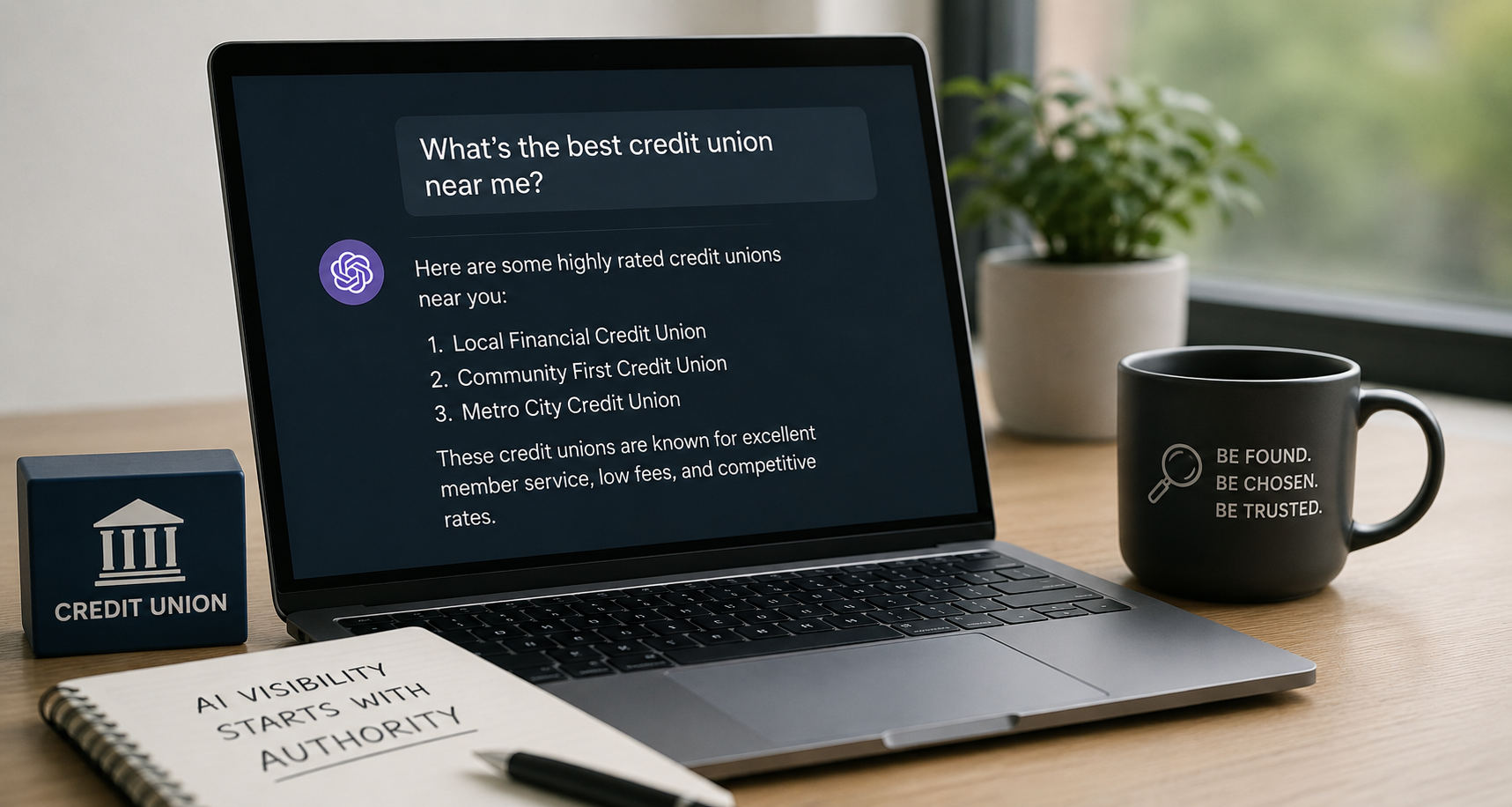
It's a Tuesday evening. Someone in your community just got approved for a new job. They're thinking about buying a car, opening a new checking account, or finally getting serious about saving. They don't open a browser and type into Google. They open ChatGPT and type: "What's the best credit union near me?"
What happens next will determine whether your institution is in the conversation — or completely invisible.
This isn't a hypothetical. For consumers under 45, large language models like ChatGPT, Gemini, and Claude have emerged as a top research method when evaluating financial institutions — a new default first step that didn't exist as a category just a few years ago. And this behavioral shift means credit unions need to start thinking about AEO — AI Engine Optimization — just as they've focused on SEO. When a potential member asks an AI agent about the best auto loan rates or which credit union serves their community, the critical question is whether your institution shows up in the response. GeearYourmarketing
Most don't. And the reasons why are very specific, very fixable, and not what most credit union marketers expect.
What ChatGPT Actually Does With That Question
Before you can fix your AI visibility, you need to understand what's actually happening inside the black box when someone types that question.
ChatGPT and tools like it don't search a directory. They don't pull up a map. They use a process called Retrieval-Augmented Generation (RAG) — they break your query into related sub-queries, scan indexed web content in real time, extract passages that best answer the question, and synthesize a response that cites only the most relevant sources. AI search engines pull from multiple sources, extract the passages that best answer a question, and cite only the pages those answers come from. They don't rank pages or evaluate content as a whole — they assemble answers from different sources and pages. Surfer
The implications for credit unions are significant. AI answer engines — ChatGPT, Claude, Perplexity, Gemini — no longer return long lists of links. They return a direct answer or bundle of answers, drawn from content they can parse quickly and cite confidently, framed as a logical response to a user's specific question. The Financial Brand
Here's what that means in practice: ChatGPT isn't evaluating your institution holistically. It's scanning for specific, answerable content — and if your website can't supply it cleanly, you're out.
Who Actually Gets Cited — and Who Gets Left Out
The citation data coming out of 2025 and 2026 benchmarks paints a revealing picture of how AI answers financial questions, and it isn't flattering for most credit unions.
Across 182,000+ tracked citations on credit union product and comparison questions, the benchmark found an owned citation rate of about 13% and a third-party citation rate of about 87%. Credit union sites lose citations when pages are stale, fragmented, or hard to verify. Codeables
That 87% number deserves to be read slowly. When a potential member asks AI about credit union products, the answer they get is drawn overwhelmingly from sources the credit union does not own or control — sites like NerdWallet, Bankrate, Forbes, Reddit, and Wikipedia. The institution's own website is an afterthought in its own conversation.
Reddit ranks highly in AI citation benchmarks because AI engines often use it for broad product questions where people want lived experience, tradeoffs, and comparisons. It captures the language people use when they ask, "Which credit union product is best?" Codeables
Different AI models favor different source types: ChatGPT answers lean toward traditional authority and rely heavily on major publications, Wikipedia, and human-centric platforms like Reddit. Perplexity tends to rely on community and experience-driven sources, with 46.7% of its top citations coming from Reddit, roughly 14% from YouTube, and a meaningful share from review platforms. Surfer
The breakthrough insight is this: your credit union's AI visibility is not primarily determined by your website alone. It's determined by your entire digital footprint — what people say about you on Reddit, whether you appear in NerdWallet or Bankrate comparisons, whether your Google reviews are strong and current, and whether credible third-party sources are talking about you at all.
A credit union with strong reviews across the web is far more likely to be recommended by AI. AI doesn't just trust your website — it looks for validation elsewhere. AI rewards brands that are talked about everywhere. The more your credit union is referenced across the web, the more "real" and trustworthy it appears to AI. Vibrant Brands
The Consensus Signal: Why AI Needs to Hear About You From Multiple Places
One of the most important concepts in AI visibility is what researchers call the "consensus signal." It explains why simply updating your website isn't enough.
According to research from Profound and SEMrush, AI platforms scan for agreement across multiple independent sources before confidently citing a brand. If your institution appears consistently across Reddit discussions, YouTube content, industry publications, review sites, and your own website — all with similar positioning and messaging — AI systems gain confidence in recommending you. Conversely, if you only exist on your own website with minimal external validation, AI systems treat your claims with skepticism. They have no independent verification, so they recommend competitors who have built broader presence. Sapt
For a credit union, this is both a challenge and an enormous opportunity. The credit unions already building consensus signals — through active community engagement, Google and Facebook review management, appearances in local news, mentions in financial comparison sites, and member conversations on Reddit — are accumulating AI authority that compounds over time. The ones that aren't are being systematically excluded from the AI answer, even when their products are competitive.
The "Citable Chunk" Problem Most Credit Unions Don't Know They Have
Even when credit unions do have good website content, they often structure it in a way that AI systems struggle to parse and cite. This is the "citable chunk" problem — and it's quietly costing institutions AI visibility they should rightfully own.
AI systems do not process entire websites the way traditional search crawlers do. To become a cited source, institutions must produce what practitioners now call citable chunks: self-contained blocks of content that restate a question, deliver a clear answer, and support it with data or a concise explanation. "There's a finite amount of token space that an AI can utilize," said one digital marketing director with credit union experience. "AI engines look for clear question-and-answer structures because they are constantly optimizing for efficiency in how they process information." The Financial Brand
This distinction matters especially for financial institutions, which have spent years producing long, comprehensive content to satisfy Google's elevated YMYL (Your Money / Your Life) standards. But the deep, comprehensive content style that satisfies YMYL can sometimes work against citation in AI engines, which often prioritize clarity, structure, and direct answers. The Financial Brand
The fix isn't to write shorter content. It's to write structured content — content that leads with a direct answer, supports it with a credible statistic or data point, and stands alone as a complete response to a specific question. A page that opens with "A share certificate at [Your CU] earns X% APY for terms ranging from 6 to 60 months, with a minimum deposit of $500" is far more citable than one that buries those details in the fifth paragraph of a product description.
Superlines' analysis of AI citation patterns found a clear distribution: 44.2% of citations come from the first 30% of a page's content. Front-load your answers. Sapt
The Case Study That Should Change How You Think About Content
The most compelling evidence that credit unions can win at AI visibility — regardless of size or budget — comes from real-world experiments conducted in 2025.
AI visibility research for the credit union industry, based on an analysis of 7,500 AI search responses, found that AI tends to reference detailed, objective web pages that are highly relevant to a user's prompt. One factor stood out as the clear, primary driver of success: AI visibility increased substantially after publishing long-form, authoritative content that directly answered the selected prompts. Finopotamus
The results from specific credit unions are striking. One small credit union in Oregon had zero AI visibility for the prompt "Who has the best high yield savings account in Stayton, Oregon?" After publishing a single, thorough 3,600-word article that directly addressed that exact question with factual product details, AI visibility for that prompt went from 0% to 100%. The article began appearing in AI-generated responses — a clear signal that targeted, prompt-specific content can reliably move a credit union from invisible to visible in AI-generated answers. Across multiple credit unions tested, the winning formula was consistent: clearly formatted content with headings, lists, and Q&A sections made it easier for AI to parse. Finopotamus
This is not a massive budget initiative. It's a content strategy initiative — one that any credit union with a marketing function can execute.
How "Best Credit Union Near Me" Actually Gets Answered
Let's get specific about what happens when someone types that exact query into ChatGPT today.
ChatGPT will not return a map with pins. It will not give your institution's phone number unprompted. What it will do is synthesize an answer that typically covers: what to look for in a credit union, how to find credit unions you're eligible to join, and potentially name specific well-known institutions — usually larger ones with high third-party citation authority — before suggesting the user check local options through a credit union locator.
Consumers are increasingly asking ChatGPT questions like "what's the best credit union near me" or "how do I choose a community bank." Agencies building for that channel now are ahead of most of the financial services marketing field. Moneysideoflife
The local query is where smaller credit unions have their greatest opportunity — and their greatest current gap. A community credit union in a mid-size city has a natural advantage in local AI answers if they've published content that explicitly names and owns their geography. A page titled "The Best Credit Union in [Your City]: Why [Your CU] Has Served [Your Community] Since [Year]" — with specific product details, rate information, membership eligibility, and branch information — is exactly the kind of citable, locally relevant content that AI uses to answer local queries.
AI agents are pulling from websites, which means your website is still the foundational infrastructure for AI visibility. But that website needs to speak to local prompts that real members are typing. Yourmarketing
Google Reviews, Reddit, and the Signals You're Probably Ignoring
Most credit union marketing plans spend zero time on Reddit. That needs to change.
Reddit ranks as a primary citation source for AI engines on credit union product questions because it captures the language people use when asking comparison questions — the informal, honest, experience-based commentary that AI systems treat as a proxy for real-world member sentiment. Codeables
This doesn't mean your credit union needs to run a Reddit marketing campaign. It means you need to be aware of what's being said about you there, and it means ensuring that positive member experiences are being documented in the places AI reads: Google reviews, Facebook reviews, and community forums where your members naturally congregate.
Brands with active profiles on review platforms have a 3x higher chance of being cited by ChatGPT because these platforms aggregate signals that AI systems use when assessing credibility. This acts like digital PR that compounds over time. Surfer
Your Google Business Profile is an AI visibility asset. Your member reviews are AI visibility assets. The question of whether you're actively managing and generating these signals is now a direct input into whether AI recommends you.
The Agentic Future: When AI Doesn't Just Answer — It Acts
The "best credit union near me" query represents today's AI behavior. What's coming next is significantly more consequential.
Somewhere right now, a member is asking an AI agent to find them a better rate, compare financial products, or choose a payment method. The agent isn't weighing your brand or your community reputation — it's reading structured data. If your credit union's products aren't machine-readable, you may already be out of the consideration set and not know it. This isn't a 2030 problem; the infrastructure is going live now. Filene
Visa has launched Intelligent Commerce with 100+ partners. Mastercard has enabled Agent Pay across every U.S. issuer. OpenAI and Stripe co-built the Agentic Commerce Protocol. Google launched a competing standard backed by Walmart, Target, Visa, and American Express. Filene
The near-term implication for credit unions: the institutions whose products are structured, current, and machine-readable will be the ones AI agents include when they're autonomously comparing loan rates, checking account features, or CD yields on behalf of a member. The ones with stale, poorly structured product data will be filtered out before the member ever knows a comparison was made.
The trust advantage credit unions spent decades building is about to be evaluated by machines. The institutions starting now will shape what those agents learn to value. Filene
What You Can Do About It Starting This Week
The gap between credit unions that are AI-visible and those that aren't is widening — but it's not yet insurmountable. Here's where to start.
Audit your AI presence today. Type your most important member acquisition queries into ChatGPT, Perplexity, and Google's AI Mode. "Best credit union in [your city]." "Best auto loan rates in [your city]." "Best HELOC near [your city]." Document what comes back. Note who gets cited. Note whether your institution appears at all.
Write prompt-specific content. Identify the exact questions prospective members are asking and build dedicated pages that answer them directly, completely, and locally. Publishing thorough, prompt-specific content can reliably move a credit union from invisible to visible in AI-generated answers. These don't need to be short — 2,000 to 4,000 words of genuinely useful, locally anchored content is the target. Finopotamus
Structure your content for AI parsing. Lead with your answer. Use clear headings. Break information into standalone sections. Avoid burying key product details in paragraph five. Keep paragraphs single-purpose — one idea per paragraph makes it easier for AI to extract a clean, self-contained answer. Use lists and tables for comparative information. Every section should stand alone. Semrush
Build your review footprint aggressively. Ask satisfied members to leave Google reviews. Respond to every review — positive and negative. Make this a quarterly priority, not an afterthought.
Pursue third-party mentions. Get your institution mentioned in local news, financial directories, community organization websites, and trade publications. Every external citation is an AI authority signal.
Keep your data consistent everywhere. Your name, address, phone number, hours, and product details need to be identical across your website, Google Business Profile, social profiles, and any directory listings. Inconsistent data equals lower trust, which equals less visibility in AI recommendations. Vibrant Brands
The Bottom Line
When someone in your community asks ChatGPT what the best credit union near them is, there are two possible outcomes. Either AI has enough information about your institution — from your website, your reviews, your third-party mentions, and your local content — to include you in the answer. Or it doesn't, and it recommends whoever built that foundation first.
A credit union can have a great brand, offer competitive products and rates, and have a well-designed website — and still be completely invisible when a potential member asks AI for help finding a financial product. The Financial Brand
The question is no longer whether AI-mediated discovery matters. It does, and the data is unambiguous. The question is whether your institution is going to be part of the answer — or whether you're going to find out you weren't by watching member acquisition numbers soften and wondering why the traditional playbook stopped working.
The credit unions that move now have a real first-mover advantage in local AI visibility. The ones that wait are building that advantage for their competitors.
Ready to Find Out Where Your Credit Union Stands in AI Search?
At Ritner Digital, we help credit unions understand exactly what AI is saying about them — and build the content, structure, and authority signals needed to change it. From AI visibility audits to prompt-specific content strategy and local authority building, we know the specific levers that move credit unions from invisible to cited.
Find out what ChatGPT says about your credit union right now — and what it should be saying.
👉🏼 Talk to the Ritner Digital team today
Frequently Asked Questions
What does ChatGPT actually say when someone searches for a credit union near them?
When a user asks ChatGPT "what's the best credit union near me," it doesn't pull up a map or a business listing. It synthesizes a response from web content it can access and cite, typically covering what to look for in a credit union, how to find ones you're eligible to join, and sometimes naming well-known institutions that have strong third-party citation authority. Local institutions that haven't published locally specific, clearly structured content are almost never mentioned by name — not because they aren't good, but because AI has nothing concrete to cite about them. The fix is building the kind of prompt-specific, locally anchored content that gives AI something to work with.
Why does ChatGPT name some credit unions and not others?
It comes down to citation authority — a combination of your website content quality, your footprint across third-party sources, your reviews, and how consistently your institution is referenced in credible external publications. Benchmark data tracking over 182,000 AI citations on credit union product questions found that 87% of citations came from third-party sources like Reddit, NerdWallet, Bankrate, Forbes, and Wikipedia — not from the credit unions' own websites. Institutions that appear on those third-party platforms, that have strong Google review profiles, and that are mentioned in local news and community publications are the ones AI trusts enough to name. It's a consensus model: AI needs to see your institution validated in multiple places before it will confidently recommend you.
Does my credit union's website content actually affect what ChatGPT says about us?
Yes — but not in the way most people expect. AI systems don't evaluate your website holistically. They scan for "citable chunks" — self-contained blocks of content that directly answer a specific question, lead with a clear answer, and stand alone without needing surrounding context. Long product pages that bury key details in paragraphs five through ten perform poorly. Pages that open with direct, specific, factually grounded answers to real member questions perform well. One credit union study found that publishing a single 3,600-word article directly answering a local query moved that institution's AI visibility for that prompt from 0% to 100% within days of the article being indexed.
Is Perplexity different from ChatGPT when it comes to credit union recommendations?
Yes, meaningfully so. ChatGPT tends to lean toward traditional authority signals — major publications, Wikipedia, and well-established websites. Perplexity draws more heavily on community and experience-driven sources, with nearly half of its top citations coming from Reddit and a significant share from review platforms. Google AI Overviews have their own citation logic that partially overlaps with both. The practical implication is that a comprehensive AI visibility strategy can't optimize for one platform only — it needs to build the kind of cross-platform footprint that performs across all of them. The overlap between platforms is your highest-priority territory: authoritative, well-structured owned content combined with strong third-party mentions and reviews.
How important are Google reviews for AI visibility?
Extremely important, and most credit unions are underinvesting here. AI systems treat review platforms as credibility validators — they aggregate member sentiment signals that AI uses to assess whether an institution is trustworthy enough to recommend. Research shows that brands with active review profiles have a 3x higher chance of being cited by ChatGPT than those without. For credit unions specifically, Google Business Profile reviews are among the most accessible and high-impact levers available. Generating a steady stream of recent, authentic reviews, responding to every review professionally, and ensuring your Google Business Profile information is current and complete are all direct inputs into your AI recommendation likelihood.
What is a "citable chunk" and how do I write one for my credit union's website?
A citable chunk is a self-contained block of content that AI can extract and use directly as an answer to a specific question. It has three parts: it restates the question, delivers a clear direct answer, and supports that answer with a specific data point, statistic, or factual detail. For example, instead of writing "Our HELOC offers competitive rates and flexible terms," a citable chunk would read: "A home equity line of credit (HELOC) at [Your CU] offers variable rates starting at X% APR, with credit limits up to $250,000 and a 10-year draw period. Members with a home equity of 20% or more and a credit score of 680+ typically qualify." The second version gives AI something to actually cite. The first gives it nothing.
My credit union has good SEO rankings. Doesn't that mean we're visible in AI too?
Not necessarily — and this is one of the most important misconceptions to clear up. Strong Google rankings do not automatically translate into AI citation. Research comparing organic search rankings to AI citations found that ChatGPT had the lowest overlap of any platform between URLs in Google's top 10 and URLs actually cited in its responses. AI systems use their own signals — content structure, external citation frequency, review profiles, and cross-source consistency — that are related to but distinct from traditional SEO signals. You can rank #1 for "auto loans [your city]" and still be completely absent from ChatGPT's answer to that same query. Your SEO foundation is valuable and still worth protecting, but it is not a substitute for an active AI visibility strategy.
How long does it take to start showing up in ChatGPT answers?
Results vary, but the timeline is shorter than most people expect when the strategy is specific and well-executed. The credit union case studies from 2025 showed visibility improvements within days of new content being published and indexed — for highly specific local prompts where targeted content was the missing ingredient. Broader brand visibility across more competitive general queries takes longer, typically three to six months of consistent content development, review generation, and third-party authority building. The key insight is that the more specific the prompt you're targeting — "best credit union for auto loans in [your specific city]" rather than "best credit union" — the faster you can move the needle, because local competition for AI citation is dramatically lower than national competition.
Where should I start if my credit union has never thought about AI visibility before?
Start by finding out exactly what AI says about you today. Spend 30 minutes running your top acquisition queries through ChatGPT, Perplexity, and Google's AI Mode. Write down who gets cited and what gets said. That baseline is your starting point for everything else. Then contact Ritner Digital — we conduct full AI visibility audits for credit unions, identify the specific content and authority gaps holding your institution back from AI citation, and build the prioritized roadmap to close them. The institutions that do this work now will be the ones AI recommends to the next generation of members already asking these questions every day.
Get your credit union's AI visibility audit from Ritner Digital →
Sources: The Financial Brand, Finopotamus, Vibrant Brands, Filene Research Institute, Codeables/Citeables, Surfer SEO, Semrush, Sapt.ai, Your Marketing Co., Geear (formerly WebStrategies), Moneysideoflife.com