How AI Overviews Are Changing How Members Find Financial Products
The Search Bar Isn't What It Used to Be
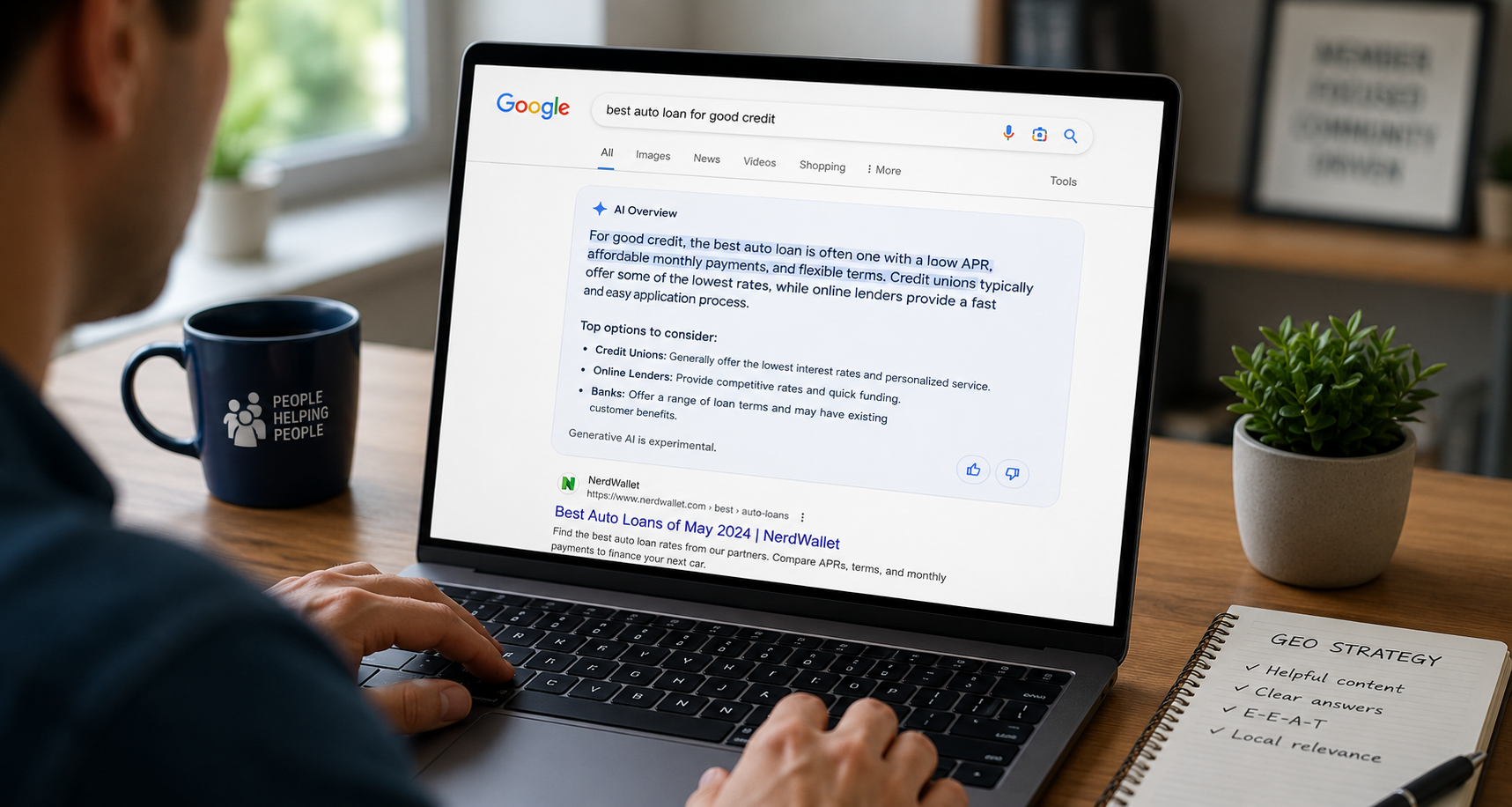
Picture a potential member sitting at their kitchen table. They're thinking about refinancing their home. Maybe they want a better rate on a credit card. They open their phone, type a question into Google — and instead of a list of blue links pointing to your website, they get a single, synthesized paragraph written by AI.
No scrolling. No clicking. No visit to your site.
This is the new reality of search — and for credit unions and community financial institutions, it represents one of the most significant shifts in member acquisition and product discovery in a generation.
Google's AI Overviews have moved from experiment to expectation. Between 2024 and 2025, this AI-powered search feature expanded from appearing in just 6.49% of searches to dominating over 50% of all queries, triggering what industry observers describe as the most significant transformation in search engine behavior since Google's inception. And the financial services sector is squarely in the crosshairs. The Digital Bloom
This post breaks down exactly what's happening, why it matters for your credit union or community bank, and what you need to do about it — starting today.
What Are AI Overviews, and Why Do They Matter for Finance?
AI Overviews (formerly known as Search Generative Experience, or SGE) are Google's AI-generated summaries that now appear at the very top of search results pages. When a member types "best credit union auto loan rates near me" or "how do I open a HELOC," Google doesn't just show a list of websites anymore — it synthesizes an answer from across the web and presents it directly on the results page.
Instead of a list of links, users are getting summarized responses, often with no click required. For credit unions, this means that the value of being "ranked #1" is fading. What's more important is whether you're being referenced in the answers AI tools deliver. WebRanking
The numbers behind this shift are striking:
AI Overviews appear in approximately 20% of Google searches, reaching up to 37.2% in some countries, making them a core part of modern search results pages. SeoProfy
By late 2025, AI Overviews started appearing for more commercial queries, increasing from 8% to 18%. Queries of 8 words or longer have a 57% chance of triggering AI Overviews. Exposure Ninja
BrightEdge data showed AI Overviews appeared on roughly 48% of tracked queries by February 2026, while Conductor found them on 25.11% of 21.9 million searches. Demand Local
For financial services specifically, the picture is nuanced but urgent. Financial services content sees a high proportion of FAQ and informational themes — approximately 54% — within AI Overviews, acting as intent filters that satisfy informational queries before users ever reach a paid link or product page. In other words, when someone asks "what is a HELOC" or "how does a share certificate work," AI is increasingly answering that question for them — and choosing whose voice gets heard. Search Engine Land
The Zero-Click Crisis for Credit Union Marketers
If AI Overviews are answering questions before members click, the downstream effect on traffic is severe. This isn't a minor blip. It's a structural change in how the web works.
Zero-click search — when users receive their answer without needing to click through to a website — has become the dominant search behavior in 2025 and 2026. 58.5% of Google searches in the U.S. end without a click, and that figure rises to 75% on mobile. Exposure Ninja
When an AI Overview is present, the effect compounds. Organic click-through rates drop significantly, with top-ranking pages losing up to 34.5%–64.4% of clicks when AI Overviews appear. User behavior is shifting to zero-click search, with only about 8% clicking results and roughly 26% ending sessions immediately after seeing an AI Overview. SeoProfy
Seer Interactive's September 2025 study reveals organic CTR plummeted 61% — from 1.76% to 0.61% — for queries with AI Overviews, while paid CTR crashed 68%, from 19.7% to 6.34%. Dataslayer
Let that sink in. Your paid search campaigns — the ones eating up a significant chunk of your marketing budget — are delivering less than a third of the clicks they were generating before AI Overviews became widespread. And that's not because your ads got worse. It's because the search results page itself has fundamentally changed.
For credit unions operating on lean marketing budgets and competing against megabanks with hundred-million-dollar digital ad spends, this is not an abstraction. This is a budget crisis masquerading as a technology trend.
Members Are Already Using AI to Shop for Financial Products
It's tempting to think this is a tech-savvy early adopter problem. It isn't.
Nearly 60% of those polled by JD Power in late 2025 said they occasionally use AI for banking and financial services, and 13% said they do so every day. In a global study, Cognizant gave banking and financial products a score of 90 out of 100 measuring consumer willingness to use AI to learn more about them. The Financial Brand
Over a billion people are using AI tools like ChatGPT, Google AI Overviews, and Perplexity to search the internet. As Google searches decline and AI searches grow in popularity, this changes how people find and interact with your brand online. Finopotamus
ChatGPT has 883 million monthly users as of January 2026, experiences 5.4 billion global monthly visits — exceeding Bing's 1.9 billion — and processes 2 billion queries daily. It is the 5th most visited website globally. Exposure Ninja
Your members are already typing questions into ChatGPT, Perplexity, Google's AI Mode, and Gemini. They're asking things like:
"What's the best credit union for a first-time home buyer in [your city]?"
"Should I get a personal loan or use a credit card for home repairs?"
"What's the difference between a money market account and a savings account?"
"Is [your credit union name] a good place to bank?"
The institutions that show up in those AI-generated answers are being considered. The ones that don't exist in AI's knowledge base are being silently excluded from the conversation — not because they aren't great, but because they haven't structured their digital presence to be AI-readable.
The Visibility Gap: Big Banks vs. Community Institutions
Here's where the competitive dynamic becomes particularly concerning for credit unions and community banks.
Profound's June 2025 data showed Bank of America with 32.2% visibility across AI platforms in banking queries. However, smaller financial brands like Navy Federal Credit Union achieved disproportionate representation in AI answers, gaining outsized consideration relative to their size. Dataslayer
That second data point is the important one. Navy Federal's AI visibility isn't an accident — it's the result of a content infrastructure specifically designed to be surfaced by AI systems. This proves the playing field isn't entirely rigged in favor of giant marketing budgets. Credit unions that invest in the right content strategy can punch far above their weight in AI-generated responses.
But the window of opportunity is narrowing. A credit union can have a great brand, offer competitive products and rates, and have a well-designed website — but still be completely invisible when a potential member asks AI for help finding a financial product. The Financial Brand
The institutions building AI visibility now are establishing citation authority that will be very difficult for latecomers to displace.
Enter GEO: The New Discipline Credit Unions Can't Ignore
Traditional SEO — ranking on page one of Google — is no longer sufficient as a standalone strategy. What's emerging in its place is Generative Engine Optimization (GEO) and Answer Engine Optimization (AEO).
The introduction of AI summaries on search platforms like Google has made traditional Search Engine Optimization largely obsolete for top-of-funnel discovery. Marketers must now embrace the intricacies of Generative Engine Optimization, which can improve an institution's chances of being featured in AI-generated recommendations. The Financial Brand
Consumers and businesses are increasingly relying on voice assistants, AI chatbots, and autonomous AI agents to find information and complete transactions, even in a complex space like banking. This is giving rise to new disciplines like answer engine optimization (AEO) and generative engine optimization (GEO) alongside SEO. At the same time, agentic commerce — where AI agents act on behalf of users to shop, recommend, and transact — is poised to redefine how customers discover and purchase financial products. PwC
GEO determines where your credit union ranks when someone asks AI tools like ChatGPT or Gemini for financial recommendations. Strong SEO still matters, but it is no longer enough. Content must clearly express local relevance and product expertise so your credit union is included in AI answers. Yourmarketing
What does GEO look like in practice for a credit union? It means structuring content so AI systems can easily parse, trust, and cite it. It means answering the specific questions your members are asking — not just stuffing keywords into product pages. It means establishing your institution as an authoritative voice on the financial topics your community cares about.
For highly regulated industries like financial services, the challenge is even greater. AI tools often oversimplify or misinterpret complex topics unless guided by accurate, structured, expert-led content. Institutions must ensure compliance with strict industry regulations, present authoritative trustworthy information that AI tools will cite, and use natural language and structured data so large language models can parse and reuse it without distorting the message. Mint Studios
What AI Cites — and What It Ignores
Understanding what gets cited in AI Overviews is the cornerstone of any effective GEO strategy. The patterns are becoming clearer:
Depth of Content Wins Thin product pages with rate tables and a "Apply Now" button are being overlooked. AI systems favor content that genuinely explains concepts, compares options, and answers follow-up questions a real person would have. A page that explains what a HELOC is, how it works, who it's right for, and what the risks are will be cited far more often than a landing page that just lists your current HELOC rates.
Structured Data and Schema Markup AI systems crawl websites in ways that differ from traditional search bots. Making sure your Schema markup is in place, your content is accessible, and internal links connect related topics is foundational for AI visibility — as important as the content itself. WebRanking
Third-Party Citations and Authority Being mentioned in credible external sources dramatically increases the likelihood of showing up in AI responses. While a robust PR program may not be feasible for every credit union, opportunities exist to be cited: submitting quotes to trade outlets, partnering with local news, participating in community events that generate media coverage, and earning mentions in financial directories and educational blogs all contribute to AI citation authority. WebRanking
Local Relevance AI Overviews increasingly incorporate local intent signals. A credit union that has content specifically addressing its community — local homebuying guides, regional economic commentary, community-specific financial education — has a natural advantage over national players when local members are asking AI questions.
The Citation Payoff Is Real Here's the encouraging news buried in the data: brands cited in AI Overviews earn 35% more organic clicks and 91% more paid clicks than those that aren't cited. Being in the AI answer isn't just about organic visibility — it makes your paid campaigns dramatically more efficient. Seer's 2026 data shows that informational queries with a cited brand averaged 15.74% paid CTR, compared with 11.19% when the brand was not cited. DataslayerDemand Local
The Gartner Warning Credit Unions Can't Afford to Dismiss
The urgency here goes beyond Google. Gartner predicts a 25% overall drop in Google search traffic in 2026, with Apple suggesting AI is also impacting search and responding by including AI summaries in its Safari browser. CU 2.0
This means click-through rates, paid ad performance, and web traffic are all on a downward trajectory — not because the platforms are performing poorly, but because the nature of how people find information is changing at a fundamental level.
Search behavior is diverging. Paid queries are becoming shorter and more transactional, while organic ones are longer and more exploratory. AI Overviews mainly appear on informational results but now influence intent across both paid and organic search. Clicks are harder to earn and more expensive — paid CTRs continue to decline while CPCs reach a six-year high, signaling that advertisers are spending more to capture fewer, high-intent interactions. Skai
For credit unions that rely on paid search to drive loan applications, account openings, and product inquiries, the implication is sobering: the cost per acquisition through traditional paid search is going up while the return is going down. The institutions investing in organic AI visibility now are building an asset that reduces long-term dependence on expensive paid traffic.
A Practical GEO Checklist for Credit Unions
So what do you actually do about all of this? Here's a practical starting framework:
1. Audit Your AI Visibility Right Now Before you can improve, you need a baseline. Regularly check ChatGPT, Bing Copilot, and Perplexity: when someone asks about your services, does your credit union come up? If not, what sources do get mentioned? Run searches for your key product categories — auto loans, mortgages, HELOCs, personal loans, checking accounts, CDs — and document what AI says and who it cites. WebRanking
2. Build Deep, Question-Answering Content Map out the real questions your members and prospects ask about each financial product you offer. Create dedicated, comprehensive content that answers those questions thoroughly. Think FAQ pages, educational guides, explainer articles, and comparison content — not just product landing pages.
3. Implement Structured Data Work with your web team or agency to ensure your key pages have proper Schema markup — particularly FAQ schema, HowTo schema for processes, and LocalBusiness schema for your branches. This makes your content far more parseable by AI systems.
4. Build Local Authority Create content that explicitly connects your institution to your community. Local homebuying guides, financial wellness resources for your specific region, and commentary on local economic conditions signal to AI that you are the relevant local authority on financial matters.
5. Pursue Third-Party Mentions Actively seek citations in credible publications, local news outlets, financial education resources, and industry directories. Every credible external mention of your institution is a vote of authority that AI systems factor into their citation decisions.
6. Monitor and Adapt GEO is an evolving discipline. The pace of change is fast — it is AI-related, after all. What works today may shift as AI systems evolve. Build regular AI visibility monitoring into your marketing reporting cadence alongside traditional SEO and paid search metrics. CU 2.0
The Regulatory Landscape: A Note on Compliance
Credit unions operate in a heavily regulated environment, and it would be irresponsible to discuss AI and financial services without acknowledging the compliance dimension. The good news is that regulators are engaging thoughtfully with AI adoption.
The NCUA has established a comprehensive AI Compliance Plan and hired three AI officers for 2025–2026, demonstrating the regulator's commitment to supporting responsible AI adoption. In August, NCUA released resources that can be referenced when evaluating or performing due diligence on third-party vendors that provide AI services. America's Credit Unions
The NCUA recognizes the importance of supporting credit unions as they evaluate, implement, and manage AI technologies. AI may present significant opportunities for improving efficiency and member experience, and it can also introduce unique risks and considerations that credit unions should carefully navigate. NCUA
For GEO and content purposes, this means your AI-visibility strategy must remain aligned with compliance requirements around advertising disclosures, rate accuracy, and claims about products and services. Accuracy and compliance aren't just regulatory requirements — they're actually GEO advantages, because AI systems strongly favor authoritative, accurate content over promotional language.
The Bottom Line: Invisible Is the New Last Place
There used to be a joke in digital marketing: "The best place to hide a body is on page two of Google." In the AI era, the new punchline is grimmer — the best place to hide a credit union is anywhere AI doesn't know it exists.
Your members are asking AI questions about financial products right now. They're asking ChatGPT whether they should get an auto loan or lease. They're asking Google's AI Mode to compare HELOC rates. They're asking Perplexity which local credit union has the best CD rates. And the institutions showing up in those answers are having conversations with your potential members before you even know those people exist.
The shift from traditional search to AI-mediated discovery is not coming. It's here. AI search traffic converts at 14.2% compared to Google's 2.8% — showing this traffic is dramatically more valuable, not just more prevalent. The members who find you through AI are highly motivated and ready to act. Exposure Ninja
The credit unions that invest in AI visibility now — through deep content, structured data, local authority, and third-party credibility — will have a structural advantage that compounds over time. The ones that wait are not just falling behind on a new tactic. They're ceding the conversation about financial products in their communities to whoever shows up in the AI answer.
And in financial services, the institution that gets to have the first conversation usually wins.
Ready to Make Your Credit Union Visible in the AI Era?
At Ritner Digital, we specialize in helping credit unions and community financial institutions build the digital presence that today's AI-driven search environment demands. From AI visibility audits and GEO content strategy to structured data implementation and authority-building campaigns, we know what it takes to make your institution show up when members are asking the questions that matter most.
Don't let the AI conversation happen without you.
👉🏼 Get in touch with the Ritner Digital team today and let's talk about where your credit union stands in AI search — and how to make sure your members can find you, no matter where they're looking.
Sources: America's Credit Unions, The Financial Brand, CUInsight, Finopotamus, WebRanking, Seer Interactive, SeoProfy, Dataslayer, Exposure Ninja, Skai, Search Engine Land, NCUA, PwC, CU 2.0, Your Marketing Co., evōk advertising
Frequently Asked Questions
What are Google AI Overviews, and how are they different from regular search results?
Google AI Overviews are AI-generated summaries that appear at the very top of Google search results pages, above all organic links and paid ads. Instead of showing a list of websites for users to click through, Google synthesizes information from across the web and presents a direct answer on the results page itself. For traditional search, ranking #1 meant your link was the first thing a user saw. With AI Overviews, a user can now get a complete answer to their financial question — "how does a HELOC work," "what's the best auto loan rate" — without ever visiting your website. The fundamental difference is that traditional SEO competed for clicks; AI Overviews compete for citations inside the answer itself.
Why should credit unions and community banks care about AI Overviews specifically?
Credit unions are particularly exposed to this shift for two reasons. First, the financial product discovery journey is almost entirely informational at the top of the funnel — people research before they apply, and that research is increasingly happening through AI. Second, credit unions typically can't outspend megabanks on paid search, so organic and AI-driven visibility has always been their equalizer. As AI Overviews erode the value of traditional organic rankings and drive paid CPCs higher, credit unions that don't adapt lose on both fronts simultaneously. The good news is that AI systems reward depth, accuracy, and local authority — qualities that community institutions are naturally positioned to deliver.
How do AI Overviews affect my credit union's paid search budget?
Significantly and immediately. When an AI Overview appears above paid ads, it pushes those ads down the page — or off the visible screen entirely on mobile. Studies from 2025 and 2026 show paid click-through rates drop by more than 60% when an AI Overview is present for that query. At the same time, cost-per-click is rising because advertisers are competing harder for the fewer high-intent clicks that remain. The practical result: you're spending more and getting less. The strategic response is to invest in AI visibility so your institution is cited inside the Overview — because brands that appear in the AI answer earn dramatically higher paid CTR than those that don't, even when both are running ads.
What is Generative Engine Optimization (GEO), and how is it different from SEO?
Traditional SEO is about getting your web pages to rank highly in a list of search results so users click on your link. GEO — Generative Engine Optimization — is about getting AI systems to reference, cite, and recommend your institution when generating their synthesized answers. The tactics overlap but diverge meaningfully. Both require quality content and technical site health. But GEO also requires content structured to directly answer specific questions, schema markup that makes your content machine-readable, and third-party credibility signals that AI systems interpret as authority. SEO optimizes for algorithms that rank pages; GEO optimizes for language models that generate answers. For credit unions, both matter — but GEO is the newer and more urgent gap to close.
What kinds of financial queries are most likely to trigger an AI Overview?
Informational and longer-tail queries are the biggest triggers. Questions like "what is the difference between a CD and a money market account," "how do I qualify for a home equity loan," "what credit score do I need for a personal loan," and "is a credit union better than a bank for a car loan" are exactly the type of searches that now reliably produce AI Overviews. Transactional queries — "apply for auto loan" or "open checking account online" — are less likely to trigger them, though that is changing. Queries of eight words or longer have a 57% chance of triggering an AI Overview, which means the longer, more nuanced questions your members are asking are the ones most likely to be answered by AI before they ever reach your website.
How do I check whether my credit union is showing up in AI search results?
The most direct approach is manual testing across multiple platforms. Open ChatGPT, Google's AI Overview (just do a relevant search in Google), Perplexity, and Microsoft Copilot. Search for the financial products and questions your members commonly research — including searches with your city or region included. Note which institutions are named, which sources are cited, and whether your credit union appears at all. Do this for a range of queries: product-specific ("best HELOC rates in [your city]"), educational ("how does a share certificate work"), and comparative ("credit union vs bank for auto loan"). What you find is your AI visibility baseline. If your institution isn't appearing in any of these answers, that's your starting point for a GEO strategy.
What content does AI actually cite when answering financial questions?
AI systems strongly favor content that is comprehensive, accurate, clearly structured, and written to answer real questions rather than sell products. Deep educational guides, well-organized FAQ pages, product comparison content, and local financial resources consistently outperform thin landing pages and promotional copy in AI citations. Content that directly mirrors the way people phrase questions — in natural, conversational language — is more likely to be surfaced. Technical factors also matter: proper schema markup (especially FAQ and HowTo schema), logical internal linking, fast page load times, and mobile accessibility all influence whether AI can successfully crawl and parse your content. Third-party mentions in credible publications — local news, financial trade outlets, community organizations — further signal authority.
Is this only about Google, or do other AI tools matter too?
Google AI Overviews are the highest-priority target simply because Google still dominates search volume. But limiting your AI visibility strategy to Google alone is a mistake. ChatGPT, Perplexity, Microsoft Copilot, and Apple's AI-integrated Safari browser are all actively being used by consumers to research financial products. Each of these platforms has different citation logic and content preferences, though there is significant overlap — authoritative, well-structured, question-answering content tends to perform well across all of them. A comprehensive GEO strategy accounts for visibility across the full AI search ecosystem, not just the Google SERP.
How long does it take to see results from a GEO strategy?
GEO is not a switch you flip — it's a compounding asset you build. Early gains in AI citation can appear within weeks when you address obvious technical gaps like missing schema markup or thin product content. Meaningful, sustained improvement in AI visibility — consistently showing up when members search for your key products — typically takes three to six months of consistent content development, authority building, and technical optimization. The important framing is that every week you delay is a week your competitors are potentially building citation authority that will be harder to displace later. The institutions that move now are establishing positioning that will compound in their favor as AI-mediated search continues to grow.
Where do I start if my credit union has never thought about GEO before?
Start with an AI visibility audit — manually test how your institution appears (or doesn't) across Google, ChatGPT, and Perplexity for your top ten financial product queries. Then assess your existing content: do your product pages actually explain your products, or do they just list rates and a button? Identify your highest-traffic informational queries and make sure you have comprehensive, accurate, question-answering content for each one. Add FAQ schema markup to your key pages. Reach out to Ritner Digital — we can conduct a full AI visibility audit for your institution, identify exactly where the gaps are, and build a prioritized roadmap to get your credit union showing up in the conversations your members are already having with AI.
Talk to the Ritner Digital team about your credit union's AI visibility →