Why Your Community Bank Is Invisible in AI Search (And How to Fix It)
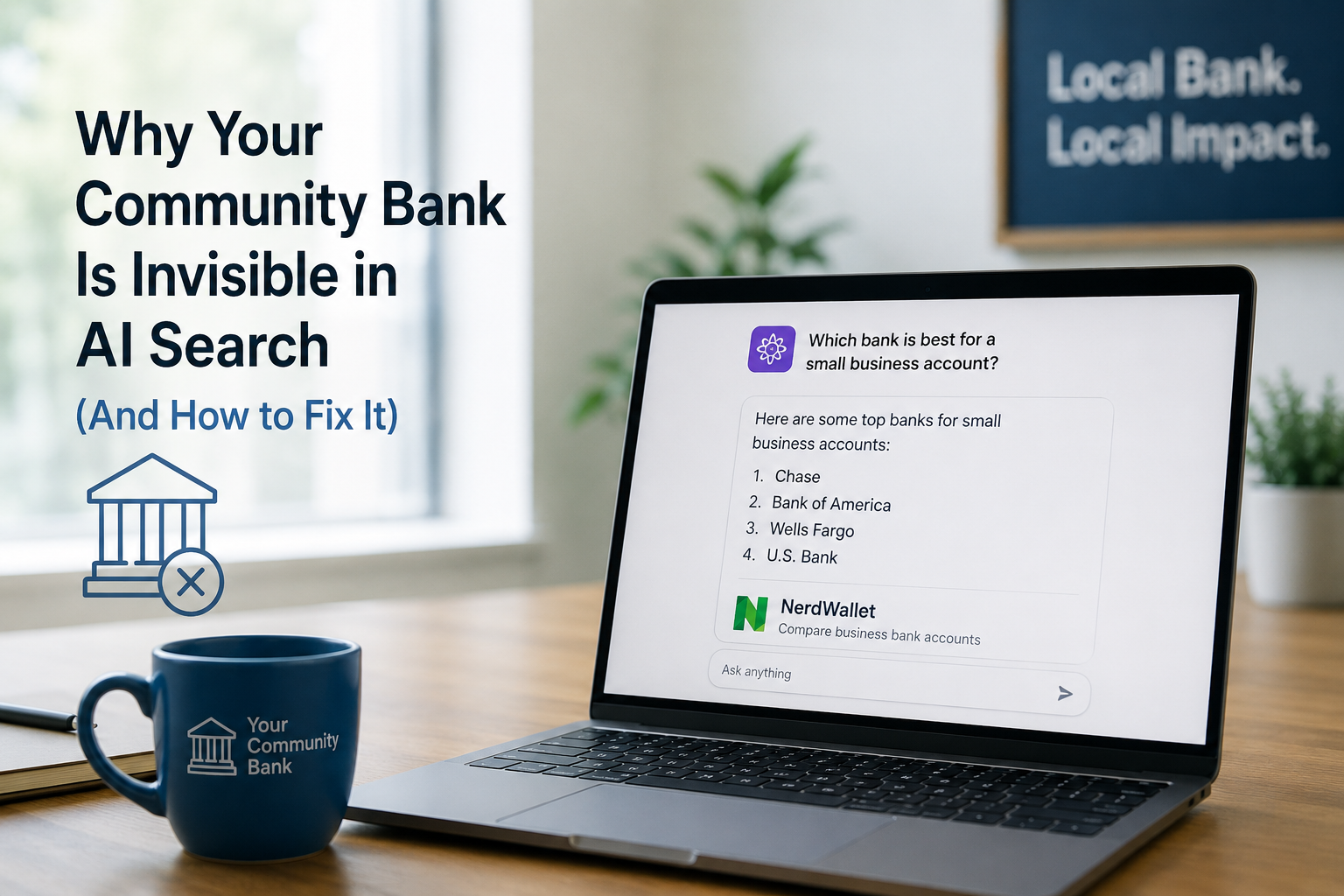
Open ChatGPT right now and type: "What's a good community bank for a small business checking account?"
Read what comes back.
There's a reasonable chance your bank isn't mentioned. There's a near certainty that NerdWallet, Bankrate, or Chase is. And there's a very good chance that a prospective customer in your market — someone who would have been a perfect fit for exactly the kind of relationship banking your institution does better than any national brand — has already read that answer, formed a shortlist, and moved toward a decision that didn't include you.
This is the community bank AI visibility problem. It's not a technology problem, it's not a budget problem, and it's not something you can wait out. It's a structural gap between how AI systems source financial recommendations and how community banks currently show up — or don't show up — in the places those AI systems trust.
This post explains exactly what's happening, why community banks are systemically disadvantaged in AI search, and the precise steps to close the gap before it becomes permanent.
The Shift That's Already Happened
Most community bank marketing teams are still primarily focused on Google rankings, paid search, and local advertising. All of those still matter. But underneath them, a structural shift in how people find financial institutions is well underway.
Prior to 2025, more than 90% of search was done via a search engine, mostly Google. That number is now dropping. A study by marketing firm HigherVisibility found that 71.5% of Americans now use tools like ChatGPT or Gemini to search for products, services, and information. Southstatecorrespondent
A JD Power survey of 4,000 consumers found that 51% of U.S. consumers said they use AI to get financial advice or information. Among those, 52% consult ChatGPT, 20% go to Google Gemini, and 8% turn to Microsoft Copilot. American Banker
Consumers are using AI search tools most heavily at the beginning of a purchase decision — the research phase, the comparison phase, the narrowing-down phase. By the time someone reaches the buying phase, the shortlist is already formed. Clients are evaluating products, comparing institutions, verifying credibility and narrowing their options before ever visiting a website. They are not arriving at your homepage with an open mind. They are arriving to confirm a view the AI already helped them build. Cognito
That last point is the one most community bankers miss. The decision isn't being made on your website. It's being made before the customer ever gets there. AI is now the pre-funnel — and most community banks have no presence in it whatsoever.
The Concentration Problem: Why Community Banks Are Systemically Losing
Here is the finding that every community bank marketer needs to sit with.
According to Avenue Z's AI Visibility Index, in Q1 2025, only 10 digital banks controlled over 83% of AI visibility across ChatGPT, Perplexity, and Gemini for financial queries. Avenue Z
And it gets more specific from there.
New research from Fintel Connect reveals that affiliate and publisher content now dominates AI-generated responses, appearing 60% of the time across financial product searches, with just two publishers — NerdWallet and Bankrate — representing 15% of all sources cited. The Financial Brand
In audits of financial brand visibility, NerdWallet appears in 90%+ of AI personal finance answers. Traditional banks like Chase and Bank of America appear in roughly 75% of banking queries. Neobanks and community institutions appear in fewer than 5% of AI finance recommendation responses — despite often offering superior rates and features. This is not a bug in the AI. It is a structural feature of how large language models process the web. Brands with the most mentions, backlinks, and structured content across the training corpus are the ones AI recommends. Metricusapp
Read that again: fewer than 5% of AI finance responses. Not because community banks are inferior institutions. Not because their rates are worse. Not because their service is worse. Because the structural signals AI systems use to validate recommendations — consistent third-party mentions, authoritative publisher coverage, structured content, entity recognition — overwhelmingly favor institutions with national scale and companies like NerdWallet that have spent a decade building exactly the kind of content architecture AI systems are designed to trust.
This is your problem. And it's fixable.
Why Each AI Platform Works Against Community Banks Differently
Understanding the specific mechanics of each platform reveals where community banks are losing ground — and where the openings are.
Google Gemini: Your Best Opportunity
Research shows that Gemini leaned heavily on financial institutions' own websites across all tested prompts, with 72% of sources coming directly from banks' pages. This suggests Google's ecosystem leans toward rewarding authoritative, first-party content, likely influenced by integration with search data. The Financial Brand
This is the opening community banks have been missing. Gemini is the platform most willing to cite your actual website — but only if that website has the technical foundations to communicate clearly to AI systems: proper schema markup, structured FAQ content, answer-first page architecture, and up-to-date local business signals. Most community bank websites have none of these things properly implemented, which is why they're absent even on the platform most likely to reward them.
ChatGPT: The Third-Party Authority Problem
ChatGPT trusts what the internet agrees on. It leans on third-party directories and reviews, showing the broadest sourcing diversity — combining affiliate content, educational articles, and financial institution-owned content. Yext
For community banks, this creates a specific problem: ChatGPT's training data skews toward institutions that have been mentioned repeatedly across authoritative third-party sources over years. National banks have decades of media coverage. Fintechs have years of tech press. Community banks have local newspaper coverage and Chamber of Commerce profiles. A study found that even small data inconsistencies — such as outdated product names — affected whether or not an AI cited a bank brand. If your bank's information is inconsistent across platforms, ChatGPT's confidence in recommending you drops accordingly. American Banker
Perplexity: The Publisher Gatekeeping Problem
For Perplexity, over 60% of AI responses were cited from publisher sources. Perplexity heavily relies on third-party cited content, frequently referencing publishers like Forbes, Fortune, Bankrate, and NerdWallet. Even a great traditional search presence may not help in platforms that rely more on affiliate-based content. Travillian Next
NerdWallet appeared in nearly every Perplexity response and was cited multiple times within single outputs, demonstrating concentrated influence over AI-powered discovery. For community banks with no presence on NerdWallet, Bankrate, or comparable publisher platforms, Perplexity responses are essentially NerdWallet responses — and your institution doesn't exist in them. The Financial Brand
The Compounding Effect
Treating AI search like a single system risks being invisible in all three. The good news is that all three models favor the same foundational element: structured, consistent, verifiable data. Yext
That's the pivot point. Community banks can't outspend Chase on AI visibility. But they can outstructure them on local relevance — and the specific, locally-grounded content that AI systems use to answer market-specific queries is exactly the kind of content a community bank is best positioned to produce.
The 7 Specific Reasons Your Community Bank Is Invisible in AI Search Right Now
Understanding the problem in the abstract isn't enough. Here are the seven specific, diagnosable reasons community banks disappear from AI search — and what the fix looks like for each one.
Reason 1: Your Website Doesn't Have Schema Markup
Schema markup is structured code that makes your content machine-readable. Without it, AI systems have to guess what your bank is, what it offers, and who it serves — and they'll default to recommending institutions they already know well rather than taking chances on ones they have to interpret.
Most community bank websites have no schema markup at all, or have it implemented incorrectly. The practical effect: AI systems that encounter your site without Organization schema, FinancialService schema, FAQPage schema, or LocalBusiness schema for each branch treat your website as lower-confidence source material and deprioritize it in favor of publishers like NerdWallet whose content is explicitly structured for machine extraction.
The fix is straightforward. Implement Organization schema on your homepage. Add FinancialService schema to your service pages. Wrap your FAQ content in FAQPage schema. Add LocalBusiness schema with complete, accurate information for every branch. Content with schema markup shows 30 to 40% higher visibility in AI-generated answers. Slaterock Automation
Reason 2: Your Content Buries the Answer
AI systems scan for content they can extract cleanly and cite directly. They look for what practitioners call "citable chunks" — self-contained blocks that state a question, answer it directly in the first sentence, and support the answer with specific facts in the following sentences.
Community bank website copy is almost universally written in the opposite structure. It starts with the bank's story, its community roots, its values — and eventually, several paragraphs in, gets to the answer the prospective customer actually wanted. AI systems don't read four paragraphs to find the answer buried in the fifth. They move on to a source that leads with the answer.
The fix: rewrite your top product pages using answer-first structure. Your auto loan page should open with a direct answer to "What are your auto loan rates and how do I qualify?" Your mortgage page should lead with what makes your mortgage products distinctive and what the process looks like. Your business checking page should answer "What does this account cost and what does it include?" in the first two sentences.
Reason 3: Your Bank Has No Publisher Presence
AI-generated answers often draw information from large comparison sites like NerdWallet and Bankrate. These sites appeared far more often than banks' own pages because their content is structured, consistent, and easy for AI to summarize. Money Talks News
The content ecosystem around a brand now matters as much as the brand's own website. Visibility today depends on being included in the information models pull from when generating an answer. Affiliates now play a defining role in determining which products appear in AI model answers. FinTech Weekly
For community banks, this creates a strategic imperative that most haven't yet recognized: getting your products listed and accurately represented on NerdWallet, Bankrate, Investopedia, and comparable publisher platforms is no longer just a lead generation tactic — it's the primary path to appearing in ChatGPT and Perplexity responses about financial products.
The fix: audit your bank's current presence on major financial publisher platforms. Are your products listed on NerdWallet? Are your rates and features accurately represented on Bankrate? Are there local business listings on every directory AI systems reference? Claim and update every profile. Where publisher relationships are available, pursue them actively.
Reason 4: Your Entity Identity Is Inconsistent Across the Web
AI systems build a model of what your bank is by cross-referencing multiple sources. When your bank's name, address, phone number, and service descriptions are inconsistent across your website, Google Business Profile, Yelp, local directories, and any other platform where you appear, AI systems lose confidence in their ability to accurately describe you — and will favor institutions with cleaner, more consistent signals.
Even small data inconsistencies — such as outdated product names — affected whether or not an AI cited a bank brand. American Banker
The fix: conduct a full NAP (name, address, phone) audit across every directory and platform where your bank appears. Ensure your institution name is formatted consistently everywhere. Update any outdated product names, branch hours, or service descriptions. Inconsistency is invisible to human readers but highly visible to AI systems — and it actively suppresses your citation rates.
Reason 5: You Have No Wikipedia Presence or Third-Party Authority
ChatGPT draws a disproportionate share of its institutional knowledge from Wikipedia and from repeatedly cited sources across authoritative publications. Community banks with no Wikipedia page and minimal presence in regional business publications, banking industry media, or financial news outlets are essentially invisible to ChatGPT's training data — which means they're invisible in ChatGPT recommendations regardless of how good their website content is.
A bank with a travel credit card that was one of the best for certain customer groups was completely absent from AI recommendations while all its competitors showed up. When investigators looked into why, they found that few sites listed the card and that the bank did not have a specific audience clearly tied to it in the content ecosystem. American Banker
The fix for Wikipedia depends on your institution's eligibility — size, history, and community significance all factor in. But the fix for third-party authority is accessible to every community bank: issue press releases consistently, pursue contributed article placements in regional business publications, build relationships with local financial journalists, and make your institution's expertise visible in the publications both your customers and AI systems read.
Reason 6: Your Google Business Profile Is Incomplete or Outdated
Google My Business optimization is one of the most immediate ways for AI systems to recommend brands based on location-specific searches or automated recommendations. For community banks, which serve geographically defined markets, Google Business Profile data is a primary signal that AI systems use to surface local financial institution recommendations. Southstatecorrespondent
Incomplete profiles — missing service categories, outdated hours, sparse or absent member reviews, no photos — tell AI systems that this institution is not actively managed and reduce confidence in recommendations. A branch that hasn't updated its Google Business Profile in two years is a branch that AI systems will routinely skip over in favor of institutions with richer, more current local signals.
The fix: audit every branch's Google Business Profile. Complete every available field. List your services explicitly — not just "bank" but "checking accounts," "small business loans," "mortgage services," and every other product category the branch offers. Update hours whenever they change. Build a systematic process for generating authentic customer reviews that mention specific products and experiences.
Reason 7: You Haven't Tested What AI Says About You
"You hear it informally now — people say, 'I'll Google or ChatGPT it,'" according to the chief brand and innovation officer at a community bank. "Do you know what gen AI is saying about your bank?" American Banker
Most community bank marketers have never run this test. They've never opened ChatGPT, typed "best community banks in [their city]," and read what comes back. They've never asked Gemini "what business checking accounts are available from local banks in [their market]?" They've never tested Perplexity with "which community banks offer the best mortgage rates in [their region]?"
Until you know where you stand, you can't prioritize what to fix. The test takes ten minutes and produces more actionable intelligence about your AI search position than months of traditional SEO reporting.
The Community Bank Advantage That AI Systems Are Designed to Reward
Here's the counternarrative — because the picture so far is grim, but the opportunity is real.
GEO levels the field for smaller institutions because visibility is now driven by clarity, relevance, and the strength of the ecosystem around you — not primarily by paid search budgets. Smaller institutions can be discovered if they are accurately and consistently represented in the right places. FinTech Weekly
Community banks have genuine structural advantages in AI search that they haven't yet learned to leverage:
Local authority is irreplaceable. When someone asks an AI tool about banking options in a specific city or neighborhood, the AI is looking for institutions with verifiable, locally-grounded authority signals — local press coverage, geographically specific content, community involvement, branch-level business profiles. National banks and neobanks can't manufacture authentic local authority. Community banks already have it. The gap is in communicating it to AI systems.
Member and customer stories are citation gold. AI systems increasingly weight authentic, human-verified social proof — real customer experiences, documented outcomes, specific product testimonials. Community banks have thousands of these relationships. The gap is in capturing and structuring them in formats AI systems can extract and cite.
Financial education content is high-demand and under-supplied locally. The content AI systems most reliably cite for financial queries is educational — explainers, guides, comparisons, how-to articles. National banks publish generic educational content. Community banks can publish locally relevant educational content: how to buy a home in a specific city, how the local housing market affects mortgage decisions, what small businesses in a specific region need from a banking relationship. This kind of locally-grounded educational content is exactly what AI systems need to answer location-specific queries — and it's content only a community bank can credibly produce.
Relationship trust translates to AI trust signals. The transparency, accuracy, and community commitment that define good community banking are the same qualities AI systems are designed to identify and reward. A bank that publishes clear, honest, accurate information about its products — with no bait-and-switch, no hidden fees buried in footnotes, no misleading rate advertising — builds the kind of trustworthiness signal that compounds in AI systems over time.
Your Community Bank AI Visibility Action Plan
Immediate Actions (This Week)
Run your AI visibility audit. Open ChatGPT, Gemini, and Perplexity. Test 10 to 15 queries your prospective customers are most likely to ask — about your specific market, your specific products, your geographic area. Document what comes back. Note which competitors appear. Note what sources are cited. This is your baseline.
Audit your Google Business Profiles for every branch. Check that hours, services, and contact information are accurate and complete. Add service categories explicitly. Flag any profiles that haven't been updated recently.
Run a NAP consistency check. Search your bank's name across Google, Yelp, local directories, and any financial industry listings. Identify inconsistencies in name format, address, phone number, or service descriptions and correct them.
Month 1 Priorities
Implement schema markup on your homepage, top product pages, and branch location pages. Organization, FinancialService, FAQPage, and LocalBusiness schema are the priorities. If your team doesn't have schema markup expertise in-house, this is worth outsourcing — it's one of the highest-ROI technical investments available for AI visibility.
Rewrite your three highest-traffic product pages using answer-first structure. Each page should open with a direct answer to the question a prospective customer would most likely type into an AI tool. Your auto loan page, your business checking page, and your mortgage page are the most common high-intent starting points.
Audit your presence on NerdWallet, Bankrate, and Investopedia. Are your products listed? Are your rates and features accurately represented? Where listing options exist, pursue them.
Month 2 and 3
Begin building your local financial education content cluster. Publish guides that are genuinely specific to your market — local housing market guides, small business banking resources for your region, financial wellness content with local context. This is content AI systems need to answer location-specific queries and content only you can credibly produce.
Build a systematic review generation process. Identify your most satisfied recent customers and make it easy for them to leave reviews on Google that mention specific products and experiences. Set a target of generating a minimum of 20 new product-specific reviews per quarter per branch.
Develop a press release cadence. Every branch opening, community partnership, local sponsorship, notable hire, and new product launch is an opportunity for a press release that builds your third-party authority footprint. Local business publications, regional newspapers, and banking industry outlets should all receive regular communications from your institution.
Add an llms.txt file to your domain root — a machine-readable document that tells AI crawlers exactly what your bank is, what it offers, and where your most authoritative content lives.
The Window That's Closing
AI is not a neutral process. The way a question gets answered shapes the answer that feels right. When a prospective customer's first introduction to their banking options is an AI-generated response that mentions Chase, NerdWallet's top picks, and maybe a neobank or two — and doesn't mention your community bank — they arrive at your website, if they arrive at all, with a pre-formed view that your institution wasn't among the top recommendations. That's an almost impossible position to recover from in a sales context. Cognito
Citation authority, like domain authority before it, compounds over time. The brands that invest in AI visibility in 2026 will be the brands that AI systems cite in 2027, 2028, and beyond. The competitive window is open — most community banks have not started yet — which represents a significant first-mover opportunity. Enrichlabs
The community banks that take AI search seriously in the next six months will build citation footprints that are genuinely difficult for later movers to displace. The ones that wait will face the same dynamic they faced when they were slow to adopt mobile banking — trying to catch up to institutions that had two years of compounding advantage already baked in.
The good news is that the playbook is clear, the tools are accessible, and the local authority advantage community banks already possess is exactly what AI systems are designed to surface. What's missing is the implementation. And that's entirely fixable.
Frequently Asked Questions
Why are community banks so much less visible in AI search than big banks?
The gap comes down to the structural signals AI systems use to validate recommendations — third-party mentions, authoritative publisher coverage, structured website content, schema markup, and consistent entity signals across the web. National banks like Chase and Bank of America have decades of media coverage, billions of dollars in content marketing investment, and widespread presence on publisher platforms like NerdWallet and Bankrate that AI systems treat as primary financial authorities. Community banks typically have local press coverage, minimal publisher presence, and websites that haven't been structured for AI readability. The visibility gap reflects that structural difference, not any difference in the quality of banking services offered.
Is it possible for a community bank to appear in AI search results if Chase and NerdWallet dominate?
Yes — especially for location-specific queries. When someone asks an AI tool "what's the best bank for small businesses in [specific city]" or "which community banks offer home equity loans in [specific market]," AI systems look for institutions with locally-grounded authority signals that national banks can't credibly provide. A community bank with strong local press coverage, well-structured locally-targeted content, accurate and complete Google Business Profiles for each branch, and a consistent entity presence across local directories has a genuine competitive advantage for geographic queries. The key is building the content and technical infrastructure that communicates that local authority to AI systems in machine-readable terms.
Which AI platform should a community bank prioritize first for visibility?
Start with Google Gemini because research shows it draws 72% of its sources directly from financial institutions' own websites — making it the platform most responsive to improvements in your own content and schema markup. This means improvements to your website have the most direct and fastest impact on Gemini visibility. Follow with Google Business Profile optimization, which feeds both Google's AI Overviews and Gemini's local recommendations. Then pursue publisher presence on NerdWallet and Bankrate to address ChatGPT and Perplexity visibility — those platforms draw heavily from publisher content rather than bank websites directly, so your own site improvements have less direct impact there without a parallel publisher strategy.
How does NerdWallet and Bankrate's dominance in AI search affect community banks?
It creates a gatekeeping effect that community banks need to understand and work around rather than ignore. When 60% or more of AI financial recommendations cite publisher content rather than bank websites, community banks that aren't listed or accurately represented on those publisher platforms are effectively invisible in the majority of AI financial recommendations regardless of how good their own website is. The strategic response is two-pronged: pursue presence on the publisher platforms AI systems trust, and build the on-site content and schema infrastructure that maximizes your visibility on Gemini — the platform that does draw directly from bank websites. Neither approach alone is sufficient; both are necessary.
What does "entity consistency" mean and why does it matter for community bank AI visibility?
Entity consistency refers to the degree to which your bank's name, address, phone number, service descriptions, and key facts are uniform and accurate across every platform where your institution appears — your website, Google Business Profile, Yelp, local directories, financial industry listings, and any other source. AI systems cross-reference multiple sources to build confidence in their understanding of what your bank is and what it offers. When they find conflicting information — different branch hours on your website versus Google, a slightly different institution name format across directories, outdated product names in old listings — their confidence in accurately describing your institution drops, and they deprioritize you in favor of institutions with cleaner, more consistent signals. Even minor inconsistencies have been documented to suppress AI citation rates.
How long does it realistically take for a community bank to improve its AI search visibility?
The timeline depends on which platform you're targeting. Google Gemini responds relatively quickly to improvements in schema markup and content structure — following Google's crawl and index cycles, you may see meaningful changes within four to eight weeks of implementing technical improvements. Google Business Profile optimization and local authority signals can affect Gemini's local recommendations within a similar timeframe. ChatGPT and Perplexity respond more slowly because they rely on training data with fixed cutoffs and deep-rooted publisher relationships that take time to build. A realistic full-strategy timeline is three to six months to measurable improvement in citation rates, with authority compounding significantly over six to twelve months. The institutions that see the fastest results are those that run a baseline audit first and then prioritize the specific gaps identified rather than trying to improve everything simultaneously.
Should a community bank try to manage AI search optimization in-house or work with a specialist?
This depends on your team's existing capabilities. Schema markup implementation, AI visibility auditing across multiple platforms, content restructuring, and publisher relationship development each require specific expertise that most community bank marketing teams weren't hired or trained to deliver. Many community bank marketing departments are already managing a full workload of traditional marketing, social media, email, and compliance-reviewed content — adding a genuinely new discipline with its own technical requirements is a significant ask. Working with an agency that specializes specifically in SEO and AI search for financial institutions — one that understands both the GEO optimization requirements and the compliance context of financial services marketing — will typically produce faster results with fewer costly missteps during the critical early window when first-mover advantage in AI visibility is still available.
Ready to Find Out Where Your Community Bank Stands in AI Search?
Ritner Digital helps community banks audit their AI search visibility, close the gaps, and build the content and technical infrastructure to start appearing in the answers their prospective customers are already reading.
Get your community bank AI visibility audit → ritnerdigital.com/#contact
Sources: American Banker GEO Banking Research (2026), Fintel Connect "Competing for Visibility in the Age of AI" Report (2025/2026), Avenue Z AI Visibility Index for Digital Banks (2025), Yext AI Visibility Analysis (2025), Metricus Fintech AI Visibility Research (2026), SouthState Correspondent GEO Banking Guide (2025), Similarweb 2026 AI Brand Visibility Index, The Financial Brand AI Search Gatekeepers Research (2025), Cognito Media AI Banking Search Analysis (2026), JD Power Banking AI Usage Survey (2025), Enrich Labs GEO Complete Guide (2026), FinTech Weekly AI Financial Visibility Research (2025)