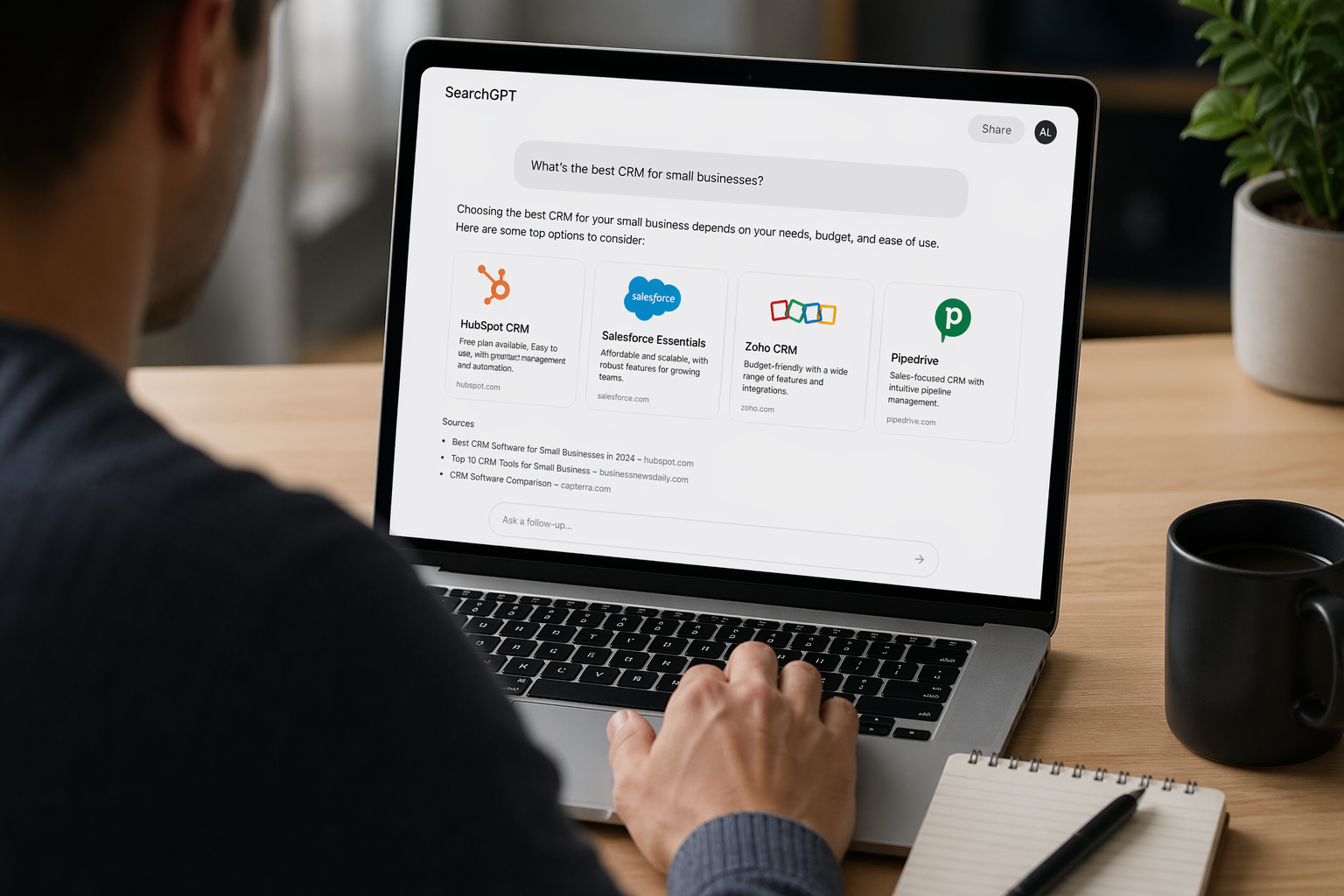
There's a term circulating in digital marketing circles that's generating both excitement and confusion in equal measure: SearchGPT. If you've seen it in a headline, heard it in a strategy meeting, or come across it in an agency pitch, you may be wondering whether it's a new platform, a new discipline, a rebranding of something you already know — or a buzzword that doesn't warrant serious attention.
The answer is somewhere in the middle, and clarifying it is genuinely important — because the underlying reality that "SearchGPT marketing" describes is very real, very significant, and something your business needs a strategy for right now.
This post explains exactly what SearchGPT is, what SearchGPT marketing means, how it differs from other AI search optimization disciplines, and whether investing in it makes sense for your business in 2026.
What Is SearchGPT?
SearchGPT is the name that was used for OpenAI's AI-powered search feature during its beta phase in 2024. OpenAI launched the SearchGPT beta, making their platform significantly more useful for commercial research. It has since become what is now officially known as ChatGPT Search. First Page Sage The two terms — SearchGPT and ChatGPT Search — are used interchangeably in marketing contexts, and for practical purposes they refer to the same thing: ChatGPT's integrated web search mode.
SearchGPT is ChatGPT's live web search mode — the feature activated when a user asks about current events, recent data, or any query where live web information is useful. It behaves differently from standard ChatGPT and requires a parallel optimization track. SearchGPT uses Bing's web index as its primary data source. Atomicagi
This distinction — between ChatGPT responding from its training data and ChatGPT actively searching the live web — is the technical heart of what makes SearchGPT different, and it matters enormously for how you optimize for it.
In the paid version of ChatGPT, approximately 35% of questions triggered a web search while 65% of answers came directly from training data. In the free version, 30% triggered a web search and 70% relied on training data. Seer Interactive Understanding which mode is active for your target queries — and optimizing for both — is the strategic challenge that SearchGPT marketing addresses.
The Scale of the Opportunity
Before getting into strategy, it's worth grounding the conversation in numbers — because the scale of ChatGPT's reach is frequently understated.
ChatGPT grew from 400 million weekly active users in early 2024 to 800 million by October 2025. The platform now processes more than one billion queries per day. ALM Corp ChatGPT has an 80.49% AI chatbot market share, dominating Perplexity, Copilot, Gemini, Claude, and DeepSeek. Exposure Ninja It is the fifth most visited website globally.
As of early 2026, ChatGPT accounts for over 77% of all AI-driven website referral traffic globally. ALM Corp And the traffic it sends converts exceptionally well — AI search converts at 14.2% versus Google's 2.8%, a fivefold advantage that makes citation share a direct revenue lever. Atomicagi
Only approximately 10% of Google's top results overlap with ChatGPT citations Writesonic — which means the content winning in ChatGPT is almost entirely different from what ranks on Google. Optimizing for Google is not, by any meaningful measure, optimizing for SearchGPT.
SearchGPT Marketing: What It Actually Means
SearchGPT marketing — or ChatGPT Search optimization — is the practice of making your brand, content, and online presence show up when users ask ChatGPT questions that trigger a live web search.
SearchGPT optimization is the practice of optimizing your online presence — both on your own website and on third-party websites — so that your company is more likely to be recommended by SearchGPT when users make commercial searches. This includes SEO, as SearchGPT factors in top Google results into its recommendations, but also requires managing reviews and references on third-party websites. First Page Sage
The dual-track nature of this optimization is what makes it distinct from both traditional SEO and general AEO. You need to optimize for two different scenarios happening inside the same platform: queries where ChatGPT responds from training data, and queries where it actively searches the live web through SearchGPT.
ChatGPT evaluates your content through four lenses: brand entity strength, topical authority, third-party citation co-occurrence, and technical crawlability. Atomicagi These four dimensions map onto both tracks — training data visibility and live search visibility — but the tactics for each differ meaningfully.
Track One: Optimizing for ChatGPT's Training Data
When ChatGPT answers without searching the web, it's drawing on patterns established during its training — which means it's responding based on how your brand has been discussed and described across the entire web over time.
ChatGPT pulls heavily from structured knowledge bases — nearly half of its citations, 47.9%, come from Wikipedia, while Reddit supplies 11.3%. SEO Sherpa This is fundamentally different from Perplexity, which relies on Reddit for 46.7% of citations, or Google AI Overviews, where Reddit accounts for 21%.
What this means for training data optimization: your brand needs consistent, accurate representation on Wikipedia and Wikidata where applicable, strong presence in authoritative industry publications and knowledge sources, and a consistent description across every platform that feeds into ChatGPT's training corpus.
SearchGPT's training data includes factors such as product usage, market share, size of customer base, and other data points representing that a company has been well-received by the market. First Page Sage This means real-world brand signals — customer volume, market presence, category recognition — feed into how ChatGPT perceives and describes your brand without a search. A brand that is genuinely prominent in its category has a structural advantage in training data visibility.
Social sentiment — how a company is discussed on discussion forums like Quora, Substack, and Reddit — is the least weighted factor in the algorithm, but it often can be the difference-maker in competitive spaces where there is no clear leader. First Page Sage
Track Two: Optimizing for SearchGPT's Live Web Retrieval
When a user's query triggers SearchGPT to search the live web, the optimization logic shifts significantly. This is where page structure, technical accessibility, content freshness, and Bing indexing become decisive.
Bing is the foundation. SearchGPT uses Bing's web index as its primary data source. If you have been ignoring Bing Webmaster Tools, SearchGPT visibility will be limited regardless of how well you rank on Google. Atomicagi Verify your site in Bing Webmaster Tools, submit your sitemap, ensure Bingbot is not blocked in your robots.txt, and monitor your Bing rankings for your priority queries. This single step alone can unlock SearchGPT visibility that you're currently missing entirely.
Content structure determines extractability. A large-scale analysis found that 44% of ChatGPT citations come from the first third of each piece of content. If the answer to the query is not near the top of the section, the model will not wait for it. Erlin Every page targeting SearchGPT citations needs to lead with a direct answer — a 40–60 word, self-contained response to the question the page addresses — before providing supporting context.
Freshness is a direct ranking signal. Content updated within 30 days receives 3.2 times more citations than older material. Refreshing statistics, updating examples, and adding a visible "Last updated" timestamp on priority pages makes a 2023 article with new 2026 data perform very differently from the same article never touched. Erlin
Technical performance has a measurable citation impact. Pages with a First Contentful Paint under 0.4 seconds average 6.7 citations. Pages loading in over 1.13 seconds average just 2.1. JavaScript-rendered content is particularly problematic — AI parsing success for static HTML with schema runs at 94%, while JavaScript-rendered content lands at 23%. Erlin Static HTML with schema markup is structurally superior to JavaScript-heavy pages for SearchGPT visibility.
Schema markup compounds citation probability. Pages with three or more schema types have a 13% higher likelihood of being cited by LLMs. Implement Article schema, FAQ schema, and Author schema at a minimum. For comparison pages, add Table schema. Erlin
The Authority Signal Layer
Both tracks of SearchGPT optimization depend on a third dimension that sits above content structure and technical optimization: domain and brand authority as recognized by ChatGPT's systems.
Sites with over 32,000 referring domains are 3.5 times more likely to be cited by ChatGPT than sites with fewer than 200 referring domains. Domain authority matters more for entry into the citation pool than for selection within it — high-DA sites get retrieved more frequently, but once retrieved, mid-authority pages in the DA 40–80 range show citation rates comparable to higher-authority domains. Erlin
This is a nuanced but important distinction. You need enough authority to be retrieved in the first place — but you don't need to be a domain authority giant to be selected once you're in the pool. Content quality, structure, and extractability determine selection from within the pool.
Third-party review profiles amplify authority signals. Domains with active profiles on Trustpilot, G2, Capterra, or Yelp have three times higher citation probability compared to sites without such presence. This reflects how ChatGPT treats review platform presence as evidence that a brand is real, active, and verifiable. Erlin
Citation velocity — how recently and frequently a brand is mentioned — is one of ChatGPT's 2026 algorithm updates. The recommended refresh cadence is every 30 to 90 days for content you want ChatGPT to actively cite. Pages not updated in six months or more are significantly less likely to be selected. Ekamoira
The Fan-Out Dimension Most Brands Miss
There is one aspect of SearchGPT's behavior that most optimization guides underemphasize — and it creates a significant opportunity for brands who understand it.
ChatGPT does not search just for the phrase a user types. It expands prompts into multiple sub-queries before assembling its answer — a process called fan-out. Erlin When a user asks "what's the best project management software for remote teams," ChatGPT might fan that query out into sub-searches for remote work tools, project management reviews, team collaboration software, and more — then synthesize across all of them.
This means your content doesn't need to match the user's exact query to be cited. It needs to answer the questions that ChatGPT will generate in its process of answering the user's question. Building content clusters that cover all the sub-questions around your core topics — not just the top-level keywords — dramatically increases your surface area for SearchGPT citations.
Should You Be Doing SearchGPT Marketing?
The direct answer: yes, if your customers are using ChatGPT to research buying decisions — and in 2026, a meaningful and growing share of them are.
The top niches in which people use ChatGPT to get assistance while making purchases include travel and hospitality at 18%, retail and CPG at 16%, and IT services at 14%. SeoProfy About 58% of US adults under 30 have used ChatGPT — nearly double the rate of adults 30 and older. Approximately 31% of Gen Z respondents say they begin searches using AI platforms or chatbots. ALM Corp
If your target customer skews younger, works in technology or professional services, or is making a considered B2B purchase, the probability that they're using ChatGPT in their research process is high and rising. The conversion advantage — LLM visitors converting at 4.4 times the rate of traditional organic traffic Ekamoira — means that even modest SearchGPT citation share can have a disproportionate revenue impact.
The practical question isn't whether SearchGPT marketing matters. It's whether your business has the content depth, technical foundation, and third-party authority signals to compete for citations in your category. Most businesses don't — yet. Measurable citation improvements typically begin within 8 to 12 weeks of targeted optimization. Sustained AI search presence takes 3 to 6 months to build. Atomicagi
The window for establishing early advantage is open. Businesses that start building their SearchGPT presence now will hold compounding advantages over competitors who wait until the channel becomes too crowded to enter cheaply.
Where to Start
If you're new to SearchGPT optimization, the practical starting sequence is straightforward.
First, audit your Bing presence — set up Bing Webmaster Tools if you haven't, submit your sitemap, verify Bingbot isn't blocked, and check your Bing rankings for your most important queries. This is foundational for live search retrieval and is almost certainly underinvested if you've been Google-focused.
Second, restructure your most important pages for answer-first content. Lead every section with a direct, clean answer. Remove the wind-up. Verify that your most critical content is delivered in static HTML, not JavaScript.
Third, audit your third-party authority signals. Are you listed on G2, Capterra, Trustpilot, or Yelp where relevant? Are you appearing in industry comparison articles and "best of" roundups on authoritative sites? These signals directly feed both ChatGPT's training data and its live retrieval selection.
Fourth, build a content refresh cycle. Identify your ten highest-priority pages and implement a 30–60 day review cadence. Update statistics, refresh examples, ensure accuracy, and update the last-modified date visibly.
Finally, start measuring. Set up ChatGPT referral traffic tracking in GA4, manually test your key customer queries in ChatGPT regularly, and begin tracking your citation share as a baseline.
Ready to Build Your SearchGPT Presence?
At Ritner Digital, we help businesses develop and execute complete SearchGPT and ChatGPT Search optimization strategies — from Bing foundation work and content restructuring to authority signal building, schema implementation, and citation monitoring.
If your brand isn't showing up when your customers ask ChatGPT about your category, we can tell you exactly why — and exactly what to do about it.
Contact Ritner Digital today to schedule a free AI visibility audit and find out how your brand performs in ChatGPT Search — and what it will take to get cited consistently.
Sources: First Page Sage, Erlin AI, SEO Sherpa, Atomic AGI, Writesonic, Seer Interactive, SEOProfy, Ekamoira
Frequently Asked Questions
What is SearchGPT and is it different from ChatGPT?
SearchGPT was the name used for OpenAI's AI-powered search feature during its beta phase in 2024. It has since become what is officially called ChatGPT Search — the integrated web search mode built directly into ChatGPT. The two terms are used interchangeably in marketing contexts and refer to the same thing. The important distinction is between ChatGPT responding from its pre-trained knowledge base versus ChatGPT actively searching the live web in real time. SearchGPT specifically refers to the latter — the live retrieval mode — which has its own optimization requirements separate from optimizing for ChatGPT's training data responses.
When does ChatGPT use SearchGPT versus answering from training data?
ChatGPT decides whether to search the web based on the nature of the query. Questions about current events, recent data, pricing, product comparisons, and anything with a recency modifier — like "best tools in 2026" — are more likely to trigger a live web search. General knowledge questions, conceptual explanations, and evergreen topics are more likely to be answered from training data. In testing, approximately 35% of paid ChatGPT queries triggered a web search while 65% relied on training data. This means brands need two parallel strategies: one for how they're represented in ChatGPT's training knowledge, and one for how their pages perform in live retrieval when SearchGPT searches the web.
Why does Bing matter for SearchGPT optimization?
Because SearchGPT uses Bing's web index as its primary data source for live web retrieval. When a user's query triggers ChatGPT to search the web, it searches Bing — not Google. If your content isn't indexed in Bing, or ranks poorly in Bing for your target queries, it is effectively invisible to SearchGPT's live search mode regardless of how well it performs on Google. Most businesses have focused entirely on Google and have never set up Bing Webmaster Tools, never submitted a Bing sitemap, and have no idea how their Bing rankings compare to their Google rankings. Fixing this foundational gap is often the fastest way to unlock SearchGPT visibility.
How is SearchGPT marketing different from regular SEO or AEO?
Regular SEO optimizes for ranking positions in Google's list of search results. AEO optimizes broadly for being cited in AI-generated answers across all platforms. SearchGPT marketing is specifically focused on the ChatGPT ecosystem — both its live web search mode and its training data responses — with optimization tactics tailored to how ChatGPT specifically selects, retrieves, and cites sources. The distinct requirements include Bing indexing and authority, fan-out query optimization, review platform presence as a trust signal, and content structured for ChatGPT's specific extraction patterns. Only about 10% of Google's top results overlap with ChatGPT citations, which confirms that these are genuinely different optimization targets requiring different strategies.
What is query fan-out and why does it matter for SearchGPT?
Query fan-out is the process by which ChatGPT expands a user's original prompt into multiple sub-queries before assembling its answer. When someone asks "what's the best accounting software for small businesses," ChatGPT may fan that out into sub-searches about accounting software reviews, small business finance tools, bookkeeping alternatives, pricing comparisons, and more — then synthesize across all of them. This means your content doesn't need to match the user's exact query to earn a citation. It needs to answer the sub-questions ChatGPT generates in its process of building the response. Building topic clusters that cover all the related questions around your core subjects — not just top-level keywords — dramatically expands your citation surface area in SearchGPT.
How important are review platforms for SearchGPT visibility?
More important than most businesses expect. Domains with active profiles on Trustpilot, G2, Capterra, or Yelp have three times higher citation probability compared to sites without such presence — a finding that surprised researchers because it wasn't an expected correlation. ChatGPT treats review platform presence as evidence that a brand is real, active, and verifiable. It functions as a trust signal that feeds into citation selection, separate from traditional authority metrics like domain authority and backlinks. For B2B companies in particular, maintaining current and active profiles on G2 and Capterra is a direct SearchGPT optimization tactic, not just a conversion rate tool.
How long does it take to start appearing in SearchGPT results?
For technical fixes — like unblocking Bingbot, correcting robots.txt issues, and submitting a Bing sitemap — improvements can begin appearing in SearchGPT's live retrieval within days to two weeks, because Bing indexes new and updated content relatively quickly. Content structural improvements typically show measurable citation improvements within eight to twelve weeks. Building the sustained brand authority that influences ChatGPT's training data — through third-party coverage, review platform presence, and consistent entity signals — takes three to six months of systematic effort. New content targeting queries where you currently have no coverage can begin appearing in SearchGPT live results within one to two weeks of publication and Bing indexing.
Is SearchGPT marketing worth the investment for small and mid-sized businesses?
Yes — and it's arguably more urgent for smaller businesses than for large enterprises, because the competitive landscape in ChatGPT citations is still relatively open. Large brands often appear in ChatGPT by default due to their scale and existing authority. Smaller brands need to deliberately optimize to compete, but the barrier is lower now than it will be in two to three years once the space matures. The conversion advantage is compelling at any scale — visitors arriving via ChatGPT citations convert at 4.4 times the rate of standard organic visitors. Even a small increase in citation share can produce revenue impact disproportionate to the investment, particularly for businesses in high-consideration categories where buyers use ChatGPT to research options before making a purchase decision.