What Is SEO Forecasting? A Plain-English Guide to Predicting Organic Search Growth
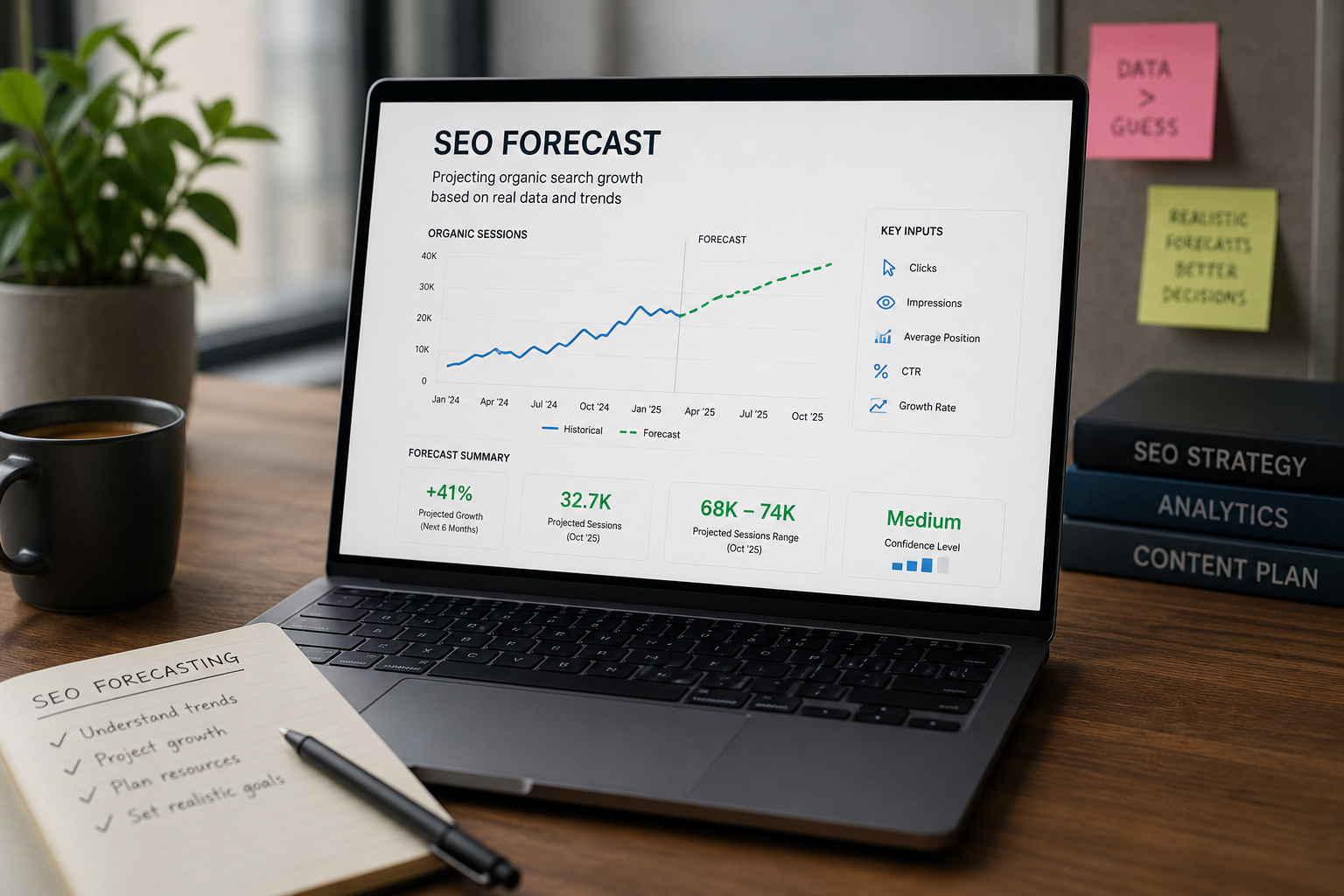
Most businesses that invest in SEO eventually ask the same question: how do we know if this is working, and when will we see results?
SEO forecasting is the discipline that attempts to answer that question with data instead of guesses. It takes what is actually happening in your Google Search Console, your ranking data, and your traffic trends, and uses that information to project where your organic search performance is headed — and when.
It is not a crystal ball. It is not a guarantee. But done correctly, SEO forecasting is one of the most useful planning tools available to any business investing in organic search — and one of the most underused.
This post covers what SEO forecasting actually is, how it works, what data it uses, where it is reliable, where it is not, and why every business with an SEO strategy should be building forecasts alongside it.
The Basic Definition
SEO forecasting is the process of using historical organic search data — clicks, impressions, rankings, click-through rates, and traffic trends — to project future performance under a given set of assumptions.
At its simplest, a forecast might answer: if our average position continues improving at its current rate, how many weekly clicks will we be generating in 90 days?
At its most sophisticated, it might model: if we publish 12 new optimized pages targeting these specific keyword clusters over the next six months, what is the expected impact on total monthly organic traffic and lead volume, and what is the confidence interval around that projection?
Both are SEO forecasts. The difference is the complexity of the inputs and the specificity of the output. But the underlying logic is the same: use what the data is already telling you about trajectory and growth rates to make informed, defensible projections about where things are headed.
Why SEO Forecasting Matters
Without forecasting, SEO investment operates largely on faith. You publish content, build links, fix technical issues, and hope that traffic and leads follow. You might have a general sense that things are improving, but you have no clear framework for evaluating whether the pace of improvement is on track, whether the strategy is working as expected, or when you should expect to see specific business outcomes.
Forecasting changes that dynamic in several important ways.
It creates accountability. When you forecast that weekly clicks will reach a specific threshold by a specific date, you have a benchmark to measure against. If you hit it, the strategy is working. If you miss it significantly, something has changed and you need to understand what. Forecasts make SEO performance measurable in a way that vague goals like "improve organic traffic" simply cannot.
It enables business planning. If your sales team needs to be ready to handle three additional inbound leads per week starting in Q3, they need to know whether SEO is going to deliver that. A forecast grounded in real trajectory data gives you something to plan around. No forecast means no reliable planning.
It sets realistic expectations. One of the most common reasons SEO investments get abandoned too early is that decision-makers expected results on a timeline that the data never supported. A proper forecast, communicated clearly at the start of an engagement, helps everyone understand that organic search compounds over months, not days — and gives them a specific, data-backed picture of what the journey looks like.
It identifies when something is wrong. If your forecast projects 80 weekly clicks by June and you're sitting at 35 in mid-May with no clear improvement trend, that gap is a signal. Either the forecast assumptions need revisiting, the strategy needs adjusting, or something external — an algorithm update, a technical issue, a competitor surge — has disrupted the expected trajectory. Forecasts make these deviations visible and actionable.
What Data Goes Into an SEO Forecast
A reliable SEO forecast draws on several data sources, each contributing a different piece of the picture.
Google Search Console is the foundation. GSC provides your actual click volume, impression volume, average CTR, and average position — all of which are essential inputs for any meaningful forecast. The 90-day trend in each of these metrics tells you the trajectory your site is currently on. Without GSC data, you are forecasting from assumptions rather than observations.
Keyword research data provides the ceiling. Tools like Ahrefs, Semrush, and Google Keyword Planner tell you how much search volume exists for the queries you are targeting. This sets an upper bound on what is theoretically achievable — you cannot get more clicks from a keyword than the keyword receives in total searches, and your expected click share is determined by your ranking position and the applicable CTR for that position.
Ranking position data is the conversion variable. Your position in search results determines what percentage of available impressions become clicks. A page ranking at position 3 will convert a dramatically higher percentage of its impressions into clicks than the same page ranking at position 15. Tracking position trends over time — and modeling what happens to clicks as position improves — is central to any click volume forecast.
Historical growth rates from your own data are the most reliable input of all. If your daily impressions have grown by an average of 25 per day over the past 60 days, that observed growth rate is a far more reliable basis for projection than any industry benchmark. Your own data reflects your specific content pace, your specific niche, and your specific competitive environment in a way that no external benchmark can replicate.
Conversion rate data extends the forecast from traffic to business outcomes. If you know from historical data that approximately 2.5% of your organic visitors submit a contact form, you can translate any traffic forecast directly into a lead forecast. This is where SEO forecasting connects most directly to business planning — it stops being about clicks and starts being about pipeline.
The Core Mechanics: How a Forecast Is Actually Built
There are several approaches to building an SEO forecast, ranging from simple to sophisticated. Here is how the core logic works at each level.
Trend extrapolation is the simplest approach. You take your observed weekly or monthly click trend — say, growing from 20 clicks per week to 43 clicks per week over 90 days — calculate the average weekly growth rate, and project it forward. This approach is fast and grounded in real data, but it assumes the growth rate stays roughly constant, which is not always true. Growth often accelerates as content compounds and then levels off as you approach the ceiling of available search volume in your niche.
Position-based modeling is more sophisticated. Rather than projecting clicks directly, you first project where your average ranking position is headed based on its current trajectory. You then apply CTR benchmarks for each position range to estimate what click volume that position will produce at your current impression volume. This approach captures the non-linear relationship between position improvement and click growth — a jump from position 20 to position 10 produces a much larger click increase than a jump from position 35 to position 25, even if both are a 10-position improvement.
Keyword-level modeling is the most granular approach. Rather than forecasting at the site level, you forecast for each individual target keyword or keyword cluster. You project when each page is likely to reach a target position, apply the CTR for that position against the keyword's search volume, and sum up the expected click contributions across your full target keyword set. This approach is the most accurate for content-driven forecasts but also the most data-intensive to build and maintain.
Scenario modeling layers multiple assumptions into a single forecast to produce a range of outcomes rather than a single point projection. A conservative scenario might assume slow position improvement and modest content growth. A base scenario uses current observed rates. An optimistic scenario assumes acceleration. Presenting a forecast as a range — "we expect to reach 80–120 weekly clicks by Q3 2026, with the base case around 95" — is almost always more honest and more useful than presenting a single number with false precision.
Where SEO Forecasting Is Reliable
SEO forecasting is most reliable when several conditions are met.
When the site has meaningful historical data. A site with 90 or more days of Google Search Console data, showing a clear trend in clicks, impressions, and position, gives you solid inputs for projection. The longer and more consistent the historical trend, the more reliable the extrapolation.
When the trajectory is clear and consistent. A site with steadily improving positions and growing impression volume over multiple months has an observable momentum that forecasts well. A site with highly volatile, inconsistent metrics is harder to forecast reliably because there is no stable trend to extrapolate from.
When the competitive environment is relatively stable. If your niche is not experiencing significant new competition, major algorithm disruption, or rapid changes in search volume, forecasts based on historical trend data will be more accurate. Highly volatile competitive environments introduce more uncertainty into any projection.
When the forecast window is short to medium term. 30 to 180 day forecasts based on current trajectory data are generally more reliable than 12 to 24 month forecasts, because the further you project, the more opportunity there is for the underlying assumptions to change. Short-term forecasts should be treated as operational planning tools. Long-term forecasts should be treated as directional indicators, not precise predictions.
Where SEO Forecasting Has Real Limits
Honest SEO forecasting requires acknowledging what it cannot reliably predict.
Algorithm updates are the single largest source of forecast disruption. Google runs hundreds of algorithm updates per year, with several major core updates that can move rankings significantly in either direction. A site that is improving steadily at position 20 can find itself at position 35 after a core update — or at position 10. These events are not predictable from historical trend data and introduce genuine uncertainty into any forward projection.
Competitive moves are similarly unpredictable. If a well-funded competitor suddenly launches an aggressive content and link-building campaign targeting your exact keyword space, your projected position improvements may not materialize on schedule. Competitive intelligence tools can give you some visibility into this risk, but they cannot eliminate it.
Content publishing pace changes affect forecasts directly. Most SEO forecasts for growing sites assume a continued pace of new content creation. If that pace slows — due to resource constraints, strategic shifts, or team changes — the forecast assumptions no longer hold and the projection timeline extends. Forecasts should be updated whenever publishing pace changes materially.
Seasonality can significantly distort trend-based projections if not accounted for. A site in a business with strong seasonal patterns — say, a tax services firm or a holiday retail brand — will see search volume fluctuations that are driven by the calendar rather than by SEO performance. Forecasting over seasonal transitions without adjusting for this introduces systematic error into the projection.
New domain uncertainty is particularly relevant for sites like Ritner Digital that are in their first 6–12 months of existence. New domains go through a period where Google is actively testing rankings — placing pages at various positions to gauge user response — before settling into more stable positions. This testing phase introduces more position volatility than older, more established sites experience, which makes short-term forecasts less reliable even when the long-term trajectory is clear.
SEO Forecasting vs. SEO Reporting: An Important Distinction
A common confusion worth clarifying: SEO reporting and SEO forecasting are not the same thing, and most SEO engagements do the former without the latter.
SEO reporting looks backward. It tells you what happened — clicks were up 12% last month, average position improved from 24 to 21, three new pages entered the top 20. Reporting is essential for understanding what has worked and what hasn't, but it does not tell you where things are headed.
SEO forecasting looks forward. It takes the trends visible in reporting and projects them into the future under stated assumptions. It answers the question your reporting never can: based on what is actually happening, what should we expect next?
Most businesses get monthly SEO reports. Far fewer get SEO forecasts. The ones that do are better positioned to make investment decisions, set internal expectations, and identify when performance is deviating from plan — all of which make their SEO investments more effective and more accountable.
How Ritner Digital Uses Forecasting
We have been publishing our own Google Search Console data publicly since we launched in January 2026, and we use real trajectory-based forecasting in both our own growth planning and our client work.
In our recent post comparing Ritner Digital's data against a company founded in 2004, we built a position-based forecast using our observed 90-day impression growth rate and position improvement trajectory to project when we would close specific gaps in weekly clicks, daily impressions, and monthly traffic volume. Those forecasts — weekly click parity by July–August 2026, impression parity by October–November 2026 — are grounded in observed data, stated assumptions, and explicit confidence ranges. We will update them publicly as the data develops.
That is what we think SEO forecasting should look like: transparent inputs, stated assumptions, honest ranges, and regular updates as new data comes in. Not a slide deck with optimistic hockey-stick graphs and no methodology. Not a vague promise that "results typically take six to twelve months." A real, data-grounded projection that you can hold us accountable to.
A Simple Framework for Getting Started
If you want to begin applying SEO forecasting to your own site, here is a straightforward starting framework.
Step one — Pull 90 days of Google Search Console data. Export your daily clicks, impressions, CTR, and average position for the most recent 90-day window. This is your baseline dataset.
Step two — Identify your trend lines. Calculate your average weekly click growth, your average daily impression growth, and the direction and pace of your average position change. Are these metrics improving, flat, or declining? At what rate?
Step three — Project forward at your current rate. Take your current weekly click total and apply your observed weekly growth rate for the next 12 weeks. This gives you a simple trend-extrapolation forecast. It will not be perfectly accurate, but it gives you a grounded baseline to work from.
Step four — Identify the key assumptions. What has to remain true for this forecast to hold? Consistent content publishing pace? No major algorithm disruption? Stable competitive environment? State these assumptions explicitly so that when the forecast is off, you can diagnose why.
Step five — Build a range, not a point. Apply your growth rate at 70%, 100%, and 130% to create conservative, base, and optimistic scenarios. Present the forecast as a range. This is more honest and more useful than a single number.
Step six — Review and update monthly. A forecast that is never updated is just a guess made once. A forecast that is reviewed against actual data every month and updated accordingly is a planning tool. Build the monthly review into your SEO process.
The Bottom Line
SEO forecasting is not about predicting the future with certainty. It is about making the most informed, data-grounded projection possible — and then holding that projection accountable to reality as new data comes in.
Done well, it transforms SEO from a faith-based investment into a plannable, measurable, accountable growth channel. It gives business owners something to plan around, something to measure against, and something to update when the environment changes.
Done poorly — with unrealistic assumptions, no stated methodology, and no regular updates — it is worse than no forecast at all, because it creates false confidence in projections that were never grounded in reality.
The difference between the two is transparency about inputs, honesty about limits, and a commitment to updating the model as new data arrives. That is the standard we hold ourselves to at Ritner Digital, and it is the standard we think every SEO forecast should meet.
Want to see what a real, data-grounded SEO forecast looks like for your site? We build forecasts from your actual Google Search Console data — no hockey sticks, no guarantees, just honest projections you can plan around.
Talk to the Ritner Digital team → ritnerdigital.com
Frequently Asked Questions
What is the difference between an SEO forecast and an SEO projection?
The terms are often used interchangeably, but there is a meaningful distinction worth understanding. A projection is typically a straight-line extrapolation of current trends — if clicks grew by 10% last month, a projection assumes they will grow by 10% next month. A forecast is more sophisticated: it incorporates multiple variables, states explicit assumptions, accounts for known sources of uncertainty, and typically presents a range of outcomes rather than a single number. In practice, most SEO forecasts blend both approaches — using trend extrapolation as the base while layering in assumption-based adjustments for things like content publishing pace, expected position improvements on specific keyword targets, and seasonal patterns.
How accurate are SEO forecasts typically?
Accuracy varies significantly depending on the quality of the input data, the length of the forecast window, and the stability of the competitive environment. Short-term forecasts — 30 to 90 days — built from clean, consistent historical data in a stable niche can be reasonably accurate, often within 20–30% of actual outcomes. Longer-term forecasts — 6 to 12 months — carry significantly more uncertainty because there are more opportunities for algorithm updates, competitive changes, and content pace shifts to disrupt the underlying assumptions. The honest answer is that SEO forecasts should be treated as informed directional estimates, not precise predictions. Any agency or tool claiming high precision on long-range SEO forecasts is overstating what the methodology can reliably deliver.
How much historical data do you need to build a reliable SEO forecast?
A minimum of 60–90 days of Google Search Console data gives you enough trend information to build a basic forecast with reasonable confidence. Less than 60 days — especially for a new domain that is still in Google's initial indexing and ranking evaluation phase — introduces significant uncertainty because the data may not yet reflect stable, settled ranking behavior. For the most reliable forecasts, 6–12 months of historical data is ideal, as it gives you enough history to identify seasonal patterns, smooth out short-term volatility, and observe how the site has responded to algorithm updates. That said, even 90 days of clean GSC data is enough to build a useful directional forecast, as the Ritner Digital examples in this blog series demonstrate.
Can SEO forecasting account for Google algorithm updates?
Not reliably, and any forecast that claims otherwise should be viewed with skepticism. Algorithm updates are by definition unpredictable — Google does not announce them in advance with enough specificity to model their impact on individual sites. What good SEO forecasting can do is build in uncertainty ranges that account for the historical frequency and magnitude of algorithm disruptions, flag when actual performance deviates significantly from forecast in a way that suggests an algorithm event may have occurred, and update projections quickly after an update to reflect the new baseline. Forecasts built on sound content and technical SEO fundamentals are also more resilient to algorithm disruption over time, because Google's updates consistently reward the same underlying quality signals — relevance, authority, and technical soundness.
What is the most common mistake businesses make when using SEO forecasts?
Treating the forecast as a guarantee rather than a projection. This happens most often when an SEO agency presents a forecast without clearly stating the underlying assumptions and uncertainty ranges, and a business owner or marketing team interprets the projected numbers as commitments. When actual performance diverges from the forecast — as it inevitably will to some degree — the response is often to abandon the strategy rather than to update the forecast assumptions and adjust the approach. The fix is to build forecasts with explicit stated assumptions, present them as ranges rather than point estimates, review them monthly against actual data, and treat significant deviations as diagnostic information rather than failures.
Should a new domain bother with SEO forecasting in its first few months?
Yes, but with adjusted expectations for accuracy. New domains go through a period of position volatility — sometimes called the Google sandbox effect — where rankings fluctuate significantly as Google evaluates and tests where to place new content. This volatility makes short-term forecasts less precise for new domains than for established ones. That said, even a new domain can build useful directional forecasts from its first 60–90 days of GSC data, as Ritner Digital has demonstrated publicly in this blog series. The value at this stage is less about precision and more about establishing a baseline trajectory, identifying whether growth is on track relative to expectations, and setting realistic internal timelines for when meaningful lead generation can be expected.
How does keyword research factor into SEO forecasting?
Keyword research provides the ceiling for any SEO forecast — it tells you how much search volume theoretically exists for the queries you are targeting, which sets an upper bound on how much traffic is achievable. In a keyword-level forecast, you identify your target keywords, estimate when each will reach a specific ranking position based on your current trajectory, apply the expected CTR for that position against the keyword's monthly search volume, and sum the projected click contributions across your full keyword set. This approach is more precise than site-level trend extrapolation but also more labor-intensive to build and maintain. For most small to mid-sized businesses, a hybrid approach works best — site-level trend extrapolation as the base, with keyword-level modeling applied to the highest-priority target terms.
How does SEO forecasting connect to lead generation forecasting?
Through conversion rate data. Once you have a traffic forecast — projected weekly or monthly clicks from organic search — you apply your observed or estimated conversion rate to translate clicks into expected lead volume. For example, if your forecast projects 120 weekly organic visitors by Q3 2026 and your historical contact form conversion rate is 2.5%, the lead forecast is approximately 3 leads per week. The accuracy of the lead forecast depends on both the accuracy of the traffic forecast and the stability of your conversion rate. Conversion rates can shift based on changes to your website, your offer, your competitive positioning, and the composition of your organic traffic — so both inputs need to be monitored and updated regularly for the lead forecast to remain reliable.
What tools are most commonly used to build SEO forecasts?
Google Search Console is the essential starting point — it provides the click, impression, CTR, and position data that forms the foundation of any forecast. Beyond GSC, tools like Ahrefs and Semrush provide keyword search volume data and ranking position tracking that enable keyword-level modeling. Google Sheets or Excel are the most common environments for actually building the forecast models, using historical GSC data exports as inputs. More sophisticated teams sometimes use statistical modeling tools or purpose-built SEO forecasting platforms, but for most businesses the combination of GSC data, a keyword research tool, and a well-structured spreadsheet model is sufficient to build forecasts that are useful and defensible.
Want a forecast built from your actual data? We pull your Google Search Console numbers, identify your trajectory, and give you a honest, range-based projection you can plan your pipeline around.