What Is the American Society for AI (ASFAI)? Inside the Invitation-Only Club Shaping AI's Future — And the Organizations Every AI Search Agency Should Know
If you spend your days thinking about how brands get cited inside ChatGPT, Perplexity, and Google AI Overviews, you eventually run into a deeper question: who is actually steering the conversation about AI itself? The platforms that decide which sources are trustworthy don't form their worldview in a vacuum. They're shaped by researchers, ethicists, standards bodies, and a small number of influential organizations whose members sit at the intersection of industry, government, and academia.
One of the most talked-about — and most exclusive — of those organizations is the American Society for AI. Here's who founded it, what it actually does, and how it fits alongside the other leading AI bodies that anyone working in AI search optimization should have on their radar.
What Is the American Society for AI (ASFAI)?
The American Society for AI is a 501(c)(4) non-profit that describes itself as the premier organization for Artificial Intelligence, with a mission to create a better world with AI. What sets it apart from nearly every other AI organization is its structure: ASFAI is a private club of prominent experts, leaders, and pioneers in AI from varying backgrounds and industries. LinkedInLinkedIn
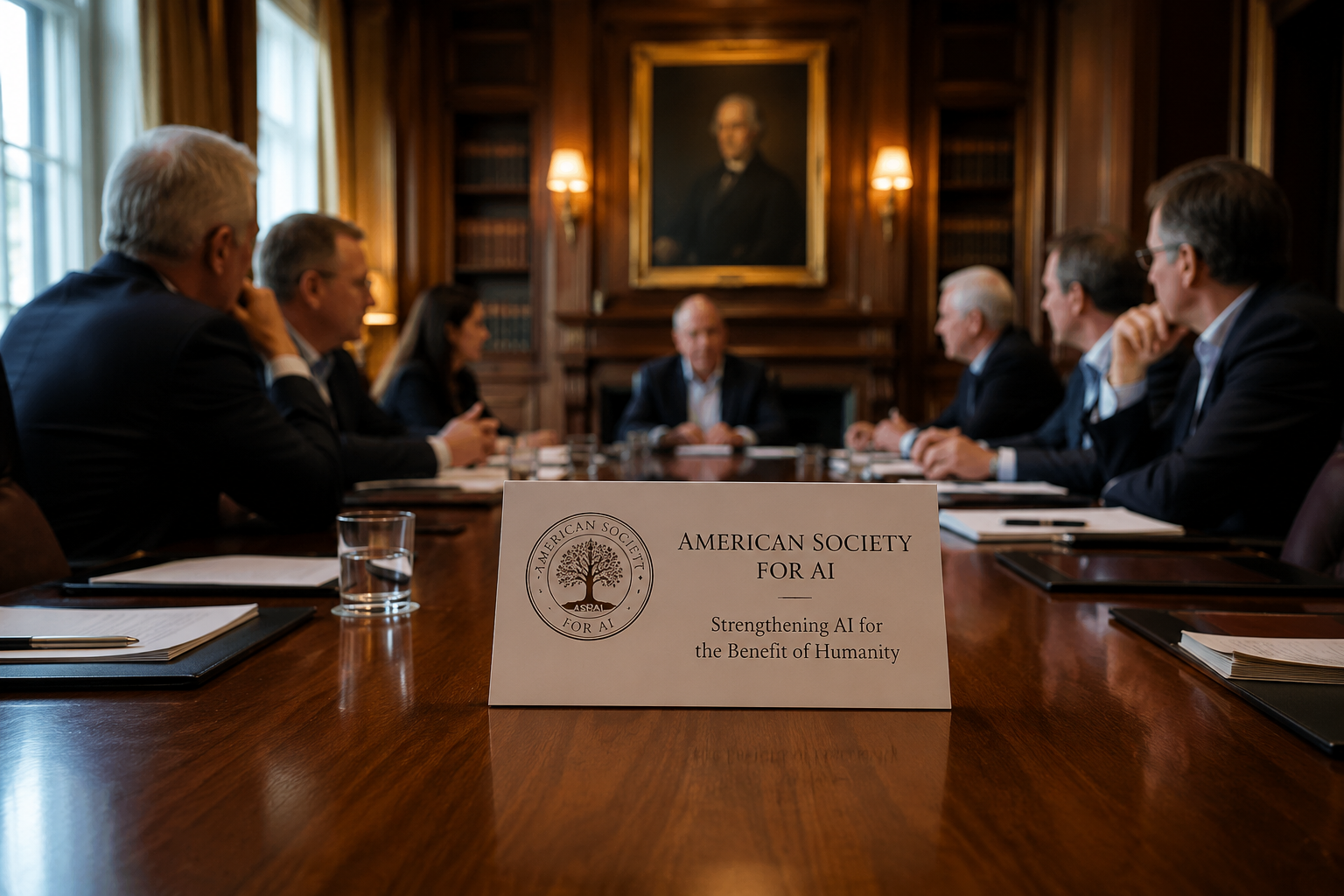
This is not a membership you apply for. Membership is private and by invitation only, and the society holds bi-annual summits each December and June at undisclosed locations available only to members. The summits are deliberately intimate — there are no recordings and no media, and members include pioneers in AI, entrepreneurs, executives, investors, lawyers, engineers, doctors, government officials, and professors. LinkedInLinkedIn
The exclusivity is the point. According to one industry analysis, ASFAI is typically regarded as the most prestigious and elite of the AI associations given its highly restrictive, invitation-only membership system, which caps membership at a maximum of 125 vetted leaders across industry, government, and academia. 50 Pros
The society also takes a notably purist stance on funding. Per its own About page, ASFAI accepts zero donations and zero sponsorships, and is run entirely by unpaid volunteers. Its stated vision is to harness AI to create a better world and foster human flourishing by bringing together the top minds in AI twice per year in a private, collaborative setting. AsfaiAsfai
Who Founded ASFAI?
The organization emerged at a specific moment in AI history. According to industry reporting, ASFAI was founded in 2023 as a response to the explosion of AI noise in the aftermath of the ChatGPT release, becoming a convening place for senior leaders to meet and discuss pressing topics in AI. 50 Pros
The central founding figure is Dr. Aaron Poynton. He is described as the Co-Founder and Executive Director of the American Society for AI, a nonprofit convening leaders from government, industry, academia, and civil society to shape long-term AI governance. Beyond ASFAI, Poynton is a senior executive with decades of experience at the intersection of artificial intelligence, global institutions, and highly regulated, mission-critical environments, and is also an executive with Applied General Intelligence working on next-generation AI systems. He holds four advanced degrees, having studied business, law, and political science at Duke, Harvard, and the London School of Economics, and is CEO of Omnipoynt Solutions, a technology strategy and business development consulting firm. Aaron Poynton + 2
In December 2024, the society formalized its leadership. Aaron Poynton was appointed Chairman of the Board, Dr. Paritosh Ambekar was named Vice-Chairman and Director of Strategic Initiatives, and former NASA astronaut and International Space Station commander Terry Virts was appointed Global Ambassador. EEJournal
The elected board reads like a who's-who of enterprise AI leadership. Members elected to serve a two-year term include Paul Daugherty, former Chief Technology and Innovation Officer at Accenture; Elizabeth Ngonzi, CEO of the International Social Impact Institute; Matthew Guggemos, COO of iTherapy; Dr. Miguel Paredes, Venture Partner at The Silicon Foundry; and Will Hatcher, an AI storyteller and 2024 inductee into TIME's 100 Most Influential People in AI. EEJournal
The society is also producing thought leadership. It is developing its first-ever anthology, "AI for Humanity: Human-Centered Strategies for Innovation and Impact," co-led and co-edited by Elizabeth Ngonzi, who chairs ASFAI's Ethics and Responsible AI Committee, and ASFAI Co-Founder and Chairman Dr. Aaron Poynton. Socialimpactinst
What Does ASFAI Actually Do?
Strip away the prestige and ASFAI's function is fairly focused. It exists to:
Convene senior leaders privately. The twice-yearly summits are the core product — a Chatham-House-style space for candid discussion among the most influential people in AI, without press or recordings.
Shape AI governance and ethics. The organization positions itself around responsible AI development and bridging the gap between technological advancement and ethics. As its founding coverage put it, ASFAI emerged as a response to the critical need to understand, govern, and leverage AI's potential while navigating the complex landscape of global competitiveness. Techfabric
Produce human-centered thought leadership through committees and publications like the AI for Humanityanthology.
In short, ASFAI is less a standards body or research society and more a high-trust network — a place where the people building and regulating AI compare notes off the record.
The Other Leading AI Organizations Worth Knowing
ASFAI is one node in a much larger ecosystem. If you advise clients on AI search and visibility, understanding the broader landscape helps you grasp how authority, trust, and "credible source" signals get established in the first place. Here are the major players in the U.S. and globally.
Association for the Advancement of Artificial Intelligence (AAAI). The oldest and most academically prestigious. It was founded in 1979 under the name American Association for Artificial Intelligence, changed its name in 2007, and now has more than 4,000 members worldwide. Its early leadership included legends of the field — Allen Newell, Edward Feigenbaum, Marvin Minsky, and John McCarthy — and Francesca Rossi has served as president since July 2022. AAAI is a research society that runs the field's flagship academic conferences. WikipediaWikipedia
Partnership on AI (PAI). The most policy- and ethics-oriented coalition. Founded in 2016, PAI is a nonprofit coalition bringing together academic institutions, major tech companies, civil society organizations, and policy experts to develop best practices and ensure AI's benefits are broadly and fairly shared. Its founding members include Amazon, Google, IBM, Apple, and Microsoft, along with nonprofit partners like the ACLU and UC Berkeley. If you want to understand where responsible-AI norms are being written, PAI is a primary source. 50 Pros50 Pros
Association for Computing Machinery (ACM) and its SIGAI. ACM is one of the largest computing professional bodies in the world. With around 100,000 members, ACM has been active in developing principles and ethical frameworks for responsible computing, and its Technology Policy Committee delivered a report with seven principles for algorithmic accountability and transparency. Its Special Interest Group on AI (SIGAI) connects practitioners across academia and industry. Human-Centered AI
IEEE Computational Intelligence Society (IEEE-CIS). The home for AI and machine-learning engineers, offering deep technical resources, standards work, and certification pathways. It's the body most associated with the engineering and standards side of intelligent systems.
Advocacy and community organizations. A cluster of groups focuses on diversity, inclusion, and social impact — including Women in AI, Black in AI, and the AI for Good Foundation, all dedicated to increasing diversity, inclusion, and social impact in the field. The AI for Good Foundation, founded in 2015, focuses on using AI to address global challenges such as climate change, public health, and inequality. LinkedIn50 Pros
Coordinating and international bodies. Above the individual societies sits coordination infrastructure. The Artificial Intelligence Scientific Organizations Coordinating Council (AISOCC) was created to encourage and facilitate communication, coordination, and collaboration among international AI scientific societies and conferences. On the policy front, the OECD AI Policy Observatory tracks government approaches to AI worldwide. Association for the Advancement of Artificial Intelligence
Here's a quick way to map them:
Why This Matters for AI Search and Optimization
Here's the connection that's easy to miss. The organizations above don't just hold conferences — they shape the authority signals that AI answer engines lean on. When ChatGPT, Perplexity, Gemini, or Google AI Overviews decide which entities and sources to trust on a topic, they're synthesizing from a web of content produced and validated by exactly these kinds of institutions, researchers, and recognized experts.
For agencies and brands working on AI search optimization, GEO, and AEO, three implications stand out:
Entity authority is the new currency. AI systems map people, brands, and organizations as entities with relationships and credibility. Understanding which bodies confer authority in a field helps you build the kind of recognized, well-connected entity profile that AI engines surface.
Where your experts show up matters. Membership, contributions, citations, and recognition from established AI and industry organizations create the trust signals that generative engines weight heavily — far more than keyword density ever did.
The "credible source" landscape is being defined right now. As AI search becomes recommendation infrastructure, the brands that get cited will be the ones structured as trusted, well-attributed sources within their domain's authority graph — not just the ones ranking on page one.
Knowing the players shaping AI — from invitation-only societies like ASFAI to open research bodies like AAAI and policy coalitions like Partnership on AI — gives you a clearer picture of how trust gets built in the AI ecosystem. And building trust, structurally and visibly, is exactly what wins citations in AI-generated answers.
Build Visibility That AI Engines Actually Trust
Understanding the AI landscape is one thing. Getting your brand cited inside ChatGPT, Perplexity, Gemini, and Google AI Overviews is another — and it requires entity optimization, structured content, and authority-building designed specifically for how AI systems choose their sources.
That's what Ritner Digital does. We build the AI search, SEO, content, and entity infrastructure that turns visibility into pipeline-influenced growth — and we publish our real benchmark data and methodology openly, so you can evaluate the work before you commit.
Book an AI Search Audit with Ritner Digital →
Tell us where you are now, what you're trying to grow, and the AI visibility problems you're trying to solve. You'll get clear next steps within one business day.
A note on sources: organizational details about ASFAI are drawn from the society's own About page and LinkedIn, EEJournal's coverage of its 2025 board, PR Newswire, and Unite.AI. Comparative organization data draws on AI Magazine, the 50Pros AI association rankings, and Wikipedia entries for AAAI and Partnership on AI. Because ASFAI is intentionally private, some operational details are limited by design.
Frequently Asked Questions
What is the American Society for AI (ASFAI)?
ASFAI is a 501(c)(4) non-profit that positions itself as a premier organization for artificial intelligence, with a mission to create a better world with AI. It functions as a private, invitation-only network of senior AI leaders from industry, government, and academia who meet at twice-yearly summits to discuss AI governance, ethics, and innovation.
Who founded ASFAI?
Dr. Aaron Poynton is the co-founder and Executive Director of the American Society for AI. He is a senior executive with experience across artificial intelligence, global institutions, and regulated environments, and was appointed Chairman of the Board in December 2024. The society was founded in 2023.
When was ASFAI founded and why?
ASFAI was founded in 2023, emerging as a response to the surge of AI activity following the release of ChatGPT. Its purpose was to create a private, high-trust space where senior leaders could meet and discuss the most pressing topics in AI away from media attention.
How do you become a member of ASFAI?
You can't apply. Membership is private and by invitation only, and reporting indicates the society caps membership at roughly 125 vetted leaders. Members include executives, investors, engineers, doctors, lawyers, government officials, and professors.
Is ASFAI the same as AAAI?
No. They are different organizations with different models. AAAI (the Association for the Advancement of Artificial Intelligence) is an open academic research society founded in 1979 with thousands of members and public conferences. ASFAI is a newer, invitation-only convening body focused on private leadership dialogue, governance, and ethics rather than published research.
What are the other leading AI organizations in the U.S. and globally?
Major bodies include AAAI (academic research), the Partnership on AI (ethics and policy, backed by Amazon, Google, IBM, Apple, and Microsoft), ACM and its SIGAI group (computing practice and policy), and IEEE-CIS (engineering and standards). Diversity- and impact-focused groups include Women in AI, Black in AI, and the AI for Good Foundation.
What's the difference between ASFAI and the Partnership on AI?
ASFAI is a small, invitation-only network focused on private convening among elite leaders. The Partnership on AI is a larger institutional coalition founded in 2016 that brings together tech companies, academic institutions, and civil society groups to publish best practices and shape responsible-AI policy openly.
Why do AI organizations matter for AI search and SEO?
AI answer engines like ChatGPT, Perplexity, Gemini, and Google AI Overviews rely heavily on authority and trust signals when choosing which sources to cite. The recognition, memberships, citations, and expertise validated by established AI organizations help build the entity authority that generative engines weight when surfacing brands and experts in their answers.
How can my brand get cited in AI answers about AI topics?
Getting cited depends on building structured, well-attributed entity authority — clear expert profiles, topical depth, recognized affiliations, structured data, and content formatted to directly answer user questions. This is the core of generative engine optimization (GEO) and answer engine optimization (AEO).