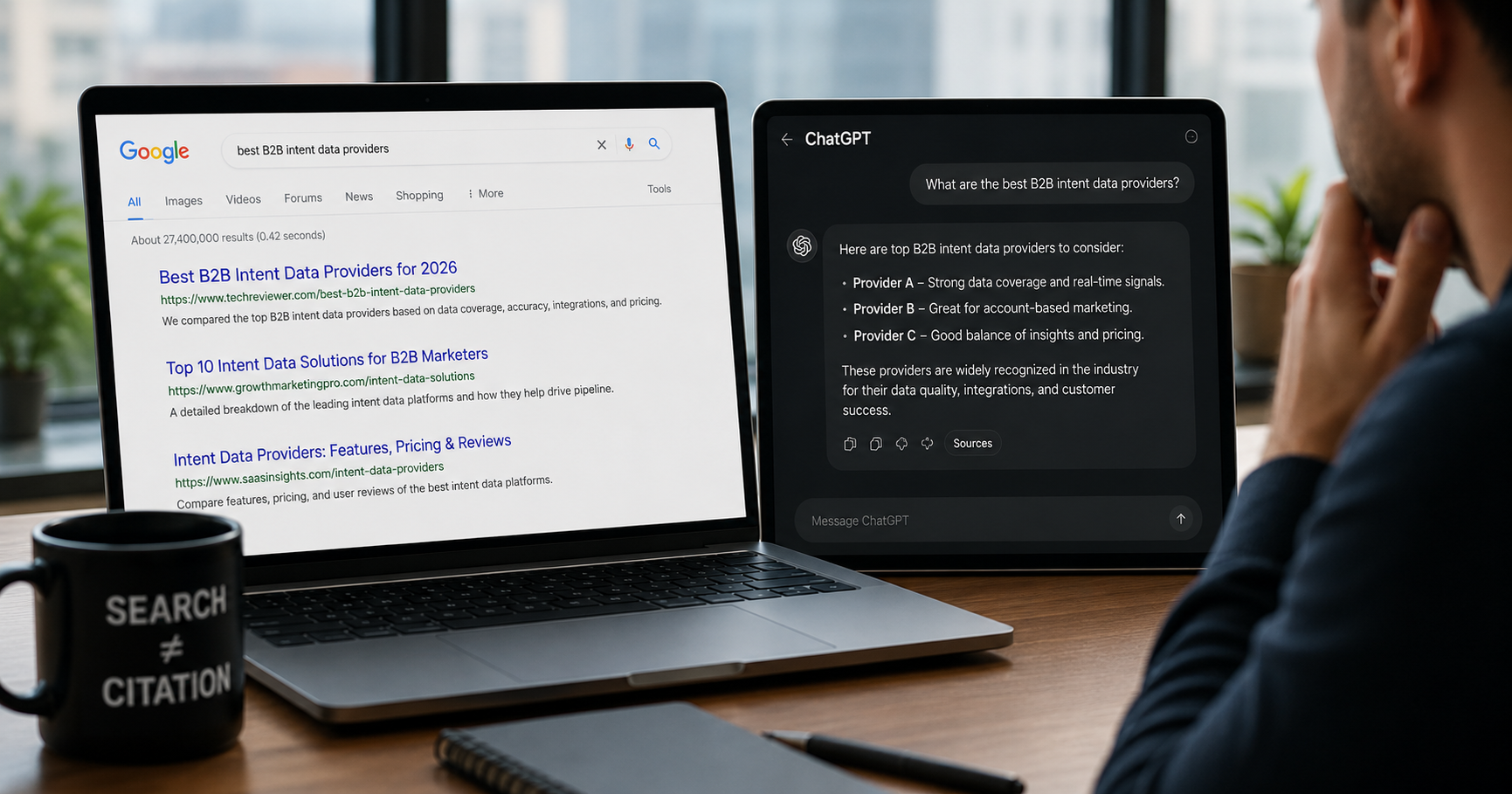
You've done everything right. Your site ranks on page one for your core terms. Your traffic looks healthy in Search Console. Your SEO agency sends green dashboards every month. And then a prospect tells you they asked ChatGPT to recommend tools in your category — and your name never came up.
You're not imagining the gap. For two decades, ranking on Google was visibility. That equation has quietly broken. A brand can dominate traditional search and be functionally invisible inside the AI answers where a growing share of buyers now do their research. This post explains exactly why that happens — the mechanical difference between how Google ranks pages and how large language models decide who to cite — and what B2B teams can do about it.
The Short Answer
Google and AI answer engines are solving two different problems. Google retrieves, ranks, and displays links; AI engines generate an answer first, then select sources to support it. Because the objectives differ, the selection behavior differs — and ranking high on Google does not reliably get you cited in ChatGPT. Wellows
The data backs this up bluntly. A Search Atlas analysis of more than 18,000 matched queries found that only 12% of URLs cited by LLMs rank in Google's top ten — meaning nearly 9 out of 10 AI-cited sources sit outside what Google deems most relevant. Looking specifically at ChatGPT, its median domain overlap with Google stayed around 10–15%, and URL-level matches typically remained below 10%. The conclusion researchers keep reaching is the same: AI visibility is now separate from SEO visibility, and brands need to optimize for both fields independently. Ciwebgroup + 2
If you take nothing else away: Google ranking and LLM citation are now two different games. You can win one and lose the other.
How Google Decides Who Ranks
Traditional search optimization, at its core, rewards a familiar set of signals: keyword relevance, backlink authority, technical health, and user engagement. Google crawls pages, indexes them, and ranks a list of links for a query. The user then chooses which link to click. The entire system is built around matching a query to documents and ordering those documents.
This produced the playbook everyone knows — target keywords, earn links, fix technical issues, climb the rankings. It still works for what it's for. Google still commands the overwhelming majority of US search. But that playbook optimizes for being clickable in a list, which is not the same thing as being quotable in an answer. Dojoai
How LLMs Actually Decide Who Gets Cited
Here's where it gets mechanically different. LLMs don't rank a list — they construct an answer and pull in supporting sources. They reach your content through two distinct pathways, and understanding both explains the gap.
Pathway one: parametric knowledge. This is what the model absorbed during training from massive datasets. It represents long-term brand familiarity — if your brand has been consistently mentioned across authoritative sources for years, the model simply "knows" you, and this pathway dominates a large share of ChatGPT queries. You cannot directly optimize a frozen training set. You can only have built enough consistent, credible presence across the web that the model already absorbed you. Virayo
Pathway two: live retrieval (RAG). When a query needs current information, the model searches the live web, retrieves relevant content, and synthesizes it into a response. This is Retrieval-Augmented Generation, and it works on principles that have almost nothing to do with traditional ranking. Virayo
Under the hood, RAG systems break content into pieces and match them by meaning, not keywords. Documents are preprocessed, segmented into chunks, and embedded as dense vector representations stored in a vector database; these embeddings capture semantic meaning in a compact form, allowing rapid similarity comparisons. The granularity of those chunks matters enormously — coarse segments offer more comprehensive information but risk including irrelevant content, while fine-grained units preserve semantic integrity. Retrieved chunks are then often re-ranked by relevance before the model writes its answer. arxivarxiv
The practical consequence is profound. A page can rank for "field sales tracking software" in Google through keyword optimization, but an LLM might retrieve it for "how do outside sales teams monitor rep activity" because the semantic meaning aligns. And critically, keyword stuffing actively hurts, because LLMs parse meaning, not keyword frequency. The tactic that historically helped you rank can actively suppress you in AI retrieval. VirayoVirayo
This is why a perfectly optimized page can be a ghost in ChatGPT. It was engineered to match queries as a clickable link, not to be the cleanest, most semantically relevant, most quotable chunk of an answer.
Why the Platforms Don't Agree With Each Other (or With Google)
It would be simpler if "AI search" behaved as one thing. It doesn't. The major engines diverge sharply because their architectures differ.
Perplexity is the closest to traditional search. It aligns most closely with Google SERPs because it performs live web retrieval, and it was the only model to demonstrate strong URL-level matching, occasionally achieving near-perfect alignment for some queries. If a platform rewards your existing SEO, it's most likely this one. Stan Ventures
ChatGPT leans heavily on what it learned in training. It cites from training rather than rankings, producing low overlap with Google results. That said, the correlation isn't zero — one analysis found that pages with an average Google ranking between 1 and 45 received about 5 citations on average, while those ranked 64–75 saw only 3.1, suggesting both systems evaluate authority and content quality similarly even though ChatGPT doesn't rely on Google's index. Stan VenturesSeaRanks
Gemini is the strangest case, given it's Google's own model. It behaved least consistently — some responses had almost no overlap with search results while others lined up more closely, and overall it shared only about 4% of the domains appearing in Google's results. Search Engine Journal
The takeaway for B2B teams: there is no single "AI ranking" to chase. Retrieval-oriented systems tend to mirror search results more closely, while reasoning-oriented systems prioritize clarity, definitions, and trusted explanations. You're optimizing for a spread of behaviors, not one algorithm. Wellows
What Actually Drives AI Citations
So if keywords and rankings aren't the lever, what is? The emerging evidence points to a different set of signals.
Authority and traffic, past a threshold. Raw popularity matters, but not linearly. Domain traffic ranks as a major factor for ChatGPT citation but sits below backlinks in importance; sites under 190,000 monthly visitors average roughly 2–2.9 citations, and only after passing that threshold does a notable correlation appear, with 10M+ visitor domains averaging 8.5 citations. The encouraging flip side: low- to medium-traffic sites are scored similarly to each other, meaning content quality, relevance, and authority outweigh raw traffic for smaller players — so even smaller websites have a real chance of being cited. SeaRanksSeaRanks
Structure and extractability. How your content is built affects whether a model can cleanly lift it. FAQ schema, Article schema, and HowTo schema all improve extractability for LLMs, and Google confirmed in a 2025 developer post that pages with FAQ schema and inline citations are weighted higher in AI Overview source selection. The same structural signals appear to help across engines. Ai Boost
Front-loaded answers. Position on the page is a citation factor in its own right. Research analyzing thousands of ChatGPT citations found a clear positional bias: the first 30% of a page accounts for 44.2% of all LLM citations, the middle contributes 31.1%, and the final 30% accounts for 24.7% — meaning the introduction carries nearly twice the citation weight of the conclusion. Burying your answer beneath 800 words of preamble is an AI-visibility tax. Ai Boost
Depth, clarity, and trusted sourcing. Across studies the pattern repeats: use structured data, break information into lists and tables that models favor, write in plain clear language, cite authoritative sources to reinforce credibility, keep content fresh because AI heavily favors recently updated pages, and build topical authority through comprehensive content clusters. And length and depth correlate directly with higher ChatGPT citations. CiwebgroupSeaRanks
Why This Matters Most for B2B
If you sell to consumers on impulse, the AI gap is a slow-moving concern. If you sell to businesses, it's urgent — because B2B buying is built on independent research.
The modern B2B buyer runs a long, self-directed evaluation before ever talking to sales. Increasingly, the first step of that evaluation is a conversational query: "What are the best [category] tools for a mid-market company?" or "Who helps with [specific problem]?" The buyer gets a synthesized answer with a short list of named, cited vendors. If you're not in that answer, you're not on the list — and you never find out you were excluded, because there's no impression, no click, and no log entry.
This is the quiet danger of the ranking-citation gap. Traditional SEO at least tells you when you slip; you watch a keyword fall. The AI gap is silent. You can be losing deals at the research stage to competitors who got cited, while your Google dashboard stays reassuringly green. The shift is real and accelerating — AI-referred sessions grew 527% year-over-year in the first half of 2025 even as traditional organic traffic declined steadily. Ai Boost
For B2B specifically, three implications stand out:
Your buyers are vendor-shopping inside AI answers. The consideration-stage query — exactly where your differentiators should show up — is increasingly answered by an LLM, not a SERP.
Being absent is invisible. Unlike a ranking drop, an AI omission produces no signal. You have to actively measure your citation presence, because nothing else will alert you.
The window is open. Because businesses implementing GEO now are capturing citation share while competition remains relatively low, early movers in a category can establish themselves as the default cited source before rivals catch on. Frase
Closing the Gap: What To Do
You don't abandon SEO — strong organic performance still feeds the system and remains your foundation. But you layer in optimization built for how LLMs actually retrieve and cite. Concretely, that means:
Write semantically, not for keywords. Cover the real questions buyers ask in natural language, since retrieval matches meaning. Stop stuffing exact-match phrases that suppress AI relevance.
Front-load direct answers. Put the answer, the key data, and your strongest claims in the opening section where citation weight is highest.
Structure for extraction. Use schema markup, clean URLs, tables, and clear FAQ blocks so models can cleanly lift and attribute your content.
Build entity authority. Consistent, credible mentions across trusted sources are what put you in the model's parametric knowledge over time. This is a compounding asset, not a quick fix.
Keep content fresh and deep. Update regularly and go comprehensive; both correlate with higher citation rates.
Measure citation presence directly. Track whether and how you appear across ChatGPT, Perplexity, Gemini, and AI Overviews — because your Google dashboard won't show you the gap.
The brands that win the next phase of search won't be the ones with the prettiest ranking reports. They'll be the ones structured to be the trusted, quotable source inside the answer — across every engine where buyers are now doing their research.
See Where You Show Up — and Where You Don't
Your Google rankings can't tell you whether ChatGPT, Perplexity, Gemini, or Google AI Overviews are recommending you to buyers. Ritner Digital can.
We built our entire practice around the gap between traditional rankings and AI citations — combining technical SEO, entity optimization, GEO, AEO, and structured content systems into one integrated program. And we publish our real benchmark data and methodology openly, so you can evaluate the work before you ever sign.
Book an AI Search Audit with Ritner Digital →
Tell us where you rank now and where your buyers are searching next. You'll get a clear read on your AI visibility — and clear next steps within one business day.
Sources informing this article include Search Engine Journal and Search Atlas (18,377-query ranking-vs-citation analysis), Stan Ventures, CI Web Group, and Wellows on the rankings-citation gap; Ai Boost and Zyppy on ChatGPT citation factors and positional bias; SE Ranking on traffic and authority thresholds; Virayo on LLM retrieval pathways; BrightEdge and Frase on AI-referral growth; and peer-reviewed work on RAG architecture, chunking, and embeddings (arXiv). Findings reflect data largely from late 2025 through early 2026; because AI platforms change quickly, specific figures will shift over time.
Frequently Asked Questions
Why does my site rank on Google but not show up in ChatGPT?
Because Google and AI engines solve different problems. Google retrieves and ranks a list of links, while AI engines generate an answer first and then select sources to support it. Ranking high on Google doesn't reliably get you cited in ChatGPT — one analysis of over 18,000 queries found only about 12% of URLs cited by LLMs rank in Google's top ten.
Is AI visibility the same as SEO visibility?
No. They've become separate disciplines. Research consistently shows AI citation and Google ranking are now distinct games, so brands need to optimize for both independently rather than assuming strong SEO automatically translates into AI citations.
How do LLMs decide which sources to cite?
LLMs reach content through two pathways. The first is parametric knowledge — what the model learned during training, which reflects long-term brand familiarity. The second is live retrieval (RAG), where the model searches the web, breaks content into chunks, matches them by semantic meaning using embeddings, and synthesizes an answer with supporting citations.
Why don't keywords help with AI citations the way they do with Google?
Because LLMs match content by meaning, not keyword frequency. They use semantic embedding search, so a page can be retrieved for a query it never literally contains. Keyword stuffing can actively hurt AI visibility, since it signals low-quality, machine-targeted content rather than genuine relevance.
Do ChatGPT, Perplexity, and Gemini cite the same sources?
No. Perplexity aligns most closely with Google because it performs live web retrieval. ChatGPT relies heavily on training data and shows low overlap with Google rankings. Gemini is the least consistent despite being Google's own model. There's no single "AI ranking" to optimize for — you're optimizing across different behaviors.
Can a smaller brand get cited in AI search, or is it only big sites?
Smaller brands can absolutely get cited. While very high-traffic domains earn more citations on average, low- and medium-traffic sites are scored similarly to one another — meaning content quality, relevance, structure, and authority matter more than raw size. A well-structured smaller site can win citations a larger but poorly structured competitor misses.
What actually increases the chance of being cited by AI?
Front-loading direct answers (the first portion of a page earns the largest share of citations), using schema markup and clean structure, writing in clear semantic language, citing authoritative sources, keeping content fresh, building topical depth, and developing consistent entity authority across trusted sites over time.
Why does this matter more for B2B companies?
Because B2B buying is built on independent, self-directed research — and that research increasingly starts with a conversational query to an AI tool. If your brand isn't cited in the answer, you're left off the consideration list, and you never find out, because an AI omission produces no impression, click, or ranking signal to alert you.
How do I know if I'm invisible in AI answers?
You have to measure it directly. Unlike a Google ranking drop, an AI omission is silent — your Search Console dashboard won't reveal it. Tracking your citation presence across ChatGPT, Perplexity, Gemini, and Google AI Overviews is the only way to see the gap.
Should I stop doing traditional SEO?
No. Strong SEO remains your foundation and still feeds the broader system. The shift is additive: you keep solid organic practices and layer in optimization built for how LLMs retrieve and cite — semantic content, extractable structure, and entity authority.