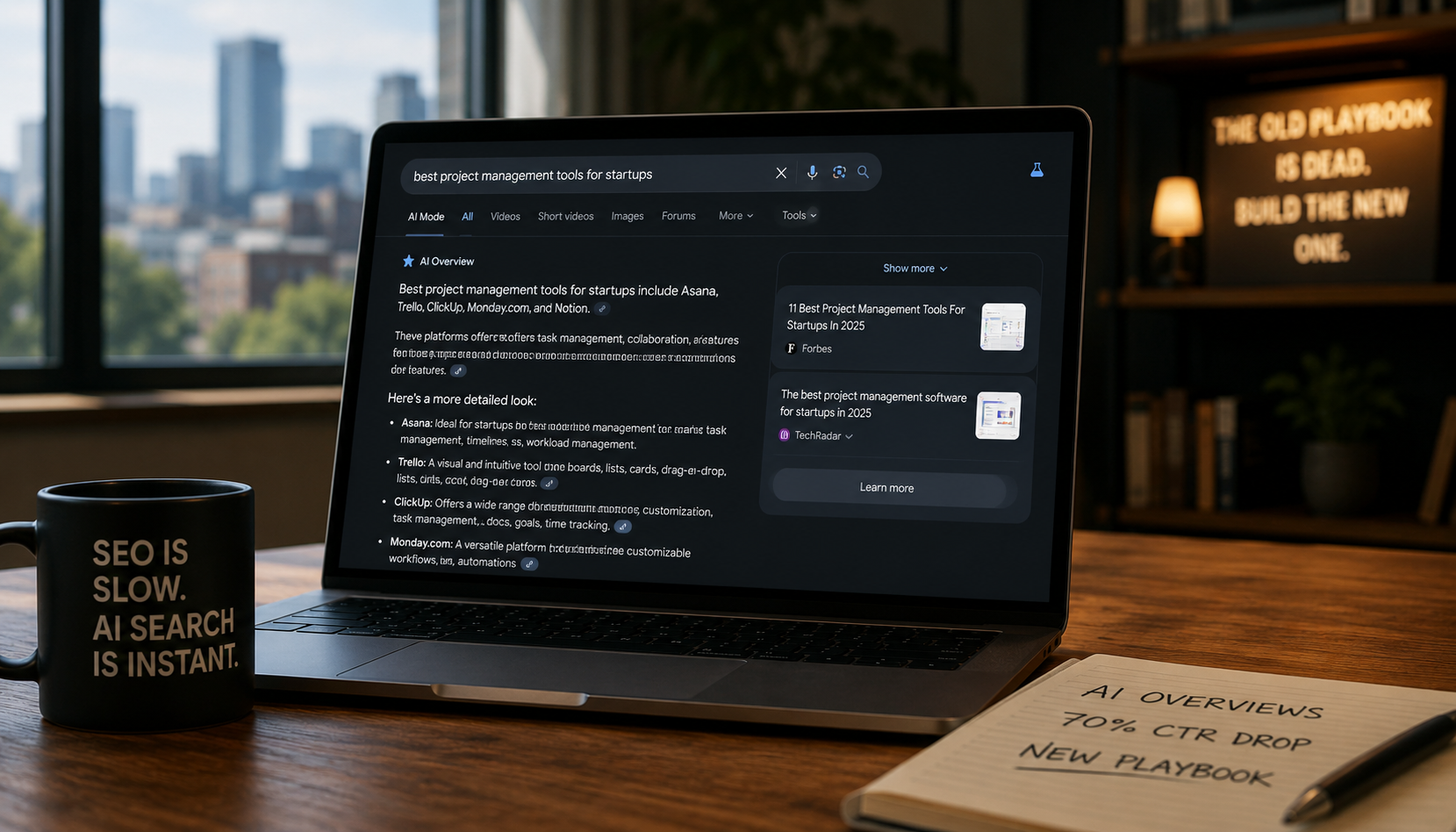
For the better part of two decades, digital marketers ran on one comfortable assumption: SEO is slow, paid is fast, so you bridge the gap. The logic went like this — your organic rankings will take six to twelve months to mature, so in the meantime you pour money into Google Ads to keep leads flowing. Paid was the bridge. SEO was the destination. The two lived on separate timelines, and you sequenced them accordingly.
That model is breaking. AI search didn't just chip away at it — it pulled out the structural beam. The bridge and the destination are now the same place, and they're both being rebuilt at the same time. If you're still treating paid ads as a holding pattern while SEO "catches up," you're running a 2019 strategy in a 2026 environment.
Here's what actually changed, and what it means for how you should be allocating budget right now.
The old playbook, briefly
The traditional funnel logic was sound for its era. Search engine results pages were predictable real estate: a few ads at the top, organic listings below, and a clear path where a user typed a query, scanned results, and clicked something. Informational searches ("how does X work," "best way to do Y") fed the top of your funnel. Transactional searches converted at the bottom. You bought your way to the top of the page while you earned your way there organically.
Paid ads delivered immediate visibility. SEO delivered cheaper, compounding visibility over time. So the strategy wrote itself: launch, run paid aggressively, taper as organic rankings climbed, and eventually let SEO carry the load while paid handled the high-intent money keywords.
The entire model depended on one thing being true — that the search results page rewarded clicks, and that the top of the page was where attention lived.
What AI search actually did
AI Overviews and conversational AI search inserted a synthesized answer above everything advertisers were competing for. The user gets their answer before they ever reach an ad or an organic link. And the data on what this did to paid performance is no longer theoretical.
Seer Interactive found that paid click-through rate for queries with AI Overviews dropped from 19.70% to 6.34% between June 2024 and September 2025 — a collapse of nearly 70% on affected queries (Search Influence, May 2026). Neil Patel's team observed AI Overviews cutting paid CTR by more than 50% for affected queries, with informational searches the most vulnerable (Neil Patel, May 2026).
The search intelligence platform Adthena analyzed performance across more than 5 million ads in six major industries from late December 2025 through January 2026. Their headline finding was sharp: aggregate data looks stable, but the real picture doesn't. Across those six industries, roughly one in four paid ads is now impacted by AI Overviews, and in healthcare, ads appear below the AI Overview about 64.6% of the time (Search Engine Land, February 2026).
The mechanism is straightforward and brutal. When an AI Overview pushes your ad below the fold, you get lower CTR, which means fewer clicks, which means fewer conversions — while your costs stay flat or climb. Cross-industry average CPC on Google Search hit $2.96–$4.22 in 2026, the steepest annual increase since 2021, driven in part by AI search competition and organic click compression (BizIQ, June 2026). You're paying more per click for fewer clicks on the exact upper-funnel keywords that used to be your cheap, reliable bridge.
That's the part the old playbook can't survive. The "run paid while you wait" strategy leaned hardest on informational, upper-funnel queries — and those are precisely the queries AI Overviews now answer directly, before the user ever sees an ad.
The plot twist: you can pay to show up in AI search too
Here's where it gets genuinely interesting, and where most businesses are still asleep.
The waiting game that defined SEO doesn't exist for AI search in the way people assume. On February 9, 2026, OpenAI began testing ads inside ChatGPT. By May 5, 2026, it had opened a self-serve Ads Manager to US advertisers with no minimum spend, added cost-per-click bidding alongside its CPM model, and launched both a measurement pixel and a Conversions API (Choice Marketing, 2026). The first confirmed live ChatGPT ad spotted in the wild was from Expedia, appearing on the very first response to a travel-planning prompt — no extended conversation required (Adthena, April 2026).
ChatGPT processes around 2.5 billion prompts daily, and OpenAI moved from a limited pilot requiring $200,000 minimum commitments to a fully self-serve platform in roughly three months (2POINT, 2026). Google, for its part, has expanded ads into and around AI Overviews and is pushing conversational ad formats through AI Mode (Birch, May 2026).
So the framing that "you have to wait on SEO but paid is instant" was always half the story. The corrected version for 2026 is this: paid placement in AI search is available now, and organic placement in AI search has to be built deliberately — not inherited from your Google SEO.
Why your existing SEO doesn't automatically carry over
This is the trap. A lot of businesses assume that because they rank well on Google, they'll naturally show up in AI answers. They won't, not reliably. The retrieval logic is different.
ChatGPT and other answer engines pull heavily from listicles, review platforms, community discussions, and authoritative third-party sources that don't always match Google's top blue links (AIclicks, June 2026). Showing up in AI answers — what's increasingly called Answer Engine Optimization, or AEO — rewards a different set of moves: answer-first content structure, clear sections, lists and tables that LLMs can lift cleanly, schema markup, and presence across the third-party sources AI systems already trust.
There's also a purely technical layer most teams haven't touched. Appearing in ChatGPT's organic answers depends on allowing the OAI-SearchBot crawler. Blocking it removes you from those results entirely, and these crawler tokens operate independently — allowing one doesn't allow the others (Choice Marketing, 2026). Plenty of sites are invisible in AI search right now for reasons that have nothing to do with content quality and everything to do with a robots.txt file nobody updated.
The new sequencing logic
So the old timeline — paid first, SEO eventually — gets replaced by something more demanding but also more honest: everything starts at once.
There's a structural reason to move early rather than wait. The brands investing in AI visibility now are establishing organic presence that reduces their paid dependency over time, while brands that wait face structurally higher customer acquisition costs as AI-driven discovery becomes the default (GoHighLevel analysis, 2026). The compounding advantage of organic search didn't disappear — it just moved into a channel where most of your competitors haven't planted a flag yet.
What this looks like in practice:
Run paid where intent is high, not where it's cheap. Transactional and high-intent searches are far less affected by AI Overviews, because users still have to take an action beyond reading the answer (Search Influence, 2026). Stop using paid to buy upper-funnel informational clicks that AI now eats for free. Concentrate spend on decision-stage queries.
Test AI search ads now, while they're underpriced. Analysts project well-optimized ChatGPT ad CTRs pushing toward 3–5%, which could bring effective CPC into the $0.50–$2 range and make the channel competitive with Google Search for high-intent categories (AI Advisors, 2026). Early channels reward early movers before bidding gets crowded.
Build SEO and AEO from day one, together. Not SEO first and AI optimization "later when we get to it." Answer-first content, schema, third-party authority, and proper crawler access are foundational now, not a phase-two project.
Change the metrics you watch. Raw click volume is a deteriorating signal. Share of voice, AI Overview citations, branded search growth, and assisted conversions tell you more about real performance in an AI-mediated funnel (Search Influence, 2026).
The bottom line
The "just run paid ads while SEO ramps up" model assumed two separate timelines and a search page that rewarded clicks. AI search collapsed both assumptions. The informational queries that paid ads used to harvest cheaply are now answered before anyone sees an ad. And the destination — organic visibility — has split into two channels, only one of which your existing SEO touches.
The replacement isn't complicated, but it is urgent: pay for placement in AI search now while it's cheap, focus traditional paid on genuine high-intent queries, and build your organic visibility for both Google and answer engines from the very start. There's no waiting room anymore. The brands treating AI search as a someday problem are quietly handing a permanent cost advantage to the ones who started today.
Is your marketing still running on the old playbook? If your paid spend is propping up rankings while your AI search presence sits at zero, you're paying more to reach fewer people — and the gap compounds every month. Ritner Digital builds search strategies for how people actually find businesses in 2026, across paid, organic, and AI search. Let's talk about where you're losing visibility →
Frequently Asked Questions
Does AI search really reduce the value of paid ads?
For a large and growing share of queries, yes. When an AI Overview appears above your ad, it answers the user's question before they ever reach a paid placement, which drives click-through rate down while your cost-per-click stays flat or rises. Seer Interactive measured paid CTR on AI Overview queries falling from 19.70% to 6.34% between June 2024 and September 2025 (Search Influence, 2026), and Adthena found roughly one in four paid ads is now impacted by AI Overviews across six major industries (Search Engine Land, 2026). The effect is heaviest on upper-funnel informational searches — exactly the queries the old "run ads while you wait" model relied on.
Are paid ads dead, then?
No. They've shifted, not disappeared. Transactional and high-intent searches remain far less affected, because users still have to take an action beyond reading the AI answer (Search Influence, 2026). The takeaway isn't "stop running paid" — it's "stop using paid to buy cheap informational clicks AI now answers for free, and concentrate spend on decision-stage queries."
Can you actually pay to show up in AI search?
Yes. OpenAI began testing ads inside ChatGPT on February 9, 2026, and opened a self-serve Ads Manager to US advertisers with no minimum spend on May 5, 2026, adding cost-per-click bidding, a measurement pixel, and a Conversions API (Choice Marketing, 2026). Google has also expanded ads into and around its AI Overviews and AI Mode (Birch, 2026). Paid placement in AI search is available right now — there's no waiting period the way there is with organic ranking.
Will my existing Google SEO automatically make me show up in ChatGPT answers?
Not reliably. Answer engines pull heavily from listicles, review platforms, community discussions, and authoritative third-party sources that don't always match Google's top results (AIclicks, 2026). There's also a technical layer: appearing in ChatGPT's organic answers depends on allowing the OAI-SearchBot crawler, and blocking it removes you entirely (Choice Marketing, 2026). Ranking well on Google is a head start, not a guarantee.
What is Answer Engine Optimization (AEO)?
AEO is optimizing your content to be surfaced and cited inside AI-generated answers rather than just ranking in traditional search results. In practice it rewards answer-first content structure, clear sections, lists and tables that language models can lift cleanly, schema markup, and presence across the third-party sources AI systems already trust (AIclicks, 2026). It runs alongside SEO, not after it.
How much do ChatGPT ads cost right now?
Early reporting puts placements around $25–$60 CPM with roughly $3–$5 CPC bid floors, though analysts project that as well-optimized CTRs climb toward 3–5%, effective CPC could fall into the $0.50–$2 range — making the channel competitive with Google Search for high-intent categories (AI Advisors, 2026). The pricing reflects an early, still-maturing channel, which is part of why moving now carries an advantage.
Should I really start SEO and AI search optimization at the same time?
Yes — that's the core shift. The old logic sequenced them (paid first, SEO later). The 2026 reality is that both organic channels have to be built from the start, because the brands investing in AI visibility now are establishing presence that lowers paid dependency over time, while those who wait face structurally higher acquisition costs as AI-driven discovery becomes the default (GoHighLevel analysis, 2026).
What metrics should I track instead of clicks?
Raw click volume is a weakening signal in an AI-mediated funnel. More useful indicators include share of voice, AI Overview and AI answer citations, branded search growth, and assisted conversions (Search Influence, 2026). These tell you whether you're staying visible where decisions actually get made, rather than just counting clicks that are drying up.