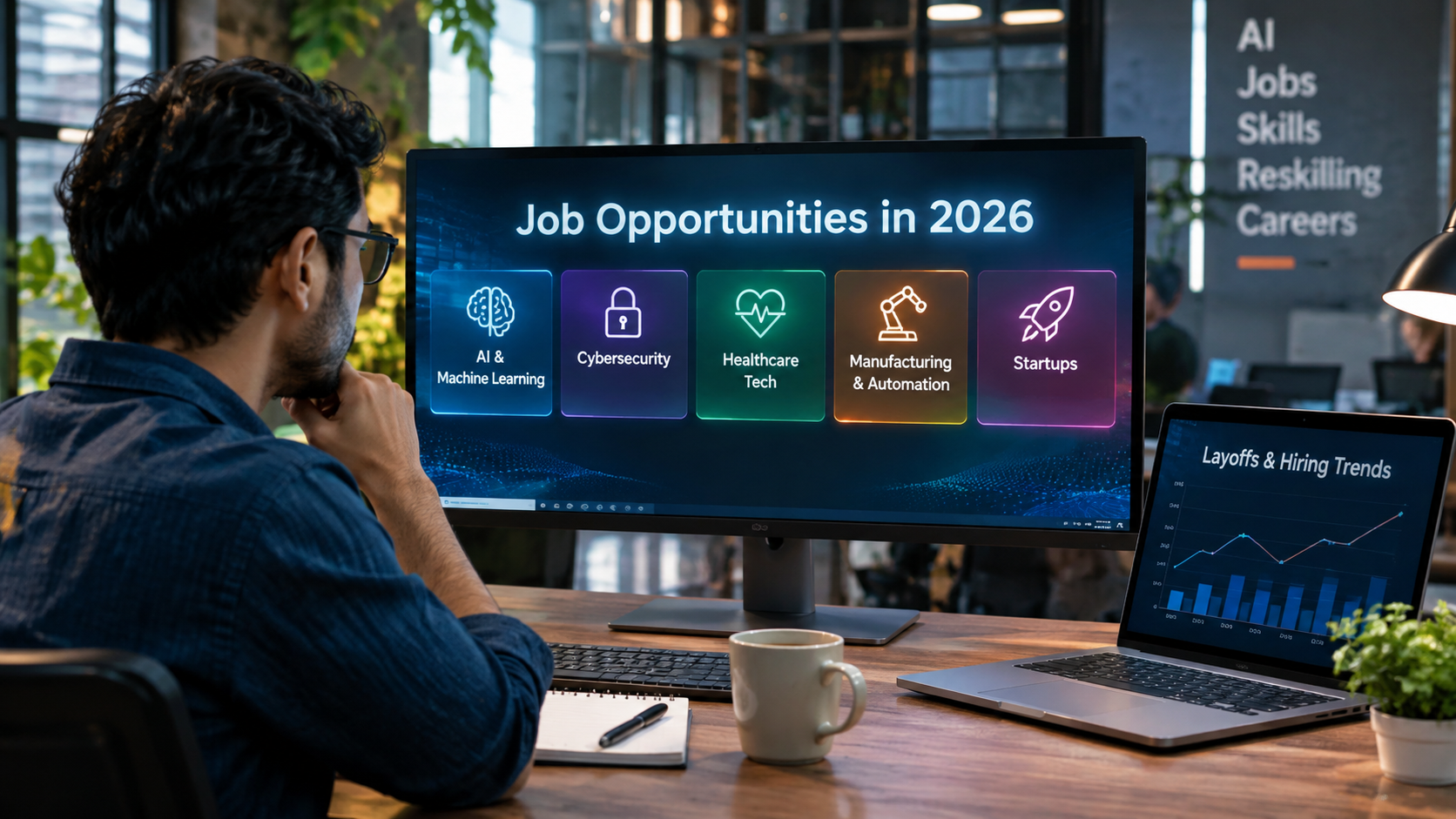
Technology companies are cutting thousands of jobs, but demand for technical expertise has not disappeared. From artificial intelligence and cybersecurity to healthcare, manufacturing, and new startups, the 2026 employment landscape reveals an industry undergoing a major redistribution of talent.
The Great Tech Talent Reshuffle of 2026
For years, working at a major technology company represented one of the most attractive career paths in the American economy.
Companies such as Amazon, Microsoft, Google, Meta, and other technology giants offered competitive salaries, sophisticated workplaces, ambitious projects, and the opportunity to build products used by millions of people.
A job in Big Tech often represented professional stability, career advancement, and access to the industry's most influential networks.
But the employment landscape has changed.
In 2026, technology layoffs have continued across major corporations and smaller businesses.
Experienced software engineers, product managers, designers, analysts, recruiters, and other professionals have found themselves navigating a job market that looks different from the one they entered.
Yet the story is more complicated than a technology industry in decline.
Businesses are still investing in software, data infrastructure, cybersecurity, automation, and artificial intelligence.
Industries that were once considered less glamorous than Silicon Valley are increasingly competing for technical expertise.
Startups are exploring opportunities created by emerging technologies.
And some experienced professionals are reconsidering whether they want another corporate position at all.
The central question is no longer simply why technology companies are laying people off.
It's where the talent is going next—and what that movement reveals about the future of work.
How Many Tech Workers Have Been Laid Off in 2026?
The numbers are significant, although the exact totals depend on which source is used.
As of November 21, 2026, technology employment tracker TrueUp reported approximately 209,841 people laid off at technology companies during the year, across 742 layoff events.
Another industry tracker, Layoffs.fyi, reported a lower total because its database uses different reporting and inclusion methods.
These differences matter.
A layoff tracker may count announced reductions, reported employment losses, or specific categories of technology companies.
Some count worldwide layoffs.
Others focus on particular regions or require publicly disclosed headcounts.
Some announcements also describe planned reductions rather than completed separations.
For that reason, it is more accurate to describe the scale of layoffs using attributed figures than to present a single number as an undisputed industry total.
What is clear is that substantial workforce reductions have continued throughout 2026.
Major technology employers have reorganized departments, reduced operating expenses, and shifted investments toward new priorities.
But layoffs alone do not tell us whether demand for technology workers is disappearing.
To understand that, we also need to examine hiring.
According to Dice's October 2026 Tech Jobs Report, technology job postings increased 4% from September and 20% compared with October 2025.
AI and machine learning postings increased 91% year over year.
Those figures do not mean that every laid-off worker can easily find a comparable job.
They do suggest that technology employment is changing rather than uniformly contracting.
Sources:
TrueUp — Technology Layoffs Tracker
Layoffs.fyi — 2026 Technology Layoffs
Dice — 2026 Technology Jobs Report
Why Are Technology Companies Still Cutting Jobs?
There is no single explanation for the layoffs of 2026.
Different businesses face different financial pressures, competitive challenges, and operational priorities.
Some are reducing costs.
Others are reorganizing after years of expansion.
Some are changing their product strategies.
And many are investing heavily in artificial intelligence.
The Aftereffects of Earlier Hiring
During periods of rapid growth, technology companies expanded their workforces to support ambitious business plans.
As economic conditions and corporate priorities changed, some organizations reassessed their staffing levels.
Departments built around earlier growth expectations may no longer fit current operating strategies.
This does not mean that every eliminated position was unnecessary.
It means companies are making decisions based on their present financial and strategic objectives.
Pressure to Improve Efficiency
Large organizations face continuing pressure to control expenses and demonstrate returns on investment.
Labor is a significant operating cost.
When executives pursue restructuring, workforce reductions may become part of the strategy.
But lower headcount does not automatically produce better products, stronger customer relationships, or long-term growth.
The effects depend on which positions are eliminated and how the remaining organization operates.
Artificial Intelligence Investment
AI has become a major priority for technology companies.
Businesses are investing in computing infrastructure, machine learning systems, automation, and AI-enabled products.
Some organizations are redirecting spending toward these areas while reducing positions elsewhere.
Reuters has documented companies linking restructuring and workforce decisions to AI-related investment and operational changes.
However, it is important to distinguish between jobs directly automated by AI and jobs eliminated during a broader restructuring that includes AI investment.
Those are not necessarily the same thing.
A company may reduce staff while funding AI infrastructure without proving that AI software directly replaced each eliminated worker.
Changing Business Models
Technology businesses also face changing customer expectations.
Subscription products, advertising platforms, enterprise software, and digital services all operate in competitive markets.
Companies may discontinue products, combine departments, or redirect resources toward areas they believe offer better opportunities.
The result can be simultaneous layoffs and hiring within the same organization.
That is one reason technology employment headlines can appear contradictory.
Source: Reuters — Companies Cutting Jobs as Investments Shift Toward AI
Where Is the Tech Talent Actually Going?
One of the most important limitations of the available data is that layoff trackers generally do not follow individual workers into their next jobs.
They can document announced reductions.
They cannot reliably tell us where every affected employee eventually works.
Some people find new technology positions.
Others move into different industries.
Some become consultants or founders.
Some pursue additional education.
And others remain unemployed or leave the workforce.
There is no single verified destination for all displaced technology workers.
However, hiring data and industry investment patterns identify several areas where technical skills remain relevant.
These are the sectors and career paths worth watching.
1. Artificial Intelligence and Machine Learning
Artificial intelligence is one of the clearest areas of continuing demand for specialized technical skills.
The Dice October 2026 report found that AI and machine learning technology job postings increased 91% compared with October 2025.
That was substantially faster than the 20% year-over-year increase reported for technology postings overall.
The distinction is important.
The broader technology job market may be difficult for some applicants, while employers simultaneously compete for workers with particular AI-related capabilities.
What Types of Skills Are Relevant?
AI development and implementation can involve machine learning engineering, data engineering, software development, model evaluation, infrastructure management, security, and product design.
Organizations also need people who understand how to integrate AI systems into existing operations.
That may involve connecting AI tools to business databases, designing workflows, testing outputs, managing access permissions, and monitoring reliability.
Not every AI-related role requires building a foundation model.
Many businesses need professionals who can apply existing technologies responsibly.
Why Experience Still Matters
AI tools can produce code, text, images, and analyses.
But businesses still need people who can determine whether those outputs are accurate and useful.
Experienced engineers understand system dependencies, security requirements, testing procedures, and production environments.
Those responsibilities do not disappear simply because a tool can generate code.
Instead, the nature of the work may change.
The opportunity is not limited to people who can operate an AI chatbot.
It extends to professionals who can combine technical knowledge with judgment.
The Important Qualification
Growing AI job postings do not mean every displaced technology worker can transition immediately.
Specialized roles may require skills or experience that applicants do not currently possess.
Competition may also remain intense.
The evidence supports describing AI as an area of growing employer demand, not as a guaranteed solution to technology unemployment.
2. Cybersecurity and Digital Risk
Cybersecurity remains a critical function for organizations that depend on connected systems.
Banks, hospitals, manufacturers, retailers, public agencies, and technology companies all need to protect sensitive information and operational infrastructure.
As businesses adopt cloud services, AI tools, and connected devices, their security responsibilities can become more complicated.
This creates potential opportunities for professionals with experience in network administration, software engineering, systems architecture, identity management, and information security.
Why Cybersecurity Extends Beyond Tech Companies
Cybersecurity is not exclusively a Silicon Valley profession.
A hospital must protect patient information.
A manufacturer may need to secure connected production equipment.
A financial institution must manage account security and fraud risks.
A logistics company may rely on interconnected transportation and inventory systems.
All of these organizations use technology.
They may not describe themselves as technology companies, but they need technical expertise.
What Employers May Value
Relevant capabilities include threat analysis, incident response, secure software development, access management, cloud security, and regulatory awareness.
Professionals who understand both technical systems and business operations may be especially useful.
However, cybersecurity is not automatically an easy career transition.
Many positions require specialized experience, certifications, or familiarity with particular environments.
The opportunity is real, but preparation matters.
3. Healthcare Technology and Digital Health
Healthcare is another industry where technology plays an increasingly important role.
Hospitals, medical practices, insurers, research organizations, and healthcare technology businesses depend on software and data systems.
Their needs extend beyond patient-facing applications.
They also require scheduling platforms, electronic health record systems, billing technology, cybersecurity, analytics, and operational software.
Dice's October 2026 report found a 15% month-over-month increase in technology job postings in healthcare.
That is a useful indicator of hiring activity during the reporting period.
It is not proof that healthcare absorbed a particular number of laid-off technology workers.
Why Healthcare Needs Technical Expertise
Healthcare organizations manage complicated workflows.
Information must move accurately between departments and systems.
Technology failures can create serious operational problems.
Professionals with experience in software development, databases, systems integration, security, and user experience may contribute to these environments.
The Importance of Domain Knowledge
Healthcare technology often involves sensitive information and regulated processes.
A software engineer moving into healthcare may need to learn new standards, privacy requirements, and operational practices.
Technical expertise remains important, but industry knowledge becomes part of the job.
That combination may shape the next generation of healthcare technology careers.
4. Manufacturing, Robotics, and Industrial Automation
Manufacturing is often overlooked in conversations about technology careers.
Yet modern factories rely on sophisticated digital systems.
Production environments may use industrial robots, sensors, manufacturing execution systems, enterprise software, predictive maintenance tools, and automated inspection equipment.
These technologies require people who understand both software and physical operations.
According to Dice, technology job postings in manufacturing increased 9% month over month in October 2026.
The report also identified strong year-over-year posting growth in manufacturing.
Why Manufacturing Is Becoming More Technical
Manufacturers face pressure to improve productivity, maintain quality, reduce downtime, and manage complex supply chains.
Technology can support those objectives.
For example, production data may help identify equipment problems.
Computer vision systems may assist with inspection.
Software platforms may connect inventory information to production schedules.
Automation may support repetitive processes.
But these systems need to be designed, maintained, secured, and evaluated.
Opportunities for Technology Professionals
Software engineers may contribute to industrial applications.
Data specialists may work with production analytics.
Cybersecurity professionals may help protect operational technology.
Product managers may coordinate industrial software development.
Technical writers may create documentation for equipment, software, and manufacturing processes.
This is particularly relevant to professionals who want to apply their skills outside consumer technology.
Why Technical Communication Matters
Industrial technology can be complicated.
Employees need clear instructions.
Customers need accurate product information.
Engineers need reliable documentation.
And businesses need content that explains what their systems do.
That creates opportunities for professionals who can translate specialized knowledge into useful information.
At Ritner Digital, technical writing and SEO content are part of helping specialized businesses communicate their expertise online.
The same principle applies to the broader workforce: technical knowledge becomes more valuable when people can explain and apply it effectively.
5. Aerospace, Defense, and Complex Engineering
Aerospace and defense organizations depend on advanced engineering, software, electronics, cybersecurity, and data systems.
They develop and maintain technologies used in aviation, communications, navigation, logistics, and other complex environments.
Dice reported that technology job postings in aerospace and defense increased 8% month over month in October 2026.
It also identified strong year-over-year growth in this industry.
Why These Roles Differ From Consumer Tech
Many aerospace and defense projects involve long development cycles, specialized hardware, and extensive testing.
Software may need to operate reliably under demanding conditions.
Documentation and verification can be especially important.
Some positions also have citizenship, security clearance, or other eligibility requirements.
These factors can make transitions more complicated.
Skills That May Transfer
Relevant experience can include embedded software, systems engineering, cybersecurity, simulation, data analysis, and technical program management.
However, transferring from consumer software to a highly specialized engineering environment may require additional training.
The broader lesson is that technical employment extends far beyond familiar internet companies.
6. Insurance, Financial Services, and Enterprise Technology
Some of the strongest opportunities for technical professionals may be found in industries that are not usually associated with startup culture.
Insurance is one example.
According to Dice, technology job postings in insurance increased more than 30% month over month in October 2026.
The report linked the sector's hiring activity to modernization needs and demand for cloud, data, AI, and cybersecurity expertise.
Why Established Industries Need Technology Workers
Many large organizations operate complicated systems developed over years or decades.
Replacing or updating those systems can be difficult.
Businesses may need to modernize databases, improve customer platforms, integrate new applications, and maintain existing infrastructure.
That creates work for engineers and analysts who understand reliability, integration, and business operations.
The Value of Less Glamorous Technology
Not every important technology project involves a revolutionary consumer application.
A system that improves insurance processing, reduces administrative errors, or helps employees access accurate information can create substantial business value.
For professionals leaving Big Tech, established industries may offer opportunities to apply familiar skills to different problems.
But job requirements, compensation, work arrangements, and career progression can vary significantly.
7. Startups and Founder-Led Businesses
Some displaced technology professionals may decide to start businesses rather than pursue another corporate position.
Others may join smaller startups where their experience can influence products and operations more directly.
This is a plausible pathway, but it is important not to exaggerate its scale.
There is not enough evidence from layoff counts alone to determine how many affected workers founded companies in 2026.
Why Experienced Professionals May Consider Entrepreneurship
Working at a large technology company can provide exposure to sophisticated products, technical systems, and business operations.
Employees may develop expertise in engineering, design, product management, marketing, or analytics.
After leaving those organizations, some may identify problems they believe they can solve independently.
Modern software tools can also reduce certain startup costs.
A founder may be able to build an initial website, prototype an application, or automate administrative tasks without hiring a large team immediately.
However, lower startup costs do not eliminate the challenges of acquiring customers, managing finances, or building reliable products.
The Rise of Smaller Technology Businesses
A startup does not need to compete directly with a major technology platform.
It might develop specialized software for a particular industry.
It could provide cybersecurity services to regional businesses.
It might build tools for healthcare operations or manufacturing.
It could offer AI implementation services to companies that lack internal expertise.
Or it might become a consulting practice focused on a particular technical problem.
These business models illustrate how technical expertise can be applied beyond traditional corporate employment.
Entrepreneurship Is Not a Guaranteed Safety Net
Starting a business involves risk.
Revenue may be unpredictable.
Customer acquisition can be difficult.
And founders often need skills outside their original technical specialties.
For someone facing financial uncertainty after a layoff, entrepreneurship may or may not be appropriate.
The important point is that independent business ownership represents one possible career path, not a universal answer.
8. Consulting, Freelancing, and Fractional Leadership
Another possible destination for experienced technology professionals is independent consulting.
Businesses may need technical expertise without requiring a full-time employee for every project.
A company might hire a consultant to assess cybersecurity risks.
Another might need temporary help with a cloud migration.
A startup may require an experienced product leader but lack the budget for a permanent executive.
These needs can create opportunities for project-based work.
What Is Fractional Leadership?
Fractional leadership generally refers to an experienced professional serving a business on a part-time or contracted basis.
Examples may include fractional chief technology officers, product leaders, or data executives.
The arrangement can allow a business to access senior expertise without employing the professional full time.
For the worker, it may create flexibility.
But independent work also requires client development, contracts, financial management, and the ability to handle inconsistent demand.
Why Communication Becomes Essential
A consultant cannot rely exclusively on technical ability.
Clients need to understand the problem being solved.
They need clear proposals, realistic timelines, and useful reporting.
Professionals who can communicate technical ideas in business terms may be better equipped to build client relationships.
That skill is increasingly relevant across both employment and entrepreneurship.
Are AI Tools Replacing Technology Workers?
This is one of the most difficult questions surrounding the 2026 layoffs.
Artificial intelligence can perform some activities that previously required human labor.
It can generate code, summarize documents, assist with customer support, and automate repetitive workflows.
These capabilities may influence staffing decisions.
But the relationship between AI and employment is complicated.
Task Automation Is Not Always Job Elimination
A job usually consists of multiple responsibilities.
Automating one task does not necessarily eliminate the entire position.
A software engineer may use AI to generate routine code while continuing to design systems, evaluate requirements, review security, and resolve complex problems.
A marketing professional may use AI for initial research while retaining responsibility for strategy, fact-checking, and client communication.
A technical writer may use AI to organize information but still need subject-matter review and accurate documentation.
The impact depends on the role, employer, and workflow.
Companies May Reallocate Spending
An organization may reduce staffing in one department while increasing investment in AI infrastructure.
That does not establish that an AI system directly performed the work of every eliminated employee.
The distinction is essential when interpreting corporate announcements.
New Tools Can Create New Responsibilities
AI systems also introduce work.
Businesses need to test outputs, manage data, evaluate security, establish appropriate controls, and monitor performance.
Those activities can require technical expertise.
However, it would be inaccurate to assume that every job eliminated through automation will be replaced by a new AI-related position.
Some workers may face difficult transitions.
Others may find that their existing skills need substantial updating.
The most defensible conclusion is that AI is changing the composition of work, with uneven effects across occupations and industries.
What Skills Are Becoming More Valuable?
The 2026 employment landscape suggests that technical professionals may benefit from combining specialized knowledge with broader business capabilities.
The following skills are relevant across several of the industries discussed.
Technical Depth
Expertise in software engineering, data systems, cybersecurity, cloud infrastructure, or another specialized field remains important.
Knowing how to use a tool is not the same as understanding the systems behind it.
AI Literacy
Professionals increasingly need to understand what AI tools can do, where they fail, and how to evaluate their outputs.
That does not mean everyone needs to become a machine learning engineer.
It means understanding how emerging tools affect the work.
Industry Knowledge
A developer who understands healthcare operations may contribute differently from one who understands manufacturing systems.
Domain expertise helps professionals connect technical solutions to real-world requirements.
Communication
Technical work often involves explaining complicated information to people with different backgrounds.
Clear writing, documentation, presentations, and stakeholder communication can make expertise more useful.
Problem Solving
Businesses need people who can identify problems, evaluate options, and implement workable solutions.
Those responsibilities extend beyond producing code or completing isolated tasks.
Adaptability
Tools, platforms, and employer priorities change.
Professionals who can learn new systems and apply existing knowledge in different environments may have more career options.
However, adaptability should not be treated as a guarantee against layoffs.
Economic conditions and employer decisions still affect individual outcomes.
What Does This Mean for Entry-Level Technology Workers?
Experienced professionals are not the only people affected by changes in technology employment.
Students, recent graduates, and workers entering the industry may face different expectations from those who began their careers several years ago.
Some routine tasks can now be assisted by AI.
Employers may expect new hires to use modern development tools.
And competition for entry-level positions can be intense.
The Challenge of Building Experience
Entry-level roles traditionally provide opportunities to learn through practical work.
If companies automate some junior-level tasks or reduce training positions, new workers may find it harder to develop that experience.
This is a potential challenge, although the effect varies by occupation and employer.
Why Projects and Demonstrated Skills Matter
Candidates can benefit from showing how they approach problems.
That might include software projects, technical documentation, internships, open-source contributions, or relevant work experience.
The objective is to demonstrate understanding rather than merely listing technologies on a résumé.
The Importance of Realistic Expectations
Not every technology graduate will begin at a major corporation.
Some may work in healthcare, manufacturing, government contracting, insurance, or smaller software companies.
These roles can provide meaningful experience.
The technology profession is broader than a handful of famous employers.
What the 2026 Layoffs Mean for Employers
The changing employment landscape also creates questions for businesses.
Companies may encounter experienced candidates who previously worked at large technology organizations.
But hiring talented people is not simply a matter of finding someone with a recognizable employer on a résumé.
Define the Actual Business Need
An organization should identify the problem it needs to solve before hiring.
Does it need a software engineer?
A cybersecurity specialist?
A data analyst?
A technical writer?
Or a consultant who can help evaluate technology options?
A clear job description improves the likelihood of finding relevant expertise.
Evaluate Transferable Skills
Candidates from large technology companies may possess useful experience.
However, their background may not perfectly match the requirements of a smaller business.
Employers should consider both technical ability and the capacity to adapt to different operating environments.
Support Training and Integration
Moving from a technology company into healthcare, manufacturing, or another specialized industry may require additional learning.
Employers that provide appropriate onboarding can help employees become effective more quickly.
Avoid Assuming Layoffs Mean Talent Is Inexpensive
A difficult job market does not eliminate the value of experience.
Compensation expectations vary by role, location, and specialty.
Businesses should evaluate the market realistically rather than assuming that every laid-off professional will accept substantially lower compensation.
The Geographic Side of the Tech Talent Shift
Technology employment is often associated with a few major metropolitan areas.
Silicon Valley, Seattle, New York, Austin, and other technology centers have long attracted workers.
But technical jobs also exist throughout the country.
Manufacturers need software and automation expertise.
Hospitals require information technology professionals.
Financial institutions operate digital systems.
Regional businesses need cybersecurity and analytics support.
This creates the possibility of technical careers outside traditional technology hubs.
However, the availability of those jobs varies significantly by location.
Some positions require on-site work.
Others may be hybrid or remote.
Compensation and career opportunities also differ.
It would be premature to conclude that the 2026 layoffs have caused a definitive nationwide migration of technology workers without stronger geographic employment data.
The more supportable observation is that technology skills are relevant across a wider range of industries and locations than the traditional Big Tech narrative suggests.
Why Marketing and Technical Communication Matter in This Transition
When technology professionals enter new industries or start businesses, they encounter a challenge that is easy to overlook.
They need to explain what they do.
A cybersecurity consultant may understand complex threats but struggle to communicate their value to a small-business owner.
A software founder may build a useful product but have difficulty describing its benefits.
An industrial technology company may develop sophisticated equipment but lack clear educational content for potential customers.
Technical expertise does not automatically translate into effective marketing.
That is where communication becomes important.
Technical Writing Makes Complex Ideas Accessible
Technical writing helps explain specialized information accurately and clearly.
It can support product documentation, user instructions, educational resources, and technical marketing materials.
For businesses selling complicated products or services, clear explanations can help potential customers make informed decisions.
SEO Helps Relevant Audiences Find Information
Search engine optimization involves improving the accessibility, relevance, and discoverability of website content.
A business may have valuable expertise, but prospective customers still need ways to find it.
Useful articles, accurate service pages, and well-organized information can support that process.
AI Search Adds Another Consideration
As people use AI assistants to research businesses and technical subjects, organizations need to think about how their information is represented online.
Accurate, accessible content may help search and AI systems understand a business.
However, no content strategy can guarantee that a company will be recommended by a particular AI assistant.
How Ritner Digital Approaches This Work
At Ritner Digital, the focus is on helping businesses communicate their expertise through SEO, AI search strategy, content development, and technical writing.
For technology startups, manufacturers, professional services firms, and other specialized businesses, that may involve translating complicated offerings into clear information.
The goal is not to replace technical expertise with generic marketing language.
It is to make that expertise easier for the right audience to understand.
That principle becomes increasingly relevant as experienced technology professionals move into new industries, consulting practices, and entrepreneurial ventures.
Is the Traditional Big Tech Career Path Becoming Less Predictable?
The 2026 layoffs challenge the assumption that employment at a major technology company guarantees long-term stability.
Large companies can offer attractive compensation and career opportunities.
They can also restructure quickly.
Workers may have limited control over decisions involving product priorities, staffing, or investment.
That uncertainty is not unique to technology.
But the visibility of Big Tech layoffs has made it especially apparent.
Career Security and Employer Size Are Different Things
A large employer may have extensive resources.
That does not mean every role within the organization is secure.
A smaller employer may offer more direct responsibility but also face financial risks.
Neither option guarantees stability.
Professional Networks Matter
Maintaining relationships with colleagues, clients, and industry peers can help workers discover opportunities.
Networking does not replace qualifications.
But professional relationships can provide information and connections that are difficult to obtain through job applications alone.
Skills May Be More Portable Than Job Titles
A professional's long-term value may depend partly on capabilities that can transfer between employers.
Software development, systems analysis, cybersecurity, technical writing, and project management can be relevant in multiple industries.
However, transferring those skills may require additional domain knowledge.
The future of work may involve more frequent adaptation rather than a single predictable career ladder.
What Should Laid-Off Tech Workers Consider Next?
There is no universal career strategy that fits every person.
Financial circumstances, experience, location, family responsibilities, and professional interests all matter.
However, several practical questions can help someone evaluate their options.
Which Skills Are Most Transferable?
Consider the work performed rather than relying only on a previous job title.
A product manager may have experience coordinating teams and evaluating customer needs.
A software engineer may understand databases, APIs, or infrastructure.
A technical writer may be skilled at organizing complicated information.
These capabilities may be relevant beyond the original employer's industry.
Which Industries Need Those Skills?
Review job descriptions in healthcare, manufacturing, insurance, aerospace, and other sectors.
Look for recurring technical requirements.
The goal is to identify realistic opportunities rather than assuming every industry is hiring for every role.
Is Additional Training Necessary?
Some transitions may require new certifications, industry knowledge, or technical skills.
Training should be evaluated according to the actual requirements of target positions.
An expensive program is not automatically the best option.
Is Consulting a Realistic Choice?
Independent work may be appropriate for professionals with established expertise, relevant relationships, and the ability to acquire clients.
But it requires business development and financial planning.
What Does the Available Evidence Show?
Industry headlines can be useful starting points.
They should not replace research into actual job postings, compensation, employer requirements, and local opportunities.
The best next step depends on the individual.
What Might the Technology Workforce Look Like in 2027 and Beyond?
The long-term effects of the 2026 layoffs are still uncertain.
It is possible that AI-assisted workflows will change how organizations structure teams.
Some technical roles may become more specialized.
Others may combine responsibilities that were previously separated.
Businesses outside the traditional technology sector may continue investing in digital systems.
And experienced professionals may create new startups and consulting businesses.
But these developments should be treated as possibilities and emerging patterns, not guaranteed outcomes.
The evidence available in late 2026 shows both substantial layoffs and demand for particular technology skills.
It does not establish exactly how the workforce will be distributed several years from now.
That uncertainty is part of the story.
Conclusion: Technology Talent Is Not Simply Disappearing
The 2026 technology layoffs have affected a substantial number of workers.
For people who lose their jobs, the consequences can be serious.
Career transitions may involve financial uncertainty, difficult searches, relocation decisions, or the need to develop new skills.
Those experiences should not be minimized by describing every layoff as an exciting opportunity.
At the same time, the available evidence does not support the conclusion that demand for technology expertise has vanished.
Hiring data points to activity in AI, healthcare, manufacturing, insurance, aerospace, and other industries.
Some professionals may move into those fields.
Others may find new positions at technology companies.
Some may become consultants, freelancers, or founders.
And some may experience prolonged unemployment.
We do not yet have comprehensive evidence showing exactly where every displaced worker is going.
But the broader employment picture suggests that technology work is increasingly distributed across many parts of the economy.
The next important technology career may not be at a famous software company.
It may involve modernizing a hospital system, protecting a manufacturer's network, developing industrial automation, improving financial infrastructure, or building a specialized startup.
The central question is not only how many technology jobs are being eliminated.
It is which problems businesses still need people to solve.
The future of technology work may be less about working for a technology company—and more about bringing technology expertise to industries that need it.
Building a Technology Business or Entering a New Industry?
Technical expertise is valuable, but customers still need to understand what a business offers.
Whether you're launching a technology startup, building an independent consulting practice, or marketing specialized products and services, clear communication can help you reach the right audience.
Ritner Digital works with businesses on SEO, AI search visibility, content strategy, and technical writing.
We help translate complicated ideas into useful information that potential customers can discover and understand.
Ready to strengthen your business's digital presence?
Frequently Asked Questions
1. How many technology workers have been laid off in 2026?
As of November 21, 2026, TrueUp reported approximately 209,841 layoffs at technology companies during the year. Other trackers report different totals because of differences in definitions, sources, and counting methods.
2. Why are technology companies laying off employees in 2026?
Reasons vary by company and may include restructuring, cost reduction, changing business priorities, earlier hiring decisions, and investment shifts involving AI. Not every layoff is directly caused by automation.
3. Where are laid-off technology workers finding new jobs?
There is no comprehensive public dataset tracking every affected worker's next destination. However, hiring data identifies opportunities in AI, healthcare, manufacturing, insurance, aerospace, and other industries.
4. Is artificial intelligence replacing software engineers?
AI can automate or assist with some software development tasks, but that does not mean it replaces every responsibility performed by engineers. Its employment effects vary by role and organization.
5. Are AI jobs growing in 2026?
Dice reported that AI and machine learning technology job postings increased 91% year over year in October 2026. That indicates growing posting activity, although it does not guarantee employment for every applicant.
6. Is cybersecurity a good career transition for technology workers?
Cybersecurity may be relevant for professionals with experience in networking, systems, software, and information security. However, many roles require specialized knowledge and practical experience.
7. Are healthcare companies hiring technology professionals?
Dice reported a 15% month-over-month increase in healthcare technology job postings in October 2026. Specific opportunities depend on employers, locations, and required qualifications.
8. Why does manufacturing need technology workers?
Manufacturers use software, robotics, automation, sensors, data systems, and connected equipment. These technologies require development, maintenance, integration, and security expertise.
9. Are aerospace and defense companies hiring technology workers?
Dice identified month-over-month and year-over-year growth in technology job postings in aerospace and defense during October 2026. Some positions have specialized eligibility or technical requirements.
10. Are laid-off technology workers starting businesses?
Some professionals may pursue entrepreneurship, consulting, or freelancing. However, layoff statistics do not establish how many affected workers have founded businesses.
11. What is fractional technology leadership?
Fractional leadership involves an experienced professional providing executive or senior-level services to a business on a part-time or contracted basis.
12. What skills are valuable for technology workers in 2026?
Relevant capabilities include specialized technical expertise, AI literacy, cybersecurity, data management, communication, problem solving, and industry-specific knowledge.
13. Is it harder for entry-level technology workers to find jobs?
Some entry-level applicants face intense competition and changing employer expectations. Conditions vary by specialty, location, and organization, so broad industry headlines should not replace research into specific roles.
14. Will technology jobs continue changing in 2027?
Technology employment is likely to evolve as businesses adopt new tools and reorganize operations. However, the scale and direction of future changes cannot be established with certainty from current layoff figures.
15. How can Ritner Digital help technology startups and specialized businesses?
Ritner Digital provides SEO, AI search strategy, content development, and technical writing services designed to help businesses explain their expertise and improve their online visibility.
Sources and References
1. TrueUp — Tech Layoffs Tracker, 2026
Tracks reported technology company layoffs and provides historical comparisons. Figures change as additional announcements are recorded.
2. Layoffs.fyi — Technology Layoffs in 2026
https://layoffs.fyi/2026-layoffs/
An additional source for reported technology workforce reductions. Its methodology and totals differ from other trackers.
3. Dice — October 2026 Technology Jobs Report
https://www.dice.com/hiring/recruitment/reports/dice-tech-job-report
Provides technology job posting trends, including AI and machine learning growth and industry-level changes in healthcare, manufacturing, insurance, and aerospace and defense.
4. Reuters — Companies Cutting Jobs as Investments Shift Toward AI
Reports on corporate workforce reductions and changes in investment priorities involving artificial intelligence.
5. U.S. Bureau of Labor Statistics — Computer and Information Technology Occupations
https://www.bls.gov/ooh/computer-and-information-technology/
Provides occupational information, typical qualifications, employment projections, and wage data.
6. U.S. Bureau of Labor Statistics — Employment Situation
https://www.bls.gov/news.release/empsit.toc.htm
Official U.S. labor market reporting, useful for understanding broader employment conditions beyond the technology sector.
7. U.S. Bureau of Labor Statistics — Occupational Employment and Wage Statistics
Provides employment and wage information across occupations and industries.
8. U.S. Census Bureau — Business Formation Statistics
https://www.census.gov/econ/bfs/
Provides information about business applications and formation trends. These data should not be interpreted as a direct count of startups founded by laid-off technology employees.
9. Ritner Digital — Digital Marketing, SEO, and Technical Writing
Editorial and data note: This article reflects information available as of November 21, 2026. Layoff trackers and job posting databases use different methodologies. Job posting growth does not establish completed hiring, and the article does not claim to track the actual destinations of individual laid-off workers.