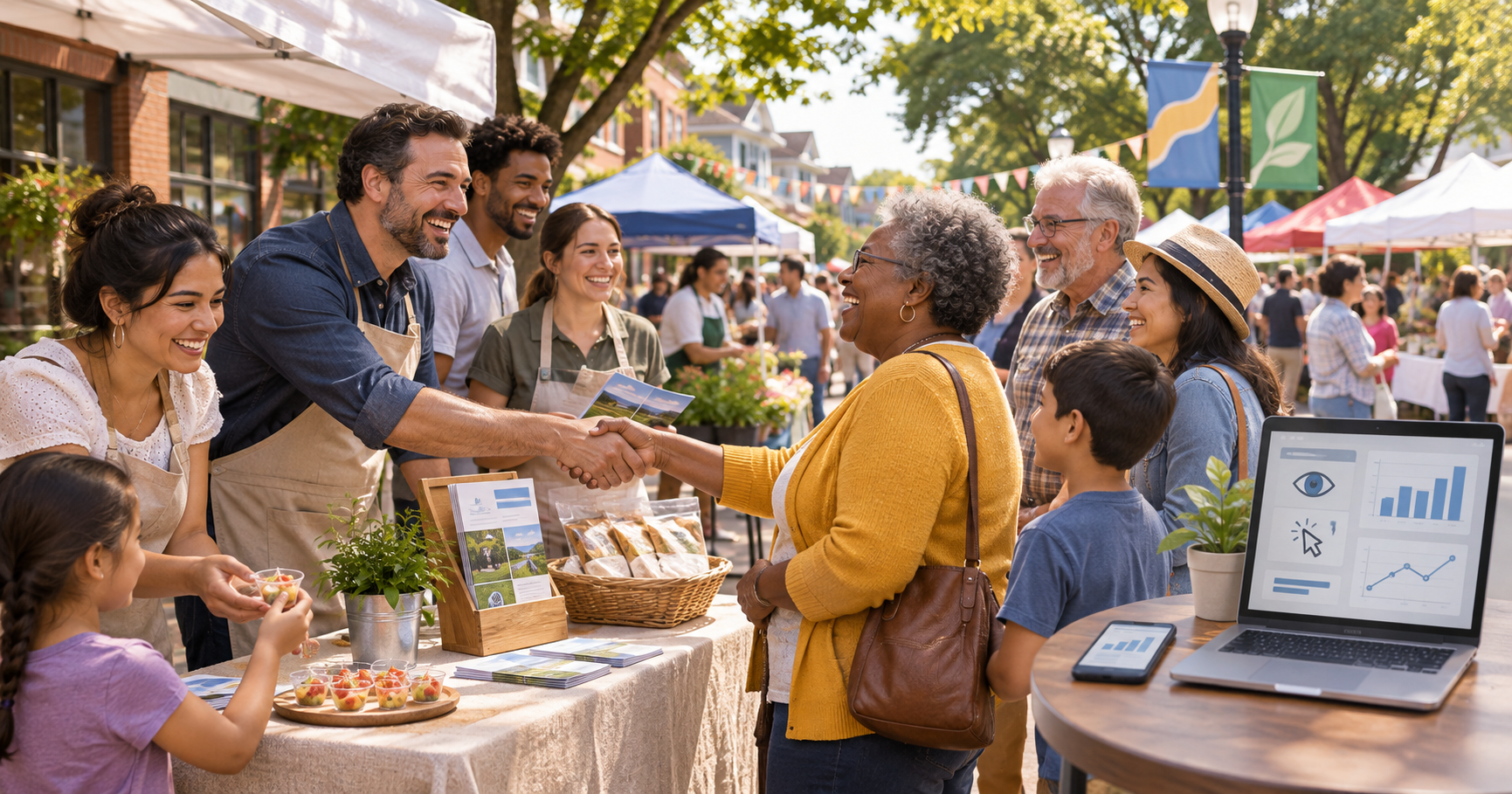
An investigation into why your business spent $30,000 convincing strangers to look at its advertisements, while the people who might become its most loyal customers were three blocks away, eating homemade cookies at a neighborhood fundraiser.
Somewhere in America, a small business owner is reviewing the monthly marketing report.
The business has been advertising consistently.
Facebook ads.
Instagram ads.
Google ads.
A few sponsored posts.
Some retargeting.
And a display campaign featuring an extremely attractive photograph of the company's products.
The marketing agency is enthusiastic.
The advertisements have generated 84,000 impressions.
Fantastic.
There have been 2,700 clicks.
Excellent.
The click-through rate is improving.
Wonderful.
The cost per thousand impressions is competitive.
Outstanding.
The business owner has learned enough advertising terminology to begin using the phrase "optimizing our customer acquisition funnel" during dinner.
Their spouse has requested that this stop.
But something strange is happening.
Despite all the digital visibility, the business still struggles to connect with people outside its existing customer base.
The same audiences keep seeing the same advertisements.
The same customers keep responding to promotions.
The social media followers seem reasonably engaged.
But the business isn't developing many new relationships.
Then, one Saturday morning, something unexpected happens.
The business owner agrees to participate in a neighborhood community event.
Nothing particularly glamorous.
A local fundraiser.
A few dozen small businesses.
Some volunteers.
A school music group.
A table selling homemade cookies.
A remarkably enthusiastic man organizing the parking.
The business doesn't have an elaborate booth.
There is no dramatic brand activation.
Nobody has hired an experiential marketing consultant to explain the importance of immersive customer engagement.
The owner simply shows up.
They donate a few supplies.
Help set up tables.
Talk with people.
Answer questions.
Meet other business owners.
And spend the afternoon participating in something the neighborhood actually cares about.
A woman mentions that she has lived nearby for six years but never visited the store.
Another person explains that they thought the business only served commercial customers.
A local teacher asks whether the company would be interested in helping with a school project.
Someone introduces the owner to the director of a community organization.
A volunteer recognizes the business name but admits she never understood what it sold.
By the end of the afternoon, the owner has learned more about the neighborhood than the advertising dashboard revealed in six months.
Not because the event magically generated a thousand new customers.
It didn't.
Not because community participation guarantees commercial success.
It doesn't.
But because the owner finally encountered people outside the carefully defined audience the advertising campaigns had been designed to reach.
People with different interests.
Different relationships.
Different reasons for being there.
And different ideas about what the business might contribute.
The owner returns to the office on Monday.
The agency presents the latest retargeting results.
"The algorithm is getting better at identifying people most likely to convert."
Wonderful.
But the owner has a question.
"What about the people the algorithm never thought to introduce us to?"
Welcome to community marketing.
Where a business can reach people by participating in something they already value, rather than attempting to persuade them to stop scrolling long enough to consider a product.
And where the most meaningful outcome may not be a transaction.
It may be a conversation.
A new relationship.
A partnership.
A better understanding of the neighborhood.
Or someone discovering that your business is more relevant to their life than they previously realized.
Advertising can help people notice your business. Community participation gives them an opportunity to experience who you are.
Those are different kinds of contact.
And they can support each other.
So let's investigate why community events can reach audiences your existing advertising rarely touches, what current research tells us about in-person connection, and how businesses of all kinds can participate without turning every community gathering into an elaborate lead-generation operation.
Because sometimes the most valuable thing your business can do is show up.
Not with a bigger banner.
But with an actual reason to be there.
Advertising Reaches Audiences. Community Events Create Encounters.
Let's begin with an important distinction.
Digital advertising can be extraordinarily useful.
It can introduce businesses to people who have never heard of them.
Reach customers actively searching for a service.
Promote a relevant event.
Support product launches.
And generate measurable commercial activity.
There is no reason to pretend advertising is obsolete.
The problem is assuming that an advertising audience represents the entire community your business could serve.
It doesn't.
Targeting Is Helpful. It's Also Selective.
Imagine a neighborhood fitness studio.
Its advertising campaigns target adults within a particular age range who have expressed interests in fitness, wellness, and exercise.
That can be a sensible starting point.
But who might the business miss?
Someone who has never belonged to a gym.
A parent whose online activity is mostly about school events.
An older adult who doesn't identify with conventional fitness advertising.
A local resident who wants to become more active but doesn't follow wellness accounts.
A person who assumes the studio is intended for experienced athletes.
Or someone who doesn't respond to fitness advertisements at all.
Now imagine the studio helping organize a community walking event.
People attend because they want to walk with neighbors.
They aren't necessarily shopping for a fitness membership.
But they meet the instructor.
Experience the business's approach.
And learn that the studio offers beginner-friendly classes.
The event provides context that an advertisement may not have supplied.
The Encounter Begins With Something Other Than a Sales Pitch.
This is what makes community participation interesting.
People may encounter the business while doing something meaningful to them.
Supporting a school.
Attending a cultural festival.
Participating in a charity walk.
Visiting an art show.
Joining a neighborhood cleanup.
Or learning a useful skill.
Their immediate purpose isn't necessarily commercial.
The business enters the relationship as a participant, contributor, organizer, or supporter.
That creates a different opportunity.
But it also creates a responsibility.
If your company participates only to extract email addresses, people may recognize the transaction disguised as goodwill.
And the event may accomplish the opposite of what you intended.
Community marketing works best when the business contributes something genuinely useful before expecting the community to contribute something back.
Not a particularly complicated principle.
Yet one that becomes surprisingly difficult once someone opens a spreadsheet labeled "Community Engagement ROI."
The 2026 Research: People Are Looking for More Real-World Connection
There's evidence that many consumers, especially younger adults, are interested in experiences that feel local, participatory, and less scripted.
In January 2026, Eventbrite published its Social Study, Reset to Real.
The study surveyed 4,051 adults ages 18–35 in the United States and United Kingdom, with fieldwork conducted in July 2025.
Among respondents:
79% expected to attend more events in 2026.
89% wanted events that connected them with their local community.
And 69% relied on personal networks and word of mouth to discover experiences.
The study also found growing interest in events combining different hobbies and interests.
For example, its platform analysis reported a substantial increase in attendance at coffee-and-running events in the United States.
These results describe younger adults in two countries.
They do not represent every age group.
And stated intentions about attending events are not the same as verified future behavior.
Eventbrite also operates an event-discovery business, so its research should be considered in that context.
But the findings are relevant.
People aren't necessarily looking for another polished promotional experience.
Many want gatherings where they can participate, discover something, and connect with other people.
The Important Word Is Participation
A community event isn't automatically valuable because it takes place outdoors or includes folding tables.
The experience needs a purpose.
A neighborhood art walk works because people want to see art.
A charity fundraiser works because people care about the cause.
A local food festival works because people want to try food and enjoy the atmosphere.
A workshop works because people want to learn something.
If your business can contribute to that existing purpose, it may become part of a positive experience.
But if your participation consists of interrupting people with a sales pitch, the effect can be different.
Nobody attends a community gardening workshop hoping to receive a 15-minute presentation about premium enterprise software.
At least not voluntarily.
Community Events Can Introduce You Through People Who Already Have Trust
Now let's discuss something advertising can't simply manufacture.
Existing relationships.
Imagine a neighborhood association organizing a community event.
Residents know the organizers.
They've attended previous gatherings.
They recognize the volunteers.
Perhaps they've participated for years.
Now your business becomes a supporter.
Someone might discover the business through a person or organization they already know.
That's different from encountering an unfamiliar advertisement.
Trusted Relationships Influence Discovery
Nielsen's 2021 Trust in Advertising study found that 88% of global respondents trusted recommendations from people they knew.
The research examined consumer perceptions across countries and advertising formats.
It's not proof that a neighborhood event will generate a particular sales increase.
Nor does it establish that everyone attending a sponsored event automatically trusts every participating business.
But it illustrates why personal recommendations can matter.
A friend saying, "You should meet the owner of that shop," is different from seeing a sponsored advertisement for the shop.
One introduces a business through a relationship.
The other introduces it through a paid message.
Both can be useful.
But they provide different kinds of context.
Borrowed Attention Is Not Borrowed Trust
Here's the important qualification.
Sponsoring a trusted organization doesn't automatically transfer its credibility to your brand.
A school may be respected.
A nonprofit may have strong community relationships.
A local festival may be beloved.
None of those facts guarantees that attendees will trust your company.
Trust still depends on what you do.
How you behave.
Whether your involvement is appropriate.
And whether your business delivers on its promises.
A giant banner doesn't establish character.
Neither does a donation accompanied by a photograph of the managing director handing over an oversized ceremonial check.
Community support can be meaningful.
But people can usually distinguish genuine participation from an elaborate publicity exercise.
Especially when the oversized check is larger than the actual donation.
The 2026 Brand Trust Research Reinforces the Importance of Relationships
Edelman's 2026 Trust Barometer Special Report on Brands surveyed 17,688 respondents across 15 countries.
The study found that 88% considered trust in a brand important or critical when purchasing.
It also emphasized that consumers are influenced by the voices of people and communities they trust.
These are consumer survey findings.
They are not causal evidence that sponsoring a community event increases purchases.
And they shouldn't be treated as precise benchmarks for every business category.
But the broader implication is relevant.
A company's message doesn't exist in isolation.
People interpret businesses partly through their experiences, relationships, and perceptions of relevance.
Advertising Says Something About You. Your Behavior Shows Something.
An advertisement can say:
"We care about our community."
Fine.
A business can communicate that claim repeatedly.
It can appear on billboards.
Social posts.
Website banners.
And company brochures.
But consider the alternative.
The business consistently supports a local youth program.
Its employees participate.
It collaborates with neighborhood organizations.
It provides appropriate resources.
And residents encounter its people as part of meaningful community activity.
Now the claim has visible behavior behind it.
That doesn't mean the business needs to advertise its generosity constantly.
In fact, excessive self-congratulation may undermine the message.
The value comes from contributing something real.
A brand promise becomes more credible when people can connect it to something the business actually does.
A revolutionary marketing concept.
Although it may require leaving the office.
Which was not included in the original campaign proposal.
The Small Business Research: Community Participation Is Already Common
Community engagement isn't a new trend invented by event platforms.
Small businesses have long supported local organizations.
And recent survey data shows how widespread these activities remain.
The MetLife and U.S. Chamber of Commerce Small Business Index's fourth-quarter 2025 spotlight reported that, among surveyed small businesses:
64% had donated to local charities in the previous year.
60% had sponsored or donated goods or services to local events.
53% had formed partnerships with local businesses.
The index uses quarterly interviews with small business owners and operators.
These are self-reported business activities.
They do not tell us how much revenue resulted from community participation.
But they reveal something important.
Community involvement is not an exotic marketing strategy.
It's a familiar part of how many businesses operate.
The Opportunity Isn't Necessarily to Invent a New Event
Sometimes the most useful question is:
"What is already happening in our community that we could contribute to?"
That might be a neighborhood arts program.
A school fundraiser.
A community clean-up day.
A local business association.
A cultural celebration.
A food-drive program.
A public workshop.
Or a volunteer initiative.
You don't always need to become the organizer.
You may be more useful as a participant.
A partner.
A resource.
Or a reliable supporter.
The community already has relationships, traditions, and people doing the work.
Your business can learn from those existing efforts.
Rather than arriving with a new branded event called:
"The Ultimate Community Connection Experience, Presented by Us."
An excellent title.
If your objective is to make the community feel like the opening act for your marketing campaign.
Seven Reasons Community Events Can Reach People Beyond Your Advertising Audience
Let's examine the mechanics.
Why might a community event introduce your business to people who haven't responded to conventional marketing?
There are several different reasons.
And they apply to more than local shops.
Restaurants.
Home services.
Fitness studios.
Professional services.
Retailers.
Healthcare practices.
Technology businesses.
Manufacturers.
And many other organizations can potentially benefit from relevant community relationships.
1. People Attend for Reasons Unrelated to Your Business
Imagine a home improvement company participating in a neighborhood gardening event.
Attendees may be there because they enjoy gardening.
They might not be searching for a contractor.
Some may never need one.
But they can encounter the business in a relevant setting.
Maybe an employee demonstrates basic maintenance techniques.
Maybe the company contributes supplies.
Maybe people ask practical questions.
The encounter happens without the person first expressing commercial interest.
That creates an opportunity for discovery.
It doesn't automatically create a customer.
The Business Is Part of the Experience, Not the Entire Attraction
That's an important distinction.
If someone attends a community event because they care about the cause, your business shouldn't assume the attendee has agreed to receive a sales presentation.
Participation should respect the event's purpose.
The company can be present.
Useful.
Visible.
And approachable.
Without demanding that everyone immediately investigate its services.
Sometimes the most effective marketing behavior is simply answering a question well.
Then allowing the person to enjoy the event.
A difficult concept for organizations whose sales software has a field labeled "Next Action Required."
2. Community Events Cross Established Audience Boundaries
Digital advertising frequently targets defined groups.
Certain interests.
Locations.
Search behaviors.
Or previous interactions.
This can improve efficiency.
But it may also mean campaigns repeatedly focus on people who resemble the business's existing customers.
Community events can bring different people into the same setting.
A family attending a neighborhood festival.
A retiree supporting a charity.
A young professional volunteering.
An employee from a nearby company.
A school administrator.
A business owner.
A local artist.
They may share an interest in the event without sharing the same consumer profile.
The Surprise Is Part of the Opportunity
Imagine a bookstore sponsoring a community science program.
It might meet families who normally purchase books online.
Educators who don't follow the store on social media.
Local organizations interested in educational partnerships.
And residents who thought the bookstore specialized exclusively in fiction.
The business learns something.
The attendees discover something.
Neither outcome necessarily appears in the advertising targeting report.
The value isn't that the event has a larger audience.
It may be much smaller.
The value is that the audience is assembled around a different purpose.
And that can create different encounters.
3. People Can Experience Your Business Instead of Imagining It
An advertisement describes an offering.
A relevant event may allow someone to experience part of it.
A bakery can offer a tasting.
A fitness studio can lead a beginner-friendly activity.
A garden center can teach planting techniques.
A technology company can demonstrate a useful tool.
A financial education business can provide a general workshop without pressuring attendees to purchase services.
A photographer can discuss lighting.
A bookstore can organize a reading.
A business doesn't need a spectacular production to make its expertise tangible.
The Research Supports the Value of In-Person Experiences
In September 2026, the Out of Home Advertising Association of America published Harris Poll research about real-world brand experiences.
It reported that 73% of surveyed U.S. adults ages 18–64 preferred products or retailers that engaged them through in-person experiences or local outdoor events.
And 80% said experiencing a product in person made them more likely to consider the brand, even without an immediate purchase.
The research was commissioned by an advertising trade association and focused heavily on retail and experiential marketing.
These are stated consumer preferences, not verified incremental sales attributable to events.
Still, the findings support a reasonable idea.
An experience can give people information that a conventional advertisement cannot.
They can ask questions.
Observe the product.
Interact with employees.
And decide whether the company feels relevant.
The quality of the experience matters.
A memorable demonstration of poor customer service is also an experience.
Just not the kind the marketing team was hoping to produce.
4. Businesses Meet Other Businesses
Community events aren't only about consumer acquisition.
They can create relationships among organizations.
Imagine a local coffee shop participating in an art walk.
The owner meets a nearby bookstore manager.
They discuss hosting a reading.
A community organization asks about providing coffee for an event.
A coworking space suggests a partnership.
Another business owner recommends the shop for office catering.
None of these interactions requires a direct consumer advertising campaign.
And not every relationship will become commercially useful.
But they reveal a different kind of opportunity.
Partners Can Introduce You to Their Communities
A business may already have a trusted relationship with its customers.
A nonprofit may have volunteers who follow its activities.
A professional organization may have members who value its programs.
A school or local arts organization may reach people your business doesn't currently know.
Appropriate collaboration can introduce organizations through a shared purpose.
But the arrangement should benefit both parties.
A partnership is not simply permission to borrow someone else's audience.
And a nonprofit shouldn't be expected to provide a mailing list as payment for a modest donation.
That isn't community engagement.
It's an audience acquisition strategy wearing a volunteer shirt.
5. A Real Conversation Can Correct a False Assumption
This may be one of the most underrated benefits.
People can know your business exists while misunderstanding what it does.
A family might assume a restaurant is too expensive.
A resident might think a fitness studio only serves advanced athletes.
A homeowner might believe a local contractor handles only commercial jobs.
An executive might assume a technology company only works with large enterprises.
These assumptions can persist for years.
Advertising might not correct them because the audience isn't necessarily paying attention.
But a conversation can.
Someone asks a question.
An employee explains the offering.
And the person realizes the business may actually be relevant.
The Business Learns, Too
This works in both directions.
Perhaps customers repeatedly misunderstand the same service.
Perhaps the business is using unfamiliar language.
Perhaps the website doesn't explain pricing.
Perhaps an entire audience believes the company doesn't serve them.
Those are useful findings.
They can inform messaging, product communication, and future marketing.
A community event isn't a formal research study.
Attendee comments are not representative survey data.
But conversations can reveal hypotheses worth investigating.
And sometimes the most useful thing a business discovers is not what people think about its advertisements.
It's what they thought the business was before anyone explained it.
A slightly uncomfortable but valuable discovery.
6. Shared Activities Give People Something to Talk About
Some people find networking events uncomfortable.
They don't particularly enjoy walking into a room full of strangers and immediately being asked what they do for a living.
A community activity can provide a shared task.
Planting trees.
Preparing food.
Making art.
Learning a skill.
Cleaning a public space.
Or supporting a local fundraiser.
The conversation can begin with the activity.
Not the person's job title.
Participation Can Feel More Natural Than Promotion
Eventbrite's 2026 Social Study found that 73% of surveyed younger adults were more likely to attend an event tied to a cause they cared about.
The report also emphasized interest in active participation and authentic experiences.
Again, these are preferences among adults ages 18–35 in the U.S. and U.K.
Not a universal rule for all customers.
But the principle is useful.
People may be more interested in participating in something meaningful than listening to a business talk about itself.
A company that makes useful participation possible may earn attention naturally.
Instead of requesting it repeatedly.
7. Relationships Can Continue Long After the Event Ends
Here's the final mechanism.
An advertisement may be encountered briefly.
An event can introduce someone to a person, organization, or place they remember.
That doesn't guarantee a relationship.
But it creates the possibility of one.
Someone returns to the store.
Attends another workshop.
Recommends the business.
Invites the owner to participate in a local project.
Or recognizes the company later when a need emerges.
The important word is later.
Not everyone will purchase immediately.
And some never will.
Your Best Event Outcome May Not Be a Sale That Day
Imagine a parent meeting a local photographer at a community arts event.
The parent doesn't need photography services.
Six months later, a family occasion creates a need.
The photographer is familiar.
That's a plausible path to a future inquiry.
But we should be careful.
We cannot automatically say the event caused the later purchase.
Other factors may matter.
The photographer's work.
Pricing.
Availability.
Recommendations.
And customer preferences.
The event may simply have contributed to familiarity.
That's still worth understanding.
But it shouldn't become a fictional attribution model in which every future customer who once attended the festival is counted as event-generated revenue.
Even if the spreadsheet would look magnificent.
Community Engagement Isn't the Same as Event Sponsorship
Let's clarify another important distinction.
A business can participate in community life in several ways.
It might sponsor an event.
Host a gathering.
Volunteer.
Provide resources.
Collaborate with organizers.
Offer a workshop.
Or simply attend consistently and support existing efforts.
These activities are related.
But they aren't identical.
Sponsorship Can Be Valuable
A sponsorship can help an event happen.
Maybe the funding covers a venue.
Equipment.
Supplies.
Accessibility services.
Or costs the organizers couldn't otherwise afford.
That's meaningful.
And clear sponsor recognition can be appropriate.
But a logo on a banner isn't automatically a relationship.
It may be an introduction.
The rest depends on how the business behaves.
Participation Can Create Deeper Understanding
A business that actually contributes staff time or relevant expertise may learn more about the community.
It may develop relationships with organizers.
Understand recurring local challenges.
And identify opportunities to support useful programs.
But volunteering shouldn't be treated as a disguised sales appointment.
If employees are helping distribute donated food, the primary goal should be distributing food.
Not asking recipients whether they're interested in the company's newest subscription offering.
Please.
There are moments when the business development department should take the afternoon off.
And this may be one of them.
Ten Community Event Ideas for Different Kinds of Businesses
Not every company needs to host a festival.
And not every community marketing strategy requires a large budget.
The best event is one that matches the business's actual capabilities and a genuine community interest.
Here are ten possibilities.
1. A Restaurant or Café: Support a Local Arts Evening
A café might collaborate with artists or a local arts organization to host an exhibition or performance.
The café provides an appropriate venue or refreshments.
The artists contribute the creative experience.
The event introduces people to the space without requiring them to arrive as restaurant customers.
The priority should remain the quality of the gathering.
Not turning every conversation into an invitation to join the loyalty program.
2. A Retail Store: Organize a Useful Workshop
A bookstore might host a reading or writing session.
A garden center might teach seasonal planting.
A home goods store might organize a repair or care workshop.
The experience should deliver actual knowledge.
Not merely create an elaborate excuse to demonstrate merchandise.
People may appreciate the business more because it helped them learn something.
Even if they don't purchase immediately.
3. A Fitness Studio: Make Movement Accessible to Beginners
A studio could collaborate with a community group on a walking event or accessible introductory class.
The activity can help residents understand what the business is like.
Importantly, the program should be appropriate to the participants' abilities and health needs.
It shouldn't imply that everyone must purchase a membership afterward.
Nor should attendees be pressured to share personal health information for marketing purposes.
The goal is participation.
Not converting a neighborhood walk into a high-pressure fitness assessment.
4. A Home Services Business: Contribute Practical Expertise
A contractor might offer a general home-maintenance education session.
An HVAC company could explain routine maintenance and signs that professional service may be needed.
A landscaping business might contribute supplies or expertise to a community planting project.
The information should be accurate and safety-conscious.
Activities involving hazardous work should remain with qualified professionals.
A community workshop is not an invitation for attendees to experiment with electrical wiring because the contractor wanted an interactive brand experience.
5. A Professional Services Firm: Offer Relevant Education
An accounting business might provide general small-business recordkeeping education.
A design studio might teach basic visual communication skills.
A technology consultant might help a nonprofit understand cybersecurity fundamentals.
A legal practice might participate in an appropriately structured educational program, subject to professional rules and clear boundaries.
The event should distinguish general education from individualized professional advice.
And provide appropriate disclosures.
Helping people understand a topic can demonstrate expertise.
It shouldn't require manufacturing a personal problem for every attendee.
6. A Manufacturer: Support Skills and Career Exploration
A manufacturer could collaborate with a school, workforce organization, or community program to demonstrate appropriate career pathways.
Employees might discuss engineering, design, production, or technical skills.
Safety, supervision, and youth-protection requirements matter.
The value isn't simply attracting future employees.
It may also be helping residents understand an important local industry.
A business doesn't have to sell directly to local consumers to participate meaningfully in the community.
7. A Technology Company: Help People Solve Everyday Problems
A software business might collaborate with a library or community organization to provide appropriate digital-skills education.
Topics could include online safety, basic technology skills, or useful software workflows.
The session should address a real need.
Not become a 45-minute demonstration of the company's product roadmap.
Attendees didn't leave their homes to learn that the latest enterprise platform includes exciting workflow automation features.
They came for help.
Give them help.
8. A Healthcare or Wellness Business: Participate Responsibly
An eligible healthcare organization might join a community health-education event.
But the activity needs appropriate professional oversight, privacy protections, and accurate claims.
Businesses should avoid collecting sensitive health information for unrelated marketing or offering medical advice outside proper professional processes.
In this setting, care and trust are more important than promotional volume.
The people attending aren't automatically prospective patients.
And their personal information is not an event souvenir.
9. A B2B Company: Support Local Business Development
A business that sells primarily to other businesses can still participate in community events.
It might contribute to entrepreneurship programs.
Collaborate with chambers of commerce.
Support workforce education.
Join local nonprofit initiatives.
Or share specialized expertise where it's genuinely useful.
The benefit may involve relationships, reputation, partnerships, or employee engagement.
Not necessarily immediate customer acquisition.
Which is fine.
Not every meaningful business activity needs to create a sales opportunity before the catering team finishes cleaning up.
10. Any Business: Support an Existing Community Cause
This may be the most broadly applicable option.
Find an existing community effort aligned with something your business can support responsibly.
Listen to the organizers.
Ask what they need.
Contribute within your capabilities.
And respect their priorities.
Sometimes that means funding.
Sometimes supplies.
Sometimes professional expertise.
Sometimes volunteers.
And sometimes simply showing up consistently.
The right approach depends on the community.
Not the business's desire to appear generous in next month's marketing newsletter.
The Best Community Event Might Be the One You Don't Organize
This deserves its own section.
Businesses often assume that participation requires ownership.
If the company wants to become more involved, it should create a branded event.
Choose a name.
Hire a photographer.
Develop a logo.
Design an experience.
Launch a campaign.
And announce that it is bringing the community together.
But the community may already be together.
It may have successful organizers.
Established traditions.
Trusted institutions.
And people working hard to sustain meaningful programs.
Start by Listening
Ask local organizations which needs are not being met.
Learn what kinds of support are actually useful.
Understand the audience.
Respect the organizers' expertise.
And consider whether your company is the appropriate partner.
A business offering to pay for accessibility services may provide more value than paying for another large branded banner.
A company providing volunteers for setup may be more useful than demanding stage time.
And a retailer offering practical supplies may help the event more than a promotional giveaway containing 300 branded stress balls.
The stress balls are probably lovely.
But they may not be what the community needs.
Be Careful About Taking Credit
A community organization may have spent years building a successful program.
Your business sponsors one year.
The marketing department announces that the company brought the community together.
That may not be a fair description of what happened.
Acknowledge the organizers.
Credit the volunteers.
And avoid presenting an established community initiative as a corporate invention.
There is nothing wrong with explaining your involvement.
But the community shouldn't disappear from its own story.
Especially when your business arrived last Tuesday carrying a check and a photographer.
The Mistakes That Turn Community Marketing Into an Uncomfortable Sales Event
Now let's examine the approaches that can undermine goodwill.
Because not every community event creates positive brand perception.
And poor participation can be worse than no participation at all.
Mistake One: Showing Up Only for the Photograph
The company arrives.
A senior executive poses beside the volunteers.
The photographer captures the moment.
The executive leaves.
The actual work begins.
The following morning, LinkedIn announces the company's deep commitment to community service.
This is the kind of activity that can feel performative.
If the business wants to support the cause, it should focus on the contribution.
Not simply the image of contributing.
Mistake Two: Treating Every Attendee as a Lead
Someone participates in a community fundraiser.
The next day, they receive a marketing email.
Then another.
Then a sales call.
They discover that signing the event registration sheet apparently constituted acceptance into an 18-month business development program.
An extraordinary misunderstanding.
Permission Matters
In the United States, the FTC's CAN-SPAM guidance applies to commercial business-to-business and consumer email.
Other jurisdictions may have additional or stricter consent requirements.
A person registering for an event does not automatically authorize every sponsor to contact them for unrelated marketing.
Businesses should explain information collection and use clearly.
And honor applicable preferences and legal requirements.
The event should build trust.
Not create a database nobody agreed to join.
Mistake Three: Trying to Dominate the Event
The community has organized a festival.
Your company has sponsored it.
Now marketing wants a 25-minute stage presentation.
A large product display.
Two branded photo backdrops.
And the company name inserted into every announcement.
Perhaps the organizers will agree.
But the sponsorship should reflect the event's purpose and agreed terms.
If your business overwhelms the experience, attendees may begin to associate your brand with interruption.
Not generosity.
Mistake Four: Ignoring Accessibility
An event isn't genuinely welcoming if people cannot participate.
Consider accessible entry routes.
Seating.
Restrooms.
Communication needs.
Sensory conditions.
Registration.
And other relevant accommodations.
The U.S. Department of Justice's ADA guidance for businesses open to the public explains that covered businesses have responsibilities to provide access and effective communication.
The applicable requirements depend on the activity, venue, and organizations involved.
Accessibility should be planned early.
Not addressed after someone arrives and discovers that the only entrance is up a flight of stairs.
A community event can be wonderfully inclusive in its advertising and still exclude people through its actual design.
That's not a branding problem.
It's a participation problem.
Mistake Five: Posting Photographs Without Considering Privacy
Community events may include children.
People participating in sensitive activities.
Private conversations.
And attendees who don't want their images used in commercial advertising.
Photography and video use should reflect applicable law, venue policies, permissions, and reasonable expectations.
This is especially important for minors and sensitive settings.
Don't assume that because someone attended a public event, your business has unlimited permission to turn them into an advertisement.
A photograph may be excellent marketing material.
The person in it may have a different perspective.
Ask appropriately.
Mistake Six: Hiding Sponsorship Relationships
If you compensate someone to endorse your business, the relationship may need to be disclosed.
The FTC's Endorsement Guides explain the importance of clear disclosures when a material connection could affect how audiences evaluate an endorsement.
Simply being listed as an event sponsor is different from secretly paying someone to praise your products.
The details matter.
A community relationship should not be used to create misleading impressions of independent support.
Trust is difficult enough to build.
There is no need to make the process deceptive.
How Community Events and Digital Marketing Should Work Together
Here's an important point.
Community events are not an argument against advertising.
They're a reason to develop a more complete marketing strategy.
Digital channels and real-world participation can reinforce each other.
Before the Event: Make It Easy to Discover
A business can promote an upcoming event through appropriate channels.
Its website.
Email subscribers who want event updates.
Social media.
Local partner organizations.
And relevant community listings.
For eligible businesses, Google Business Profile supports event posts containing dates, descriptions, and other details.
For suitable public events, Google's event structured-data guidance describes how properly marked-up event pages may become eligible for enhanced search experiences.
Eligibility does not guarantee appearance.
And not every private or restricted event qualifies.
But the larger point is useful.
People need clear information about where, when, and why an event is happening.
They shouldn't have to find a flyer in a grocery store window and then contact three people to determine whether registration is required.
During the Event: Make the Experience More Important Than the Content Capture
Yes, the business may want photographs.
Short videos.
Quotes.
And material for future communications.
But those activities shouldn't overwhelm the event.
The primary experience comes first.
People came to participate.
Not become extras in a corporate marketing production.
After the Event: Continue the Relationship Appropriately
Thank the organizers.
Recognize partners.
Fulfill commitments.
Share approved photographs.
Reflect on what the business learned.
And make any legitimate next steps easy.
Someone interested in the business should be able to find its website.
Understand its offering.
And contact it if they wish.
But the entire attendee group shouldn't automatically be enrolled in a sales campaign.
Digital marketing can help people find the event. The event can help people understand the business. Your website can help them explore the relationship afterward.
That's a connected strategy.
Not a battle between online and offline channels.
And much more useful than announcing that community marketing has officially replaced Google Ads.
Google may have some objections.
So would the businesses generating legitimate customers from them.
Measuring Community Event Success Without Counting Every Handshake as a Lead
Now we reach the CFO's favorite question.
What was the return?
A reasonable question.
Events cost money.
They require time.
Supplies.
Staffing.
Planning.
Transportation.
And opportunity costs.
A business should understand what it is investing.
But it should also define what it hopes to accomplish.
Different Events Have Different Objectives
A retail product demonstration might be intended partly to support purchases.
A neighborhood fundraiser may prioritize community contribution.
A professional workshop might support education and visibility.
A volunteer partnership may focus on a cause and employee participation.
A small-business networking event might develop professional relationships.
These are different activities.
And they deserve different performance measures.
Cvent's 2026 Research Reveals the Measurement Gap
In June 2026, Cvent published a survey of 901 event and marketing professionals across 12 countries.
It found that 96% of respondents believed their marketing activities were building audience trust.
But only 28% reported having a robust framework for measuring events' impact on trust.
And 49% said their existing framework needed improvement.
These are marketer perceptions.
They are not evidence that 96% of events objectively increased trust.
And the findings concern professional event marketing broadly, not only neighborhood community events.
Still, the problem is recognizable.
Businesses may feel that an event was valuable.
Without having a reliable way to evaluate what changed.
Measure What the Event Was Intended to Achieve
For an educational workshop, useful measures might include attendance, participation, feedback, and requests for future sessions.
For a retail demonstration, the business might examine relevant sales and follow-up interest.
For a partnership, it might document whether the organizations developed a meaningful ongoing relationship.
For a community service event, the primary outcome could be the actual contribution.
Supplies distributed.
Volunteer hours completed.
Or funds provided to the cause.
These measures can be useful.
But businesses should not automatically convert every community outcome into advertising ROI.
Sometimes the event was worth supporting because the community needed support.
That can be a legitimate business decision.
It shouldn't require inventing a precise future revenue figure to justify it.
A Hypothetical $2,500 Community Event
Let's create a fictional example.
A neighborhood retailer participates in a community art festival.
Its total investment is $2,500, including event fees, supplies, staff time, and related costs.
The business has several objectives.
Support a local event.
Introduce itself to residents who haven't visited.
Develop relationships with neighboring businesses.
And demonstrate a relevant product.
During the event, employees have 40 substantive conversations.
Twenty people voluntarily request information about future workshops.
Three neighboring businesses discuss possible collaboration.
Over the following month, six new customers mention the festival when visiting the store.
These figures are entirely illustrative.
They are not typical event conversion benchmarks.
What can the retailer conclude?
The event produced observable engagement.
Several people expressed continuing interest.
Some customers reported discovering the business through the festival.
And potential partnerships emerged.
That's useful evidence.
But it doesn't prove the event caused all subsequent purchases.
Some people may have known the store already.
Others may have encountered advertising.
And the event may have influenced customers without directly producing a transaction.
Don't Pretend That Every Conversation Has a Dollar Value
A marketing report might say:
"Forty conversations multiplied by an estimated customer lifetime value of $600 equals $24,000 in potential event revenue."
Please don't.
Forty conversations are not forty new customers.
An estimated customer lifetime value isn't immediate revenue.
And potential revenue is not profit.
A more responsible analysis would separate actual costs, direct sales, qualified follow-up, relationships, and broader community outcomes.
Then evaluate whether the event was worthwhile against its intended purpose.
The results may justify participating again.
Or suggest a different event would be more useful.
That's what measurement is for.
Not generating the largest possible number before the next budget meeting.
The Long-Term Advantage: Community Events Help Businesses Become Familiar in Different Ways
Let's return to the beginning.
Your digital campaigns may be reaching people interested in your products.
That's useful.
But community participation can introduce the business through different experiences.
A shop owner helps organize a neighborhood event.
A service provider teaches a useful skill.
A manufacturer supports workforce education.
A restaurant hosts a community gathering.
A professional firm contributes expertise.
A technology company helps people solve an everyday problem.
These encounters can create new associations.
The business is no longer simply an advertisement.
It's a place.
A person.
A helpful resource.
A contributor.
Or a familiar part of the community.
Familiarity Can Develop Without an Immediate Purchase
A person may encounter the business repeatedly.
At a local event.
Through a partner.
During a workshop.
On the business's website.
Or through a recommendation.
The interactions can contribute to recognition and comfort.
But they aren't guaranteed to produce a transaction.
And the business shouldn't assume every attendee wants a commercial relationship.
Sometimes the most valuable outcome is that the community understands the company better.
And the company understands the community better.
That mutual understanding can inform marketing, services, and future participation.
Which is a more interesting result than simply increasing the number of times the logo appeared in public.
The logo can be everywhere.
The relationship can still be nowhere.
A 90-Day Community Marketing Plan for Any Business
Let's make the strategy actionable.
You don't need a large event budget.
You don't need a team of experiential marketing specialists.
And you don't need to launch a branded festival in the first month.
Start with curiosity.
Days 1–30: Learn What's Already Happening
Begin by identifying relevant communities and existing events.
For a neighborhood business, that might include local associations, arts programs, charitable organizations, small-business groups, and public gatherings.
For a business serving a broader professional audience, relevant communities may include industry groups, educational programs, nonprofit partners, and workforce organizations.
The objective is not to collect as many sponsorship opportunities as possible.
It's to understand which activities your business can genuinely support.
Speak with organizers.
Ask what they need.
Review practical requirements.
Consider accessibility, staffing, safety, permissions, and budget.
Then select one realistic opportunity.
Ideally, something aligned with the company's actual capabilities and values.
Not simply the event offering the largest logo on the biggest banner.
Days 31–60: Participate and Contribute
Work with the organizers.
Agree on expectations.
Provide the promised support.
Train employees on the purpose of the event.
Clarify what information may be collected.
And establish appropriate communication and privacy practices.
If the business is contributing expertise, prepare something useful.
If it's providing volunteers, ensure the activity is organized safely.
If it's sponsoring an event, understand how the support will be used.
And if it plans to promote the event, make sure the information is accurate.
Then participate.
Talk with people.
Listen.
Answer questions.
And remember that not every interaction requires a sales pitch.
Some people may be genuinely interested in your business.
Others won't be.
Both can have a good experience.
Days 61–90: Follow Through and Evaluate
Thank the organizers.
Complete outstanding commitments.
Review what the business learned.
Document meaningful conversations where appropriate.
Assess the event against its actual objectives.
And determine whether continued involvement would be useful.
If attendees voluntarily requested information, respond appropriately.
If potential partnerships emerged, explore them.
If the community identified a need the business could help meet, consider it seriously.
If the event wasn't a good fit, say so.
Not every event deserves to become an annual tradition.
The goal is to develop thoughtful participation.
Not a calendar filled with obligations simply because community engagement has been added to the marketing plan.
Ask One Especially Important Question
After the event, ask:
"If our business received no publicity from participating, would our contribution still have been useful?"
This isn't a complete ROI test.
And businesses have legitimate marketing objectives.
But the question can reveal whether participation was grounded in something real.
If the only purpose was taking photographs beside the organization's banner, the strategy may need reconsideration.
If the event delivered meaningful value, the business has at least contributed something worthwhile.
And any commercial benefit can be evaluated separately.
That's a healthier foundation for long-term community relationships.
The Community Event Checklist: Twelve Questions Before You Commit
Before participating in the next local event, work through these questions.
Does the event have a clear purpose beyond promoting our business?
Is the audience or community genuinely relevant to our organization or values?
Have we spoken with the organizers about what support would be useful?
Are we contributing something meaningful rather than merely seeking exposure?
Can we participate without disrupting the event's original purpose?
Have accessibility, safety, staffing, and appropriate permissions been considered?
Are sponsorship relationships and marketing activities transparent?
Do we understand what attendee information, if any, we may legitimately collect?
Can interested people easily learn more about our business afterward?
Have we defined success in terms appropriate to the event?
Do we have a reasonable plan for following through on commitments?
Would the community still benefit if the event generated no immediate sales?
These questions are not a standardized industry scoring system.
They're a practical framework for making better decisions.
A business that can answer them thoughtfully is more likely to approach participation responsibly.
A business that cannot may need to reconsider why it's attending.
Especially if the primary objective is acquiring a list of email addresses from people who were simply trying to buy a cupcake.
Community Events Aren't Automatically Better Than Advertising
Now let's make one final clarification.
The title of this article is intentionally provocative.
"Why Community Events Reach People Your Advertising Never Will."
The literal claim needs qualification.
Advertising can reach many of the same people who attend community events.
And well-designed campaigns may introduce businesses to audiences they could never meet through a small local gathering.
Some businesses operate nationally or internationally.
Some serve customers who prefer digital interactions.
Some products are not suited to event demonstrations.
And some communities have limited access to physical gatherings.
Events also require resources.
Time.
Transportation.
Staffing.
Accessible venues.
And planning.
They're not universally efficient or appropriate.
The Real Difference Is the Path to the Relationship
Advertising often begins with the business's message.
A community event begins with a shared activity or purpose.
Advertising can be carefully targeted.
Community participation can introduce the company to people connected by interests, geography, relationships, or a cause.
Advertising can create awareness quickly.
Community involvement can provide opportunities for direct interaction.
Neither channel guarantees trust.
Neither guarantees customers.
And neither should replace a sound business strategy.
The Best Strategy Can Use Both
Imagine a business supporting a neighborhood arts event.
Digital advertising helps relevant residents discover the gathering.
The event creates an enjoyable, useful experience.
The business contributes meaningfully.
People encounter the brand in context.
And the website helps interested visitors learn more afterward.
The channels reinforce one another.
The advertisement isn't the enemy.
The event isn't a miracle.
Together, they may help the business reach people through more than one kind of interaction.
The opportunity is not to abandon advertising. It's to stop assuming that advertising is the only way people should encounter your business.
A simple distinction.
And one that can change how an organization thinks about growth.
In Conclusion: The Community Isn't an Audience You Own. It's a Relationship You Participate In.
Let's return to our small business owner.
The advertising campaign generated 84,000 impressions.
The website received thousands of clicks.
The marketing agency produced several impressive reports.
Those results may be useful.
But something was missing.
The business didn't know enough about the people living and working nearby.
People had assumptions about the company.
Other organizations had needs the business could help address.
Potential partners were close by.
And meaningful relationships existed outside the channels the business had been paying to use.
Then the owner attended a neighborhood event.
Not a particularly expensive event.
Not an elaborate brand activation.
Just a gathering where people came together around something they cared about.
The owner listened.
Contributed.
Met people.
And discovered that community engagement can create opportunities to understand and be understood.
Some of those encounters may lead to customers.
Others may lead to partnerships.
Some may lead to referrals.
And others may never produce a commercial transaction.
That doesn't make every interaction equally valuable.
Nor does it make every event worth sponsoring.
But it changes the conversation.
A business isn't only a collection of advertisements, products, and conversion funnels.
It can also be a participant in the communities where its customers, employees, partners, and neighbors live and work.
That participation should be genuine.
And it should be evaluated responsibly.
Because community involvement isn't a shortcut to trust.
It's an opportunity to behave in ways that might deserve it.
Advertising can tell people what your business offers. Community participation gives them a chance to discover what kind of business you are.
That's the difference.
A customer may forget the ad.
They may remember the workshop.
The helpful employee.
The conversation.
The event their children enjoyed.
The organization your company supported.
Or the person who took time to answer a question without immediately trying to sell something.
And later, when the need arises, your business may feel familiar.
Not because the algorithm predicted their purchase intent.
But because they encountered you in a context that mattered to them.
So keep using advertising where it works.
Keep improving the website.
Keep producing useful content.
But consider showing up in the places where relationships already exist.
Not to claim ownership of the community.
Not to turn every gathering into a sales event.
And not because someone in marketing discovered that authentic engagement is trending.
Show up because participation is worthwhile.
Because your business has something useful to contribute.
And because the people you hope to serve are more than the characteristics listed in your advertising targeting settings.
Some of them are neighbors.
Volunteers.
Parents.
Artists.
Employees.
Organizers.
Customers.
Potential partners.
And people who have never considered your business because nobody has ever given them a reason to.
You might meet them at a community event.
You might learn something.
They might learn something.
And perhaps the next great business relationship will begin not with a click, but with someone saying:
"Oh, you're the people who helped with that event."
No algorithm required.
Although marketing will absolutely ask whether you can track the conversion.
Ritner Digital: Make Your Community Connections Part of a Stronger Marketing Strategy
At Ritner Digital, we believe businesses grow by making their value easier for the right people to discover, understand, and remember.
Sometimes that begins with Google.
Sometimes with useful content.
Sometimes with a referral.
And sometimes with a real conversation at a community event where the business wasn't even the main attraction.
For small businesses, retailers, service providers, professional firms, local organizations, and companies serving broader markets, strong digital marketing can complement the relationships they develop in the real world.
A community event can introduce your business to new people.
A clear website can help those people understand what you offer.
Useful content can answer their questions.
And a thoughtful digital strategy can make it easier for interested people to reconnect afterward.
Through SEO, AI search visibility, content strategy, and related digital marketing, Ritner Digital helps businesses communicate their expertise and reach relevant audiences.
We don't believe every company needs a large event budget.
We don't believe every volunteer activity should become a lead-generation campaign.
And we definitely don't believe buying an enormous banner automatically creates a meaningful community relationship.
We believe marketing works better when it reflects what a business actually does and the people it genuinely serves.
If your company is investing in advertising but struggling to build broader recognition and meaningful connections, contact Ritner Digital.
Let's explore how your digital presence can support the relationships your business is building, both online and offline.
No guaranteed event ROI.
No invented community engagement scores.
And no requirement to hand a business card to everyone waiting in line for a cupcake.
Just thoughtful marketing grounded in real value, clear communication, and useful connections.
Because the people who become your customers don't live inside your advertising dashboard.
They live in communities.
And sometimes the best way to understand those communities is to participate in them.
Frequently Asked Questions
1. Why are community events important for business marketing?
Community events can introduce businesses to people through shared activities, local relationships, and relevant experiences.
They may create opportunities for conversations, product demonstrations, professional partnerships, and brand familiarity.
However, participation doesn't guarantee sales or positive perceptions.
The value depends on the event, the contribution, and the audience.
2. How do community events reach people traditional advertising might miss?
Community events bring together people through shared interests, causes, geography, or relationships rather than only through advertising targeting criteria.
A person may attend without having any prior interest in the participating business.
That creates an opportunity for discovery.
Advertising can also reach these people, so the difference is primarily the context and type of interaction.
3. Do community events work for businesses that aren't local retailers?
Yes, potentially.
Manufacturers, technology companies, professional firms, healthcare organizations, B2B providers, and other businesses can participate in appropriate community activities.
The objective may involve education, relationships, recruitment, local partnerships, or reputation rather than immediate consumer sales.
The activity should fit the company's capabilities and legitimate community needs.
4. What are good community event ideas for small businesses?
Potential ideas include educational workshops, local arts collaborations, charity events, neighborhood cleanups, beginner-friendly activities, business development programs, and community festivals.
The best choice depends on what people actually want and what the business can responsibly contribute.
Supporting an established event may be more practical than creating a new one.
5. Do community events generate more trust than digital advertising?
They can create opportunities for direct interaction and meaningful experiences, but there is no universal guarantee that events generate more trust than advertising.
Nielsen's 2021 research found high reported trust in personal recommendations.
That supports the importance of relationships but does not establish a specific event-driven sales lift.
6. What does the 2026 Eventbrite research say about community gatherings?
Eventbrite's 2026 Social Study surveyed 4,051 adults ages 18–35 in the United States and United Kingdom.
It found strong stated interest in future events, local connection, participation, and personal recommendations.
The results concern younger adults in the sampled countries and should not be generalized to every business audience.
7. Should a company sponsor an event or host its own?
It depends on objectives, resources, expertise, and community needs.
Sponsorship may be appropriate when an existing organization already runs a valuable program.
Hosting can make sense when the business has a relevant idea or resource that isn't otherwise available.
Neither approach is inherently superior.
8. What's the difference between event sponsorship and community engagement?
Sponsorship typically involves financial or in-kind support in exchange for agreed recognition or benefits.
Community engagement can include volunteering, partnerships, education, listening, and other ongoing participation.
A sponsorship may be part of a wider community relationship, but a logo placement alone doesn't necessarily establish one.
9. How can a business participate without seeming self-promotional?
Focus on the event's purpose.
Ask organizers what they need.
Contribute useful resources or expertise.
Respect the people attending.
And avoid turning every interaction into a sales pitch.
Appropriate recognition of the business is fine, but the contribution should remain meaningful even without extensive publicity.
10. What should businesses do before attending a community event?
Understand the event, audience, organizers, and expectations.
Agree on the business's contribution.
Review staffing, safety, accessibility, permissions, and privacy requirements.
Clarify whether the company will distribute information, conduct demonstrations, or collect contact details.
Define appropriate objectives before committing resources.
11. Can a community event help a business find new partners?
Potentially.
Events may bring businesses into contact with local organizations, nonprofit groups, professionals, and other companies.
Some relationships may develop into collaborations or referrals.
Others may not have a commercial outcome.
The appropriate goal is to identify meaningful mutual interests rather than treating every introduction as a sales opportunity.
12. Should companies collect email addresses at community events?
Only through appropriate, transparent processes consistent with applicable law and the information people have agreed to provide.
An event registration list should not automatically become an unrelated marketing list.
In the United States, the FTC's CAN-SPAM guidance covers commercial email and relevant requirements.
Other jurisdictions may impose stricter consent rules.
13. How can community events help local SEO?
Relevant events can give businesses legitimate opportunities to publish useful local information, collaborate with community organizations, and help people find their physical locations.
Eligible businesses can promote events through Google Business Profile posts.
This doesn't guarantee improved organic rankings, and businesses shouldn't manufacture events simply to create SEO pages.
14. Should businesses create event pages on their websites?
For significant public events, clear event pages can be useful.
They should explain the date, location, purpose, registration details, and accessibility information.
Google's Event structured-data guidance describes eligibility requirements for certain event search features.
Not every private or invitation-only gathering qualifies, and markup doesn't guarantee search appearance.
15. How do businesses measure community event ROI?
Start with the event's purpose and relevant costs.
Depending on objectives, examine participation, actual community contributions, substantive conversations, voluntary follow-up requests, partnerships, direct sales, and later customer feedback.
Avoid assigning invented revenue values to every conversation.
Community impact and commercial outcomes may need to be reported separately.
16. Can community events lead to customers months later?
Yes, potentially.
A person may become familiar with a business through an event and later develop a need.
But a later purchase doesn't automatically establish that attendance caused the transaction.
Business owners should combine available customer feedback and recorded interactions with appropriate acknowledgment of attribution limits.
17. What if an event produces no immediate sales?
That doesn't automatically mean the event failed.
It may have achieved a legitimate objective involving community support, education, or relationships.
But the business should evaluate whether the activity was worthwhile against its original purpose and investment.
If sales were the primary objective, the absence of results deserves consideration.
18. How can businesses make community events accessible and inclusive?
Plan appropriate physical access, communication, registration, seating, and participation options.
Consider the venue, audience, and activity.
The ADA's guidance for businesses serving the public explains relevant accessibility responsibilities in the United States.
Specific legal requirements can depend on the organizer, setting, and activity.
19. Can businesses photograph attendees for marketing content?
They should consider applicable privacy, publicity, venue, and consent requirements.
Special care is appropriate when children or sensitive activities are involved.
Attendance alone shouldn't be treated as blanket permission for commercial use of someone's image.
Communicate photography practices clearly and obtain appropriate permissions.
20. Should businesses stop advertising and invest only in community events?
No.
Advertising and community participation serve different purposes.
Digital advertising may reach relevant audiences efficiently.
Community events can support real-world interaction and relationships.
A thoughtful marketing strategy may use both, with investments based on the business model, audience, and evidence of results.
21. What's the biggest community marketing mistake businesses make?
One major mistake is treating the community as an audience to extract value from rather than a group of people with its own priorities.
Showing up primarily for photographs, sales pitches, and email collection can undermine the event's purpose.
Meaningful participation begins by understanding what the community actually needs.
22. How can Ritner Digital help businesses connect community events with digital marketing?
Ritner Digital provides SEO, AI search visibility, content strategy, and related digital marketing services.
For businesses of different sizes and industries, relevant work may include improving website clarity, making services easier to discover, developing useful content, and creating appropriate digital paths for people who first encounter the business through real-world experiences.
Event logistics and specialized legal compliance may require additional professionals.
To discuss your marketing goals, contact Ritner Digital.
The people your business hasn't reached yet may not be waiting for another advertisement. They may be waiting to encounter your company in a place, activity, or relationship that already means something to them.