Why Long-Tail Keywords Snowball Into Sitewide Authority (And How to Use This Strategy Deliberately)
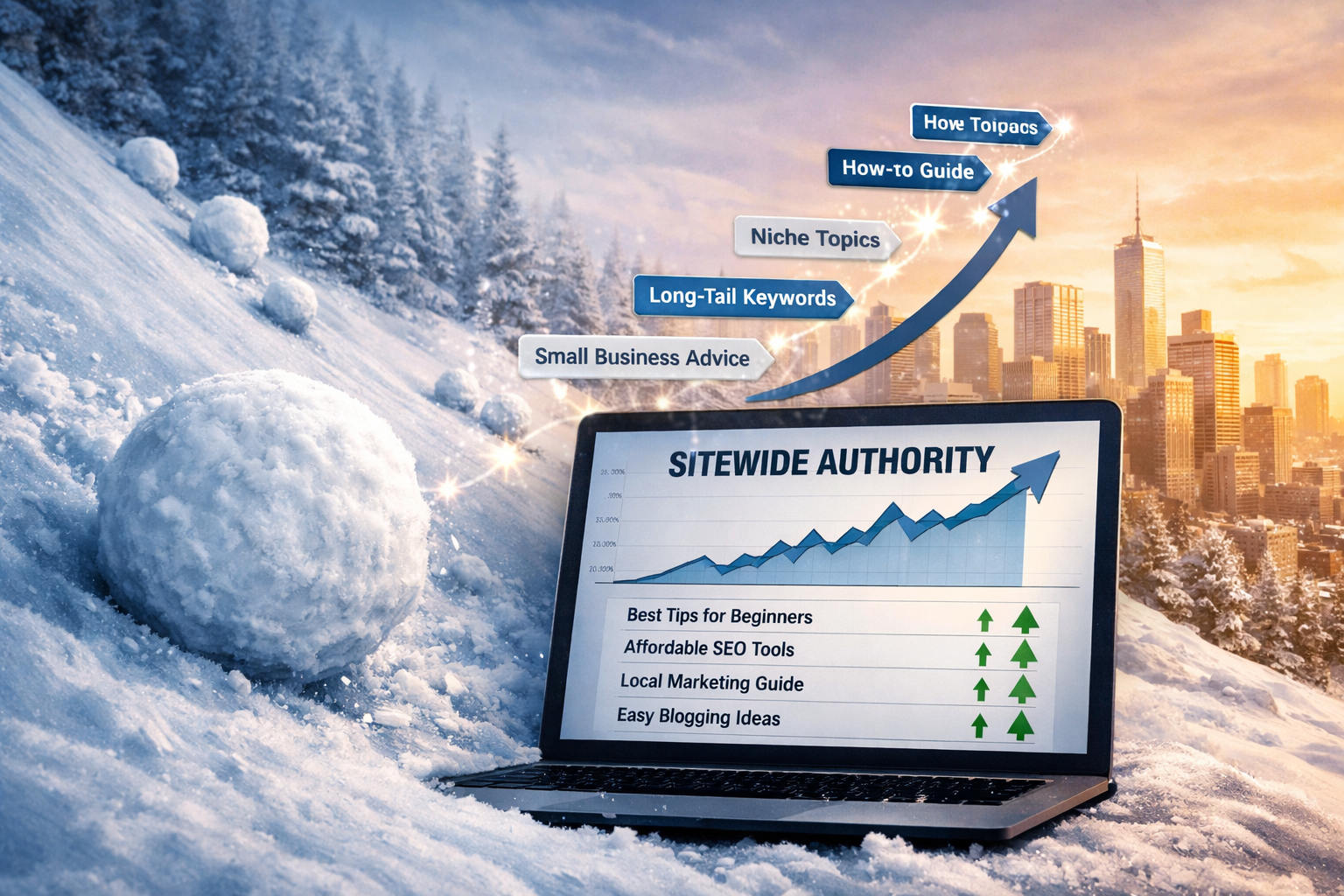
There's a strategy at the heart of great content marketing that most businesses either don't know about or don't fully trust enough to commit to. It's not flashy. It doesn't produce overnight results. But when it works — and when you understand the mechanism behind it — it's one of the most powerful compounding forces in all of digital marketing.
It's called the long-tail keyword strategy. And the reason it works isn't just because long-tail keywords bring in traffic on their own. It's because of what they do to the rest of your site when you build enough of them.
They create a snowball effect that lifts everything — including the service pages and competitive terms that you could never rank for on their own.
Here's how it works.
Start With the Basics: What Is a Long-Tail Keyword?
A keyword is simply the phrase someone types into a search engine when they're looking for something. Keywords exist on a spectrum from broad to specific.
On the broad end you have terms like "marketing agency" or "digital signage" or "personal injury lawyer." These are called short-tail or head keywords. They get enormous search volume — sometimes hundreds of thousands of searches per month — and they are brutally competitive. The businesses ranking on page one for those terms have typically been building domain authority for years, spending significant resources on SEO, and accumulating thousands of backlinks. For most small and mid-sized businesses, trying to rank for these terms directly is like trying to out-sprint someone who got a five year head start.
On the specific end you have terms like "how much does digital signage cost for a small retail store" or "best marketing agency for home service companies in New Jersey" or "what to do if you're in a car accident that wasn't your fault." These are long-tail keywords. They get much lower individual search volume — sometimes only a handful of searches per month — but they are far less competitive, far more specific, and far more indicative of genuine buyer intent.
The long-tail keyword strategy is built on a simple but powerful insight: if you create enough high-quality content targeting enough specific long-tail queries, the cumulative effect is transformative — not just for the individual pieces of content, but for your entire domain.
The Mechanism: How Long-Tail Content Builds Domain Authority
To understand why this works, you need to understand how search engines evaluate websites at a domain level rather than just a page level.
When Google crawls your website, it's not just evaluating each page in isolation. It's building a picture of your entire domain — what topics you cover, how deeply you cover them, how consistently you publish, how people interact with your content, and whether other sites consider you credible enough to link to. This holistic evaluation produces something that SEO practitioners refer to as domain authority — a measure of how much trust and credibility Google has assigned to your website as a whole.
Here's the critical part: domain authority is not fixed. It grows. And one of the most reliable ways to grow it is by consistently publishing high-quality content that ranks well for specific queries, even very low-volume ones.
Every time a piece of your content earns a top-ranking position for a long-tail keyword — even one that only gets fifty searches a month — it sends a signal to Google. This site knows what it's talking about in this space. This site publishes content that people find useful. This site deserves to be trusted in this topic area.
And here's where the snowball begins: those trust signals don't stay contained to the page that earned them. They spread across your entire domain. They lift the authority of every other page on your site — including your service pages, your homepage, and the competitive short-tail terms that you couldn't touch before.
The Topical Authority Multiplier
There's a concept in modern SEO called topical authority, and it's become increasingly central to how search engines rank content. The basic idea is that Google doesn't just want to surface pages that are technically optimized — it wants to surface pages from sources that have demonstrated genuine, comprehensive expertise in a topic area.
Think of it this way. If you want to know about a medical condition, would you rather get information from a general lifestyle blog that published one article on the topic, or from a medical institution that has published hundreds of deeply researched articles covering every aspect of that condition from every angle? Google asks the same question, and it increasingly favors the latter — the source that has demonstrated topical depth and breadth, not just individual page optimization.
This is where long-tail content becomes extraordinarily powerful as a strategy rather than just a tactic. When you publish thirty, fifty, a hundred pieces of content covering specific questions and subtopics within your area of expertise, you're not just ranking for thirty or fifty or a hundred individual queries. You're building a body of work that signals to Google: this domain is a genuine authority on this topic. And that signal has a multiplying effect on everything else you've published.
A service page that was sitting on page three of Google for a moderately competitive keyword — not because it was poorly written or badly optimized, but simply because your domain didn't yet have enough authority — starts to climb. Not because you changed anything on that page. Because the surrounding content ecosystem you've built has elevated the authority of the entire domain it lives on.
That's the snowball.
How the Lift Actually Reaches Your Service Pages
Let's make this concrete, because the mechanism is worth understanding in detail.
Your service page — let's say it's a page targeting "digital marketing agency for small businesses" — is sitting on page two or page three of Google. You've optimized it well. The copy is good. The page loads fast. But it's not moving.
Meanwhile, you've been publishing long-tail content consistently. Articles like "how to know if your small business needs a marketing agency," "what does a marketing agency actually do for you month to month," "how much should a small business spend on marketing," "the difference between a marketing agency and a freelancer," "questions to ask before hiring a marketing agency." None of these individual pieces get enormous traffic. But they rank. People find them. People read them. Some of them click through to other pages on your site — including your service page.
Several things are happening simultaneously as a result.
Internal linking is distributing authority. Each of those long-tail content pieces links back to your service page where relevant. In SEO terms, this creates internal link equity — a transfer of authority from the ranking content pages to the service page you most want to rank. The more high-ranking content you have pointing to a specific page, the more authority that page accumulates.
Google is building a topical map of your domain. As it crawls all of this related content, it's constructing a picture of your site as a genuine authority on the topic of marketing for small businesses. When it evaluates your service page in that context, it's no longer looking at an isolated page from a domain with thin content. It's looking at a page that sits within a rich, authoritative content ecosystem. That context matters enormously to how it ranks the page.
User behavior signals are strengthening your domain. People who find your long-tail content and find it genuinely useful are spending time on your site, reading multiple pages, and returning. These behavioral signals — time on site, pages per session, return visit rate — are among the factors Google uses to evaluate whether a domain deserves higher rankings. Every long-tail piece that delivers real value to a reader is contributing to a positive behavioral signal profile for your entire domain.
Backlinks accumulate to the domain, not just the page. When someone reads one of your long-tail articles and finds it valuable enough to link to from their own website, that backlink benefits your entire domain, not just the specific page they linked to. A portfolio of long-tail content that earns even modest backlink attention over time creates a rising tide of domain-level authority that floats every page on your site.
The Keyword Clustering Effect
There's another dimension to this strategy that makes it even more powerful: keyword clustering.
Long-tail keywords rarely exist in isolation. They cluster around broader topics and themes. And when Google sees that your domain has published multiple pieces of content that cluster around the same topic — each addressing a different specific query within that topic — it starts to recognize your domain as the authoritative resource for the entire cluster.
This means that your individual long-tail pieces don't just rank for their specific target queries. They start to rank for related queries that you didn't even specifically target. Google infers that if you've covered this topic from this many angles, your content is probably relevant and authoritative for adjacent questions as well.
The practical effect is that your content starts ranking for more keywords than you wrote it for. A single well-researched long-tail article might rank for its primary target keyword and also pick up rankings for five, ten, or twenty related queries that you never specifically optimized for. Multiply that across a content library of fifty or a hundred articles, and the cumulative keyword footprint of your site becomes dramatically larger than the sum of its individual parts.
And all of that expanded keyword footprint feeds back into domain authority, which feeds back into the rankings of your service pages.
The Timeline: When Does the Snowball Start Rolling?
Understanding the mechanism is one thing. Understanding when to expect it to produce visible results is equally important, because this strategy requires patience that many businesses struggle to maintain.
In the first one to three months, individual long-tail pieces start to get indexed and earn their first rankings. Traffic from any single piece is modest. There is no visible sitewide lift yet. This is the foundation-laying phase, and it feels slow because it is.
In months three through six, a pattern starts to emerge. Multiple pieces of content are ranking simultaneously. Internal linking is beginning to create meaningful connections between pages. Google is starting to build its topical map of your domain. You may begin to notice that some of your older content is ranking for queries beyond its primary target — the first sign that the clustering effect is beginning to work.
In months six through twelve, the compounding becomes visible. Domain authority metrics start to move meaningfully. Service pages that were stuck on page two or three begin to climb. Keyword footprint expands noticeably. Traffic from organic search grows not just because of new content but because existing content is ranking better and for more queries than before.
In year two and beyond, the snowball is fully rolling. New content benefits immediately from the authority you've already built. Service pages are ranking for competitive terms that would have been completely out of reach twelve months earlier. The content you published in year one is still generating traffic and authority, compounding on top of itself while your year two content adds another layer.
What This Means for How You Should Build Your Content Strategy
Understanding this mechanism should have a direct impact on how you approach content planning — because the snowball effect is not accidental. It's the result of deliberate, strategic choices about what to write, how to structure it, and how to connect it.
Go deep on your topic area before trying to go broad. The topical authority that drives sitewide lift comes from depth and comprehensiveness, not variety. Pick the core topic area most relevant to your primary service and build a genuinely comprehensive library of content around every question, subtopic, and angle within that space before expanding into adjacent areas. A site with fifty deeply relevant articles on one topic will outperform a site with fifty articles scattered across five loosely related topics almost every time.
Build your internal linking structure intentionally. Every piece of long-tail content you publish should link to your most important service pages where the connection is natural and relevant. Don't force it — readers and search engines both recognize when internal links feel artificial. But when a natural connection exists, make it. The cumulative effect of consistent, relevant internal linking is one of the most underutilized authority-building tools available.
Answer the questions your ideal buyer is actually asking. The long-tail keywords that produce the best compounding effect are the ones that reflect genuine buyer questions — the things people type into Google when they're trying to understand a problem, evaluate a solution, or decide between options. These questions exist at every stage of the buying journey, and content that genuinely answers them earns the behavioral signals — time on site, return visits, low bounce rates — that strengthen your domain authority over time.
Publish consistently and protect the cadence. The snowball effect is a function of accumulation over time. Ten pieces of content don't produce it. A hundred pieces published consistently over twelve to eighteen months do. Treat your publishing schedule the way you'd treat any other critical business operation — not as something you do when you have time, but as something you protect because you understand what it's building.
Be patient with your service pages. If you're executing this strategy correctly, your service pages will rank better six months from now than they do today — not because you changed anything on those pages, but because the content ecosystem around them has grown and matured. Understanding this helps you resist the urge to constantly tinker with service pages that feel stuck, and redirect that energy toward publishing the content that's actually doing the lifting.
The Compounding Advantage Nobody Talks About Enough
Here's the thing about the long-tail snowball strategy that doesn't get said enough: it gets easier over time, not harder.
In the early months, every piece of content is climbing from zero. You have no authority to leverage, no internal link equity to distribute, no topical depth for Google to recognize. Every ranking you earn is hard won.
But as the snowball builds, each new piece of content you publish lands on a domain with growing authority. It gets indexed faster. It ranks sooner. It earns a higher starting position than it would have six months ago. The same quality content that might have taken four months to reach page one in your first quarter might reach page one in three weeks in your second year — simply because of the authority foundation you've built beneath it.
And your competitors who didn't start this process when you did can't just catch up by publishing a lot of content quickly. Domain authority and topical depth take time to build. You can't rush the trust signals. You can't compress the behavioral data. The head start you build by executing this strategy consistently is genuinely difficult to replicate quickly — which makes it one of the most durable competitive advantages in digital marketing.
The businesses that understand this don't ask "is it working yet?" after three months. They ask "how deep can we go?" And the answer, almost always, is deeper than they've gone so far.
At Ritner Digital, we build long-tail content strategies designed to compound over time and lift your entire digital presence — not just individual pages. If you want to understand what a deliberate keyword snowball strategy could look like for your business, let's talk.
Frequently Asked Questions
What exactly is a long-tail keyword and how is it different from a regular keyword?
A long-tail keyword is simply a more specific, more detailed search phrase compared to a broad or generic one. "Marketing agency" is a short-tail keyword. "What should I look for when hiring a marketing agency for my small business" is a long-tail keyword. The difference matters for a few reasons. Long-tail keywords are significantly less competitive because fewer businesses are specifically targeting them. They attract searchers with much clearer intent — someone typing a detailed, specific question is almost always further along in their decision-making process than someone typing a broad two-word phrase. And because they're specific, the content you create to answer them tends to be highly relevant to exactly the right person, which produces better engagement signals and better conversion rates even when the raw traffic numbers are modest.
If long-tail keywords get so little traffic individually, why is it worth targeting them?
Because the value of long-tail keywords was never really about the individual traffic numbers — it's about what they build collectively. A single long-tail article getting 40 visitors a month sounds unimpressive. A library of 80 long-tail articles each getting 40 visitors a month is 3,200 monthly visitors from highly targeted, high-intent traffic. More importantly, those 80 articles are simultaneously building topical authority, distributing internal link equity to your service pages, generating behavioral signals that strengthen your domain, and expanding your keyword footprint into related queries you didn't even specifically target. The individual pieces are modest. The cumulative effect is transformative. This is the core insight that separates businesses that treat content as a checklist from businesses that treat it as a compounding asset.
How many long-tail articles do I need before I start seeing the sitewide lift?
There's no magic number, and anyone who gives you a specific figure without knowing your industry, your competition level, and your current domain authority is guessing. That said, most SEO practitioners — ourselves included — tend to observe meaningful sitewide lift beginning to show up somewhere in the range of 30 to 50 genuinely high-quality, relevant pieces of content. Before that threshold, individual pieces are ranking and generating modest traffic, but the topical authority signal isn't yet strong enough to produce noticeable movement on your more competitive service pages. After that threshold, the compounding effect becomes increasingly visible — domain authority metrics move, service page rankings improve, and new content starts ranking faster and higher than it would have earlier in the process. Getting to 30 to 50 pieces of genuinely useful, well-targeted content typically takes six to twelve months of consistent publishing for most businesses.
Does the long-tail strategy work for local businesses or is it mainly for national brands?
It works exceptionally well for local businesses — arguably even better in some ways, because the competition for locally-specific long-tail queries is often dramatically lower than for national ones. A national marketing agency competing for "how to choose a marketing agency" is up against thousands of competitors. A local HVAC company targeting "why is my heat pump freezing up in winter in South Jersey" is competing against almost nobody — and the person searching that query is almost certainly local, almost certainly frustrated, and almost certainly going to call someone if they find a helpful answer. Local long-tail content that combines topic specificity with geographic relevance can produce leads relatively quickly compared to national content, and the sitewide authority it builds applies just as powerfully to your local service pages as it would to any other site.
What's the difference between topical authority and domain authority and why do both matter?
Domain authority is a broad measure of how much trust and credibility a search engine has assigned to your website as a whole, based on factors like the quality and quantity of backlinks pointing to your site, the age of your domain, your technical SEO health, and your overall content quality. Topical authority is more specific — it's a measure of how deeply and comprehensively your site covers a particular subject area. Both matter, but for most small and mid-sized businesses, topical authority is actually the more actionable one to focus on. You can build genuine topical authority through consistent, deep content creation without needing a massive backlink profile. And strong topical authority in your niche tends to improve your domain authority over time as a byproduct — because authoritative topical content earns links, generates engagement, and signals credibility to search engines in all the right ways.
How does internal linking actually work and how important is it to the snowball effect?
Internal linking is the practice of linking from one page on your site to another relevant page on the same site. When you publish a long-tail article about "questions to ask before hiring a digital marketing agency" and include a natural, relevant link to your marketing services page within that article, you're doing two things simultaneously. You're giving readers a clear path to learn more about working with you, which improves the likelihood of conversion. And you're passing what SEO practitioners call link equity — a portion of the ranking authority that the long-tail article has earned — to the page you're linking to. The more high-ranking long-tail articles you have linking to a specific service page, the more cumulative authority that service page receives. Done consistently across a large content library, internal linking becomes one of the most powerful tools for lifting the rankings of your most commercially important pages without changing a single word on those pages.
Can I just publish a lot of content quickly to speed up the snowball effect?
Publishing more content faster will accelerate the process to a point, but there are important caveats. Quality cannot be sacrificed for quantity. Thin, generic, or poorly researched content doesn't earn the behavioral signals — time on page, low bounce rate, return visits — that contribute to domain authority. It doesn't earn backlinks. It doesn't rank for the queries it targets. And in some cases, a large volume of low-quality content can actually work against you by signaling to search engines that your domain prioritizes output over usefulness. The sweet spot is the fastest publishing cadence you can maintain while still producing content that genuinely answers a real question better than what's currently ranking for that query. For most businesses that means somewhere between two and five pieces per week rather than ten mediocre pieces per day.
My service pages are well optimized but stuck on page two or three. Will this strategy actually move them?
In most cases, yes — and this is one of the most common scenarios where the long-tail snowball strategy produces the most dramatic visible results. A service page that's technically well-optimized but stuck in the middle of search results is almost always there because of a domain authority gap, not a page quality gap. The page itself is fine. The domain it lives on simply hasn't yet earned enough trust and authority for Google to elevate it above the competitors sitting above it. Building a robust library of topically relevant long-tail content addresses that gap directly — by growing domain authority, building topical depth, and funneling internal link equity to the service page from multiple ranking pieces of content. The page doesn't need to change. The ecosystem around it needs to grow. That's exactly what this strategy does.
Should I be targeting long-tail keywords in my service pages themselves or just in blog content?
Both, but in different ways. Your service pages should be optimized for the most commercially relevant keywords for your business — the terms people search when they're ready to hire or buy. These tend to be more competitive, shorter-tail phrases. Your blog and content library is where the long-tail strategy lives — answering the research-phase questions, the how-to queries, the comparison questions, the problem-identification searches that people conduct before they're ready to contact a service provider. The two types of content work together. Your long-tail blog content captures people early in their journey, builds familiarity and trust, and funnels authority and traffic toward your service pages. Your service pages convert the people who arrive already ready to act. Optimizing only one side of that equation leaves significant opportunity on the table.
How do we know which long-tail keywords to target first?
Start with the questions your ideal customers are actually asking — and if you're not sure what those are, the best sources are your own sales conversations, your customer service interactions, and the questions people ask when they find your business for the first time. Beyond that, tools like Google Search Console show you what queries are already bringing people to your site, which is often a goldmine of long-tail opportunities you haven't yet specifically targeted. Google's own autocomplete and "People Also Ask" features give you a real-time window into what searchers in your space are looking for. Prioritize queries that reflect genuine buyer intent over purely informational curiosity, that are specific enough to have low competition, and that connect naturally to the services you most want to sell. Build from there, go deep on each subtopic before moving to the next, and let the compounding do its work over time.
Want to build a long-tail content strategy that actually compounds into real authority and real leads? The Ritner Digital team would love to map that out with you.