Why Your Marketing Agency Is Either Your Franchise System's Greatest Asset or Its Biggest Liability
Franchise systems fail for a lot of reasons. Poor unit economics. Weak training. Inadequate support infrastructure. But one of the most preventable — and most commonly overlooked — cause of franchisee dissatisfaction, underperformance, and eventual churn is something that happens long before a location closes: a franchisee who feels invisible, uninformed, and unsupported in their local market.
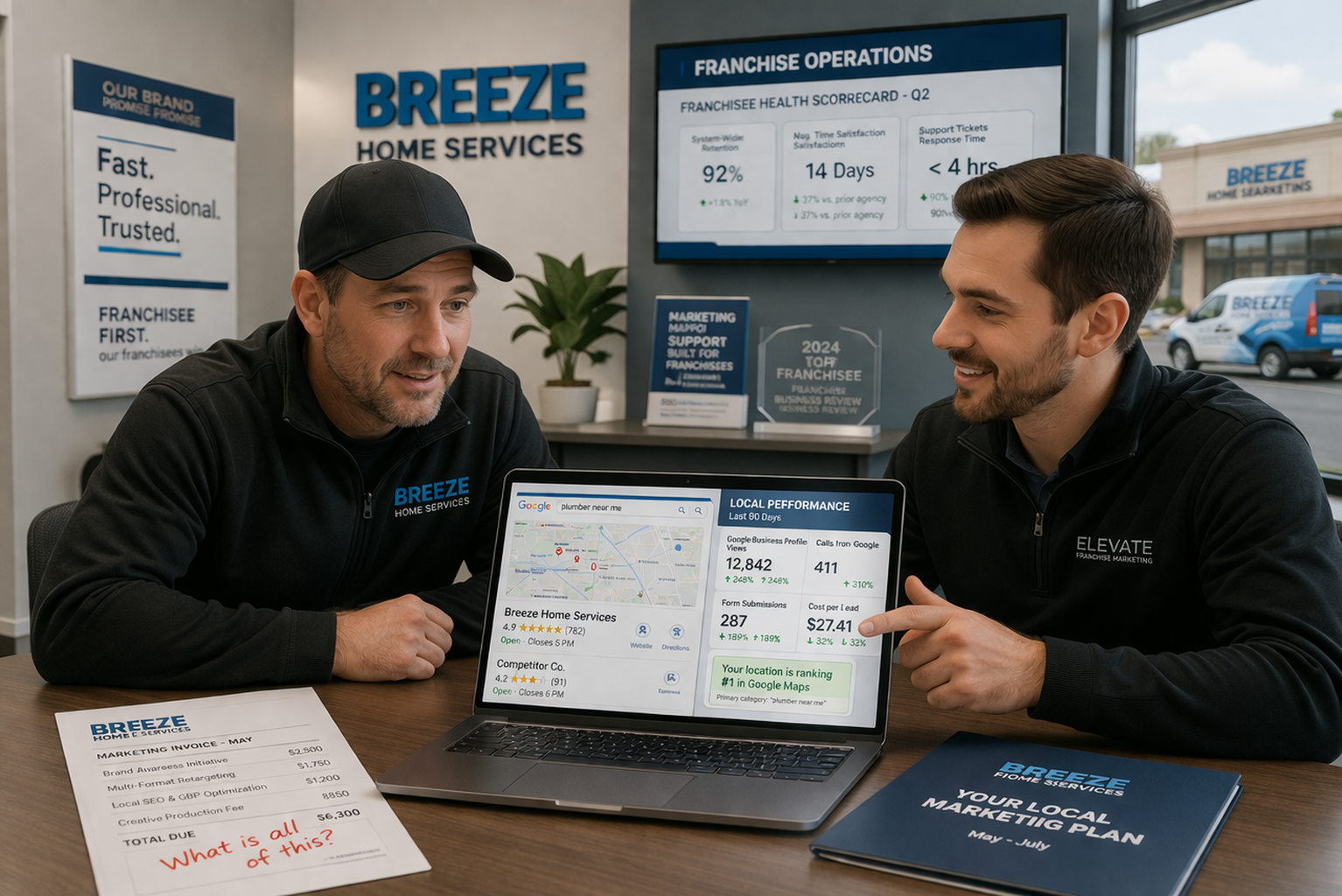
They signed on to a brand. They paid a franchise fee. They trusted that the system would work. And then they opened their doors, watched their competitors show up on Google while they didn't, got a monthly marketing invoice they couldn't interpret, and had no idea whether any of it was working. Nobody called. Nobody explained it. Nobody asked how they were doing.
That is a marketing agency problem. And it is costing franchise systems franchisees.
This post is about why the right marketing agency — with the right structure, the right transparency, and the right communication cadence — is one of the most important retention tools a franchise system has. And why the wrong one, or the right one operated incorrectly, quietly destroys the trust that holds a franchise network together.
The Franchisee Visibility Problem Nobody Talks About Enough
What Franchisees Actually Experience
Put yourself in the position of a franchisee who has just opened a new location. You have invested significant capital. You are managing staff, operations, customer relationships, and the daily chaos of running a business. You are counting on the franchise system — and the marketing infrastructure that came with it — to help people find you.
What you often get instead is a monthly charge on your account for a marketing fund you contributed to, a corporate dashboard you were shown once during onboarding and never really understood, and the vague awareness that something called "digital marketing" is happening somewhere on your behalf. Whether it is working, what specifically is being done for your location versus other locations, why your neighbor's competing business keeps showing up above you in search results, and who you would even call to ask these questions — none of that is clear.
This is not a hypothetical. It is the most common experience franchisees report when marketing support is centralized without adequate transparency and communication at the local level. And it breeds exactly the kind of low-grade resentment that, over time, turns into the franchisee who stops following brand standards, starts experimenting with their own rogue marketing, and eventually becomes the renewal conversation you dread.
The Rogue Website Problem
One of the most visible symptoms of franchisee marketing invisibility is the rogue website. It happens in franchise systems more often than corporate teams want to admit — a franchisee who feels their location isn't showing up in local search, or who simply doesn't understand what the corporate marketing is doing for them, goes out and builds their own website. Or hires a nephew who does web design. Or pays a local agency to run Google Ads for their specific location using a domain they control.
The result is a fragmented digital footprint that creates multiple problems simultaneously. From an SEO perspective, competing websites for the same brand in the same market can cannibalize each other's search rankings and create confusing signals for Google about which entity is the authoritative source. From a brand perspective, rogue websites almost inevitably violate brand standards in ways that range from minor to significant. From a customer experience perspective, a potential customer who lands on an inconsistent or low-quality franchisee website forms an impression of the entire brand.
The franchisee who built the rogue website is not a bad actor. They are a business owner who felt invisible and took matters into their own hands. The solution is not enforcement — it is making the centralized marketing visible, understandable, and credible enough that franchisees trust it and don't feel compelled to go around it.
The Data Gap That Erodes Trust
Franchisees are business owners. They think in terms of return on investment. When they contribute to a marketing fund or pay a monthly fee for marketing support, they want to know what they are getting for that investment — not in the aggregate for the system, but specifically for their location.
When that data is not provided, or provided in a format that is impossible for a non-marketer to interpret, or buried in a corporate report that arrives quarterly and shows system-wide metrics rather than location-specific performance, franchisees fill the data gap with assumption. And assumptions formed by a franchisee who feels uninformed are almost always negative. They assume the marketing isn't working. They assume their marketing dollars are going to higher-performing markets. They assume corporate doesn't care about their specific location. None of these assumptions may be accurate — but in the absence of clear, accessible, location-specific data delivered consistently, they are the natural conclusions a smart business owner will draw.
Why a Unified Marketing Strategy Is Non-Negotiable for Franchise Systems
The Fragmentation Tax
Every franchise system that allows marketing fragmentation — multiple agencies working different locations, franchisees running their own campaigns alongside corporate efforts, inconsistent brand execution across digital properties — pays a fragmentation tax. It shows up in lower aggregate search rankings than a unified strategy would produce. It shows up in brand inconsistency that confuses customers and dilutes recognition. It shows up in wasted spend where franchisee-funded campaigns compete with corporate campaigns for the same keywords in the same markets. And it shows up in the operational burden of trying to manage, audit, and remediate dozens of marketing relationships rather than one.
A unified marketing strategy — one agency, one brand framework, one coordinated campaign architecture that operates at both the national brand level and the individual location level simultaneously — eliminates the fragmentation tax. It allows the system to build search authority that benefits every location rather than scattering signals across competing properties. It ensures brand consistency without requiring constant enforcement. And it creates a single point of accountability for performance that makes measurement clear and correction fast.
National Brand Authority, Local Market Visibility — Both at Once
The central tension in franchise marketing is between national brand consistency and local market relevance. A franchisee in Phoenix is competing against local businesses that know their market, their community, and their specific customer base. A franchisee in Boston is dealing with a completely different competitive environment, different seasonal patterns, and different customer behaviors. A one-size-fits-all corporate campaign that treats every location identically will underserve every location simultaneously.
The right marketing architecture for a franchise system operates on two levels simultaneously. At the national level, it builds brand authority — consistent messaging, unified domain structure, system-wide SEO signals, and brand campaigns that make the name mean something everywhere. At the local level, it executes location-specific tactics — local search optimization for each individual franchise location, geo-targeted paid campaigns that reflect the competitive reality of each specific market, locally relevant content that connects the brand to the community each location actually serves.
This dual-level architecture requires a marketing partner with both the strategic sophistication to design it and the operational infrastructure to execute it across dozens or hundreds of locations simultaneously. It is not a job for a local agency managing one location. It is not a job for a corporate marketing team managing campaigns from headquarters with no local execution capacity. It requires a partner that has built the systems, the processes, and the team structure to do both at once.
Consistent Branding Protects the Entire Network
Every franchisee's customer interaction reflects on every other franchisee in the system. A customer who has a poor experience with one location — or who encounters an off-brand website, a confusing social media presence, or a marketing message that contradicts what the brand stands for — carries that impression of the brand as a whole. The franchise model's greatest strength — the ability to scale a trusted brand across multiple operators — is also its greatest vulnerability. Brand consistency is not just an aesthetic preference. It is a fundamental protection for every franchisee's investment.
A unified marketing strategy enforces this consistency structurally rather than through policing. When every location's digital presence is built on the same framework, managed through the same systems, and executed by the same partner operating to the same brand standards, consistency is the default rather than the exception. The energy that would otherwise go into auditing and remediating brand violations goes instead into improving performance.
The Monthly Franchisee Call — The Most Undervalued Retention Tool in Your System
Why Communication Is a Marketing Function, Not Just an Operations Function
Most franchise systems think about franchisee communication as an operations responsibility — training, compliance, operational support. Marketing is treated as something that happens to franchisees rather than something that happens with them. The agency runs the campaigns. The reports go to corporate. Franchisees get an invoice.
This is a structural mistake with real retention consequences. Franchisees who understand what their marketing is doing, why specific tactics were chosen for their location, what the data shows about local performance, and what is planned for the coming months are dramatically more likely to trust the system, follow brand standards, and renew their agreements. Franchisees who have no window into any of this are the ones who go rogue, escalate complaints to corporate, and become cautionary tales in FDD disclosures.
The monthly franchisee call with the marketing agency is the structural solution to this problem — and it is one of the most underutilized tools in franchise system design. Not a corporate call where marketing is mentioned in passing. Not a quarterly report that lands in an inbox. A dedicated, recurring conversation between each franchisee — or groups of franchisees in similar markets — and the marketing team responsible for their location's performance.
What a Proper Monthly Marketing Call Actually Looks Like
A monthly franchisee marketing call is not a status update where an account manager reads metrics from a slide deck. It is a genuine business conversation between a marketing partner who understands the local market and a business owner who understands their customers and their operational reality.
It starts with location-specific performance data presented in plain language — not industry jargon, not aggregate system metrics, but what is actually happening for this specific location this month compared to last month and compared to the same period last year. Search rankings, website traffic, lead volume, campaign performance, and any anomalies that need explanation.
It includes honest context — why performance moved the way it did, what external factors affected results, what the data suggests about the competitive environment in this specific market. A franchisee who understands why their traffic was down in January because a competitor ran an aggressive paid campaign and here is how we responded is a franchisee who trusts the system. A franchisee who just sees that traffic was down in January with no explanation is a franchisee who starts asking questions corporate does not want to field.
It ends with a clear forward plan — what specifically is happening for this location over the next thirty days, what the franchisee can do locally to support the marketing effort, and what questions or concerns from the franchisee need to be addressed before the next call.
Done consistently, this call transforms the marketing relationship from a black box that franchisees pay into to a collaborative partnership that franchisees value, defend, and cite as a reason they renewed.
Group Calls vs. Individual Calls — How to Structure It at Scale
For franchise systems with large networks, individual monthly calls with every franchisee may not be operationally feasible. The solution is thoughtful segmentation rather than elimination of the call structure. Franchisees can be grouped by market type, location size, performance tier, or stage of business — new locations in their first year have different needs and different questions than established locations in their third or fourth year.
Group calls structured around these segments allow for peer conversation between franchisees in similar situations, which adds value beyond what a one-on-one call with the agency can provide. A new franchisee hearing an established franchisee in a similar market describe how their search traffic built over the first twelve months is more persuasive than anything the agency can say about expected timelines. Peer credibility within a franchise network, just like peer credibility in any professional community, is enormously powerful.
Individual calls should be reserved for franchisees in performance outlier situations — either significantly underperforming the system average in ways that require individualized strategic attention, or significantly outperforming in ways that warrant a deeper conversation about scaling what is working. Both situations benefit from dedicated attention that a group format cannot provide.
What to Look for in a Marketing Agency Partner for Your Franchise System
Franchise Marketing Experience Is Not Optional
A marketing agency that has not worked with franchise systems before will learn on your dime. The technical requirements of franchise marketing — multi-location SEO architecture, location-specific landing page frameworks, Google Business Profile management at scale, brand consistency enforcement across dozens or hundreds of digital properties — are genuinely different from standard single-location marketing. An agency that is excellent at marketing for independent businesses is not automatically equipped to handle a franchise network.
Ask prospective agency partners specifically about their experience managing multi-location marketing, how they structure campaigns to build both national brand authority and local market visibility simultaneously, what their process is for onboarding and communicating with individual franchisees, and how they handle the situation where a franchisee's local market conditions require a different tactical approach than the system standard. Their answers will tell you more about their actual franchise marketing competency than any case study they put in front of you.
Transparency Infrastructure Is a Requirement, Not a Feature
The right franchise marketing partner has built the reporting and transparency infrastructure to give every franchisee access to their own location's performance data in a format that a non-marketer can understand and act on. This means location-specific dashboards — not system-wide aggregate reports. It means plain-language explanations of what the data means, not raw metric dumps. It means proactive communication when something changes — a ranking drop, a competitor surge, a campaign adjustment — not radio silence until the monthly report arrives.
Ask prospective agency partners how they report to individual franchisees, what a franchisee actually sees on a monthly basis about their own location's performance, and how quickly a franchisee can get a direct answer from someone on the agency team if they have a question between reporting periods. The answers reveal whether the agency has actually built the infrastructure to serve a franchise network or whether they are planning to manage corporate and hope franchisees don't ask too many questions.
Account Structure Matters More Than Agency Size
A large agency with dozens of franchise clients is not automatically a better choice than a mid-size agency with deep franchise experience and a thoughtful account structure. What matters is how the agency's internal team is organized to serve your network. Is there a dedicated team or contact for franchisee communication, or are franchisee questions routed through a general support queue? How many accounts does each account manager actually handle, and is that number low enough to allow them to genuinely know each franchisee's market and business situation?
The franchisee communication breakdown that costs systems their best operators almost always happens not because the agency is incompetent but because the account structure was not designed to support the volume and quality of franchisee interaction the network actually requires. A franchisee who cannot get a real person on the phone when they have a question about their marketing — or who talks to a different account manager every time they call — will eventually stop trusting the system entirely.
The Unified Technology Stack
The right marketing agency partner for a franchise system brings a unified technology stack that serves both corporate oversight needs and franchisee transparency needs simultaneously. This typically means a central CRM and reporting platform that corporate can use to see system-wide performance across all locations while each franchisee can see their own location's data in isolation. It means a content management architecture that allows local customization within brand guardrails without requiring individual franchisees to have technical skills. It means a Google Business Profile management system that handles the scale of a multi-location network without requiring manual updates for every location every time something changes.
Building or selecting this stack correctly at the outset is significantly less expensive than trying to retrofit it onto a fragmented collection of location-by-location tools after the fact. It is also one of the clearest signals a franchise system can send to franchisees that their marketing investment is being managed with sophistication and accountability.
The Retention Math — Why This Is Worth Taking Seriously
What Franchisee Churn Actually Costs
Franchisee churn is expensive in ways that extend well beyond the lost royalty stream from a closing location. There are the direct costs — legal fees, rebranding, re-leasing or re-selling a territory, recruiting and qualifying a replacement franchisee, and the onboarding investment for the new operator. There are the indirect costs — the reputational signal that a closing location sends to prospective franchisees, the disruption to neighboring locations in the same market, and the leadership bandwidth consumed by a franchisee exit that could have gone to growing the system.
When marketing invisibility, data opacity, and a lack of communication are contributing factors to a franchisee's decision to exit — and they frequently are — those costs are the direct consequence of a solvable marketing infrastructure problem. The monthly cost of building and maintaining the franchisee communication and transparency structure described in this post is a fraction of the cost of a single franchisee exit, let alone the pattern of exits that emerges when a system's marketing support is consistently failing its operators.
Retention as a Marketing Outcome
The most sophisticated franchise marketing organizations understand that franchisee retention is itself a marketing outcome — not just an operations metric. A franchise system with strong franchisee satisfaction generates better FDD disclosure data, more candid and positive franchisee validation conversations with prospective buyers, and a reputation in the franchisee community that attracts higher-quality candidates. These are marketing outcomes that compound over time in ways that affect the system's growth trajectory as much as any external campaign.
The monthly franchisee marketing call, the location-specific performance dashboard, the unified strategy that makes every operator feel genuinely supported — these are not just operational nice-to-haves. They are retention tools that produce measurable downstream marketing value through the referrals, validations, and reputation signals that determine whether your franchise development pipeline is full of qualified candidates or running dry.
The Bottom Line
The marketing agency relationship in a franchise system is not a vendor relationship. It is infrastructure — as foundational to the system's health as the operations manual, the training program, and the franchisee agreement. Get it right and it becomes a genuine competitive advantage that shows up in franchisee satisfaction, brand consistency, local market performance, and renewal rates. Get it wrong and it quietly erodes the trust that holds a franchise network together, one invisible, uninformed, frustrated franchisee at a time.
The fix is not complicated. It requires a partner with genuine franchise marketing experience, a transparency infrastructure that gives every franchisee real visibility into their own location's performance, a communication cadence that treats franchisees as the business partners they are, and a unified strategy that builds brand authority at the system level while driving real results at the location level.
If your franchise system's marketing agency relationship does not look like that today, you are paying a retention tax that you do not have to pay.
Frequently Asked Questions
Strategy and Structure
Q: How is marketing a franchise system different from marketing a single-location business?
It is a categorically different job, not just a scaled-up version of the same job. Single-location marketing optimizes one set of digital properties for one market. Franchise marketing has to build national brand authority that lifts every location simultaneously while executing location-specific tactics that reflect the competitive reality of dozens or hundreds of individual markets — all within brand guardrails that protect the consistency every franchisee's investment depends on. The technical architecture alone — multi-location SEO, Google Business Profile management at scale, location-specific landing page frameworks, unified reporting across every location — requires systems and processes that most single-location agencies have never had to build. An agency that is excellent at marketing for independent businesses is not automatically equipped to handle a franchise network, and assuming otherwise is one of the most expensive mistakes a franchise system can make.
Q: Should every franchise location have its own website or should there be one central brand website?
The most effective architecture for most franchise systems is a single brand domain with location-specific pages — not separate websites for each franchisee. A unified domain structure allows the entire system to build search authority collectively rather than scattering signals across dozens of competing properties. Each location gets its own optimized page within the brand domain that handles local search, local content, and location-specific information — giving franchisees the local visibility they need without the fragmentation that comes from independent sites. Separate franchisee websites, particularly ones built without coordination with the central marketing strategy, almost always hurt overall system search performance even when individual locations believe they are helping themselves. This is one of the clearest areas where a unified strategy produces results that no individual franchisee acting alone can replicate.
Q: What is the biggest strategic mistake franchise systems make with their marketing agency relationship?
Treating it as a corporate vendor relationship rather than a network-wide partnership. When the agency's primary relationship is with corporate marketing and franchisees are treated as end recipients of whatever corporate decided to do on their behalf, the transparency and communication gaps that drive franchisee dissatisfaction are structural and almost inevitable. The agency is optimizing for the client relationship it has — which is with corporate — rather than for the success of every location in the network. Reorienting the agency relationship so that franchisees are genuine stakeholders in the marketing program — with their own visibility into performance data, their own access to the agency team, and their own voice in how local tactics are executed — changes the dynamic entirely. It requires more operational infrastructure from the agency, but it produces dramatically better franchisee satisfaction and retention outcomes.
Q: How do we build a marketing strategy that works for both new franchise locations and established ones?
New and established locations have genuinely different needs and should be treated differently within a unified strategy rather than identically. A new location needs aggressive local launch activity — Google Business Profile setup and optimization, local citation building, geo-targeted paid campaigns to drive immediate awareness in the trade area, and a content strategy that establishes local relevance quickly. An established location needs a different mix — ongoing organic search maintenance, competitive monitoring in a market where rivals have had time to respond to the brand's presence, reputation management, and increasingly sophisticated targeting as the customer data from that location accumulates. The marketing calendar, the budget allocation, and the tactics should both reflect where each location is in its lifecycle. A unified agency partner with good account structure can manage this differentiation systematically rather than requiring corporate to manually oversee it.
Q: How should marketing budget be allocated between national brand campaigns and local location marketing?
There is no universal right answer — it depends on the system's stage of growth, the competitive landscape, and the degree to which brand recognition already exists in target markets. Early-stage systems with limited brand recognition generally benefit from weighting more heavily toward local market activation — getting individual locations found and generating leads in their specific trade areas matters more than building national brand awareness when the network is small. More mature systems with established brand recognition can shift more weight toward brand-level campaigns that lift the entire network. What is consistent regardless of stage is that some investment at both levels is almost always more effective than concentrating entirely on one. A marketing partner that can execute both and adjust the balance over time as the system grows is significantly more valuable than one optimized for only one level.
Franchisee Communication
Q: How often should franchisees hear from the marketing agency?
At minimum, once a month — and that contact should be substantive, not a report dropped into an inbox. A monthly call or structured update that covers location-specific performance in plain language, explains what drove results in the prior period, outlines what is planned for the coming month, and creates space for franchisee questions and input is the baseline communication standard for a well-run franchise marketing program. Between monthly touchpoints, franchisees should have a clear and accessible way to reach someone on the agency team when they have an urgent question or notice something happening in their local market. Radio silence between monthly reports — or worse, no regular structured communication at all — is the communication pattern most consistently associated with franchisee dissatisfaction and eventual churn.
Q: What should a monthly franchisee marketing call actually cover?
It should cover four things in order. First, location-specific performance data from the prior month presented in plain language — what happened, what moved, and what it means — not raw metric dumps or system-wide aggregates. Second, honest context for why performance moved the way it did — external factors, competitive activity in the local market, algorithm changes, seasonal patterns, and what the agency did in response. Third, a clear forward plan for the coming thirty days — what specifically is being executed for this location, what the franchisee can do locally to support the marketing effort, and any decisions that need franchisee input. Fourth, space for the franchisee's questions, concerns, and observations about their local market that the agency might not be seeing from the data alone. That last part is frequently undervalued — franchisees have ground-level intelligence about their local competitive environment that can significantly improve the quality of the agency's tactical decisions if the agency actually asks for it and listens.
Q: Is it realistic to do individual monthly calls with every franchisee in a large network?
For very large networks it may not be feasible to do individual calls with every location every month — but the answer is thoughtful segmentation, not elimination of the call structure. Franchisees can be grouped by market type, location size, business stage, or performance tier and served with group calls that allow peer conversation alongside agency communication. New locations in their first year, mid-stage locations, and mature established locations all have different needs and different questions — grouping by stage allows the agency to deliver relevant content to each group without repeating the same conversation to every individual location. Individual calls should be reserved for outlier situations — locations significantly underperforming the system average that need individualized strategic attention, or locations significantly outperforming where a deeper conversation about scaling what is working is warranted. Both situations benefit from dedicated attention a group format cannot provide.
Q: What do we do when a franchisee starts asking questions we can't answer about their marketing performance?
First — treat it as a signal, not a complaint. A franchisee who is asking questions about their marketing performance is a franchisee who is engaged with their business and paying attention. That is not the problem. The problem is that your current marketing infrastructure is not giving them the information they need to answer those questions themselves, which means they are coming to corporate to fill a gap that should have been filled by the agency's reporting and communication structure. The immediate answer is getting them connected to someone at the agency who can walk them through their specific location's data in real time. The structural answer is auditing your reporting and communication cadence to understand why a franchisee had unanswered questions in the first place and fixing the gap before the next franchisee hits the same wall.
Q: How do we handle a franchisee who insists on doing their own marketing outside the system?
Start by understanding why before responding with enforcement. In the overwhelming majority of cases, a franchisee running rogue marketing is a franchisee who does not believe the centralized marketing is working for their location — and they may or may not be wrong about that. Enforcement without addressing the underlying trust and visibility deficit will push the behavior underground rather than eliminating it and will accelerate the franchisee's disengagement from the system. The conversation should start with getting them genuine visibility into what the centralized marketing is actually doing for their location, why specific tactics were chosen, and what the performance data actually shows. If the centralized marketing genuinely is underperforming for their location, that is information the agency needs to have and act on. If it is performing well but the franchisee simply did not have visibility into it, that is a communication failure the system needs to fix. Either way, enforcement is the last resort, not the first response.
Data and Reporting
Q: What data should every franchisee be able to see about their own location?
At minimum — local search rankings for the keywords that drive customers to their location, Google Business Profile performance including search impressions, direction requests, and phone calls, website traffic attributed to their location, paid campaign performance if campaigns are running for their location, and lead or conversion volume with a trend line that shows whether performance is improving or declining over time. All of it should be presented in a format a non-marketer can read and understand without a translation session. Aggregate system metrics are useful for corporate oversight but are close to meaningless for a franchisee trying to understand whether their specific location is getting a return on their marketing investment. Location-specific data, in plain language, delivered consistently, is the minimum transparency standard for a franchise marketing program that wants franchisees to trust it.
Q: How do we make sure franchisees can actually understand the data they receive?
Design the reporting for the audience receiving it, not for the audience producing it. Marketing agencies default to reporting formats that make sense to marketers — impressions, click-through rates, cost per click, quality scores, domain authority. These metrics are meaningful to people who work in marketing every day and largely opaque to a franchisee who is also managing staff, handling customer issues, and running day-to-day operations. The right reporting translates marketing metrics into business outcomes — how many people searched for your location this month, how many called, how many visited your website, how many leads did your campaigns generate, and how does that compare to last month and last year. When a franchisee can read their own report and immediately understand whether their marketing is working, the trust in the system that report represents goes up dramatically. When they cannot, the trust goes down regardless of what the actual numbers say.
Q: What should we do if the data shows a franchisee's location is genuinely underperforming?
Tell them — clearly, promptly, and with a plan. One of the fastest ways to destroy a franchisee's trust in the marketing system is for them to discover through their own observation that their location is underperforming when the agency's reporting gave no indication of a problem. Proactive disclosure of performance issues, paired with a clear explanation of what is driving them and a concrete plan for addressing them, demonstrates that the agency is a genuine partner rather than a vendor managing their own account relationship. Franchisees are business owners who can handle difficult information when it is delivered with respect and accompanied by a path forward. What they cannot handle — and what they should not have to — is finding out that problems existed long before anyone told them.
Rogue Marketing and Brand Consistency
Q: How common is the rogue website problem in franchise systems?
More common than most corporate marketing teams want to acknowledge. It tends to emerge in systems where franchisees feel their location is not visible in local search and where the centralized marketing program has not given them adequate transparency into what is being done on their behalf or why. The franchisee who builds a separate website or hires a local agency is almost never trying to undermine the brand — they are a business owner trying to solve a visibility problem they believe the system is not solving for them. The frequency of rogue marketing activity in a franchise network is one of the most reliable indicators of how well the centralized marketing program is communicating its value to franchisees. Systems with strong communication and transparency structures see very little of it. Systems where franchisees feel invisible see a lot of it.
Q: What is the SEO damage when a franchisee runs a competing website alongside the brand's centralized presence?
It can be significant and in some cases takes months to fully reverse. When two websites representing the same brand are competing for the same local search terms in the same market, they split the search authority that would otherwise be concentrated in one property. Google's algorithms are designed to identify and rank the most authoritative and relevant result — having two competing signals from the same entity creates confusion rather than authority. Depending on how the rogue site is built and how aggressively it is being optimized, it can also create duplicate content issues, inconsistent NAP data — name, address, phone number — across the web that undermines local search rankings for both properties, and brand consistency violations that affect how the brand appears in local search results system-wide. Cleaning this up after the fact requires technical SEO remediation work that is time-consuming and entirely avoidable with the right upfront communication and transparency structure.
Q: How do we enforce brand standards in marketing without alienating franchisees who feel unsupported?
The most effective brand standard enforcement in marketing is structural rather than punitive — building the centralized marketing infrastructure so well that franchisees have no reason to go around it. When every franchisee has clear visibility into what the centralized marketing is doing for their location, has a direct line to the agency team to ask questions and raise concerns, and can see in plain language that the centralized investment is producing results, the motivation to build a rogue website or hire a local agency largely evaporates. Enforcement conversations become rare because the underlying dissatisfaction that drives non-compliance has been addressed. When enforcement is necessary despite those structures being in place, it should be preceded by a genuine inquiry into what the franchisee's concern is — there is almost always a legitimate business grievance underneath the compliance issue that deserves to be heard and addressed alongside the standards conversation.
Agency Selection
Q: What questions should we ask a marketing agency before hiring them to manage our franchise system?
Ask how many franchise systems they currently manage and what the largest network they have worked with looks like in terms of location count. Ask specifically how they structure franchisee communication — what does a franchisee actually receive from the agency on a monthly basis, and who do they call when they have a question. Ask how they build campaigns to serve both national brand authority and local market visibility simultaneously. Ask what their process is when a franchisee's local market requires a different tactical approach than the system standard. Ask how they handle a situation where a franchisee is unhappy with their location's performance. And ask them to show you — not describe, but show you — what a franchisee-facing performance report actually looks like. Their answers to these questions will tell you more about their actual franchise marketing competency than any pitch deck.
Q: How do we evaluate whether our current marketing agency is actually serving our franchisees well?
Ask your franchisees directly — and ask them anonymously if you want honest answers. Survey them on whether they understand what the marketing agency is doing for their location, whether they feel they have adequate visibility into their own performance data, how often they hear from the agency, whether they find those communications useful, and whether they believe the marketing investment is producing results for their specific location. The delta between what corporate believes franchisees are experiencing and what franchisees actually report experiencing is one of the most clarifying data points a franchise system can collect. If significant gaps exist, you have a structural problem in your marketing agency relationship that needs to be addressed — either by working with the existing agency to build better franchisee-facing infrastructure or by finding a partner that already has it.
Q: How much should franchise marketing cost and how should the budget be structured?
There is no universal right number — it depends heavily on the system's size, competitive landscape, growth stage, and the scope of services required. What matters more than the total number is how the budget is structured and what accountability exists against it. Marketing fund contributions from franchisees should be managed with full transparency — franchisees should know how the fund is allocated, what percentage goes to national brand activity versus local market support, and what the agency's fee structure is within that total. Hidden agency fees, unclear allocation between brand and local, and fund expenditures that cannot be directly connected to franchisee-level outcomes are among the fastest ways to erode franchisee trust in the marketing program. Transparent budget structure, even when the total investment is significant, is far less damaging to the franchisee relationship than opacity around a smaller number.
Ritner Digital builds marketing programs for businesses that need their investment to produce measurable results. For franchise systems looking for a marketing partner that serves both corporate and franchisee needs, visit ritnerdigital.com or call (703) 420-9757.