Amerikick Martial Arts: A Brand Analysis From a Marketing Perspective
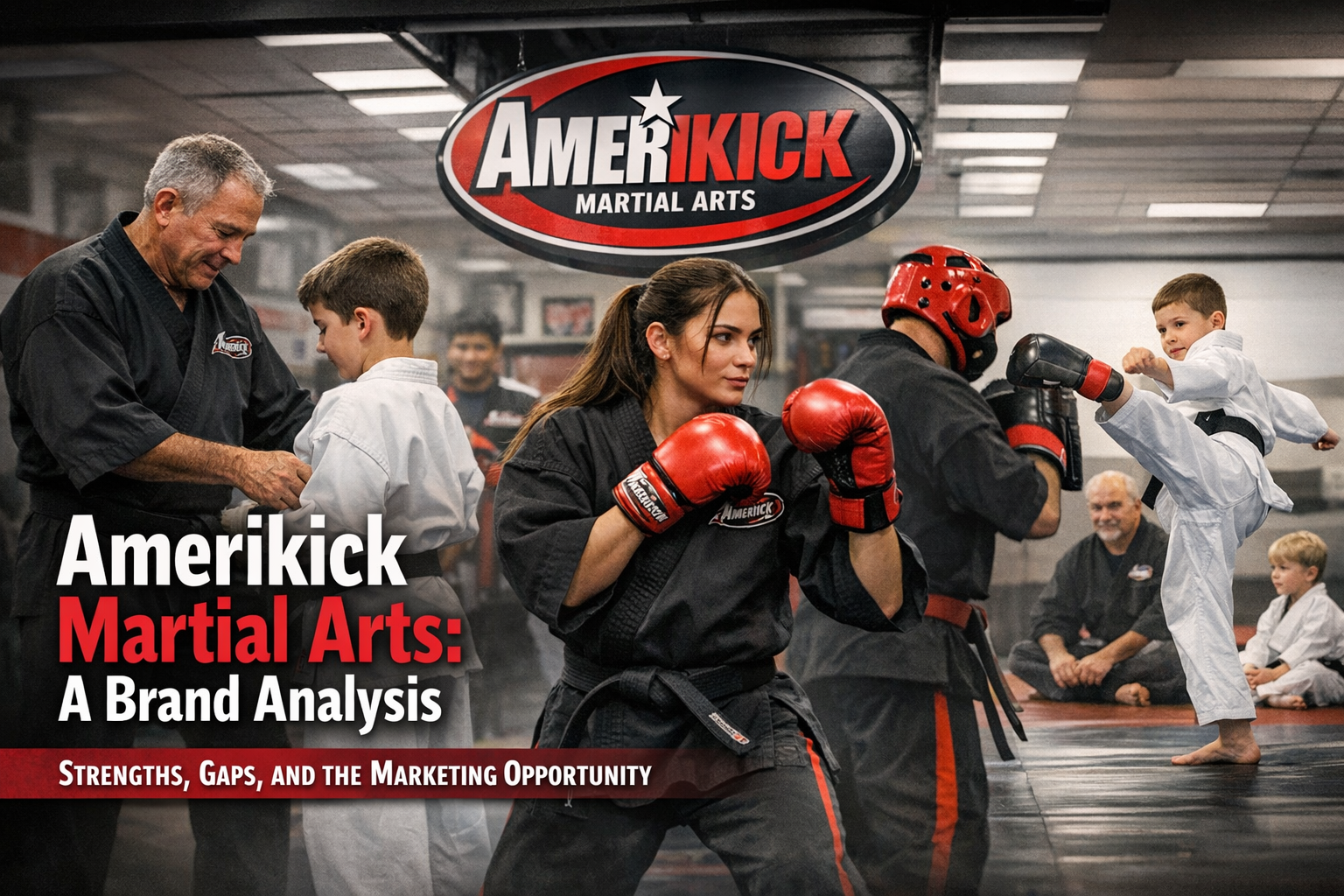
Some brands earn their longevity. Others just survive long enough to call it a legacy. Amerikick falls firmly into the first category.
Founded in 1967 by Grandmaster Dennis Tosten in Philadelphia, Pennsylvania — originally known as American Karate Studios — Amerikick has been operating for nearly six decades. Franchise Clique That is not an accident. It is the result of a brand that understood its core product, built genuine community around it, and franchised that model with enough support infrastructure to sustain real growth across decades of changing consumer behavior, shifting fitness trends, and increasing competition.
But longevity is not the same as optimization. This analysis looks at Amerikick the way a marketing strategist would — what the brand is doing right, where real gaps exist in its digital and franchise marketing infrastructure, and what the opportunity looks like for a brand with this much authentic equity to build on.
This is not a takedown. Amerikick has earned genuine respect in this industry. It is an honest assessment of where a strong brand with significant untapped marketing potential stands in 2026.
The Brand Foundation — What Amerikick Has Built That Most Franchises Can't Buy
Nearly Six Decades of Authentic Credibility
In the franchise world, credibility is the most expensive thing to acquire and the hardest to fake. During the late 1960s, martial arts studios in Philadelphia were few and far between. Amerikick was the first of its kind, beginning a whole new world for people craving something different. Amerikick That pioneer positioning — being first in a market before anyone else recognized the market existed — is the kind of brand origin story that no amount of marketing spend can manufacture after the fact.
Grandmaster Dennis Tosten trained with and received his black belts from world-famous martial artists including Joe Lewis — the first full-contact heavyweight kickboxing champion of the world — Ed Parker, founder and Grandmaster of American Kenpo, and Remy Presas, founder and Grandmaster of Filipino Modern Arnis. Growjo That lineage is real, documented, and verifiable. In a market full of fitness studios that borrow martial arts aesthetics without martial arts substance, authentic lineage is a significant brand differentiator — and Amerikick has it in depth.
A Curriculum That Actually Means Something
Most fitness franchises have a program. Amerikick has a curriculum. There is a meaningful difference. Amerikick's curriculums are based on the traditional arts of Kenpo, Bando, Taekwondo, Shotokan, Wushu, and Filipino Arnis in addition to modern boxing, kickboxing, and sport karate. The age-specific curriculums are designed to achieve maximum results in self-defense, fitness, and flexibility and challenge students in fun and exciting ways. Franchise Clique
The Character Development Program and Life Skills Program enhance the value of the program by educating students in values and principles of self-control, respect, leadership, discipline, and focus. The curriculums train students from age 3 to master-level black belt instructor. Franchise Clique
This matters enormously from a marketing perspective. The parents who are the primary decision-makers for children's enrollment are not buying karate lessons — they are buying focus, discipline, confidence, and character development. Amerikick's curriculum delivers all of those outcomes and has the decades of proof to back them up. That is a content marketing goldmine that most brands in this space are not fully exploiting.
The Franchise Structure Is Genuinely Founder-Led
Amerikick's ongoing support and commitment to franchisees is a daily process. They offer weekly emails, distance learning modules, monthly meetings, one-on-one troubleshooting, and campaign strategy support. They position themselves as the most involved group of directors in the industry. amerikick
Executive Vice President Mark Russo began his martial arts training under Master Dennis Tosten and opened his own Amerikick franchise location in 1991. He has since co-promoted the Amerikick Internationals since 1995, building it into one of the largest sport karate tournaments on the East Coast. Amerikickmartialarts
The leadership of this franchise system is not a private equity group that bought a martial arts brand and hired operators to run it. It is practitioners who built the brand, own locations in the network, and are directly accountable to the same market forces their franchisees face. That is a genuine competitive advantage in franchise recruitment and in franchisee trust — and it is a brand story that deserves to be told more loudly and consistently than it currently is.
The Digital Marketing Landscape — Where Amerikick Stands Today
The Website: Functional But Underperforming Its Brand Equity
Amerikick's corporate website does the basics. It communicates the brand's history, describes programs, provides location information, and makes a case for franchise ownership. For a brand with nearly sixty years of history and a genuine community of students and families who have been transformed by the program, it underperforms significantly as a lead generation and brand storytelling asset.
The content architecture is not built around how prospective students and parents actually search for martial arts programs. A parent in Cherry Hill, New Jersey searching "kids karate classes near me" or "martial arts for 6-year-olds South Jersey" is not landing on an Amerikick page that speaks directly to their search intent and their specific location. The gap between Amerikick's genuine local presence across its markets and its visibility in local search is one of the most addressable opportunities in the entire brand's marketing picture.
The franchise information section has the right content instincts — it leads with mission, values, and lifestyle before getting into numbers — but it lacks the social proof infrastructure that converts serious franchise prospects. Validated franchisee testimonials, location-specific performance data presented appropriately, and a clear visual representation of what the franchise community looks like are all missing or underdeveloped.
Local SEO — The Biggest Immediate Opportunity
This is where the gap between Amerikick's real-world brand strength and its digital visibility is most stark. The brand has operated locations across the Eastern United States for decades. Many of those locations have been serving their communities for years, accumulating real customer satisfaction, real reviews, and real community relationships. That local authority should translate directly into dominant local search visibility — and in many markets, it is not doing so at the level the brand's actual market position warrants.
The fundamentals of local SEO for a multi-location franchise are well understood: optimized Google Business Profiles for every location, consistent NAP data across all directories and citation sources, location-specific landing pages that reflect the actual community each school serves, and a review generation strategy that captures the genuine satisfaction of students and families systematically rather than sporadically.
The Amerikick Internationals tournament — one of the largest sport karate events on the East Coast, currently a World Rated event on the NASKA circuit Amerikickmartialarts — is a content and community asset that could be driving significant search traffic, brand searches, and local awareness across the entire system year-round. It is underutilized as a digital marketing asset relative to its actual scale and significance in the martial arts community.
Social Media — Passion Is Present, Strategy Is Inconsistent
Individual Amerikick locations show genuine social media activity — there is real passion in the content that gets posted, real student transformation stories, real competition highlights and community moments. That authentic, community-driven content is exactly what performs in the social media environment that drives enrollment decisions for fitness and enrichment programs.
The challenge is consistency and strategic coordination across the network. When social media is left entirely to individual location owners without a system-level content strategy, brand guidelines, and shared asset library, the result is uneven execution — some locations posting regularly with strong content, others posting rarely or inconsistently, and the overall brand presence on social platforms failing to add up to more than the sum of its parts.
The competitive landscape makes this matter more than it might have a decade ago. National martial arts franchises with larger marketing infrastructure — ATA International with its 950-plus locations, and well-funded fitness brands that have moved into the martial arts space — are running coordinated social media programs that create consistent brand presence across their networks. Amerikick's authentic story and genuine community are better raw material than most of those competitors have. The gap is in the infrastructure to deploy that material consistently and strategically.
Content Marketing — An Enormous Untapped Asset
Amerikick has been producing outcomes — confident kids, disciplined adults, championship competitors, and students who started at age six and are now teaching the next generation — for nearly sixty years. That is an almost inexhaustible library of content waiting to be systematically documented, published, and distributed.
Student testimonials from the Amerikick community speak to the brand's transformational impact directly: "I've been training with this team and family since age 6. I am now 36. Honor, Respect, Integrity and Giving Back — I've learned all of this while learning to defend myself." Another says: "I started at Amerikick as a 7-year-old shy kid. I can't tell you how proud I am to have earned my black belt. Now I have the privilege of teaching the next generation of martial artists." Amerikick
Those are not marketing copy. Those are real outcomes from real people who have been transformed by this brand. A systematic content strategy built around student journey stories — from first class to black belt to instructor — would generate organic search traffic, social engagement, and enrollment conversions that paid advertising cannot match for authenticity or cost-efficiency.
The parent audience that drives children's enrollment is highly responsive to transformation narratives. Before-and-after stories about focus, confidence, and discipline in children — told through video, long-form blog content, and social proof — are the highest-converting content type in this market. Amerikick has more of this content available in the lived experience of its student base than virtually any competitor. It is not being harvested and distributed at the scale the opportunity warrants.
The Franchise Marketing Infrastructure — Strengths and Gaps
What the System Does Well
Amerikick's franchise support model has genuine strengths that deserve recognition. The marketing support offered to franchisees includes advertising, custom ad slicks, commercials, social media optimization, website support, lead generation, community outreach, low-cost strategy, inbound, outbound, referral engines, co-op efforts, and local and national branding — described as done-for-you support. Amerikick
The initial training covers two weeks of intense instruction at a corporate location covering sales, curriculum, marketing, advertising, POS, process, and classroom mechanics. The ongoing support includes weekly emails, distance learning modules, monthly meetings, one-on-one troubleshooting, and campaign strategy. amerikick
The hands-on, founder-operated nature of the franchise support means that franchisees are not getting advice from a corporate marketing department that has never run a school — they are getting guidance from people who own and operate Amerikick locations and understand the real operational environment those franchisees are working in every day. That is a meaningful differentiator in franchise support quality.
The Transparency and Data Gap
Where the franchise marketing infrastructure has its most significant gap is in the transparency and data layer that modern franchisees expect and that modern digital marketing requires. Franchisees contributing to marketing efforts — whether through royalties, co-op programs, or their own local spend — need visibility into what those investments are producing for their specific location, in a format they can actually read and act on.
The martial arts franchise market is competitive. Franchisees who cannot clearly see whether their marketing investment is working, who have no visibility into their local search rankings, who cannot understand why one location is growing and another is flat — those franchisees become the dissatisfied operators who either go rogue with their own marketing efforts or exit the system entirely.
Building a location-specific reporting infrastructure that gives every Amerikick franchisee clear, plain-language visibility into their digital performance is not a luxury — it is a retention investment that protects the system's growth and the brand's market position.
The Regional Directorship Model — A Marketing Asset Being Underutilized
Amerikick is one of the only associations offering regional directorships within the United States, with the ability to oversee and direct multiple locations and franchisees with profit sharing from their regions. Franchise Clique
From a marketing perspective, this structure is underutilized as a brand amplification tool. Regional directors who own and operate locations, who have deep relationships with franchisees in their region, and who have a financial stake in the success of every school in their territory are the ideal conduit for a coordinated regional marketing strategy that no purely corporate-driven program can replicate. Regional directors can coordinate local PR, cross-promote between locations, run regional events that build brand awareness across a market, and serve as the peer voice that gives franchisees confidence in marketing initiatives.
The Amerikick Internationals tournament model — where Mark Russo has built one of the largest sport karate events on the East Coast — is proof that this system's leadership knows how to build community events with marketing impact. Scaling that event-based marketing model across regions, with regional directors owning the execution in their territories, would create marketing reach that no paid digital campaign can achieve for the cost and community depth.
The Competitive Landscape — Where Amerikick Wins and Where It Faces Pressure
The Genuine Differentiators
In a market that ranges from basement karate schools to national fitness chains running kickboxing classes with no traditional martial arts substance, Amerikick's differentiators are real and defensible. Nearly sixty years of operation. Authentic lineage from world-class martial artists. A curriculum built by practitioners for practitioners. A franchise system led by people who own locations in the network. A tournament association that is a legitimate event in the national sport karate community. A student community spanning multiple generations — adults who trained as children and are now bringing their own children through the program.
These are not marketing claims. They are documented facts that can be verified, told through compelling stories, and used to create a brand position that no competitor funded by private equity and built around a fitness trend can match.
Where National Scale Competitors Create Pressure
The martial arts franchise market has consolidated significantly around several larger competitors. ATA International, with more than 950 licensed locations globally and over a million students trained since its founding in 1969, brings a marketing infrastructure that Amerikick's smaller network cannot match in raw spend. National fitness brands — both dedicated martial arts chains and hybrid fitness concepts that have incorporated kickboxing and martial arts programming — bring consumer marketing sophistication and digital infrastructure that outperforms smaller franchise systems on brand awareness metrics.
The risk for Amerikick is not that these competitors are better — it is that they are more visible. A parent searching for kids' martial arts classes in a market where an Amerikick location operates may encounter ATA's well-funded national digital presence before they find the local Amerikick school that has been serving that community for years. Winning that search visibility gap requires the exact investment in local SEO, location-specific content, and Google Business Profile optimization that represents the most actionable near-term opportunity in Amerikick's marketing picture.
The Post-Pandemic Fitness Market — A Tailwind Worth Capturing
The market conditions for a brand like Amerikick have arguably never been better. Parents are actively seeking enrichment activities with documented developmental benefits for their children. The mental health case for martial arts — discipline, focus, confidence, resilience — has become more mainstream as awareness of youth mental health challenges has grown. Adult fitness consumers are increasingly seeking alternatives to traditional gym memberships that offer both physical training and community belonging.
The martial arts industry in the US has been totaling around $5 billion a year in revenue, with around 3.6 million people actively participating in martial arts every year and over 80,000 martial arts businesses. Glofox That market is growing, and Amerikick's authentic brand position — nearly sixty years of real outcomes, not a fitness trend — is exactly what a market segment increasingly skeptical of manufactured wellness brands is looking for.
The question is whether the brand's marketing infrastructure is positioned to capture that tailwind or whether competitors with better digital visibility will take the enrollment growth that Amerikick's genuine brand equity should be earning.
The Marketing Opportunity — What Amerikick Should Be Building
A Unified Digital Architecture That Matches the Brand's Real Strength
The single highest-leverage marketing investment Amerikick could make is a unified digital architecture that builds system-wide search authority while giving every individual location the local visibility its community presence deserves. This means a single brand domain with optimized location pages for every school, a coordinated Google Business Profile management program across the network, and a content strategy that systematically documents and publishes the transformation stories the brand has been producing for six decades.
This is not a massive budget investment. It is a strategic infrastructure investment that produces compounding returns — every piece of location-specific content, every student story published, every review generated and responded to builds search authority that benefits the location permanently. The brands that dominate local search in the fitness and enrichment category are not necessarily the ones with the biggest ad budgets — they are the ones that have built the most relevant, consistent, locally rooted digital presence. Amerikick has the authentic local roots. It needs the digital infrastructure to make them visible.
A Franchisee Communication and Transparency Program
The monthly franchisee marketing call is not a luxury for a system of Amerikick's scale — it is a retention investment. Franchisees who have clear visibility into what their marketing is producing, who understand the strategy behind the tactics being executed for their location, and who have a direct line to the marketing team when they have questions are franchisees who trust the system and renew their agreements.
The Amerikick franchise model has genuine strength in the hands-on, accessible support it offers. Formalizing that into a structured monthly marketing communication cadence — location-specific performance data, plain-language explanation of what drove results, forward plan for the coming month — would transform the marketing relationship from something that happens to franchisees into something that happens with them.
The Content Engine — Finally Harvesting Sixty Years of Outcomes
If Amerikick systematically documented and published one student transformation story per week across its network — one child who went from shy and unfocused to confident black belt, one adult who found discipline and community in the program — that content would generate more organic enrollment inquiries than most paid campaigns at a fraction of the cost. The content exists in the lived experience of every school in the system. It needs a structure, a publishing cadence, and a distribution strategy to become the marketing asset it should be.
The Amerikick Internationals tournament is a content event that the brand is currently underleveraging in digital terms. A major regional and national sport karate event, with competitors from across the country, creates natural video content, community stories, social media moments, and brand awareness that should be driving search traffic and brand recognition year-round — not just in the weeks around the event.
The Bottom Line
Amerikick is a brand that has earned its longevity through genuine product quality, authentic community, and a franchise model led by practitioners who understand what they are building. Since 1967, Amerikick has been getting kids in the best shape of their lives Franchise Clique — and the documented outcomes of that mission, across multiple generations of students and families, represent a brand story that almost no competitor in the martial arts franchise space can match.
The marketing gap is not in the story — it is in the infrastructure to tell it consistently, at scale, in the digital environments where enrollment decisions are increasingly made. Unified local SEO architecture, systematic content marketing built around genuine student outcomes, franchisee transparency and communication programs, and a coordinated social media strategy that amplifies what individual locations are already doing organically — these are the investments that would close the gap between Amerikick's real-world brand strength and its digital market position.
Sixty years of authentic credibility is the most valuable marketing asset a brand can have. The opportunity is to build the digital infrastructure worthy of it.
Frequently Asked Questions
The Brand and Its History
Q: How long has Amerikick been operating and why does that matter from a marketing perspective?
Amerikick was founded in 1967 by Grandmaster Dennis Tosten in Philadelphia, Pennsylvania, originally known as American Karate Studios. Franchise Clique Nearly six decades of continuous operation is not just a historical footnote — it is one of the most powerful marketing assets the brand possesses. In a fitness and enrichment market full of concepts that launched five years ago and are positioning themselves as established brands, nearly sixty years of documented outcomes, multi-generational student relationships, and community roots is genuinely rare and genuinely valuable. The marketing challenge is not inventing credibility — it is making existing credibility visible in the digital environments where enrollment decisions are being made today.
Q: Who founded Amerikick and what makes the founding story marketable?
Grandmaster Dennis Tosten trained with and received his black belts from world-famous martial artists including Joe Lewis — the first full-contact heavyweight kickboxing champion of the world — Ed Parker, founder and Grandmaster of American Kenpo — and Remy Presas, founder and Grandmaster of Filipino Modern Arnis. Growjo That lineage is documented, verifiable, and meaningful to anyone who knows the martial arts world. In an industry where credibility claims are frequently inflated or fabricated, authentic documented lineage from legendary practitioners is a brand differentiator that money cannot manufacture after the fact. It belongs front and center in Amerikick's brand storytelling — not buried in an about page that most visitors never reach.
Q: What makes Amerikick's curriculum different from other martial arts franchise systems?
Amerikick's curriculums are based on the traditional arts of Kenpo, Bando, Taekwondo, Shotokan, Wushu, and Filipino Arnis in addition to modern boxing, kickboxing, and sport karate. The age-specific curriculums are designed to achieve maximum results in self-defense, fitness, and flexibility and challenge students in fun and exciting ways. The Character Development Program and Life Skills Program enhance the value of the program by educating students in values and principles of self-control, respect, leadership, discipline, and focus. Franchise Clique From a marketing perspective, the curriculum's depth and its explicit character development outcomes are the most persuasive content the brand has for the parent audience that drives children's enrollment. Parents choosing martial arts for their children are not primarily buying karate techniques — they are buying confidence, focus, discipline, and resilience. Amerikick's curriculum delivers all of those outcomes and has the documented track record to prove it.
Q: How does Amerikick's leadership structure affect its brand credibility?
Significantly and positively. Executive Vice President Mark Russo began his martial arts training under Master Dennis Tosten, opened his own Amerikick franchise location in 1991, and has co-promoted the Amerikick Internationals since 1995 — building it into one of the largest sport karate tournaments on the East Coast. Amerikickmartialarts A franchise system led by practitioners who own locations in the network and are directly accountable to the same market forces their franchisees face is a fundamentally different proposition from a franchise system run by a corporate team or private equity group that bought a brand and hired operators. That founder-practitioner leadership is a brand story worth telling explicitly and consistently — in franchise recruitment marketing, in franchisee communications, and in consumer-facing content that explains why Amerikick's instructors are different.
Digital Marketing and Online Presence
Q: What is Amerikick's biggest digital marketing gap right now?
Local search visibility — the gap between where the brand's real-world community presence warrants it to rank in local search and where it actually appears when prospective students search for martial arts programs in markets where Amerikick locations operate. A parent searching "kids karate classes near me" or "martial arts for children" in a market where an Amerikick school has been serving the community for years should be finding that school at the top of local search results. In many markets, that is not happening consistently. The investment required to close that gap — optimized Google Business Profiles, location-specific content pages, a systematic review generation program, and consistent NAP data across all directories — is well understood and highly executable. It is the highest-return near-term marketing investment available to the brand.
Q: How should Amerikick be approaching its website architecture for a multi-location franchise?
The most effective architecture for Amerikick's scale is a single brand domain with optimized location-specific pages for every school in the network — not separate websites for individual locations and not a generic locations page that lists addresses without locally relevant content. Each location page should be built around the specific community that school serves, with locally relevant content, location-specific reviews, accurate hours and contact information, and clear calls to action for the programs offered at that location. This architecture allows the entire system to build search authority collectively — every piece of content, every review, every local signal contributing to a brand-level domain authority that benefits every location — while giving each school the local visibility its community presence deserves.
Q: Is Amerikick's social media presence strong enough given the brand's scale?
Individual locations show genuine passion and authentic community content — real student transformation stories, competition highlights, community moments — which is exactly the content type that drives enrollment decisions in the fitness and enrichment category. The challenge is consistency and strategic coordination across the network. When social media execution is left entirely to individual location owners without a system-level content strategy, shared asset library, and brand guidelines, the result is uneven — some locations posting with real impact, others posting rarely, and the overall brand presence on social platforms not adding up to what the brand's genuine community would support. A coordinated social media program that gives individual locations templates, shared assets, and a publishing framework while preserving the authentic local voice would significantly amplify what is already happening organically across the network.
Q: What role should the Amerikick Internationals tournament play in the brand's digital marketing?
A much larger one than it currently plays. Mark Russo has promoted the Amerikick Internationals since 1995, building it into one of the largest sport karate tournaments on the East Coast and currently a World Rated event on the NASKA circuit. Amerikickmartialarts A major regional and national competition event with competitors from across the country creates natural video content, community stories, social media moments, search traffic opportunities, and brand awareness that should be driving digital marketing value year-round — not just in the weeks immediately surrounding the event. A content strategy built around the tournament — competitor profiles, training content, results coverage, historical retrospectives — would generate organic search traffic and brand searches from the national sport karate community that no paid campaign can replicate at the same cost and authenticity level.
Q: How important are Google reviews for individual Amerikick locations?
Critically important — and likely the single most underleveraged asset in the entire network's local marketing picture. Google reviews are one of the primary factors Google uses to determine local search ranking, and they are one of the primary factors prospective students and parents use to evaluate martial arts schools before making contact. A school with fifty authentic five-star reviews describing specific student outcomes — a child's confidence transformation, an adult finding community and discipline, a family that has had multiple members train through the years — will consistently outperform a school with ten generic reviews in both search ranking and enrollment conversion rate. Amerikick's student community is genuinely enthusiastic and genuinely transformed by the program. The gap is in systematically asking satisfied students and families for reviews at the right moment in their experience rather than leaving review generation to chance.
Franchise Marketing and Franchisee Support
Q: What does Amerikick currently offer franchisees in terms of marketing support?
The marketing support offered to franchisees includes advertising, custom ad slicks, commercials, social media optimization, website support, lead generation, community outreach, low-cost strategy, inbound and outbound marketing, referral engines, co-op efforts, and local and national branding — positioned as done-for-you support. Amerikick The initial training covers two weeks of intense instruction at a corporate location covering sales, curriculum, marketing, advertising, and more. Ongoing support includes weekly emails, distance learning modules, monthly meetings, one-on-one troubleshooting, and campaign strategy. amerikick The hands-on, practitioner-led nature of this support is a genuine strength — franchisees are getting guidance from people who actually run schools, not from a corporate marketing department operating at a remove from the real business environment.
Q: Where does the franchise marketing support have the most room to improve?
The transparency and data layer. Franchisees contributing to marketing efforts — through royalties, co-op programs, or their own local spend — need clear, location-specific visibility into what those investments are producing in a format a non-marketer can read and act on. System-wide aggregate metrics are useful for corporate oversight but tell an individual franchisee almost nothing about whether their specific location's marketing is working. A structured monthly reporting cadence that gives every franchisee their own location's search rankings, Google Business Profile performance, website traffic, lead volume, and campaign results — delivered in plain language with honest context for what drove the numbers — would transform the marketing relationship from a black box franchisees pay into to a collaborative partnership they value and defend.
Q: What is the regional directorship model and how does it create marketing opportunity?
Amerikick is one of the only associations offering regional directorships within the United States, with the ability to oversee and direct multiple locations and franchisees with profit sharing from their regions. Franchise Clique From a marketing perspective this structure is significantly underutilized. Regional directors who own and operate locations, who have deep relationships with franchisees in their territory, and who have a financial stake in every school's success are the ideal conduit for coordinated regional marketing that no purely corporate-driven program can replicate. Regional directors can coordinate local PR, cross-promote between locations, run regional events that build brand awareness across a market, and serve as the peer voice that gives franchisees confidence in marketing initiatives. The Amerikick Internationals is the proof of concept — a practitioner-led event that built genuine regional and national marketing impact. That model deserves to be scaled across the regional director structure.
Q: Should Amerikick franchisees be running their own local marketing in addition to the corporate program?
Yes — but in coordination with the system, not in parallel to it. The most effective franchise marketing programs operate on two synchronized levels simultaneously: system-level activity that builds brand authority and awareness across the entire network, and locally activated tactics that connect each school directly to the specific community it serves. Community outreach, school demonstrations, local event sponsorships, neighborhood-specific social media content, and relationships with local businesses and schools are all forms of local marketing that franchisees are uniquely positioned to execute because they are embedded in those communities in ways the corporate marketing team is not. The key is building a framework that channels that local energy within brand guidelines rather than leaving franchisees to improvise without coordination — which is how rogue marketing and brand inconsistency emerge.
Competitive Landscape
Q: Who are Amerikick's main franchise competitors and how does the brand compare?
The martial arts franchise landscape includes ATA International — with more than 950 licensed locations globally — Tiger-Rock Martial Arts, and a growing number of fitness-oriented brands that have incorporated kickboxing and martial arts programming into their offerings. Compared to these competitors, Amerikick's advantage is authenticity and depth — nearly sixty years of genuine martial arts lineage, a curriculum built by world-class practitioners, and a community that spans multiple generations of students and families. The gap is in marketing infrastructure and digital visibility. Competitors with larger networks and more centralized marketing resources can outspend Amerikick on awareness campaigns and digital advertising. The strategic response is not to try to match that spend — it is to win on authenticity, local community depth, and the kind of documented long-term outcomes that fitness trend brands cannot credibly claim.
Q: How does Amerikick differentiate from the growing number of fitness kickboxing concepts that have entered the market?
Fundamentally and meaningfully — but that differentiation is not being communicated clearly enough in the brand's current digital presence. Fitness kickboxing concepts offer a workout. Amerikick offers a curriculum-based martial arts education with documented character development outcomes, authentic lineage from world-class practitioners, age-specific programming from age 3 through master level, and a community with nearly six decades of multi-generational relationships. A former student who has been training since age 6 and is now 36 describes the experience: "Honor, Respect, Integrity and Giving Back — I've learned all of this while learning to defend myself, building a strong mind, strong spirit, strong body and fostering the will to succeed." Amerikick No fitness kickboxing franchise can produce that kind of testimonial because no fitness kickboxing franchise has been operating long enough or with enough depth of curriculum to generate it. Making that differentiation explicit and central in Amerikick's marketing — rather than positioning the brand as another fitness option — is one of the highest-leverage strategic decisions available to the brand.
Q: Is the current market environment favorable for Amerikick's growth?
Very much so. The martial arts industry in the US totals around $5 billion a year in revenue, with around 3.6 million people actively participating in martial arts every year. Glofox Beyond the raw market size, the conditions driving enrollment decisions are favorable for exactly what Amerikick offers. Parents are actively seeking enrichment activities with documented developmental benefits — focus, discipline, confidence, resilience — for their children. The mainstream conversation about youth mental health has made the character development outcomes of martial arts more relevant than ever to the parent audience making enrollment decisions. Adult fitness consumers are increasingly seeking alternatives to traditional gym memberships that offer both physical training and genuine community. Amerikick's authentic brand position — nearly sixty years of real outcomes, practitioner-led instruction, multi-generational community — is precisely what a market growing more skeptical of manufactured wellness brands is looking for. The question is whether the marketing infrastructure is in place to capture the tailwind the brand's genuine equity deserves.
Ritner Digital builds marketing programs for businesses that need their investment to produce measurable results. For brands looking to close the gap between their real-world strength and their digital market position, visit ritnerdigital.com or call (703) 420-9757.