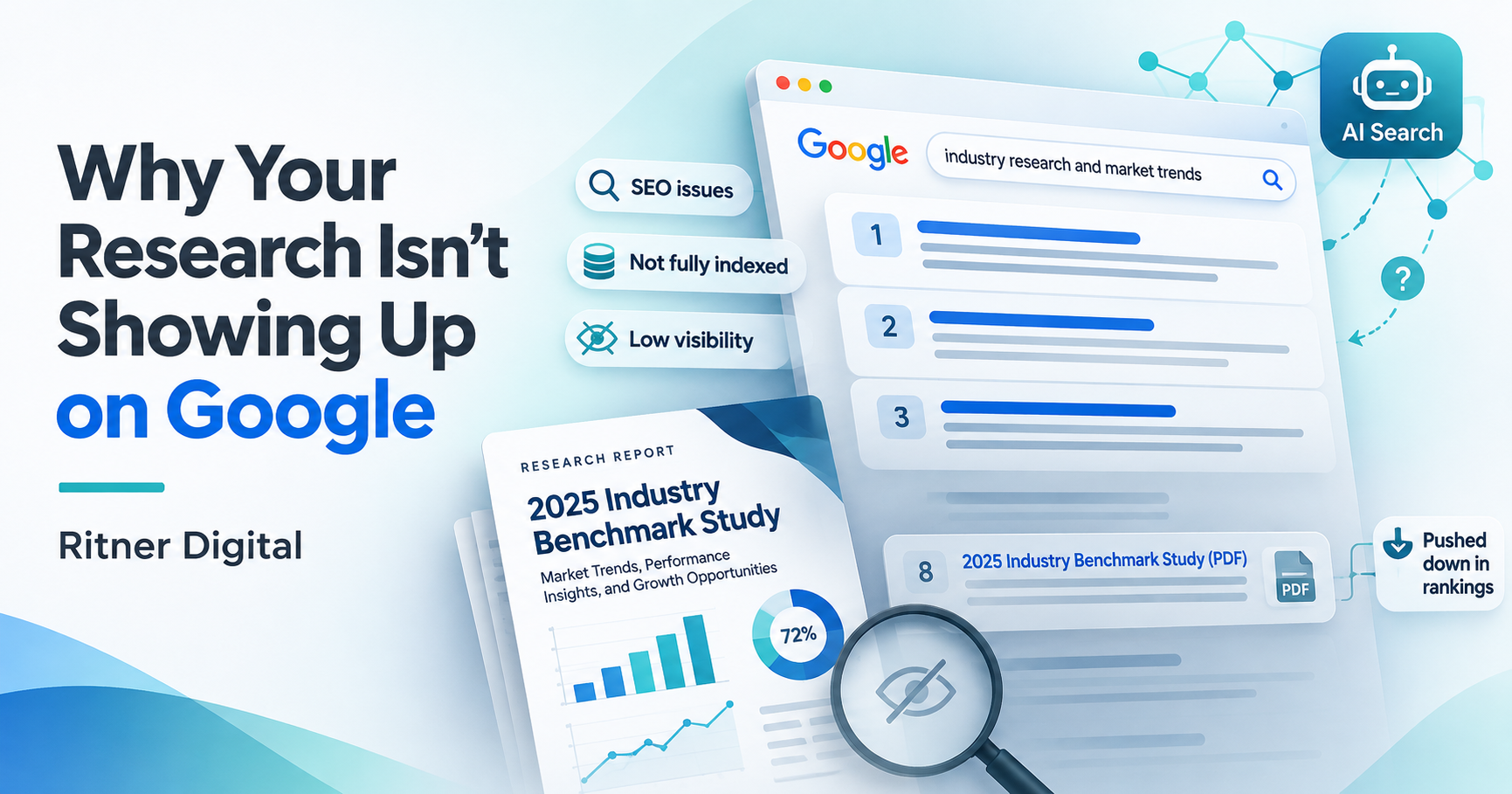
An investigation into the corporate epidemic of producing valuable research, hiding it in a PDF, and wondering why the internet has declined to organize a parade.
Somewhere in America, a company has just completed an extraordinary piece of research.
It took nine months.
It involved 1,400 survey respondents, six industry experts, two statisticians, a research agency, and a project manager who has not experienced uninterrupted sleep since February.
The findings are genuinely interesting.
They challenge conventional wisdom. They reveal a pattern nobody had previously documented. They contain information that could help potential customers make expensive, complicated decisions.
The executive team is thrilled.
The design team has created a beautiful 47-page report featuring tasteful gradients, sophisticated typography, and several stock photographs of professionals looking thoughtfully through glass conference room walls.
Marketing has given it a title:
The 2026 Strategic Transformation and Innovation Excellence Insights Report.
Nobody knows what this means.
Nevertheless, the report launches.
The company announces it on LinkedIn. Fourteen employees like the post. The CEO comments, "Great insights from the team!" Someone in accounting shares it by accident.
The report receives 63 downloads, of which nine are internal employees, three are competitors, and one is the project manager checking whether the download button works.
Two weeks later, it disappears into the Resources section of the website, where it joins 19 previous reports and a webinar recording from 2021.
The research is exceptional.
The discoverability is a hostage situation.
And the company is left asking a perfectly reasonable question:
Why can't potential clients find our research on Google?
The answer is rarely that the research wasn't good enough.
More often, the company has confused publishing something with making it discoverable.
Those are two very different activities.
And if your business is investing substantial time, money, and expertise into original research that nobody can find, you may have created one of the most expensive digital filing cabinets in your industry.
Let's investigate.
The First Problem: Your Research Is Written for People Who Already Know It Exists
Companies have an unfortunate habit of naming important things as though they are secret government initiatives.
Consider the following fictional research report:
Project Horizon: The Future of Enterprise Operational Resilience.
Very impressive.
Sounds expensive.
Probably required a steering committee.
But what does the research actually reveal?
Imagine it found that mid-sized manufacturers lose significant productivity because equipment maintenance records are scattered across incompatible systems.
That is useful information.
A plant manager might search Google for:
"Why do maintenance records cause production delays?"
An operations director might search:
"Manufacturing downtime causes and prevention."
A consultant might search:
"Equipment maintenance data problems in manufacturing."
Nobody is searching for Project Horizon.
Nobody knows Project Horizon exists.
The only people familiar with that phrase attended the internal launch meeting, and several of them were only there because lunch was provided.
This is where otherwise impressive research begins its journey into obscurity.
The company describes the research using its own internal language instead of the language its potential clients use when searching for answers.
Google's Search Essentials documentation specifically recommends using words people would use to find your content and placing those terms in prominent locations, including page titles, headings, and descriptive links.
This is not an argument for abandoning sophisticated language.
It is an argument for understanding the difference between a research project's official name and the problem that makes its findings valuable.
You can keep Project Horizon.
Put it on the cover.
Give it an impressive logo.
Name a conference room after it.
But the page introducing the research should explain what people will learn, who the findings concern, and why the information matters.
For example:
Manufacturing Downtime Research: Why Maintenance Data Problems Delay Production
Suddenly, a person who has never heard of your company has a reason to visit.
The research hasn't changed.
The language connecting it to an audience has.
A small but consequential distinction.
The Second Problem: You Published a Report Instead of Building a Searchable Resource
There is nothing inherently wrong with a PDF.
PDFs are useful.
They preserve formatting.
They're easy to share, print, download, and circulate among colleagues who insist on attaching things to emails despite the existence of hyperlinks.
Google can also index them.
Its official documentation on indexable file types explicitly lists PDF files among the document formats Google Search can process.
So the problem is not that Google categorically refuses to acknowledge PDFs.
The problem is that companies frequently publish valuable research only as a downloadable document, surrounded by a landing page containing approximately 83 words.
Those words usually say:
"We are pleased to announce the release of our latest comprehensive report, exploring key trends and emerging insights."
Terrific.
What trends?
What insights?
What did the research find?
Why should anyone care?
Apparently, these details are classified until the visitor enters their email address, job title, company size, industry, and possibly their mother's maiden name.
The landing page offers no meaningful answers.
The PDF contains all of them.
And the people searching Google for those answers may never encounter the report.
A Research Landing Page Should Actually Contain Research
Imagine a software company studies cybersecurity preparedness among 600 small businesses.
Its findings include original data about employee training, recovery planning, and security spending.
Instead of publishing a landing page with a generic introduction and a download button, the company could create a substantial HTML research page containing:
A clear summary of the central findings.
The most useful statistics and explanations.
A transparent description of the research methodology.
Dedicated sections answering specific industry questions.
Relevant links to related analysis and resources.
An optional downloadable version of the complete report.
Now Google has a substantive webpage to crawl, interpret, and potentially surface for relevant searches.
Visitors can evaluate the research before committing to a download.
Journalists can reference individual findings.
Potential clients can understand the company's expertise without completing an application that resembles a mortgage preapproval.
And the PDF can still exist.
Everybody wins.
Except the person who spent three meetings defending the decision to hide everything behind a form.
That person may need a moment.
Does This Mean You Should Never Gate Research?
No.
Gating research can make sense when the business objective is qualified lead generation and the material has enough value to justify asking for information.
But there is a difference between gating the complete asset and hiding every useful finding.
A strong compromise is to make the major discoveries available on a public webpage while reserving additional value for the download.
That additional value might include detailed data tables, industry breakdowns, research instruments, expanded analysis, or an implementation workbook.
The public page earns attention.
The downloadable resource offers depth.
The visitor gets to decide whether the exchange is worthwhile.
And your research no longer requires a stranger to hand over their professional contact information just to discover what the first paragraph means.
The Third Problem: Google May Not Even Know Your Research Page Exists
Before we address content strategy, we should examine a less glamorous possibility.
Your page may not be properly indexed.
This is the digital equivalent of opening a beautiful retail store, stocking it with expensive merchandise, and forgetting to connect the entrance to the street.
The merchandise exists.
The customers exist.
Unfortunately, the customers are outside.
Google's documentation on crawling and indexing explains the technical processes involved in discovering pages and understanding their contents.
A research page can encounter several barriers along the way.
It might be blocked from crawling.
It might carry an accidental noindex directive.
It might have a canonical tag identifying another URL as the preferred version.
It might require a login.
The page's main content might rely on JavaScript that isn't rendering as expected.
Or the URL might simply be poorly connected to the rest of the website.
These are different problems, and they require different solutions.
A noindex directive is not a content quality issue.
A missing internal link is not a public relations issue.
And a report that Google has never discovered will not suddenly rank because someone adds "2026" to the title and asks the marketing team to manifest better search visibility.
Your Research Needs an Entrance
Google's link best practices explain that links help search engines discover pages and understand their relevance.
Yet companies regularly publish major research under URLs that are almost completely isolated.
The report isn't linked from relevant service pages.
It doesn't appear within related blog articles.
It has no useful connections to the rest of the website.
The only route to it is clicking "Resources," selecting "Research," filtering by year, and scrolling past several retired webinar announcements.
This is not website navigation.
This is an escape room.
An important research asset should be discoverable from relevant pages on your own site.
If your company has produced original findings about healthcare staffing, those findings may deserve links from your healthcare industry page, related articles about labor shortages, relevant solutions pages, and other research resources.
These connections help people move naturally between the questions they're researching and the expertise your business offers.
They also provide Google with additional paths to discover the material.
You have already paid to produce the research.
Giving it a few thoughtful internal links is a relatively modest additional investment.
Your Research Might Be Valuable. But Is It Actually Useful to the Person Searching?
Let's address a distinction that causes considerable discomfort in corporate boardrooms.
Important research is not automatically useful research.
At least not to every audience.
Your report may contain extraordinary information about supply-chain risk.
But someone searching "how to reduce supplier delays" needs actionable context.
A procurement manager looking for supplier risk indicators may need examples and definitions.
A CFO investigating inventory costs may need financial implications.
A journalist covering manufacturing trends may want a clearly attributed statistic.
All four could benefit from your research.
But they are approaching it with different questions.
A report that says "Operational Excellence in the New Industrial Landscape" might not clearly answer any of them.
This is why search discoverability requires more than placing a keyword in the title.
You need to understand the problems your audience is trying to solve.
One Research Study Can Support Several Distinct Questions
Imagine your research reveals that companies with fragmented supplier data experience greater purchasing delays.
One finding could support an article explaining how fragmented data affects procurement.
Another could examine the operational costs of poor supplier visibility.
A third might explain how procurement leaders can evaluate data integration options.
These are different pieces of content serving different informational needs.
They should not be nearly identical articles with slightly different keyword variations.
That would be the content equivalent of dressing three identical mannequins in different neckties and calling them a diverse executive leadership team.
The articles should contribute genuinely different explanations, examples, or analyses.
Google's SEO Starter Guide emphasizes producing content that is useful, unique, current, and organized in ways people can understand.
The implication is straightforward.
Don't publish 35 pages because your spreadsheet contains 35 keyword variations.
Publish the pages that answer meaningfully different questions.
Then connect those pages to the larger research asset.
You are building a useful body of knowledge.
Not a keyword terrarium.
Original Research Is Becoming More Valuable, Not Less
Now for some genuinely encouraging news.
Your research may be among the most valuable forms of content your business can produce.
Especially if the findings are original.
In the age of AI-generated summaries, increasingly similar blog articles, and websites that appear to have been written by the same exceptionally enthusiastic robot, proprietary information provides a meaningful point of distinction.
A business that publishes another generic explanation of customer retention is competing with thousands of existing explanations.
A business that publishes original findings from interviews with 500 customers may contribute information nobody else has.
That doesn't guarantee rankings.
But it creates genuine informational value.
And the distinction is increasingly relevant to how business buyers discover and evaluate providers.
The 2026 Research on B2B Thought Leadership Is Worth Paying Attention To
The 2026 Edelman–LinkedIn B2B Thought Leadership Impact Report surveyed more than 1,100 management-level professionals to examine the role of thought leadership across the business buying process.
Its findings emphasize several themes.
Original thinking and proprietary evidence matter in a world where AI can quickly generate generic explanations.
Trusted outside voices can strengthen a company's credibility.
Useful research and ideas circulate through private conversations among colleagues.
And strong thought leadership can influence how prospective buyers discover, evaluate, and remember companies.
This is important because a potential client might encounter your research months before contacting your business.
They might share it internally.
They might bring it into a budget discussion.
They might use it to challenge an existing assumption.
They might remember your company when a related problem becomes urgent.
Not every meaningful interaction generates an immediate form submission.
Sometimes the value of research is that it makes your company part of the conversation before a purchasing decision formally begins.
Which is precisely why burying valuable research on page 11 of a Resources archive is such a peculiar strategic decision.
You have created something that could influence a buying conversation.
Then you've placed it in the digital equivalent of a basement storage unit.
Your Report Contains Evidence. Your Website Contains Adjectives.
Here is an uncomfortable question.
Does your research page explain what your company discovered?
Or does it mostly explain how excited your company is to have discovered it?
Corporate writing frequently mistakes enthusiasm for information.
Consider this fictional landing page introduction:
"We're thrilled to unveil our groundbreaking annual research report, showcasing transformative perspectives on the rapidly evolving ecosystem of strategic business innovation."
That is 24 words of absolutely nothing.
It tells the reader that someone is thrilled.
Good for them.
But the potential client came looking for information.
They did not come to monitor the emotional status of your communications department.
Now compare it with:
"Our survey of 600 manufacturing managers found that inconsistent maintenance records were a commonly reported obstacle to identifying equipment problems before production interruptions."
That is a useful statement.
It describes the research.
It identifies the population studied.
It communicates a finding.
It creates a reason to keep reading.
It also gives journalists, analysts, potential buyers, and search engines something substantive to understand.
Lead With What You Learned
A strong research page should establish its most important discoveries early.
That does not mean eliminating context or caveats.
It means respecting the fact that readers are trying to determine whether the material addresses their question.
Explain what was studied.
Identify who participated.
Present the primary findings.
Describe why they matter.
Then provide the necessary detail to support the conclusions.
This approach also aligns with Google's guidance on creating helpful, reliable, people-first content, which encourages original information, meaningful analysis, clear sourcing, and content that leaves readers with a satisfying understanding of the subject.
And please distinguish between findings and interpretations.
If 42% of respondents reported difficulty measuring a particular outcome, say that.
Don't transform it into "42% of all businesses are experiencing a catastrophic measurement crisis."
Unless that is what your research actually established.
Statistics deserve better than being forced into increasingly dramatic marketing copy against their will.
Your Research Methodology Is Not an Administrative Detail
One of the most overlooked parts of research publishing is the methodology.
Companies sometimes treat it like an embarrassing family secret.
It's hidden in tiny print.
Buried in the appendix.
Available only upon request.
Or described with the reassuringly specific phrase "a comprehensive industry survey."
But methodology is part of what makes research credible.
Readers need to understand where the evidence came from.
How many people participated?
Who were they?
When was the research conducted?
How were participants recruited?
What questions were asked?
Were the findings weighted?
What limitations should readers consider?
Were the results independently verified?
A well-explained methodology helps serious readers assess what the research can and cannot support.
It also provides context that journalists and other researchers need when deciding whether to cite a finding.
Not every study requires an elaborate technical appendix.
But a statement like "Our research shows that businesses are increasingly concerned about cybersecurity" needs considerably more support than an illustration of a padlock floating above a circuit board.
Google's people-first content guidance encourages demonstrating clear sourcing, evidence of expertise, and information about who created the material.
It also recommends making authorship transparent where readers would reasonably expect it.
That matters for original research.
If qualified researchers, engineers, analysts, or subject-matter experts contributed to a report, explain their involvement accurately.
If the analysis was independently reviewed, say so.
If there are limitations, disclose them.
Credibility doesn't require pretending your research is perfect.
It requires being transparent about how its conclusions were reached.
The internet already has enough anonymous experts making extremely confident statements based on a chart somebody posted in a group chat in 2019.
Your research should aim higher.
The Research Is on Your Site. The Authority Is Somewhere Else.
Another discoverability problem occurs when companies fail to connect their research with relevant conversations outside their websites.
Original research can be useful to journalists, trade publications, professional associations, educators, newsletter writers, industry analysts, and other organizations.
But those people must have a reason to encounter it.
Publishing a report does not automatically generate citations.
Especially if nobody outside the company knows it exists.
Imagine your firm publishes original findings about the rising costs of specialized construction materials.
That research might be relevant to construction trade publications.
Industry newsletters might find it useful.
A journalist covering building costs might want to investigate a particular finding.
Professional organizations could potentially reference the research in educational material.
But these opportunities require relevant outreach, editorial judgment, and a resource worth citing.
Not 900 automated emails beginning:
"Dear Esteemed Content Partner, I greatly admired your recent article, which I have definitely read."
That is not research distribution.
That is spam wearing a blazer.
Earn Attention With Findings, Not Flattery
A more useful approach is to identify the strongest findings and consider who would genuinely benefit from them.
Does the research contradict a commonly repeated assumption?
Does it provide fresh local or industry-specific data?
Does it identify a measurable trend?
Does it offer evidence relevant to a current professional debate?
Those are potential reasons for someone to investigate or cite the material.
Then make the underlying findings easy to verify.
Include specific figures.
Explain the methodology.
Provide clear attribution.
Make the relevant research accessible.
Offer qualified experts for comment when appropriate.
Links from reputable, relevant websites can help people discover research and provide additional context for search engines. Google's SEO documentation explains that links help Google find pages and can add context to the resources being referenced.
That doesn't mean you should buy links or manufacture coverage.
It means genuinely useful research can deserve attention beyond your own website.
The goal is not to convince the entire internet to link to your report.
It's to make your findings accessible to the people who have a legitimate reason to reference them.
The Company Blog Is Not a Research Distribution Strategy by Itself
There is a recurring corporate ritual that deserves examination.
A company spends an enormous amount of money producing research.
Then someone publishes a blog post announcing it.
Then someone else publishes a LinkedIn update announcing the blog post announcing the research.
Then a newsletter announces the LinkedIn update.
Finally, the marketing team produces a quarterly report documenting that these activities occurred.
Everyone has fulfilled their responsibilities.
The research remains largely undiscovered.
The problem is not that blogs, newsletters, or social media are useless.
The problem is treating them as isolated promotional tasks rather than connected ways to reach the right audience.
Different formats can introduce the same research to people in different contexts.
An executive summary can help busy decision-makers.
An industry-specific article can speak to a particular audience.
A technical explanation can help specialists.
A credible media mention can reach people unfamiliar with your brand.
A newsletter can bring the findings to existing subscribers.
An internal sales resource can help explain the research during a genuine prospect conversation.
The research should be the foundation.
The different formats should help people understand and use it.
Don't Confuse Repurposing With Rewriting the Same Paragraph 16 Times
Effective research repurposing creates additional value.
Suppose a study explores the customer service challenges facing regional healthcare providers.
A useful supporting article might explain the operational implications of one finding.
A separate expert interview could explore potential causes.
A third piece could discuss limitations or questions the study raises for future research.
Those are distinct contributions.
By contrast, publishing multiple articles that simply rearrange the same sentences is not a thoughtful content strategy.
It's a sentence relocation program.
Google's 2026 guidance for generative AI search also cautions against producing large numbers of pages primarily to manipulate search visibility.
The priority should be helpful, original material that addresses real audience needs.
A study can justify several strong supporting pages.
It does not justify establishing an entire digital civilization of near-duplicate blog posts.
Your Search Results May Be Giving People Absolutely No Reason to Click
Let's assume the research page is indexed.
Google can read it.
The content is substantive.
The page even appears for relevant searches.
And still, hardly anyone visits.
The next question is whether the search listing communicates the page's value.
Consider this title:
"2026 Research Report | Our Company"
Compare it with:
"2026 Healthcare Staffing Research: Key Findings From 800 Hospital Leaders"
The second title identifies a topic, an audience, a year, and the type of evidence available.
It makes a clearer promise to a person searching for healthcare staffing research.
Google's guidance on title links recommends writing descriptive, concise titles that accurately reflect the page's content.
Google may generate its own title link from multiple signals, so your title tag is not an absolute command.
But it's still worth providing a clear one.
The same principle applies to page descriptions.
Google's documentation on search snippets explains that snippets are primarily generated from page content and may also use a page's meta description when appropriate.
A meta description cannot force Google to display specific words.
It can, however, provide a useful summary.
For example:
"Explore findings from a 2026 survey of 800 hospital leaders on staffing shortages, workforce retention, and operational pressures."
That is informative.
It doesn't promise to revolutionize healthcare.
It doesn't claim the report will change the way humanity understands labor.
It tells the reader what's inside.
There is a refreshing modesty to this approach.
The marketing department may find it unsettling.
Your Research Needs Structure, Not Just a Beautiful Cover
A well-designed report is a good thing.
A well-structured webpage is also a good thing.
They are not interchangeable.
Research pages benefit from logical sections that help visitors navigate the information.
Clear headings can identify major findings and questions.
Short introductions can explain the context.
Methodology sections can establish scope and limitations.
Definitions can clarify technical terminology.
Related resources can help readers investigate topics more deeply.
And the most important findings should be present in readable text.
This becomes especially relevant when organizations publish essential information almost entirely inside graphics or interactive experiences.
A visual presentation may be useful for a human reader.
But text remains an important way for search systems to understand the actual findings.
Google's AI search documentation specifically recommends ensuring important content is available in textual form and making material easy to find through internal links.
If the most important finding in a research report appears only as tiny text embedded inside an image, consider explaining it in the surrounding page content.
Not because graphics are bad.
Because meaningful information deserves more than one way to be understood.
A page should not require visitors to solve an interactive puzzle before they can discover what percentage of respondents selected "somewhat dissatisfied."
That is a statistic.
Not the final clue in a mystery novel.
Structured Data Can Help, But It Is Not Wizardry
For appropriate research articles and blog posts, Article or BlogPosting structured data may help Google understand information such as the headline, author, publication date, and images.
Google explains these possibilities in its Article structured data documentation.
This can be useful when implemented accurately.
But structured data is not a magic ranking spell.
Marking something as scholarly does not make it scholarly.
Adding an author field does not create expertise.
And inserting 400 lines of elaborate markup around a vague landing page will not transform it into a meaningful research resource.
Your research still needs to be accessible, credible, relevant, and useful.
Markup should describe what exists.
It should not attempt to manufacture qualities the content doesn't have.
What About AI Search? Can Your Research Appear in AI Overviews and AI Mode?
This question is becoming increasingly important.
Potential clients don't always conduct research by entering short keywords and clicking through a familiar list of blue links.
They may ask Google more complex questions.
They may use AI Overviews or AI Mode to investigate a topic, compare explanations, or find supporting sources.
And they may encounter references to research that helps answer those questions.
Google's official guidance on AI features and websites makes an important point: the established fundamentals of SEO remain relevant to AI Overviews and AI Mode.
Google says there is no separate special optimization required simply to become eligible for these experiences.
Pages must meet Google's technical requirements, be indexed, and be eligible to appear in Search with a snippet.
Google also emphasizes useful content, clear site structure, crawlable links, and important information presented in text.
In other words, your research doesn't need to be sprinkled with mysterious artificial intelligence keywords.
It needs to be understandable and discoverable.
AI Search Does Not Eliminate the Need for Original Evidence
Imagine someone asks an AI-powered search experience:
"What are the biggest operational risks facing mid-sized manufacturers?"
A generic article repeating widely known challenges might provide background.
But an original study containing relevant, credible evidence can offer something more specific.
It can provide findings that didn't previously exist in the public conversation.
That makes original research potentially useful in a search environment increasingly concerned with supporting complex answers.
It does not guarantee that Google will surface or cite your study.
Search engines make their own decisions about what to show.
But the value of publishing clear, original, accessible information remains.
The 2026 Edelman–LinkedIn report likewise emphasizes the importance of proprietary evidence and human judgment as AI changes how B2B buyers discover information.
There is a lesson here.
If your research contains information the rest of the internet doesn't have, that's worth preserving and explaining.
If your research consists primarily of generic statements that could have been produced without conducting any research at all, the situation is less encouraging.
The internet is not currently experiencing a shortage of articles explaining that innovation is important.
We may survive without another.
You're Measuring Downloads While Missing the Bigger Picture
Now we must discuss measurement.
I understand this is an emotionally difficult subject.
A research project has launched.
Management would like numbers.
Preferably numbers that go up.
Marketing opens a dashboard.
Someone asks how many downloads the report received.
That can be a useful metric.
But it does not tell the whole story.
A report could influence prospective clients through organic search, industry citations, email sharing, sales conversations, and other interactions that don't immediately produce a download.
A potential buyer might read the public summary and return weeks later.
A journalist might reference a finding.
An existing customer might send the research to a colleague.
A prospective client might discover the company through an article derived from the study.
A single download count won't capture all of that.
Start With Google Search Console
Google Search Console can help determine whether your research pages are appearing for relevant searches.
Its official documentation explains how site owners can examine search performance by queries and pages, including impressions and clicks.
These metrics answer different questions.
Impressions indicate how often your pages appeared in eligible search results.
Clicks show how often users selected your results.
Search queries can reveal the language people use when discovering your material.
Page-level reports can show whether your main research page or a supporting article is receiving attention.
The URL Inspection tool can help investigate indexing status.
And as of August 31, 2026, Google says its dedicated generative AI performance reporting had rolled out worldwide, offering additional visibility into impressions and URLs appearing within generative AI features.
That creates more ways to examine how content is being surfaced.
But none of these reports should be mistaken for a complete measure of business impact.
An impression is not a client.
A click is not a signed contract.
A report download is not necessarily a qualified opportunity.
It is important to measure discovery alongside actual commercial outcomes.
The Research Metrics That Matter Depend on the Goal
If your objective is increasing industry awareness, relevant search visibility, citations, and qualified readership may be meaningful.
If your objective is supporting sales, you may care about whether prospects engage with the research and whether it helps move conversations forward.
If your goal is lead generation, you may track downloads, qualified inquiries, and subsequent conversion rates.
If you're trying to establish authority in a specialized subject, you may examine whether relevant publications and professionals reference your findings.
These goals overlap, but they are not identical.
The mistake is selecting a metric because it's easy to collect and then treating it as proof of success.
A company could generate thousands of downloads by offering a generic free template.
That doesn't necessarily mean the audience wants to buy its consulting services.
Another company might attract a much smaller audience composed of highly relevant decision-makers.
That could be considerably more useful.
The dashboard cannot make that strategic judgment for you.
Despite its many impressive features, the dashboard has not attended your sales meetings.
How to Rescue Research That's Already Been Published
Now suppose your business has three years of valuable research sitting quietly on its website.
The reports are good.
The writing is respectable.
The data is useful.
The website traffic suggests they may have been placed under a medieval curse.
What should you do?
You don't necessarily need to commission an entirely new research program.
Start by examining the assets you already have.
First: Find Out What's Actually Indexed
Identify the URLs associated with your research.
Check their indexing status in Google Search Console.
Review whether important pages are accessible, whether technical directives are appropriate, and whether canonicalization is working as intended.
Google's canonicalization guidance explains how its systems select representative URLs among duplicate or substantially similar pages.
A technical problem may be suppressing the version you actually want people to find.
Fix those issues before investing in major promotional campaigns.
Advertising an inaccessible research page is a little like inviting guests to a dinner party at a building with no doors.
Second: Identify the Findings People Would Actually Search For
Review the research with fresh eyes.
Forget the original launch campaign.
Forget the internal project title.
Ask what questions the findings answer.
Which audience would benefit?
What problems does the evidence help clarify?
What original information does the study contribute?
Search Console data, customer conversations, sales questions, and careful topic research can help connect the findings to real search demand.
Sometimes a study contains several overlooked opportunities because the company originally promoted it as one broad report rather than examining the specific value of its findings.
Third: Improve the Public Research Page
Create or expand the HTML page.
Write a descriptive title.
Explain the study's purpose.
Present the strongest findings.
Include meaningful analysis.
Add methodology and limitations.
Provide relevant headings.
Make the complete report available in a sensible format.
Retain a stable URL wherever possible, or use appropriate redirects if a change is necessary.
The goal is to make the public page a worthwhile destination even for someone who never downloads the report.
Fourth: Connect the Research to the Rest of the Website
Link to relevant findings from appropriate service pages, industry pages, and existing articles.
Use descriptive link text.
Make it straightforward for visitors to move between practical problems and the research that helps explain them.
Google's sitemap guidance also explains that sitemaps can help search engines discover URLs, particularly on larger or more complex sites.
A sitemap doesn't guarantee indexing.
But it can support a well-organized discovery process.
Fifth: Give the Research a Legitimate Distribution Plan
Identify the people and publications that could actually use the findings.
Create relevant supporting content.
Share specific discoveries, not merely announcements that a report exists.
Look for opportunities to contribute expert commentary.
Make sure your sales team knows the research exists and understands what it can responsibly demonstrate.
Then monitor how the material performs and improve it based on what you learn.
This should be an ongoing process rather than a single launch-day ritual.
The research may remain useful long after the original announcement disappears from LinkedIn.
Which, based on the average lifespan of a LinkedIn announcement, could be approximately 19 minutes.
A 30-Day Research Discoverability Recovery Plan
If you want a practical starting point, here's how a business might organize the first month.
Week One: Audit the Research Library
Inventory important reports and their associated URLs. Review indexing status, relevant search queries, existing traffic, internal links, and the quality of each landing page.
Prioritize the assets with the strongest original findings and clear relevance to potential customers.
Do not spend the first week redesigning every PDF cover.
The PDFs are not currently your biggest problem.
Week Two: Rebuild One Important Research Page
Choose a high-value report.
Create a useful public summary with substantive findings, clear headings, methodology, and an appropriate download option.
Improve its title and description.
Check technical accessibility.
Make sure the page accurately represents what the study establishes.
Week Three: Build Supporting Content and Connections
Identify a few important questions the research can genuinely answer.
Improve or create relevant supporting articles.
Add contextual internal links.
Connect the findings to appropriate service or industry pages without forcing a sales pitch into every paragraph.
Week Four: Distribute and Measure
Share the findings with relevant audiences.
Consider targeted outreach to publications or organizations with a genuine interest in the subject.
Review Search Console and analytics to establish early baseline information.
Document what has changed.
And remember that search crawling, indexing, rankings, and business results can take time.
Google's crawling and indexing FAQ explicitly notes that neither crawling nor indexing is guaranteed.
Thirty days is a useful window for implementing improvements.
It is not a guaranteed deadline for achieving first-page rankings.
Anyone promising otherwise may also have access to a bridge they would like to sell you.
Please Don't Solve This by Publishing 400 AI-Generated Blog Posts
We should address the tempting shortcut.
A company discovers that its research isn't receiving enough organic traffic.
Someone proposes generating hundreds of keyword-focused articles based on the report.
The plan promises enormous topical coverage.
Minimal writing costs.
Accelerated publishing.
Possible domination of the industry's information ecosystem before the end of the quarter.
It sounds wonderful.
Until you examine the proposed articles.
They repeat the same points.
They offer little original analysis.
They make broad claims from narrowly defined findings.
They contain suspiciously enthusiastic introductory paragraphs about the evolving landscape of absolutely everything.
And several appear to have been written for hypothetical executives who exist only inside software demonstrations.
This is not the solution.
Google's people-first content guidance makes clear that content should be created primarily to help people, rather than simply to manipulate search rankings.
Its 2026 AI search guidance also warns against scaled content produced primarily to capture search variations.
AI can certainly help with legitimate research publishing tasks.
It can assist with organizing material, identifying themes, drafting summaries, and improving accessibility.
But it should not manufacture evidence, distort findings, invent expert opinions, or produce large quantities of nearly identical content.
Use technology to make your real research easier to understand.
Do not use it to bury that research beneath a second, much larger pile of less useful content.
You already have valuable evidence.
That's the advantage.
Preserve it.
Your Research Should Lead Somewhere Useful, Including Toward Your Business
There is another mistake worth discussing.
Some organizations treat research content as though any commercial connection would compromise its integrity.
Others take the opposite approach and insert a sales pitch every 200 words.
Neither extreme is necessary.
A good research page can be informative, transparent, and commercially relevant.
Suppose your company provides supply-chain consulting.
You've published original research about inventory visibility problems.
A reader should be able to understand the research without booking a discovery call.
They should also have a clear path to learn about your company's relevant expertise if they're interested.
That could mean linking to a related service page.
Offering a useful consultation.
Providing a relevant case study.
Or including a straightforward contact option.
The goal is not to trap every reader inside a funnel.
It's to make the next step obvious for readers who want to take one.
Strong research helps establish what your organization understands.
Relevant service information explains how your organization may be able to help.
These two things can support each other without becoming indistinguishable.
A person looking for evidence should receive evidence.
A person looking for assistance should be able to find assistance.
The website should not force either visitor to participate in a 12-step lead-nurturing ceremony before locating the information they came for.
The Real Problem Isn't That Your Research Is Boring. It's That Nobody Can Find the Interesting Part.
Let's return to our fictional company.
It has spent nine months producing an outstanding study.
The findings are original.
The methodology is sound.
The subject matters to prospective clients.
The design is professional.
The report contains the kind of information that could help a buyer evaluate an expensive decision.
But the landing page is vague.
The title doesn't resemble anything people search for.
The valuable findings are hidden inside a form-protected PDF.
The page has almost no internal links.
Nobody has considered how the research connects to specific questions customers ask.
And the launch strategy consisted primarily of posting an announcement and hoping the internet would handle the rest.
This company does not necessarily have a research problem.
It has a discoverability problem.
And that distinction matters.
Because the solution is not always more content.
Sometimes it's making existing content accessible.
Sometimes it's restructuring a page.
Sometimes it's explaining a finding more clearly.
Sometimes it's aligning a report with the actual questions prospective customers ask.
Sometimes it's fixing a technical issue that has quietly prevented an otherwise excellent resource from appearing in search.
And sometimes it's acknowledging that the title Strategic Transformation and Innovation Excellence Insightscommunicates slightly less information than the project team believes.
The research deserves better.
The audience deserves better.
And the poor project manager who spent nine months coordinating survey revisions absolutely deserves better.
In Conclusion: Your Research Deserves More Than a Quiet Life in the Resources Tab
Original research is expensive.
It requires expertise, time, analysis, and the willingness to discover that a cherished internal assumption may be completely wrong.
That effort can create something genuinely valuable.
It can inform buyers.
Support better decisions.
Challenge industry assumptions.
Attract credible attention.
Establish expertise.
And help potential clients understand why a company might be worth considering.
But none of that happens automatically because a PDF exists.
Research needs to be discoverable, understandable, credible, and connected to the questions people are already asking.
The best research marketing doesn't disguise the evidence.
It makes the evidence easier to find and use.
That means combining sound technical SEO with clear writing, thoughtful page structure, relevant search intent, transparent sourcing, and a realistic distribution strategy.
It means recognizing that a research launch is the beginning of an asset's useful life, not the end.
And it means resisting the corporate instinct to name every important document as though it were part of a classified space program.
Your research might actually be brilliant.
Your potential clients might genuinely need it.
But until those two groups can find each other, you're essentially running a very sophisticated library with the lights off.
You don't need another 47-page report to solve that.
You need to open the doors.
Preferably before someone schedules another meeting about why last quarter's downloads were disappointing.
Your Research Has Value. Ritner Digital Can Help People Find It.
At Ritner Digital, we believe businesses should get more value from the expertise and content they've already worked hard to create.
If your company has published valuable research that isn't getting discovered, the answer may involve technical SEO, search intent, content structure, internal linking, or a more effective approach to turning original insights into searchable resources.
Our focus is helping businesses become easier to find and understand through strategic SEO and digital visibility.
We won't tell you that adding three keywords to your PDF will suddenly generate 10,000 qualified leads.
We will, however, take the problem of discoverability seriously.
Even if we occasionally make fun of a corporate report title along the way.
Your research deserves readers. Your expertise deserves visibility. And your potential clients should not need specialized archaeological equipment to find either.
Contact Ritner Digital to discuss how your business can improve its search visibility and make more of its valuable content.
Frequently Asked Questions
1. Why isn't my company's research showing up on Google?
Your research may not appear because of indexing problems, weak internal links, restrictive technical settings, limited relevance to search queries, or competition from other pages.
Another common issue is publishing findings only inside a downloadable document without providing a substantial, searchable HTML summary.
Start by checking the page in Google Search Console to determine whether Google has indexed it. Then review its content, titles, structure, and internal links.
Indexing is necessary for appearing in Google Search, but it does not guarantee strong rankings.
2. Can Google index research reports published as PDFs?
Yes. Google can index PDF files, as documented in its supported file types guidance.
However, a PDF being indexable doesn't automatically mean it is the best format for every research publishing objective.
For high-value business research, a complementary HTML page can provide an accessible summary, logical navigation, contextual links, and a clearer path to related services or resources.
3. Is it better to publish research as a webpage or PDF?
For many businesses, the strongest approach is to offer both.
An HTML research page can present the important findings, explain the methodology, and help readers discover relevant information through search.
A PDF can provide a convenient downloadable version with detailed analysis, supporting material, and consistent formatting.
The choice should reflect how your audience wants to consume the research and what the organization hopes to accomplish.
4. Should businesses put research reports behind an email form?
It depends on the research and the business objective.
A gated download may support lead generation, but requiring an email address before revealing any meaningful findings can make the research less accessible.
A balanced approach is to publish a useful, publicly accessible summary while offering the complete report or supplemental resources as an optional download.
That allows people to evaluate the research before deciding whether to exchange contact information.
5. How do you optimize original research for SEO?
Start by identifying the questions the research answers and the language people use when investigating those topics.
Create a descriptive page title, present the main findings in readable HTML, use logical headings, document the methodology, and include relevant internal links.
Check technical indexing and accessibility.
Then distribute the research to appropriate audiences and measure performance using tools such as Google Search Console.
The objective is to make original evidence genuinely useful and discoverable, not simply to insert keywords into a report.
6. Can original research help a company appear in Google AI Overviews or AI Mode?
Potentially.
Google says pages appearing as supporting links in its AI search features must satisfy its standard technical requirements and be eligible for indexing and display in Search.
It also emphasizes useful content, accessible text, and clear site structure.
Original research can offer valuable evidence for complex questions, but no individual publication is guaranteed to appear or be cited.
Google explains the relevant requirements in its AI features guidance.
7. What makes research valuable for B2B SEO?
Strong B2B research addresses important questions with credible information that potential buyers cannot easily find elsewhere.
It might include original survey findings, industry benchmarks, customer insights, operational analysis, or expert interpretations supported by evidence.
The 2026 Edelman–LinkedIn Thought Leadership Impact Report highlights how original thinking, proprietary evidence, and credible outside perspectives can influence business buyers.
For SEO, that research also needs to be accessible and relevant to real search queries.
8. Does a research report need backlinks to rank on Google?
There is no universal minimum number of backlinks required for a page to rank.
Links from relevant websites can help search engines discover content and provide signals about its relevance.
However, search visibility also depends on other considerations, including the usefulness of the content, technical accessibility, search intent, and competition.
Instead of buying links or pursuing irrelevant mentions, businesses should focus on producing credible research that relevant publications and professionals have genuine reasons to cite.
9. How can I tell whether Google has indexed my research?
Use Google Search Console's URL Inspection tool to examine the status of a specific research page.
The tool can help identify whether a URL is indexed and provide information about how Google processes it.
You can also review page indexing reports and search performance data to investigate larger patterns across your website.
Remember that a page can be indexed without ranking prominently for your desired searches.
Those are separate issues requiring different investigations.
10. How long does SEO take to improve the visibility of research?
There is no guaranteed timeline.
Technical corrections may allow a page to become eligible for indexing, but the time required for crawling, indexing, and ranking changes varies.
Competition, website authority, content quality, and the nature of the search queries all matter.
Google explicitly states that submitting a sitemap or requesting indexing doesn't guarantee inclusion in search results.
Evaluate improvements over time rather than expecting immediate rankings following a single update.
11. Should companies create separate blog posts from their research findings?
Yes, when the findings support genuinely distinct, useful topics.
A single research study may contain evidence relevant to several questions or audiences.
Creating thoughtful supporting articles can help explain those findings in greater depth and connect them to relevant searches.
But producing dozens of nearly identical posts simply to target keyword variations is unlikely to provide the same value.
Each supporting article should contribute a meaningful explanation, interpretation, or practical application.
12. How should a business measure the success of research content?
The right measurements depend on the business objective.
Useful indicators may include organic search impressions, clicks, relevant search queries, qualified visits, research downloads, citations, and inquiries.
For B2B companies, it may also be valuable to examine whether research supports sales conversations and helps buyers evaluate the organization.
Avoid treating one metric, such as downloads, as proof of overall business impact.
13. Can older research reports still attract organic search traffic?
Yes, provided the information remains relevant and the publication dates and limitations are clear.
Historical research can offer useful benchmarks, trend comparisons, and context for newer studies.
However, outdated findings should not be presented as current evidence.
Companies can revisit older reports, clarify what the findings still demonstrate, and connect them to newer analysis.
Where the research is no longer reliable or relevant, it may be better to revise or retire the content.
14. Does adding schema markup make research rank higher?
Not automatically.
Relevant structured data can help Google understand particular information about a page and may support eligibility for certain search features.
For example, Google's Article structured data guidance covers properties such as headlines, authors, and dates.
But schema markup cannot replace substantive content, accurate sourcing, or technical accessibility.
It should accurately describe the page rather than attempt to compensate for weak research or unclear writing.
15. How can Ritner Digital help a company whose research isn't being discovered?
Ritner Digital offers SEO services that address technical issues, keyword research, site structure, content audits, and on-page optimization.
For businesses with underperforming research content, those areas can be important to improving how valuable information is organized and discovered.
The right starting point depends on whether the main obstacles involve indexing, content relevance, navigation, search visibility, or a combination of factors.
To discuss your website and research content, contact Ritner Digital.
Because brilliant research shouldn't require a search-and-rescue operation.