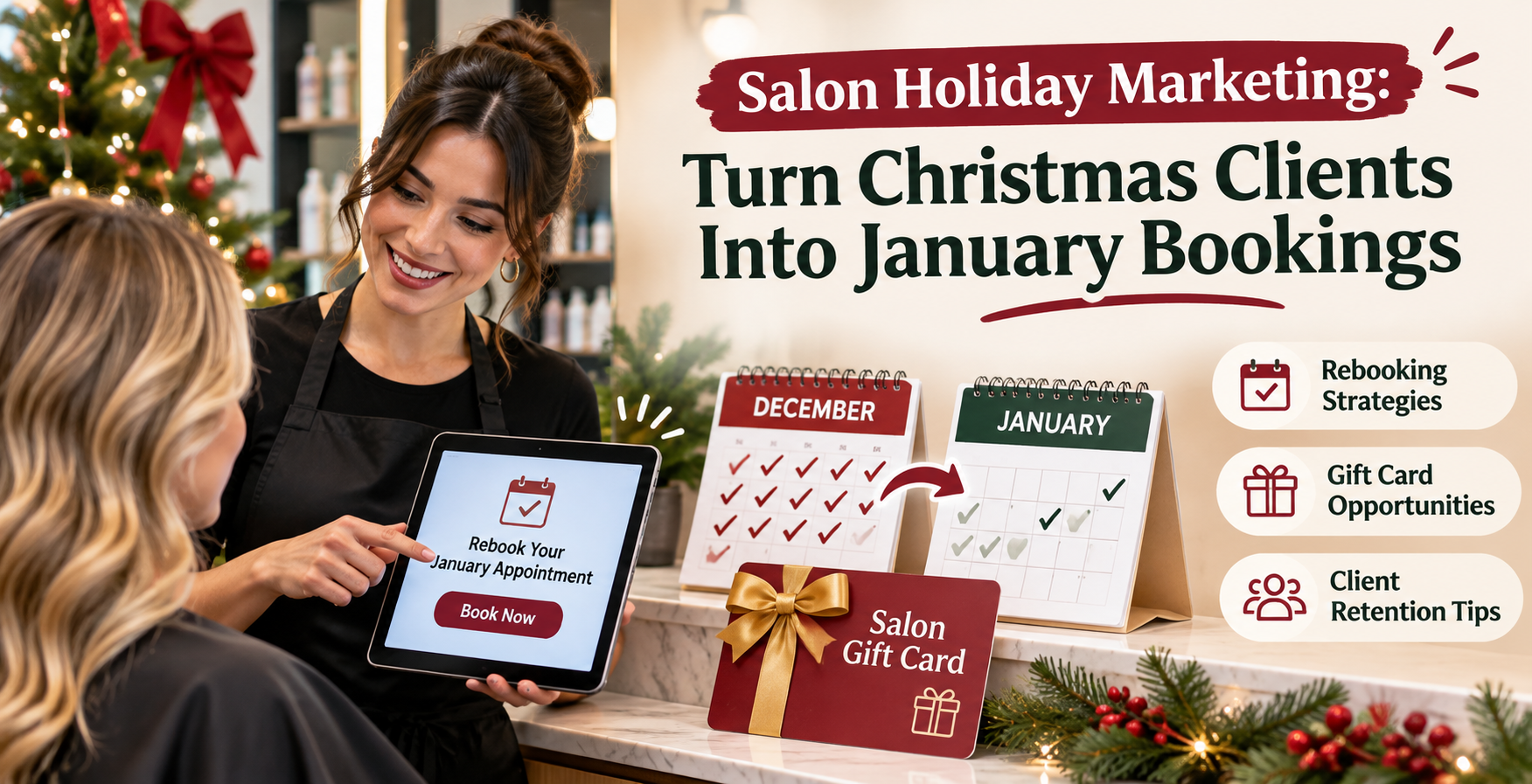
December is one of those months when salon owners barely have time to look at the calendar.
The appointment book is packed. Clients are squeezing in color appointments before Christmas parties, booking blowouts for holiday events, refreshing their cuts before family gatherings, and trying to get their preferred stylist before the year ends.
Your phone keeps ringing. Your stylists are busy. Your waitlist is growing.
From the outside, business looks incredible.
Then January arrives.
The holiday parties are over. People have spent money on gifts, travel, and celebrations. Some clients feel comfortable waiting a little longer before their next appointment.
Suddenly, the calendar that was impossible to squeeze people into a few weeks earlier has open spaces.
It's a familiar seasonal challenge for many salons, although the pattern varies by location, services, and clientele.
But here's the opportunity most salon owners overlook:
The best time to market your January appointments isn't necessarily January. It's when your clients are already sitting in your chairs in December.
Every holiday appointment represents more than immediate revenue. It's a chance to strengthen an existing relationship, understand a client's future needs, and make their next booking easier.
Someone visiting for a color refresh may need maintenance in several weeks. A client getting a holiday haircut might want to establish a more consistent schedule. A first-time visitor who loved their experience may be open to returning, but only if the salon makes the next step clear.
And those gift cards purchased throughout December?
They can introduce entirely new customers to your business after the decorations come down.
The challenge is turning holiday activity into an intentional retention strategy rather than assuming clients will remember to come back.
Recent research illustrates why that matters.
In Constant Contact's November 2026 holiday marketing research, 22.1% of surveyed small businesses said they weren't planning any specific follow-up to encourage holiday customers to return in the new year. More than 70% weren't planning to invite holiday shoppers to join an email list or loyalty program.
Those findings cover small businesses across industries, not salons exclusively. But they point to a common marketing weakness: businesses concentrate on generating holiday demand without building a system to maintain the relationship afterward.
For salons, that creates an opportunity.
You don't necessarily need another expensive advertising campaign to make January more productive.
You need to make better use of the relationships, attention, and demand you already have in December.
Here's how to turn a packed Christmas calendar into a stronger start to the new year.
A Fully Booked December Doesn't Automatically Create a Strong January
A busy holiday season feels like success because the results are immediately visible.
Appointments fill. Revenue comes in. Stylists are occupied. The salon feels energetic and productive.
But a full calendar measures current demand.
It doesn't necessarily tell you how many customers will return, when they'll need another service, or whether your team has enough future appointments scheduled.
This is where holiday marketing and customer retention become two different activities.
Holiday marketing gets people through the door during a high-demand period.
Retention marketing gives them relevant reasons and convenient opportunities to continue their relationship with your salon.
Both are important.
But if all your energy goes toward filling the final weeks of December, you may miss opportunities to create demand for January, February, and beyond.
The Value of Returning Clients
The 2025 Zenoti Beauty and Wellness Benchmark Report reported that 42% of clients who visited more than once annually generated 80% of revenue in the businesses studied.
These are figures from Zenoti's platform data across beauty and wellness businesses. They shouldn't be interpreted as a universal revenue breakdown for every salon.
Nevertheless, they demonstrate how important repeat visits can be to business performance.
A customer who comes in once for a special occasion creates one transaction.
A customer who returns regularly can develop a long-term relationship with the stylist, purchase additional services when appropriate, and recommend the business to others.
That recurring relationship has value beyond a single holiday appointment.
January Shouldn't Depend Entirely on New Customers
Acquiring new clients can require advertising, organic search visibility, social media content, referrals, and other marketing activity.
Existing clients already know your salon.
They've experienced the service, met your team, and developed expectations about what you provide.
This doesn't mean they'll automatically return.
But your salon has an opportunity to communicate with them in a more relevant way than it could with a stranger encountering the business for the first time.
A thoughtful follow-up can remind someone of their maintenance needs, introduce appropriate availability, or help them book a service they've already been considering.
January retention begins by making it easier for satisfied December clients to take the next step.
The Holiday-to-January Strategy Starts Before Christmas
Many salons wait until the first week of January to begin promoting available appointments.
By then, they may already be competing for attention with New Year's promotions, post-holiday sales, and customers returning to work and regular routines.
A stronger approach begins while December appointments are happening.
This doesn't mean pushing every customer to book another appointment immediately.
It means recognizing the natural opportunities to discuss future services and making booking easy when someone is interested.
Start With the Calendar You Already Have
Before creating a campaign, review your upcoming December appointments.
Look at the services being performed, the expected maintenance schedules, and your January availability.
Which stylists have openings?
Which services tend to require follow-up?
Are there clients who regularly visit every four, six, or eight weeks?
Are particular days or time slots more difficult to fill?
The answers will vary from salon to salon.
A color-focused salon may have different retention opportunities than a salon specializing in cuts, extensions, or natural texture services.
The point is to plan around your actual business.
Work Backward From January Availability
Instead of asking, “How do we promote January?” start with a more specific question:
“Which January appointments would be appropriate for the clients we're seeing in December?”
Someone receiving a root touch-up in early December may be approaching their next service window during January.
A client getting a haircut immediately before Christmas may not need another appointment until February or March, depending on the cut and their preferences.
A customer receiving a complex color transformation might have a customized maintenance plan.
Not every December visit should become a January booking.
The goal is to recommend appropriate future services rather than force every client into the same schedule.
When the recommended timing makes sense, rebooking feels like part of good service instead of a sales tactic.
Strategy 1: Make Rebooking Part of the Holiday Appointment
One of the simplest ways to support future appointments is to discuss the next visit before the client leaves.
This is especially useful during December, when customers are already thinking about their appearance and may be planning upcoming events.
But the conversation needs to feel personal.
A generic “Would you like to book again?” may be easy to dismiss.
A specific recommendation based on the service is more helpful.
For example:
“To maintain this color, I'd recommend checking in again in about six to eight weeks, depending on how it grows out. Would you like to look at some appointment options?”
This gives the client a reason to consider scheduling.
It also explains that the timing is a recommendation, not an arbitrary sales target.
Let the Stylist Lead the Conversation
A stylist understands the service performed and the client's maintenance needs.
That makes them well positioned to explain when another appointment may be appropriate.
The front desk can then make scheduling convenient.
This creates a simple handoff:
The stylist recommends the next service and timing.
The client decides whether they want to schedule.
The front desk or booking system helps them reserve an appropriate appointment.
It shouldn't feel like pressure.
It should feel like the salon is helping the client plan.
Make the Recommendation Specific
Instead of saying “Come back in January,” explain what the client might need.
For example:
“Your gloss may be ready for a refresh around the middle of January.”
Or:
“If you'd like to maintain this shape, we can look at your next cut once we reach the appropriate maintenance window.”
Specific recommendations make the conversation more useful.
They also help prevent the salon from booking appointments too early or recommending unnecessary services.
Rebooking Is Useful, but Confirmation Matters
Zenoti's 2025 benchmark reporting identified a substantial difference between average salons and top-performing salons in the share of appointments rebooked within 24 hours of a visit.
However, newer 2026 Zenoti salon benchmark research also warns that aggressive rebooking without effective confirmation can create calendar problems when appointments are later cancelled.
The practical lesson isn't to fill the calendar with tentative reservations at any cost.
It's to encourage meaningful, confirmed appointments that clients actually intend to attend.
Clear confirmations, appropriate reminders, and reasonable cancellation policies should support the process.
Strategy 2: Turn Your December Waitlist Into a January Opportunity
A fully booked December often means some customers cannot get the appointment they originally wanted.
They may have called too late, needed a specific time, or wanted a stylist whose holiday calendar was already full.
That demand doesn't have to disappear.
An organized waitlist can help your team understand who is still interested and what alternatives might work.
Offer Alternatives Instead of Dead Ends
Imagine a customer calls hoping for a haircut before Christmas.
Every suitable appointment is booked.
Instead of simply saying there's no availability, your team might explain:
“We don't have an opening with that stylist before Christmas, but I can check our January availability. Would you like to look at the first available options?”
This doesn't replace the customer's original preference.
But it offers a useful alternative.
Some customers will need the service before a particular event.
Others may be flexible and happy to schedule a little later.
You won't know unless you ask.
Keep Your Waitlist Accurate
A waitlist is only valuable when the information is current.
Record the requested service, preferred stylist, acceptable dates, and the customer's permission to be contacted.
If an opening appears, offer it to someone whose requirements match.
Don't promise appointments that aren't available.
And don't automatically book someone without their agreement.
Revisit Unfulfilled Requests
As December ends, review customers who asked about availability but never secured an appointment.
If appropriate and permitted, reach out with relevant January options.
Keep the message focused on their actual request.
Someone who asked about a color consultation shouldn't receive a generic promotion for unrelated services.
Thoughtful follow-up is more useful than mass messaging.
Strategy 3: Segment Your Holiday Clients Instead of Sending Everyone the Same Promotion
Not every person visiting your salon in December has the same relationship with your business.
Some are regular clients.
Others are visiting for the first time.
Some book only for special occasions.
Others may be returning after a long absence.
A single January promotion can't address every situation equally well.
This is where customer segmentation becomes valuable.
Segmentation simply means organizing clients into useful groups so communication can reflect their needs.
Existing Regular Clients
These customers already have an established relationship with your salon.
They may appreciate convenient rebooking, maintenance reminders, and updates about their preferred stylist's availability.
The best message is often practical rather than promotional.
“Your next color appointment is approaching. Here are the available dates.”
That may be more valuable than a blanket discount.
First-Time Holiday Clients
These clients present a different opportunity.
They may have booked for a wedding, party, family photographs, or another seasonal event.
They might not yet know whether the salon is a good long-term fit.
Their first experience should do the work of building trust.
After the appointment, an appropriate thank-you and invitation to return can help keep the relationship open.
Avoid assuming that one successful visit means the client is ready for a membership or expensive package.
Start by making the next relevant service easy to understand.
Occasional Clients
Some people visit the salon only a few times each year.
Their habits may reflect their budget, lifestyle, or preferred maintenance schedule.
A January promotion won't necessarily change those needs.
Instead, consider sharing relevant information about services they may find useful.
For example, someone who prefers low-maintenance hair color might appreciate advice about keeping their look fresh between major appointments.
The objective is to stay useful without pressuring them to visit more frequently than they want.
Lapsed Clients
A December visit from someone who hasn't been in for months may be an opportunity to reconnect.
But be thoughtful about the tone.
Don't make them feel guilty for being away.
A simple message acknowledging that it was good to see them and explaining how to book again is often enough.
Gift Card Recipients
These clients require a separate strategy because some may have never visited your salon before.
They may need help selecting a service, understanding pricing, or choosing a stylist.
Their first experience should make the business feel approachable.
Rather than treating gift card redemption as a standalone transaction, consider how that appointment could introduce someone to a long-term relationship with your salon.
Strategy 4: Turn Christmas Gift Cards Into First-Time January Appointments
Gift cards are an important bridge between holiday sales and post-holiday customer acquisition.
Someone purchases a gift card in December.
The recipient receives it at Christmas.
Then they begin thinking about when and how to use it.
For salons, this creates an opportunity to introduce a new customer to the business without requiring that person to discover the salon through advertising.
According to Zenoti's salon gift-card research published in 2026, 24% of gift-card redemptions at salons and spas on its platform came from first-time visitors.
That's a platform-specific finding, but it demonstrates why gift-card recipients deserve attention as potential new clients.
Make Gift Cards Easy to Redeem
A customer shouldn't need to call multiple times to understand how to use their gift card.
Explain whether the card can be applied to online bookings, how balances are handled, and whether particular services require consultations.
Make redemption information accessible on your website.
If the card can only be redeemed through certain channels, explain that clearly.
Create a Helpful Gift Card Landing Page
A simple website page can answer common questions.
How does someone book?
Can the card be used toward any service?
What happens if the appointment costs more than the card value?
Can the remaining balance be used later?
What should a first-time client expect?
Providing clear answers can reduce uncertainty before the appointment.
Treat Redemption as New Client Onboarding
When a first-time gift card recipient arrives, the goal should be an excellent service experience.
Help them choose the appropriate service and professional.
Explain the consultation process.
Make sure they understand the appointment's cost and any remaining gift-card balance.
At the end of the service, discuss future maintenance when relevant.
Don't immediately pressure someone into additional purchases simply because they received a gift.
Don't Manufacture Gift-Card Urgency
Gift cards have legal protections.
The Consumer Financial Protection Bureau's gift-card guidance explains federal rules governing expiration dates and fees, and state laws may provide additional consumer protections.
Avoid inventing a January expiration date or implying that funds will disappear unless that accurately reflects lawful terms.
The reason to encourage redemption should be the value of the salon experience, not misleading scarcity.
Strategy 5: Create a January Offer That Doesn't Depend on Heavy Discounts
When the January calendar has openings, discounts can feel like the obvious solution.
A salon might consider 20% off services, discounted color packages, or a limited-time promotion.
Those offers can sometimes be appropriate.
But discounting shouldn't be the automatic response to seasonal fluctuations.
Your salon has operational costs, employee compensation responsibilities, and a brand position to maintain.
Reducing prices without understanding the economics may attract appointments that contribute less profit than expected.
Focus on Relevance Before Price
Think about what clients are likely to need after the holiday season.
Some may want a maintenance appointment.
Others may be interested in repairing the appearance of dry or stressed hair.
Some may want a consultation for a change they've been considering.
A campaign centered on a real customer need may be more compelling than a general discount.
For example:
“Start the Year With a Haircare Plan That Fits Your Routine.”
This could direct visitors toward consultations, maintenance services, or appropriate treatments.
It doesn't need to promise unrealistic results.
Consider Value-Added Experiences
Depending on your service menu, you might offer a seasonal consultation, a customized maintenance recommendation, or an appropriately priced service bundle.
Only offer add-ons that are relevant and financially sustainable.
Don't include products or services merely to make an offer seem larger.
Protect Your Existing Pricing
If you choose to run a promotion, be clear about eligibility, dates, included services, and restrictions.
Don't advertise a discount against an inflated or misleading reference price.
Make sure the promotion fits your positioning.
A high-end salon may prefer an educational campaign focused on personalized service rather than aggressive seasonal discounting.
The goal is to create appointments that make sense for customers and the business.
Strategy 6: Use Personalized Follow-Ups to Continue the Relationship
A thoughtful follow-up can help clients remember your salon after the holiday rush.
But personalized communication doesn't mean adding someone's first name to an otherwise generic promotion.
It means making the message relevant to the customer's experience.
A client who received highlights may appreciate information about color maintenance.
Someone who booked a short haircut might value a reminder about the typical timing for maintaining that style.
A first-time visitor may simply appreciate a thank-you and an easy way to reach the salon.
Make the Message Useful
Consider this example:
Subject: Ready to Plan Your Next Color Appointment?
“Thank you for visiting us during the holidays! We hope you're loving your new color.
If you'd like to maintain the look, we can help you plan your next appointment based on your preferred maintenance schedule.
You can view our availability and book online whenever you're ready.”
This message provides context and a clear next step.
It doesn't demand immediate action.
Time Messages Around the Service
Sending every client a January promotion on January 2 may be convenient for the salon, but it won't necessarily be relevant.
A better approach uses the type of service and the recommended maintenance interval to inform follow-up timing.
Someone who received a haircut days before Christmas may not need another appointment immediately.
Someone with a different color-maintenance schedule might.
The timing should reflect the individual service rather than the calendar alone.
Use Email and Text Responsibly
Email marketing can support retention when messages are relevant and recipients have the appropriate permissions.
In the United States, the FTC's CAN-SPAM compliance guide explains requirements for commercial email, including accurate sender information, truthful subject lines, and unsubscribe mechanisms.
Marketing text messages are also subject to applicable consent and communications rules.
Don't assume that having a customer's phone number for appointment reminders means you can automatically send promotional campaigns.
Use permission-based communication, honor opt-outs, and apply the rules appropriate to your location and messaging platform.
Respecting communication preferences is part of building trust.
Strategy 7: Make January Booking Convenient, Especially on Mobile
A retention campaign can generate interest without generating appointments.
The difference often comes down to what happens when someone clicks the booking link.
Imagine a customer receives a helpful email reminding them to schedule their next color service.
They click “Book Now.”
The link sends them to a generic scheduling page.
They need to select the salon, search for their stylist, and navigate a long list of services.
The process feels more complicated than expected.
They decide to book later.
That moment is where marketing and website conversion optimization meet.
Connect Follow-Ups to Relevant Booking Options
When your booking system supports it, link clients to the appropriate stylist or service.
A maintenance reminder should make it easy to book the relevant appointment.
A gift card email might direct recipients to a page explaining how to redeem their card.
A consultation campaign should link to the consultation process.
The less unnecessary repetition, the easier it is for someone to complete the appointment.
Make Booking Available Outside Business Hours
Zenoti's 2025 salon consumer survey reporting found that 48% of surveyed hair and beauty salon clients said they'd be much more likely to return to a salon offering appointment booking or changes at any hour.
The same research reported that 35% needed to manage appointments outside normal business hours.
These are self-reported preferences, not guaranteed improvements in retention.
Still, they make a practical point.
Customers may want to schedule while they're at home, commuting, or planning their week.
A convenient online booking experience can support that behavior.
Check the Entire Booking Journey
Test your website and booking system on a phone.
Can visitors find the button?
Is the service menu understandable?
Can they choose a stylist and time without unnecessary confusion?
Are important pricing and cancellation policies clear?
Does confirmation arrive reliably?
Don't assume the experience works because your staff knows how to use it.
A January campaign is only as effective as the path between interest and a completed appointment.
Strategy 8: Give January Its Own Content Strategy
Your December social media content probably focuses on holiday transformations, festive styling, gift cards, and appointment availability.
That content makes sense for the season.
But your January marketing should tell a different story.
Once the holidays are over, customers may have different priorities.
They may be returning to normal routines, evaluating spending, or thinking about their goals for the new year.
Your content should reflect those changes.
Shift From Holiday Glamour to Real-Life Maintenance
December posts might feature formal styling, dramatic color refreshes, and holiday-event looks.
January content could focus on maintaining color, choosing manageable hairstyles, understanding haircare routines, or planning a future transformation.
This approach keeps your salon relevant without trying to recreate holiday urgency.
Use Your December Work as January Content
Your stylists will likely create beautiful results throughout the holiday season.
With appropriate client permission, document those services.
Then use selected photographs to support January posts.
A December brunette transformation could become an educational post explaining maintenance.
A haircut might become part of a stylist portfolio.
A color correction could support a service page explaining consultation requirements.
You don't have to create every January marketing asset from scratch.
You can thoughtfully reuse approved content that provides value in a new context.
Answer Questions Your Clients Actually Ask
If clients frequently ask how often they should refresh highlights, write a useful explanation.
If they want to know how to choose between different color services, create a guide.
If they ask about maintenance costs, explain which factors influence pricing.
These topics can support social media content and SEO-friendly website pages.
Google's people-first content guidance recommends creating information that genuinely helps visitors rather than producing content solely to attract search rankings.
For a salon, that means answering real customer questions and connecting those answers to relevant services.
Strategy 9: Use Google Business Profile to Promote January Availability
Some potential customers won't see your Instagram posts or receive your emails.
They may discover your salon through Google Search or Maps.
That makes your Google Business Profile another place to communicate relevant information about your business.
Google allows eligible businesses to publish updates, offers, and events directly through their profiles.
According to Google's Business Profile post guidance, updates can include descriptions, images, and action buttons directing people toward relevant webpages.
Promote Actual Availability
If your salon has January openings, consider publishing an update that helps customers understand their options.
For example:
“Planning a fresh look for the new year? Our January appointment calendar is open. Explore our services and book an available time with our team.”
Make sure the statement is accurate.
Avoid claiming that only a few appointments remain unless your booking information supports that claim.
Keep the Booking Link Relevant
A Google Business Profile update should connect visitors to a useful destination.
That might be your salon's appointment page or a relevant service page with clear booking access.
Don't direct people to an unrelated homepage if they still need to search for the information they were promised.
Keep Business Information Current
Holiday hours, January operating schedules, services, and contact information should be accurate.
A customer who finds outdated business hours or a broken booking link may have difficulty completing an appointment.
Local visibility is valuable, but the customer experience that follows matters just as much.
Strategy 10: Build a January Retention Plan Around the Individual Stylist
In many salons, customer loyalty is closely connected to the stylist.
Clients return because they trust a particular professional's expertise, communication, and understanding of their preferences.
That makes stylist-specific retention particularly important.
A generic salon-wide campaign may be useful, but it shouldn't replace more relevant client communication.
Help Stylists Understand Their January Calendars
Review upcoming availability by stylist and service.
Identify where there are appropriate opportunities to reconnect with clients whose maintenance schedules are approaching.
Avoid encouraging team members to overbook or pressure customers simply to fill available time.
The goal is to help clients schedule suitable appointments while supporting a manageable workload.
Use Individual Stylist Booking Links
If your booking platform supports it, include relevant stylist-specific links in appropriate follow-ups.
A client who has an established relationship with a particular colorist shouldn't have to search for that person again.
Encourage Consistent, Authentic Communication
Not every stylist needs to become a social media personality.
However, individual professionals can contribute useful content by explaining services, sharing approved transformations, and helping clients understand maintenance.
The salon's branding and messaging should support that individuality.
A cohesive retention system can still feel personal.
Strategy 11: Consider Loyalty Programs Without Creating Unnecessary Complexity
Loyalty programs can encourage repeat engagement when they provide meaningful value.
But they're not a substitute for excellent service, transparent pricing, or convenient booking.
A client won't necessarily return simply because a salon introduces points or rewards.
The program needs to fit the business and the customer's actual habits.
Keep the Benefits Understandable
A loyalty program should be easy to explain.
Customers should understand how they participate, what benefits are available, and whether there are limitations.
Avoid complicated conditions that make rewards difficult to use.
Evaluate Memberships Carefully
For some salons, memberships may support recurring services and more predictable customer relationships.
But they require thoughtful pricing, clear terms, and operational planning.
Zenoti's 2026 salon benchmark report found stronger sales and existing-guest visit growth among membership businesses than among non-membership businesses on its platform.
The report describes an association, not proof that introducing a membership will automatically cause the same results for another salon.
Before launching a program, evaluate your service economics, demand, staff capacity, cancellation terms, and customer preferences.
Sometimes a simple rebooking process is more valuable than a complicated rewards structure.
Strategy 12: Plan for January Without Overloading Your Team
Retention shouldn't create a new operational burden during the busiest month of the year.
If your front desk is already overwhelmed, adding a complicated manual follow-up process may lead to mistakes.
A practical system should make the work easier.
Use Your Existing Scheduling Software
Many salon management platforms offer features such as appointment reminders, client records, online booking, and communication tools.
Review what your current system supports before purchasing additional software.
You may already have tools that can help organize rebooking, identify upcoming service intervals, or send permitted follow-ups.
Build Simple Workflows
A reasonable process might involve a stylist discussing maintenance, the front desk offering appropriate future dates, and the booking platform handling confirmation.
For clients who aren't ready to schedule, an optional reminder or relevant follow-up may be helpful.
Keep the process manageable.
Don't Automate Away the Relationship
Automation is useful for repetitive tasks.
It can send reminders, surface availability, and reduce manual scheduling work.
But the personal relationship is still important.
A stylist's thoughtful recommendation carries a different kind of value than a generic promotional message.
The strongest retention systems combine convenient technology with genuine professional attention.
A Practical December-to-January Salon Retention Calendar
A successful seasonal strategy doesn't have to be elaborate.
It needs to happen early enough that the salon isn't trying to solve everything after New Year's Day.
Early December: Prepare the Foundation
Review January availability and identify which services are likely to generate appropriate maintenance appointments.
Make sure your online booking system is functioning correctly.
Update stylist profiles, service descriptions, and important booking policies.
If you're planning a seasonal campaign, prepare the content and confirm that your team understands the message.
Decide how you'll collect and manage appropriate communication permissions.
Mid-December: Focus on Rebooking During Appointments
As customers visit for holiday services, encourage stylists to discuss future maintenance when relevant.
Offer convenient appointment options.
Keep the conversation service-focused and optional.
Capture approved photographs that can support January content.
Review the waitlist and offer suitable alternatives where possible.
The Week Before Christmas: Make Future Booking Easy
Your team may be working at full capacity.
Avoid introducing a complicated last-minute marketing campaign.
Instead, make January booking links easy to find.
Ensure gift-card redemption instructions are accurate.
If your salon offers online scheduling, confirm that customers can access it even when the salon is closed.
Use straightforward messaging.
“January appointments are available” is enough when the goal is simply to communicate useful information.
The Week After Christmas: Welcome Gift Card Recipients
Customers may begin exploring how to use the gift cards they received.
Make the redemption process simple.
Publish relevant information on your website and social channels.
Help first-time visitors understand services, pricing, and consultation requirements.
This is also a good time to review upcoming appointments and confirm that your scheduling information is accurate.
Early January: Send Relevant Follow-Ups
Reach out to eligible clients whose next appointment is approaching.
Keep the messaging appropriate to their service history and communication preferences.
Publish educational content about maintenance, haircare routines, and services your salon offers.
Use genuine availability rather than invented urgency.
Mid-to-Late January: Review Results and Adjust
Look at completed appointments, not just campaign clicks.
Identify which services and stylists have available capacity.
Review whether first-time holiday visitors are returning.
Ask customers about the booking experience.
Use what you learn to inform February and future retention efforts.
The strategy should continue beyond the first few weeks of the year.
How to Measure Whether Your January Retention Strategy Is Working
A campaign can generate activity without producing meaningful results.
Your salon may send hundreds of emails, publish multiple social posts, and receive plenty of clicks.
But are clients completing appointments?
That's the question that matters.
Start With Completed Rebookings
Track how many December clients schedule an appropriate future appointment.
Where possible, distinguish scheduled appointments from completed visits.
A reservation that is later cancelled doesn't have the same operational value as an appointment the customer attends.
Look at Returning Client Visits
Compare how many January appointments come from existing clients versus first-time customers.
This can help you understand whether your retention activity is supporting your calendar.
Remember that January demand may also be influenced by service cycles, staffing, location, weather, and customer spending patterns.
Don't attribute every change to marketing alone.
Track Gift Card Redemption
If your system supports it, review how many gift-card recipients book appointments after Christmas.
Pay particular attention to first-time guests and whether they later choose to return.
Gift-card sales, redemptions, and repeat visits are different measures.
Measure the Full Booking Journey
A website visitor who clicks “Book Now” hasn't necessarily scheduled an appointment.
If you're using website analytics, distinguish booking-link interactions from confirmed reservations whenever your booking platform supports reliable measurement.
Tracking should respect privacy and avoid collecting unnecessary personal information.
Use a Simple Retention Calculation
One useful internal measure is the share of a defined December client group who complete another appointment during a relevant follow-up period.
For example:
Repeat-visit rate = Returning clients who complete another appointment ÷ Eligible clients in the original group × 100
Define eligibility and the follow-up window carefully.
A haircut client with a twelve-week maintenance interval shouldn't necessarily be treated as lost because they didn't return in January.
For that reason, service-specific repeat-visit measurements may be more useful than treating every client identically.
Seven Mistakes That Can Undermine Your January Appointment Strategy
Even a well-intentioned campaign can miss the mark.
1. Waiting Until January to Start Planning
If your salon knows it experiences a post-holiday shift in demand, begin preparing while December clients are still visiting.
2. Offering Discounts Before Understanding the Problem
An empty appointment slot doesn't automatically mean the price is too high.
The issue may involve visibility, scheduling convenience, timing, or a lack of relevant follow-up.
Investigate before discounting.
3. Sending Everyone the Same Message
A first-time gift-card recipient has different needs from a long-term color client.
Segment communication when practical.
4. Rebooking Without Confirming Client Intent
A calendar filled with tentative appointments can create cancellations and scheduling confusion.
Prioritize genuine commitments and reliable confirmation workflows.
5. Making the Next Appointment Difficult to Schedule
A retention email won't accomplish much if the booking link is broken or the scheduling process is confusing.
Test the experience.
6. Treating January as the Only Goal
Some December clients won't need another appointment until February or March.
Recommend appropriate timing rather than forcing everyone into a January promotion.
7. Forgetting the Experience That Creates Loyalty
Marketing can remind someone to return.
But the quality of their consultation, service, communication, and overall experience plays a major role in whether they want to come back.
Retention starts inside the salon.
The Bigger Opportunity: Turn Seasonal Marketing Into a Year-Round Retention System
Christmas is a useful moment to improve client retention because the salon is already experiencing concentrated demand.
But the principles shouldn't disappear once January appointments begin filling.
Every appointment presents a chance to understand the customer's needs and make future scheduling easier.
Every first-time visitor represents an opportunity to provide a memorable experience.
Every service page, stylist bio, and booking link can help customers make informed decisions.
And every thoughtful communication can reinforce the relationship rather than simply promote another sale.
Over time, these small improvements can become part of a repeatable customer experience.
Instead of building a completely new marketing strategy every time the calendar becomes quieter, the salon has a system that supports ongoing engagement.
That doesn't eliminate seasonality.
It doesn't guarantee a fully booked calendar every month.
But it helps reduce dependence on last-minute promotions and gives the business more visibility into future demand.
The strongest retention strategy isn't built around making customers feel obligated to return.
It's built around giving them a genuinely good reason to want to.
Frequently Asked Questions
1. How can salons turn Christmas appointments into January bookings?
Salons can encourage appropriate future appointments by discussing maintenance during December visits, offering easy rebooking, following up with eligible clients, and making January availability accessible online. The recommended timing should reflect the service performed and the customer's preferences. Not every holiday appointment should automatically become a January visit.
2. When should salons start promoting January appointments?
Planning should begin before the holiday rush reaches its peak. Early December is a useful time to review future availability, prepare booking links, and establish follow-up workflows. As clients visit throughout December, stylists can discuss future maintenance where appropriate. January marketing can then reinforce those conversations.
3. Is January always a slow month for hair salons?
No. Demand varies by location, services, clientele, and business model. Some salons experience reduced demand after the holidays, while others benefit from gift-card redemptions, new-year transformations, and regular maintenance visits. Review your own historical booking patterns rather than assuming every salon follows the same seasonal cycle.
4. Should salons offer January discounts to fill appointments?
Discounts can be useful in certain circumstances, but they aren't always necessary or profitable. Before reducing prices, evaluate whether the issue involves scheduling convenience, awareness, client follow-up, or service relevance. Educational campaigns, appropriate service offerings, and easier rebooking may support demand without relying on broad discounts.
5. How do you encourage clients to rebook before leaving the salon?
Have the stylist explain the recommended maintenance schedule and why it makes sense. Then offer convenient booking options without pressure. A specific, client-centered recommendation is generally more useful than a generic request to schedule another appointment. Confirm that the client genuinely wants the reservation.
6. How can gift cards help salons attract January clients?
Gift cards purchased during the holidays can introduce new customers to the salon when recipients redeem them. Clear redemption instructions, helpful service information, convenient booking, and an excellent first appointment can support a positive experience. The longer-term opportunity comes from earning a second visit, not simply processing the gift card.
7. What should salons post on social media in January?
January content can focus on maintenance advice, realistic haircare routines, service education, stylist expertise, and authentic transformations. Posts should reflect the services the salon actually provides and the questions customers ask. Clear booking directions can connect interested viewers to relevant appointments.
8. Is email or SMS better for salon retention marketing?
Both can be useful, depending on customer preferences, message purpose, and applicable permissions. Email works well for educational content and detailed offers. Text messages may be appropriate for concise, timely communication where authorized. The channel should fit the customer's expectations, and salons must follow applicable marketing and privacy requirements.
9. How often should salons send January rebooking reminders?
There is no universal ideal frequency. Timing should depend on the client's service, maintenance needs, preferences, and the messages they've already received. Excessive reminders can become intrusive. A relevant, well-timed message may be more useful than several generic promotions.
10. Should salons promote January appointments on Google Business Profile?
Yes, when the information is accurate and useful. Eligible businesses can publish updates and offers through Google Business Profile. A post announcing available appointments or relevant services can help customers understand what's happening at the salon. Include a suitable action link and follow Google's content policies.
11. Can a loyalty program improve salon client retention?
A well-designed loyalty program may encourage repeat visits when the benefits are clear and meaningful. However, it shouldn't replace good service or convenient booking. Salons should evaluate costs, customer preferences, and the program's actual performance before making it a major part of their retention strategy.
12. How can salons bring back clients who haven't visited in months?
Start with a respectful, relevant message rather than a guilt-based promotion. Where appropriate and permitted, explain current services, availability, or options that might interest them. Make booking simple. Some clients may have changed their routines or preferences, and those decisions should be respected.
13. What should salons do if January appointments are already filling up?
Focus on providing an excellent experience, maintaining accurate availability, and supporting appropriate rebooking into future months. There's no need to manufacture urgency or introduce unnecessary discounts. A strong retention strategy can help February and March as well as January.
14. How can salon websites support seasonal client retention?
A well-designed website makes services, stylist information, pricing expectations, and appointment options easy to find. It can also support educational content, gift-card redemption guidance, and seasonal updates. Mobile-friendly booking and clear calls to action help interested customers complete the next step.
15. What metrics should salons track for January retention?
Useful measures include completed repeat appointments, confirmed rebookings, gift-card redemptions, new-client return visits, cancellations, and booking conversion rates. Evaluate results using consistent definitions and appropriate service-specific timeframes. Avoid judging success only by email opens, social media engagement, or booking-button clicks.
Your Christmas Calendar Is Full. Your January Strategy Should Be Ready Too.
A packed December is a wonderful sign that people value your salon's services.
Clients are making appointments, trusting your stylists, and choosing your business during one of the most socially active times of the year.
But that demand creates an opportunity that extends beyond Christmas.
Every appointment is a chance to strengthen a relationship.
Every maintenance conversation can help someone plan their next visit.
Every gift card can introduce a potential long-term customer.
And every thoughtful follow-up can make it easier for someone to return when the time is right.
The salons that approach retention strategically don't have to rely exclusively on last-minute promotions when the calendar changes.
They have a clearer understanding of their customers, more relevant communication, and a booking experience designed to support repeat visits.
That doesn't mean every client needs to return in January.
It means the next appropriate appointment shouldn't be forgotten simply because the holiday rush was busy.
December brings the demand. A thoughtful retention strategy helps turn that demand into lasting customer relationships.
Ready to Turn Holiday Traffic Into Year-Round Salon Growth?
At Ritner Digital, we believe effective digital marketing should do more than generate temporary attention.
It should connect your business with the right audience, communicate your value, and make it easier for customers to take meaningful action.
For salons, that means thinking beyond holiday promotions.
A stronger website, clearer booking experience, thoughtful content strategy, and relevant customer communication can all work together to support long-term relationships.
Your holiday calendar may already be full.
The next opportunity is making sure your digital marketing helps support what happens afterward.
Contact Ritner Digital to discuss a marketing strategy that connects seasonal demand with stronger visibility, better customer experiences, and more opportunities for repeat business.