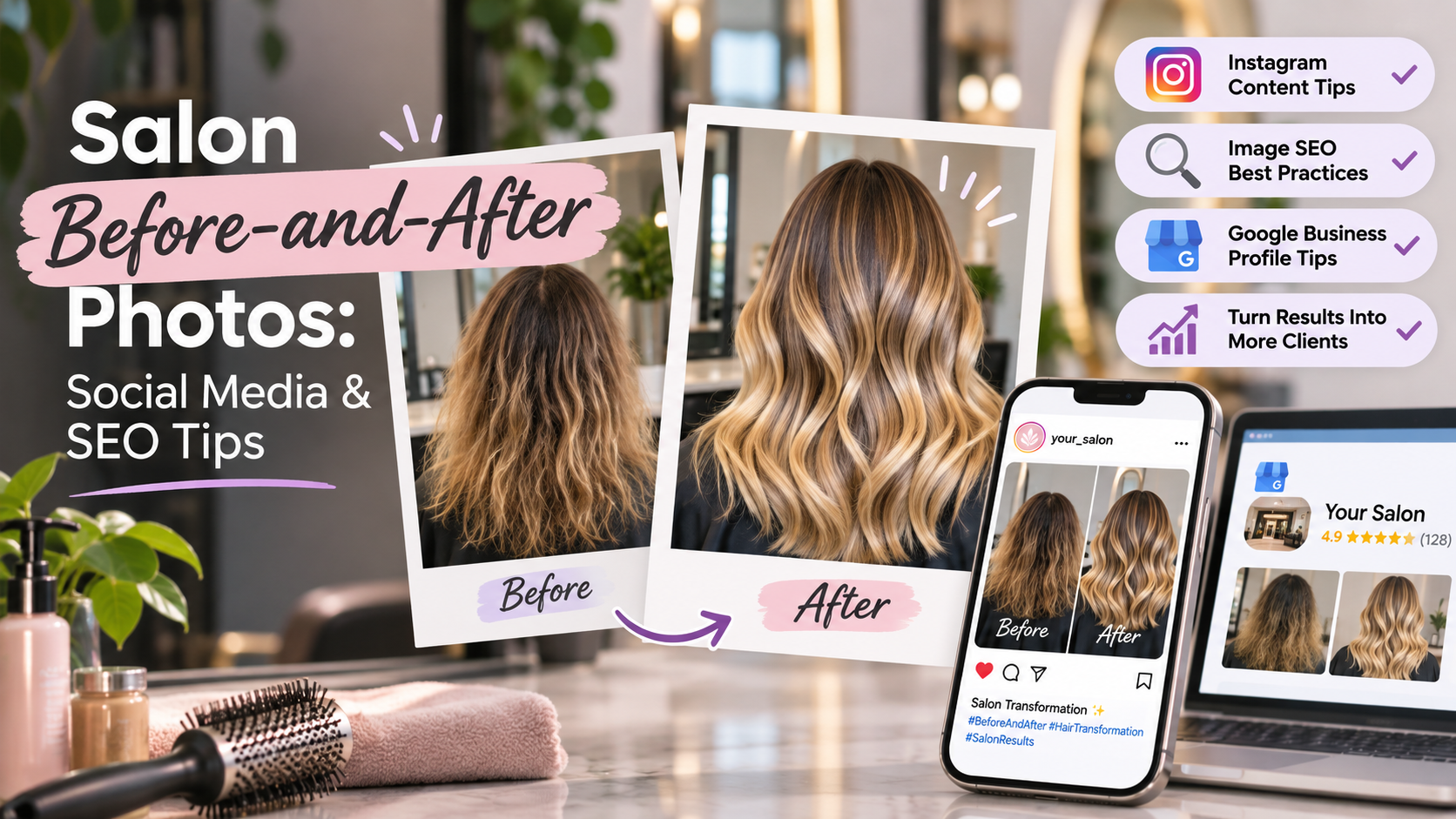
A potential client is scrolling through Instagram when a hair transformation catches their attention.
The first photo shows dull, uneven color with noticeable regrowth. The second reveals a dimensional brunette with soft highlights, beautiful shine, and a completely different overall appearance.
They stop scrolling.
They look closer.
Then they visit the salon's profile to see more.
Within a few minutes, they might be reviewing the stylist's work, reading comments, checking the salon's location, and deciding whether to book a consultation.
That's the potential power of a great before-and-after photo.
It doesn't just show a finished hairstyle. It gives someone a visual example of what a professional can accomplish.
For salons, that kind of content is particularly valuable because potential clients often want to see evidence of a stylist's skills before committing to an appointment.
But here's the part that gets overlooked.
Taking a beautiful before-and-after photo isn't the same as using it effectively for marketing.
A transformation might receive hundreds of likes without generating a single appointment. A stunning image might disappear into an Instagram feed after a few days. A salon could have years of impressive work saved on someone's phone while its website contains almost none of it.
Meanwhile, people searching Google for specific services might never discover those results.
The opportunity isn't simply to take more pictures.
It's to create a strategy that turns real client transformations into useful content across social media, your salon website, Google Business Profile, and search results.
And there's research supporting the importance of showing your work.
In a 2022 consumer survey conducted by Boulevard, 22% of respondents identified a stylist's online portfolio as their primary consideration when choosing a new stylist or barber. Availability influenced 33%, while recommendations from friends influenced 27%.
The research is several years old and represents one survey population, not a universal measurement of salon customers today. But it demonstrates something important: for a meaningful segment of the people surveyed, seeing a professional's previous work was central to their decision.
That makes transformation photography more than a social media trend.
It can become part of how salons demonstrate expertise, communicate their brand, build trust, and help prospective customers decide whether to book.
The difference comes down to how thoughtfully those images are created, organized, and shared.
Why Before-and-After Photos Work So Well for Salon Marketing
Hair is visual.
Someone considering a new color, haircut, extension service, or texture transformation often has a specific result in mind.
They might be looking for a warmer brunette, a softer blonde, a more flattering haircut, or a style that requires less daily maintenance.
Descriptions can help explain those services, but photographs allow customers to see examples of the actual work.
That distinction matters.
A salon can describe its stylists as talented, experienced, and passionate. Those statements may be genuine, but they don't show what the stylists can create.
A portfolio provides evidence that prospective customers can evaluate for themselves.
Transformation Photos Make Expertise Visible
Consider a colorist who specializes in correcting uneven blonde.
A service description might explain the stylist's training, experience, and approach to color correction.
A series of carefully documented transformations can show how that expertise has been applied.
Prospective clients can examine color placement, blending, tone, and the overall result.
This doesn't guarantee that everyone will achieve an identical outcome. Hair history, condition, texture, and maintenance preferences all influence what is possible.
But visual examples can help customers understand the stylist's work and begin a more informed conversation.
They Help Customers Imagine a Possibility
A potential client may not know the professional terminology for the look they want.
They might struggle to explain what they mean by “natural blonde,” “expensive brunette,” or “more movement.”
A transformation photo gives them a reference point.
Instead of trying to translate an idea into technical language, they can show a stylist an example and discuss whether a similar approach would work for their own hair.
That's valuable for the appointment experience, not just marketing.
Better visual references can support better consultations.
They Make Your Salon's Specialties Easier to Understand
Not every salon wants to be known for the same work.
Some focus on dimensional color, others on precision cutting, extensions, bridal styling, natural textures, or low-maintenance transformations.
Before-and-after content can reinforce those specialties.
If your salon wants to attract more curly haircut clients, a portfolio featuring relevant textures and techniques is more informative than a collection dominated by unrelated color transformations.
If your focus is lived-in blonde, showing real examples of those services helps communicate what that specialty means.
The strongest transformation content doesn't just look impressive. It attracts attention to the work you actually want to be known for.
Before-and-After Photography Is Proof, Not Just Content
Many businesses approach social media with a simple question:
“What should we post today?”
That mindset can lead to publishing whatever photographs happen to be available.
For salons, a more valuable question is:
“What do potential clients need to see before they feel comfortable booking with us?”
The answer may include evidence of professional skill, experience with particular hair types, realistic results, and an understanding of the client's desired outcome.
Transformation photos can help address these needs.
However, they're most effective when presented with enough context to be meaningful.
Beautiful Results Without Context Can Create Confusion
Imagine seeing a dramatic blonde transformation.
The finished result looks incredible.
But the post doesn't explain whether the process took one appointment or several sessions.
It doesn't mention whether the client had previous color, whether extensions were added, or whether the hair was styled differently afterward.
A potential customer could assume that the final result is achievable in one appointment.
If that assumption is unrealistic, the photograph may create expectations the salon cannot meet.
This is where good marketing requires more than visual appeal.
The image should represent the service accurately.
Transparency Strengthens the Story
A thoughtful transformation caption might explain that the stylist corrected uneven color over two appointments, used a gloss to refine tone, or created a lower-maintenance look through customized highlighting.
These details give prospective clients a more realistic understanding of the work.
They also allow the stylist's expertise to become part of the story.
Instead of simply saying, “Look at this transformation,” you're explaining why particular decisions were made.
That changes the post from visual entertainment into useful information.
And useful information can support trust.
The Biggest Before-and-After Mistake: Making the Photos Look Better Than Reality
Professional photography can improve how your work is presented.
Good lighting, clean backgrounds, thoughtful composition, and consistent framing make a difference.
But there's an important distinction between improving the presentation of a photograph and changing the appearance of the actual result.
A dramatic change in lighting can make hair appear shinier, brighter, or warmer.
Different camera angles can exaggerate volume or length.
Filters can alter color tones.
And editing software can make a transformation look significantly different from what the client experienced in person.
This creates a credibility problem.
Keep the Before and After Consistent
Whenever possible, photograph both stages in the same location.
Use comparable lighting.
Keep the camera at approximately the same distance and height.
Capture similar angles.
If the before photo shows the back of the hair, the after photo should include a comparable view.
If the before photo shows unstyled hair while the after shows a professional blowout, clarify that styling is part of the finished appearance.
These practices help viewers evaluate the transformation more fairly.
Avoid Misleading Editing
It's reasonable to crop photographs, correct exposure, or adjust composition.
But avoid edits that materially alter the hairstyle, color, density, texture, or outcome being advertised.
The UK Advertising Standards Authority's guidance on before-and-after photos discusses the risk of exaggerating product or service results through visual presentation and production techniques.
That guidance applies to advertising under the UK system, but the broader principle is useful for salon marketing elsewhere: photographs used in advertising should not give a misleading impression.
In the United States, the Federal Trade Commission's advertising and endorsement guidance similarly emphasizes truthful, nonmisleading advertising claims.
For a salon, that means the finished result should accurately reflect what the stylist achieved.
Natural Doesn't Have to Mean Unprofessional
Authentic photography doesn't require poor lighting or unflattering composition.
You can create a recognizable visual style without manipulating the actual work.
A consistent photography station with neutral lighting and a simple background can help the salon produce polished images repeatedly.
The goal is to make the results easy to see.
Not to make them look artificially perfect.
How to Take Better Salon Before-and-After Photos
You don't necessarily need an expensive camera or professional photographer for every appointment.
A modern smartphone, suitable lighting, and a consistent process can provide high-quality portfolio photographs.
The key is developing a repeatable system.
1. Create a Dedicated Photo Location
Choose an area inside the salon with good, consistent lighting.
A plain background helps keep attention on the hair.
Avoid cluttered shelves, distracting equipment, and unnecessary objects behind the client.
If possible, use the same location for both images.
A dedicated photography spot also makes it easier for stylists to remember where and how to capture their work.
2. Use Lighting That Represents Color Accurately
Hair color can appear dramatically different under various lighting conditions.
Warm artificial lighting may make blonde appear more golden.
Cool lighting can change how brunette or red tones are perceived.
Try to use consistent, neutral lighting that reveals the actual color without creating harsh shadows.
If the photo is intended to show color accuracy, avoid switching lighting setups between the before and after.
A photograph can look editorial and still be honest.
3. Capture Multiple Angles
One image may not communicate the full result.
For a color transformation, consider capturing the front, back, and side.
For a haircut, different angles can demonstrate shape, layers, and movement.
For extensions, show how the added length or fullness blends with the client's natural hair.
Different services benefit from different views.
The goal is to document the work in a way that helps prospective clients understand it.
4. Maintain Consistent Framing
Before-and-after comparisons become harder to interpret when one photograph is tightly cropped and the other shows the client's entire upper body.
Try to maintain a similar distance and angle.
This allows viewers to focus on the actual transformation rather than changes in the composition.
5. Show Real Hair Texture
A finished blowout can be beautiful, but it may not communicate what a curly haircut looks like in its natural state.
If a stylist specializes in curls, consider photographing relevant results in the way clients are likely to wear their hair.
If the service involves both cutting and styling, explain that.
Showing a variety of textures and realistic finishes gives visitors more useful information.
6. Photograph the Starting Point Honestly
The before image is important because it establishes the context of the service.
Avoid intentionally making it look worse through poor lighting, awkward positioning, or unnecessary manipulation.
A strong before-and-after comparison should document the change, not manufacture it.
7. Take the Photos Before the Client Leaves
Make photography part of the appointment workflow when the client has agreed to participate.
If the team waits until the end of the day to remember which services should have been documented, many opportunities will be missed.
A consistent routine makes content creation easier.
It also reduces the pressure to stage elaborate shoots after every appointment.
Client Consent Should Be Part of Your Content Process
Before-and-after photographs involve real people.
That means client comfort, privacy, and permission need to be considered before content is published.
A customer may be happy to have their hairstyle photographed but uncomfortable with their face appearing on social media.
Someone might allow images on the salon's Instagram account but not want their photographs used in paid advertising.
These preferences deserve respect.
Ask Before Photographing and Publishing
A practical approach is to obtain clear, informed permission describing how photographs may be used.
Depending on the salon's needs, consent might address the website, social media, Google Business Profile, printed materials, and paid advertisements.
For minors, additional safeguards and appropriate parent or guardian authorization may be necessary.
Consent and publicity requirements vary by jurisdiction, so salon owners should use a release process appropriate to their location and intended uses.
Give Clients Meaningful Choices
Some people may agree to photographs showing only the back of their hair.
Others may be comfortable with their face appearing but not with their name or social media handle being included.
Avoid assuming that consent to take a photo automatically means consent to use it everywhere.
Also distinguish permission from the person being photographed from copyright or licensing rights associated with the photograph itself.
If a professional photographer created the image, confirm that the salon has the appropriate rights for its intended use.
Avoid Revealing Sensitive Details
Transformation posts shouldn't disclose private information about someone's hair history, medical circumstances, or personal life without appropriate permission.
Even something that seems harmless to the stylist may be sensitive to the client.
You can explain the service without telling someone's entire personal story.
A great marketing photograph should make the client feel proud of the result, not uncomfortable about how their image is being used.
How to Turn One Transformation Into Multiple Social Media Posts
One of the most common mistakes salons make is using a beautiful transformation only once.
The stylist publishes a before-and-after photograph on Instagram.
The post performs reasonably well.
Then it disappears beneath newer content.
That photograph may never appear on the salon website, service pages, Google Business Profile, or another relevant channel.
A more strategic approach treats each approved transformation as a reusable content asset.
One appointment can support several different pieces of content, provided the salon has the necessary permission and rights.
The Traditional Before-and-After Post
Start with the simplest format.
Show the starting point and the finished result.
Explain the service clearly.
Identify the stylist when appropriate and include a relevant booking direction.
This gives viewers the essential information without overwhelming them.
A Social Media Carousel
A carousel allows you to tell the story in more detail.
The first slide might show the finished result.
The next could display the starting point.
Additional slides could show different angles, explain the consultation goal, or describe maintenance considerations.
This format can be particularly useful for services involving several decisions.
Instead of relying on one dramatic image, you're helping the audience understand the transformation.
A Short-Form Video
A transformation can also become a short video.
The video might begin with the finished result, briefly show the original condition, and then reveal the final look from several angles.
A stylist could explain the technique or discuss the client's goals.
Keep the content focused on the actual service rather than adding effects that distract from the result.
Original footage can be particularly useful here.
In a January 2026 update, Meta reported that original posts accounted for 75% of Instagram recommendations in the United States during the fourth quarter of 2025.
This is Meta's own platform reporting, not a guarantee that any individual salon Reel will receive more reach. Nevertheless, it reinforces the value of creating genuine content rather than relying entirely on recycled material.
An Educational Post
The same transformation can answer a common customer question.
For example:
“Can dark brunette hair become blonde in one appointment?”
Or:
“What does low-maintenance color actually look like?”
Use the real appointment as an example.
Explain what was possible, which factors influenced the process, and what clients should understand before booking a similar service.
This positions the stylist as someone who can explain their work, not simply display it.
A Client-Testimonial Post
If the customer chooses to provide feedback and gives permission for it to be shared, a transformation can be paired with an authentic review.
The combination communicates both the visible result and the client's actual experience.
Never invent quotes or present a fabricated testimonial as genuine.
If there's a material incentive or relationship connected to an endorsement, follow applicable disclosure requirements.
The FTC's guidance on consumer reviews and testimonials provides additional information about truthful testimonials and relevant disclosures.
Instagram: How to Make Before-and-After Content More Strategic
Instagram is naturally suited to visual businesses, but posting attractive photographs isn't a complete marketing strategy.
The audience needs enough information to understand the work, remember the salon, and know what to do next.
Make the First Image Count
People scroll quickly.
The opening image should clearly communicate why the post is relevant or interesting.
For many transformations, the finished result makes an effective starting point.
For others, a strong side-by-side comparison or short reveal may work better.
There isn't a universal rule.
Test different approaches and observe which formats generate meaningful engagement from people who might actually become clients.
Write Captions That Add Information
A caption reading “Obsessed with this transformation!” communicates excitement.
But it leaves potential customers with important questions.
What service was performed?
What was the client's goal?
Was the result achieved in one appointment?
What maintenance might be involved?
A more useful caption could read:
Example: Dimensional Brunette Transformation
“Our client wanted to soften her existing highlights and create a richer brunette with dimension that would grow out naturally. We used customized color placement and a gloss to refine the tone, then finished with soft styling to showcase the result.
Thinking about a similar color change? Book a consultation so we can discuss your current hair color, goals, and maintenance preferences.”
This example should be adapted to the actual service performed.
The goal is to connect the photograph to information the audience values.
Use Specific, Relevant Descriptions
Terms such as dimensional brunette, curtain bangs, textured haircut, balayage, and lived-in blonde can help describe the work.
Use them naturally when they accurately reflect the result.
If location is relevant, include the city or service area in readable language.
Avoid stuffing unrelated city names or dozens of repetitive keywords into captions.
Your audience should understand the post first.
Make the Booking Path Obvious
A transformation may attract attention, but the customer still needs a way to take the next step.
Your Instagram bio should clearly identify the business and guide visitors toward your website or scheduling page.
Relevant posts can direct people to that link.
For services that require a consultation, say so.
If someone asks how to book in a comment or direct message, respond with useful information rather than relying exclusively on a generic automated reply.
Use Insights to Improve Your Strategy
Instagram's professional Best Practices resources cover content creation, engagement, reach, and account guidance.
For salon owners, this information can help support decisions about formats, publishing habits, and audience engagement.
But don't evaluate content only by likes.
A post with fewer views may generate more relevant appointment inquiries than one with broad entertainment appeal.
Pay attention to the relationship between the audience you're reaching and the services you're trying to promote.
Google Business Profile: The Overlooked Home for Salon Photography
Many salons put tremendous effort into Instagram while paying less attention to the photographs appearing on Google.
That's a missed opportunity.
Your Google Business Profile can be an important discovery point for people searching for salons, hairstylists, and beauty services in a particular area.
Someone may find your salon on Google Maps before ever seeing your Instagram account.
They might read reviews, examine the business information, and browse photographs to understand the type of work your team performs.
Transformation photos can contribute to that impression.
Upload Real Examples of Your Services
Google's Business Profile photo guidance allows businesses to add photographs representing their products and services.
The guidance recommends images that are well lit, in focus, and free from significant alterations or excessive filtering.
For salons, suitable examples may include color transformations, haircuts, styling, extensions, and other services the business actually offers.
Use photographs that accurately represent the work.
Avoid uploading near-identical images simply to increase the total number of photos.
Maintain a Variety of Images
A salon's Google Business Profile should help prospective customers understand the business as a whole.
Transformation photographs are valuable, but so are images of the salon interior, exterior, and other relevant aspects of the customer experience.
Someone visiting for the first time may also want to recognize the location and understand the atmosphere.
Think of the profile as a practical introduction to the business.
Follow Google's Publishing Requirements
Google specifies technical requirements for uploaded photographs and reviews submitted media under its policies.
Images that violate applicable policies may not appear publicly.
More importantly, posting photographs does not guarantee improved local search rankings.
Google Business Profile imagery can provide useful information for customers evaluating your business, but it should be part of a broader local SEO strategy rather than treated as a ranking shortcut.
Your Salon Website Is Where Transformation Photos Can Keep Working
Social media content often has a short period of concentrated attention.
A salon website gives you more control over how your portfolio is organized, explained, and connected to booking.
This is one of the most important differences between posting photographs and developing a digital marketing strategy.
Your best work shouldn't exist only inside a social media feed.
It should also support the pages people visit when they're researching your services.
Add Relevant Photos to Service Pages
If your salon has a dedicated balayage page, show genuine examples of balayage services.
If it offers extensions, include relevant photographs showing the results of those services.
A curly haircut page should feature work that reflects the textures and approaches the salon actually specializes in.
Relevant images help visitors understand what the service may involve.
They're more useful than placing every transformation inside one unrelated gallery.
Connect Results to Individual Stylist Profiles
Your stylists may have different strengths.
A color specialist could showcase dimensional blondes and corrective work.
A precision cutter might display short haircuts and structured shapes.
A stylist experienced with curls could feature a range of relevant textures and techniques.
When the portfolio aligns with the stylist's specialties, prospective clients can make more informed booking decisions.
Build an Organized Portfolio
A portfolio doesn't need hundreds of photographs to be effective.
It needs enough variety and context to help visitors evaluate the salon's work.
Organize images by service type, stylist, or another structure that makes sense for the business.
Keep the navigation straightforward.
Include service information and appropriate booking links near the images.
Don't make someone admire a transformation and then search through several unrelated pages to find out how to book it.
Image SEO: How Google Can Better Understand Your Salon Photography
Before-and-after photos can support more than the visual appearance of your website.
When published appropriately, they can become part of your search engine optimization strategy.
Google Search includes image-based discovery experiences, including Google Images and visual elements within other search results.
However, simply uploading a photograph doesn't guarantee it will rank or generate traffic.
Search engines need to discover the file and understand its context.
Google's Image SEO Best Practices explain several ways website owners can improve image discoverability.
Use Descriptive File Names
A photograph uploaded with a filename such as IMG_4829.jpg provides little context.
A descriptive filename such as dimensional-brunette-balayage-after.jpg is more meaningful when it accurately represents the image.
If the photograph shows a specific technique, describe that technique.
If you have photographs documenting different stages, distinguish the before and after clearly.
Avoid adding irrelevant keywords.
A filename should describe the actual file, not attempt to target every imaginable salon search.
Write Useful Alt Text
Alt text helps convey image information to people who cannot see the photograph.
It can also provide context for search engines.
For example, an informative after image might use alt text such as:
“Back view of shoulder-length brunette hair with soft caramel balayage highlights.”
A separate before image could describe the starting appearance.
If the page already explains part of the transformation in surrounding text, keep the alt text focused on the information necessary to understand the image.
The W3C Web Accessibility Initiative's image guidance explains that text alternatives should reflect the purpose of an image.
Alt text isn't simply an opportunity to repeat keywords.
It should help someone understand what the photograph communicates.
Use Captions That Explain the Work
A caption can provide context that a photograph alone cannot.
For example:
“Dimensional brunette created with customized highlighting and a gloss. Result achieved during one appointment.”
Only publish that statement if it's accurate.
Captions can clarify whether the result involved multiple sessions, extensions, styling, or other relevant details.
Google's image documentation explains that page content, captions, and surrounding text can help its systems understand an image.
That's another reason to place transformation photographs on relevant service pages instead of uploading them without context.
Keep Images Discoverable
Your website should make important images accessible through standard, crawlable image elements.
Google recommends using supported HTML image elements so search engines can discover image files.
Depending on the site's setup, image sitemaps can also help Google find relevant images.
If you're using a website builder or content management system, much of this may be handled automatically, but it is still worth checking.
Avoid Oversized Files That Slow Down the Website
High-resolution images look appealing, but excessively large files can make salon pages slow to load.
Use appropriate image dimensions and modern compression methods.
Responsive image techniques can help deliver suitable file sizes for different screens.
Google's Core Web Vitals guidance highlights loading performance, responsiveness, and visual stability as important aspects of page experience.
A beautiful portfolio shouldn't make the website frustrating to use.
Don't Expect Automatic Google Images Rankings
Image SEO works within a broader system.
Page relevance, accessible content, technical implementation, competition, and many other factors can influence search visibility.
Publishing more photos isn't a substitute for a sound website strategy.
The goal is to make your genuine work understandable and discoverable while improving the experience for people visiting the site.
How to Connect Before-and-After Photos With Local SEO
For many salons, the audience that matters most is local.
A transformation attracting thousands of views from people hundreds of miles away may be less valuable than one helping nearby customers find the right stylist.
That doesn't make broad reach meaningless.
It means marketing performance should be connected to the salon's goals.
Create Service Pages With Local Relevance
If your salon offers balayage in a specific city, the relevant service page should clearly describe the service and where it's available.
Include accurate service information, relevant photographs, and a straightforward booking option.
The page should answer common customer questions rather than repeating the city name unnaturally.
A well-developed local service page can connect a client's search intent with evidence of the salon's expertise.
Use Location Context Naturally
When describing a transformation online, mentioning the salon's location may help nearby customers understand where the service is available.
For example:
“Soft brunette balayage by our color team in Princeton, New Jersey.”
That is an illustrative example, not a claim about an actual salon or its location.
The location should always reflect where the service was performed or where the business operates.
Avoid adding multiple unrelated cities to every post.
Connect Visual Content to Relevant Searches
Think about the language potential clients use.
Someone might search for “curly haircut near me,” “blonde color specialist,” or “hair extensions in [city].”
Your website should explain the relevant services accurately.
A transformation photograph can reinforce that information.
The image helps demonstrate the work while the accompanying page helps explain the service.
SEO helps people discover your salon. Your photographs help them evaluate whether it's the right salon for them.
The Difference Between a Photo That Gets Likes and One That Helps Generate Bookings
Social media metrics can be useful.
Reach, impressions, saves, shares, and engagement may reveal how audiences interact with your content.
But none of those numbers automatically represents a new appointment.
A dramatic transformation could attract attention from other hairstylists, beauty enthusiasts, and people who simply enjoy watching makeovers.
That engagement isn't necessarily bad.
However, if the salon's primary goal is acquiring local clients, popularity alone doesn't tell the whole story.
Measure Meaningful Actions
Depending on your website and booking system, consider evaluating profile visits, website visits, service page engagement, consultation requests, and confirmed appointments.
Some platforms can also help you measure how visitors move from social content to your website.
But be careful about attribution.
A client may see a transformation on Instagram, search for your salon on Google, read reviews, and book several days later.
The final booking source may not capture the full journey.
Ask Clients How They Found You
A simple question during intake can provide useful context.
“How did you hear about us?”
You might discover that someone recognized a transformation on Instagram, saw a stylist's portfolio, or found your business through Google.
This isn't a perfect attribution method, but it can complement digital analytics.
Evaluate Which Services Generate Interest
A salon may discover that brunette color content consistently produces relevant consultation inquiries while other posts attract primarily general engagement.
That information can help guide future content priorities.
However, don't assume a small number of inquiries proves that one style of photography is universally superior.
Look for patterns over time.
Compare results carefully, and consider how promotions, seasonality, appointment availability, and service pricing affect performance.
How to Build a Salon Transformation Content Library
A salon's strongest content strategy often begins with work it's already doing.
Your team performs services every day.
Each approved transformation can become part of a growing library that supports future marketing.
The challenge is organizing everything.
Without a system, photographs may remain on individual stylists' phones, get lost in message threads, or become difficult to identify months later.
Save Images in a Shared, Organized Location
Use a storage system your team can access appropriately.
Organize files by service, stylist, or appointment date.
Keep the original images when possible, along with approved versions intended for publication.
Maintain a clear record of permissions and permitted uses.
Avoid storing client-identifying information unnecessarily inside public filenames.
Include Context With Every Transformation
When you save a photograph, document the information that makes it useful.
For example:
The service performed and stylist responsible
The starting point and intended outcome
Whether the result required multiple appointments
Relevant finishing or maintenance details
Client permission, usage restrictions, and photo rights
This information helps whoever creates the content describe it accurately later.
It also reduces the risk of a social media manager guessing what happened during an appointment.
Establish a Simple Approval Process
A stylist may capture a great result, but that doesn't mean the image should immediately go online.
Review the photo for quality, accuracy, permissions, and relevance.
Confirm the service description.
Check that the image matches the salon's visual standards without misleading editing.
Then approve the content for the appropriate channels.
A simple process helps maintain consistency as the library grows.
A 30-Day Before-and-After Marketing Plan for Salons
You don't need to publish a new transformation every day.
You need a repeatable process that makes your existing work easier to use.
Week 1: Audit the Content You Already Have
Review the salon's Instagram, website, Google Business Profile, and existing image folders.
Identify your strongest examples.
Look for gaps.
Are certain services barely represented?
Are some stylist portfolios outdated?
Does the website showcase the work your salon wants to attract more of?
Check that you have the necessary permissions before reusing older photographs.
Week 2: Standardize Photography
Choose a consistent location and lighting setup.
Explain the process to your team.
Create a simple routine for capturing before images, after images, and useful alternative angles.
Agree on how client permission will be recorded.
Make it easy for stylists to submit their work without interrupting the customer experience.
Week 3: Refresh Your Website and Google Presence
Select approved photographs for relevant service pages and stylist profiles.
Update filenames, alt text, and captions appropriately.
Review whether your Google Business Profile reflects your current services and salon environment.
Make sure customers can move easily from viewing results to learning more or booking.
Week 4: Publish a Focused Social Media Series
Choose a few transformations that represent the services you want to highlight.
Create different pieces of content around them.
One might explain the technique.
Another might address a common consultation question.
Another could showcase the finished result and direct interested viewers to the service page.
Monitor the response.
Look for useful questions, local interest, and appointment inquiries rather than focusing exclusively on the number of likes.
The Most Common Before-and-After Marketing Mistakes
Even exceptional salon work can be underused or misrepresented.
These are some of the most important issues to avoid.
Posting Without Client Permission
A good photograph isn't worth damaging a customer relationship.
Establish an appropriate consent process and respect individual preferences.
Changing Lighting to Exaggerate Results
Different lighting can dramatically change the appearance of hair color.
Keep comparisons reasonably consistent and avoid misleading enhancements.
Showing Only the Most Dramatic Transformations
Extreme makeovers can attract attention, but subtle results are valuable too.
A beautiful gray blend, natural haircut, or low-maintenance color refresh may speak directly to a different client.
Your portfolio should reflect the range of work you actually want to provide.
Publishing Without Explaining the Service
An attractive photograph leaves viewers to guess what was done.
Add relevant context, including limitations or multiple sessions when necessary.
Using the Same Generic Caption Repeatedly
A feed filled with “Another amazing transformation!” doesn't communicate the differences between services or stylists.
Use captions to tell real, useful stories about the work.
Keeping Your Best Photos Only on Instagram
Social media shouldn't be the only home for your portfolio.
Use appropriate images on service pages, stylist profiles, and other relevant discovery channels.
Ignoring Booking Links
A transformation can attract a prospective client without making it obvious how to proceed.
Connect the content to a clear next step.
Treating Every Viral Post as a Business Success
Views and likes can provide useful information, but evaluate whether your content is reaching relevant audiences and supporting your actual goals.
How Before-and-After Photos Support Salon Branding
Your visual portfolio does more than demonstrate individual technical skills.
Over time, it communicates what your salon stands for.
A salon known for natural, low-maintenance color may develop a portfolio filled with subtle dimension, soft grow-outs, and wearable finishes.
A salon specializing in bold creative color might showcase vivid transformations and more experimental looks.
A luxury salon might emphasize precision, refined finishing, and a consistent photography style.
These visual patterns help shape how prospective clients understand the business.
Build a Recognizable Photography Style
Consistency can make your content feel connected across platforms.
This might involve similar backgrounds, lighting, image quality, and presentation.
Your social media posts don't need to look identical.
But they should feel like they come from the same business.
Let the Work Reflect Your Positioning
If your brand emphasizes healthy hair and realistic maintenance, show examples that support that approach.
If your stylists specialize in textured hair, make sure your portfolio accurately represents that experience.
The strongest branding doesn't require every image to follow a trend.
It communicates the work and experience your salon genuinely provides.
Balance the Salon Brand With Stylist Identity
Individual stylists should receive appropriate credit for their work.
Their portfolios can highlight their specialties while remaining connected to the salon's visual identity.
This creates an opportunity for both individual professionals and the overall business.
Prospective clients can recognize the salon while also identifying the stylist they want to book.
Why Original Salon Photography Has Long-Term Value
Trends change.
Social media platforms update their features.
Popular formats come and go.
But genuine examples of your team's work can remain useful long after the original post was published.
A high-quality transformation photograph can support a service page, help a stylist explain an approach, or provide inspiration during a consultation.
An organized content library also gives your salon more flexibility.
You don't need to create every piece of marketing material from scratch.
You can revisit approved, relevant work and present it in a new context when it serves a clear purpose.
For example, an older brunette transformation might be useful in a blog explaining low-maintenance color.
A haircut portfolio could support an updated stylist biography.
An extension transformation might illustrate a consultation page.
The photograph becomes more valuable when it's connected to information that helps customers.
This is also why ownership and usage rights matter.
A salon that has the appropriate rights to its own original content has more control over where and how that work is presented.
Stock photography may help support certain design needs, but it cannot substitute for genuine evidence of your team's actual services.
Frequently Asked Questions
1. Why are before-and-after photos important for salon marketing?
Before-and-after photographs demonstrate the results of actual salon services. They help prospective customers evaluate a stylist's work, understand available services, and imagine possible outcomes. They can support social media engagement, website portfolios, consultations, and local business discovery. Their value depends on accurate presentation, relevant context, and how effectively they're connected to the customer journey.
2. How should salons take before-and-after photos?
Use consistent lighting, camera distance, framing, and backgrounds whenever possible. Capture the starting point honestly and photograph relevant angles of the finished result. Avoid filters or edits that materially distort the service outcome. A dedicated photo area and repeatable process can improve consistency without requiring expensive equipment.
3. Do clients need to give permission before salons post their photos?
Salons should obtain appropriate permission before publishing identifiable client photographs. The permission should address the intended use, such as social media, website content, or advertising. Legal requirements vary by location and circumstances. Clients may also have different preferences about showing their face, name, or social media account. A clear consent process helps protect both the customer and the business.
4. Are before-and-after photos good for Instagram?
They can be particularly useful on Instagram because the platform supports visual content formats such as photos, carousels, Stories, and Reels. However, attractive images alone don't guarantee reach or bookings. Strong posts combine authentic results, clear service information, relevant captions, and an understandable next step for interested clients.
5. Can salon before-and-after photos improve SEO?
Relevant transformation photographs can support a salon's SEO strategy when they're published on useful, accessible website pages. Descriptive filenames, appropriate alt text, image optimization, and relevant surrounding content can help search engines understand the images. However, uploading photos doesn't guarantee Google rankings or increased website traffic.
6. Should salons upload before-and-after photos to Google Business Profile?
Relevant, genuine service photographs can help potential customers understand a salon's work when evaluating its Google Business Profile. Images should follow Google's technical and content guidelines, including recommendations for clear, well-lit, minimally altered photography. These uploads should complement accurate business information, reviews, and a broader local SEO strategy.
7. What should salons write in before-and-after captions?
Useful captions explain the client's general goal, the service performed, relevant techniques, and realistic expectations. When appropriate, mention whether a transformation required multiple appointments or additional styling. Use clear language and include a relevant booking or consultation direction. Avoid unsupported promises and generic descriptions that don't explain the work.
8. How often should salons post before-and-after photos?
There isn't a universal posting frequency that works for every salon. A consistent schedule using high-quality, approved content is generally more sustainable than posting frequently without a clear strategy. The appropriate frequency depends on the salon's capacity, audience, service mix, and marketing goals. Review platform insights and relevant business outcomes to refine the schedule.
9. Should before-and-after photos include the client's face?
Not necessarily. Many hair transformations can be documented effectively from behind or from carefully selected angles. Whether to show a face should depend on the purpose of the photograph and the client's informed permission. Respect preferences about identification, tagging, and sharing personal details.
10. What is the best file format for salon website photos?
Common web image formats include JPEG, PNG, and WebP. The appropriate choice depends on image quality, file size, transparency needs, and website compatibility. The most important goals are preserving accurate visual detail while avoiding unnecessarily large files that slow page loading. Google Business Profile has its own supported formats and upload requirements.
11. How do salons turn transformation posts into appointments?
Connect the photograph to a relevant service or stylist, explain the work, and make booking easy to understand. Use clear links from social profiles to website or scheduling pages. Ensure that service information and booking requirements are accurate. Measure meaningful actions such as inquiries and confirmed appointments rather than assuming engagement automatically produces customers.
12. Can salons reuse the same photos on multiple platforms?
Yes, when they have the appropriate client permissions and image rights for each intended use. A transformation may be relevant to Instagram, Google Business Profile, stylist portfolios, and service pages. Adapt the image format and accompanying information to each platform instead of publishing identical content everywhere without considering the audience.
13. Do before-and-after photos need alt text?
Informative website images should have appropriate text alternatives so people using assistive technology can understand their purpose. For transformation images, the alt text may describe the relevant hair color, haircut, texture, or visible change. The description should be concise, accurate, and based on the image's context. Avoid filling alt text with repeated SEO keywords.
14. Should salons use AI to enhance before-and-after photographs?
Basic editing can help with presentation, but using AI to change the appearance of hair color, texture, length, fullness, or service results risks misleading potential clients. When a photograph is being used as evidence of actual work, authenticity should take priority. If an image is a concept or simulation rather than a real client result, label it clearly and don't present it as a genuine transformation.
15. How can a salon measure whether before-and-after content is working?
Evaluate social media engagement alongside website visits, inquiries, consultation requests, and confirmed appointments where reliable measurement is available. Ask new clients how they discovered the salon and which examples influenced their decisions. Look for patterns over time, but avoid treating every like or view as evidence of revenue.
Your Best Marketing Content May Already Be Sitting on Your Stylists' Phones
Every day, salons produce something that many businesses struggle to create: genuine examples of skilled work.
A fresh haircut.
A dimensional brunette.
A successful color correction.
An extension transformation.
A beautiful result that required careful planning and technical expertise.
These moments can become valuable marketing content.
But only when they're captured accurately, shared with permission, organized thoughtfully, and connected to the ways prospective clients discover and evaluate your salon.
A transformation photograph can attract attention on Instagram.
The same work can help someone understand a stylist's specialty on your website.
It can provide useful visual context on a relevant service page.
And appropriate photographs can support your Google Business Profile when people are researching local salons.
Together, those touchpoints create a more connected customer experience.
Instead of depending on a single social media post to do everything, your content works across different stages of the decision-making process.
The goal isn't to manufacture dramatic results or chase viral trends.
It's to make the excellent work your team already performs more visible, understandable, and useful to prospective customers.
Because your best marketing asset may not be your logo, your latest promotion, or the number of followers on your Instagram account.
It may be the real transformations happening in your salon every day.
The opportunity is learning how to turn those transformations into a marketing system that supports discovery, trust, and bookings.
Ready to Turn Your Salon's Best Work Into a Smarter Marketing Strategy?
At Ritner Digital, we help businesses connect the dots between content, social media, search visibility, and the customer experience.
Beautiful content deserves more than a moment of attention.
It should help the right people discover your business, understand what makes you different, and know how to take the next step.
Whether your salon needs a stronger social media strategy, better use of photography across its website, improved local SEO, or a more organized content system, the goal is to make your marketing work together.
You already have the talent.
You already have the results.
Now it's time to make those results easier for potential customers to find.
Contact Ritner Digital to discuss how social media, SEO, and strategic content can help your salon turn its best work into lasting digital visibility.