AI Citation Tracking Tools Compared
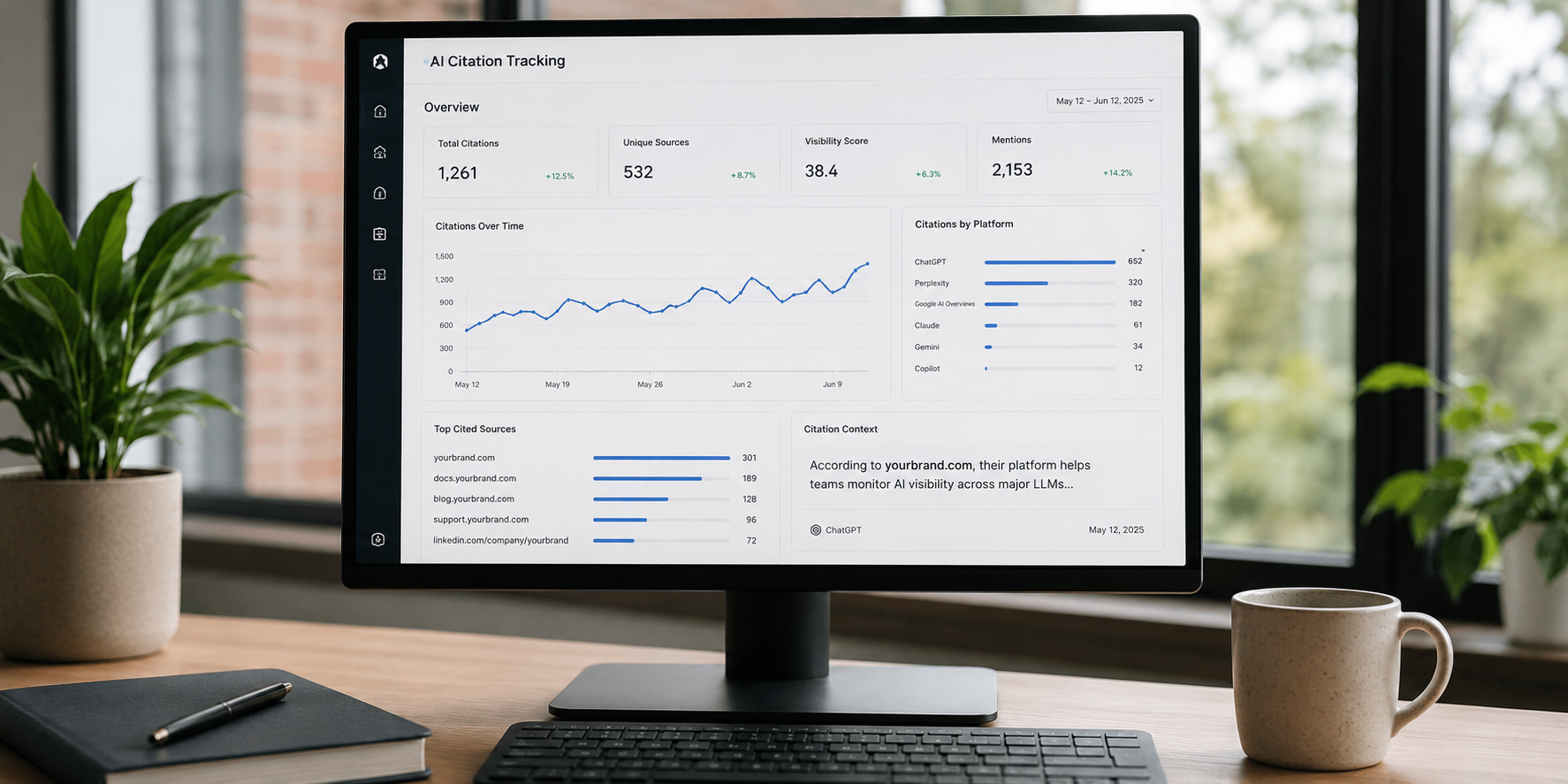
If you're serious about AI search visibility, at some point you need to stop manually asking ChatGPT whether your brand shows up and start measuring it systematically. Manual testing gives you a snapshot. Systematic tracking gives you a trend — and trends are what strategy runs on.
The market for AI citation tracking tools is moving fast. New entrants are appearing regularly, established SEO platforms are adding AI features, and the category hasn't yet consolidated around clear winners the way traditional rank tracking did. That creates both opportunity and confusion — there are real tools doing real work, and there are features being marketed as AI citation tracking that amount to little more than keyword monitoring with an AI label on top.
This comparison covers the tools that matter most right now, what each one actually measures, where each one falls short, and how to think about which combination makes sense for your situation.
What AI Citation Tracking Actually Needs to Do
Before comparing specific tools, it's worth being precise about what the category is trying to measure — because the tools vary significantly in how thoroughly they address each of these requirements.
Citation frequency. How often does your brand appear in AI-generated answers for a defined set of queries? This is the primary metric — your share of AI-generated mentions across a query set over time.
Share of voice. Of all the brands appearing in AI answers for your target queries, what percentage of mentions belong to you versus your competitors? Citation frequency tells you your absolute performance. Share of voice tells you your relative performance.
Platform coverage. Are you tracking ChatGPT, Perplexity, Google AI Overviews, Gemini, and other relevant platforms separately? Each platform has different citation behavior, and a tool that only tracks one is giving you a partial picture.
Sentiment and characterization. When your brand is cited, how is it being described? Positive, neutral, or negative? Accurately or inaccurately? A brand being cited as an example of what not to do has a citation but not visibility that helps.
Source attribution. When an AI system cites your brand, what source is it drawing from? Which of your content pieces or third-party mentions are driving the citations? This is the diagnostic layer that tells you what's working and what to produce more of.
Query flexibility. Can you track the specific queries that matter to your business — the ones your buyers are actually asking — rather than being limited to a preset query library?
Trend tracking over time. Single-point measurements are snapshots. The value of a tracking tool is in the trend data — is your citation frequency improving, declining, or flat over weeks and months?
Not every tool on this list addresses all of these requirements. Most address some of them well and others poorly or not at all.
The Tools
HubSpot AI Search Grader / HubSpot AEO Features
HubSpot has moved aggressively into AI search measurement, integrating AEO tracking into its Marketing Hub at the enterprise tier. The core functionality allows users to define a set of prompts — specific questions relevant to their business — and track how frequently their brand appears in AI-generated responses to those prompts across multiple platforms over time.
The standout feature is the CRM integration. Because HubSpot can connect AI citation data to pipeline and revenue data, it creates a feedback loop that most standalone tools can't match — you can see which AI search visibility improvements correlate with inbound lead increases, and use CRM data to define the prompts most relevant to your actual buyer journey rather than guessing at what your prospects are asking.
The limitations are real. HubSpot's AI search features are currently strongest for tracking prompt-specific citation frequency and less developed on source attribution and competitive share of voice. The platform coverage is improving but varies by tier and continues to evolve. And the cost — this functionality lives in higher Marketing Hub tiers — makes it inaccessible for smaller teams or agencies managing multiple client accounts at a reasonable per-client cost.
Best for: Mid-market and enterprise B2B brands already on HubSpot who want AI citation data connected to CRM and revenue metrics.
Limitations: Cost, evolving platform coverage, less developed on competitive intelligence and source attribution.
Semrush AI Toolkit / Position Tracking Updates
Semrush has been integrating AI Overview tracking into its core position tracking product, allowing users to see when their tracked keywords trigger an AI Overview and whether their domain appears within it. This is less comprehensive than dedicated AI citation tracking but meaningful for brands whose primary concern is Google AI Overviews specifically.
The advantage of Semrush's approach is that AI Overview data sits alongside traditional ranking data in a tool teams already use — making it easier to see the relationship between organic rankings and AI Overview inclusion for the same keywords. A keyword where you rank position two but don't appear in the AI Overview is a different strategic problem than a keyword where you rank position eight and do appear in the AI Overview.
The limitation is platform scope. Semrush's AI tracking is concentrated on Google's ecosystem. If your buyers are using ChatGPT or Perplexity — which for most B2B categories they increasingly are — the Semrush AI features give you an incomplete picture.
Best for: Teams already on Semrush who want to add AI Overview visibility to their existing keyword tracking without adding another tool.
Limitations: Limited to Google AI Overviews, not a comprehensive multi-platform AI citation tracker.
Profound
Profound is one of the purpose-built AI search monitoring platforms that has emerged specifically to address the gap that traditional SEO tools leave. It tracks brand citations across multiple AI platforms — including ChatGPT, Perplexity, and others — against a defined set of queries, and provides trend data on citation frequency and share of voice over time.
The platform is designed for the specific workflow that AI search monitoring requires: define your query set, run those queries across AI platforms on a regular cadence, track how your brand and your competitors are mentioned, and surface changes over time. The competitive intelligence layer is one of Profound's stronger features — you can see how your citation frequency compares to specific competitors across the same query set, which is the competitive benchmarking that most brands need to prioritize their efforts.
Profound is still maturing as a product, and the category it sits in is evolving fast. Feature sets are expanding regularly, pricing has been in flux as the market develops, and integrations with broader marketing stacks are limited compared to established platforms like HubSpot or Semrush.
Best for: Brands and agencies that want dedicated, multi-platform AI citation tracking as a primary focus rather than as a feature within a broader SEO tool.
Limitations: Newer platform with evolving features, limited integrations, pricing that is still finding its market level.
Peec.ai
Peec.ai is another purpose-built AI visibility monitoring tool with a focus on brand citation tracking across the major AI platforms. Its core product tracks how frequently a brand appears in AI-generated answers, how competitors compare, and how citations trend over time.
Peec.ai has invested particularly in the competitive intelligence layer — making it relatively easy to benchmark your brand's AI citation frequency against a defined set of competitors across multiple platforms simultaneously. For brands whose primary use case is understanding how they compare to specific competitors in AI-generated answers, this competitive focus is a meaningful differentiator.
The platform is earlier-stage than some alternatives, which means both the promise of rapid feature development and the risk of product instability that comes with early-stage tools. Customer support and documentation quality vary, and the query volume available at different pricing tiers affects how comprehensively you can track your full priority query set.
Best for: Brands focused primarily on competitive AI citation benchmarking across multiple platforms.
Limitations: Earlier-stage platform, evolving product stability, query volume limitations at lower tiers.
Brandwatch and Similar Media Monitoring Platforms
Traditional media monitoring platforms like Brandwatch have been extending their coverage to include AI-generated content — tracking when brand mentions appear in AI answers in addition to their traditional coverage of news, social, and web mentions. For brands already using media monitoring tools, this extension can provide a unified view of brand mentions across traditional and AI channels without adding another tool.
The limitation is depth. Media monitoring platforms are built for breadth — tracking mentions across a massive range of sources — rather than for the specific structured query tracking that AI citation monitoring requires. They can tell you when your brand was mentioned in an AI-generated context but are less equipped to tell you your citation rate against a defined query set, your share of voice against specific competitors, or which content assets are driving the citations you're earning.
Best for: Enterprise brands already using media monitoring at scale who want AI citation data folded into an existing brand intelligence workflow.
Limitations: Built for breadth rather than AI-specific depth, less precise on query-specific citation tracking and source attribution.
Manual Testing with Documented Frameworks
This deserves inclusion not as a tool endorsement but as an honest acknowledgment that for smaller brands and agencies, a disciplined manual testing process — run consistently on a defined cadence — can produce meaningful insight without tool subscription costs.
The process: define a fixed set of priority queries, run them across your target AI platforms on a weekly or bi-weekly basis, document the results in a structured spreadsheet, and track citation frequency and competitor mentions over time. The limitation is obvious — it doesn't scale, it's time-consuming, and it's subject to the variability of AI-generated responses that makes any single manual test an unreliable data point. But for teams that haven't yet justified the cost of a dedicated tool, a structured manual process is significantly better than no measurement at all.
Best for: Smaller brands and agencies in early stages of AI search measurement who haven't yet justified dedicated tool investment.
Limitations: Doesn't scale, time-intensive, subject to response variability, no trend automation.
How to Choose
The right tool — or combination of tools — depends on three variables: your platform priorities, your budget, and whether you need AI citation data integrated with broader marketing metrics or as a standalone measurement.
If Google AI Overviews is your primary concern and you're already on Semrush, add AI Overview tracking to your existing position tracking setup before evaluating dedicated tools. The integration with your existing keyword data is valuable and the incremental cost is minimal.
If you need multi-platform coverage — ChatGPT, Perplexity, Gemini, and Google AI Overviews — a purpose-built tool like Profound or Peec.ai is currently the most direct solution. Neither is perfect, but both are purpose-built for the measurement problem you're trying to solve in a way that general SEO platforms aren't yet.
If you're a mid-market or enterprise B2B brand on HubSpot and you want AI citation data connected to pipeline metrics, HubSpot's AEO features are worth evaluating seriously despite the cost, because the CRM integration creates insight that standalone AI tracking tools can't replicate.
If you're managing multiple client accounts as an agency, the economics of per-seat or per-domain pricing on dedicated tools matter significantly. Evaluate how query volume and domain limits are structured before committing — many tools price in ways that become expensive quickly at agency scale.
If budget is the primary constraint, a structured manual testing process is a legitimate starting point. Build the habit of systematic measurement before investing in tools to automate it. The discipline of defining your query set and tracking results consistently is more valuable than any tool used inconsistently.
The Honest State of the Category
AI citation tracking is a category in formation. The tools available today are meaningfully better than nothing and meaningfully worse than where they'll be in twelve to twenty-four months. The platforms are investing, the methodologies are maturing, and the measurement frameworks are becoming more standardized — but none of the current options is a fully solved product.
The practical implication is that the right approach right now is systematic rather than perfect. Pick the tool or process that gives you consistent data on your priority metrics — citation frequency, competitive share of voice, platform coverage — and run it consistently. Trend data from an imperfect tool run consistently is more valuable than perfect data from a tool used sporadically.
The brands that will have the most useful AI search measurement in two years are the ones building the measurement habit now, not the ones waiting for a perfect tool before starting.
Ritner Digital tracks AI citation data across platforms for clients as part of integrated AI search programs — with reporting that connects visibility metrics to business outcomes. If you want to understand what your current AI citation landscape looks like, start with a conversation.
Frequently Asked Questions
Do any of these tools track all major AI platforms in one place?
The purpose-built tools like Profound and Peec.ai come closest, but none of them tracks every relevant AI platform comprehensively yet. The category is moving fast enough that platform coverage is one of the most actively developed features across all of these products — what's true today about which platforms a given tool covers may be different in six months. Before committing to any tool, verify current platform coverage directly with the vendor rather than relying on documentation that may be outdated. The platforms that matter most for most B2B brands right now are ChatGPT, Perplexity, Google AI Overviews, and Gemini — confirm coverage of all four before making a purchasing decision.
How many queries should we be tracking in a dedicated tool?
Start with ten to twenty high-priority queries and expand from there as you establish what the data is telling you. More queries produce more data but also more noise — a sprawling query set makes it harder to identify the patterns that drive strategic decisions. The most useful query sets are tightly focused on the specific questions your ideal buyers are asking at the consideration and decision stages of their journey. Broad awareness queries generate interesting data but rarely the actionable competitive intelligence that informs content and authority investment decisions. Once your ten to twenty priority queries are producing consistent trend data, expand into adjacent query types where you want to build visibility.
Can these tools tell us which specific content is driving our AI citations?
Source attribution — knowing which of your content pieces or third-party mentions is being cited when your brand appears in AI answers — is one of the least developed features across the current tool landscape. Some tools surface cited URLs when AI systems include them in responses, but AI systems don't always cite sources explicitly even when they're drawing from them. HubSpot's AEO features have invested more in this layer than most, and purpose-built tools are actively developing it. In practice, the most reliable way to understand which content is driving citations is to combine tool data with manual testing — when you see a citation in a tracked query, manually run the same query and examine the full AI response including any cited sources.
Is there a free tool for tracking AI citations?
Nothing purpose-built and free provides reliable systematic AI citation tracking at this stage of the market. Google's AI Overview appearances can be partially inferred from Search Console data — queries where your site appears with featured placement may correlate with AI Overview inclusion — but Search Console doesn't provide explicit AI citation reporting. Manual testing using a structured spreadsheet is the most accessible zero-cost approach, and for teams in early stages of AI search measurement it's a legitimate starting point. The investment required to do manual testing consistently enough to produce useful trend data is time rather than budget — which for some teams is the more constrained resource.
How frequently do these tools query AI platforms to track citations?
It varies significantly by tool and by pricing tier. Some tools run queries daily, others weekly, and some allow you to configure the cadence. For most brands, weekly tracking produces sufficient trend data without the cost implications of daily querying at scale. Daily tracking makes more sense when you're in an active period of content publishing or authority building and want to see citation changes more quickly. One important caveat: AI-generated responses have inherent variability — the same query can produce different responses on different runs even with no underlying change in the web content being retrieved. Tools that average results across multiple query runs produce more reliable data than those reporting single-run snapshots.
Should we use one tool or combine multiple tools?
For most brands, one purpose-built AI citation tool combined with your existing SEO platform's AI features is sufficient and avoids the data reconciliation complexity that comes with using multiple overlapping tools. A practical combination for B2B brands currently on Semrush is Semrush for Google AI Overview tracking alongside a purpose-built tool for multi-platform coverage — you get Google-specific depth from Semrush and broader platform coverage from the dedicated tool without significant overlap. Adding a third tool rarely produces proportionally more insight relative to the time required to manage and interpret multiple data sources. If you're already on HubSpot at a tier that includes AEO features, evaluate whether those features meet your needs before adding a standalone tool on top.
How do these tools handle AI response variability — the fact that the same query can produce different answers each time?
This is one of the core technical challenges in AI citation tracking, and the tools handle it with varying degrees of sophistication. The most rigorous approach is running each query multiple times per measurement period and aggregating the results — reporting your citation rate as the percentage of runs that returned a mention rather than a binary yes or no from a single run. Some tools do this natively; others report single-run results that can be misleading. When evaluating tools, ask specifically how they handle response variability and what their methodology is for producing reliable citation frequency data rather than noisy single-point measurements. A tool that runs each query five times and reports the average is producing meaningfully more reliable data than one running each query once.
What metrics should we report to stakeholders who aren't familiar with AI search?
Translate AI citation metrics into business-adjacent language that connects to outcomes stakeholders already understand. Citation frequency becomes visibility rate — the percentage of relevant buyer questions where your brand is present versus absent. Share of voice connects directly to competitive positioning — if you're appearing in 20% of AI answers in your category and your primary competitor is appearing in 60%, that's a competitive gap with revenue implications. Trend direction — is your citation rate improving, declining, or flat quarter over quarter — is the most intuitive progress metric for non-technical stakeholders. Where possible, connect AI visibility trends to downstream metrics they already track: branded search volume, direct traffic, and inbound lead volume all tend to move in the same direction as AI citation frequency over time, giving you a narrative that grounds AI search data in business outcomes rather than standalone metrics.
Ritner Digital builds AI search measurement into client engagements from day one — tracking citation frequency, competitive share of voice, and trend data across platforms as part of an integrated program. If you want to understand what systematic AI search tracking looks like in practice, start here.