AI Search Audit Checklist for B2B Brands
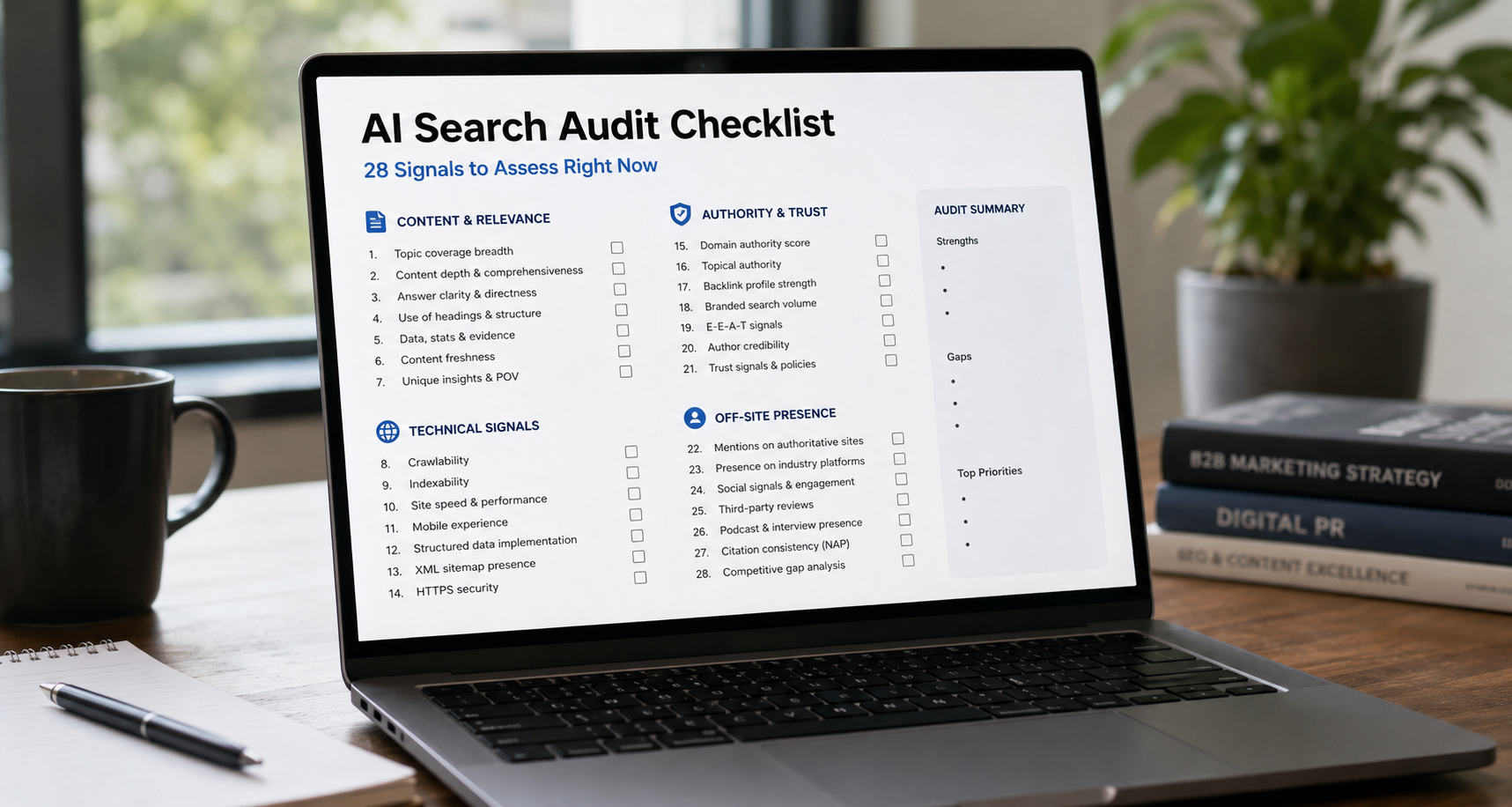
Most B2B brands have no idea where they stand in AI-generated search results. They haven't tested it systematically. They haven't mapped the competitive landscape. They haven't identified which signals are working and which are creating blind spots. They're either assuming the problem doesn't apply to them yet or assuming it's too new and unpredictable to do anything about.
Both assumptions are wrong — and both are costing brands consideration they don't know they're losing.
This checklist is designed to give B2B marketing teams and agency clients a structured framework for auditing their current AI search visibility — what's working, what's missing, and where to focus first. Work through it in order. The sections build on each other, and the findings in early sections inform the priorities in later ones.
Section One: Baseline Visibility Testing
Before strategy, you need a baseline. This section establishes where you currently stand across the AI platforms your buyers are most likely using.
1. Identify your ten highest-priority queries. These are the questions your ideal buyers are most likely to ask an AI system before shortlisting vendors. Think in terms of: category definition queries ("what type of agency handles X"), comparison queries ("what should I look for in a Y provider"), recommendation queries ("what are the best options for Z"), and problem-solution queries ("how do I solve X challenge"). Write them down explicitly before you start testing.
2. Test each query across all four major AI platforms. Run every query through ChatGPT, Perplexity, Google AI Overviews, and Gemini. Use both search-enabled and non-search-enabled modes in ChatGPT where possible. Document the full response for each query on each platform — not just whether your brand appears, but which brands do appear, how they're described, and what sources are cited.
3. Record your brand's citation frequency. For each platform, note how many of your ten priority queries return a response that mentions your brand. Calculate a citation rate — if you appear in three of ten queries on ChatGPT, your ChatGPT citation rate is 30%. Do this for each platform separately. This is your baseline number. Everything else in this audit is about understanding why that number is what it is and how to improve it.
4. Record competitor citation frequency. Run the same exercise for your top three to five competitors. Which of them appears most frequently? On which platforms? For which query types? This competitive mapping tells you which signals your competitors have built that you haven't — and which gaps are most responsible for the disparity.
5. Note how your brand is characterized when it does appear. Citation frequency is not the only metric that matters. When your brand is mentioned, what is the AI saying about you? Is the characterization accurate? Is it positioning you correctly for your target buyer? Is it outdated? A brand being cited with incorrect or outdated positioning may be worse than not being cited at all in some cases.
6. Identify the query types where you're consistently absent. After testing all ten queries across all platforms, look for patterns. Are you absent specifically on recommendation queries but present on definition queries? Are you appearing on one platform but not others? Are you visible for broad category terms but invisible for the specific service-level queries that signal buying intent? The pattern of absence tells you more than the overall citation rate.
Section Two: Content Audit
This section assesses whether your on-site content is structured in a way that AI systems can efficiently retrieve and cite.
7. Map your existing content against your priority query list. For each of the ten priority queries you identified in Section One, does your website have a piece of content that directly and completely answers it? Not content that touches on the topic — content that answers the specific question as its primary purpose. If the answer for more than half your priority queries is no, content gap is your primary problem.
8. Audit content structure for AI retrievability. Review your highest-priority content pieces for the structural signals that make content more citable. Does the content state the question explicitly before answering it? Are answers given directly and concisely before elaboration? Are headers descriptive enough that an AI system can understand the content of each section without reading the full piece? Is the content written in clear prose rather than bullet-heavy fragments that lose context when extracted?
9. Check for FAQ and Q&A formatted content. AI systems have a strong preference for content structured around explicit questions and direct answers. Audit how much of your content uses this format intentionally. Service pages, pillar guides, and blog posts that incorporate FAQ sections — with questions written the way a buyer would actually phrase them — are significantly more citable than content that doesn't use this structure.
10. Assess topical depth in your core service areas. Pick your two or three most important service categories and count how many pieces of content you have that go deep on each one. Surface-level coverage of many topics produces lower AI citation rates than comprehensive coverage of fewer topics. If you have one blog post on a subject that your competitors have built a ten-piece content cluster around, they will consistently outrank you for AI citations on that topic.
11. Audit content freshness and accuracy. AI systems retrieving current web content in search-enabled mode weight recency. Review your most important content pieces for outdated statistics, deprecated tool references, and information that has changed since publication. Content that was accurate two years ago but is now partially incorrect is a citation liability — an AI system that retrieves it and cites inaccurate information reflects poorly on both the AI and, indirectly, your brand.
12. Check that your highest-priority content is ranking in Google. Search-enabled AI retrieval draws heavily from content that Google has already indexed and deemed credible. If your most important content pieces aren't ranking for their target queries — or aren't indexed at all — they are functionally invisible to AI retrieval systems. Verify indexation in Search Console for every content piece you consider high priority for AI citation.
Section Three: Technical and Structural Audit
This section covers the infrastructure signals that determine whether AI systems can reliably access, parse, and trust your content.
13. Verify GPTBot is not blocked in your robots.txt. OpenAI's crawler, GPTBot, indexes content for use in ChatGPT's search-enabled responses. Check your robots.txt file to confirm GPTBot is not disallowed — either explicitly or as a side effect of broad crawler blocking rules. The same check applies to PerplexityBot and other AI crawlers that have emerging relevance. Blocking these crawlers doesn't protect you from anything meaningful — it only ensures your content is excluded from retrieval.
14. Audit your schema markup implementation. Structured data tells AI systems and search engines explicitly what your content is about and who produced it. Check for Organization schema on your homepage with accurate name, URL, logo, contact information, and social profiles. Check for Article or BlogPosting schema on published content with author, date, and publisher fields populated. Check for FAQ schema on question-and-answer content. Check for Service schema on service pages. Missing or incomplete schema is one of the fastest technical fixes available for AI search visibility.
15. Assess your entity definition consistency. AI systems build knowledge graphs. Your brand needs to be defined as a consistent entity across your website, your Google Business Profile, your LinkedIn company page, your social profiles, and any third-party directories or databases that reference you. Name variations, address inconsistencies, and conflicting descriptions across these sources create entity confusion that reduces AI systems' confidence in representing your brand. Audit for consistency across all of these touchpoints.
16. Check Core Web Vitals and page speed. AI crawlers, like search engine crawlers, have limited patience for slow or technically broken pages. A site with poor Core Web Vitals and slow load times may be crawled less thoroughly and less frequently, which directly limits AI retrieval access to your content. Run your highest-priority pages through PageSpeed Insights and address any critical performance issues.
17. Audit internal linking structure. Internal links tell both search engines and AI systems which content is most important on your domain. If your highest-priority content pieces — the ones you most want cited in AI answers — are not well-linked from other pages on your site, they receive less authority signal and less crawl priority. Map your internal linking structure and ensure your most important pages are connected clearly to your homepage and to each other.
18. Identify and fix crawl errors. Use Search Console or a crawl tool to identify pages returning errors, redirect chains, and content that exists on your site but isn't being indexed. Every piece of content that can't be reliably crawled is a potential citation that doesn't happen. Crawl health is the floor beneath which all other AI search optimization becomes impossible.
Section Four: Authority and Off-Site Signal Audit
This section assesses the external credibility signals that AI systems use to determine whether your brand is worth citing at all.
19. Count your unique referring domains. Pull your backlink profile in Ahrefs or Semrush and count the number of unique domains linking to your site. This is your referring domain count — the primary input to domain authority scores and a direct signal of how credible the broader web considers your domain. Compare this number to your top competitors. The gap between your referring domain count and theirs is a quantified measure of the authority disadvantage you're working against.
20. Assess the quality of your referring domains. Raw referring domain count matters less than the authority of those domains. A hundred links from low-authority sites contribute less than ten links from high-authority publications in your industry. Review the top twenty referring domains linking to your site and assess their relevance and authority. If most of your backlinks come from directories, low-authority blogs, or sites unrelated to your industry, your link profile quality is a gap to address.
21. Audit your presence on industry review platforms. For B2B brands, identify the review platforms most relevant to your category — Clutch, G2, Capterra, Trustpilot, or others depending on your service type — and audit your current presence on each. How many reviews do you have? What is your average rating? How recently were reviews posted? How does your review volume compare to competitors appearing in AI answers? Review signals on authoritative platforms are a direct input to how AI systems characterize your brand in recommendation queries.
22. Audit your Google Business Profile. Even for B2B brands without a traditional storefront, a complete and active Google Business Profile contributes to entity recognition and local search signals that inform AI systems. Check that your GBP is verified, that your category is accurate, that your services are listed completely, that your description reflects your current positioning, and that you have a consistent review generation practice in place.
23. Inventory your earned media coverage. Search for your brand name across Google News, industry publications, and major platforms. How many times has your brand been mentioned in third-party content in the past twelve months? Which publications have covered you? How authoritative are those publications? A brand with minimal earned media coverage is sending AI systems a weak multi-source credibility signal regardless of how good its own content is.
24. Check your presence in structured databases. AI training data draws heavily from structured, authoritative databases — Wikipedia, Wikidata, Crunchbase, LinkedIn company pages, industry association directories, and similar sources. Audit your presence in each of these. A complete, accurate Crunchbase profile. A LinkedIn company page with full information. Presence in relevant industry association directories. These structured entries contribute to the entity knowledge graph that AI systems use to recognize and represent your brand.
25. Assess your social proof footprint. Beyond formal review platforms, AI systems draw on a broader social proof signal — mentions in podcasts, quotes in articles, appearances in roundup content, inclusion in comparison pieces, and references in community forums. Audit how frequently your brand appears in this kind of content. Brands that are regularly quoted, referenced, and included in category conversations have a fundamentally different AI visibility profile than brands that exist primarily on their own domain.
Section Five: Competitive Gap Analysis
This section synthesizes the findings from the previous four sections into a prioritized competitive picture.
26. Build a signal comparison matrix. Create a simple side-by-side comparison of your brand versus your top two or three competitors across the key signals: citation frequency by platform, content depth in core service areas, referring domain count and quality, review volume on key platforms, earned media mentions in the past twelve months, and schema implementation completeness. This matrix makes the gaps visual and quantified rather than impressionistic.
27. Identify your highest-leverage gaps. Not all gaps are equal. Some are faster to close than others. Some have more direct impact on AI citation frequency than others. Review volume on key platforms can move in weeks. Content gaps can be addressed in months. Domain authority gaps take longer. Prioritize the gaps that combine high impact with achievable timelines given your resources.
28. Set a 90-day, 6-month, and 12-month benchmark. Based on your baseline citation rates from Section One and your gap analysis from Sections Two through Five, set specific targets for where you want your citation frequency to be at each interval. These targets should be realistic given the gaps identified — not aspirational numbers disconnected from the work required to achieve them. Revisit and retest against these benchmarks at each interval.
How to Use This Checklist
Work through it once to establish your baseline, then return to it quarterly as a progress audit. The AI search landscape is moving fast enough that a snapshot taken today may look meaningfully different in six months — both because your signals will have changed and because the AI systems themselves update continuously.
The brands that will have the strongest AI search visibility twelve months from now are the ones doing this audit today, identifying their specific gaps, and executing against them consistently rather than waiting for the landscape to stabilize before taking action.
It isn't going to stabilize. The window to build advantage while most of your competitors are still ignoring this is open right now — and it won't stay open indefinitely.
Ritner Digital runs AI search audits for B2B brands — mapping current visibility, identifying competitive gaps, and building the roadmap to close them. If you want this done for your brand rather than doing it yourself, the conversation starts here.
Frequently Asked Questions
How often should we run this audit?
Quarterly is the right cadence for most B2B brands. The AI search landscape moves fast enough that a snapshot taken today can look meaningfully different in ninety days — both because your own signals will have changed and because AI systems update their models, retrieval behavior, and citation patterns continuously. The baseline visibility testing in Section One is the highest-priority piece to repeat every quarter, since citation frequency is the most direct measure of whether the underlying work is producing results. The technical and structural sections can be audited less frequently — semi-annually is sufficient unless you've made significant site changes — while the off-site signal sections should be reviewed quarterly alongside the visibility testing.
We don't have a dedicated SEO team. Can we still work through this checklist internally?
Yes, with realistic expectations about time and expertise. Sections One and Two — baseline visibility testing and content auditing — are accessible to any marketing professional who understands their buyers and their content. Section Three requires some technical familiarity with robots.txt, schema markup, Search Console, and crawl tools, but the individual items are well-documented and most can be checked without deep technical expertise. Section Four requires access to backlink analysis tools like Ahrefs or Semrush for the referring domain items, but the review platform, earned media, and structured database audits can be done manually. The biggest risk of doing this internally without SEO experience is misinterpreting what you find — knowing that a signal is missing is easier than knowing how to fix it correctly.
Which section of this audit should we prioritize if we can only focus on one right now?
Section One, without question. The baseline visibility testing tells you what you're actually dealing with before any other work makes sense. Teams that skip the baseline and jump straight to fixing signals often spend effort on the wrong things — improving content structure when the real gap is review volume, or building backlinks when the primary issue is that GPTBot is blocked in their robots.txt. Ten queries tested across four platforms takes a few hours and produces more strategic clarity than weeks of assumption-driven optimization work.
How do we know if our schema markup is actually working correctly?
Google's Rich Results Test tool is the most accessible starting point — paste in any URL and it will show you which schema types are detected and whether they contain errors. Search Console's Enhancements section also surfaces schema errors at scale across your full site. For AI search specifically, the goal isn't just error-free schema — it's comprehensive schema that gives AI systems a complete structured picture of your brand, your content, and your services. An Organization schema with no errors but missing fields like sameAs links to your social profiles, or a BlogPosting schema without author and publisher information, is technically valid but strategically incomplete. Review both validity and completeness rather than just checking for errors.
Our competitors have much higher referring domain counts than we do. Is it realistic to close that gap?
Realistically closing a large referring domain gap takes twelve to twenty-four months of consistent effort — there's no version of link building that works faster than that without shortcuts that create more risk than value. What you can do in the near term is narrow the quality gap rather than the quantity gap. Ten well-placed links from genuinely authoritative, relevant publications in your industry will produce more AI citation impact than a hundred links from low-authority sources. Digital PR, expert commentary placements, strategic content partnerships, and earning citations through genuinely useful original research are the highest-quality link acquisition paths for B2B brands. Prioritize those over volume-based approaches and you can close the authority gap faster than the raw referring domain numbers suggest.
What should we do if we find that GPTBot is blocked on our site?
Fix it immediately — it's one of the fastest and highest-impact technical corrections available in AI search optimization. Open your robots.txt file, locate any rules that disallow GPTBot or use broad wildcard disallows that catch all bots, and remove or modify them to explicitly allow GPTBot. Do the same for PerplexityBot and any other AI crawler user agents you can identify. Then submit your sitemap through Search Console to accelerate reindexation of your content. The entire fix takes less than an hour and removes a ceiling that was limiting everything else you might do to improve AI search visibility. Many sites have this block in place without knowing it, often as a legacy of early AI opt-out guidance that didn't distinguish between training crawls and retrieval crawls.
How do we interpret it if we're appearing in AI answers but with inaccurate or outdated information?
Treat it as a higher priority than not appearing at all, because inaccurate citations can actively damage your positioning with buyers who trust AI-generated answers. The first step is identifying the source of the inaccurate information — is it coming from outdated content on your own site, from a third-party source that has incorrect information about you, or from the AI model's training data which predates a change in your business? If it's on-site content, update it immediately and ensure the updated version gets reindexed. If it's a third-party source, reach out to correct the record where possible. If it's training data, the fix is a longer-term effort of building updated, accurate information across enough authoritative sources that the next model training cycle incorporates the corrected picture.
Should we be auditing for AI search visibility separately from our regular SEO reporting?
Yes — they require different measurement frameworks and different tools. Traditional SEO reporting tracks keyword rankings, organic traffic, and backlink growth. AI search auditing tracks citation frequency across platforms, share of voice in AI-generated answers, sentiment associated with your brand in AI responses, and which content assets are driving citations. Some of these metrics can be tracked with purpose-built AI visibility tools. Others require systematic manual testing on a regular cadence. Folding AI search metrics into your existing SEO report without distinguishing them produces a muddled picture where neither set of insights is actionable. Treat them as parallel reporting tracks that inform a unified content and authority strategy rather than a single merged report.
What's a realistic citation rate to aim for after six months of focused effort?
It depends on your starting baseline, your competitive landscape, and how aggressively you execute against the gaps identified in this audit. For a B2B brand starting from near-zero citation frequency in a moderately competitive category, a realistic six-month target is appearing in three to five of your ten priority queries on at least two major AI platforms. That's a citation rate of 30 to 50% on a focused query set — not across all possible queries, but on the ten you've specifically optimized for. In highly competitive categories with well-resourced incumbents, that timeline stretches. In less contested niches, it compresses. The benchmark that matters most isn't an absolute number — it's consistent improvement in your citation rate quarter over quarter, which tells you the underlying work is compounding in the right direction.
Ritner Digital runs AI search audits for B2B brands and builds the roadmap to close the gaps this checklist reveals. If you'd rather have this done for you than work through it yourself, start here.