Atlanta Businesses: The FIFA World Cup Is 10 Weeks Away — Here's How to Talk to Your Marketing Agency Right Now
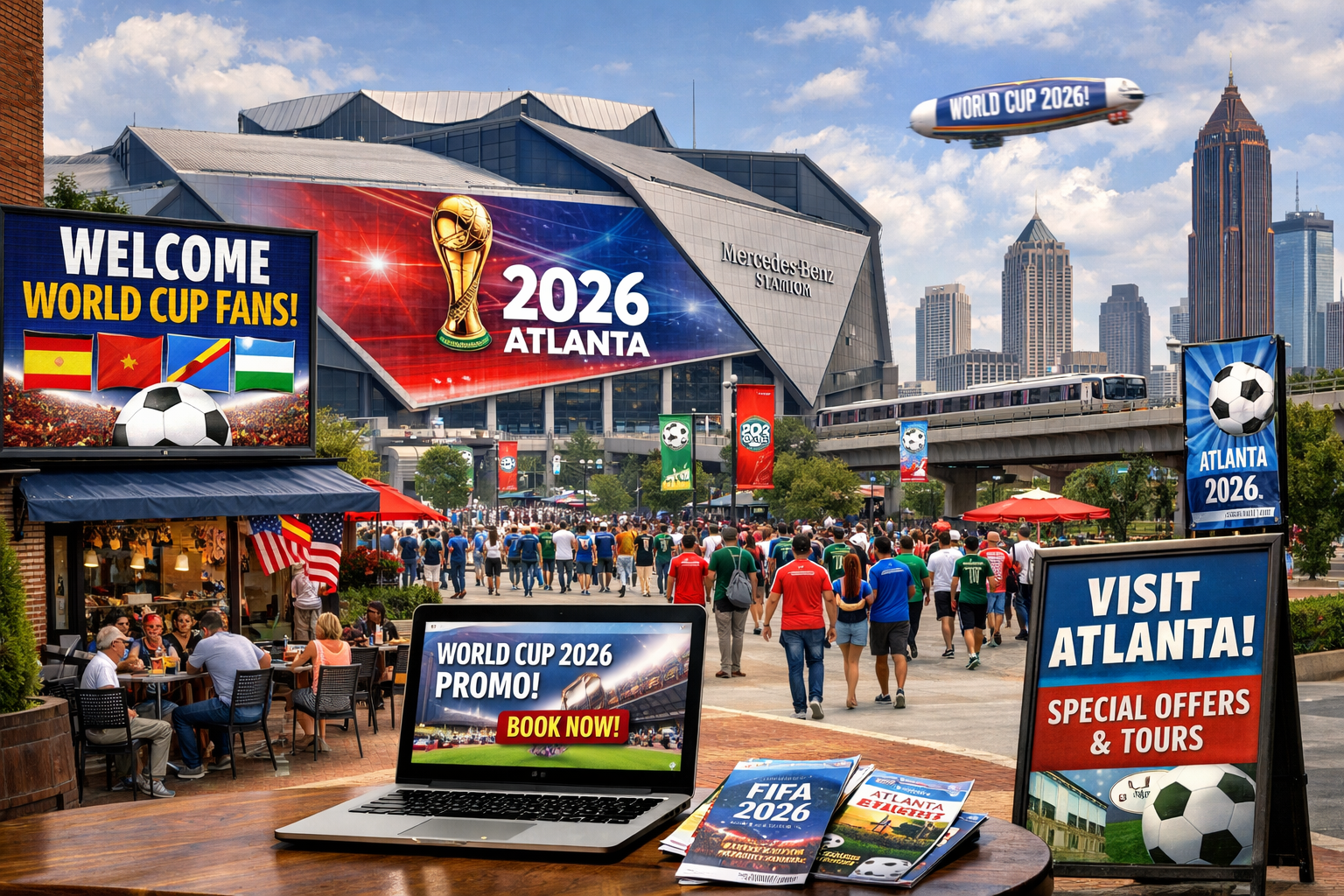
Atlanta isn't just hosting the World Cup. Atlanta is hosting one of the most consequential slices of it.
Atlanta has been selected to host eight matches — including five group stage matches, a round of 32 match, a round of 16 match, and a semifinal — at Mercedes-Benz Stadium between June 15 and July 15, 2026. Mercedes-Benz StadiumThat's the second highest number of matches of any U.S. host city behind Dallas, and it includes a semifinal that will draw one of the largest global television audiences of the entire tournament.
Atlanta is projected to generate over $1 billion in economic activity from its eight matches, driven by more than 300,000 unique visitors. Partners Real Estate Of those attendees, 75% are expected to be traveling from other states and countries. GMA
This isn't a local sports crowd. This is the world, landing in Atlanta for five straight weeks. And the Atlanta businesses that capture the most value from this moment won't be the ones that hoped the foot traffic would find them — they'll be the ones that built visibility, digital presence, and marketing momentum before the first whistle blew.
If you haven't had a serious conversation with your marketing partner about the World Cup yet, this is the week to do it. Here's exactly how to approach that conversation and what to make sure gets covered.
What Makes Atlanta's Situation Uniquely Powerful
Before you map out your marketing strategy, understand what makes Atlanta's World Cup window genuinely different from most host cities.
First, the duration. Eight matches spread across an entire month — June 15 through July 15 — means Atlanta isn't experiencing a concentrated single-weekend spike. It's experiencing sustained, rolling waves of international visitors for thirty consecutive days. That's a fundamentally different opportunity than a city hosting two or three matches in a tight cluster. Visitors will arrive, explore, leave, and be replaced by new waves of visitors tied to subsequent matches. Businesses that maintain consistent marketing presence throughout the entire window — rather than doing a one-week push and going quiet — will see dramatically better results.
Second, the semifinal. Atlanta was selected as a premiere World Cup venue, and the semifinal alone will draw a global television audience and the highest caliber of international soccer fans. Mercedes-Benz Stadium The fans who travel to semifinals are not casual observers. They're deeply invested supporters who have already committed significant money to follow their team deep into the tournament. They spend more, stay longer, and explore cities more thoroughly than group-stage attendees. Atlanta businesses should be thinking specifically about the July 15 window as a peak-within-a-peak.
Third, the geographic reach. International travelers are expected to hub into metro Atlanta but will be looking for weekend getaways and destinations to explore during breaks between matches. The economic reach extends far beyond hotels and restaurants, touching attractions and businesses across Georgia. GMA Atlanta-based businesses that market themselves as part of an extended Southern experience — connecting to nearby attractions, neighborhoods, and day-trip destinations — have an angle that stadium-adjacent businesses simply can't offer.
Atlanta's confirmed matches include Spain vs. Cabo Verde, Czechia vs. South Africa, Spain vs. Saudi Arabia, Morocco vs. Haiti, Congo DR vs. Uzbekistan, plus the knockout round games in July. Atlantafwc26 That's a remarkably diverse mix of nationalities — Spanish, South African, Czech, Moroccan, Haitian, Congolese, Uzbek, and Saudi fans, among others — each with distinct cultures, languages, food preferences, and spending habits. The Atlanta business that thinks about this diversity and speaks to it will stand out dramatically from the competitor who assumes everyone arriving is an American soccer fan.
The Clock Is Running: What's Still Available and What Isn't
Some of the premium marketing inventory tied to the World Cup in Atlanta — certain billboard placements near Mercedes-Benz Stadium, official activation zones, and partnership packages tied to the host committee — has already been committed. If you haven't moved on those, they're largely gone.
But for most Atlanta small and mid-size businesses, the most valuable marketing available right now isn't the stuff that requires official FIFA relationships or six-figure budgets anyway. It's the digital work: paid targeting of inbound travelers, local SEO, content, reviews, and email. All of that is still executable — but it needs to start now. Every week that passes is a week of search impressions, review-building time, and audience warm-up that you don't get back.
Brands that plan now will benefit from better placement, pricing, and production timelines. The most successful campaigns don't rely on a single touchpoint — they guide consumers along a journey from awareness to consideration to action. A visitor may first see your brand in an airport terminal or on social media, then again through Google search or a mobile app, and finally interact with you in person. Availmediagroup
When you call your marketing partner, lead with this: "We have roughly ten weeks before Atlanta's first match. What can we realistically execute in that window, what should we prioritize, and what's it going to cost to do it properly?" A good agency will give you an honest answer. If they try to sell you everything at once without helping you triage, that's a red flag.
What to Cover in the Conversation
Google Business Profile and local SEO
This is the unglamorous foundation that matters more than almost anything else. The 300,000+ visitors coming to Atlanta will search on their phones — for restaurants near Mercedes-Benz Stadium, for bars showing World Cup matches, for things to do between games, for neighborhoods to explore. If your Google Business Profile has outdated hours, sparse photos, or a thin review profile, you are invisible to that search at the exact moment someone is standing in your city ready to spend money.
Make sure your hours reflect your actual World Cup operating plans — if you're staying open later on match days, that needs to be updated. Make sure your photos are current and professional. Make sure your categories accurately describe what you offer. And make sure you have a plan to generate reviews in the weeks ahead, because international visitors will rely on review signals far more heavily than local regulars who already know you.
Ask your marketing partner: "Is our Google Business Profile fully optimized for someone who has never been to Atlanta and is searching from a phone right now? What specifically needs to be updated before June 15?"
Multilingual and multicultural targeting
Atlanta's match lineup reads like a United Nations attendance sheet. Spanish fans alone will be there for two group-stage matches. Moroccan supporters, Czech fans, Congolese, Uzbek, South African, Haitian — the cultural diversity of visitors coming to Atlanta is extraordinary, and most Atlanta businesses will do absolutely nothing to speak to it.
The businesses that stand out will be the ones that make even small gestures toward multilingual presence: a Google Business Profile description available in Spanish and French, a few social media posts in Portuguese or Arabic timed to relevant matches, a WhatsApp contact option for international visitors who prefer messaging to phone calls. None of this requires a major investment. All of it signals that your business is ready to welcome the world.
Ask your marketing partner: "What would it take to make our digital presence accessible to the primary nationalities coming to Atlanta's matches? Which languages should we prioritize given our specific match lineup?"
Paid digital targeting of inbound travelers
Atlanta has an enormous airport — Hartsfield-Jackson is the busiest in the world — and hundreds of thousands of international visitors will be flowing through it over the course of the tournament. Those visitors are searchable long before they land. They're on Google looking up hotels, neighborhoods, and things to do. They're on Meta platforms in interest groups tied to Spain, Morocco, and their national teams. They're watching YouTube travel content about Atlanta right now.
A well-structured paid campaign targeting people in relevant countries showing travel intent toward Atlanta, running in the six to eight weeks leading up to and through the tournament, can put your business in front of exactly the right person at exactly the right moment for a fraction of what a billboard costs.
Ask your marketing partner: "Can we build a paid campaign specifically targeting international travelers flying into Atlanta for the World Cup? What's the right platform mix, targeting approach, and budget range to be competitive?"
Match-day content and social media
Atlanta has eight match days between June 15 and July 15. That's eight natural content moments, eight opportunities to be part of the conversation happening on every social platform in the world, and eight chances to show potential customers that your business is alive to the moment and worth visiting.
Content tied to the cultural identities of the nations playing — the food, the history, the soccer culture of Spain, Morocco, Congo DR, and the rest — is shareable, searchable, and authentically interesting. Watch party promotions, match-day specials, behind-the-scenes content showing your preparation, staff spotlights from employees who are fans of competing teams — all of this participates in the World Cup energy without requiring an official FIFA sponsorship.
The business opportunity during the World Cup isn't in the stadium — it's at the corner bar, on public transportation, and on the cell phone screen. By focusing on the user experience, brands can score their own commercial goals. Sherlock Communications
One important note: FIFA's intellectual property protections are strict. Your agency should guide you away from using official logos, protected tournament language, or anything that implies an official relationship with FIFA that doesn't exist. The goal is to be part of the cultural moment authentically, not to create legal exposure.
Ask your marketing partner: "Can we map out a content calendar for every Atlanta match date between June 15 and July 15? What does that execution look like and who's responsible for it?"
Email and SMS marketing to your existing base
Your existing customers are your most reliable audience, and they need to hear from you specifically about the World Cup before it starts. Let them know your plans — if you're doing watch parties, extended hours, special menus, or match-day promotions, tell your list now and tell them again closer to the dates. Existing customers who know you're going all-in on the World Cup will come back more often, bring visiting friends and family, and be your best ambassadors during the tournament.
Ask your marketing partner: "Do we have a World Cup email and SMS sequence mapped out? Let's tie specific messages to each match date on Atlanta's schedule."
Reputation management
International travelers may hub into metro Atlanta but will be looking for weekend getaways and destinations to explore during breaks between matches. GMA Those travelers will choose where to eat, drink, and spend based heavily on reviews. A business with 47 reviews and a 4.2 star rating is competing against one with 340 reviews and a 4.8 star rating — and the international visitor with no prior Atlanta knowledge is going to choose the latter every time.
The next six to eight weeks are your last real window to build review volume before the tournament starts. Be systematic about asking satisfied customers to leave reviews. Respond to every existing review. Make sure your rating on Google, Yelp, and TripAdvisor reflects the experience you actually deliver.
Ask your marketing partner: "What's our current review standing across platforms, and what's the plan to strengthen it before June 15?"
Atlanta's Bigger Context: This Is a Legacy Moment
Hosting the World Cup will continue to build upon Atlanta's growing legacy as the epicenter of soccer in the United States. Atlanta United launched as the most successful expansion franchise in the history of Major League Soccer since beginning play in 2017, and U.S. Soccer's new National Training Center is being established just south of the city. Mercedes-Benz Stadium
The World Cup isn't arriving in Atlanta as a random event. It's arriving as the culmination of years of the city positioning itself as a serious soccer market — and with the new U.S. Soccer National Training Center opening nearby, this is explicitly not a one-time moment. The infrastructure, the reputation, and the global visibility Atlanta earns during the 2026 World Cup will have lasting effects on how the city is perceived internationally for years to come.
For historical comparison, Atlanta's 1996 Olympics generated $5 billion in economic impact, suggesting the World Cup's concentrated visitor surge could approach similar per-match impacts. Partners Real Estate The businesses that invest in their visibility now aren't just chasing a summer revenue spike — they're building brand recognition with a global audience that will continue to pay off long after July 15.
Busy periods cost money before they make money. Businesses must consider stocking additional inventory, hiring extra staff, upgrading systems, and investing in marketing — and all of this happens before the big day. WSFL This is why the conversation with your marketing partner has to be a real strategic discussion about budget, timeline, and priorities — not just a quick call to add a few social posts. The investment is real. So is the return.
What to Say When You Make the Call
Whether you're a current client of a marketing agency or you're looking for new support, here's how to frame the conversation:
"Atlanta is hosting eight World Cup matches starting June 15, including a semifinal on July 15. We want to make sure our business is positioned to capture as much of this as possible. We have roughly ten weeks. We want to understand what's realistically achievable, what channels we should prioritize, and what budget we need to do it properly. We're not trying to do everything — we're trying to do the right things in the time we have."
That framing signals that you're serious, that you understand the timeline, and that you want strategic guidance rather than a menu of services. The best marketing partners will respond with clarity and honesty about what's achievable. The ones to avoid are the ones who say yes to everything without helping you prioritize.
Atlanta has eight chances to make a global impression this summer. The businesses that show up prepared will remember this summer for years. The ones that waited will spend those same years wondering what they missed.
Ritner Digital works with businesses across Atlanta and the Southeast on digital marketing strategy, local SEO, paid media, and content. If you want to talk about what a focused World Cup marketing push looks like for your specific business, reach out — let's make the most of this moment together.
Frequently Asked Questions
How many World Cup matches is Atlanta hosting and when do they run?
Atlanta is hosting eight matches at Mercedes-Benz Stadium between June 15 and July 15, 2026 — the second highest total of any U.S. host city behind Dallas. The schedule includes five group stage matches, a round of 32, a round of 16, and a semifinal. That's a full month of sustained international visitor activity, which makes Atlanta's opportunity considerably different from cities hosting just two or three matches in a compressed window.
Is it too late for Atlanta businesses to ramp up their marketing?
Not too late, but the window is genuinely narrow. Some premium advertising placements and official activation opportunities tied to the host committee are already committed. What remains — and what delivers the highest return for most small and mid-size businesses — is digital: paid targeting of inbound travelers, Google Business Profile optimization, content, email marketing, and reputation building. All of that is still executable in the time remaining, but every week that passes is visibility, review volume, and audience warm-up that you can't get back.
Which nationalities should Atlanta businesses be trying to reach?
Atlanta's confirmed match lineup includes Spain, Cabo Verde, Czechia, South Africa, Saudi Arabia, Morocco, Haiti, Congo DR, and Uzbekistan — alongside the knockout round teams still to be determined. That means Spanish, French, Arabic, Czech, and a range of other language speakers will be among your visitors. Spanish fans alone are coming for two group-stage matches. Any business that makes even modest efforts to speak to these communities in their own language — through translated digital presence, multilingual social content, or WhatsApp contact options — will have a meaningful advantage over competitors who assume every visitor speaks English.
Does a business need to be near Mercedes-Benz Stadium to benefit?
No, and this is one of the most important things for Atlanta businesses to understand. The 300,000+ visitors coming to Atlanta for the matches aren't spending all of their time in the stadium corridor. They're exploring neighborhoods, seeking out authentic local experiences, taking day trips, and filling hotels and restaurants across the metro area. International travelers in particular tend to be curious and adventurous visitors who want to experience a city beyond its tourist center. Businesses in Inman Park, Little Five Points, Ponce City Market, Buckhead, and neighborhoods across the city all stand to benefit — if they're visible and findable when visitors go looking.
What makes Atlanta's opportunity different from other host cities?
A few things stand out. The duration is the biggest factor — a full month of matches means sustained waves of international visitors rather than a concentrated spike. The semifinal is another differentiator — the fans who travel to semifinals are deeply committed, higher-spending visitors who have already invested significantly in following their team through the tournament. And Atlanta's role as the emerging epicenter of American soccer, anchored by Atlanta United and the new U.S. Soccer National Training Center opening nearby, means this isn't a one-off event. The World Cup is part of a longer story Atlanta is telling about itself on the global stage.
What digital marketing channels should Atlanta businesses prioritize right now?
In roughly this order: Google Business Profile optimization and local SEO, because that's what visitors search first and most. Paid digital campaigns targeting inbound international travelers on Google and Meta, because those people are searchable right now and can be reached before they land. Content tied to the specific match schedule and nationalities visiting Atlanta, because cultural relevance drives engagement and sharing. Email and SMS to your existing customer base, because your warmest audience needs to know your World Cup plans. And reputation management across Google, Yelp, and TripAdvisor, because international visitors with no prior Atlanta knowledge will rely heavily on reviews to choose between businesses they've never heard of.
How should Atlanta businesses think about the semifinal specifically?
The July 15 semifinal is a peak-within-a-peak. Semifinal attendees tend to be the most passionate, most committed soccer fans in the entire tournament — people who have been traveling and following their team for weeks. They spend more, stay longer, and explore cities more thoroughly than early-round group-stage visitors. Atlanta businesses should treat the semifinal window as their highest-priority marketing moment and make sure their operations and marketing are firing on all cylinders for that specific date and the days surrounding it.
Do we need an official FIFA sponsorship to market around the World Cup?
No — and for most small and mid-size Atlanta businesses, official FIFA sponsorship wouldn't be attainable or cost-effective anyway. What you can do is participate in the cultural energy of the event authentically: reference that matches are happening in Atlanta, celebrate the nations and cultures visiting the city, create watch party events, develop soccer-themed promotions, and produce content that speaks to the excitement of the moment. What you cannot do is use FIFA's official logos, protected terminology, or imagery in a commercial context without authorization. A good marketing agency will know exactly where these lines are and keep your campaigns firmly on the right side of them.
How long does the marketing opportunity actually last?
The matches run June 15 through July 15, but the opportunity is broader on both ends. Visitors begin arriving in Atlanta days before each match and often extend their stay to explore the city. The fan festival and surrounding programming create energy beyond individual match days. And the digital footprint — the reviews earned, the social impressions generated, the brand recognition built — continues paying dividends long after July 15, as visitors return home and share their Atlanta experience with friends, family, and followers across the world. Atlanta businesses that earn strong reviews and social buzz during the tournament are building assets that last well beyond the summer.
What should I watch out for operationally during such a high-traffic period?
Marketing drives people to your door, but if your operations aren't ready for the volume, the reviews you earn during the World Cup will hurt you rather than help you. Before you invest heavily in driving traffic, make sure you've thought through staffing levels for match days and surrounding dates, inventory for a sustained high-demand period, reservation or wait management systems, and whether your payment processing can handle international cards and contactless payment methods that international visitors commonly prefer. Your marketing should also accurately reflect your capacity — overpromising an experience you can't consistently deliver to a global audience is a risk no Atlanta business should take during a moment this visible.
How do I find the right marketing partner if I don't already have one?
Be direct about your timeline and specific situation when you reach out. Ask the agency what they can realistically execute in eight to ten weeks, which channels they'd prioritize for your specific business type, and whether they have experience working with businesses during major events or high-traffic periods. Ask for a clear breakdown of what success looks like and how they'd measure it. A trustworthy marketing partner will give you honest answers about what's achievable and what isn't — including telling you if your window for certain tactics has already closed. Anyone who says yes to everything without helping you prioritize is not the partner you need right now.