Backlink Audit: River Rat Motorsports
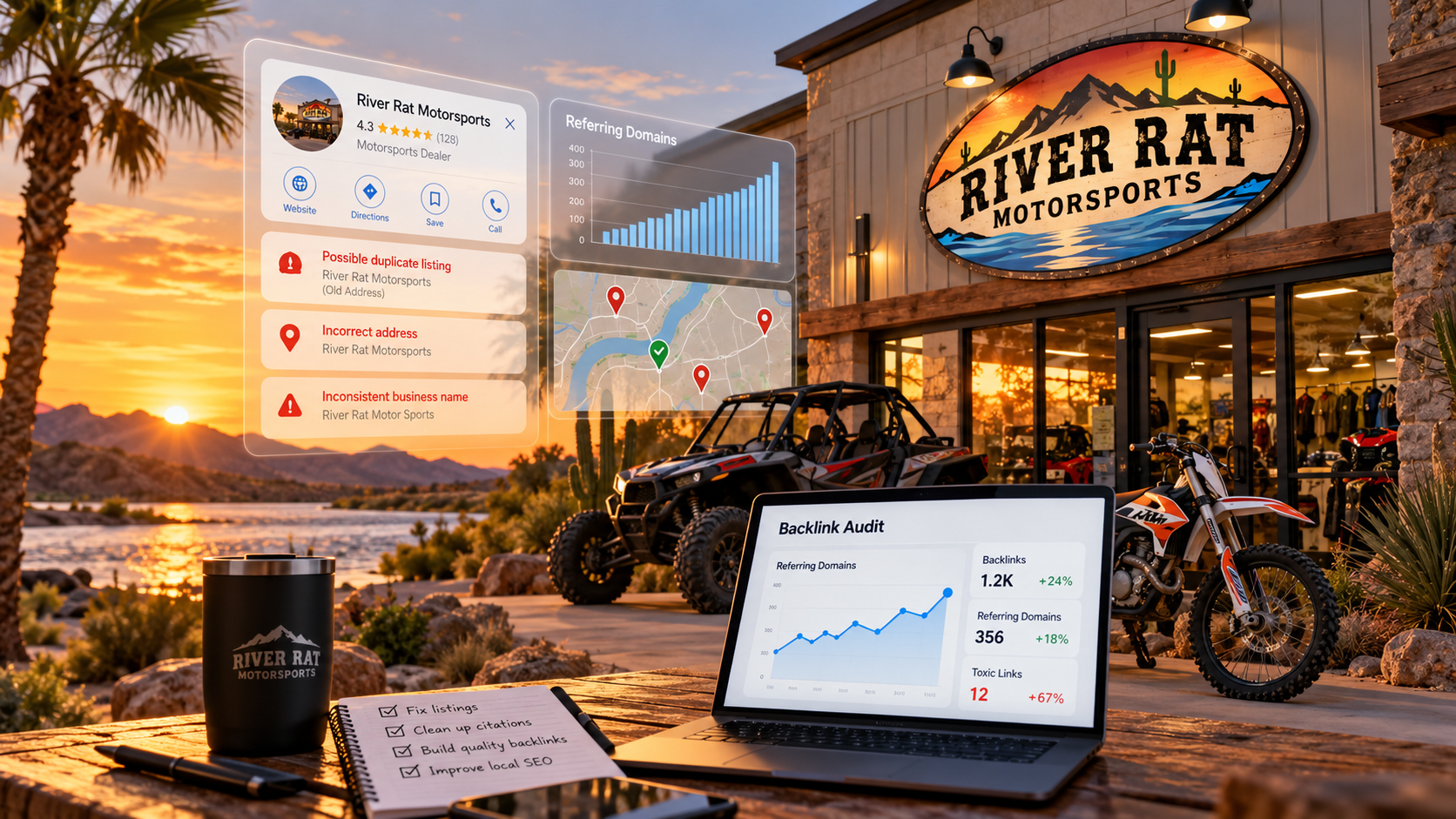
Nine in ten visitors already knew your name. The rest of the web isn't telling anyone else.
Prepared for: River Rat Motorsports — riverratmotorsports.com
Locations: 1030 Hwy 95, Bullhead City, AZ 86429 · (928) 220-8215 | 1596 Countryshire Ave, Lake Havasu City, AZ 86403 · (928) 302-3001 Platform: DX1 · Founded 2009 (per LinkedIn)
Data: Semrush domain overview, pulled September 26, 2026 · third-party listings verified individually the same week
Prepared by: Ritner Digital
Three weeks ago we ran River Rat Motorsports through our 30-prompt AI visibility test, and it posted the highest score we have published: 27 out of 30. Then we read the transcripts. In every answer where a competitor appeared, Anderson Powersports was named first and described down to the model — RZR, Ranger, Defender, Maverick — while River Rat got "CFMOTO, Kawasaki, and others." We ended that audit with one line: the corroborating source writes the description.
This is the follow-up, and it answers the obvious question. If the engines describe dealers from whatever third-party records exist, what do River Rat's records actually say?
Short answer: they say the wrong things, in the wrong places, about a business that stopped existing in that form years ago. The profile is bigger than most dealers its size and describes less. That is fixable, and most of it is free.
Same disclosure as always: River Rat is not a client. It's the audit every prospect gets, done in the open.
Part 1: The headline numbers
Semrush's read on riverratmotorsports.com as of September 26, 2026:
For calibration: Mount Holly Nissan sat at Authority Score 25 on 315 referring domains when we audited it in August. Victory SK sat at 2. Our own domain, under a year old, was 15 in August. At 19 with 549 referring domains, River Rat has a bigger link footprint than a franchise Nissan store and less authority to show for it. That gap is the audit.
The growth numbers are real. Organic traffic more than doubled and keywords grew by a third. But look at where the traffic comes from.
Navigational searches are people typing the business's name. They are 17% of the keywords and roughly 91% of the traffic. The 155 transactional keywords — the "buy," "for sale," "dealer near me" terms that make up the biggest slice of what the site ranks for — send about 48 visits a month between them. All non-branded search combined is somewhere around 130 visits.
That is the AI audit's finding reproduced in Google's own data. In the AI test, every engine produced a complete, fourteen-brand, two-store description of River Rat — but only when the question already contained the name. Google is doing the same thing. People who know River Rat find it. People shopping for a side-by-side in Bullhead City mostly don't.
Semrush's AI numbers point the same way. River Rat has 16 mentions across ChatGPT (4), Google AI Mode (7) and Gemini (5), and zero in AI Overviews. The three top cited sources for those mentions are the dealer's own site (11), Facebook (6) and Google (5). No third-party dealer directory, manufacturer page or local organization makes the top of that list. The engines are describing River Rat almost entirely from River Rat, which is exactly why they can only do it when asked by name.
Part 2: 21,400 backlinks from 549 domains
Divide backlinks by referring domains and you get an average of about 39 links per linking domain. Mount Holly Nissan's ratio was about 11.
A high ratio almost always means a handful of domains are linking from every page of their site — footers, sidebars, templated dealer pages, inventory feeds. For a powersports dealer on DX1, the likely candidates are visible from the outside. CFMOTO hosts a dealer subdomain for each store (riverratbullheadcity.dz.cfmotousa.com and riverratelakehavasu.dz.cfmotousa.com). Inventory syndication sites like MotoHunt generate a page per unit and per brand filter. Social and marketplace profiles add more. Every one of those can produce hundreds or thousands of links from a single domain.
That's not a problem in itself. Sitewide links from a manufacturer are among the best links a dealer can hold. But it means the 21.4K number is mostly volume, not breadth, and the +10% trend is probably inventory churn rather than new sources vouching for the business.
The number that matters is 549, and the question is how many of those 549 are real, relevant, and pointed at the right page. We can't answer that from the overview, and we won't guess. The full referring-domain export — TLD and country breakdown, follow/nofollow split, top anchors, and which pages the links land on — is the first thing we'd pull. In the Mount Holly audit, that breakdown turned a respectable 315 into roughly a third of that once the Singapore and .dev link-farm layer was set aside. River Rat's profile may be cleaner or dirtier. The export decides.
What we can do from public data is audit the part of the profile that describes the business. That turned out to be where the story is.
Part 3: What the web actually says about River Rat
We pulled every third-party listing we could reach for both stores. Here is how they describe the business.
Four findings come out of that table.
The typo is a tracer
"Textron Off-Raod" — misspelled exactly that way — appears on MotoHunt and on ChamberofCommerce.com. Two unrelated platforms don't independently make the same typo. They copied the same source: an old dealer description, almost certainly from the previous website, that still describes River Rat as an Arctic Cat, E-Z-GO and Textron dealer and a discount tire outlet.
That's useful, because it tells us how the record propagates. Nobody at River Rat wrote those listings recently. One paragraph written years ago was scraped, copied and re-served, and it is still the description the aggregator layer uses today. Fixing it means replacing the source paragraph everywhere it was seeded, not editing one listing at a time and hoping.
Husqvarna and Beta don't exist anywhere but your website
The current website carries fourteen brand lines in its navigation. Its About page — updated since our AI audit, and now correct — lists twelve. River Rat has 2027 Husqvarna TX 300s and Beta dirt bikes in stock.
Outside MotoHunt's inventory-driven brand field, which updates itself from the stock feed, not one third-party description we found mentions Husqvarna or Beta. Mahindra appears in three. Meanwhile E-Z-GO, Textron and Specialized — lines the current site doesn't list — appear in six.
This is the mechanism behind the AI audit's weakest answers. When Gemini described River Rat as "Kawasaki, CFMOTO, and others," it was summarizing a Yellow Pages record. When Claude called it "your Kawasaki and CFMOTO dealer," it was working from a place graph that files the business as a truck dealer. The engines weren't wrong about the sources. The sources are wrong about the business.
The city's own site has you in the wrong place
The single most valuable local link available to a Bullhead City business is the city's own tourism site, bullheadcity.com — the "Adventure Awaits" site that sends visitors to off-road trails and the Colorado River, which is to say, River Rat's customers.
River Rat has a listing there. It has the wrong phone number: (928) 757-2480, a 757 exchange that phone directories place primarily in Kingman. River Rat's Kingman store is closed. It carries no link to the website. And the map pin is geocoded at coordinates roughly 26 miles south of the store — about five miles past Needles, California.
If that sounds familiar, it should. In the AI audit, Gemini answered a question about dealers near Laughlin by sending the buyer 45 miles down the river to Lake Havasu, skipping the Bullhead store ten minutes from the Laughlin bridge. We can't prove this listing caused that. We can say the city's own record puts the store in the wrong state.
One email to the city fixes the phone, the pin and the missing link. It is the highest-value, lowest-effort item in this report.
Every platform files you under something different
Truck Dealer. Motorcycle Repair. Motorcycle Dealers. New Car Dealers. Boat Dealers. Motor Vehicle Manufacturing. Kawasaki Motorcycle Dealer. ATV Dealer. Motorsports Store.
That's nine categories across the listings above, for one business. Only a few are wrong on their face — River Rat isn't a truck dealer, a new car dealer or a manufacturer — but the spread is the problem. Google and the AI engines build their understanding of what a business is from agreement across sources. Right now the sources don't agree, and the one that matters most, Google Business Profile, has picked one of the wrong ones.
The name drifts too: "River Rat Motor Sports" as two words on Mohave Local, "River Rat Motorsports - Bullhead City and Lake Havasu City" on Nextdoor and Locally, separate per-store names on ChamberofCommerce.com. None of that is serious alone. Together with the category spread, it's why the engines resolve River Rat perfectly by name and loosely by category.
One more wrinkle worth knowing: "River Rat" is a common Colorado River nickname, and at least one other business in the same market uses it — River Rat Radio, the licensee behind Parker and Lake Havasu radio stations. Brand searches for "river rat" alone will always be shared. That's another reason the full name, the category and the brand list need to be consistent everywhere.
Part 4: The migration left pieces behind
River Rat moved to the DX1 platform at some point, and the old site's URL structure didn't fully come with it.
Some legacy URLs resolve correctly. The old About page (/information-about-us--info) and old inventory URLs (/default.asp?…) resolve to current pages. Others don't. The old locations page (/map-and-directions-dealership--locations) and the old Lake Havasu hours page both return 404.
Two consequences. First, any backlink pointing to a 404 passes nothing. The Lake Havasu Yellow Pages listing is one of them — its website field points at the dead locations URL. The referring-domain export will show how many others do.
Second, Google still has old versions of these pages in its index, and the snippets it serves are the old copy: Textron Off-Road, Specialized, a direct staff email address, a fax number, and the line calling River Rat northwest Arizona's source for Mahindra tractors. That last one is worth keeping — it's a strong, specific claim — but it no longer appears on the live About page, so it now lives only in stale snippets and one ChamberofCommerce.com listing.
Two small template bugs are also live on the homepage. The Throne section is headed "Shop Surron," and its body text renders a raw placeholder, "[Dx1:StateShort]," where "AZ" should be. Minor, visible to every visitor, and a one-ticket fix with DX1.
Part 5: One URL for two stores
Here is the structural finding that connects everything above to the Anderson problem.
River Rat runs two stores from one website with no location pages. The header's "Bullhead City" and "Lake Havasu City" links go to anchors on a single Directions page (/Directions#Bullhead and /Directions#LakeHavasu). There is no standalone URL for either store, so there's nothing for a directory, a manufacturer locator, a map listing or an AI engine to point at that says "this is the Bullhead store."
Anderson Powersports does the opposite, and does it aggressively:
Six domains, one per store plus a hub, each with its own brand list. Every manufacturer locator, every Google profile, every directory can point each Anderson store at a URL that describes that store alone. That's why, in the AI audit's jet-ski question, every engine presented Anderson's river stores as a group a buyer could shop across, while River Rat's two stores got that treatment once in three tries — and why town-level questions kept dropping one River Rat store or the other.
We are not recommending River Rat buy more domains. Separate domains split authority, and River Rat's single domain is the right call for a two-store business. What it needs is what Anderson has in effect: one indexable page per store, with its own address, phone, hours, brand list, inventory link and LocalBusiness schema, each marked as a branch of the same organization. Then every listing in Part 3 can link to the right store's page instead of the homepage.
Semrush's competitor list shows the same asymmetry from the other side:
Against its four closest competitors, River Rat holds a 22% traffic share, on 352 keywords of its own.
Three things stand out. Anderson appears only as its South Havasu domain, because its other stores are separate sites — each one competing for its own town. The biggest keyword overlap is with roxoroffroad.com, the brand site for Mahindra ROXOR, a line River Rat sells: the dealer is competing with its own manufacturer for its own product terms. And arizonabiker.com is a directory that lists River Rat. The competitive set is small, which is the good news. A two-store dealer that fixes its record doesn't have far to climb.
Part 6: What Semrush thinks you are
One oddity from the overview. Semrush's Key Topics panel for riverratmotorsports.com shows EU-to-UK shoe sizing, women's dresses and women's bottoms. The traffic figures attached to those topics are the size of the whole topic market, not River Rat's traffic, so this doesn't mean the site gets apparel visits.
It does mean the tool's classifier, reading the keywords the site ranks for, thinks the site is partly about apparel sizing. Our guess is a gear-sizing or apparel page ranking for size-conversion terms, but the organic positions export will show exactly which keywords drive it. Whatever the cause, it's the same pattern as the Truck Dealer category and the Kawasaki-and-CFMOTO descriptions: machines reading River Rat's footprint and coming away with the wrong business.
Part 7: The assets you're not using
The profile isn't all problems. Three assets stand out, and each is a template for work that scales.
CFMOTO proves the model. Both stores have dealer subdomains on CFMOTO's own network (Bullhead, Lake Havasu), correctly addressed. In the AI audit, the CFMOTO question produced the single best description of River Rat in thirty answers — CFORCE, UFORCE, ZFORCE, motorcycles, both stores — because ChatGPT verified dealers against exactly those pages. That's what a manufacturer-published relationship does. River Rat sells fourteen lines. We could confirm this treatment for one.
The racing roster is a link program waiting to happen. River Rat's racing roster lists five sponsored riders:
That's roughly a hundred podiums and more than thirty rider-years of sponsorship. Every one of those riders has race results, series pages, social profiles and possibly personal sites. In the Mount Holly audit, one sponsorship receipt was the best local link in the profile. River Rat has a decade of sponsorship relationships and, as far as public data shows, hasn't asked for the link on any of them.
The Mahindra claim is the strongest positioning line the company has. "Northwest Arizona's source for Mahindra tractors" is specific, true, and unowned — in the AI audit, ChatGPT sent a Mohave County tractor buyer to a dealer 200 miles away. The claim was on the old About page and dropped in the migration. It should be back on the site, on its own page, and on every listing that has a description field.
Part 8: Why the standard playbook is wrong here
Hand this domain to a generalist SEO and you'll get a link-building quota: guest posts, "high-authority" placements, directory blasts. For River Rat, almost all of that misses.
More links won't fix a wrong description. River Rat already has 549 referring domains and a bigger footprint than dealers who outrank it in AI answers. Adding volume to a record that says E-Z-GO, truck dealer, 26 miles south of the store just propagates the wrong record faster.
Generic links don't carry the right signal. River Rat's relevance comes from powersports, off-road racing, the Colorado River and Mohave County. A link from a general business blog tells Google nothing about any of those.
Bulk directory submissions add surface area for errors. Every new directory is another place the stale paragraph can be copied into.
The right strategy is narrower: correct the record, give each store its own page to be pointed at, get the manufacturers to corroborate every line, and turn the racing and community relationships River Rat already has into links.
Part 9: The roadmap, in priority order
Tier 1 — Correct the record (weeks 1–4, near-zero cost)
Fix the Bullhead City tourism listing. Correct the phone to (928) 220-8215, re-pin the map to 1030 Hwy 95, and add the website link. Ask the city to add the Lake Havasu store if their platform allows regional listings.
Change the Google Business Profile primary category on both stores from Truck Dealer to Motorcycle Dealer or ATV Dealer, with secondary categories for Motorcycle Repair Shop, Personal Watercraft Dealer, Tractor Dealer and Motor Scooter Dealer as applicable. Point each profile's website field at its store page once Tier 2 exists.
Write one canonical business description — both stores, all current brands including Husqvarna, Beta, Mahindra tractors and ROXOR, the northwest Arizona Mahindra line, founded 2009, family-owned — and replace the old paragraph everywhere it was seeded: Yelp (both stores), MotoHunt, Yellow Pages, ChamberofCommerce.com, Loc8NearMe, Nextdoor, Locally, Facebook and LinkedIn. Remove E-Z-GO, Textron and Specialized where they're no longer carried, and the tire-outlet line if it no longer applies.
Fix LinkedIn's address and industry. 1680 W Acoma Blvd matches neither store, and "Motor Vehicle Manufacturing" is the wrong industry.
Merge or remove duplicate listings on ChamberofCommerce.com and Yellow Pages, and correct the Tuesday-closed hours on the Havasu entry.
Align Yelp categories. Bullhead is filed as Motorcycle Repair, Havasu as Motorcycle Dealers. Both should lead with the dealer category.
Map the legacy URLs. Every old-platform URL with a backlink or an index entry should 301 in a single hop to its closest current page. Start with the two 404s we found and the Yellow Pages link pointing at one.
Fix the two template bugs on the homepage.
Pull the full referring-domain export, tag every link follow or nofollow, flag anything toxic, and list every link pointing at a 404 or at the homepage when it should point at a store.
Tier 2 — Give each store its own page (months 1–2)
Build a Bullhead City page and a Lake Havasu City page with their own URLs and unique content: address, phone, hours, the brands and inventory at that store, staff at that store, directions from the towns it serves (Laughlin, Fort Mohave, Needles and Kingman for Bullhead; Parker and the Havasu area for Lake Havasu), and LocalBusiness schema with a parentOrganization reference. Link both from the header in place of the anchors. This is the page every listing in Tier 1 and every locator in Tier 3 should link to.
Tier 3 — Manufacturer corroboration (months 1–3)
CFMOTO shows what this does. Replicate it across every line River Rat carries: Kawasaki, Yamaha, Suzuki, KTM, Husqvarna, Beta, Arctic Cat, Mahindra, Mahindra ROXOR, STACYC, Surron and the rest. For each brand and each store, confirm River Rat appears on the manufacturer's dealer locator with the right address, phone and store-page link. Most locators render in JavaScript and couldn't be checked by a crawler-style fetch, so this is a manual check — ideally a spreadsheet with a row per brand per store.
Start with Mahindra. It's the line with the biggest gap between River Rat's actual position and what the engines say, and the one where ChatGPT explicitly cited the Mahindra locator while returning the wrong dealer.
Tier 4 — Convert relationships into links (months 2–6)
The racing roster. Ask each sponsored rider to link River Rat from their own site, series profiles and social bios, and to name the store they ride for. Where River Rat sponsors events, classes or local tracks, request the sponsor listing with a link. Give each rider a proper page on the site with results, so there's something for race coverage to link to.
Local organizations. Confirm membership and listings with the Bullhead Area and Lake Havasu Area chambers. River-industry groups such as the Lake Havasu Marine Association are natural fits for a PWC dealer.
Service and finance partners. Lenders, extended-warranty providers and parts distributors often publish dealer directories. They're relevant, often followed, and nobody asks.
Tier 5 — Content that earns links (months 3–12)
River Rat's site is inventory and templates. Nothing on it earns a link on its own merits. A handful of pages that answer questions only a river-corridor dealer can answer would change that:
Mahindra tractors for Mohave County land: what size tractor a desert parcel actually needs, and what River Rat stocks.
Registering an OHV or PWC in Arizona, and riding across the river in California and Nevada.
KTM vs Husqvarna vs Beta for desert riding, from a dealer that sells all three and sponsors riders on them.
Where to ride around Bullhead City and Lake Havasu, written with the sponsored riders.
These are the pages local media, riding forums and AI engines cite. They also give the engines something specific to say about River Rat that isn't "and others."
Part 10: What we would not do
No link quotas or purchased placements. The problem is description, not volume.
No mass directory submissions until the canonical description exists. Otherwise each submission copies the wrong record.
No separate domains per store. Anderson's structure works for a five-store group with different brands at each store. River Rat's authority belongs on one domain with strong store pages.
No disavowing before the export is reviewed by hand. A high links-per-domain ratio usually means sitewide manufacturer and syndication links, which are assets.
No new content before Tiers 1 and 2. Publishing into a record that files the business as a truck dealer wastes the content.
Part 11: What success looks like
Days 1–60. Tourism listing fixed, GBP categories changed, canonical description live on every major listing, legacy URLs mapped, store pages built. Expect the Truck Dealer label to disappear from place-based AI answers and the E-Z-GO/Textron description to start aging out as aggregators recrawl. Don't expect traffic yet.
Days 60–180. Manufacturer locators verified for every line, rider and sponsorship links arriving, first content pages live. Expect referring domains to grow modestly and non-branded traffic to move off its roughly 130-visit floor.
Days 180–365. Compounding. The goal is for non-branded search to become a real share of traffic, not a rounding error, and for the AI answers to name River Rat with its actual brands — and eventually first.
Track four things: non-navigational share of organic traffic (currently about 9%), referring domains rather than raw backlinks, the count of manufacturer locators verified per store, and the rank order in a quarterly re-run of the ten AI prompts. The score is already 27. What has to move is which name comes first and what the engines say next to it.
The short version
River Rat doesn't have a link shortage. It has 549 referring domains, a bigger footprint than dealers it trails, and a genuine manufacturer relationship with CFMOTO that produced the best AI answer in our entire test.
What it has is a stale record. One old paragraph, copied across the aggregator layer, still describes an E-Z-GO and Textron dealer and a tire outlet. The city's own tourism site lists a Kingman-exchange phone number and pins the store in California. Google files it as a truck dealer. Two stores share one anchor-linked page. No third-party description mentions Husqvarna or Beta.
The engines and Google are doing exactly what they're built to do — repeating the most available record. Fix the record, give each store a page, get every manufacturer to vouch for every line, and turn a decade of racing sponsorships into links. That's how "and others" becomes the brand list, and how second becomes first.
Frequently Asked Questions
If River Rat has 21,400 backlinks, why is the Authority Score only 19?
Because backlinks count every link, and referring domains count every site. 21,400 links from 549 domains is about 39 per domain, which usually means a small number of sites are linking from every page — manufacturer dealer subdomains, inventory syndication, social profiles. Those can be good links, but they don't add breadth. Authority comes from how many distinct, trusted sites vouch for you, and what those sites say.
Organic traffic went up 121%. Isn't that good news?
It is, but about 91% of the traffic is people searching the business's name. The 155 transactional keywords — the "for sale" and "dealer near me" terms — send roughly 48 visits a month combined. Growth in branded search means more people know River Rat. The work in this audit is about reaching the people who don't.
Why does it matter what old directory listings say?
Because that's what the AI engines and Google summarize. In our September 5 AI audit, the engines described River Rat from Yellow Pages and aggregator records while describing Anderson from richer sources. The same old paragraph — including a "Textron Off-Raod" typo — appears on multiple platforms today. Whatever that paragraph says is what the web believes.
What's wrong with the Bullhead City tourism listing?
Three things. The phone number is (928) 757-2480, not the store's (928) 220-8215. The map pin is geocoded about 26 miles south of the store, below Needles, California. And the listing doesn't link to the website. It's the city's own site and it targets exactly the visitors River Rat sells to, which makes it the single most valuable local listing to get right.
Why does Anderson have six websites, and should River Rat copy that?
Anderson runs five stores with different brand mixes at each, and gives each store its own domain plus a hub. That lets every listing and locator point at a URL describing one store. River Rat shouldn't copy the domains — splitting authority hurts a two-store business — but should copy the effect with one strong page per store on the existing site.
Is the "Truck Dealer" category really a big deal?
Yes. Google Business Profile category is one of the strongest local ranking signals, and AI engines that rank from the place graph use it directly. In the AI audit, Claude's place results filed both stores as Truck Dealer. A buyer searching for a side-by-side dealer is matched against a category that says otherwise.
Do we need to disavow anything?
Not before the full export is reviewed by hand. A high links-per-domain ratio is usually sitewide manufacturer and syndication links, which you want to keep. If the export shows a link-farm layer like the one we found in the Mount Holly audit, we'd document it and review it narrowly.
What's the fastest win?
Two, both free and both this week: fix the Bullhead City tourism listing, and change the Google Business Profile categories on both stores. Then write the canonical description and replace the old paragraph everywhere it lives.
How do the racing sponsorships turn into links?
Every sponsored rider has a public footprint — race results, series pages, social bios, sometimes a personal site. Ask each one to name and link River Rat as a sponsor, and give each a page on River Rat's site that race coverage can link to. Five riders with about a hundred podiums between them is more earned-link material than most dealers ever have.
How long before results show?
Corrections to Google Business Profile and major listings register within weeks. Aggregator descriptions age out over one to three months as they recrawl. Manufacturer and sponsorship links build over two to three quarters. The AI answers follow retrieval quickly for browsing engines and more slowly for everything else.
What do you need to go deeper?
The full Semrush backlink and referring-domain exports, Google Search Console, and access to both Google Business Profiles. That lets us annotate every top link, tag follow/nofollow, find every link pointing at a dead URL, and turn this into a single prioritized roadmap alongside the AI audit.
Questions, or ready to move forward?
This audit was built from Semrush's domain overview, River Rat's own site, and every third-party listing we could verify individually. Everything in Tier 1 is actionable as written, and it's yours to run whether or not we work together.
If you want the full export annotated link by link, the store pages scoped, and the ten AI prompts re-run after the fixes, get in touch. Real reply from the founder within one business day.
Sources verified
Semrush domain overview for riverratmotorsports.com — Authority Score, backlinks, referring domains, organic traffic, keyword intent, key topics, organic competitors and AI visibility, pulled September 26, 2026
Ritner Digital — AI Always Names Anderson First (River Rat 30-prompt AI visibility audit, September 5, 2026)
River Rat legacy URLs: /information-about-us--info (resolves), /map-and-directions-dealership--locations (404), /map-and-directions-dealership--hours-lake-havasu-city (404)
CFMOTO dealer subdomains: Bullhead City and Lake Havasu City
Anderson Powersports — hub site and store sites for Bullhead City, Lake Havasu North, Lake Havasu South, Parker and Reno
Earlier Ritner Digital audits referenced: Mount Holly Nissan backlink audit (August 13, 2026); Victory SK backlink audit (August 31, 2026)