How a photograph from 1935, the story of an Irish woman named Honora, and a gift from my grandmother remind us that one of the greatest things we can leave future generations costs almost nothing.
There is something profoundly moving about being introduced to someone who died decades before you were born.
Not through a genealogy website. Not through a census record, a gravestone, or a collection of birth and death certificates. But through someone who loved you enough to make sure you knew where you came from.
My paternal grandmother, whom I called Nan, gave me a particularly meaningful piece of our family history: a photograph taken in the summer of 1935, accompanied by a carefully prepared introduction to my great-great-grandmother, Honora Enright Sheehan, known to her family as Nora.
The baby in that photograph is my Nan.
Long before she became my grandmother, she was a little girl sitting on the lap of her own grandmother. Decades later, she would give me that very photograph, along with the story of the woman who held her.
Honora was born on May 1, 1864, in County Kerry, Ireland. She immigrated to the United States, settled in Philadelphia, married, raised six children, and became the grandmother of 29 grandchildren.
But those are only the basic facts of her life.
What makes the accompanying account so extraordinary is everything else my Nan wanted me to know about her.
Nora had pierced ears and wore little dangling earrings. She loved shopping on South Street. She kept dogs and birds. Her grandchildren remembered her generosity and loving nature. Her Catholic faith was important to her, and it became part of the inheritance she passed to subsequent generations.
These are the kinds of details that rarely appear in official historical records. They are the small, seemingly ordinary characteristics that make someone recognizable as a human being.
And nearly a century after that photograph was taken, I know them because my Nan decided they were worth writing down.
It raises a question that extends far beyond my own family:
What if one of the greatest things parents and grandparents can do for their children is simply introduce them to the people who came before them?
Not just tell them their names, but tell them who they were.
Tell them how they lived. What they loved. Where they worked. What they believed. What made them laugh. What they endured. How they became the people whose decisions would eventually shape generations they would never meet.
Because without those stories, an extraordinary amount of human history disappears quietly.
Meet Honora Enright Sheehan: From County Kerry, Ireland, to Philadelphia
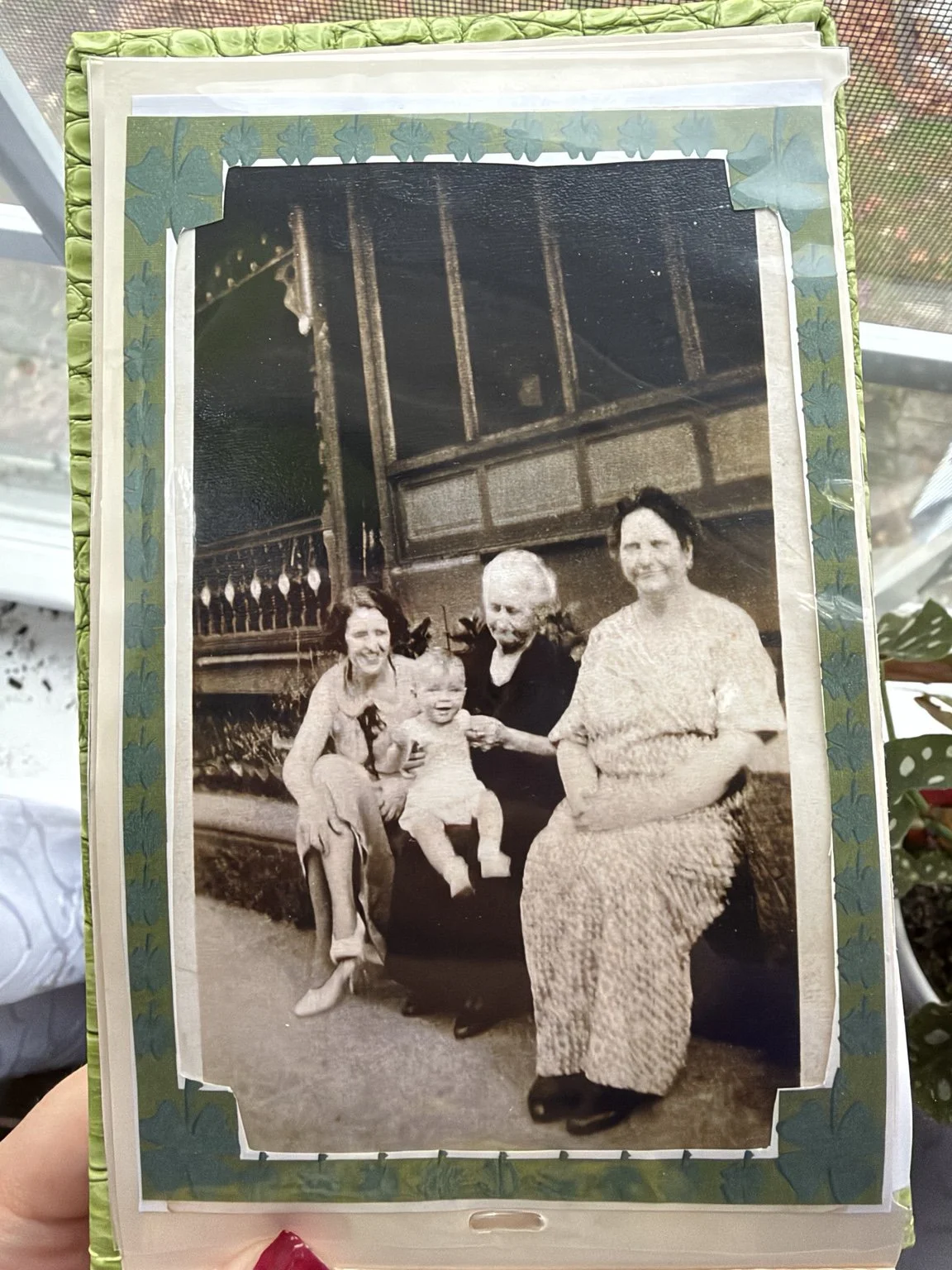
Honora Enright Sheehan holding her granddaughter, my Nan, in the summer of 1935. Also present are my Nan's mother, Margaret Anora, and Nora's friend, Maggie Connors. Photograph preserved in a private family collection.
Honora Enright was born in County Kerry, Ireland, on May 1, 1864.
According to the family history my Nan preserved alongside her photograph, Nora was the oldest of seven children: four girls and three boys.
Six of those seven children eventually emigrated to the United States. All six settled in Philadelphia. Their youngest sister, Ellen, remained in Ireland.
It is a remarkable family detail, particularly when considered in the context of nineteenth-century immigration.
Today, maintaining relationships across continents can be as simple as opening a phone. We can see the faces of relatives thousands of miles away, exchange photographs instantly, and travel internationally in a matter of hours.
For Nora's generation, leaving Ireland meant something very different.
The decision to cross the Atlantic carried uncertainties that are difficult to fully appreciate today. Communication depended on letters, journeys were considerably more difficult, and returning home was not necessarily practical.
I do not know exactly when Nora departed Ireland, what her journey was like, or whether she ever saw Ellen again.
I wonder what it was like for the youngest of seven siblings to remain in Ireland while all six of her brothers and sisters established lives in Philadelphia. I wonder how often they wrote to one another, whether photographs were exchanged, and how much Ellen knew about the American branches of her family.
Those unanswered questions are another reason preserving family history matters. Every generation possesses information that later generations may desperately wish they had asked about.
What we do know is that Nora established a life in Philadelphia.
She worked as a domestic employee in the Society Hill area and married Dennis Sheehan around 1889 or 1890 at Old St. Joseph's Church in Willings Alley.
Together, Dennis and Nora had six children: two daughters and four sons.
Over the following decades, their family expanded considerably. By the time the photograph accompanying this article was taken in 1935, Nora had 26 grandchildren, with three more still to come.
An Irish woman born in County Kerry during the nineteenth century had become the grandmother of a large Philadelphia family whose descendants would carry pieces of her story into the twenty-first century.
One of those grandchildren was my Nan.
And because of her, I have the privilege of knowing something about the woman whose lap she sat on all those years ago.
Philadelphia's Irish Immigrant History Is Also Our Family History
Philadelphia's history is often told through its most recognizable figures and institutions.
We learn about Benjamin Franklin, the Declaration of Independence, Independence Hall, revolutionary politics, industrial development, and the city's role in the creation of the United States.
But Philadelphia was also built through the ordinary decisions of generations of people.
People who left their homes. People who arrived looking for employment. People who established churches, raised children, opened businesses, maintained households, cared for neighbors, and created communities.
Irish immigrants were an important part of that history.
According to the Encyclopedia of Greater Philadelphia's history of Irish immigration, Irish immigrant communities developed throughout Philadelphia, particularly in neighborhoods connected to employment along the Delaware River and in other working-class areas of the city.
The nineteenth century brought substantial Irish immigration to the region. The Great Famine of the 1840s accelerated an already significant movement of people from Ireland to the United States.
The encyclopedia's examination of Philadelphia immigration between 1790 and 1860 describes how industrialization attracted newcomers while rising Catholic immigration also contributed to religious and political tensions within the city.
Nora belonged to a later generation of Irish immigrants. Although she was born after the Great Famine, she entered an American city whose Irish communities had already been shaped by decades of migration, religious organization, labor, and adaptation.
Philadelphia offered opportunities, but immigrant life was not without difficulty. Irish Catholic communities experienced discrimination and social tensions throughout the nineteenth century.
Their experiences cannot be reduced to a simple narrative of arriving in America and immediately achieving prosperity.
They built lives within the circumstances available to them.
Their children and grandchildren inherited the consequences of those efforts, often without knowing how much had happened before they arrived.
That is what makes individual family histories such an important complement to institutional history.
A textbook can explain Irish immigration to Philadelphia. A family photograph can show what one Irish immigrant's life eventually became.
For me, that history is not entirely abstract. It is connected to a photograph of my grandmother as a baby, being held by a woman who was born in Ireland in 1864.
The history of Philadelphia and the history of my family intersect in that one image.
The Irish Women Whose Work Helped Sustain Philadelphia
One particularly important detail in Nora's family history is that she worked as a domestic employee in Society Hill.
My Nan also noted that Nora's employers attended St. Mary's Church.
These details occupy only a small portion of the written account, but they connect Nora to a much larger, frequently overlooked history of immigrant women's labor.
Domestic employment was a common occupation for Irish immigrant women during the nineteenth century. Their work helped maintain American households and formed part of the economic lives of cities like Philadelphia.
Yet there is often a considerable imbalance in whose lives were extensively documented.
We may know the names of the people who owned historic homes, the architects who designed them, and the prominent families who occupied them.
We are less likely to know the individual stories of the women who worked inside those homes.
For generations, the people most visible in historical archives were often those with political authority, financial resources, institutional prominence, property, or public recognition.
Meanwhile, women who cooked, cleaned, cared for children, maintained homes, and performed other essential labor frequently left behind comparatively little personal documentation.
Their work was indispensable. Their individual experiences were not always considered important enough to preserve in equal detail.
Family storytelling can help correct that imbalance.
My Nan's account does not provide the names of Nora's employers, describe her daily responsibilities, or tell us how long she worked in Society Hill.
It does, however, preserve her occupation, the neighborhood where she worked, and even the church her employers attended.
Those details give future generations a starting point for understanding her place within Philadelphia's social and economic history.
More importantly, my Nan remembered Nora for far more than her labor.
She wrote about a woman who enjoyed shopping, wore earrings, loved animals, maintained friendships, practiced her faith, and was remembered affectionately by her family.
Nora existed outside the work she performed for other people.
Preserving those details restores something that formal employment records alone could never provide: a sense of her individuality.
A Marriage in Willings Alley and a Family Rooted in Philadelphia
According to my Nan's written account, Nora married Dennis Sheehan around 1889 or 1890 at Old St. Joseph's Church in Willings Alley.
The church itself is a significant piece of Philadelphia history.
Founded in 1733, Old St. Joseph's Church has witnessed nearly three centuries of religious and social change. Its present church building dates to 1839, and its history reflects the transformation of Catholic life in America as immigrant communities grew.
By the time Nora and Dennis married, the parish had already experienced generations of changes within Philadelphia's Catholic community.
There is something powerful about knowing the location where your ancestors married, especially when that location remains part of the contemporary city.
Philadelphia is filled with places that possess two histories simultaneously.
There is the public history of a church, street, neighborhood, cemetery, building, or institution.
Then there is the private history belonging to the families whose lives unfolded there.
Willings Alley is a historical Philadelphia location. For the descendants of Dennis and Nora Sheehan, it is also associated with the beginning of a marriage that would eventually produce generations of family members.
South Street is a recognizable Philadelphia destination. For our family, it also carries the memory of a woman who loved to shop there long before the neighborhood became what it is today.
Society Hill is known for its historic architecture and residential character. For our family, it is also where an Irish immigrant named Honora worked.
Holy Cross Cemetery is a burial ground. It is also where Nora was laid to rest.
Knowing these connections transforms the geography of a city.
The streets become more than streets. The buildings become more than architecture. They become places where the decisions, relationships, and experiences that preceded our own existence took place.
That is one of the beautiful things about having access to family history: it allows us to experience familiar places through unfamiliar generations.
The Photograph From the Summer of 1935: My Nan and Her Grandmother
The photograph at the center of this story was taken during the summer of 1935.
Nora was 71 years old.
Her husband, Dennis, had died in May of the previous year. According to my Nan's written account, Nora was dressed in black because she was still mourning him.
Sitting on her lap was my paternal grandmother, my Nan.
It is a remarkable thing to look at a photograph of someone you have always known as your grandmother and see her as a baby being held by her own grandmother.
We tend to know our grandparents within the context of our own lives. We know them through the roles they occupy in our families, through the memories we make with them, and through the relationships we develop over the years.
But they had entire lives before we existed.
They were once children themselves. They had parents and grandparents of their own. They belonged to a world that existed long before ours, surrounded by people whose names we may never have heard.
In her written account, my Nan explains that her mother, Margaret Anora, knew she was in safe hands because Nora already had 26 grandchildren at the time, with three more yet to come.
Nora's friend, Maggie Connors, was also present.
The photograph captures an ordinary family moment that became extraordinary simply because it survived.
Nobody in that photograph could have known precisely what the world would look like when subsequent generations saw it.
They could not have imagined the technology we would use to preserve it, the ways it could be shared, or that someone born generations later might write about it on the internet.
Without my Nan's written explanation, the image would remain visually meaningful. But so much of its significance would be missing.
I would not necessarily know why Nora was wearing black. I would not know how many grandchildren she had, the name of her friend, or the circumstances surrounding that particular summer.
My Nan preserved more than a photograph. She preserved its meaning.
A photograph captures what was visible in a particular moment.
A story preserves what that moment meant.
That distinction is central to the way we should think about family archives.
An unlabeled photograph can survive for a hundred years while losing nearly everything that made it personally significant. The people remain visible, but their names, relationships, personalities, and circumstances can become irretrievable.
My Nan took the additional step of making sure that did not happen here.
My Nan Introduced Me to Her Grandmother
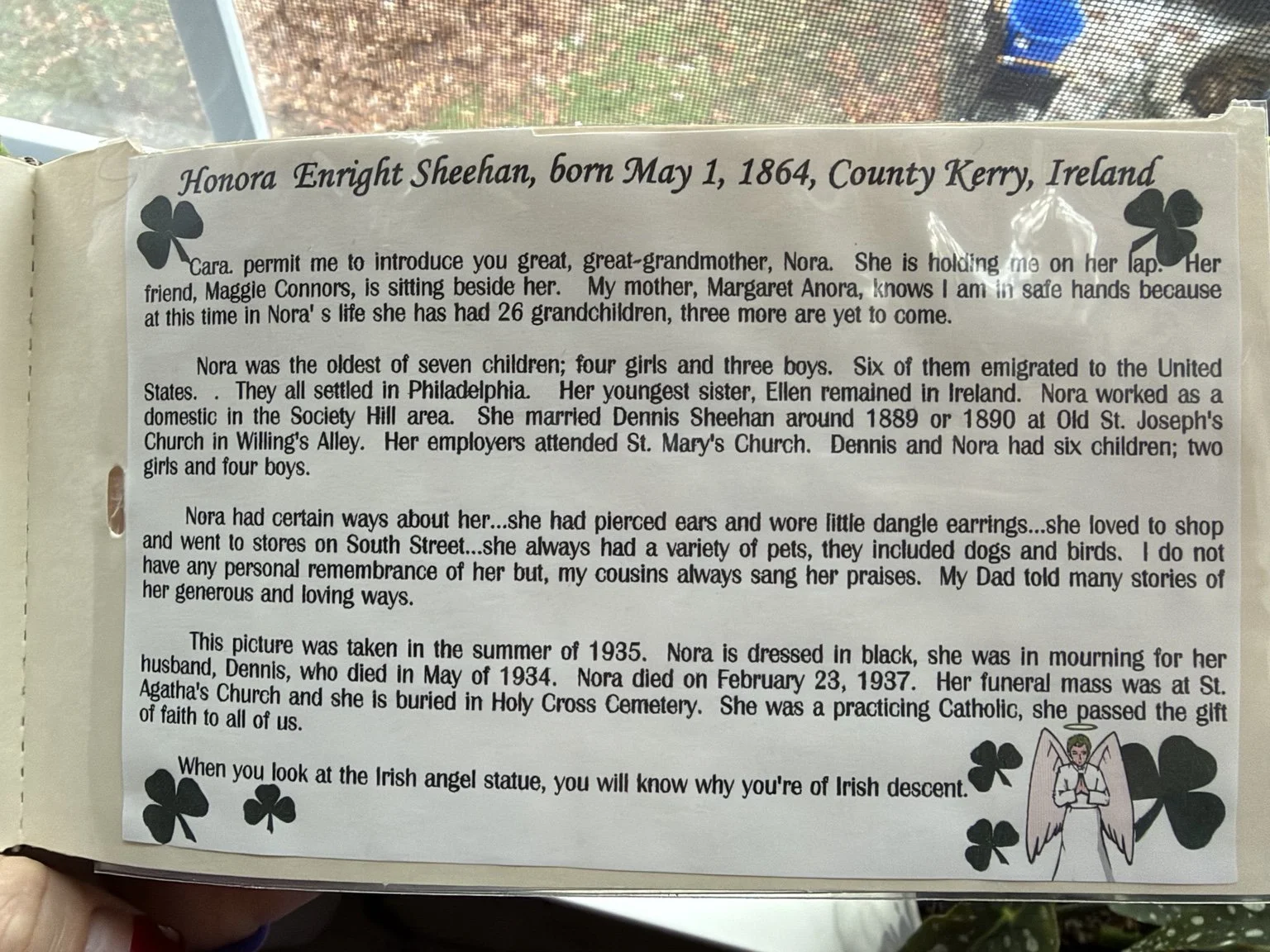
A personal introduction written by my paternal grandmother, Nan, documenting the life, personality, Irish heritage, and Philadelphia history of her grandmother, Honora Enright Sheehan.
The written introduction my Nan gave me begins:
“Cara, permit me to introduce you great, great-grandmother, Nora.”
There is something beautiful about the intention behind that sentence.
My Nan was not merely organizing family information. She was facilitating an introduction between two people separated by generations.
She understood that I could never meet Nora in person, but that I could still know something about her.
She understood that a family relationship does not necessarily end with the death of one person. Through storytelling, it can extend forward to descendants who have not yet been born.
And she understood that the details most worth preserving were not exclusively the ones that could be found in official documents.
She could have written Nora's date of birth, marriage, and death and stopped there.
Instead, she told me about her earrings.
She told me about her shopping habits.
She told me about her pets.
She told me how her grandchildren remembered her.
My Nan acknowledged having no personal recollection of Nora, despite being held by her in the photograph. Nora died in 1937, when my Nan was still very young.
But my Nan explained that her cousins always spoke highly of their grandmother and that her father told many stories of Nora's generous and loving ways.
Those stories were passed to my Nan, who then passed them to me.
The distinction is important because it shows how family memory actually works.
Not every story we inherit is something we personally witnessed. Sometimes we are entrusted with someone else's memories, and it becomes our responsibility to carry them forward.
My Nan did not need to remember sitting on Nora's lap to recognize the importance of that moment.
She understood its significance through the stories of the people who did remember Nora.
There is no elaborate research paper or professionally published biography accompanying this photograph. There is simply a grandmother who understood that her granddaughter might someday want to know these things.
And there is something especially meaningful about reading a family history that was written specifically for you.
It makes the experience feel less like historical research and more like a conversation across generations.
The Greatest Inheritance Is Not Always Financial
When people discuss what they hope to leave their children and grandchildren, the conversation often turns toward financial security.
A home. Savings. Investments. Jewelry. Property. Family heirlooms.
Those things can have enormous practical and emotional value.
But there is another category of inheritance that receives considerably less attention: the inheritance of identity.
Where did we come from?
Who were the people responsible for the circumstances into which we were born?
What did they believe in? What choices did they make? What difficult experiences did they survive? What opportunities did they create for those who followed them?
What parts of their personalities might still be recognizable in our families today?
These questions do not require us to believe that ancestry determines our destiny.
We are individuals with our own choices, experiences, and identities. Nevertheless, understanding the lives that preceded ours can provide valuable context for understanding our families and ourselves.
A grandmother's stories can reveal the origins of a family tradition.
A father's account of his childhood can help explain the values he later emphasized as a parent.
A grandfather's recollection of immigration can provide a deeper understanding of the opportunities his descendants experience.
A mother's account of her mistakes can offer guidance that feels more meaningful because it comes from someone whose life we know.
Financial inheritance may change what a person can afford.
An inheritance of stories may change what a person understands.
Unlike many traditional forms of inheritance, family storytelling does not require substantial financial resources. It requires time, attention, willingness, and the recognition that ordinary experiences are worth preserving.
My Nan gave me something that could not simply be purchased elsewhere.
The photograph itself is meaningful, but her decision to accompany it with a personal account is what makes the gift irreplaceable.
She gave me information that was available to her through her own family relationships and that might otherwise have become increasingly difficult to recover.
There is a kind of generosity in recognizing what you know today that someone else might need tomorrow.
Parents and grandparents have an extraordinary opportunity to practice that generosity.
The Psychology of Family Stories and Intergenerational Identity
The importance of family storytelling extends beyond sentimentality.
Psychological research has examined how personal and family narratives contribute to the development of identity, autobiographical memory, and an individual's understanding of their place within a larger social world.
Developmental psychologist Robyn Fivush has written extensively about the relationship between memory, storytelling, and identity.
In her 2011 review, The Development of Autobiographical Memory, published in the Annual Review of Psychology, Fivush examines how autobiographical memory develops throughout childhood and adolescence within social and cultural environments.
Her research discusses how conversations between parents and children about past experiences can influence the detail and organization of children's developing personal memories.
In another article, Remembering and Reminiscing: How Individual Lives Are Constructed in Family Narratives, Fivush explores how everyday storytelling within families contributes to the construction of personal identity.
This research helps illustrate why conversations about family experiences can be developmentally meaningful.
A child learns about the world through personal experiences, but also through the stories shared by others.
When parents and grandparents talk about their lives, they introduce children to experiences outside their immediate circumstances. They provide examples of how people understand change, relationships, challenges, decisions, and the passage of time.
A family story about immigration might introduce a child to uncertainty and adaptation.
A story about losing a job might help explain that careers do not always follow predictable paths.
A story about a relative who made mistakes and later changed might offer a more realistic understanding of human growth.
A story about a great-great-grandmother who emigrated from Ireland can connect contemporary family life to events that might otherwise exist only in history books.
Fivush's work on intergenerational narratives and family storytelling also describes associations between adolescents' knowledge of family stories and measures of identity development, emotional well-being, and meaning in life.
This does not mean that knowing one's ancestry guarantees psychological resilience or emotional well-being. Families are complicated, and research findings should not be interpreted as universal promises or proof of causation.
However, thoughtfully shared stories can create opportunities for connection, reflection, and a greater understanding of the experiences that shaped a family.
They can help children recognize that their own lives exist within a much longer history without suggesting that the past must dictate their future.
There is something grounding about knowing that the world did not begin with us.
Generations of people lived complicated lives before we arrived. They experienced uncertainty, confronted change, made difficult decisions, and navigated circumstances we may never fully understand.
Knowing something about those lives can broaden the way we think about our own.
Children Eventually Want Answers to Questions They Did Not Know to Ask
One of the difficulties of preserving family history is the timing.
When we are young, we often have access to relatives who possess extraordinary historical knowledge.
But we may not yet have the curiosity, perspective, or maturity to appreciate what they know.
We are busy being children. We are developing our independence, establishing careers, raising families, and managing the immediate demands of our lives.
Then, sometimes decades later, the questions begin to emerge.
What was my grandmother like before she became a grandmother?
Where did my great-grandparents meet?
Why did our family settle in Philadelphia?
What happened to the relatives who stayed behind in Ireland?
What did my grandfather do before the career I remember him having?
Who were the people standing in that old photograph?
Why did we celebrate holidays a certain way?
What did my mother dream of becoming when she was young?
Unfortunately, the people best positioned to answer those questions may no longer be here.
This is why parents and grandparents should consider documenting their stories even when their children do not appear particularly interested.
Interest in family history can develop later in life.
A child who does not want to hear about great-grandparents today may become an adult who spends years trying to reconstruct their lives.
A teenager who rolls their eyes at family stories may one day become a parent who wants to explain those same traditions to their own children.
The value of a family document cannot always be measured by the enthusiasm of its immediate audience.
Sometimes you are creating something for a future version of your child.
Sometimes you are creating something for someone who has not been born.
That is one of the reasons I appreciate what my Nan did.
She did not leave it entirely up to future generations to reconstruct Nora's story.
She took information that was available to her and preserved it in a form that could be revisited, appreciated, and shared long after she had first given it to me.
Why the Ordinary Details of a Person's Life Matter So Much
Most people do not consider their own lives historically significant.
They may assume that unless they accomplished something extraordinary, held an important position, experienced a famous event, or achieved public recognition, there is little reason to document their experiences.
But ordinary life becomes extraordinary when viewed across generations.
Consider Nora's shopping trips to South Street.
At the time, they may have been entirely unremarkable. They were simply something she enjoyed.
Today, that detail connects a living descendant to a particular aspect of a woman's personality in an earlier era of Philadelphia history.
The fact that she wore dangling earrings gives us another small window into her preferences.
Her dogs and birds tell us something about the life she created around herself.
I particularly like that my Nan chose to include those details.
They were not necessary to establish Nora's ancestry or her place in our family tree. They did not explain a major historical event.
They simply made her more human.
They remind us that people in old photographs were not fundamentally different from us.
They had favorite places to shop. They had preferences about their appearance. They enjoyed animals. They had friendships, routines, frustrations, and habits.
They were not historical figures to themselves.
They were people living in the present.
One of the greatest mistakes we can make when documenting family history is assuming that descendants will only care about significant milestones.
A hundred years from now, someone may be deeply interested in the little details we overlook today.
What music did you listen to while driving?
What did your kitchen look like?
Where did your family go for dinner?
What did you do on Saturday mornings?
What expressions did your parents always use?
What did your neighborhood smell like in the summer?
What did you think your future would look like?
These are the details that make a life tangible.
Write them down.
Women, Family Memory, and the History That Rarely Makes It Into Textbooks
Family stories are especially important when considering the generations of women whose contributions were not always extensively documented in public records.
For much of history, women's experiences were often recorded through their relationships to other people.
Daughter of. Wife of. Mother of. Widow of.
Those relationships were important, but they represented only part of a person's identity.
A marriage certificate can establish when a woman married.
A birth certificate can establish when she had a child.
A death certificate can establish when her life ended.
None of those documents necessarily tells us whether she was funny, outspoken, ambitious, reserved, creative, stubborn, generous, or adventurous.
They do not tell us how she understood herself.
That is why preserving family memories about women like Nora matters.
Her marriage to Dennis and her six children are essential parts of her biography. So are her employment, friendships, personal style, shopping habits, affection for animals, and religious beliefs.
The woman who worked in Society Hill was also the woman who enjoyed South Street.
The grandmother holding a baby in 1935 was also someone who had once been a young woman in Ireland.
The elderly widow dressed in black had lived decades of experiences before that photograph was taken.
Every person who appears in an old family album was once living through a present moment as complicated and immediate as our own.
Remembering them as complete human beings is one way of honoring that reality.
There is also something worth recognizing about the role my Nan played in preserving this history.
Across generations, the work of remembering often takes place quietly within families.
Someone keeps the photographs. Someone remembers the birthdays. Someone knows how everyone is related. Someone preserves the letters, passes down the recipes, and explains the significance of family heirlooms.
That work may not receive much recognition, but its long-term value can be immeasurable.
Without the people who choose to preserve those memories, future generations may never have the opportunity to discover them.
My Nan was one of those people.
And this article exists, in part, because she was.
Family History Does Not Have to Be Perfect to Be Worth Preserving
There can be a tendency to romanticize the past when discussing ancestry.
We emphasize sacrifice, loyalty, perseverance, hard work, family devotion, and the other qualities we hope to associate with the people who came before us.
But authentic family history is not necessarily a collection of inspirational stories.
Families also experience conflict, estrangement, grief, financial hardship, addiction, discrimination, illness, mistakes, and complicated relationships.
Some stories are difficult to tell. Some are not ours to share publicly. Some may involve people who remember the same events differently.
Preserving family history does not require exposing private information or forcing relatives to discuss painful experiences.
It does, however, benefit from honesty.
We do not need to invent heroic motives for our ancestors when we do not know why they made particular choices.
We do not need to fill missing information with assumptions.
We do not need to pretend that every family relationship was loving or that every hardship resulted in a positive outcome.
My Nan's written introduction acknowledges the limits of her own knowledge. She did not personally remember Nora, but she preserved what had been communicated through other family members.
That distinction matters.
She did not manufacture memories simply because she appeared in the photograph.
She told me what she knew and explained how she knew it.
A responsible family historian can write that something is remembered, believed, documented, or uncertain.
Those qualifications do not make the story less meaningful. They make it more trustworthy.
We can honor the people who came before us without transforming them into fictional characters.
The Digital Age Has Created a New Problem for Family History
It might seem strange to worry about preserving photographs in an era when people take more pictures than ever before.
Our phones contain thousands of images. We have videos, text messages, social media posts, emails, cloud storage accounts, and digital archives.
We produce documentation of our lives on a scale that previous generations could scarcely have imagined.
Yet abundance does not automatically translate into preservation.
A photograph buried among thousands of smartphone images may be difficult for a future family member to locate.
A social media account may become inaccessible.
A cloud storage subscription may lapse.
An old phone may stop working.
A video may be stored in a format that becomes difficult to access.
More importantly, a photograph can survive digitally while losing its context entirely.
Who is in the picture? Where was it taken? Why were those people together? What was happening in their lives at the time?
Digital documentation is often immediate, but intentional historical preservation requires a different mindset.
There is a difference between posting something for people to see today and preserving something for people to discover fifty years from now.
The former prioritizes immediacy. The latter prioritizes durability, accessibility, and context.
At Ritner Digital, we spend considerable time thinking about communication, storytelling, and the ways information reaches people.
Family history provides a particularly human example of why those principles matter.
My Nan accomplished something with a photograph and a written introduction that many families risk failing to accomplish despite having access to sophisticated technology.
She preserved the context.
Technology can help us preserve our stories, but technology cannot decide which memories are meaningful.
It cannot recover a conversation that never happened.
It cannot reliably identify an ancestor whose name was never recorded.
It cannot recreate the authenticity of someone's firsthand account.
The most important preservation decision still begins with a human being recognizing that something deserves to be remembered.
How Parents and Grandparents Can Preserve Family Stories for Future Generations
Creating a family archive does not have to be an overwhelming undertaking.
You do not need professional genealogy training, sophisticated equipment, or a complete understanding of your ancestry.
You can begin with a single photograph and a few paragraphs, just as my Nan did.
Here are some practical ways to start.
1. Write Personal Introductions to Family Members Who Have Passed Away
Rather than simply recording a relative's name, write a short introduction addressed to someone in the next generation.
Imagine introducing a grandchild to your own grandmother.
Explain who she was, how you remember her, what she enjoyed, and what you think a future descendant would find interesting.
Use the details that make her recognizable.
You can follow the same approach with parents, grandparents, siblings, aunts, uncles, family friends, and other people whose lives shaped yours.
Begin with a sentence similar to the one my Nan used:
Allow me to introduce you to someone I wish you could have known.
That simple opening can change the way you approach the entire project.
Instead of writing a list of historical facts, you are introducing a real person to someone who matters to you.
One page per person can eventually become an extraordinary family collection.
2. Label Your Photographs
Whenever possible, record the full names of the people in a photograph, the approximate date, the location, and their relationships to one another.
Include the occasion and any circumstances that explain why the photograph was taken.
If you are uncertain about someone's identity or a date, indicate that uncertainty rather than presenting a guess as established fact.
Create separate written captions or digital descriptions when marking an original photograph might damage it.
A photograph becomes significantly more useful to future generations when the people looking at it know what they are seeing.
Think about all the information my Nan provided about one photograph.
She explained relationships, identified a family friend, shared the date, and even explained why her grandmother was dressed in black.
Those details transformed a photograph into a historical document.
3. Record Conversations With Older Relatives
With their permission, record conversations with parents, grandparents, and other older family members.
These recordings can preserve something that written histories cannot fully capture: the sound of a person's voice.
A laugh, an accent, a familiar expression, or the way someone tells a particular story can become an irreplaceable part of a family archive.
The conversation does not need to be formal.
Ask about childhood, school, first jobs, neighborhoods, friendships, family traditions, and experiences of major historical events.
Sometimes the most interesting memories emerge when the conversation moves away from prepared questions.
And remember that recording a person's stories does not necessarily mean sharing them publicly. A private family collection can be just as meaningful.
4. Preserve Family Recipes and the Stories Behind Them
Recipes are another form of historical documentation.
A recipe can reflect immigration, economic circumstances, religious traditions, regional influences, or the preferences of a particular family member.
Write down not only the ingredients and instructions but also the person associated with the dish.
When did your family typically prepare it? Was it reserved for holidays? Did someone adapt it after moving to America? Was there an ingredient that a particular relative insisted upon using?
The story surrounding a recipe can be just as meaningful as the recipe itself.
5. Write Letters to Future Generations
Imagine a great-grandchild opening a letter you wrote decades before they were born.
What would you want that person to know?
You might describe your family, your work, your experiences, your hopes, or the era in which you lived.
You might write about lessons you learned through experience or explain why certain values became important to you.
You could even include descriptions of everyday life that seem entirely ordinary today but may be fascinating in the future.
The letter does not need to contain profound wisdom.
Your willingness to speak directly to someone in the future is already meaningful.
6. Digitize Important Physical Documents
Photographs, letters, certificates, scrapbooks, newspaper clippings, and other family materials can deteriorate over time.
The National Archives' guide to preserving family archives offers practical information on handling, storing, displaying, and digitizing personal historical materials.
Create digital copies of important documents when possible while also protecting the originals.
Keep copies in more than one location, and make sure trusted family members know where they are stored.
Avoid relying exclusively on a single device, social media platform, or online account.
Digital preservation works best when it includes both redundancy and a plan for future access.
7. Connect Personal Stories to Historical Places
Document the churches, schools, homes, businesses, streets, and cemeteries associated with your relatives.
These places can help descendants understand the communities in which their ancestors lived.
For families with Philadelphia roots, a neighborhood history can be an excellent companion to genealogy research.
The Encyclopedia of Greater Philadelphia provides an extensive collection of essays covering the region's neighborhoods, institutions, immigrant communities, and historical development.
Personal family documents provide individual experiences. Historical resources help explain the larger circumstances surrounding them.
Together, they can create a much richer understanding of the past.
8. Explain the Significance of Family Heirlooms
A piece of jewelry, a religious statue, a photograph, a piece of furniture, or an old book may carry enormous sentimental value to one generation.
But without an explanation, subsequent generations may not understand why it mattered.
My Nan's written account ends with a reference to an Irish angel statue and its connection to my ancestry.
By accompanying that object with Nora's story, she gave it a significance that extended beyond its appearance.
Consider doing the same with your own family possessions.
Who originally owned an object? How did it come into the family? Why was it kept? What memories are associated with it?
An heirloom accompanied by its story becomes something far more meaningful than an old possession.
30 Questions to Ask Your Parents and Grandparents Before Their Stories Are Lost
Sometimes the most difficult part of preserving family history is knowing where to begin.
These questions can help start meaningful conversations across generations:
What is your earliest childhood memory?
What were your parents like as people?
What do you remember about your grandparents?
Where did your family originally come from?
Why did our family settle where it did?
What was the neighborhood you grew up in like?
What was your childhood home like?
Who were your closest friends growing up?
What did you enjoy doing as a child?
What was your first job?
What did you want to become when you were younger?
How did you meet your spouse or partner?
What family traditions do you remember most fondly?
What foods did your family regularly prepare?
What music did you listen to?
What historical events do you remember living through?
What was the most significant change you witnessed during your lifetime?
Who had the greatest influence on you growing up?
What did your parents teach you about life?
What experiences changed the way you saw the world?
What challenges are you comfortable sharing?
What accomplishments are you most proud of?
What family stories did older relatives tell you?
Are there family members you wish you had known better?
What do you remember about relatives who immigrated to America?
What role did faith, culture, or community play in your upbringing?
What are some things people might be surprised to learn about you?
What do you wish you had asked your own parents or grandparents?
What would you like future generations to understand about your life?
How would you introduce yourself to a great-grandchild you may never meet?
That final question is particularly meaningful.
It gives someone the opportunity to define their own legacy rather than leaving future generations to construct an understanding of them from incomplete information.
And perhaps an equally important question is this: Who would you like to introduce your grandchildren to?
There may be someone from your childhood whose name your grandchildren have never heard, but whose influence on your life indirectly shaped theirs.
Tell them about that person.
Philadelphia Is an Archive of Families
Walk through Philadelphia, and you are surrounded by evidence of generations of people who lived, worked, loved, struggled, and built their lives there.
Some of their stories appear on historical markers.
Some are preserved in libraries, churches, museums, and institutional archives.
Others exist only in family photo albums, old letters, recipe books, cemetery records, and the memories of elderly relatives.
Those private collections possess historical value.
They help preserve the experiences that larger historical narratives cannot capture in their entirety.
The history of Irish Philadelphia is not merely a history of immigration statistics, religious institutions, or economic development.
It is also the history of individual women like Honora Enright Sheehan.
A woman who was born in County Kerry in 1864.
A woman who worked in Society Hill.
A woman who married in Willings Alley.
A woman who loved shopping on South Street.
A woman who had pets, friends, children, and grandchildren.
A woman who mourned her husband and was remembered by her family for her generosity.
Nora died on February 23, 1937. According to my Nan's account, her funeral Mass took place at St. Agatha's Church, and she was buried in Holy Cross Cemetery.
My Nan also wrote about Nora's Catholic faith and how she considered it something that had been passed down through the family.
Her life ended decades before mine began.
But the opportunity to learn about her did not end with her death.
Her photograph survived.
The stories her family told about her survived.
And the little girl she held in the summer of 1935 grew up to become a grandmother who wanted her own granddaughter to know who Nora was.
That little girl could not have understood the historical significance of the moment captured in the photograph.
But decades later, she understood the significance of preserving it.
Storytelling Is an Act of Preservation
At Ritner Digital, we often consider storytelling in the context of organizations, communities, businesses, and brands.
What makes a story memorable? How do we communicate something meaningful? How do we preserve information in ways that make it accessible and valuable to others?
But the principles of meaningful storytelling extend into our personal lives.
Stories help us recognize what matters.
They carry knowledge between people who may never otherwise encounter one another.
They preserve experiences that would disappear if nobody documented them.
And they provide continuity across years, decades, and generations.
There is a tendency in digital marketing to discuss the value of a story through measurable outcomes.
How many people read it? How many people shared it? How much attention did it generate?
Those are important considerations in a business context.
But not all meaningful communication needs a large audience.
The most meaningful story you ever write may not be published on a website, promoted through a marketing campaign, or read by thousands of people.
It might be a single page addressed to your grandchild.
It might be a letter explaining who your mother was.
It might be a collection of photographs with handwritten descriptions.
It might be an account of your childhood that nobody asks to read until long after you have written it.
Its value is not determined by its audience size.
My Nan's introduction to Nora was written for me.
It was not intended to attract public attention or become a published article about the importance of preserving family history.
Yet years later, its message has the potential to encourage other families to preserve their own stories.
That is part of what makes storytelling so powerful. We cannot always anticipate how far a story will travel or how meaningful it will eventually become.
Some stories only need to reach one person to accomplish something extraordinary.
Give the Next Generation an Introduction
The written account accompanying Nora's photograph ends by referencing an Irish angel statue and its significance to our family's heritage.
My Nan wanted me to understand why I was of Irish descent.
But what she provided was more meaningful than an explanation of ancestry.
She gave me a person to associate with that heritage.
Irish immigration was no longer exclusively something I could read about in a history book.
It was connected to a woman who wore dangling earrings, loved shopping, kept dogs and birds, and lived on the other side of generations of Philadelphia family history.
There is no way to fully recover everything about Nora's life.
There will always be questions I cannot answer, conversations I cannot have, and experiences I can only wonder about.
But I know more about her than I would have otherwise because my Nan made the effort to preserve what she knew.
And when I look at that photograph, I am reminded that before my Nan was my grandmother, she was somebody else's granddaughter.
She was once the baby being held, cared for, and protected by someone from an older generation.
Years later, she would become a grandmother herself and find her own ways to give something meaningful to the generations that followed her.
This introduction to Nora was one of those gifts.
And it is a gift that anyone can give.
If you are a parent, write down the stories your children might want to know when they are older.
If you are a grandparent, introduce your grandchildren to the people who shaped your life.
If you have photographs stored in boxes, take the time to explain who is in them.
If you have a parent or grandparent who is willing to share their experiences, ask questions while you have the opportunity.
Do not wait until you believe your story is important enough to tell.
To someone in the future, your ordinary Tuesday might be a fascinating piece of history.
Your favorite restaurant might be a connection to a neighborhood that no longer exists.
Your handwriting might become something a descendant treasures.
Your voice might become one of the most valuable recordings your family possesses.
And a few paragraphs about someone you loved might become the only introduction a great-great-grandchild ever receives.
We cannot control how long our possessions survive or how many generations will remember our names.
But we can decide whether to leave the next generation something meaningful to discover.
In the summer of 1935, an Irish immigrant named Honora Enright Sheehan held her granddaughter on her lap in Philadelphia.
She could not have known that generations later, the photograph capturing that moment would become part of a story about the importance of remembering.
And my Nan, the little girl in that photograph, may not have anticipated just how meaningful her gift would become.
But nearly a century after that photograph was taken, Nora's story is still being told.
Because my Nan understood that her grandmother was worth remembering.
And because she took the time to introduce me to her.
Frequently Asked Questions
Why is it important to preserve family history?
Preserving family history allows future generations to understand the experiences, relationships, traditions, and circumstances that shaped their families. It also contributes to the preservation of local and cultural history by documenting individual lives that may not appear extensively in institutional records.
Family stories can provide meaningful context for understanding one's heritage, identity, and connections to previous generations.
Who was Honora Enright Sheehan?
According to a privately preserved family history, Honora Enright Sheehan, known as Nora, was born on May 1, 1864, in County Kerry, Ireland. She immigrated to the United States, settled in Philadelphia, worked as a domestic employee in Society Hill, and married Dennis Sheehan around 1889 or 1890.
She had six children and eventually 29 grandchildren. She died on February 23, 1937, and was buried in Holy Cross Cemetery.
Her story was preserved by one of her granddaughters, my paternal grandmother, Nan, who appears as the baby in the family's 1935 photograph.
Why did so many Irish immigrants settle in Philadelphia?
Philadelphia offered employment opportunities, established immigrant communities, religious institutions, and family networks that attracted Irish immigrants during the nineteenth century.
The Great Famine accelerated Irish migration during the mid-nineteenth century, while subsequent generations continued emigrating for a variety of economic, personal, and family-related reasons.
What jobs did Irish immigrant women hold in nineteenth-century Philadelphia?
Many Irish immigrant women worked in domestic service, including household employment involving cooking, cleaning, childcare, and other responsibilities.
Irish immigrant women also worked in other occupations, and their experiences varied depending on their circumstances, education, family responsibilities, and employment opportunities.
What are the psychological benefits of knowing your family history?
Research into autobiographical memory and family narratives suggests that sharing stories can contribute to identity development and help individuals understand their experiences within a broader social and family context.
Family storytelling may also encourage meaningful intergenerational conversations. However, its effects vary between individuals, and familiarity with family history does not guarantee particular mental health outcomes.
What is the best way to preserve family stories?
An effective approach combines written accounts, labeled photographs, recorded interviews, digital copies of important documents, and appropriate storage of original materials.
The most important consideration is preserving context. Future generations should be able to understand who appears in photographs, what happened, and why particular memories mattered.
What should grandparents write down for their grandchildren?
Grandparents can document childhood memories, family traditions, personal experiences, stories about older relatives, employment history, friendships, favorite activities, and lessons learned throughout life.
They can also write personal introductions to deceased family members whom their grandchildren never had the opportunity to meet.
Ordinary details are often particularly valuable because they may not exist anywhere else.
How can grandparents pass down family history to young children?
Grandparents can share family stories through photographs, illustrated albums, letters, recorded conversations, recipes, and visits to historically meaningful family locations.
They can also create keepsakes for children to revisit as adults. A child's limited interest in genealogy today does not mean they will not value those materials later in life.
How can I research my Irish ancestors in Philadelphia?
Begin by collecting existing family documents, photographs, names, birth dates, marriage information, immigration details, and burial records.
Census records, church registers, historical newspapers, cemetery records, and immigration documents may provide additional information.
Resources such as the National Archives, the Encyclopedia of Greater Philadelphia, and relevant religious and historical archives can help guide further research.
How should old family photographs be stored?
Old photographs should generally be protected from excessive light, humidity, heat, and unsuitable storage materials.
Digitizing photographs creates additional copies, but physical originals should also be preserved appropriately.
The National Archives' family preservation resources provide guidance for caring for historical photographs and documents.
Is oral family history a reliable historical source?
Oral family history is valuable because it preserves personal experiences and details that may not appear in official documents.
However, memories can change over time, and stories passed between generations may contain inaccuracies.
The best approach is to preserve oral accounts while clearly identifying uncertainties and comparing them with documentary evidence when available.
What is the difference between genealogy and family storytelling?
Genealogy primarily focuses on establishing family relationships, documenting ancestry, and researching historical records.
Family storytelling complements genealogy by preserving the personalities, experiences, memories, relationships, and cultural circumstances of individual family members.
Genealogy can tell you how you are related to someone. Family storytelling can help you understand who that person was.
Is it too late to start documenting my family history?
No. Even if relatives have passed away or documents have been lost, surviving photographs, personal recollections, historical records, and conversations with other family members can provide a starting point.
You can also begin documenting your own life today, ensuring that future generations have access to information that might otherwise disappear.
Every Story Deserves the Chance to Be Remembered
At Ritner Digital, we believe storytelling is about more than generating attention. It is about communicating meaning, preserving identity, and creating connections that endure.
Whether you are sharing the history of a family, documenting the legacy of a longstanding Philadelphia business, communicating the mission of an organization, or building a digital presence that reflects who you are, the way your story is told matters.
Behind every family, business, organization, and community are real people whose experiences deserve to be understood.
Technology changes. Platforms evolve. Generations come and go.
Meaningful stories have the potential to outlast them all.
Have a story, organization, business, or legacy that deserves to be shared? Let Ritner Digital help you communicate it with authenticity, intention, and purpose.
Sources and References
Primary Family Source
Private family collection. Photograph of Honora Enright Sheehan, her granddaughter, Margaret Anora, and Maggie Connors, dated summer 1935.
Personal family history written by my paternal grandmother, Nan, introducing me to her grandmother, Honora Enright Sheehan. Undated. Personal biographical information about Honora and the circumstances surrounding the photograph are drawn from this document.
Philadelphia and Irish Immigration History
Encyclopedia of Greater Philadelphia. Irish (The) and Ireland.
Bergquist, James. Encyclopedia of Greater Philadelphia. Immigration (1790–1860).
Old Saint Joseph Parish. Church History: 1733–Today.
Encyclopedia of Greater Philadelphia. Regional historical and cultural reference resource.
Psychology, Memory, and Family Narratives
Fivush, Robyn. (2011). The Development of Autobiographical Memory. Annual Review of Psychology, 62, 559–582. https://doi.org/10.1146/annurev.psych.121208.131702.
Fivush, Robyn. (2008). Remembering and Reminiscing: How Individual Lives Are Constructed in Family Narratives. Memory Studies, 1(1), 49–58. https://doi.org/10.1177/1750698007083888.
Fivush, Robyn. Family Storytelling: Maternal Reminiscing and Intergenerational Narratives.
Historical and Family Archive Preservation
United States National Archives and Records Administration. How to Preserve Family Archives.
Are You a Descendant of Honora Enright Sheehan or Maggie Connors? I’d Love to Hear From You.
If you are a descendant of Honora Enright Sheehan or her friend Maggie Connors, a relative of the Enright, Sheehan, or Connors families, or someone whose family history intersects with theirs in Philadelphia or Ireland, I would genuinely love to connect with you.
With Honora's six children, 29 grandchildren, and six of the seven Enright siblings having settled in Philadelphia, there are undoubtedly branches of our family tree with stories, photographs, and memories I have yet to discover.
I would also love to learn more about Maggie Connors, the friend who appears alongside my family in the 1935 photograph. Somewhere, another family may have preserved stories about Maggie, photographs of her, or memories of her friendship with Nora. How wonderful would it be to reconnect two families nearly a century after their loved ones sat together for a photograph?
Perhaps you have a family photograph I have never seen, a story passed down through your grandparents, or another piece of our shared Philadelphia history that has been preserved in your family.
I would love to hear your story, exchange family memories, and potentially welcome you as a guest on the Ritner Digital podcast to explore our family connections, Philadelphia’s Irish heritage, and the experiences that have shaped our respective generations.
My Nan gave me an incredible starting point, but I imagine there is so much more of this story waiting to be told.
After all, family history is rarely held by one person. It exists in pieces, scattered across generations, households, friendships, and branches of family trees that may have lost touch with one another over time.
Perhaps this article can help bring some of those pieces back together.
Get in touch with me through Ritner Digital. I would love to hear from you.