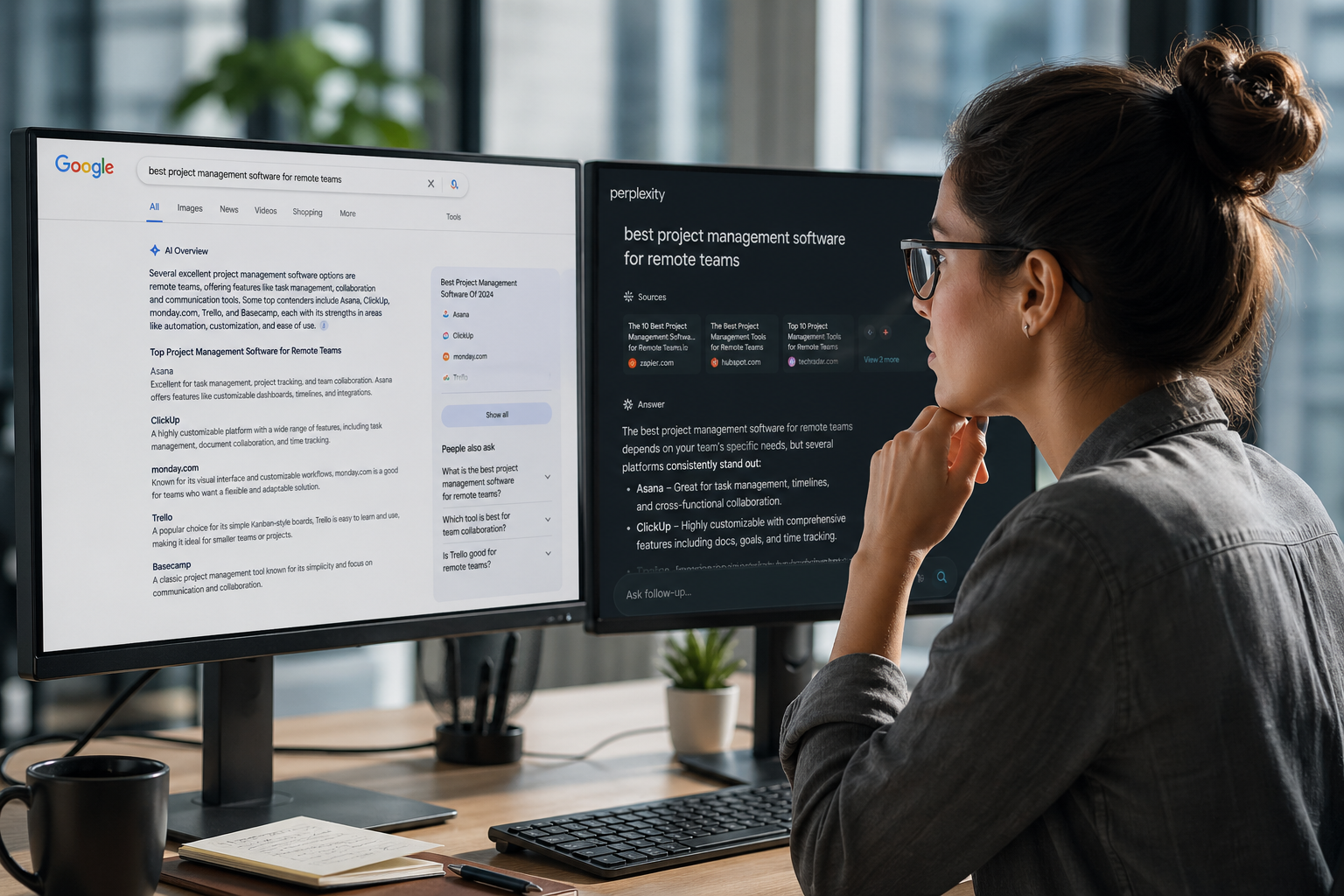
The Era of One-Size-Fits-All SEO Is Over
For two decades, digital marketers operated on a simple premise: rank on Google, win the internet. There was one dominant search engine, one algorithm to understand, and one playbook to follow. Your job was to optimize for Google. Everything else was a rounding error.
That era is over.
In 2026, your potential customers are finding information — and finding you — through fundamentally different channels with fundamentally different mechanics. Google's AI Overviews now appear on roughly one in five US search queries. Meanwhile, Perplexity AI processed 780 million search queries in May 2025 alone, up from 230 million in mid-2024 — a 239% increase in query volume in under a year. Averi These are not the same audience using the same tool differently. They are different audiences using different tools that reward different content for different reasons.
The businesses that understand this distinction — and build content strategies that speak to both — are the ones pulling away from competitors who are still running a 2019 playbook in a 2026 landscape.
This is the guide to understanding what's different, why it matters, and exactly what to do about it.
Part I: Two Engines, Two Completely Different Architectures
Before you can optimize for both platforms, you need to understand that they are not competing versions of the same thing. They are architecturally distinct systems with different goals, different mechanics, and different relationships with the content you create.
How Google AI Overviews Work
Google's AI Overviews sit at the top of traditional search results, generating a synthesized answer before users ever see a blue link. They are built on top of Google's existing search infrastructure — the same crawl, the same index, the same authority signals that have governed SEO for years.
Google's AI Overviews draw primarily from existing organic results — 97% of cited sources come from the top 20 organic results. AI Labs Audit This is the critical architectural fact about Google AIO: it is, at its core, a presentation layer built on top of traditional search. If you are already ranking organically, you have a foundation for AI Overview visibility. Classic SEO strategy — E-E-A-T signals, strong backlink profiles, structured data, technical health — remains decisive.
But here's what's changed: Google AI Overviews are decoupling from traditional rankings. In July 2025, 76% of cited URLs ranked in the organic top 10. By February 2026, only 38% came from the top 10, with 31.2% from positions 11–100 and 31% from beyond the top 100. Starmorph The relationship between traditional ranking and AI Overview inclusion is loosening. Authority signals, structured data, and content completeness are increasingly determining who gets cited — independent of where a page ranks organically.
How Perplexity Works
Perplexity operates on an entirely different model. Perplexity uses Retrieval-Augmented Generation (RAG), a technique where the large language model searches external knowledge databases in real-time before generating answers. When you submit a query, Perplexity's retrieval module searches predefined knowledge bases for relevant information, chunks documents into self-contained units ideal for LLM processing, and synthesizes an answer with inline citations linked to source documents. Discovered Labs
The defining principle of Perplexity's architecture is that it does not answer from memory. Every query triggers a real-time web search. This has profound implications for optimization: there is no stored ranking. There is no position to defend. There is only the question of whether your content is crawlable, structured clearly enough to extract passages from, and credible enough to cite.
The fundamental difference comes down to a simple question: do you want a direct answer, or do you want a list of places to find an answer? Perplexity is a conversational AI answer engine at its core, designed to synthesize information and give you a straight response with its sources cited. Google, on the other hand, is a massive link ecosystem that has started layering AI on top of its traditional results. LLMrefs
Why This Means Your Strategy Must Bifurcate
Optimizing for "AI search" as a monolithic category is like optimizing for "social media" without distinguishing between LinkedIn and TikTok. Averi The citation mechanics are different. The source preferences are different. The content formats that win are different.
Only 11% of domains are cited by both ChatGPT and Perplexity. ChatGPT favors Wikipedia and encyclopedic content (47.9% of top citations), Perplexity heavily cites Reddit (46.7%), and Google AI Overviews prefer YouTube and multi-modal content (23.3%). Averi The divergence is not marginal — it is structural. A content strategy optimized for one platform will systematically underperform on the others.
Part II: The Google AIO Playbook
Understanding how to appear in Google's AI Overviews requires understanding what signals Google is using to select sources for those summaries.
Structured Data Is No Longer Optional
Structured data in JSON-LD format is the most impactful technical change you can make. Google explicitly recommends JSON-LD, and every AI engine tested prefers it because it is cleanly separated from HTML and easier to parse programmatically. FAQPage schema makes content 3.2x more likely to appear in AI Overviews. Fully-populated Product and Review schema achieves a 61.7% citation rate versus 41.6% for generic schema. Structured data markup provides a 73% higher selection rate for Google AI Overviews. Only 12.4% of websites currently implement structured data. Starmorph
That last number deserves emphasis. Fewer than one in eight websites use structured data effectively — which means implementing it well is still a significant competitive advantage, even in 2026.
Entity Authority Over Keyword Density
Google's Knowledge Graph underpins its AI Overview generation. Content that establishes clear entity relationships — connecting your brand, your expertise, and your topic area into a coherent, machine-readable picture — is more likely to be surfaced. This means your content strategy needs to think not just about what you're writing, but about how consistently and coherently you're building your topical footprint across your site and across the web.
Video Is a Citation Source
YouTube accounts for 18.2% of all citations sourced from outside the top 100 organic results Starmorph in Google AI Overviews. If you are not producing companion video content for your key topics, you are leaving a meaningful slice of AI Overview visibility on the table. Transcripts, structured descriptions, and clear topic-to-video alignment matter here.
The Click-Through Reality
Here is the uncomfortable truth about Google AIO that every business needs to reckon with: AI Overviews now reduce clicks by 58% for the top-ranking search result, and organic CTR dropped from 1.41% to 0.64% for queries with AI Overviews. Averi Zero-click searches are accelerating.
However, brands cited in AI Overviews see 35% higher organic CTR than non-cited brands — making citation the new competitive advantage. Averi The goal has shifted: you are no longer just trying to rank. You are trying to be cited in the summary that appears before anyone sees your rank.
Part III: The Perplexity Playbook
Perplexity requires a meaningfully different approach. Where Google AIO rewards the established authority signals of traditional SEO, Perplexity rewards a specific kind of content architecture that most websites have not yet built for.
Answer First, Always
Perplexity's extraction system pulls passages — not pages. It is looking for the clearest, most direct answer to the query it is processing. Lead with the answer: your first paragraph should answer the query. Use definitive statements — "The best X is Y," not "Y might be good." Include specific data: numbers, percentages, dates. Structure for scanning: headers, bullets, numbered lists. OSP
The old content writing convention — build up context, then deliver the point — works against you on Perplexity. Bottom Line Up Front (BLUF) writing is not just stylistically preferable; it is structurally necessary for passage extraction.
Specificity Over Generality
The selection criteria favor content that is factually specific rather than generically informative. A page that says "email marketing delivers strong ROI" will not get cited. A page that says "email marketing delivers an average ROI of $36 for every $1 spent, according to Litmus 2024 data" will. Perplexity's system gravitates toward content with concrete numbers, named sources, and clear expertise signals because its product promise to users is accuracy. UpGrowth
This changes how you approach every claim in your content. Vague assertions are not just weak writing — they are actively disqualifying for Perplexity citation.
Freshness Is a Primary Signal
Freshness is a strong signal for Perplexity. A site that publishes regularly will tend to be cited more than a static site, even if domain authority is comparable. Update your strategic content at least quarterly. Visibly date your articles and update the date during revisions. Publish on trending topics in your industry quickly after they emerge. AI Labs Audit
Perplexity also indexes content faster than most AI platforms. Freshly published pages can appear in Perplexity answers within days, not weeks. UpGrowth This is a meaningful operational advantage over traditional SEO, where ranking gains take months. A well-optimized piece of content published today on a trending topic in your industry can appear in Perplexity answers within the week.
Earned Media Is the Foundation
Perplexity's citation behavior skews heavily toward third-party news and earned media placements. A company's own website, by contrast, is inherently promotional, which the system discounts. A single article in TechCrunch or Forbes does not just generate direct traffic — it creates an externally verified authority signal that Perplexity's reranking system reads as evidence that the entity being described is credible and citation-worthy. AuthorityTech
This is the deepest implication of Perplexity optimization: it rewards the kind of off-site authority-building that most small and mid-sized businesses have underinvested in. PR, industry publication bylines, expert commentary in trade media, and genuine third-party coverage are no longer just brand-building activities. They are direct inputs into your Perplexity citation probability.
The Reddit Factor
Reddit accounts for 46.7% of Perplexity's citations, making it the most frequently referenced platform in AI-generated answers. Additional research confirms that Reddit generates nearly 2x more citations than traditional reference platforms such as Wikipedia. Wellows
This is not a loophole to exploit. Perplexity cites Reddit because authentic, community-validated discussions are credible signals — not because Reddit content is easier to game. The practical implication: genuine participation in relevant subreddits, answering real questions in your area of expertise with detailed, sourced responses, builds Perplexity citation probability in a way that no amount of on-site optimization alone can replicate.
Technical Accessibility
Getting cited by Perplexity AI requires making your content technically accessible to PerplexityBot. Cloudflare's bot management, AWS WAF rules, and some WordPress security plugins block PerplexityBot by default. Check your server logs, not just your robots.txt. UpGrowth Many businesses are accidentally invisible to Perplexity not because of bad content, but because of infrastructure settings they don't realize are blocking the crawler.
Part IV: What the Two Platforms Share
Despite their architectural differences, both Google AIO and Perplexity share a set of underlying authority signals. Investing in these is the most efficient use of resources for businesses that cannot run two completely separate content teams.
E-E-A-T signals matter on both platforms. Named expert authors, author bios with verifiable credentials, outbound citations to credible sources, and content that demonstrates genuine subject matter expertise all improve your standing on both Google and Perplexity.
Schema markup performs across both. FAQPage schema in particular has outsized impact — pages with FAQPage markup are 3.2x more likely to appear in AI responses, and schema contributes up to 10% of ranking factors. With only 12.4% of websites implementing structured data, early adopters gain competitive advantage. Discovered Labs
Third-party validation is a universal authority signal. According to Corporate Ink's 2026 PR measurement research, third-party trust signals influence 70–80% of AI visibility outcomes across platforms. AuthorityTech Building genuine external credibility — through press, research citations, industry recognition — compounds across every AI visibility channel simultaneously.
Content depth is rewarded by both. Neither platform cites thin content. Both reward comprehensive, accurate, well-sourced content that genuinely answers the questions users are asking.
Part V: The Business Case for Bifurcation
Some businesses will read this and wonder whether splitting focus between two platforms is worth the added complexity. The data makes the case clearly.
AI referral traffic grew 527% year-over-year across 19 GA4 properties in early 2025, and converts at 4.4 to 5 times the rate of traditional organic search. Starmorph
AI-referred traffic converts at 14.2% compared to Google's 2.8%, and pages with proper structure earn 2.8x higher citation rates than poorly formatted content. Discovered Labs
The traffic volumes are smaller than traditional organic search — for now. But the conversion quality is dramatically higher, because users arriving from AI-generated answers have typically been pre-qualified by the answer itself. They know what they're looking for. They know you offer it. They're clicking through to act.
73% of B2B buyers now use AI tools like ChatGPT and Perplexity in their research process, yet most B2B SaaS companies optimize for a single platform, or worse, assume all AI engines work the same way. Averi This gap between buyer behavior and brand optimization is the opportunity. The businesses that close it first will have a durable early-mover advantage.
Part VI: A Practical Bifurcated Strategy
Here is how to operationalize this without building two separate content operations from scratch.
Start with the shared foundation. Before splitting your efforts by platform, make sure the baseline is solid: named authors with real credentials, FAQPage and Organization schema deployed, outbound citations to authoritative sources in your content, PerplexityBot allowed in your robots.txt, and a consistent publishing cadence that signals freshness.
Restructure your content for passage extraction. Every major piece of content should open with a direct answer to the question the page is targeting. Use clear H2 and H3 headings that mirror the questions your audience is actually asking. Keep paragraphs to two or three sentences. Use bullet lists and tables for comparative information. This structure serves both platforms.
Layer in Google-specific work. Invest in video content for your top topics and optimize the transcripts and descriptions. Build out your Knowledge Panel presence and entity associations. Monitor which queries trigger AI Overviews in your space and ensure your content specifically addresses those queries with structured, citable answers.
Build Perplexity-specific authority. Identify the three or four industry subreddits most relevant to your customers and participate genuinely — not promotionally. Pursue earned media placements in publications your audience reads and that Perplexity's system respects. Make every factual claim in your content specific and sourced. Update your highest-value pages quarterly and make the update dates visible.
Measure both separately. Perplexity sends trackable referral traffic that shows up in Google Analytics under the referral source "perplexity.ai." Track it separately from organic search. Monitor branded search volume as a downstream indicator that AI citation is driving awareness. Run monthly manual tests on your most important queries in both Google and Perplexity to track your citation presence.
Conclusion: The Split Has Already Happened
The search landscape your customers live in is already bifurcated. They use Google for some things and Perplexity for others. They find answers in AI summaries, in community discussions, in cited sources they've never heard of before — and they trust those answers enough to act on them.
Your optimization strategy needs to reflect that reality. Not because it's a trend worth watching, but because your competitors who figure it out first will build a visibility advantage that compounds over time, across two channels, in front of buyers who are closer to a decision than any audience traditional SEO ever reliably reached.
The one-size-fits-all era is over. The businesses that thrive in what comes next will be the ones who understand that optimization is no longer a single discipline pointed at a single destination — it is a portfolio of strategies, each calibrated to the specific mechanics of the platform where your next customer is looking for you.
Sources
Averi.ai — Perplexity vs Google: How to Optimize for Both Search Engines in 2026 (averi.ai)
Averi.ai — ChatGPT vs. Perplexity vs. Google AI Overviews: The B2B SaaS Citation Benchmarks Report (2026)(averi.ai)
Authority Tech — ChatGPT vs. Perplexity vs. Google AI Overviews: Which Drives More B2B Pipeline in 2026(authoritytech.io)
Authority Tech — How Perplexity Selects Sources: Inside the Algorithm That Decides Who Gets Cited(authoritytech.io)
Starmorph — AEO and GEO: The Complete Guide to Getting Traffic from AI Search in 2026 (starmorph.com)
Dataslayer — AI Overviews Killed CTR 61%: 9 Strategies to Show Up (2026) (dataslayer.ai)
Wellows — Perplexity Search Visibility Tips: 8 Ways to Get Cited 2025 (wellows.com)
Discovered Labs — Perplexity Optimization: How to Get Cited & Linked (2026) (discoveredlabs.com)
LLMRefs — Perplexity vs Google: A Head-to-Head SEO and UX Analysis (llmrefs.com)
upGrowth — How to Get Cited by Perplexity AI 2026 Optimization Guide (upgrowth.in)
Outbound Sales Pro — Perplexity AI Optimization: How to Get Cited & Rank (2025) (outboundsalespro.com)
AI Labs Audit — How to Get Cited by Perplexity AI: 9 Proven Tactics (2026) (ailabsaudit.com)
Ready to build a search strategy that performs across Google AIO and Perplexity — not just one or the other? Let's talk → ritnerdigital.com/#contact
Ritner Digital helps businesses across South Jersey and the greater Philadelphia region build modern digital marketing strategies that actually reflect how their customers search in 2026.
Frequently Asked Questions
What is a bifurcated search strategy?
A bifurcated search strategy is an approach to digital visibility that treats Google AI Overviews and platforms like Perplexity as distinct channels requiring distinct optimization — rather than assuming one content approach performs equally across both. Because each platform uses different architecture, different citation signals, and different source preferences, a single unified strategy leaves significant visibility on the table for at least one of them.
Do I really need to optimize for Perplexity if Google still dominates market share?
Google still commands the overwhelming majority of traditional search volume, but market share alone is not the right metric for this decision. Perplexity's user base skews toward high-intent researchers and B2B buyers who are actively evaluating options — not casually browsing. AI-referred traffic converts at dramatically higher rates than traditional organic traffic, which means even modest Perplexity citation can deliver outsized business impact relative to the effort required to earn it. The question is not whether Google matters more — it clearly does — but whether you can afford to be invisible to the audience that Perplexity is serving.
How is Google AI Overviews different from regular Google search results?
Traditional Google search returns a ranked list of links. AI Overviews generate a synthesized written answer at the top of the results page, drawing from multiple sources and presenting a summary before the user ever sees an organic link. The presence of an AI Overview on a query has been shown to significantly reduce click-through rates for traditional organic results — meaning the new competition is not just other websites ranking above you, it is Google itself answering the question before anyone clicks anywhere.
Why does Perplexity cite Reddit so heavily?
Perplexity's citation model is built around credibility signals, and Reddit's community validation mechanisms — upvotes, replies, community moderation — function as quality signals that the algorithm trusts. Authentic, detailed, community-vetted discussions read as reliable to Perplexity's system in ways that brand-owned content often does not, because a company's own website is inherently promotional. This does not mean Reddit is a shortcut. Gaming Reddit produces the opposite effect. Genuine, expert participation in relevant communities — answering real questions thoroughly, with sources — is what earns the kind of community-validated authority that Perplexity rewards.
Will optimizing for Perplexity hurt my Google rankings?
No. The content practices that improve Perplexity citation — clear structure, named expert authorship, specific data-backed claims, outbound citations to credible sources, FAQ schema, regular content updates — are either neutral or actively beneficial for Google as well. The two platforms share a common foundation of quality signals. The optimization differences are additive, not competitive. You are not choosing one over the other. You are layering platform-specific tactics on top of a shared base.
What is structured data and do I need it for both platforms?
Structured data is code added to your website — typically in JSON-LD format — that explicitly communicates what your content is about to search engines and AI systems. FAQPage schema, Organization schema, Article schema, and local business schema are all examples. Both Google AI Overviews and Perplexity perform better citation-wise when content is marked up with structured data, because it makes your content easier for machines to parse and evaluate. FAQPage schema in particular has been shown to increase AI citation probability by more than three times, and fewer than 13% of websites currently use it — making it one of the highest-leverage technical investments available right now.
How do I know if Perplexity is already citing my content?
The most direct method is manual testing. Open Perplexity and search for the questions your target audience is most likely to ask in your area of expertise. Check whether your domain appears in the cited sources. Do this monthly across your ten to fifteen most important queries. For a more systematic view, there are emerging tools — including Wellows, Rankshift, and LLMrefs — that track AI citation presence across platforms. You can also monitor "perplexity.ai" as a referral source in Google Analytics, which will show you traffic coming directly from Perplexity citations.
Does Perplexity send actual traffic to my website?
Yes, and this is one of the meaningful differences between Perplexity and some other AI platforms. Perplexity's citation model includes clickable inline links to source pages, meaning users who want to explore a source further can click directly through to your website. That traffic is trackable in standard analytics as a referral from perplexity.ai. The conversion rates on that traffic tend to be high because the user has already been pre-qualified by Perplexity's answer — they know what you offer and are clicking through to learn more or take action.
How often should I update my content to stay visible in Perplexity?
At minimum, quarterly updates to your highest-priority pages. Perplexity's freshness bias is strong — content that hasn't been updated in twelve or more months loses citation probability to newer coverage of the same topic, even if the older content is more comprehensive. Practically, this means auditing your most important pages every three months, updating statistics and dated references, refreshing the publication date visibly on the page, and updating the dateModified field in your schema markup. For fast-moving topics in your industry, publishing quickly on emerging trends can earn citations within days given how rapidly Perplexity indexes new content.
What is the single most important thing I can do to improve visibility on both platforms right now?
Implement FAQPage schema on your most important pages and restructure the content on those pages to lead with direct, specific, sourced answers to the questions your audience is searching. This one combination — structural clarity plus schema markup — improves your citation probability on Perplexity, increases your likelihood of appearing in Google AI Overviews, and improves your traditional organic performance simultaneously. If you do nothing else from this guide, do that. Then layer in earned media and community participation once the on-site foundation is in place.
Want help auditing your current search visibility across Google and Perplexity and building a strategy that works on both? Reach out to Ritner Digital.