Sometime in the next decade, a lot of marketing leaders are going to have the same disorienting conversation. Leads will have thinned out. The organic traffic that reliably filled the funnel for fifteen years will have quietly eroded. The dashboards will look wrong. And someone in the room will ask the question that defines the era: what happened?
The uncomfortable answer, for many of them, will be that nothing happened suddenly. The ground shifted gradually, predictably, and with plenty of warning — and they kept running the old playbook because it still mostly worked, right up until it didn't. The brands sitting on the other side of that conversation, the ones quietly compounding qualified demand while their competitors panic, won't have gotten lucky. They'll have made a specific bet early: that in an AI-mediated market, evidence-based marketing is not a nice-to-have. It's the whole game.
This is a piece about why that bet is the right one, what the window actually looks like, and why the firms that internalize it now — Ritner Digital among the small group already building their entire methodology around it — will look, a decade from now, like they saw something everyone else missed.
The Disruption Isn't Coming. It's Already Measurable.
Let's start with the part that's no longer speculative. The structural shift away from click-based discovery is underway and quantifiable.
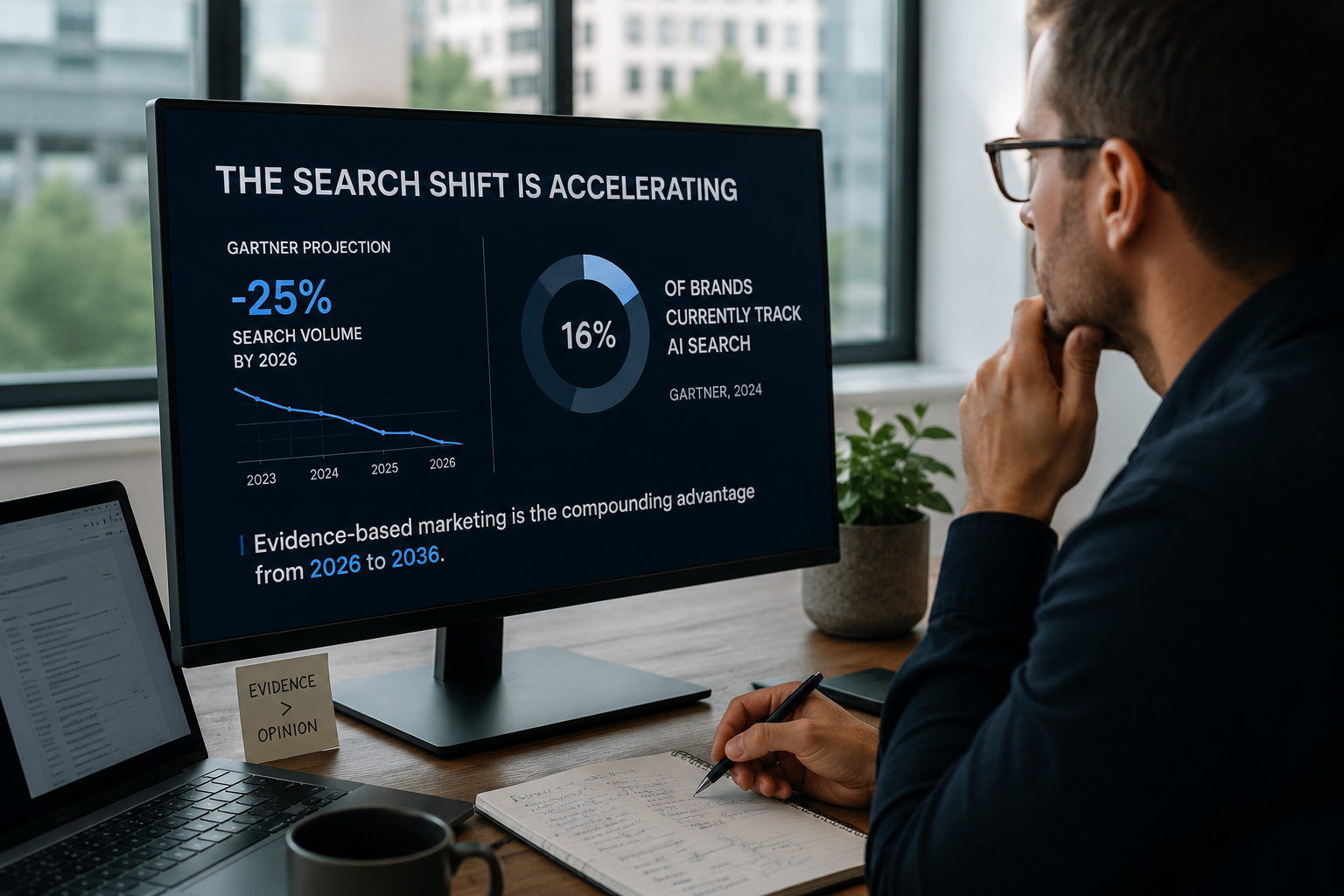
The most-cited forecast comes from Gartner, which projected that by 2026, traditional search engine volume will drop 25%, with search marketing losing share to AI chatbots and other virtual agents, escalating further later in the decade. A fair-minded marketer should note the caveat here, and it's one we'd insist on: Gartner's prediction emerged from what the firm itself described as "internal debate" rather than a rigorous, peer-reviewed methodology. Treat the exact percentage as directional, not gospel. Gartner"Am I Cited"
But you don't have to rely on a single forecast, because the leading indicators are already showing up in real data. AI-generated summaries reduce average click-through rate by 15.5%, and for non-branded searches the decline reaches as high as 20%. That non-branded category matters more than it sounds — non-branded keywords are your highest-volume, top-of-funnel traffic drivers, and they've seen a disproportionate roughly 20% CTR decline across all positions. Meanwhile, the connection between ranking and visibility is breaking: the overlap between top-10 Google rankings and AI Overview citations collapsed from 75% in mid-2025 to between 17% and 38% by early 2026, meaning high rankings no longer guarantee AI visibility. Shiwaforce + 2
In plain terms: the informational content that used to fill the top of your funnel is now being answered directly inside the AI response, before anyone reaches your site. The "what is X" and "how to do Y" articles that fed your pipeline are answered on the results page, and 60% of all Google searches now end without a single click — climbing to 93% in Google's AI Mode. This is the mechanism by which leads "mysteriously" dry up. It isn't mysterious at all. Mersel AI
Why Evidence — Not Volume, Not Cleverness — Becomes the Deciding Factor
Here's the pivot that separates this analysis from generic "AI is changing search" commentary. The disruption itself is widely understood. What's less understood is which capability actually determines who wins the new game. And the answer, increasingly, is the discipline of evidence.
The clearest articulation of this comes from marketing-analytics thinking that frames the entire competitive landscape around it: in 2026, competitive advantage depends on who can evaluate evidence, not who can generate it. That sentence deserves to be read twice. Anyone can now generate content, campaigns, and claims at infinite scale — AI made production free. The scarce, decisive skill is the rigor to evaluate what's true, defend decisions with data, and feed verifiable substance into systems that reward exactly that. Funnel
This connects directly to how AI answer engines decide what to surface. As we've covered in our work on why AI search rewards scientific thinking, these systems behave like cautious reviewers — they preferentially cite specific, sourced, verifiable claims over confident assertion. So evidence-based marketing isn't just good epistemics; it's the literal input that earns visibility in the channel that's replacing search. The brands that traffic in vague superlatives become invisible to the machine. The brands that publish specific, sourced, checkable substance become the machine's preferred sources.
The same evidence discipline shows up on the analytics side, too. Teams that don't invest in robust infrastructure often rely more on intuition, hierarchy, or past precedent than on evidence — and it's easier for fear to take over decision-making in those circumstances. That last clause is the quiet tragedy of the "what happened" companies. When the data foundation is weak, the response to declining numbers is panic and guesswork, which makes everything worse. Evidence isn't only how you win attention; it's how you stay calm and correct under pressure. Funnel
The Window Is Real, and It's Closing on a Schedule
The reason this is a now problem rather than a someday problem is that the advantage compounds. This isn't a switch you flip when leads drop; it's a position you build before they do.
The opportunity is unusually wide right now precisely because most companies haven't moved. As of late 2025, only 16% of brands systematically track AI search performance, creating significant opportunity for early movers — and early movers establish expertise and case studies that become competitive advantages. Sixteen percent. That's not a crowded field; that's an open one. ALM Corp
And the cost of waiting isn't linear — it's a widening gap. The most vivid framing of the timeline comes from a CFO-oriented analysis: companies that wait until late 2026 are executing remediation while their more prepared competitors are already capturing the leads they're missing — this is when the numbers separate the field. The mechanism behind that separation is authority that builds on itself: businesses that restructured in 2025 and early 2026 are compounding citation authority — AI systems cite them regularly, reinforcing their authority signals and driving qualified discovery from users who never clicked a Google result — while their competitors watch organic traffic decline. AdamsilvaconsultingAdamsilvaconsulting
This is the crux of the 2026–2036 story. Citation authority is not a quick buy. Entity recognition, cross-web credibility, a body of sourced original content — these accrue slowly and then pay off durably. The company that starts in 2026 spends a few years looking like it's doing roughly what everyone else is doing. Then the compounding curve bends, and by the early 2030s the gap between the prepared and the unprepared is no longer something you can close with a quarter of hustle. That's the conversation the left-behind leaders will be having: not "we made one wrong call," but "we were a few years too late to a game where years can't be bought back."
What "Pulling Ahead" Actually Requires
It would be easy to read all this as doom, or as a vague exhortation to "embrace AI." It's neither. The path forward is concrete, and it's built on the same evidence discipline throughout.
Diversify Away From Borrowed Traffic
The first move is structural: stop renting your entire pipeline from one channel. The analysts converge here. Diversify your traffic sources — don't rely solely on organic search; develop email, social, direct relationships, and owned content. Even Gartner's own guidance to marketing leaders was to consider allocating resources to testing other channels in order to diversify. A brand with multiple owned, evidence-rich channels has shock absorbers. A brand wholly dependent on organic clicks has a single point of failure that's actively failing. EmarketedBlackHatWorld
Build Pillar Content That AI Wants to Cite
The second move is to become a source rather than a destination. Create comprehensive guides and resources that AI systems can cite to position your brand as an authority — the content you create today becomes the source that AI references tomorrow. That phrase, "the source AI references tomorrow," is the entire long-game thesis in eight words. The evidence-dense pillar content you publish now is what populates the AI answers your customers will read in 2030. Emarketed
Measure What Actually Matters Now
The third move is to retire metrics that are quietly going obsolete and adopt ones that reflect reality. Track share of model — how often your brand appears in AI responses — monitor brand search volume to gauge awareness, and treat direct traffic as a lagging indicator of AI visibility success. This is evidence discipline applied to your own scoreboard: if you keep measuring clicks while value migrates to citations, your dashboard will tell you you're losing right up until you can't see the new game at all. Emarketed
Treat It as Ongoing Experimentation, Not a One-Time Fix
Finally, this is a practice, not a project. The agencies and brands handling it well share a posture: they test aggressively, measure what they can, educate clients on landscape changes, and build proprietary expertise rather than waiting for perfect clarity. The landscape is volatile enough that certainty never arrives. Waiting for it is itself the losing move. As one agency analysis put it bluntly, the question isn't whether AI search matters — the data makes that unambiguous — the question is whether you'll lead the transition or scramble to catch up. ALM CorpALM Corp
Where Ritner Digital Sits in This
We'll be candid, because candor is the brand. Ritner Digital is not the only firm that sees this shift — anyone reading the data honestly can see it, and there are capable agencies moving on it. What we'd claim is narrower and more defensible: we're among the small group that built our methodology around evidence from the start, rather than bolting "GEO" onto a legacy SEO offering after the fact.
That distinction matters because of how we've framed our entire approach. We've described ourselves as a trust acceleration firm and argued at length that AI search rewards those who think like scientists. This article is the logical third step: if AI rewards evidence, and evidence compounds into durable citation authority, then evidence-based marketing is the specific discipline that determines who pulls ahead over the next decade. Those three ideas aren't separate posts — they're one coherent bet, and we've been making it publicly and consistently while much of the market is still deciding whether the shift is real.
The honest pitch is not "we have a secret no one else has." It's that we've been rigorous about this earlier and more completely than most, the window for building compounding authority is open but closing on a schedule, and the cost of starting late is measured in years you can't reclaim.
The Bottom Line
A decade from now, the marketing landscape will have sorted into two groups, and the sorting is happening right now, quietly, in the decisions being made this year. One group treated the AI shift as a distant rumor and kept optimizing for a click curve that was already flattening. The other treated evidence as the core competitive asset — publishing verifiable substance, building citation authority, diversifying their channels, and measuring the new reality instead of the old one.
The first group will eventually hold the "what happened?" meeting. The second group won't need to, because they'll already know what happened: they did the rigorous, unglamorous, compounding work while it still felt optional. The content you create today becomes the source that AI references tomorrow — and tomorrow is closer than the comfortable timeline suggests. Emarketed
The brands that pull ahead won't be the loudest or the best-funded. They'll be the ones who decided, early, that evidence wins.
Don't schedule the "what happened?" meeting. Get ahead of it. Ritner Digital helps businesses build the evidence-based visibility and compounding citation authority that separate the brands pulling ahead from the ones getting left behind. Get in touch with us →
Frequently Asked Questions
What is evidence-based marketing, and why does it matter more now?
It's the discipline of making specific, sourced, verifiable claims and defending decisions with data rather than intuition or hype. It matters more now because AI made content production essentially free, which shifts the advantage elsewhere: in 2026, competitive advantage depends on who can evaluate evidence, not who can generate it. The scarce skill is rigor, not output. Funnel
Is organic search traffic really going to decline that much?
The direction is clear even if exact figures vary. Gartner projected traditional search engine volume will drop 25% by 2026 as search loses share to AI chatbots and virtual agents, with steeper declines later in the decade. Treat the precise number with caution, though — Gartner itself described the prediction as emerging from "internal debate" rather than a rigorous, peer-reviewed methodology. The leading indicators are already real regardless. Gartner"Am I Cited"
How is this already showing up in the data?
In click-through rates and the rank-citation disconnect. AI-generated summaries reduce average click-through rate by 15.5%, reaching as high as 20% for non-branded searches. And rankings no longer guarantee AI visibility — the overlap between top-10 Google rankings and AI Overview citations collapsed from 75% in mid-2025 to between 17% and 38% by early 2026. ShiwaforceMersel AI
Why do leads "dry up" without an obvious cause?
Because top-of-funnel informational content now gets answered inside the AI response, before anyone reaches your site. The "what is X" and "how to do Y" articles that fed your pipeline are answered on the results page, and 60% of all Google searches now end without a single click — climbing to 93% in Google's AI Mode. The decline is gradual and easy to miss until the funnel is visibly thin. Mersel AI
Why is acting now so important — can't I wait until it affects me?
Because the advantage compounds and can't be bought back quickly. Companies that wait until late 2026 are executing remediation while more prepared competitors are already capturing the leads they're missing — businesses that restructured earlier are compounding citation authority that AI systems reinforce over time. Citation authority accrues slowly, so a late start means a gap measured in years. Adamsilvaconsulting
Isn't everyone already doing this? How big is the opportunity?
The opportunity is still wide open. As of late 2025, only 16% of brands systematically track AI search performance, creating significant opportunity for early movers who establish expertise and case studies as competitive advantages. The field isn't crowded yet — it's just beginning to fill. ALM Corp
What should I actually do to stay ahead?
Four moves. Diversify beyond organic search — develop email, social, direct relationships, and owned content rather than relying solely on organic. Build citable pillar content, because the content you create today becomes the source AI references tomorrow. Update your metrics — track share of model, brand search volume, and treat direct traffic as a lagging indicator of AI visibility. And treat it as ongoing experimentation: test aggressively, measure what you can, and build expertise rather than waiting for perfect clarity. Emarketed + 3
What metrics replace clicks and rankings?
Visibility and influence metrics rather than traffic ones. Track share of model — how often your brand appears in AI responses — monitor brand search volume to gauge awareness, and use direct traffic as a lagging indicator of AI visibility success. Measuring only clicks will tell you you're losing without showing you the new game. Emarketed
Should I abandon traditional SEO entirely?
No — diversify and extend, don't abandon. Even Gartner's guidance to marketing leaders was to allocate resources to testing other channels in order to diversify, not to drop search. Strong fundamentals still feed AI answers; the point is to stop depending on any single channel as a point of failure. BlackHatWorld
Why does evidence-based marketing make a team more resilient, not just more visible?
Because weak data foundations lead to panic decisions when numbers slip. Teams that don't invest in robust infrastructure rely more on intuition, hierarchy, or past precedent than on evidence, and it's easier for fear to take over decision-making in those circumstances. Evidence is how you stay calm and correct under pressure, not just how you win attention. Funnel